Posts

Reviewing 2015 OLED Industry through Keywords

  1. OLED TV

OLED TV, first released in Q4 2013, recorded approximately 50,000 units of shipment each in Q1 and 2 this year. The shipment increased to 100,000 units in Q3, more than twice the amount of each quarter in H1 2015. As it is estimated that close to 200,000 units were released in Q4, over 90% of LG Display’s 2015 target is expected to be achieved. This is considered to be showing price competitiveness against other TV as the price of OLED TV fell to 1/2 of the initial price and effectiveness of aggressive marketing emphasizing the advantages of OLED TV compared to newly released LCD TV. In Q3 earnings results announcement, LG Display revealed their plan of 1,000,000 units of OLED TV panel shipment in 2016 and forecast OLED TV’s growth. For the industry, 2015 has been the year that secured foothold for OLED TV’s market expansion.


  1. Galaxy S6 Edge

At the time of Galaxy S6 and Galaxy S6 Edge’s release, Samsung Electronics estimated the initial supply to be 50:50. However, Galaxy S6 Edge showed 70% in actual demand and this led to shortage in supply. Samsung Display met the demand by starting flexible AMOLED line operation earlier than scheduled. 2015 proved future market growth potential by opening consumers’ wallets through designs possible only with flexible AMOLED panel.


  1. Samsung Display Supply Diversification

During the Q3 earnings announcement, Samsung Display revealed their plan to expand non-Samsung clients by 30%. Accordingly, in Q3, when smartphone market’s growth was expected to slow down, the sales performance improved by 13% compared to its previous quarter through key client’s new product release and expansion of client base. Particularly, the market occupation of AMOLED panel shipped toward China is analyzed to have increased within the global mobile market as Chinese set companies released AMOLED panel equipped smartphones.


  1. Apple’s OLED Application

Apple, which has been using LCD panel for all products, first applied flexible AMOLED panel, produced by LG Display, to 2015 smartwatch Apple Watch and drew much attention. In H2, Apple diversified suppliers by using Samsung Display’s flexible AMOLED panel. This move is analyzed to be groundwork for flexible OLED application to smartphone following smartwatch. 2015 has been a year with much interest in when flexible AMOLED panel equipped iPhone will be released.


  1. OLED Lighting

Global OLED lighting industry went through a great transformation in 2015. OLEDWorks announced they will acquire key parts of Philips’ OLED lighting business, relevant production facilities, and intellectual property. With this take over, OLEDWorks greatly expanded business through widened product portfolio and simultaneous lighting panel mass production in the US and Germany. LG Chem. transferred OLED lighting business to LG Display. The value of transfer is 1.6 billion KRW, and it is seen to be a strategy to increase competiveness by transferring the business to LG Display with their OLED panel mass production knowledge and to focus on existing materials business. The take over and business transfer of the main players in OLED lighting industry, OLEDWorks and LG Chem., are following their own business strategy. However, following these moves, related investment is expected to be delayed for some time and eyes are on how these will affect the OLED lighting business overall.
 

Korea’s Last PMOLED Company to Fade into History?

NeoView Kolon, a subsidiary merged by Kolon Group in order to foster electronics business in 2001, is known within the industry to close down the PMOLED sector on December 31.


NeoView Kolon established factory in Hongseong, South Chungcheong Province of South Korea in 2003 and began PMOLED mass production. At this point, Samsung SMD (the current Samsung Display) and LG Electronics were also mass producing PMOLED. Other PMOLED producing companies included Korea’s Orion, Japan’s Futaba, and Tohoku Pioneer, and China’s Visionox. However, Samsung SMD stopped PMOLED business and sold manufacturing equipment to China’s Truly, and Samsung Display began AMOLED business from 2007. Subsequently, LG Electronics also closed down PMOLED sector and merged OLED related personnel to LG Display and launched AMOLED business. Orion was sold to China’s Changhong.


With the active application of AMOLED to Samsung Electronics’ Galaxy series, global PMOLED business began to rapidly shrink, and in order to maintain business, PMOLED companies pushed ahead with OLED lighting panel business.


NeoView Kolon entered into the automotive instrument panel business with PMOLED transparent display, but this business was also not easy. Furthermore, as the factory location is Hongseong, deep in the countryside, there was high turnover of employees and difficulty in technology development and recruitment. Despite the investment of over 100,000 million KRW, the company showed continued deficit.


NeoView Kolon turned into a financial sinkhole for Kolon Group and worsened the Group’s financial structure, leading to persistent discussion of selling or withdrawal of the business. Recently, Samsung Display is actively pushing forward the transparent AMOLED panel business. As such, transparent display business value for Kolon decreased, and it is estimated that this led to the decision of closing down the business.

[2015 OLED Evaluation Seminar] Oxide TFT Technology that 2015 should Spotlight

By Hyun Jun Jang


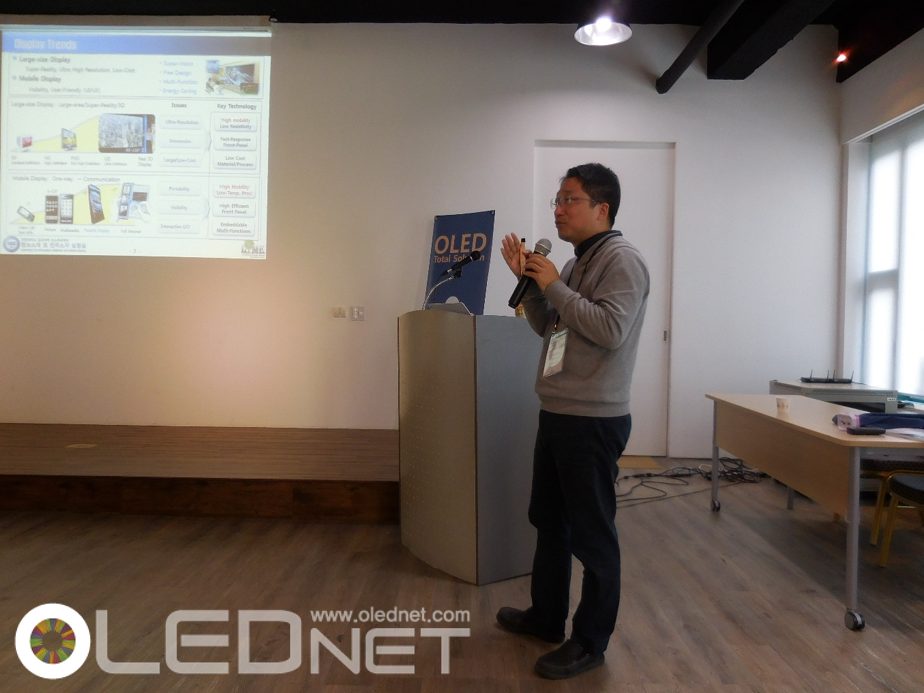
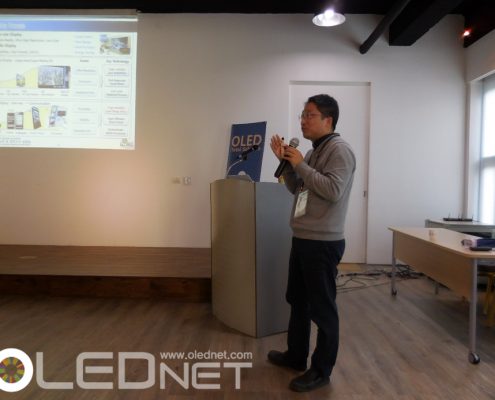
During the 2015 OLED Evaluation Seminar (December 4) hosted by UBI Research, Professor Jin-Seong Park of Hanyang University gave a presentation titled OLED Oxide TFT Technology Trend, discussing oxide TFT, related industry, and technological issues as well as TFT technology that should receive the spotlight in 2016.


Oxide TFT has an advantage of high mobility and large area uniformity compared to a-Si TFT. As such, it is being more applied to large area OLED panel and used in LG Display’s OLED TV.


Park revealed that there are mainly 4 issues regarding oxide TFT and led with the reliability issue. Oxide TFT is essentially in amorphous state but when crystalized, the density and crystallizability increase; as oxygen does not move away and stay in place, defects occur less and reliability is high. Japan’s SEL and Sharp published CAAC (C-Axis Aligned Crystal) structure related oxide TFT paper, and Cornell University produced CAAC oxide TFT by increasing the substrate temperature and adjusting oxygen’s partial pressure.


The second issue is composition ratio. Park reported that composition ratio is the most closely related characteristic to TFT’s mobility. He revealed that recently research is being carried out centering around IGZO (indium gallium zinc oxide), but also oxide TFT research with different composition ratio is continually published. For example, ITZO (indium tin zinc oxide)’s mobility has been reported to reach 30cm/Vsec, and BOE is working on the related research. Research results, which showed increased mobility and reliability for IGZTO, which is IZTO with G added, was published, as well as ZnON (zinc oxide nitride) TFT’s 100cm/Vsec mobility. BOE demonstrated ZnO TFT applied 14.1inch AMOLED.


The third issue is the device structure. Park explained that efficiency can increase when top gate structure is used to oxide TFT as parasitic capacitor is not needed, but that the process is difficult. However, Park reported that JOLED revealed when self-alignment is used the number of masks used can be reduced and increases performance. This structure is applied to OLED TV by LG Display.


Lastly, Park gave the safety of device as the last issue. Oxide TFT can exhibit degradation effects from light, oxygen, hydrogen, and moisture. Park reported that hydrogen particularly has great effect on the safety. He explained that although the current prevailing OLED TFT is LTPS, as the panel becomes larger there will be technological competition between oxide and LTPS. Reporting that TFT which is cost efficient and shows high performance in diverse factors such as resolution will dominate the market, Park concluded his presentation.


[2015 OLED Evaluation Seminar] Can LG Display and Samsung Display Become OLED Market’s Rule Maker?

By Hyun Jun Jang


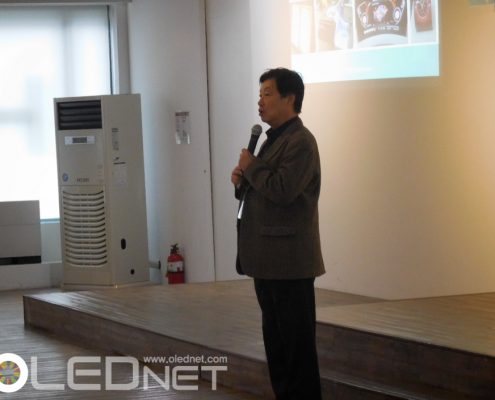
At 2015 OLED Evaluation Seminar (December 4) hosted by UBI Research, UBI Research’s president Choong Hoon Yi gave a talk titled AMOLED Panel Industry Trend and Market Forecast discussing OLED industry until 2015 and forecasting 2016 OLED market.


Yi presented 2 issues related to flexible OLED. The first issues he discussed was regarding foldable types in foldable display. Yi explained that in-folding is where display is placed inside and out-folding has display on the outside, and revealed that in-folding type is mainly being developed. He also added that these technologies will be useful in FinTech (financial technology: new form of financial technology using mobile, social network, big data, etc.).


According to Yi, another issue for flexible display is film application. In order to increase the yield of flexible display, film has to replace cover glass. However, this could lead to unpleasant touch sensation and Yi emphasized technology such as polishing has to be applied to improve this to convince the consumers.


Regarding the market, Yi estimated that the total global smartphone market will grow to record approximately 2,000 million units until 2020, with Samsung Electronics’ 400 million units. He also estimated that the OLED display proportion of Samsung’s Galaxy series will continue to increase and that most of Galaxy products will have AMOLED panel in 2019. Of this, Yi announced that flexible OLED and rigid OLED are to record approximately 280 million units and 120 million units respectively. He also forecast that the OLED TV market will grow into approximately 11 million units and that materials and equipment companies will rapidly grow.


At present, the display market is entering low growth state, and companies are focusing on strengthening the market competitiveness through new technology development and production potential increase. Samsung Display is actively striving to increase OLED panel’s supply for external companies. LG Display announced 1.84 billion KRW investment for world’s largest OLED focused P10 factory and other areas.


Yi reported that as flexible OLED evolves, the mobile display resolution competition of the present will disappear, and he estimated that as LTPS-LCD market decreases, the sales of related panel companies, such as BOE, Sharp, JDI, and LGD, will diminish.


Yi also told the audience that he is expecting Samsung Electronics to put OLED TV on the market from 2018 and the sales of the companies, Sharp, AUO, and CSOT, that were supplying them with LCD panels will fall. Essentially, he explained that as the OLED market grows, LCD dealing companies’ position will weaken which will lead to the strengthening of OLED panel production and related companies’ position.
 

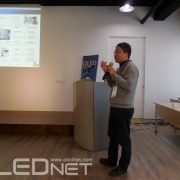
When asked about the future of Korean display panel companies, Yi replied that when LCD and OLED are competing, set companies decides the market. However, if OLED can unite the market, Yi emphasized that the display panel will be rebranded as Rule Maker and LG Display and Samsung Display will be in its center.


[2015 OLED Evaluation Seminar] Transparent Flexible Display’s Necessity Found in Worth

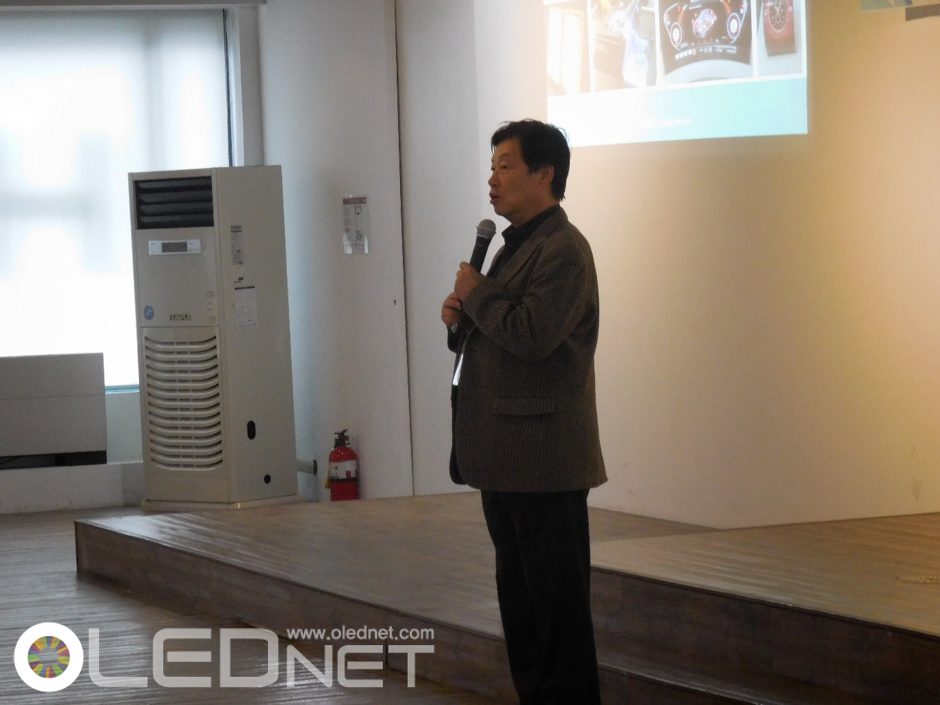
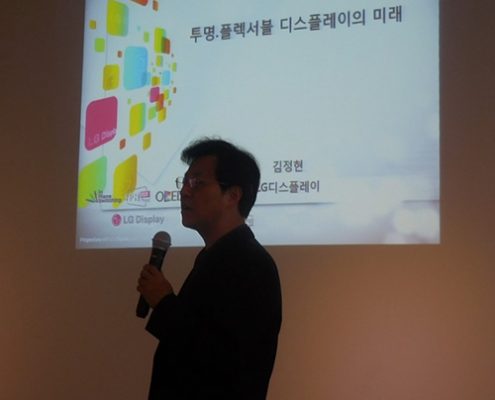
On December 4, UBI Research hosted 2015 OLED Evaluation Seminar in HJ Convention Center in Seoul, South Korea. The first speaker, LG Display TFD Biz Operation Group’s Chief Research Engineer Jeonghyun Kim spoke on transparent and flexible display’s worth.


Under the title of ‘Transparent/Flexible Display’s Future’, Kim discussed overall development trend of display and marketability. At present, the display market is changing to OLED, but as the growth rate is decreasing Kim added that new market creation is necessary. He explained that this is the time for a breakthrough of new market and transparent flexible display can play the lead. Kim also mentioned the marketability of transparent flexible display that can be actualized through OLED.


Transparent flexible OLED display possesses high technology level required by plastic substrate, low temperature process technology, and module among others. However, while introducing transparent and flexible OLED display’s worth, Kim emphasized the need for related technology development. The transparent display’s worth, mentioned by Kim, includes space expansion potential through home interior design, communication and safety increase within public facilities, AR information on existing transparent area, and sentimental and recreational experience at observatory and gallery. Regarding flexible display’s worth, he cited mobility in thinness and lightness, utilization through digital board, and space expansion through design freedom.


As a prime market for transparent flexible display application, Kim discussed automotive display market; considering the automotive market trend toward driverless/electric vehicles, display utilization inside the vehicle will increase and automotive industry will seek OLED display first.


With the LG Display’s video with diverse applications of transparent flexible display and future direction for display, Kim concluded his presentation.

Korea’s Survival Hangs on OLED; Government Support is Urgently Needed

The last 5 years of budget for Korean semiconductor, which is a key industry for the nation, and display related industry’s original technology development expenses was researched and analyzed.


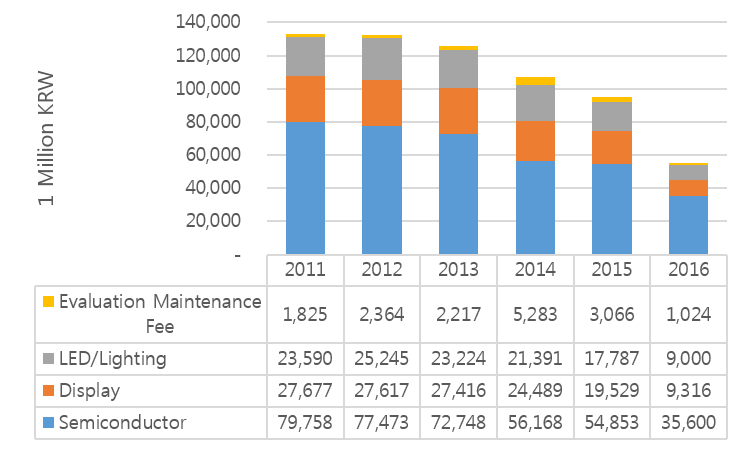
Electronic information device sector’s expenses can be categorized into semiconductor, display, LED/lighting, and evaluation maintenance fee.

 
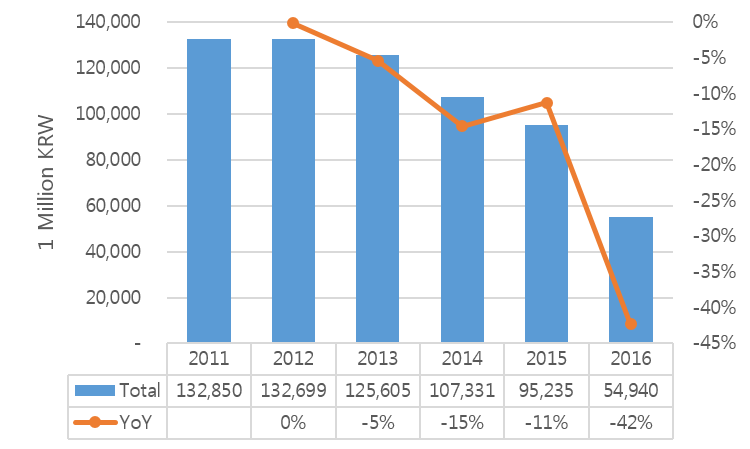
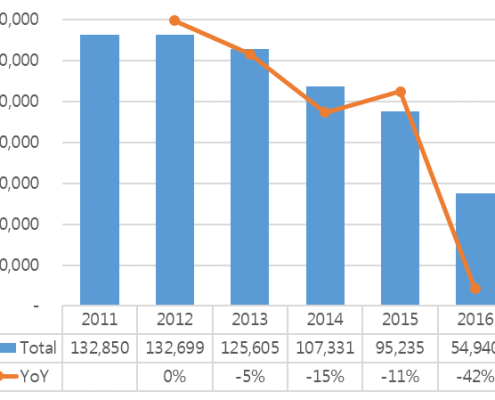
In 2011, 130,000 million KRW was provided as technology development expense, but since then the amount annually decreased. In 2015, the amount was 95,000 million KRW, but in 2016, it is estimated to decrease further 42% and only 55,000 million KRW is expected to be provided.


weekly focus 1


weekly focus 2


weekly focus 3


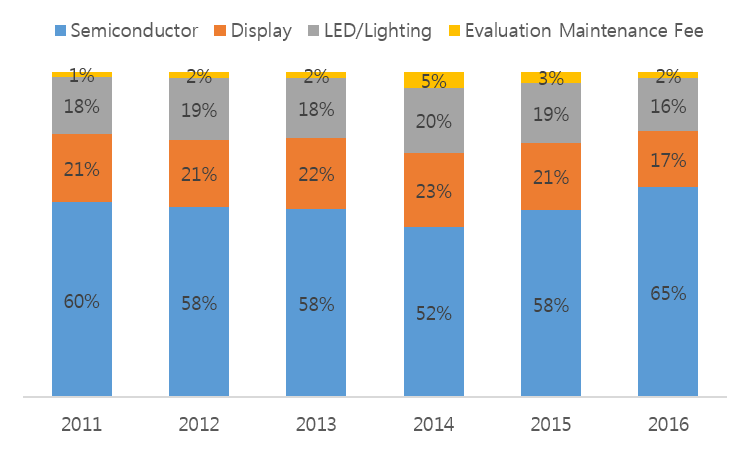
Semiconductor funding for 2015 occupies 58% of the total budget with 54,800 million KRW. Although that amount will be reduced to 35,600 million KRW in 2016, it is expected to occupy 65% of the total funding.


For display section, the 2015 funding is only 19,500 million KRW, a 21% of the total budge. In 2016, this is estimated to fall to 17%.


The government funding for display sector, which is the core of Korean electronic information industry, is around the same level as LED/Lighting sector.


The rapid reduction of government funding for display industry is expected to cause much difficulty in future display business.


weekly focus 4


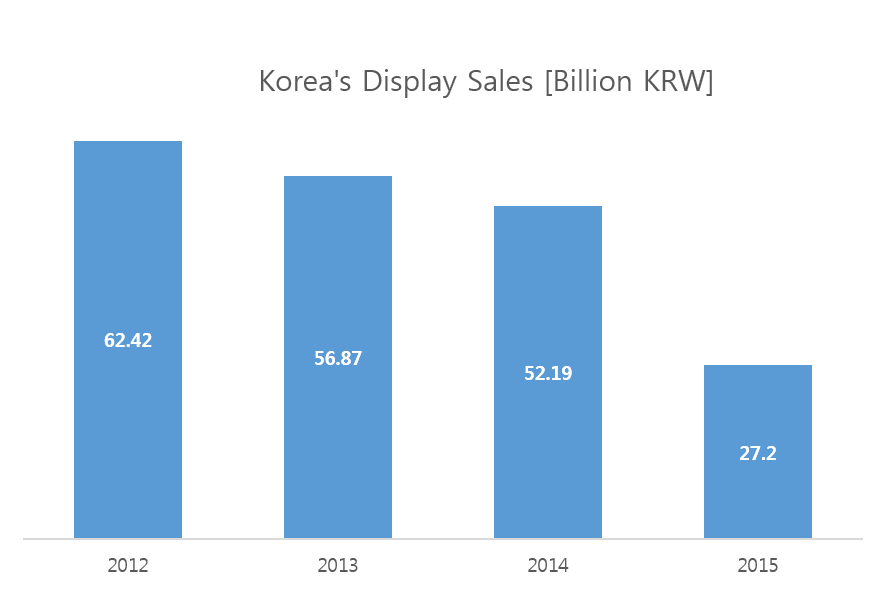
The Korean display panel market that is being maintained by 2 companies, Samsung Display and LG Display, recorded 62 billion KRW in 2012. However, it fell to 52 billion KRW in 2014, and the market power is gradually weakening. As Chinese companies are becoming more active in LCD market, Korean companies’ price competitiveness is waning in low-priced panel market.


If BOE’s Gen10.5 line begins operation in 2018, Korean display companies’ market power is analyzed to rapidly fall in LCD market. In order for the Korean display business to take-off again, now is the time for the government to fund OLED panel which has high added value.

LG Display Reveals Confidence in OLED

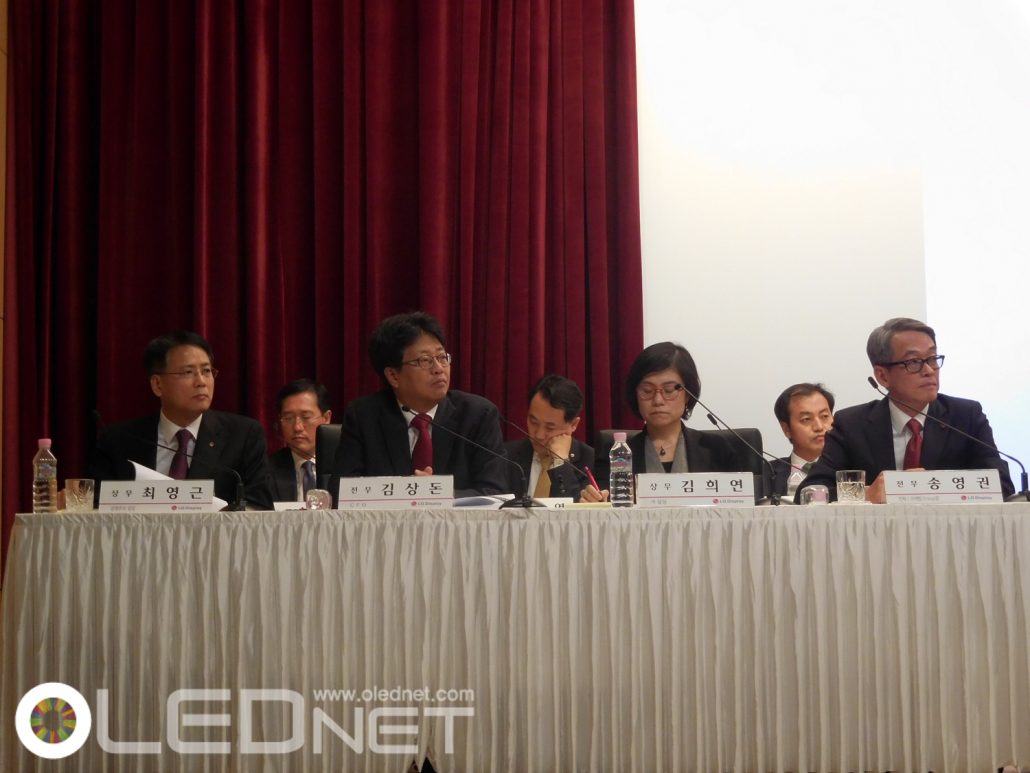
On October 22, LG Display emphasized their conviction in large area OLED and plastic OLED once again when announcing the performance results held in LG Twin Towers. LG Display revealed that their future business will be OLED and will lead the market through OLED.


LG Display’s CFO Sang-don Kim announced that OLED is the top priority in terms of portfolio, and regarding display’s future direction, explained that there is new momentum through automotive, IoT, and commercial display. He also added that the sales did not quite meet what was estimated earlier this year but it is on proper track.


LG Display is estimating 400-500 thousand units of OLED TV panel shipment for TV and aiming for 1 million units next year. Regarding the poor sales, he gave trial errors in new technology development, which was the main focus, as the reason. LG Display will plan optimized investment after market trend consideration.


In 2015, 55inch or larger panel for TV occupied 8% of the shipment, but the target is gradually increasing it to 20% or higher. LG Display highlighted TVs are becoming larger at a fast pace; 65inch and 77inch OLED TV, rather than what was expected to be the main product 55inch, showed higher than expected sales. Kim explained that to maximize production cost reduction of OLED panel, they are internally adjusting material cost and yield. He also forecast that the demand will increase through production increasing projects.


LG Display recorded 7,000 million USD* of revenue in 2015 Q3. This 7% increase compared to its previous quarter is due to the increase of shipment area through TV’s panel size increase and success of product mix. Business profit fell by 32% compared to previous quarter with 300 million USD*. LG Display revealed they will push for profit improvement through inventory level management and operation rate adjustment. They also reported they will strengthen competitiveness through synergy with OLED lighting business and showed anticipation for future.


* 1 USD = 1,100 KRW


LG디스플레이

Samsung and LG’s Shared Vision for OLED

On the first day of OLEDs World Summit (October 27-29) held in Berkeley, USA, Samsung Display and LG Display gave their talks back to back. Samsung Display’s Vice President Chang Hoon Lee and LG Display’s Joo Soo Lim discussed their thoughts on OLED under the titles of ‘The Future of OLEDs’ and ‘A Future Game Changer’ respectively.

Samsung Display’s Lee, who gave his presentation first, reiterated Samsung Display’s leadership position in the mobile market and how Samsung Electronics’ recent mobile display reflects this. Comparing RGB pixel structure and their own diamond pixel structure, Lee drew comparison between human eyes and diamond pixels; due to cell distribution in eyes, humans are more sensitive to green colors and that diamond pixels reflect this by having twice as many green subpixels as blue and red ones. The diamond pixels also maximize the sub-pixel packing and increases the PPI.

Regarding the advantages of OLED display, Lee gave 2 examples using Samsung Electronics’ latest smartphone models. Utilizing the fact that selective control of each pixel is possible in AMOLED displays, Samsung provided Vision Aid to help people with color blindness. OLED’s ability to achieve total black is used in Super Dimming function where screen brightness can be reduced to 2nits to be used in the dark environment.

LG Display’s Lim revealed that an adult in the US spends 9 hours 40 minutes a day on average looking at one form of display or another. Highlighting the need and importance of quality display, Lim also discussed advantages of OLED display over LCD such as total black, 3D effects, and color gamut.

As the future OLED display, Both Lee and Lim placed slightly more emphasis on flexible (plastic) OLED than transparent or mirror display. Samsung Display discussed requirements necessary for a successful flexible display in more depth touching on the need for suitable cover window, flexible touch (sensor), flexible encapsulation, and flexible backplane. On the other hand, LG Display discussed flexible display’s design freedom and its influences on the wearable, mobile, and automotive markets. Lim also placed much importance on how flexible OLED can be used in virtual reality display market. The 2 speakers ended their talks affirming the need for new display market and innovation through OLED technology and new applications.

The presentations given by the 2 apparent leaders in the OLED display industry were remarkably similar with both speakers underlining major points of OLED in broad strokes. The need for solutions for future OLED, whether it be flexible, transparent, or mirror display, through innovation and technological advances is an absolute truth if not maybe too obvious. There also may be some comfort to be had in the shared vision within the OLED community. However, it is also a fact that numerous attendees of the conference commented on the similarities of the 2 presentations and the lack of any surprises.

LG Chem.’s OLED Lighting Business Toward LGD. What is the Future Direction?

It was announced that LG Display will take over LG Chem.’s OLED lighting business department. As the department that was leading the opening of OLED lighting panel market is being merged into LG Display, a significant change in OLED lighting industry is anticipated.


One of the merits of this merge is expected to be further improving OLED lighting panel’s mass production potential through LG Display’s existing OLED panel mass production line, labor, and technology. Additionally, when new investment of OLED lighting panel mass production line is being processed, time and cost can be reduced on the basis of LG Display’s manufacturing equipment/material supply chains.


On the other hand, as OLED lighting market is still in initial stages the size is not so large. As such, whether LG Display will newly invest is a key issue. Generally, for display panel companies that invest with market size of thousands of millions of dollars in mind, OLED lighting panel line’s new investment does not seem to have a great advantage for LG Display.


Therefore, if LG Display carries out OLED lighting panel business, the first step is estimated to be mass production in parts of Paju’s AP2 line rather than new investment for OLED lighting panel mass production line. If parts of AP2 line begin mass production first, mass production timing can be much sooner than new investment and can positively affect expansion of OLED lighting panel market.


The issue is marketing strategy. In 2009, Samsung Electronics successfully opened AMOLED smartphone market in Korea via push strategy using AMOLED themed music video that became viral. Much like this, in order to show profit in OLED lighting panel business, LG Display should open the market through push marketing strategy.

LG UHD OLED TV Price Falls Once More

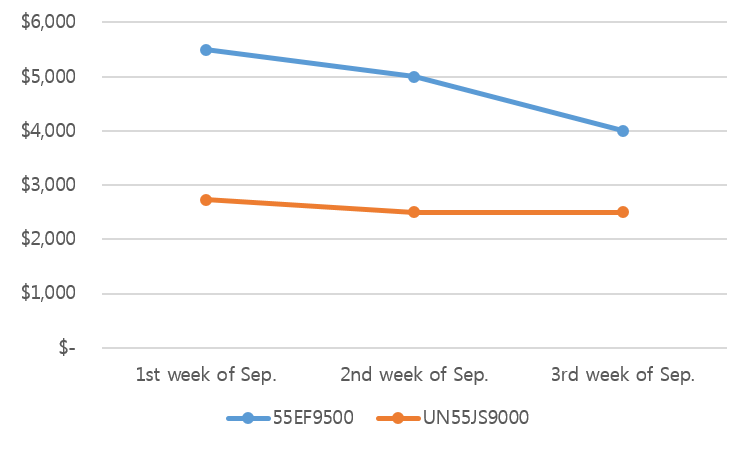
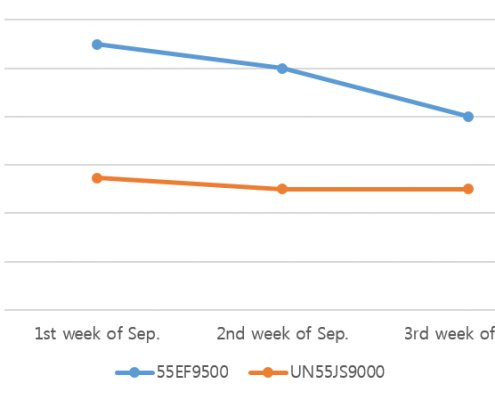
The price of OLED TV by LG Electronics is falling fast. The 55inch flat UHD OLED TV (55EF9500), released last month, fell to $3,999 in 3 weeks, a 27% decrease from the initial $5,499. This price decrease is much faster than that of LG Electronics’ curved model of 55inch UHD OLED TV released in April.


Samsung Electronics’ 55inch SUHD TV, UN55JS9000, showed approximately over $2,500 price difference in comparison with 55EF9500 between the 1st week and the 2nd week of September. However, in the 3rd week, UN55JS9000 and 55EF9500 each showed 4% and 15% of decrease rate to record $2,497 and $3,999 respectively, with approximately $1,500 difference. This is the highest reduction rate for LG Electronics’ OLED TV.


lg oled tv price fall


In addition to the price reduction, LG Electronics is marketing their products aggressively. They are in the process of installing OLED TV this month in 39 key airports in 23 countries including the US, Germany, and Russia, with plans to install approximately 200 units of OLED TV by the end of October.

[IAA 2015] Audi and Porsche, Propose Future Models of Smart Car

At IAA 2015 (September 17 – 27), Audi and Porsche presented OLED lighting and display equipped vehicles.


In the past, Audi has proved OLED technology’s excellence through diverse models and demonstrations, including introduction of ‘swarm’ in 2013 with its 3D OLED car rear lighting panels. At this motor show, Audi revealed Audi e-tron quattro, the first concept car with Matrix OLED technology. As well as the Matrix OLED lighting, interior OLED display was also applied to the concept car. Audi explained that the Matrix OLED lighting, which was applied to the rear lighting, can continuously change lights and does not cast shadow. Full OLED interface was also applied to the car and all functions required in driving can be control by display touch. Audi revealed that they will gradually apply these technology to next generation Audi series.


Porsche presented their first four-seat electric sports car Mission E as a concept model. The instrument cluster for this concept car is displayed virtually in OLED. The menu can be activated through buttons on the handle. It can also be automatically activated as the cluster’s eye tracking system can perceive the driver’s attention. The display also follows the seat position and body attitude of the driver in what is known as a parallax effect; the display moves according to the driver’s posture for easier viewing. Porsche revealed that Porsche Car Connect technology will also be applied which will allow the user to control key functions of the vehicle through a smartphone.


As OLED using lighting and display are actively applied to smart cars, attention on the automotive OLED is also increasing. At the National Research Development Industry General Workshop, held in July 2015, Samsung Display and LG Display each stated their thoughts on display that will be applied to future smart cars.


Samsung Display’s executive director Hye Yong Chu asserted that smart is display’s future, including smart car. She also explained that for the actualization of smart technology, other ancillary smart technology, such as eye tracking and voice recognition technology, are required.


Yoon Sooyoung, LG Display’s vice president, stated that automotive display can be used for CID, dashboard, cluster, and window, and that the development of transparent and flexible technology is necessary.


During the keynote session of IMID 2015, Munhyun Kim of Hyundai Motors revealed that OLED panels will mainly be applied to smart car compared to LCD as it can easily be flexible. He also added that the automotive OLED’s percentage within the total OLED market will increase, and anticipated that it will exceed 30% in 2017.


Porsche Mission E, Porsche Home page

Porsche Mission E, Porsche Home page

Q2 AMOLED Market, the Largest So Far

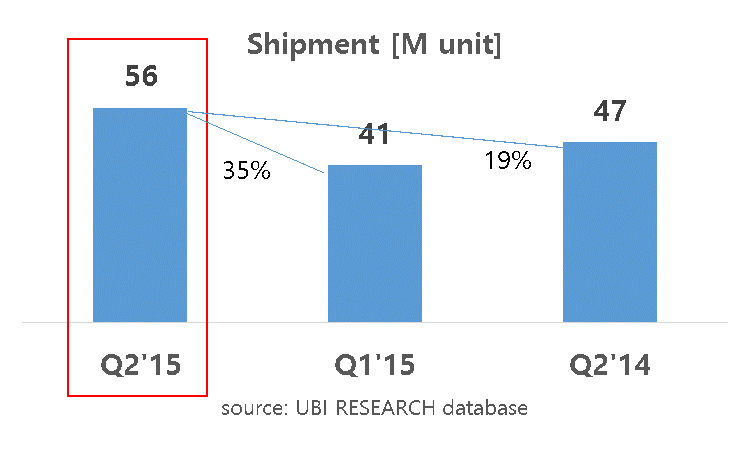
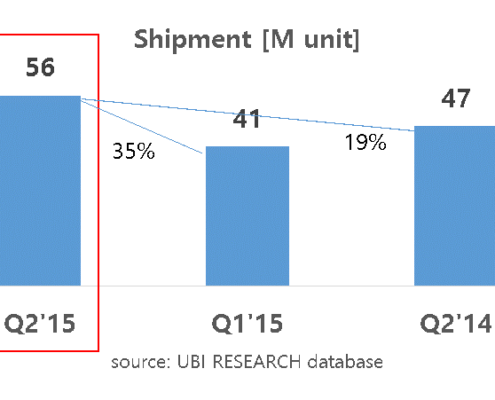
According to UBI Research’s Weekly OLED Analysis Report, Q2 AMOLED panels recorded the largest shipment and sales so far. With 56 million units, the Q2 shipment increased by 35% in comparison with Q1, and a 19% increase compared to the same period last year. US$ 2,800 million was recorded for sales, which is a 65% increase compared to its previous quarter.


Last quarter’s AMOLED market growth is due to Samsung Display’s AMOLED panel supply volume for Chinese set companies and increase in LG Display’s flexible OLED panel production for smartwatch.


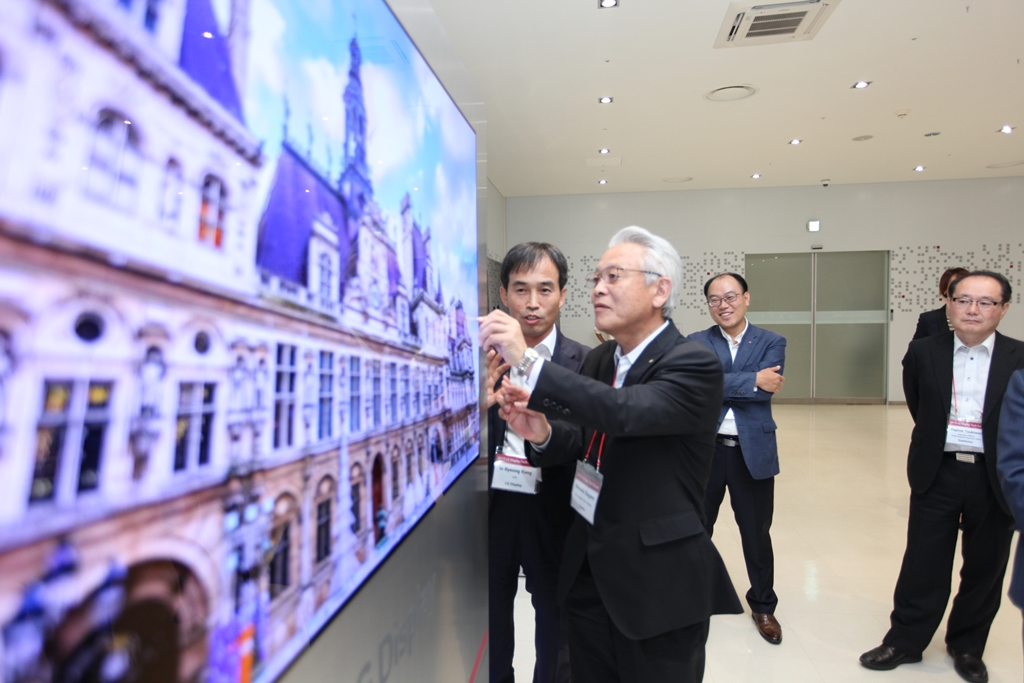
LG Display Opens 2015 Tech Forum in Collaboration with Other Companies

Source : LG Display

LG Display set out to discover new technology through open innovation in collaboration with other companies.


On September 15, LG Display invited top global display material and component companies to Paju factory and opened 2015 LG Display Tech Forum. The invited companies included Merck, Asahi Glass, and Sumitomo.


Under the heading of ‘OLED, New Opportunity and Challenge’, 13 key collaborating companies in material, process, glass, and circuitry sectors participated. They promised to share market trend, and LG Display’s OLED and LCD technology development direction and cooperate regarding future technology.


LG Display increased emphasis on OLED; LG Display revealed detailed business strategy for large and small size OLED, and discussed technology and products that should be developed together in collaboration with companies in each stage.


Additionally, LG Display newly established Technology Innovation Award for collaborating companies that contributed to LG Display’s product improvement with innovative technology. The award was presented to Asahi Glass for developing glass light guide panel used in thin panel actualization, and display material companies Merck and Nitto Denko.


LG Display’s CEO Han Sang-beom explained that LG Display could pave the way for OLED with world’s first technology due to much effort and enthusiastic corporation from R&D partners. He also entreated each company to continue to change and evolve through their own R&D competitiveness and creativity and lead the future display market.

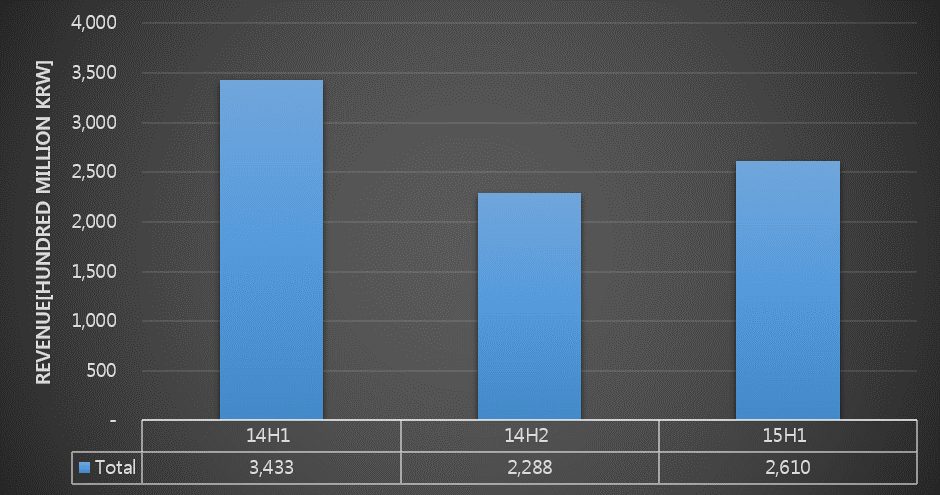
Minus Growth for H1 OLED Material Market with Mere US$ 564 Million*

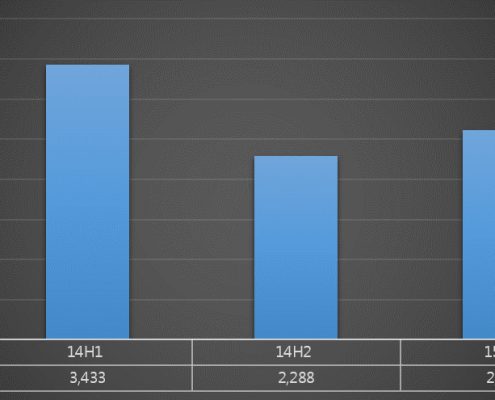
According to UBI Research, the 2015 H1 OLED material market recorded approximately US$ 564 million; this is a 14% increase compared to 2014 H2, but a 24% decrease against 2014 H1.


Despite reports that Samsung Electronics and LG Electronics are selling much larger volumes of flexible OLED applied Galaxy S6 Edge and OLED TV respectively compared to last year, the OLED material market is gradually stagnating.


The main reason for this OLED material market’s downward turn is Samsung Display’s operation level which remained stationary at 50% in H1. This led to stationary material usage compared to the year before. LG Display is producing flexible OLED and large size OLED panel for TV. However, approximately only 100,000 units of OLED panels were sold in H1 and material usage was also lowl. The current capa. is 34K but as the OLED material cost spent in H1 is approximately US$ 36 million, the operation rate is analyzed to be only 30% of the total capa.


The OLED material market is decreasing because the supply price is rapidly falling without increase in production volume. OLED material companies are frustrated at the 10-15% price decrease per quarter. At present, as the only clients are Samsung Display and LG Display, material companies are compelled to reduce the price as the failure to do so could lead toward the termination of business. OLED material companies spend several thousands of millions of dollars annually on development to meet constant improvement demanded by clients. There is much difficulty for OLED material companies as display companies continue with one-sided demands without compensation regarding development cost.


For OLED industry to maintain its continued growth, it requires more than success of panel companies. Material companies that play a pivotal part within the industry have to continue development and production of quality materials in order to create a healthy growth cycle. However, display companies are destroying the ecosystem.


What OLED material companies currently crave is for Chinese display companies to mass produce OLED panels as soon as possible.


* 1 USD = 1,100 KRW


OLED Material Market Revenue 2014 H1 – 2015 H1

OLED Material Market Revenue 2014 H1 – 2015 H1

[IFA 2015] Panasonic OLED TV

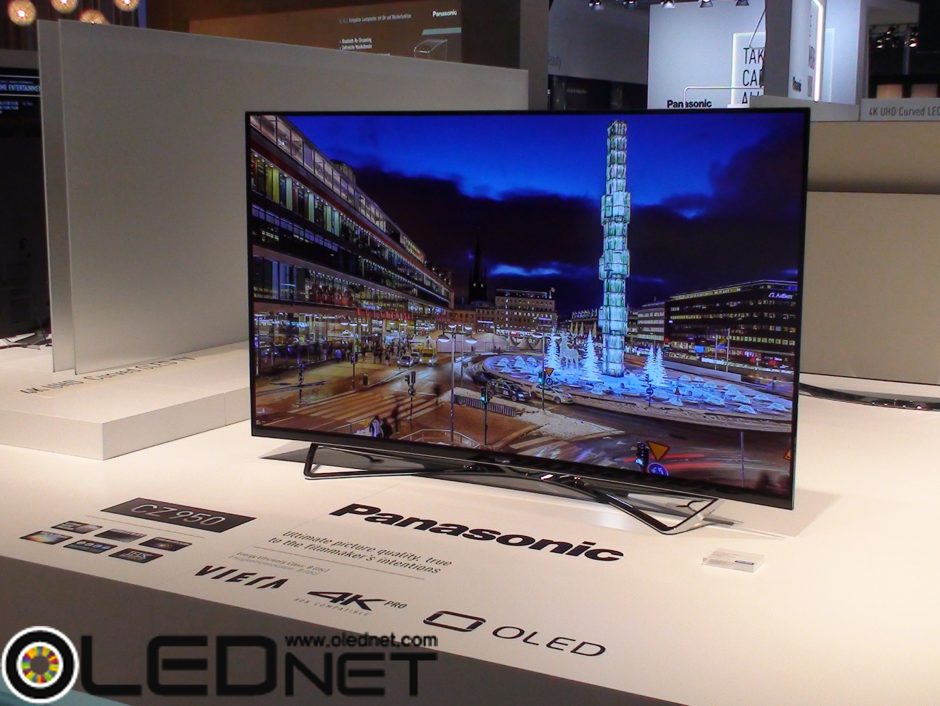
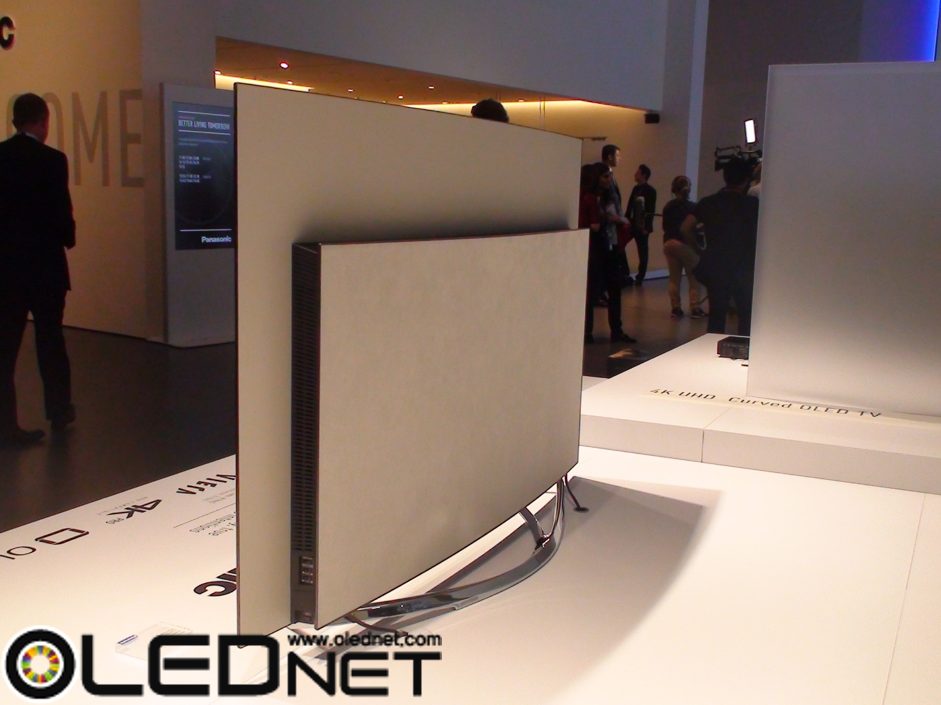
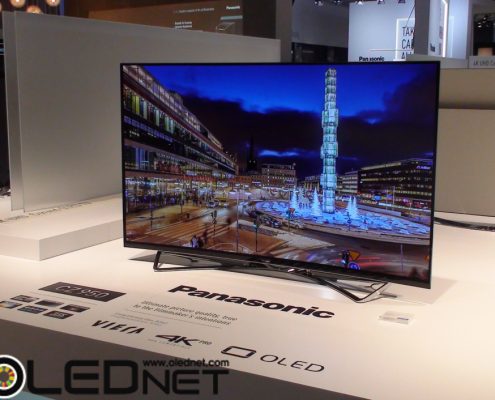
Panasonic that used to lead Japanese electronics industry with Sony is focusing more on OLED TV industry. Until IFA 2014, Panasonic exhibited self-made OLED TV using oxide TFT and solution process OLED technology. However, since CES 2015 Panasonic presented LG Display’s WRGB OLED panel applied OLED TV. It is unusual to introduce OLED TV through IFA 2015 when Panasonic is only selling TV domestically and stopped TV business abroad. According to Panasonic the company is planning to mass produce within 2015.


OLED TV revealed in IFA 2015 is a CZ950 model with 4K resolution. It is interesting to note that special material is used to cover the back of the set to give a furniture look.


Panasonic OLED TV, IFA 2015

Panasonic OLED TV, IFA 2015


Panasonic OLED TV, IFA 2015

Panasonic OLED TV, IFA 2015


Panasonic is also presenting OLED TV and LCD TV in darkroom to demonstrate OLED TV’s superiority in contrast ratio.

[IMID 2015] LG Display Reveals Detailed OLED Plans

During the keynote session of IMID 2015 (August 18 – 21), LG Display’s Sang Deog Yeo, the head of OLED division revealed LG Display’s intention to change the world with OLED together with everyone and strength in OLED industry expansion. Yeo explained that the most important factor in the success of large area OLED is strong conviction in OLED’s success and courage; he also announced further investment for OLED as future growth stimulus.


Yeo reported that TV’s first revolution was a change from black and white TV to color. The second revolution was the appearance of flat panel display and that the third revolution will be OLED. He explained that the key factors in TV panels are design and picture quality. He evaluated that these factors are advancing separately in other display while OLED is improving these issues together.


Explaining in more detail, Yeo reported that OLED has high design freedom as OLED structure is simple, a self-emitting light without BLU. Additionally, each pixel of OLED can operate independently and actualize true black, leading to differentiated picture quality.


In the beginning, LG Display struggled in applying WRGB technology and oxide TFT to OLED TV, which resulted in almost 0% of yield. Even within the company, there were opinions that oxide TFT application to Gen8 panel or larger will be almost impossible. However, the effort including introduction of external compensation circuit and coplanar structure, and compensation algorithm application to brightness and color brought LG Display’s current success of OLED TV mass production.


Yeo announced that much like how LG Display solved OLED TV’s technological problems of the past, they will improve the oxide TFT mobility to 50. He also revealed that LG Display is searching for a method of applying top-emission technology to mass production in order to improve transparent and flexible OLED technology, and researching light shutter technology and improved plastic substrate application technology.


LG Display recently announced their decision to invest approximately US$ 9,300 million centering around OLED. During the keynote session, Yeo reported that LG Display will increase the large area OLED panel’s production rate through investment, specifically from current 600 thousand units to 2 million units in 2017. He also announced that they will expand Gumi Gen6 line which will be used to increase production rate of small to medium-sized OLED panels and plastic OLED panels.


Although there has been speculation regarding this investment, through this keynote speech, it can be forecast the investment will be used in specific roadmap of large and small to medium-sized OLED. For the progress of OLED industry, which is growth stimulus of the future, Yeo emphasized the need for closer cooperation between materials, components, manufacturing equipment, and set companies, and laboratories and universities.

LG Display’s Sang Deog Yeo, IMID 2015

LG Display’s Sang Deog Yeo, IMID 2015

How Can Small and Medium-Sized OLED Panel Companies Survive?

With the great increase of interest in flexible OLED from China and Taiwan’s small and medium-sized panel companies, diverse issues related to this are emerging.


Recent smartphone trend is moving from high resolution and specs toward diverse designs such as curved or bendable/foldable and flexible display that can differentiate applications. AMOLED flexible display is currently being applied to smartphone and smartwatch. However, only 2 companies, Samsung Display and LG Display, are supplying these high spec flexible AMOLED panel.


Small and medium-sized panel companies do not have the technology to mass produce high performance flexible AMOLED panel and cannot invest in mass production. For these reasons, Chinese and Taiwanese small and medium-sized companies are aiming for finding new applications where flexible PMOLED or low resolution flexible AMOLED can be applied and make mass production investment. Accordingly, set companies’ interest in flexible OLED applied application is also increasing.


Additionally, companies are in agreement that yield of flexible PMOLED that is applied to some smartbands does not meet demand. Taiwan’s wisechip and RiTdisplay, key PMOLED companies, are concentrating on developing flexible PMOLED and flexible OLED lighting. Taiwan’s AUO and Innolux, and China’s Visionox and EDO are also among those that are developing wearable flexible AMOLED.


Diverse application development where lower resolution flexible AMOLED, flexible PMOLED, or flexible OLED lighting, instead of expensive high-end smartphone and smartwatch, can be applied is essential. The outcome of this is forecast to greatly affect the growth of small and medium-sized OLED panel companies.

[Analyst Column] Korean Display Industry Is On Descent

Dr Choong Hoon Yi, UBI Research Chief Analyst, ubiyi@ubiresearch.co.kr


The analysis of 2015 2Q results of Samsung Display and LG Display shows clear indication that Korean display industry is on descent.


[2015 Q2 Korean Display Total Sales Analysis]

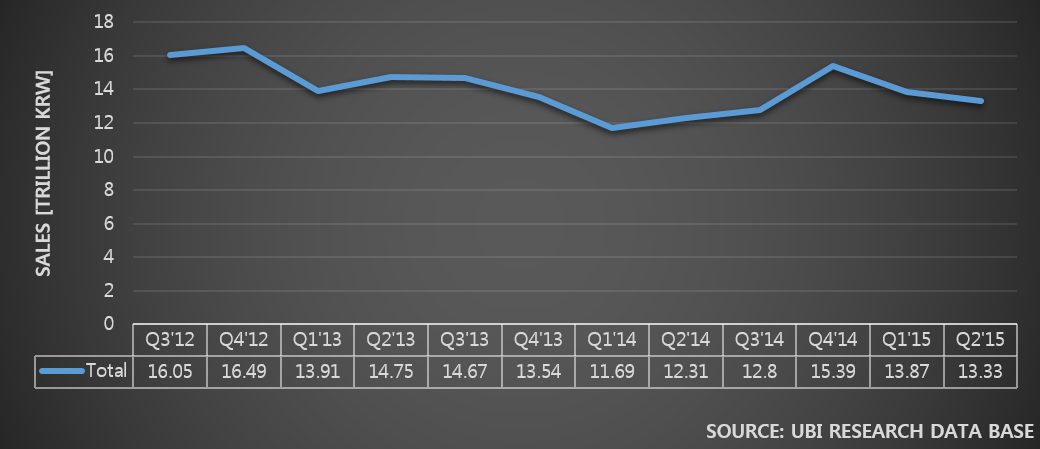
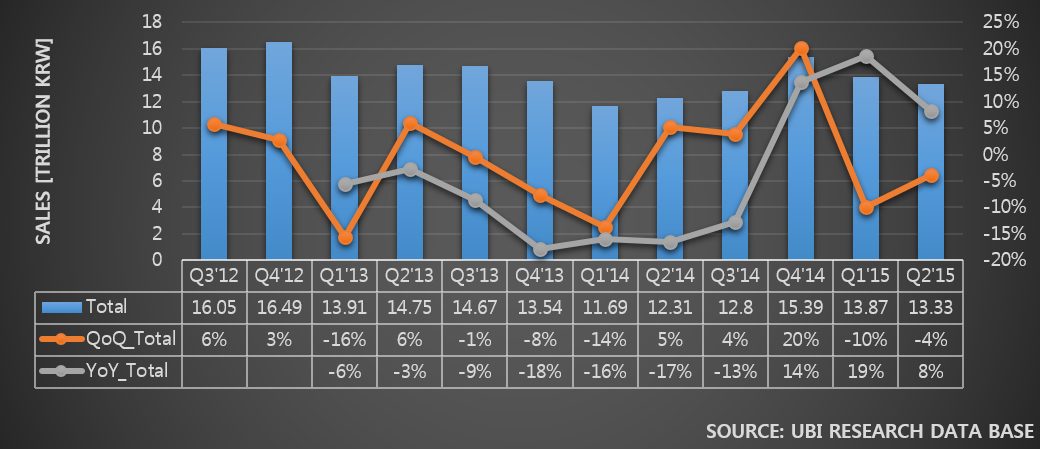
According to the results announcement of the 2 companies, the total of 2015 Q2 sales is approximately US$ 11,000,000,000. Compared to the total sales in 2013 Q2 which was US$ 13,000,000,000, Korean display industry trend is exhibiting clear downward tendency.

0812 graph1


2015 Q2 Korean display sales records -4% QoQ, and 8% YoY.

0812 graph2


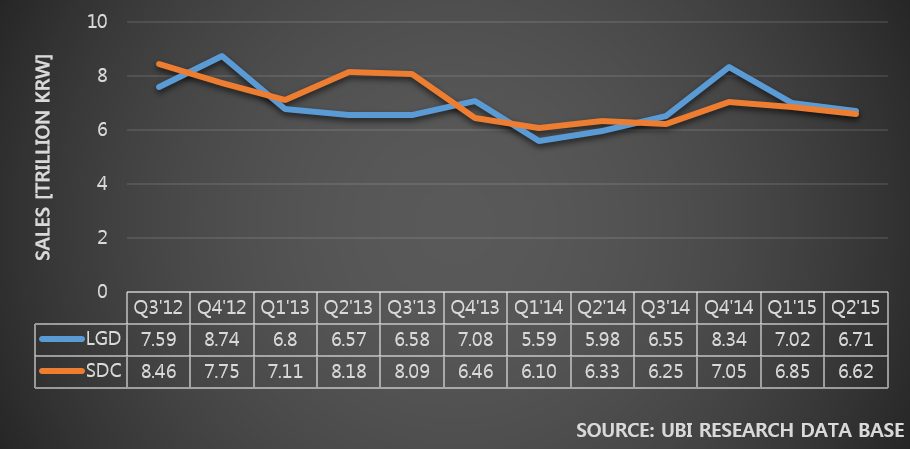
The main reason for the decrease in sales is Samsung Display’s deterioration of earnings results. While LG Display’s sales of the past 3 years remain fairly consistent but Samsung Display’s sales is gradually decreasing.

0812 graph3


[2015 Q2 Korean Display Total Business Profit Analysis]

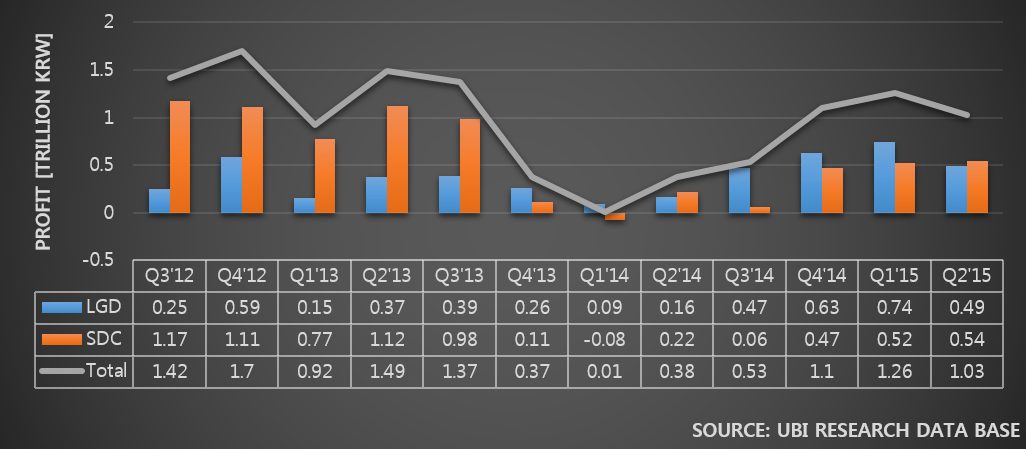
Connecting the high points of the total of 2 companies’ business profit reveal that the business value is worsening as the trend moves downward. This also is much contributed to Samsung Display’s business profit decrease.

0812 graph4


[Samsung Display and LG Display Sales Analysis]

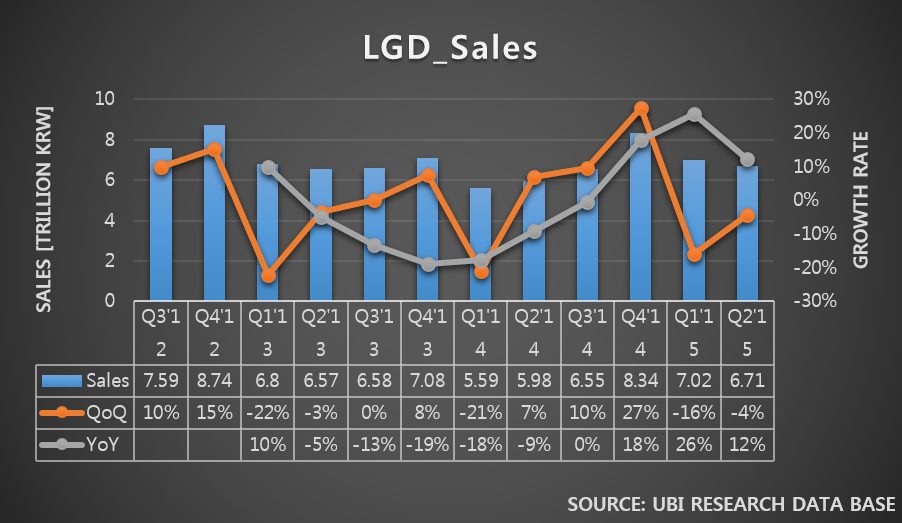
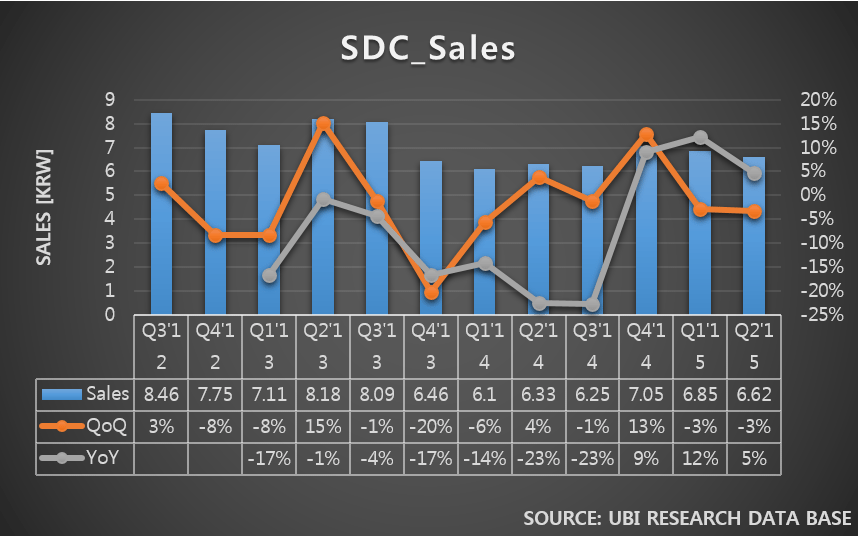
According to the earnings announcement of both companies, Samsung Display and LG Display recorded sales of approximately US$ 5,500,000,000 and US$ 5,600,000,000 respectively. LG Display is maintaining higher sales results compared to Samsung Display for the past 5 quarters. Each company’s QoQ showed to be -4% (LGD) and -3% (SDC) and YoY to be 12% (LGD) and 5% (SDC). The simultaneous decrease of QoQ sales of both companies demonstrates that the Q3 sales could also fall.
 

0812 graph5


0812 graph6


[Samsung Display and LG Display’s Competitiveness Analysis]

Looking at the profit/sales graph of Samsung Display and LG Display, it is apparent that Samsung Display showed superior competitiveness until 2013 Q3, but since then LG Display averaged higher.


[Conclusion]

The reason for the downward trend of Korean display industry is analyzed to be the fall of display panel price due to the Chinse display companies’ mass production through aggressive investment. Particularly, in or after 2017 when China’s BOE is estimated to begin Gen10.5 LCD line, LCD panel price will fall even more rapidly. This is forecast to lead Korean LCD industry to suddenly lose competitiveness. For Korean display companies that have immense LCD sales to show positive growth, it is time to expand OLED business that can be differentiated from Chinse display companies.


The only solutions for Korean display industry are OLED investment in large scale and conversion of LCD line to OLED line. At the time of BOE’s Gen10.5 line operation, Korean display companies also should respond with Gen6 flexible OLED investment and early establishment of Gen8 OLED line.

[Analyst Column] LG Display Q2 Earnings Analysis and Signification of Flexible OLED Investment

Dr Choong Hoon Yi, UBI Research Chief Analyst, ubiyi@ubiresearch.co.kr


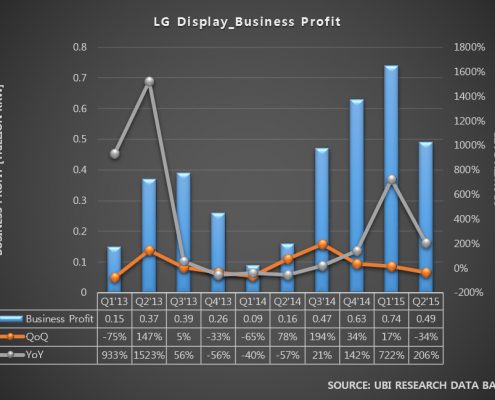
On July 23, LG Display announced its earnings results at LG Twin Towers in Yeouido, South Korea. LG Display reported that their Q2 sales recorded approximately US$ 5,700,000,000 with business profit of approximately US$ 420,000,000.


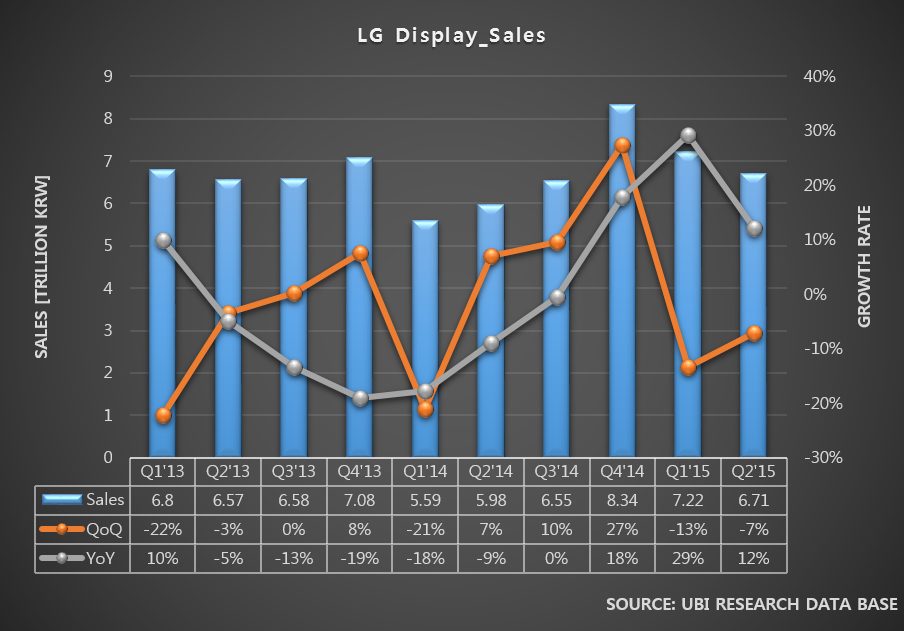
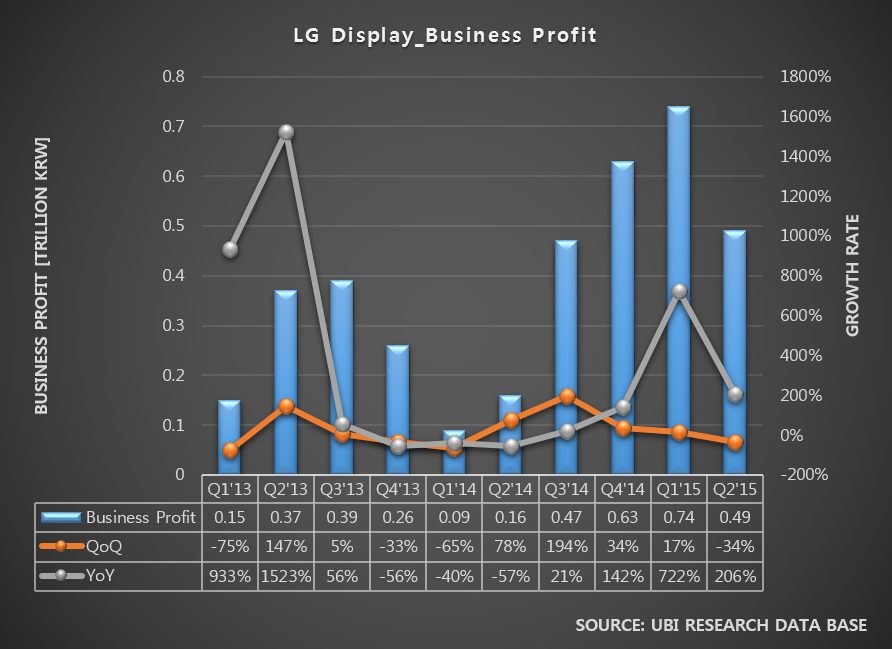
Although sales fell by approximately US$ 260,000,000 (-5%) compared to the previous quarter, it was an increase of US$ 620,000,000 (12%) compared to the year before. Business profit showed approximately US$ 210,000,000 decrease (-34%) QoQ, and YoY US$ 280,000,000 increase (206%).


0805 graph1


LG Display’s sales and business profit of Y/Yo (green line) showed U shape of trend of growth in previous 5 quarters but this quarter recorded a fall. It is analyzed that the growth could slow down from 2H 2015.
 

The drop of the LG display’s Y/Yo growth in this 2Q is much attributed to smartphone market’s slow down and TV market reduction. It is also estimated the panel price reduction due to Chinese display companies’ aggressive investment is reflected.


0805 graph2


For LG Display to stop the degrowth, mass production of products that are differentiated from competition, is urgently needed, away from LCD panel that is LGD’s current major business.


On the day, LG Display’s management announced approx. US$ 900,000,000 investment for Gen6 flexible OLED line in order to lead flexible OLED market. The investment location is Gumi factory. Investment location is Gumi factory with the initial investment of 7.5K. It is expected world’s second flexible OLED exclusive line will established following Samsung Display. It is anticipated that up to 15K will be established for this line.


Considering last year’s LG Display’s business profit was approx. US$ 1,100,000,000, the US$ 900,000,000 flexible OLED investment is very large. The investment decision must have been very difficult. However, the reasons for LG Display’s drastic flexible OLED exclusive line investment are because companies that produce LTPS-TFT LCD (LGD’s existing main market) is increasing, and because Samsung Display is already monopolizing rigid OLED market and therefore difficult to secure market share.


LG Display’s CFO Kim Sang-don explained that flexible OLED Gen6 line investment was decided at the board of directors meeting on July 22, and was made official on the morning of July 23. Kim added that the decision was reached so that LG Display can lead the OLED business in terms of technology and to occupy initial market in foldable and rollable technologies. He also commented the monthly capa. of the flexible OLED line will be 7.5K.


Regarding large area OLED panel, it was emphasized that this year’s panel production target remains to be 600,000 units and 1,500,000 units next year, same as the ones announced during the Q1 earnings results presentation. It was also revealed that 34K, approximately 9K higher than current capa., will be in operation in 2016. Addressing the concern of oversupply of next year’s 1,500,000 units while the OLD TV market is still small, LG Display suggested the solution of increasing the demand by active promotion from the second half of this year.


Despite the fall of mid to large size panels’ sales price, from the enlargement of sets and AIT technology applied sales performance, the business profit of approximately US$ 4,000 million was recorded. This is a 34% decrease compared to the previous quarter but a 199% increase from the same period in 2014. LG Display estimates that the sales will increase in the third quarter due to seasonal factors and panel’s enlargement trend.

Korean Government, Will It Give Up Its Top Spot in Display Industry?

Recent Samsung Electronics and LG Electronics’ TV and smartphone performance results are causing experts to be concerned over degrowth.


The axis that is centering Korean industry is dependent on these 2 companies and Hyundai Motor Company. In the 20th century when technology skills were lacking, Korean government and these 3 companies closely cooperated and coordinated product development and market cultivation. The low value of KRW invigorated the 3 companies’ export business. Strong government support allowed development of products that could compete against Japanese products occupying the international market. The potential that allowed the companies to overtake Japanese firms that were dominating electronics industry and increase the international market share was based on Korean government’s diverse interest and enthusiastic backing.


Japan’s display industry collapsed due to several reasons. Their pride that that latecomers including Korea will not be able to catch up to their technology, the discontinuation of investment by overlooking the need of the 21st century of information for display market, and the disregard of latecomers’ price competitiveness can be attributed to the collapse.


Korean display companies gave up on Gen10 investment in LCD business and began localization in China though establishing Gen8 LCD factory in China. However, Chinse display companies, with the backing of their government in large scale, continue to invest despite the deficit.


If BOE’s Gen10.5 LCD factory is complete, China will lead the global industry in terms of yield, and overtake Korea through China’s domestic market and price competitiveness. Now there are only 2 years left. It is only a question of time before Korea’s LCD industry falls apart.


The only thing that is left for Korean display industry is OLED. As Korean display industry plays an important role in Korean economy, the decline of display industry will have direct impact on employment, export, and domestic market.


However, Korean government is currently ignoring display industry. LCD and OLED have been excluded from WTO’s tariff elimination. China, which is rapidly becoming a new contender in display industry, has agreed with the U.S. to exclude LCD and OLED advocating protection of Chinese market and industry, and other countries followed. China is adding 5% tax for 32inch products or larger; Samsung Display and LG Display are operating LCD factories in China in order to be exempt. The labor force is moving away from Korea to China. Korea’s Ministry of Trade, Industry and Energy is overlooking the importance of Korea’s display industry.


To make matters worse, Korean government has no tax regarding manufacturing equipment. When display companies import expensive manufacturing equipment, no tax is added. Recently, due to a low exchange rate of the yen, Japanese companies’ price competitiveness is 1.5 times higher than several years ago. At a time when Korean manufacturing equipment companies are losing heavily in the competition against Japanese, Korean market is actually giving up the market to Japanese companies.


For example, if Samsung Display and LG Display have saved 10,000,000 USD on the purchase of manufacturing equipment, the result is Korean companies’ loss of 100,000,000 USD. Although 10,000,000 USD is a large amount of money to Samsung Display and LG Display, the consequential loss of 100,000,000 USD for Korean manufacturing equipment market is even more immense.


The Korean display ecosystem that has been carefully established is being destroyed by its own government.


Although Korean government is paying lip service to build strong small and medium-sized businesses, in actuality, it is giving small amount of money to large companies and continuing to ignore smaller Korean manufacturing equipment companies. For the future of the smaller Korean manufacturing equipment companies struggling against the weak yen, a system of where they can at the very least survive in domestic market is needed.


Job creation for the young engineers requires more consideration for small and medium-sized businesses rather than large companies that can thrive without any help.

LGD Expands Market Through Active Support of OLED


On July 23, LG Display announced its earnings results at LG Twin Towers in Yeouido, South Korea. During this event, LG Display revealed its decision to invest approximately US$ 900 million in Gen6 flexible OLED line in order to lead the flexible OLED market.


LG Display’s CFO, Kim Sang-don, explained that flexible OLED Gen6 line investment was decided at the board of directors meeting on July 22, and was made official on the morning of July 23. Kim added that the decision was reached so that LG Display can lead the OLED business in terms of technology and to occupy initial market in foldable and rollable technologies. He also commented the monthly capa. of the flexible OLED line will be 7.5K.


Regarding large area OLED panel, it was emphasized that this year’s panel production target remains to be 600,000 units and 1,500,000 units next year, same as the ones announced during the Q1 earnings results presentation. It was also revealed that 34K, approximately 9K higher than current capa., will be in operation in 2016. Addressing the concern of oversupply of next year’s 1,500,000 units while the OLD TV market is still small, LG Display suggested the solution of increasing the demand by active promotion from the second half of this year.


Despite the fall of mid to large size panels’ sales price, from the enlargement of sets and AIT technology applied sales performance, the business profit of approximately US$ 4,000 million was recorded. This is a 34% decrease compared to the previous quarter but a 199% increase from the same period in 2014. LG Display estimates that the sales will increase in the third quarter due to seasonal factors and panel’s enlargement trend.


China’s Gen10.5 Investment, Korean Display Companies’ Countermeasure?

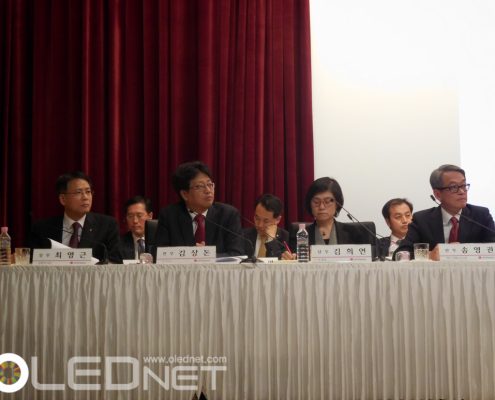
At the 10th National Research Development Industry General Workshop in Display (8-10 July) in Muju, South Korea, industry-academy experts gathered and held a discussion on the future display strategy under the heading ‘Korean Display Industry Crisis, What is the Solution?’.


At the previous keynote speech, vice president of LG Display, Yoon Sooyoung explained that the key points for the third revolution will be design innovation, design freedom differentiated though real image, and picture quality that can closely resemble visual reality. He also added that the third display is OLED that can actualize various advantages such as transparency, flexibility, and high picture quality at once, and considering material/component and mass production technology status, OLED will also be able to achieve competitive prices soon.


Samsung Display’s executive director Hye Yong Chu forecast next generation display will be smart display, human friendly, holographic, and disruptive innovation. Particularly she estimated that thorough size and design innovation, flexible display will be able to create new application and market and that flexible OLED will form the core.


The shared opinion of Samsung Display and LG Display, key Korean display companies, at the keynote session was Korean display industry’s need to lead the next generation display market in order to prepare for China’s pursuit and requirement of active participation and cooperation from industry-academy to achieve this.


During the panel discussion that followed the keynote session, many different opinions were suggested regarding Korean display industry status from academy-industry. Of China’s BOE’s Gen10.5 investment, Samsung Display’s Chu disclosed that investment at the right moment was more important than preemptive investment; the focus will be curved and edge display market expansion and widening the technology gap with latecomers, and investment will be carefully considered before making a decision. LG Display’s Yoon also explained that areas where cost innovation are possible are limited even with investment is carried out as the current display market is different from previous ones. He added that Gen10.5 investment has to be deliberated and emphasized that focus should be on how to make OLED competitive.


Against the China’s aggressive investment on Gen8 or higher, Samsung Display and LG Display’s positions are analyzed to be of same opinion of carefully considering investment while pioneering the market maximizing the existing technology prowess.


미래 디스플레이 전략 대토론회


[SID 2014] Latecomers catching up aggressively

AMOLED latecomers; BOE, AUO and Tianma are rapidly catching up the AMOLED development of Samsung Display (SDC) and LG Display (LGD) at SID 2014.

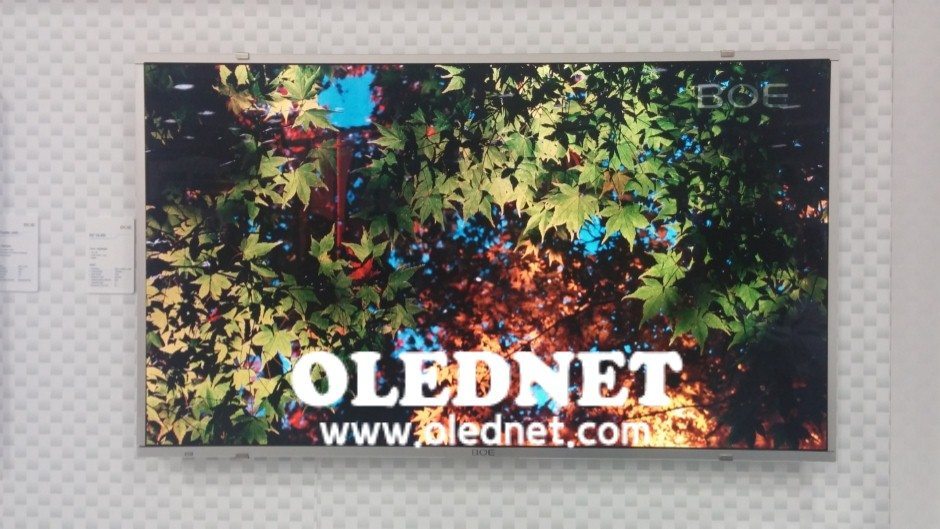
BOE expressed possibility of investing in TV following mobiles by displaying 55” FHD AMOLED panel. In terms of technology readiness level, it is incompatibly lower than panels of LGD and SDC though, it is considerably fast that it was developed in six months and produced in a pilot line in Hefei.

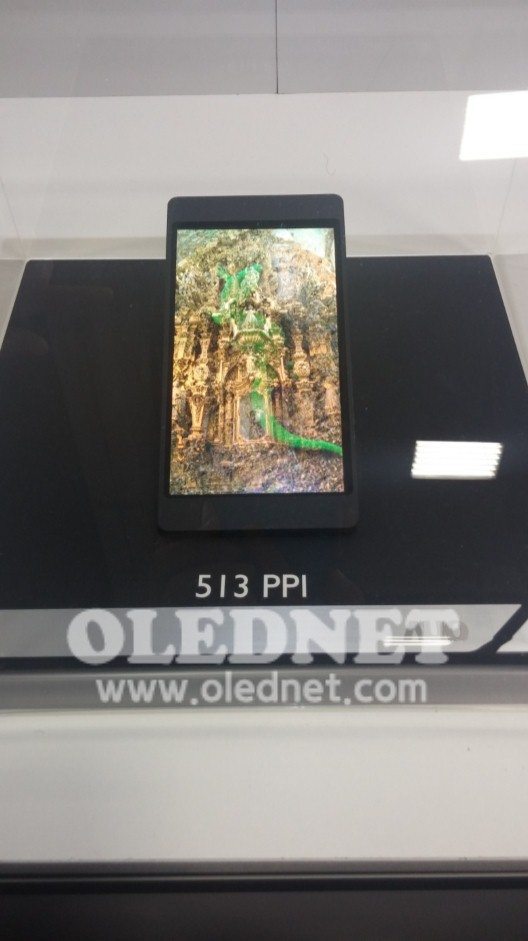
AUO showed that its AMOLED technology had reached at certain level by unveiling 5.7” WQHD (513ppi) ultra-high resolution AMOLED panel. More attention drew towards AUO’s panel because its production method is RGB+FMM as SDC uses and the high resolution is realized with real RGB strip type rather pentile. AUO also expressed its will on AMOLED business by showing 5” HD flexible AMOLED panel and 1.6” AMOLED panel for a smart watch.

Tianma also unveiled 5.5” HD AMOLED panel. Its performance lags behind the current AMOLED panel, but it ai    ms to supply middle-end and low-end panel targeting mass-production of 5.5” FHD AMOLED through continuous R&D.

Challenges of Chinese and Taiwanese makers become serious in the AMOLED market, where Korean makers, SDC and LGD, are dominant, and the latecomers are about to invest in the sector. Thus, it is expected that the AMOLED industry will constantly grow.

<BOE’s55ich FHD OLED panel>

 <AUO’s 5.7inch FHD AMOLED panel>

<AUO’s 5inch HD flexible AMOLED panel>

<Tianma’s 5.5inch HD AMOLED panel>

Portfolio Items