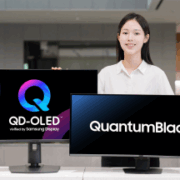
‘Unrivaled Color Expression’ QD-OLED, Superior Viewing Angles

Exceptional viewing angles proven by UL ‘QuantumView’ validation… Luminance maintenance over 60% even at 60-degree angle

□ UL Solutions completes viewing angle evaluation for the entire ‘QD-OLED’ lineup

□ Luminance stays above 60% with almost no change in color coordinates at 60-degree side view

□ QD-OLED becomes essential for dual/pro-reference monitors to avoid luminance drop and color distortion

□ Samsung Display: “Quantum Dots exhibit a ‘Lambertian-like’ emission pattern, scattering light widely for superior viewing angles”

□ Expansion of self-emissive monitor market from gaming-focused B2C to high-precision B2B sectors

Samsung Display’s QD-OLED, known for having the best color expression among existing displays, has once again been recognized for its exceptional picture quality by proving superior viewing angles.

The company announced on the 22nd that its QD-OLED for TVs and monitors has recently completed the ‘QuantumView™’ validation by UL Solutions, a global safety science leader. The ‘QuantumView™’ evaluation measures changes in luminance and color coordinates based on the viewing position (moving in 10-degree increments from the front up to a 60-degree point). The evaluation results for the entire QD-OLED lineup showed that at a 60-degree side view, the luminance maintenance rate remained above 60% compared to the front, and the color coordinate change was almost negligible at 0.012 or less. For typical LCDs, the luminance maintenance rate at a 60-degree angle drops below 20%, and the color coordinate change can reach up to 0.025—about twice the variance seen in QD-OLED.

“Viewing angles have always been a key factor in selecting a TV, considering environments where multiple people watch together in a living room,” said a Samsung Display representative. “Recently, as usage patterns change—such as the increased use of dual or triple monitors and professional reference monitors for collaborative work—the demand for wide-viewing-angle QD-OLED monitors is also rising.”

The company attributes QD-OLED’s superior viewing angle characteristics to its unique top-emission structure and the ‘Lambertian’ emission property of Quantum Dot materials. Light typically has directionality, causing brightness or color to change depending on the viewing angle. However, ‘Lambertian emission’ refers to an optical property where light is emitted uniformly in all directions, providing consistent brightness regardless of the angle.

“In a QD-OLED, Quantum Dots absorb blue OLED light and re-emit it into red and green wavelengths. These nanometer-sized particles don’t just convert color; they exhibit a Lambertian emission pattern where light spreads widely in a spherical shape,” the company explained. “Unlike other large OLED technologies, QD pixels directly create vivid, high-purity colors at the front, simultaneously improving color accuracy and light efficiency.”

Based on these superior wide-viewing-angle and color reproduction characteristics, Samsung Display is expanding its OLED monitor market beyond the gaming-centered B2C market into B2B areas with high demand for high-precision displays, such as video/graphic professionals, content creators, and financial traders. Recently, ASUS and Dell Technologies launched their professional monitor lines—ProArt and UltraSharp, respectively—featuring QD-OLED, receiving positive market responses. Other manufacturers like Acer, Lenovo, and MSI are also expected to introduce professional monitor lineups.

“The ‘QuantumView™’ validation objectively proves that QD-OLED is a technology that provides consistent picture quality across diverse viewing environments,” said Jung Yong-wook, Vice President and Head of the Strategic Marketing Team at Samsung Display. “By collaborating with global brands using QD-OLED, which combines outstanding color expression with wide viewing angles, we will provide consumers with the best possible viewing experience large displays can offer.”

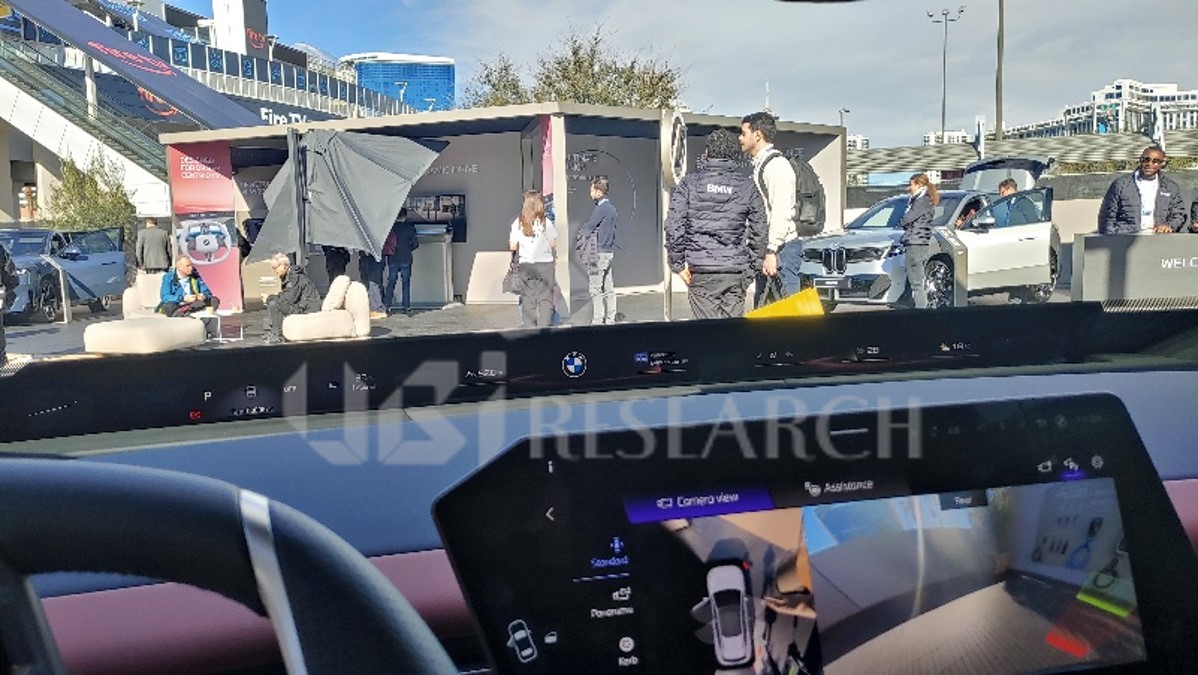
BMW iX3 showcasing its pillar-to-pillar Panoramic Vision Head-Up Display at CES 2026, representing the future of dashboard-free car interiors.

PHUD is The Future of The Automotive Cockpit

Panoramic Head-Up Displays (PHUDs) are once again accelerating the evolution of the automotive cockpit. While traditional HUDs displayed only limited information, such as speed and GPS, within a restricted area directly in front of the driver, PHUDs are next-generation interfaces that utilize a horizontal, pillar-to-pillar area along the bottom of the windshield to provide integrated driving information, safety warnings, vehicle status, and entertainment. As they can absorb most of the functions of physical instrument panels and central displays, PHUDs are emerging as a key pillar in realizing a “smart cockpit without a dashboard,” going beyond the role of a simple display device.

The primary reason PHUDs are garnering attention is their ability to simultaneously enhance safety and user experience. When driving, drivers must shift their gaze between road conditions and the display screen to check information mounted on the dashboard, leading to increased fatigue and distraction. In contrast, with PHUDs, the driver’s gaze remains directed toward the windshield even while driving, allowing driving information to enter their natural field of vision. This reduces the burden of shifting focus and enables more intuitive information perception. The elimination of the instrument cluster enables a minimalist interior, allowing automakers greater freedom in interior design. As the display area becomes wider and longer, it can efficiently provide different information to both the driver and passengers, serving as the foundation for expanding PHUD from a simple driving assistance system into an interaction hub for the entire vehicle.

PHUD has passed the proof-of-concept stage and is entering the mass production phase. BMW was the first to present the direction of PHUD as “Panoramic Vision,” and introduced the direction of the next-generation cockpit by unveiling the Neue Klasse-based iX, which incorporates BMW Panoramic Vision, at CES 2026. The Xiaomi YU7, a mid-size electric SUV set to go on sale in 2025, is equipped with a 1.1-meter panoramic display, accelerating the blossoming of the PHUD market. Major automakers such as Valeo and Marelli are also speeding up mass production of PUHD, meaning PHUD is rapidly moving beyond being a symbolic technology of concept cars and entering the realm of the actual market. While HUDs were imaging units providing information on a scale of merely a few inches, PHUDs require a much wider display area and advanced optical structures, so changes are expected across the entire supply chain for displays and optical components.

BMW iX3 featuring the Panoramic Vision PHUD technology exhibited at CES 2026

BMW iX3’s Panoramic Vision exhibited at CES 2026. It presents the direction of next-generation smart cockpits through PHUD technology that replaces the instrument cluster and stretches along the bottom of the windshield. (Source: UBI Research)

The evolutionary direction of PHUD will focus on replacing the instrument cluster and displaying ultra-wide information in the short term, but in the mid-to-long term, it will evolve into a form that combines with AR-HUD to overlay information onto the actual road. Furthermore, by integrating with in-vehicle IoT, AI-based personalized services, and safety warning systems, PHUD will transform beyond a mere information display function into a smart interaction platform that connects the vehicle, driver, passengers, and the external environment.

The competition for PHUD will not be a simple battle over display size, but rather a competition for cockpit dominance centered on how naturally and safely information can be delivered inside the vehicle.

Changwook Han, Executive Vice President/Analyst at UBI Research (cwhan@ubiresearch.com)

▶2026 Medium & Large Size OLED Display Annual Report

▶2025-2026 Automotive Display Technology and Industry Trends Analysis Report

※ This article is produced by UBIResearchNet.

Unauthorized reproduction or citation without source attribution is prohibited.

When quoting, please clearly indicate the source (UBIResearchNet) and provide a link.

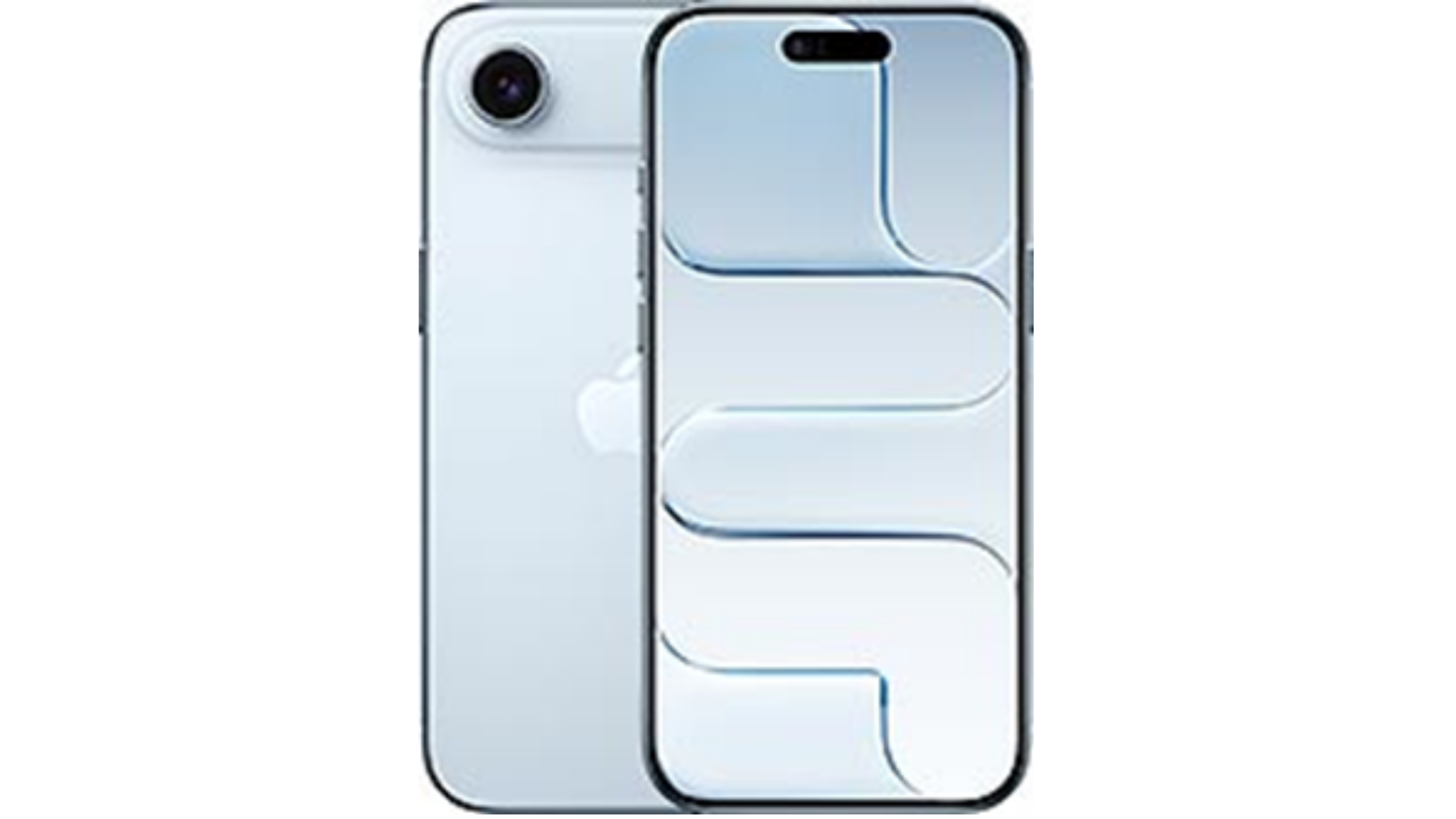
Apple's iPhone Air representing the shift in the OLED supply chain towards premium models for the upcoming iPhone 18 series.

iPhone Air Fades Out… Apple Reinforces Pro-Centric Strategy in iPhone 18 Lineup

Apple's iPhone Air faces a significant panel inventory due to low sales. With Apple strengthening its premium-centric strategy, production plans for the Air are virtually halted for this year. (Image source: GSMArena)

With the iPhone Air facing high inventory issues, Apple is restructuring its OLED supply chain to prioritize high-margin Pro, Pro Max, and Foldable models for the iPhone 18 series. (Image source: GSMArena)

Apple’s OLED supply chain for upcoming iPhones is being strategically restructured. The key change is not merely a redistribution of volumes, but rather which supplier takes responsibility for which models. Starting with the iPhone 18 series, the launch schedule for standard models is expected to shift from fall to the first half of 2027, leading to changes in the business dynamics among Samsung Display, LG Display, and BOE.

Unlike the iPhone 17 series, the iPhone 18 lineup is expected to adopt staggered release timings by model. High-end models—including Pro, Pro Max, and a foldable iPhone—will be launched first, while lower-end models will be delayed to the first half of 2027. As a result, the OLED panel market for iPhones in 2026 will naturally be centered on premium panels.

In this transition, LG Display stands out as a key beneficiary. For the iPhone 18 series, LG Display is expected to focus more on producing panels for Pro and Pro Max models rather than standard or Air models. This shift does not simply mean a change in product mix, but rather an improvement in profitability. By increasing the share of high-priced premium panels instead of lower-priced models, LG Display can significantly enhance both revenue and margins even with similar shipment volumes. This supply structure is expected to work in LG Display’s favor, with its OLED revenue from iPhones projected to increase by more than 15% year-on-year.

In contrast, the iPhone Air is effectively absent from this year’s production plan. Both Samsung Display and LG Display are holding substantial panel inventories, and even if additional orders arise toward the end of the year, volumes are unlikely to exceed around 1 million units. Although initially anticipated as a new product category, the iPhone Air has been deprioritized within the supply chain. Moreover, it remains uncertain whether Apple will launch a new Air model at all. This suggests that Apple is reinforcing a lineup strategy focused on clearly defined premium segments rather than expanding ambiguous mid-tier products.

Samsung Display is expected to prioritize production of panels for the foldable iPhone, as well as Pro and Pro Max models within the iPhone 18 series. While production of panels for standard models may begin toward the end of the year, the overall portfolio will be centered on foldable and Pro segments. In particular, Samsung Display is likely to supply both the main and secondary panels for the foldable iPhone, positioning itself as the most critical supplier in terms of technological capability and supply stability. However, with the delayed launch of standard models to the first half of 2027, Samsung Display’s overall iPhone panel shipments are expected to remain at a similar level to the previous year. The key focus will shift from volume growth to revenue expansion driven by high-value models.

BOE is likely to play a more limited role. The iPhone 18 series is expected to adopt LTPO+ panels, and BOE is currently considered to lack the technological maturity required for mass production at this specification level. Compared to conventional LTPO, LTPO+ demands higher performance in power efficiency, driving stability, and quality reliability, raising the entry barrier for Apple’s premium supply chain. As a result, BOE is expected to continue supplying panels primarily for legacy models such as the iPhone 17 and iPhone 17 Pro, with shipment volumes remaining at levels similar to the previous year.

The key takeaway from this shift is not the absolute shipment volume, but the qualitative transformation of the supply structure. The effective absence of the iPhone Air, the delay of standard model launches, and the expansion of LTPO+ adoption all indicate that Apple is consolidating its supply chain around premium products. Samsung Display will maintain its core supplier position centered on foldable and Pro models, while LG Display is expected to enhance its performance through a Pro and Pro Max-focused strategy. Meanwhile, BOE will remain constrained to a limited role centered on legacy models due to challenges in meeting next-generation specifications.

Apple is effectively redesigning its OLED supply chain around profitability and stability by separating model launch timing, panel specifications, and supplier roles. Going forward, the key competitive factor for panel makers will not be shipment volume, but rather which company can reliably supply a greater share of high-value premium panels.

Junho Kim, Analyst at UBI Research (alertriot@ubiresearch.com)

▶2026 Small OLED Display Annual Report

▶2026 Medium & Large Size OLED Display Annual Report

※ This article is produced by UBIResearchNet.

Unauthorized reproduction or citation without source attribution is prohibited.

When quoting, please clearly indicate the source (UBIResearchNet) and provide a link.

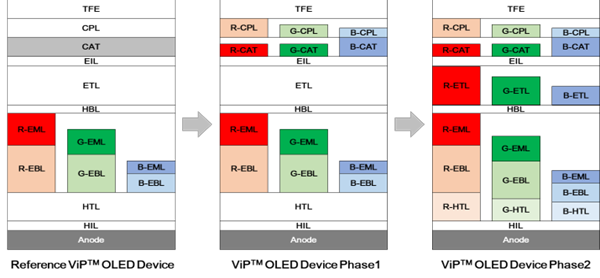
Diagram of different phases of ViP™ OLED devices showing the independent optimization of subpixel common layers to enhance display efficiency.

High-efficiency pTSF-OLED made possible only by ViP™ technology

Visionox and the research team of Professor Lian Duan at Tsinghua University jointly presented research results demonstrating OLED efficiency improvements through ViP™ (Visionox intelligent Pixelization) technology at ICDT 2026 (International Conference on Display Technology). This presentation is particularly noteworthy as it marks the first co-authored paper between Visionox, which has led the ViP™ process innovations, and Prof. Lian Duan’s group, which developed the pTSF (phosphor-assisted TADF-sensitized fluorescence) mechanism and contributed to its mass production adoption.

OLED panels fabricated using the fine metal mask (FMM) process have a pixel aperture ratio (APR) of only 20–30%. This narrow emitting area forces high current densities through the device, fundamentally accelerating efficiency roll-off and material degradation. On large-area substrates of Gen 8 and above, mask sagging makes precise alignment increasingly difficult, creating serious yield challenges for producing high-resolution OLED panels at 400 ppi and beyond.

The ViP™ technology, disclosed by Visionox in May 2023, patterns pixels via photolithography, enabling an APR exceeding 50%. Furthermore, unlike FMM, it allows the common layers of each R, G, and B sub-pixel — including HIL, HTL, EBL, ETL, and others — to be designed and optimized in complete independence.

The research team systematically investigated the efficiency-improvement effects of ViP™ technology along three axes: materials, layer thickness, and emission mechanism. In the FMM process, the hole transport material (HTM) has traditionally been selected based on the performance requirements of the blue device. With ViP™, however, the common layers for each sub-pixel can be chosen independently to match their respective emission characteristics.

Diagram showing the structural changes of ViP™ OLED devices from Reference to Phase 1 and Phase 2, illustrating the independent optimization of common layers (CAT, CPL, ETL, EBL, etc.) for each RGB subpixel

Structural optimization phases of ViP™ OLED devices revealed by Visionox and the Tsinghua University research team. It overcomes the limitations of FMM by independently designing the common layers of each subpixel to prove efficiency improvements. (Source: Visionox & Tsinghua University)

A comparison of three HTM materials sharing the same HOMO level (−5.2 eV) but differing in hole mobility revealed that a red device based on an HTM with significantly lower mobility degradation under high electric field conditions achieves an efficiency roll-off (G16/G255) of 101% — effectively zero — at high luminance, while extending LT95 lifetime by 48% relative to the reference device.

Two-stage optimization effects were quantitatively verified through SETFOS optical simulation. In Stage 1, individually tuning the cathode (CAT) and capping layer (CPL) thicknesses for the R and B devices alone improved white efficiency by 5%. In Stage 2, further optimizing the HTL, EBL, and ETL thicknesses for each of R, G, and B added an additional 9% (green), 3% (red), and 2% (blue) improvement. The combined white efficiency gain from both stages exceeds 7%, a magnitude comparable to a full year’s efficiency progress achievable through materials innovation (typically 5–10%).

ViP™ enables device structure optimization tailored to each emission color. A blue device based on the pTSF mechanism achieves theoretical efficiency 1.6–2.5× higher than that of a TTA (triplet-triplet annihilation) fluorescent device. Applying the pTSF mechanism across a white panel can boost overall efficiency by up to 55%. However, in FMM-based mass production lines, the HOMO/LUMO energy levels of the HTM and EBM required for pTSF green and pTSF blue pixels are mutually incompatible, making it practically impossible to raise efficiency within a single panel. ViP™ resolves this structural barrier and opens the path to integrating both a pTSF green device and a pTSF blue device within a single panel.

This study suggests that as ecosystem collaboration deepens between material suppliers and equipment manufacturers, the efficiency gains enabled by ViP™ technology will accelerate further. For next-generation applications demanding high resolution and low power consumption — large-format IT panels (monitors, laptops), AR/VR headsets, and automotive displays — the ViP™–pTSF technology combination is poised to emerge as a core source of differentiated competitive advantage that FMM-based mass production lines cannot replicate.

Changho Noh, Senior Analyst at UBI Research (chnoh@ubiresearch.com)

▶2026 Medium & Large Size OLED Display Annual Report

▶2025 OLED Emitting Materials Report Sample

※ This article is produced by UBIResearchNet.

Unauthorized reproduction or citation without source attribution is prohibited.

When quoting, please clearly indicate the source (UBIResearchNet) and provide a link.

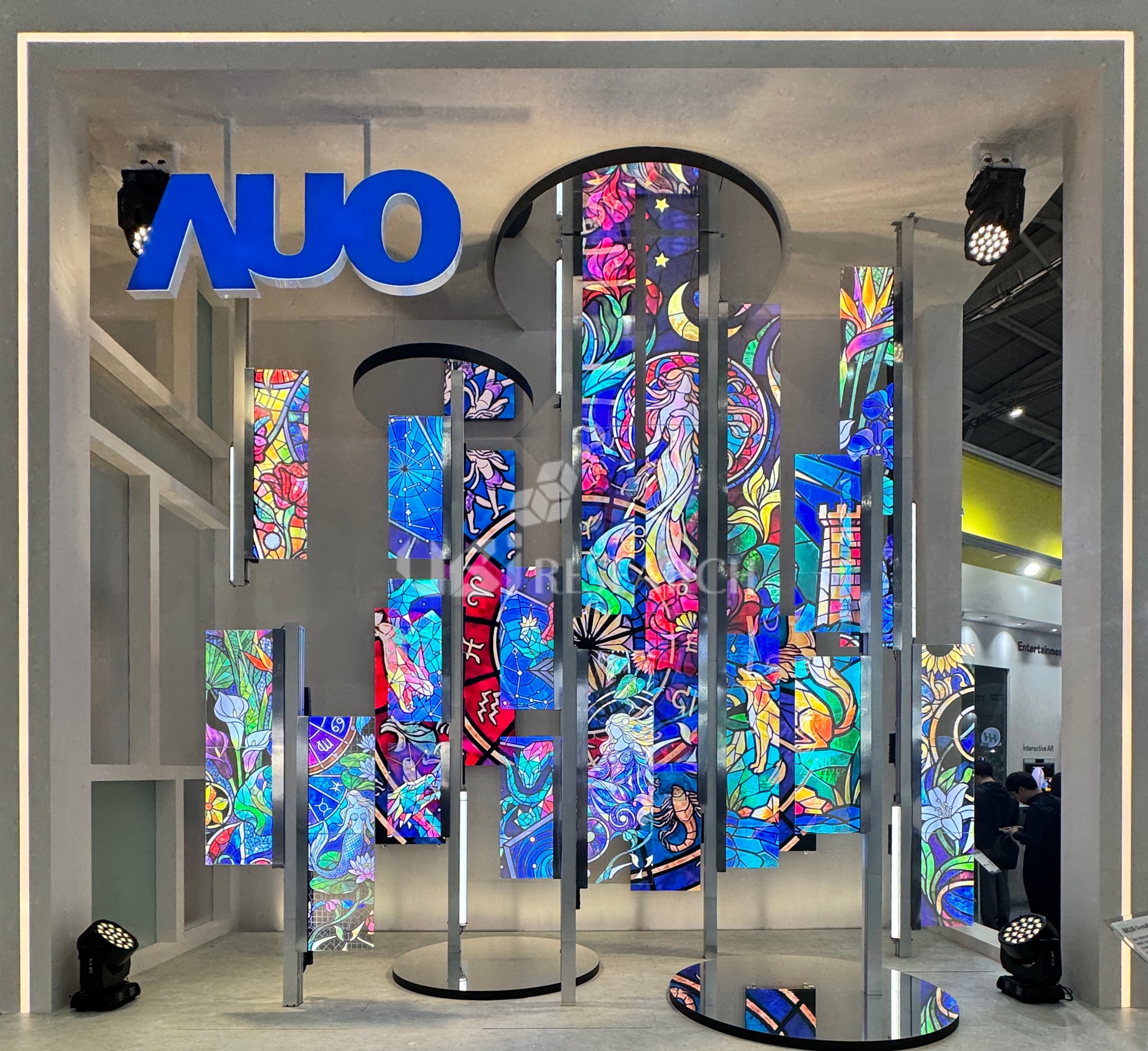
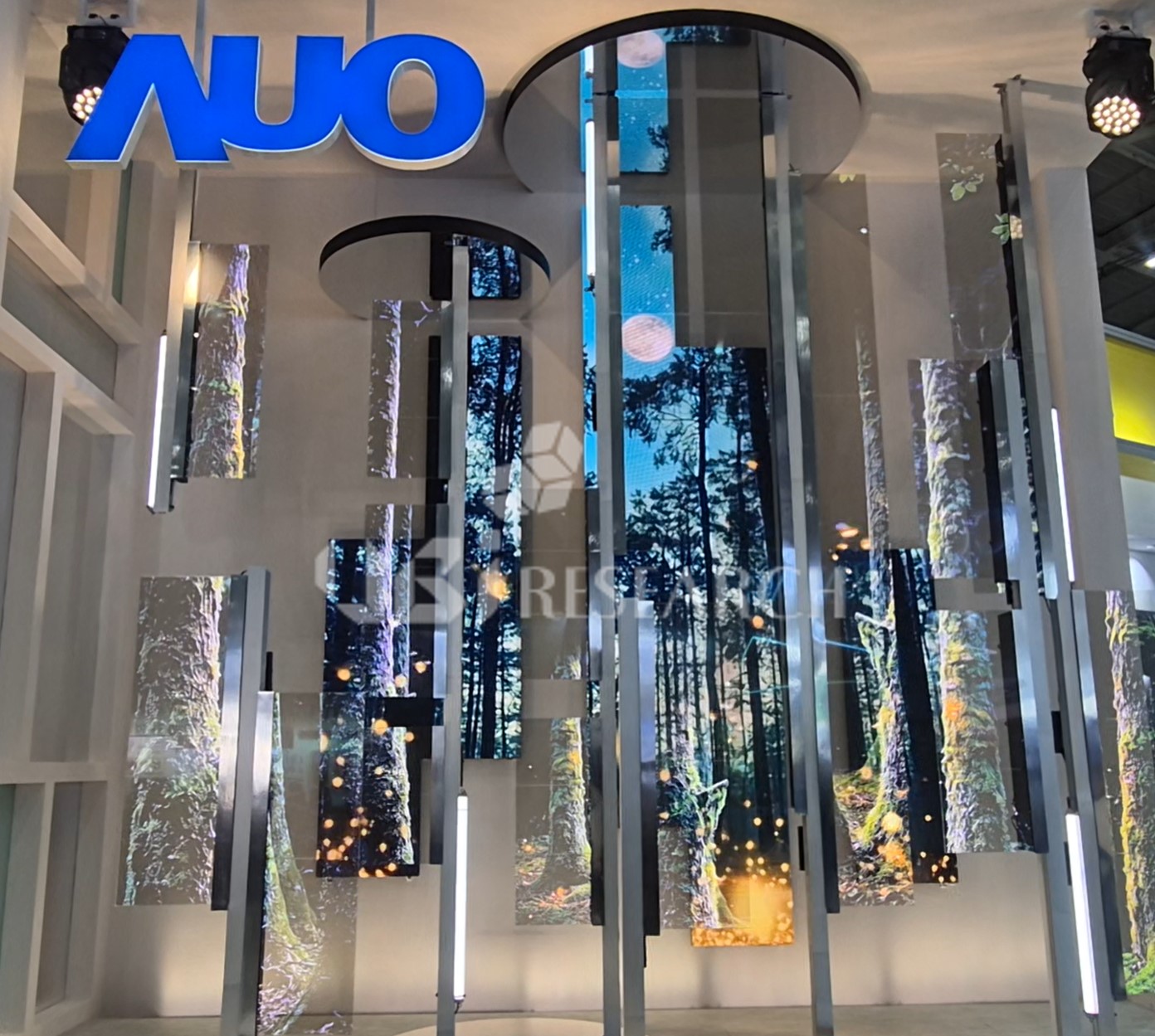
AUO's transparent Micro-LED display structure showing a stained glass design at Touch Taiwan 2026, representing its Smart Life Solution transformation.

[2026 Touch Taiwan] “Connecting the World with Light”… AUO Emerges as a Global “Smart Life Solution” Group

AUO, which previously focused on the manufacturing of display panels, has by 2026 completely transformed into a massive “Smart Life Solution Group” encompassing Artificial Intelligence (AI), mobility, and optical communications.

At its core lie Ennostar, the central hub for next-generation optoelectronic integrated solutions; AMS (AUO Mobility Solutions), which leads the automotive business; and ADP (AUO Display Plus), a company specializing in industry-specific customized solutions.

Giant transparent Micro-LED display structure featuring a colorful stained glass pattern at the entrance of the AUO booth at Touch Taiwan 2026

A giant transparent Micro-LED display structure at the entrance of the AUO booth at Touch Taiwan 2026. Featuring a colorful stained glass pattern, it symbolizes AUO’s leap beyond hardware manufacturing into a ‘Smart Life Solution’ group. (Source: UBI Research)

■ Ennostar: The Heart of the Micro-LED Ecosystem, from Upstream to Downstream

Ennostar, the technological foundation of the AUO Group, has established a unique vertical integration system in the Micro-LED field—often hailed as the game-changer for next-generation displays.

• Design and Production: Through in-house design and production of LED epitaxial wafers and chips, Ennostar has internalized the core material technologies essential for next-generation displays.

• Evolution of Packaging and Modules: Moving beyond mere chip production, Ennostar has developed its packaging and module business as a primary pillar, fulfilling its role as a core supply chain partner within the group by providing automotive solutions to its subsidiary, AMS.

■ AMS and ADP: Innovation in Mobility and Smart Spaces

High-performance LED packaging and module solutions produced by Ennostar are elevated into cutting-edge automotive solutions through the subsidiary AMS.

• Smart Cockpit: AMS combines Ennostar’s pixelated automotive LEDs with high-brightness Micro-LED panels to supply “Smart Cockpits”—interfaces for the era of autonomous driving that go beyond simple instrument clusters—to global automakers.

• Customization Services: ADP applies these technological capabilities to medical, retail, and educational displays, diversifying the group’s revenue structure by providing smart space solutions optimized for each industry.

■ “We Sense, We Communicate”: Opening the Arteries of AI Data Centers

The evolution of AUO and Ennostar does not stop here. Under the new motto “We Sense, We Communicate,” both companies are leaping beyond being display manufacturers to become integrated optoelectronic solution providers.

In particular, they are focusing on high-speed data transmission solutions for AI data centers to handle the explosive growth of traffic in the AI era. Ennostar’s compound semiconductor and light source technologies are merging with silicon photonics, evolving into core components that reduce power consumption and maximize data transmission efficiency.

■ Building an Intelligent Ecosystem Beyond Hardware

Analyst Joohan Kim of UBI Research analyzed that “the ability to control ‘light’ that AUO has secured through Ennostar has now moved beyond the purpose of illuminating screens to become the pathway for the flow of AI data.”

As a leader of an intelligent ecosystem that connects everything from the arteries of AI data centers to mobility interfaces—rather than just a panel manufacturer—AUO’s 2026 is shining more brightly than ever before.

Joohan Kim, Senior Analyst at UBI Research (joohanus@ubiresearch.com)

▶101 inch Micro-LED Set BOM Cost Analysis For TVs

▶Industry Trends and Technology of Micro-LED Displays for XR Report

※ This article is produced by UBIResearchNet.

Unauthorized reproduction or citation without source attribution is prohibited.

When quoting, please clearly indicate the source (UBIResearchNet) and provide a link.

Exhibition scenes from Touch Taiwan 2026 showcasing next-generation Micro-LED displays and automotive smart cockpits by AUO, Innolux, and PlayNitride.

Touch Taiwan 2026: Micro-LED Exhibition Products and New Application Technology Trends

The Touch Taiwan 2026 exhibition was held on April 8 at the Taipei Nangang Exhibition Center in Taiwan. Going beyond a simple display event, the exhibition took place as an electronics technology industry event under the theme of “Innovation Together,” covering the fields of smart displays, electronic production equipment, and eco-friendly smart manufacturing.

While AUO focused on automotive solutions last year, this year appeared to be focused on the commercialization of transparent display products. Transparent Micro-LED displays have higher transmittance and lower manufacturing costs compared to transparent OLEDs, making them easier to commercialize.

Transparent Micro-LED based CrystalForest Display installed at the front of the AUO booth at Touch Taiwan 2026

AUO’s transparent Micro-LED panel ‘CrystalForest Display’ showcased at Touch Taiwan 2026, highlighting various everyday applications such as commercialization and smart living. (Source: UBI Research)

The CrystalForest Display in the photo above is a transparent micro-LED panel that allows the sharing of reality and digital information through a single perspective, expressing the shift of the future from technology to human life. Through transparent displays, various applications necessary for daily life, such as entertainment and smart living, were showcased, including a 64” sports AR solution, a 42” AI Translator, a 30” Interactive AR Box, Crystal Tree, and a 16.1” dual-sided display.

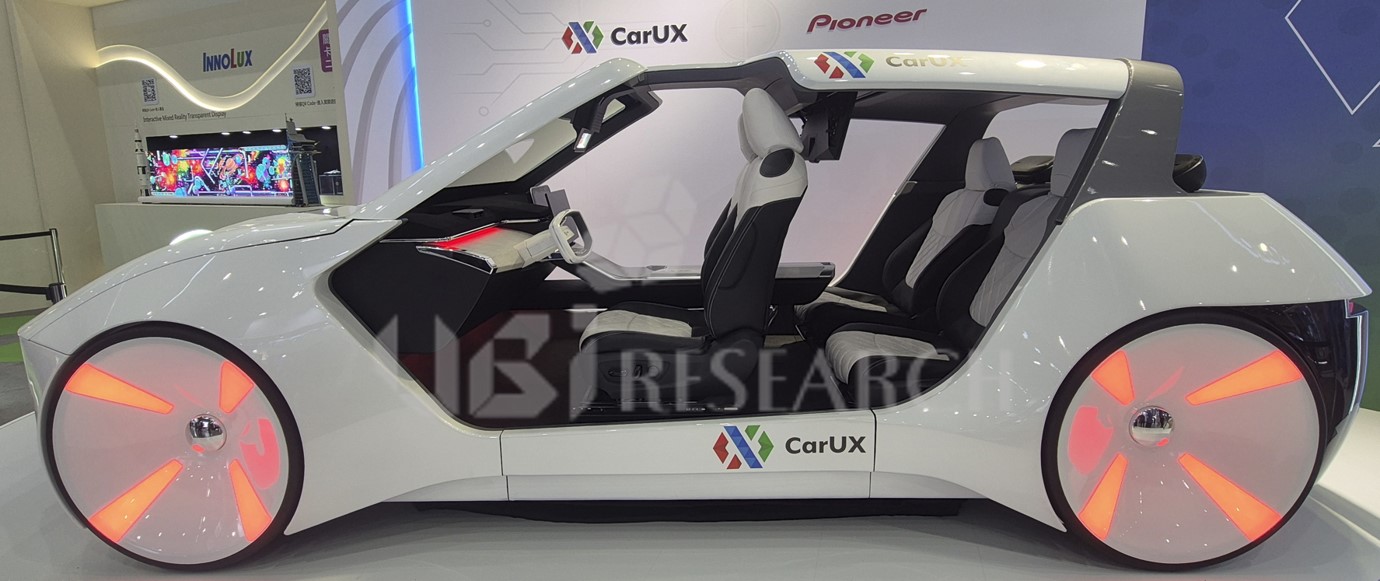
Similar to last year, Innolux showcased CarUX’s high-resolution displays and intelligent smart cockpit systems targeting the automotive market through its subsidiary, CarUX, under the slogan “Pioneering in-Car User eXperience.” Additionally, retail and public display exhibitions were held featuring mirrors and transparent displays. Home application products, such as the 85” InnoScenery and Dressing Mirror, which combine LCD panels with AI technology, were also on display.

A car equipped with high-resolution displays and an intelligent smart cockpit system presented by Innolux's subsidiary, CarUX

A vehicle equipped with an intelligent smart cockpit system exhibited by CarUX, an Innolux subsidiary. It targets the automotive market under the slogan ‘Pioneering in-Car User eXperience’. (Source: UBI Research)

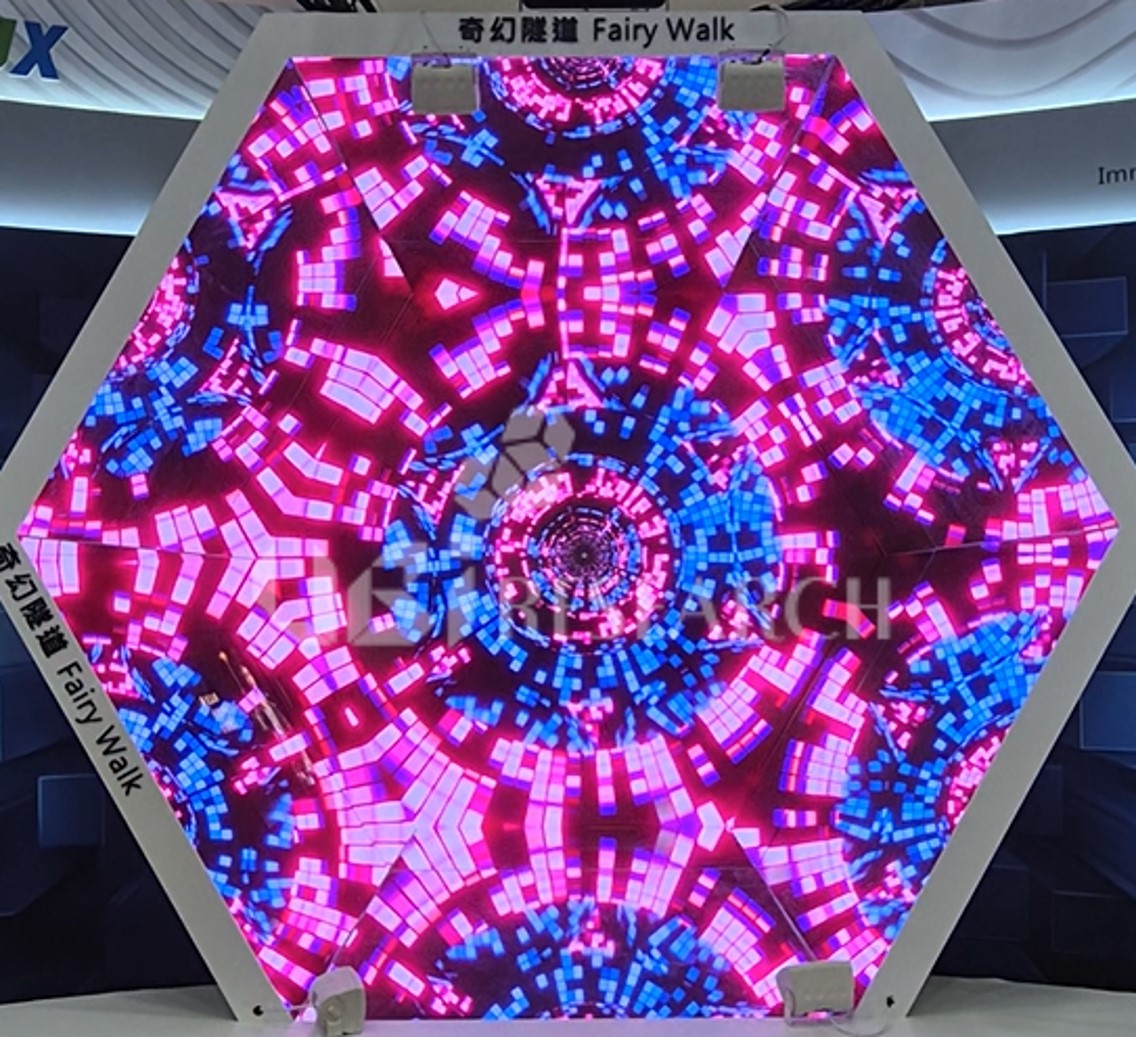
Innolux's immersive interactive art display 'Fairy Walk Micro-LED Display' revealed at Touch Taiwan 2026

Innolux’s ‘Fairy Walk Micro-LED Display: Immersive Interactive Art’. (Source: UBI Research)

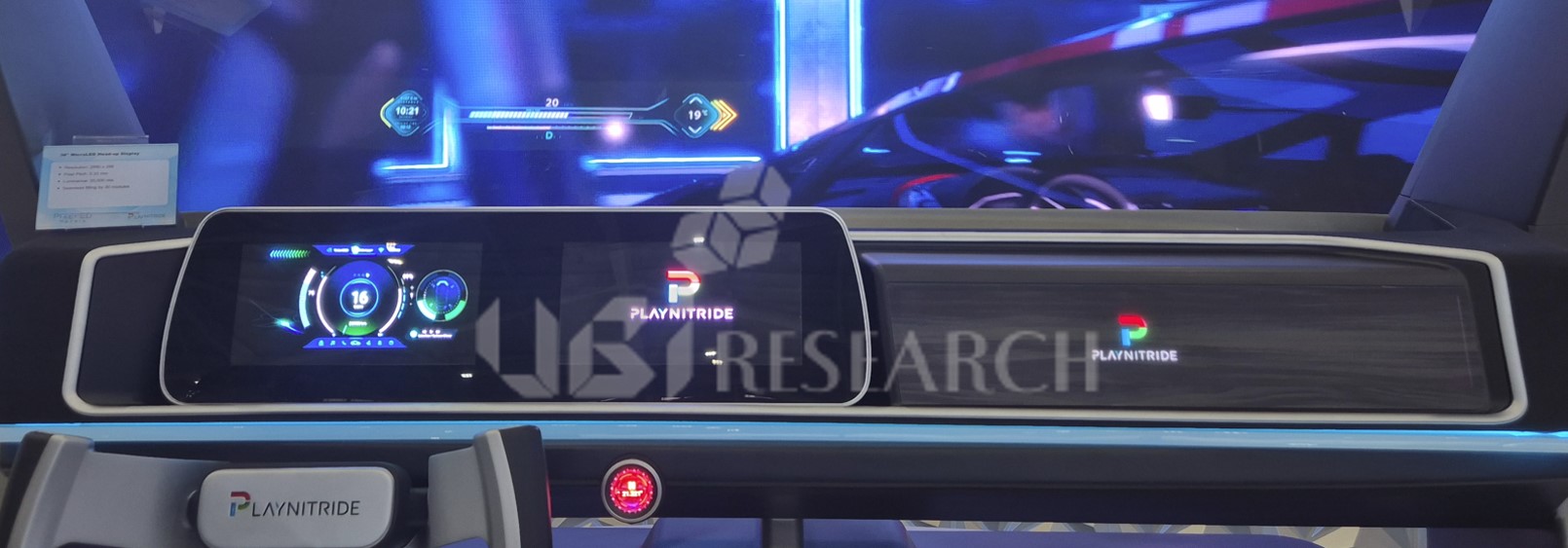
Playnitride exhibited an 89” Micro-LED for TVs, a 0.18” Full-color Microdisplay for AR, a 1.39” smartwatch, a 38” Head-up Display, a 19” Invisible Display, and an Octagon transparent display.

Automotive Micro-LED display solutions, including a 38-inch Head-up Display, exhibited by PlayNitride at Touch Taiwan 2026

Automotive Micro-LED display showcased by PlayNitride. (Source: UBI Research)

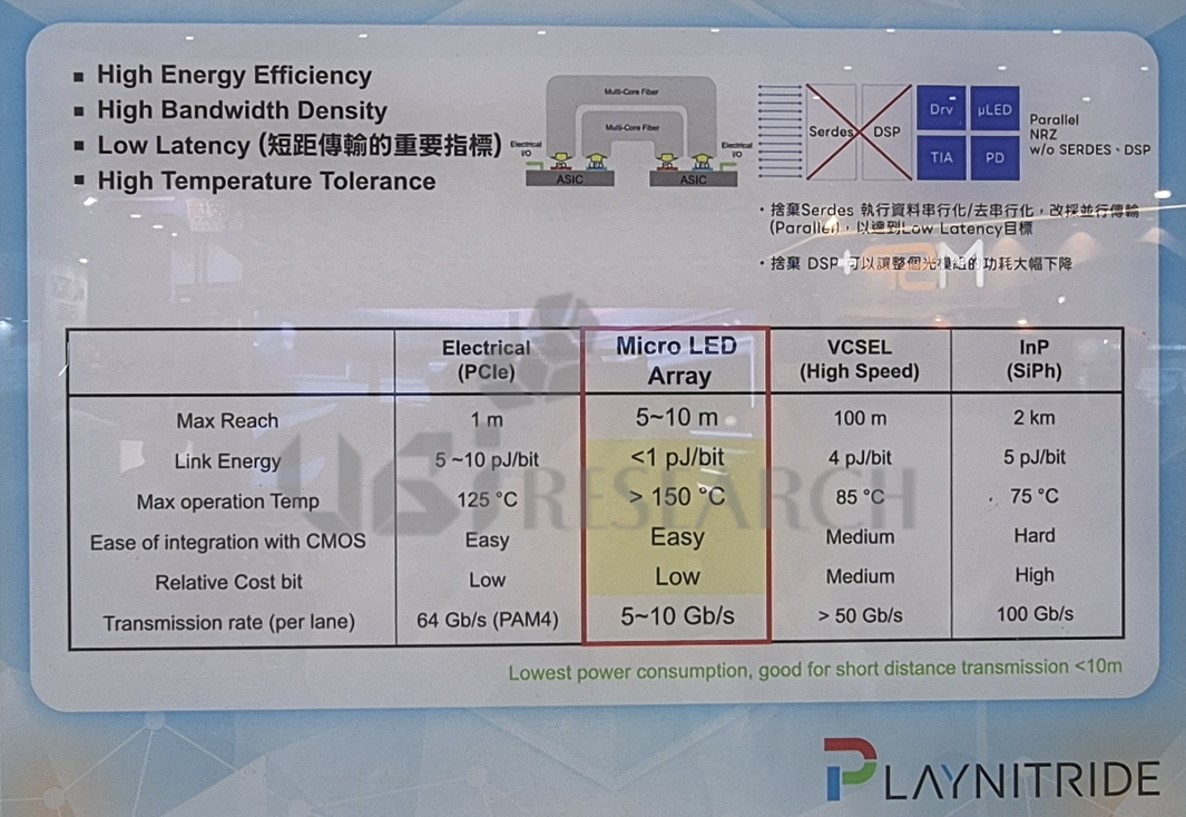
At the recent Touch Taiwan exhibition, the application, advantages, and importance of Micro-LED technology in the field of semiconductor CPO technology were introduced. Both Playnitride and AUO were focusing on developing Micro-LED CPO technology as a new business.

This signifies the expansion of display process technology into the semiconductor packaging sector. Glass substrate manufacturing equipment and materials designed to maximize AI semiconductor performance, such as FOPLP (Fan-Out Panel Level Packaging) and TGV (Through-Glass Electrode), appeared as key themes. The exhibition demonstrated that Micro-LED is beginning to enter a new market segment by integrating with semiconductor CPO technology.

PlayNitride's exhibition panel introducing the technical advantages of Micro-LED Arrays, such as low power consumption, in the semiconductor CPO (Co-Packaged Optics) technology field

Advantages of Micro-LED Arrays in CPO (Co-Packaged Optics) technology introduced at the PlayNitride booth. It demonstrates the expansion of display processes into the semiconductor packaging field. (Source: UBI Research)

Namdeog Kim, Senior Analyst at UBI Research (ndkim@ubiresearch.com)

▶101 inch Micro-LED Set BOM Cost Analysis For TVs

▶Industry Trends and Technology of Micro-LED Displays for XR Report

※ This article is produced by UBIResearchNet.

Unauthorized reproduction or citation without source attribution is prohibited.

When quoting, please clearly indicate the source (UBIResearchNet) and provide a link.

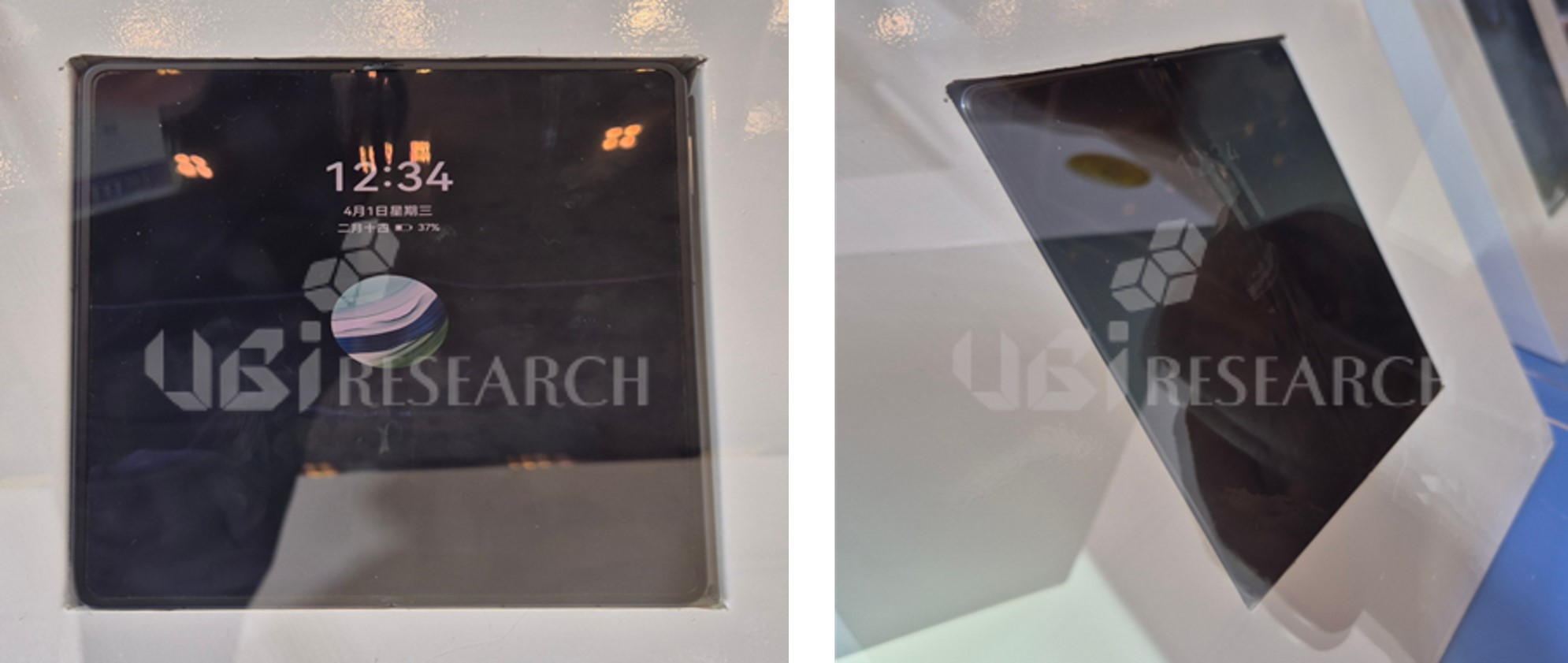
Visionox's latest creaseless foldable display module demonstrating an invisible crease at the ICDT 2026 exhibition.

Creaseless Foldable Technology Competition Intensifies

Following Samsung Display’s demonstration of a laser-drilling-based creaseless panel at CES 2026 and BOE’s disclosure of its creaseless technology at MWC 2026, Visionox unveiled a creaseless foldable module at ICDT 2026 — signaling an intensifying technological competition at the panel supplier level.

Visionox's creaseless foldable module with PET-free technology exhibited at ICDT 2026

Visionox’s Creaseless foldable module showcased at ICDT 2026. By replacing the internal PET film with high-rigidity non-plastic materials, the crease depth change remains under 20μm even after 200,000 folds. (Source: UBI Research)

Samsung Display changed its approach to the metal support plate at the bottom of the panel — replacing chemical etching with laser drilling to form dozens of microscopic holes, distributing bending stress across the fold line rather than concentrating it at a single point. At CES 2026, a side-by-side “Crease Test” demonstration using a Galaxy Z Fold 7 panel showed no visually perceptible crease. The technology is expected to be adopted for the Galaxy Z Fold 8 and Apple’s foldable iPhone panels.

BOE redesigned the panel’s internal stack from a single neutral layer to a multi-neutral-layer architecture and applied a gradient modulus approach, distributing and absorbing stress across multiple layers — achieving a crease reduction of over 40% compared to conventional panels. Because only the design was changed without adding external components, manufacturing costs are reduced. The technology has already been applied to Honor Magic V6 and has completed mass-production validation.

Visionox’s creaseless foldable module takes a fundamentally different path from the two approaches above. While Samsung Display controls stress through support plate processing and BOE through internal layer redesign, Visionox addresses the physical root cause of crease at the materials level. The key is the complete removal of the PET (polyethylene terephthalate) film previously used as the internal support material in foldable modules. PET is the root cause of crease formation, as plastic deformation accumulates with repeated folding. Visionox has replaced it entirely with a high-rigidity, non-plastic material, creating a structure in which no permanent deformation occurs even after folding. In addition, a high-recovery OCA (optically clear adhesive) is applied, improving the module’s shape recovery speed after unfolding by 1.6x compared to conventional designs, thereby suppressing the accumulation of local stress.

Visionox has further stacked a multilayer composite cover structure — comprising glass, an ultra-thin protective film, and a nano-reinforced layer — along with a gradient stiffness support plate, minimizing the surface height difference between the folding region and the flat region. Measured results confirm a surface height differential of within 30μm between the folding and flat regions, and a crease depth change of less than 20μm after 200,000 repeated folding cycles. The overall module thickness is 0.4mm or less — 20% thinner than conventional designs — while front impact resistance is improved by 1.3x and rear pressure resistance by 1.25x.

In summary, the three companies are taking distinct physical approaches toward the creaseless goal: Samsung Display through support plate processing, BOE through internal panel stack redesign, and Visionox through direct materials substitution.

With Apple’s foldable iPhone launch expected in the second half of 2026 projected to significantly boost demand for foldable panels, which customers each company secures through its respective creaseless approach will be a critical variable in the reshaping of the supply chain.

Changho Noh, Senior Analyst at UBI Research (chnoh@ubiresearch.com)

▶2026 Small OLED Display Annual Report

▶2026 Medium & Large Size OLED Display Annual Report

※ This article is produced by UBIResearchNet.

Unauthorized reproduction or citation without source attribution is prohibited.

When quoting, please clearly indicate the source (UBIResearchNet) and provide a link.

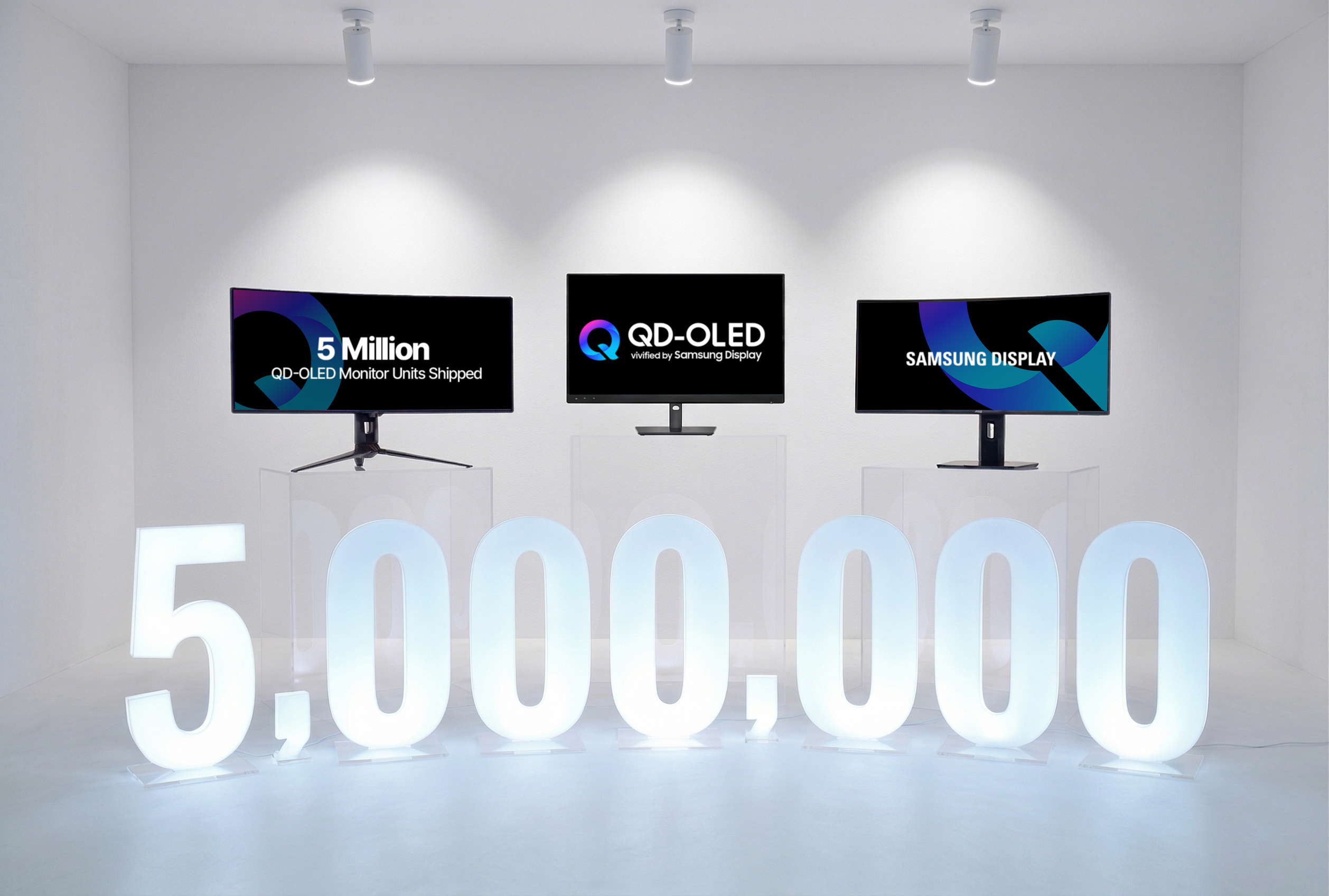
“LCD Fades as the QD-OLED Monitor Era Arrives”: Samsung Display Surpasses 5 Million Units in Cumulative QD-OLED Monitor Shipments

□ Reaching 5 million units in roughly 4 years since mass production launch… Average annual growth rate of over 320%

□ Innovating ultra-high resolution with ‘Quantum Dot,’ shifting the paradigm of the premium monitor market

□ Partnering with 16 global brands… Focused on expanding the reach of self-emissive monitors

□ Son Dong-il, Head of Business Unit: “Accelerating the technological transition of the monitor market based on QD-OLED’s unrivaled picture quality, quality, and stable production capacity”

QD-OLED for monitors surpassed a cumulative shipment of 5 million units this March, establishing itself as the ‘new normal’ in the premium monitor market.

Samsung Display announced that its QD-OLED for monitors exceeded the 5-million-unit mark in March, approximately four years after the start of mass production. Since successfully mass-producing QD-OLED for the first time in the world in late 2021 and entering the premium monitor market, Samsung Display has led the popularization and technological transition of the self-emissive monitor market, recording an average annual growth rate of over 320% through 2025. Notably, this 5-million-unit milestone was achieved in less than two years since reaching 1 million cumulative units in May 2024, proving once again the rapidly increasing global demand.

QD-OLED is a technology that internalizes ‘Quantum Dots (QD)’—nanometer-sized semiconductor particles that absorb light energy and convert it into specific wavelengths—into the display. Unlike conventional large OLEDs that implement color through a separate color filter, QD-OLED converts light from a blue OLED into red and green light within the QD-emitting layer. The unique optical characteristics of Quantum Dots allow for exceptionally high-purity color expression, resulting in superior color accuracy, color volume, and color luminance. Additionally, thanks to the wide light-scattering properties of Quantum Dots, it offers wide viewing angles and excellent response times, allowing users to enjoy clearer picture quality without motion blur even at the same refresh rate compared to LCDs.

According to global market research firm Omdia, the share of products equipped with self-emissive panels in the premium monitor market priced over $500 (based on revenue) is projected to expand from 22% in 2024 to 41% by 2026. Samsung Display is driving this market growth by collaborating with 20 global customers, including Acer, AOC/Philips, ASUS, Dell, GIGABYTE, HP, Lenovo, MSI, and Samsung Electronics, and has released over 150 types of QD-OLED monitors to expand the market’s reach.

Recently, the company launched a 34-inch 360Hz QD-OLED with a ‘V (Vertical)-Stripe’ pixel structure that enhances text readability and is currently supplying it to global monitor manufacturers. Furthermore, it has developed ‘QuantumBlack™’, a low-reflection and high-strength film that reduces light reflection on monitor screens by 20% compared to previous in-house films while increasing panel hardness to 3H, and applied it to all new QD-OLED monitor products launched this year. ‘Quantum Black’ reduces external light reflection to express more perfect blacks; this black expression adds depth and three-dimensionality to game content by clarifying the boundaries between objects and backgrounds, thereby doubling immersion.

According to Omdia, Samsung Display recorded a 75% market share (based on shipments) in the self-emissive monitor display sector last year. Son Dong-il, Executive Vice President and Head of the Large Display Business at Samsung Display, stated, “The rapid growth and overwhelming market share of QD-OLED stem from its unrivaled picture quality, quality competitiveness, and stable production capacity. We will continue to introduce differentiated technologies and products closely aligned with customers and the market to change the landscape and trends of the monitor market and lead the technological transition.”

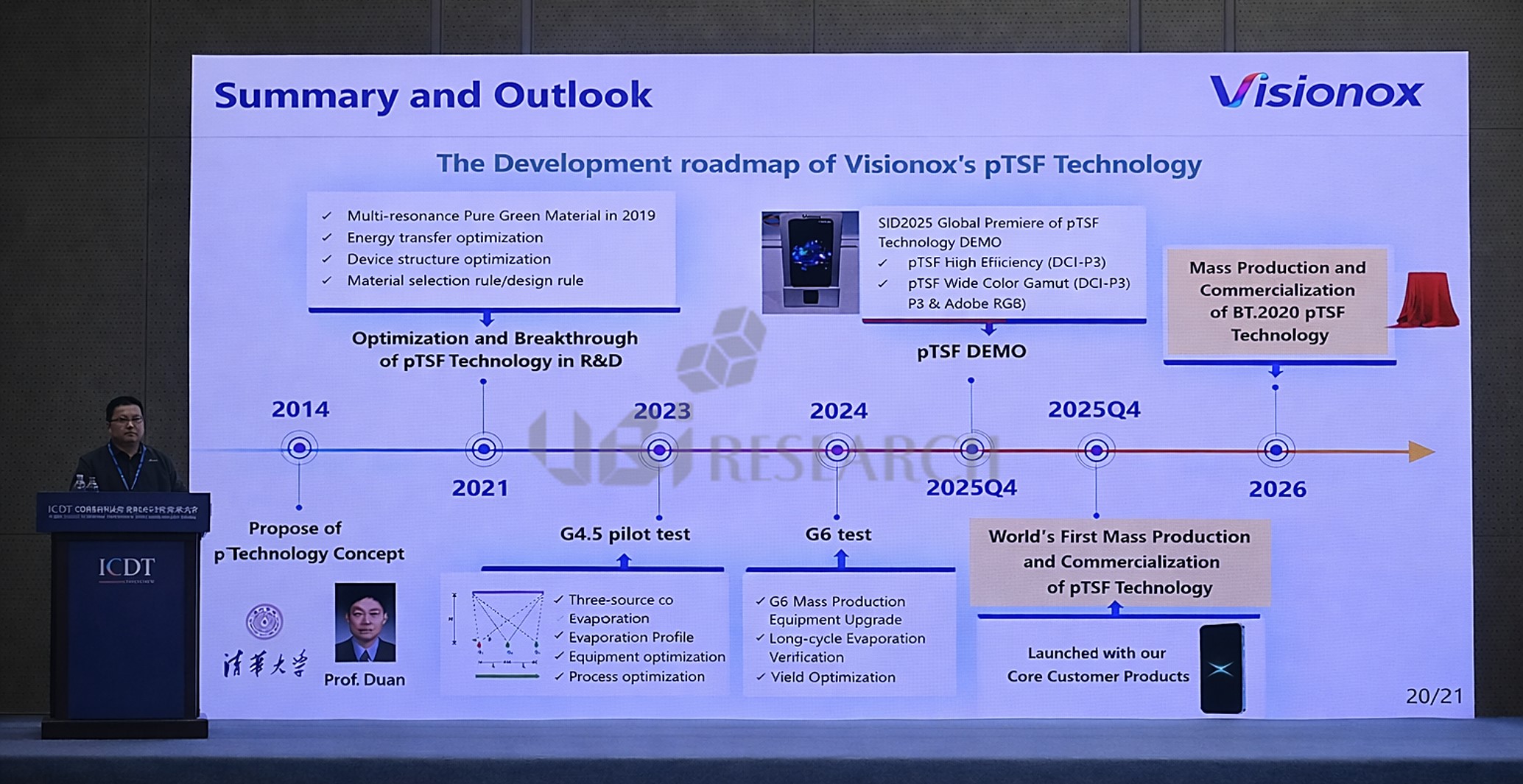
Presentation slide outlining Visionox's pTSF technology roadmap from concept to 2026 mass production at ICDT 2026.

Visionox Achieves 95% of BT.2020 with pTSF Technology Advancement

At ICDT 2026, Dr. Guomeng Li of Visionox presented the mass production roadmap for panels applying pTSF (Phosphor-assisted TADF-sensitized fluorescence) technology. He emphasized that by addressing key limitations of conventional phosphorescent OLEDs—such as broad emission spectra and shoulder peak issues—the technology marks a turning point in OLED color reproduction.

At SID 2025, Visionox had already demonstrated the feasibility of this approach by showcasing a pTSF-based green OLED achieving color gamut at the level of DCI-P3 and Adobe RGB.

Visionox's pTSF technology development and 2026 mass production roadmap presented by Dr. Guomeng Li at ICDT 2026

Visionox’s pTSF development roadmap presented by Dr. Guomeng Li at ICDT 2026. The goal is the full-scale mass production and commercialization of BT.2020 pTSF technology by 2026. (Source: UBI Research)

pTSF, a next-generation OLED emission technology, uses a phosphorescent material as a sensitizer to transfer energy to a narrow-spectrum fluorescent emitter, enabling 100% exciton utilization while improving color purity.

Visionox first presented pTSF performance at SID 2025 with a CIEx of less than 0.21. Less than a year later, at ICDT 2026, the company reported achieving a CIEx of 0.17 and approximately 95% of the BT.2020 color gamut. In addition, Visionox stated that, compared with its mass-produced phosphorescent OLEDs, the new structure delivered more than 30% higher efficiency and over 50% longer lifetime.

According to Visionox, these improvements were achieved by optimizing the combination of host materials, phosphor sensitizers, and narrow-spectrum fluorescent dopants, while also controlling the exciton recombination zone to reduce factors that degrade device performance. In particular, the company explained that expanding the recombination zone helped mitigate TTA and TPA, making it possible to improve both efficiency and lifetime at the same time. Visionox also added that stable characteristics were confirmed in evaluations including temperature-dependent IVL behavior, high-temperature driving stability, and capacitance variation.

Visionox also presented the development history and mass production plan for its pTSF technology. According to the presentation, the concept of pTSF was first proposed in 2014 by Professor Duan’s research team at Tsinghua University. By 2019, the company had established the technical foundation through the development of high-purity green materials based on multi-resonance structures, along with optimization of energy transfer and device architecture. It then proceeded with process and equipment validation as well as yield improvement through G4.5 pilot testing in 2021 and G6 testing in 2024, before unveiling a pTSF technology demonstrator at SID 2025. Visionox stated that in the second half of the same year, the technology entered the early stage of mass production and commercialization through customer products.

Visionox presented 2026 as the point at which BT.2020-level pTSF technology would be applied to mass production, and stated that it plans to further expand commercialization of the technology.

Changwook Han, Executive Vice President of UBI Research, commented, “The significance of pTSF lies not only in extending the color gamut, but in its ability to achieve BT.2020-level ultra-wide color reproduction while simultaneously securing both efficiency and lifetime. Competition in the premium OLED market is likely to become increasingly centered on color performance, and high-color-purity emission structures such as pTSF have strong potential to emerge as core technologies in the future.”

Changwook Han, Executive Vice President/Analyst at UBI Research (cwhan@ubiresearch.com)

▶2026 Small OLED Display Annual Report

▶2026 Medium & Large Size OLED Display Annual Report

※ This article is produced by UBIResearchNet.

Unauthorized reproduction or citation without source attribution is prohibited.

When quoting, please clearly indicate the source (UBIResearchNet) and provide a link.

Exhibition displays at ICDT 2026 showcasing the commercialization of Micro-LED technology, featuring products from BOE, Tianma, and TCL CSOT.

ICDT 2026, Micro-LED Product Exhibition and Technology Trends

At the ICDT 2026 Display Symposium, it was confirmed that Mini/Micro-LED technology is being commercialized alongside technological development by many companies.

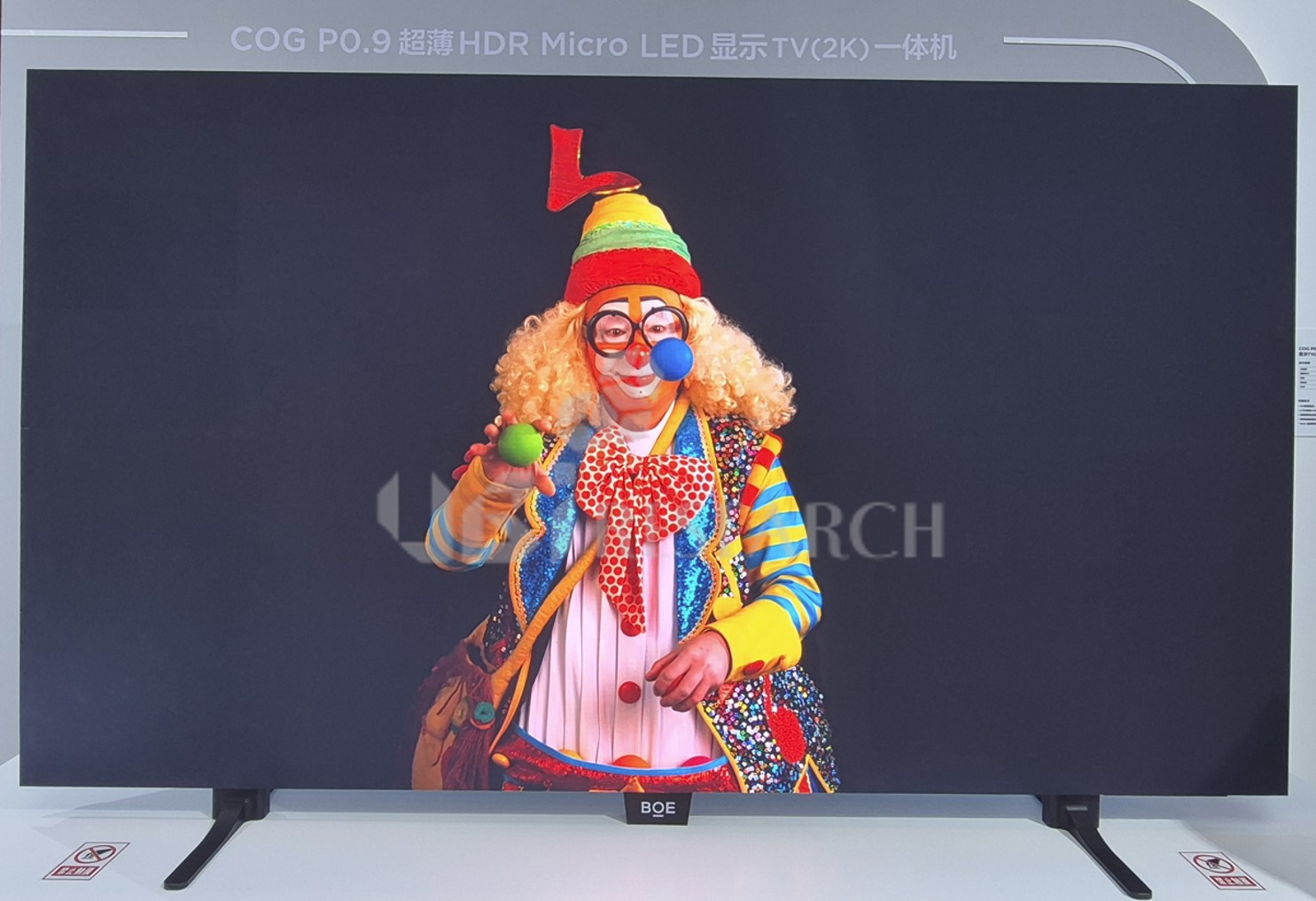
High-quality, ultra-large micro-LED panels were exhibited, manufactured using tiling on glass substrates rather than COB substrates. Micro-LED panels utilizing glass substrates are gradually expanding their presence in the ultra-large premium TV market due to their narrow pitch. BOE exhibited an 81-inch (2K, P0.9) TV combining Micro-LED chips with a TFT substrate and plans to begin mass production this year. Visionox exhibited a 135-inch (4K, P0.7) product featuring a micro-LED panel manufactured on a TFT substrate developed by Vistar.

BOE's 81-inch (2K, P0.9) Micro-LED TV showcased at ICDT 2026

BOE’s 81-inch (2K, P0.9) Micro-LED TV on a TFT substrate, presented at ICDT 2026. (Source: UBI Research)

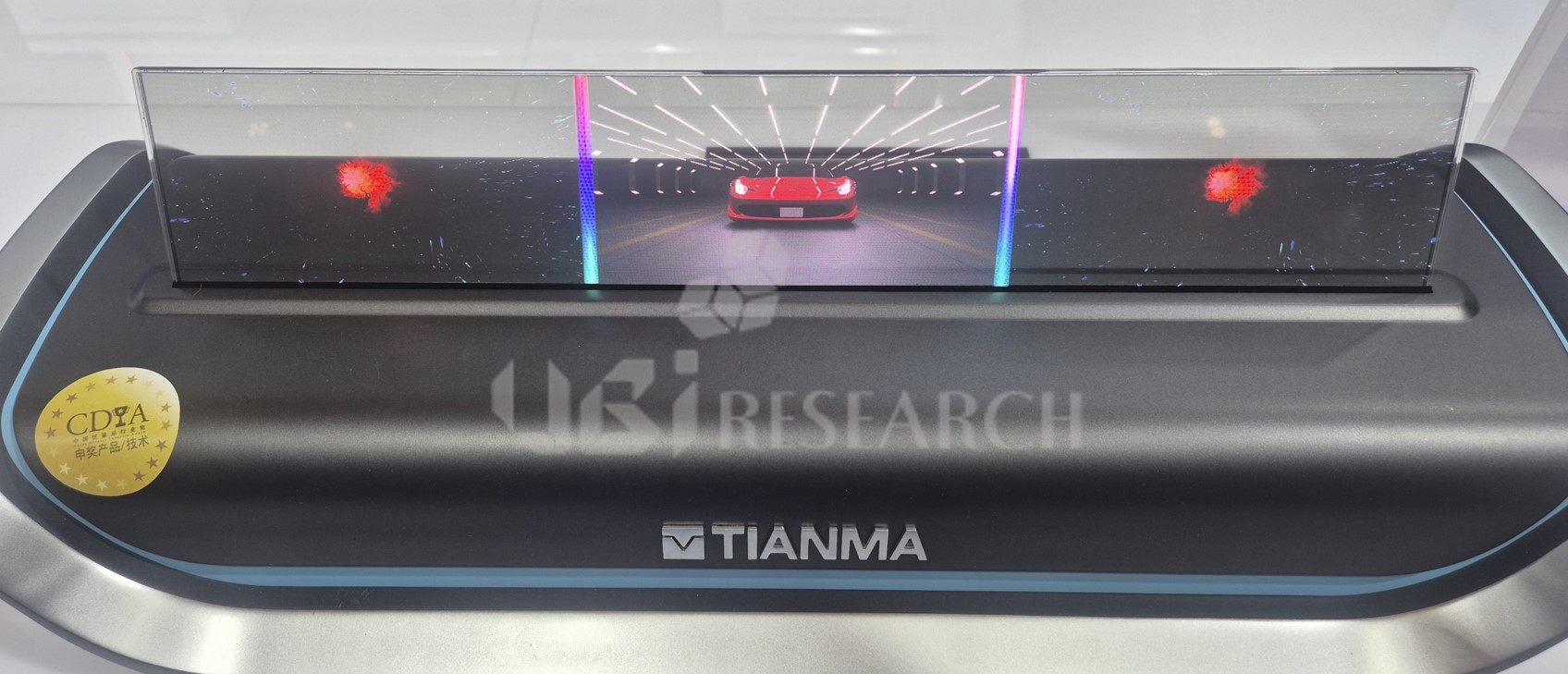
Expectations are growing for Micro-LEDs with high brightness and reliability as automotive displays. Tianma showcased 7-inch and 19-inch high-brightness (>5,000 nits) transparent Micro-LEDs for automotive applications. They feature a transmittance of 60%, a reflectance of less than 2.5%, and an outer border of less than 0.1 mm. While visibility has been enhanced by the high brightness, transmittance needs improvement for automotive applications. Currently undergoing evaluation by clients, their application in automobiles is anticipated.

Tianma's 19-inch transparent Micro-LED automotive display featuring over 5000 nits ultra-high brightness at ICDT 2026

Tianma’s 19-inch transparent ultra-high brightness Micro-LED. With 60% transmittance and over 5,000 nits of brightness, it is expected to be applied in automotive displays. (Source: UBI Research)

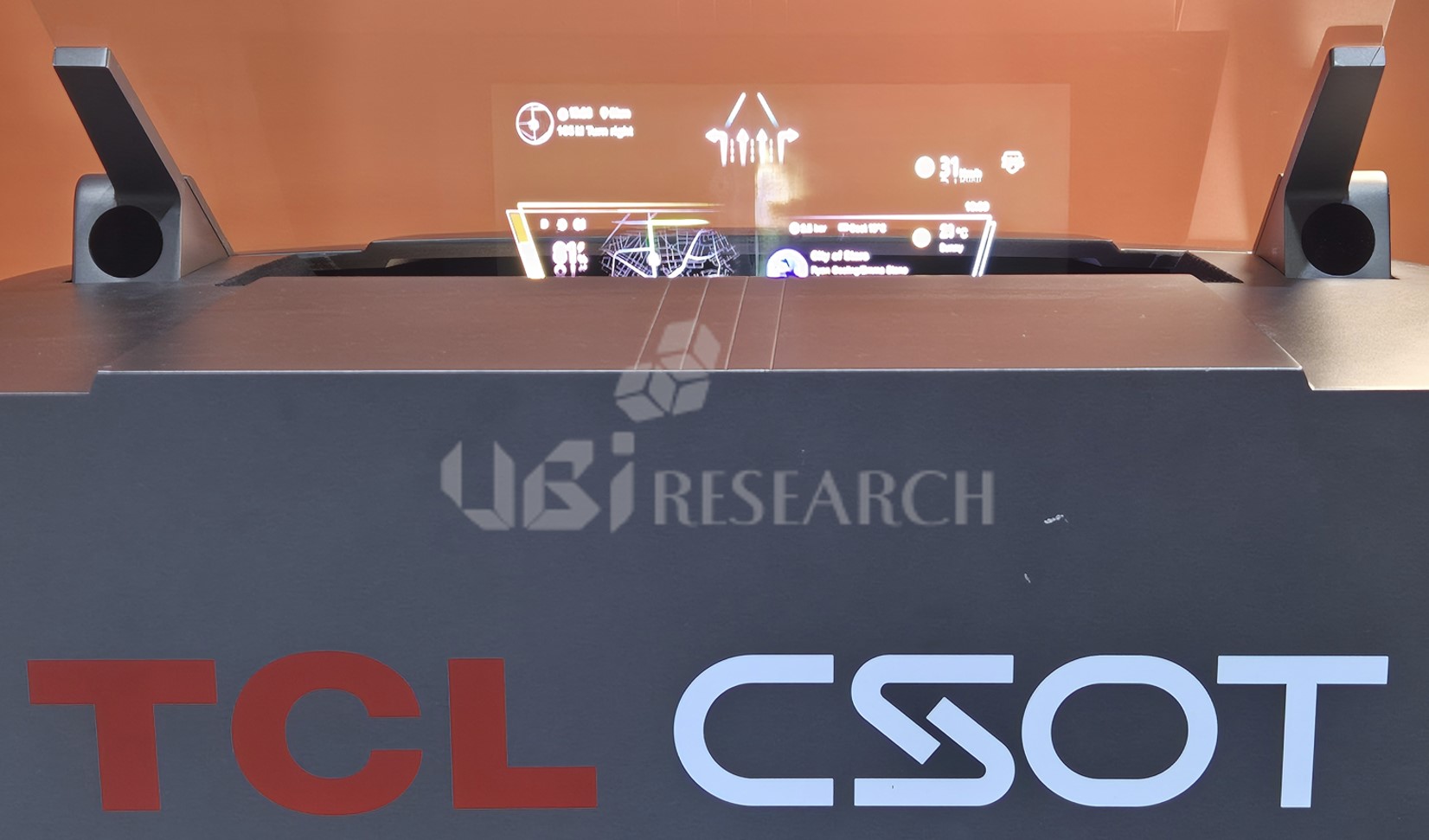
TCL CSOT also showcased a 14.3” ultra-high brightness (panel brightness: 45,000 nits) P-HUD Display and a 4.6” AR-HUD. Micro-LED transparent displays can enhance spatial transparency, technical appeal, and intuitive interaction, so a commercial market is expected to open within a few years.

TCL CSOT's 14.3-inch P-HUD display with 45,000 nits ultra-high brightness demonstrated at ICDT 2026

TCL CSOT’s 14.3-inch ultra-high brightness P-HUD display. Achieving a panel luminance of 45,000 nits, it targets the automotive Micro-LED market. (Source: UBI Research)

Regarding AR devices using Micro-LEDs, TCL CSOT exhibited a 0.05-inch (5080 PPI) Green Mono display product and a 0.28” (5131 PPI) single-substrate Full Color device. At the Micro-LED Technology Forum, discussions focused on improving key core technologies—such as Epi Wafer, Micro-LED chip technology, Mass Transfer and Bonding, and Inspection and Repair—as well as strategies for reducing product costs to expand the Micro-LED product market. It was evident that comprehensive cooperation among material, component, equipment, and panel manufacturers is further necessary for the rapid market penetration of Micro-LED display products.

A report published by UBI Research summarized development cases and technical issues regarding companies developing Quantum Dot (QD) conversion single-chip full-color technology.

Namdeog Kim, Senior Analyst at UBI Research (ndkim@ubiresearch.com)

▶101 inch Micro-LED Set BOM Cost Analysis For TVs

▶Industry Trends and Technology of Micro-LED Displays for XR Report

※ This article is produced by UBIResearchNet.

Unauthorized reproduction or citation without source attribution is prohibited.

When quoting, please clearly indicate the source (UBIResearchNet) and provide a link.

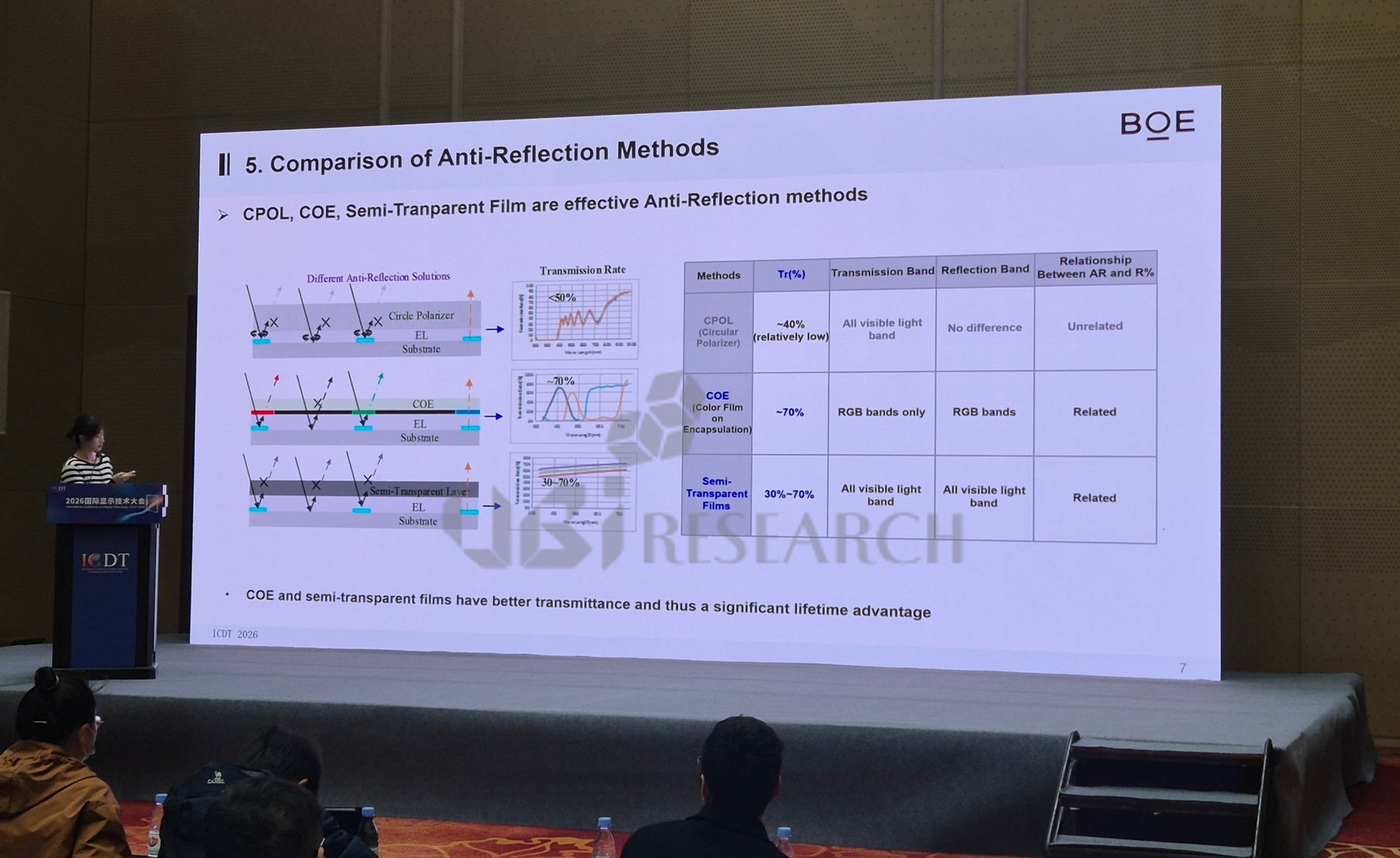
BOE presentation slide at ICDT 2026 comparing anti-reflection methods and highlighting the transmission rate advantages of COE over CPOL.

[ICDT 2026] BOE Highlights Low Reflectance as the Key for Ultra-Large OLEDs… Proposes COE Technology as a Solution

BOE presenting a comparison of anti-reflection methods including CPOL, COE, and Semi-Transparent Film at ICDT 2026

At ICDT 2026, BOE presented a polarizer-free structure using COE and Semi-Transparent Films as a solution for reducing reflection in large-size OLEDs, replacing the traditional CPOL structure. (Source: UBI Research)

At ICDT 2026, BOE presented “Application of ACR Optimization Technology for Wide Viewing Angle in Large-Size OLED Displays,” emphasizing low reflectance and improved ACR (Ambient Contrast Ratio) as key competitive factors for ultra-large OLED displays.

As the ultra-large display market expands into ultra-large TVs, commercial signage, and video walls, visibility in various environments is becoming more important than simple brightness competition. In environments with indoor lighting or external light sources, reflected light can significantly degrade image quality, making effective reflection control a critical technology.

To address this issue, BOE focused on the structural differences in reflectance characteristics in ultra-large OLEDs. In conventional OLEDs, surface reflection and internal reflection appear together, but in ultra-large OLEDs, diffuse reflection becomes the dominant reflection component due to the AG (Anti-Glare) layer and diffusion layer. BOE therefore emphasized that reducing internal reflection itself, rather than simply lowering surface reflection, is the key to improving ACR.

BOE also announced that it has developed an 81-inch P0.9 ultra-large OLED display with a reflectance of 6.9% and an ACR of over 200:1 under 100 lux conditions. The company stated that the display also achieved brightness above 500 nits and a lifetime exceeding 50,000 hours, making it suitable for commercial display environments.

In addition, seamless tiling is important for ultra-large displays. To achieve this, bezel reduction and a lower aperture ratio are both required. However, as the aperture ratio decreases, transmittance can also decline and affect lifetime, meaning that balancing reflectance, transmittance, and lifetime is essential.

In this context, BOE pointed out the limitations of conventional panel structures using CPOL (circular polarizer). While CPOL is effective in suppressing reflection, its relatively low transmittance makes it difficult to satisfy the lifetime and brightness requirements simultaneously in ultra-large displays.

As an alternative to CPOL, BOE proposed a non-polarizer structure using COE (Color Filter on Encapsulation) and semi-transparent film. According to BOE, this structure is more suitable for ultra-large OLEDs because it can secure lifetime and brightness through higher transmittance while also effectively controlling reflectance.

The non-polarizer approach proposed by BOE can address reflectance, transmittance, lifetime, and seamless tiling requirements simultaneously in ultra-large OLEDs. A structure using COE and semi-transparent film could be considered a more suitable solution for ultra-large OLEDs than conventional CPOL, and may become an important factor in the development of ultra-large commercial OLED displays.

Junho Kim, Analyst at UBI Research (alertriot@ubiresearch.com)

▶2026 Medium & Large Size OLED Display Annual Report

▶2026 Small OLED Display Annual Report

※ This article is produced by UBIResearchNet.

Unauthorized reproduction or citation without source attribution is prohibited.

When quoting, please clearly indicate the source (UBIResearchNet) and provide a link.

Tianma's next-generation smartphone AMOLED panel demonstrating 240Hz high refresh rate and ultra-slim bezels at ICDT 2026.

[ICDT 2026] Tianma Achieves 240Hz and 98.5% Screen-to-Body Ratio in Smartphone OLED… Balancing Performance and Design

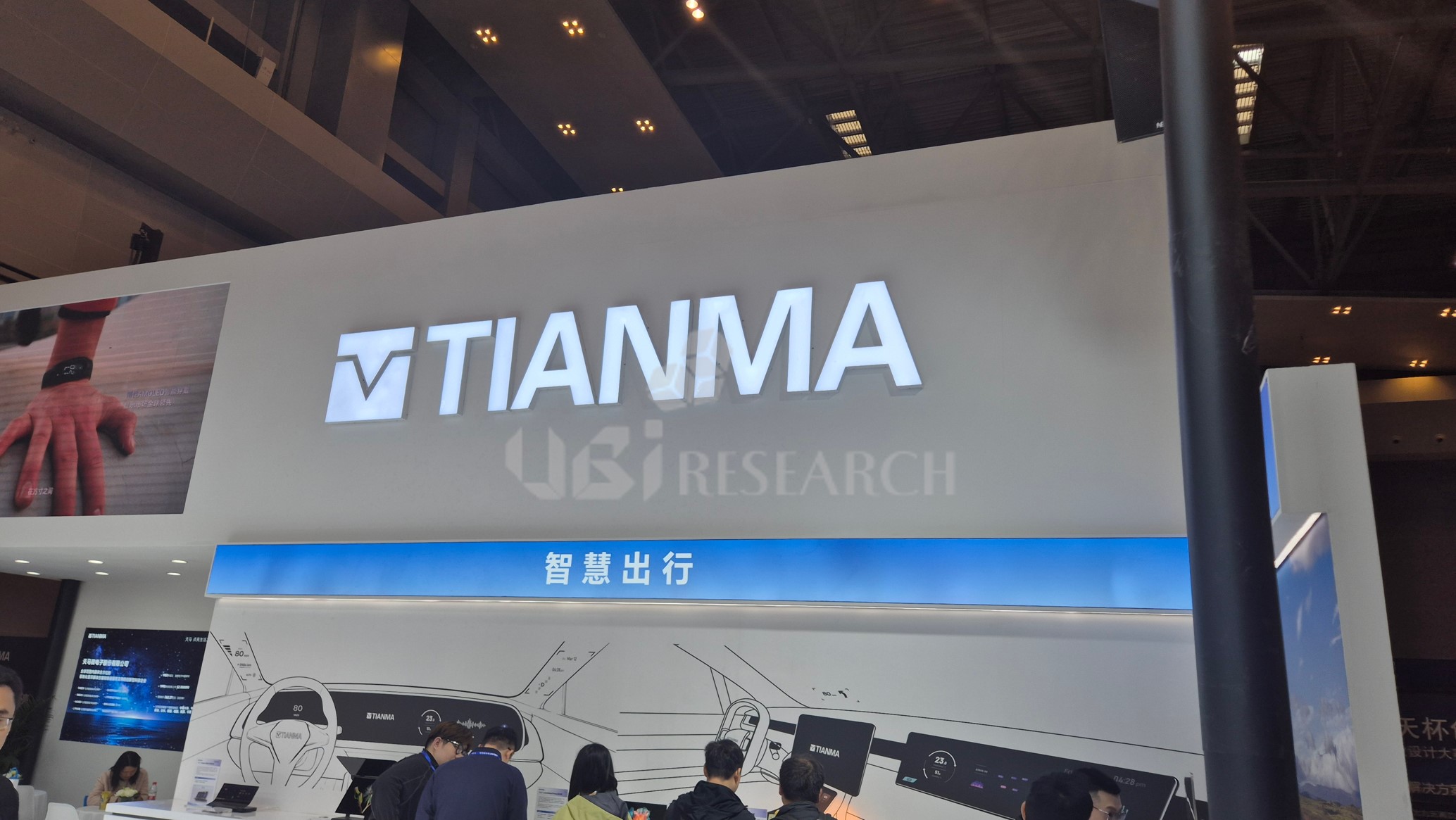
Tianma booth at the ICDT 2026 exhibition

Tianma booth at the ICDT 2026 exhibition. (Source: UBI Research)

At ICDT 2026, held in Chongqing, China starting March 31, Tianma presented a new direction for mobile OLED competition by emphasizing both high refresh rate and full-screen technologies in smartphone AMOLED displays.

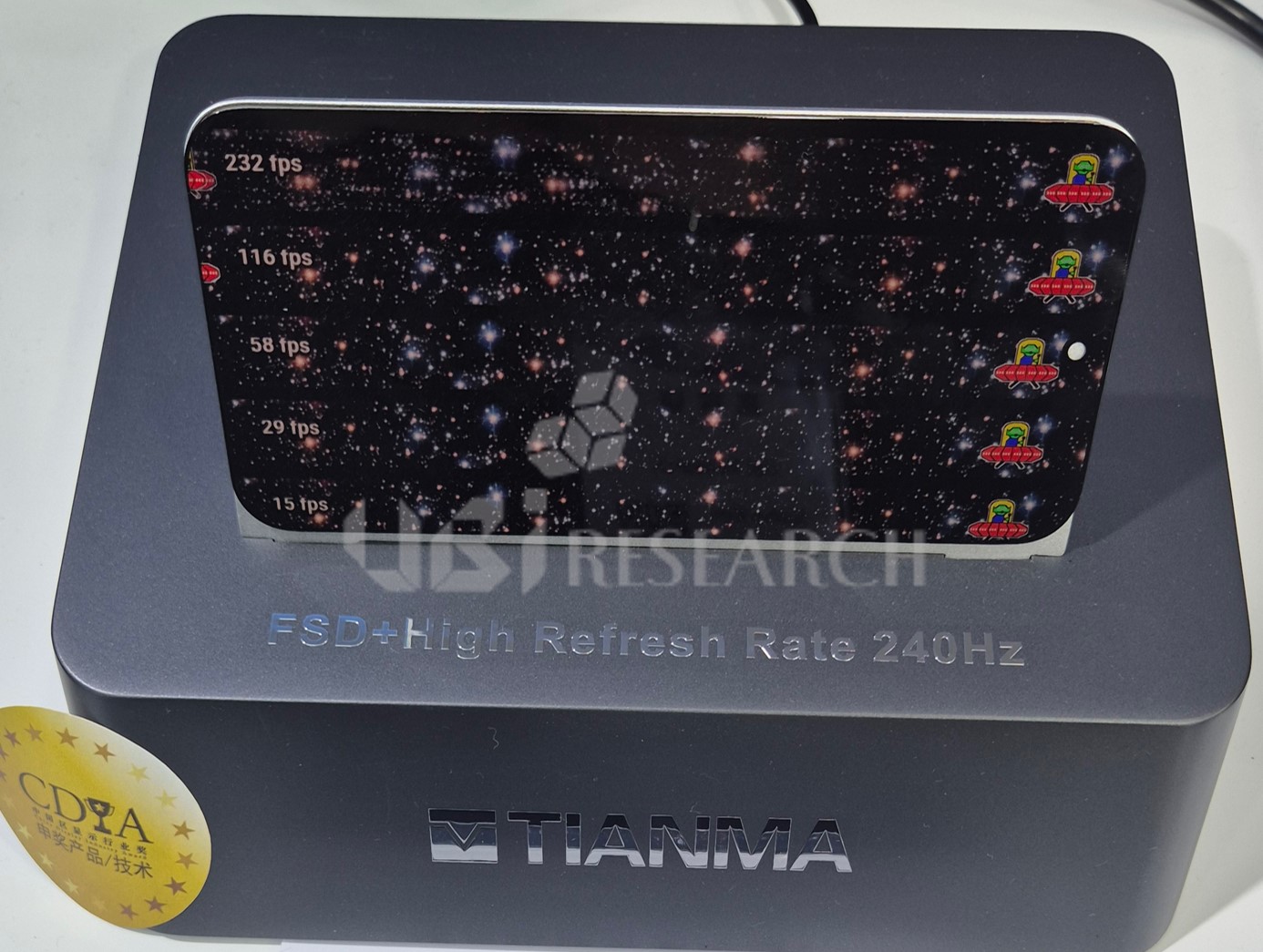
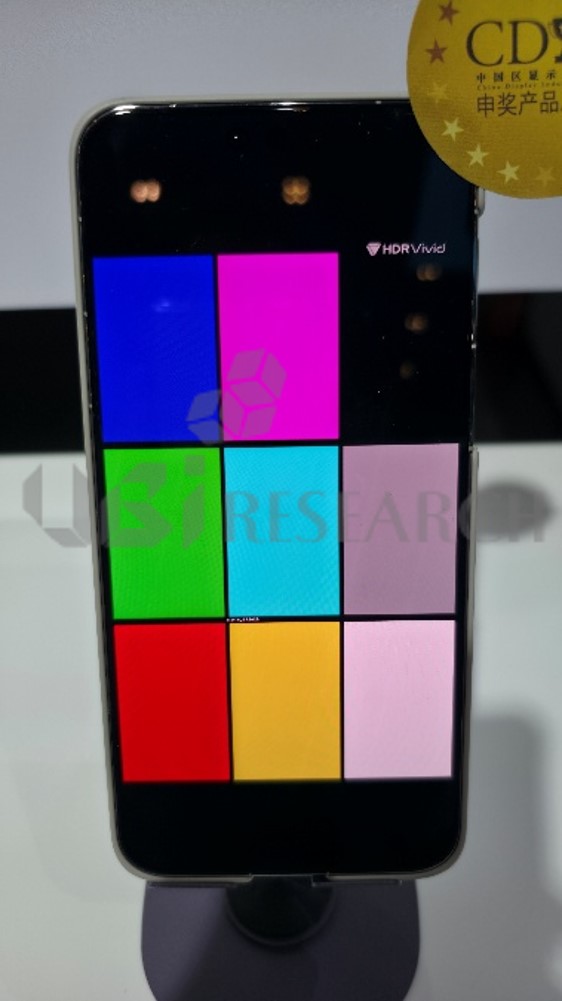
At this exhibition, Tianma unveiled an Ultra-high Refresh Rate AMOLED and an FSD (Full Screen Display) AMOLED, along with an integrated panel combining both technologies. Notably, it achieved a 240Hz-class refresh rate and a 98.5% screen-to-body ratio simultaneously in a mobile OLED panel.

The Ultra-high Refresh Rate AMOLED focuses on delivering refresh rates exceeding 200Hz. Tianma applied a circuit structure that separates data writing and TFT driving, addressing the long-standing trade-off between speed and accuracy in conventional AMOLED panels. In addition, by significantly extending compensation time, the panel delivers clear image quality without motion blur even at high refresh rates, ensuring fast response, color uniformity, and long-term reliability.

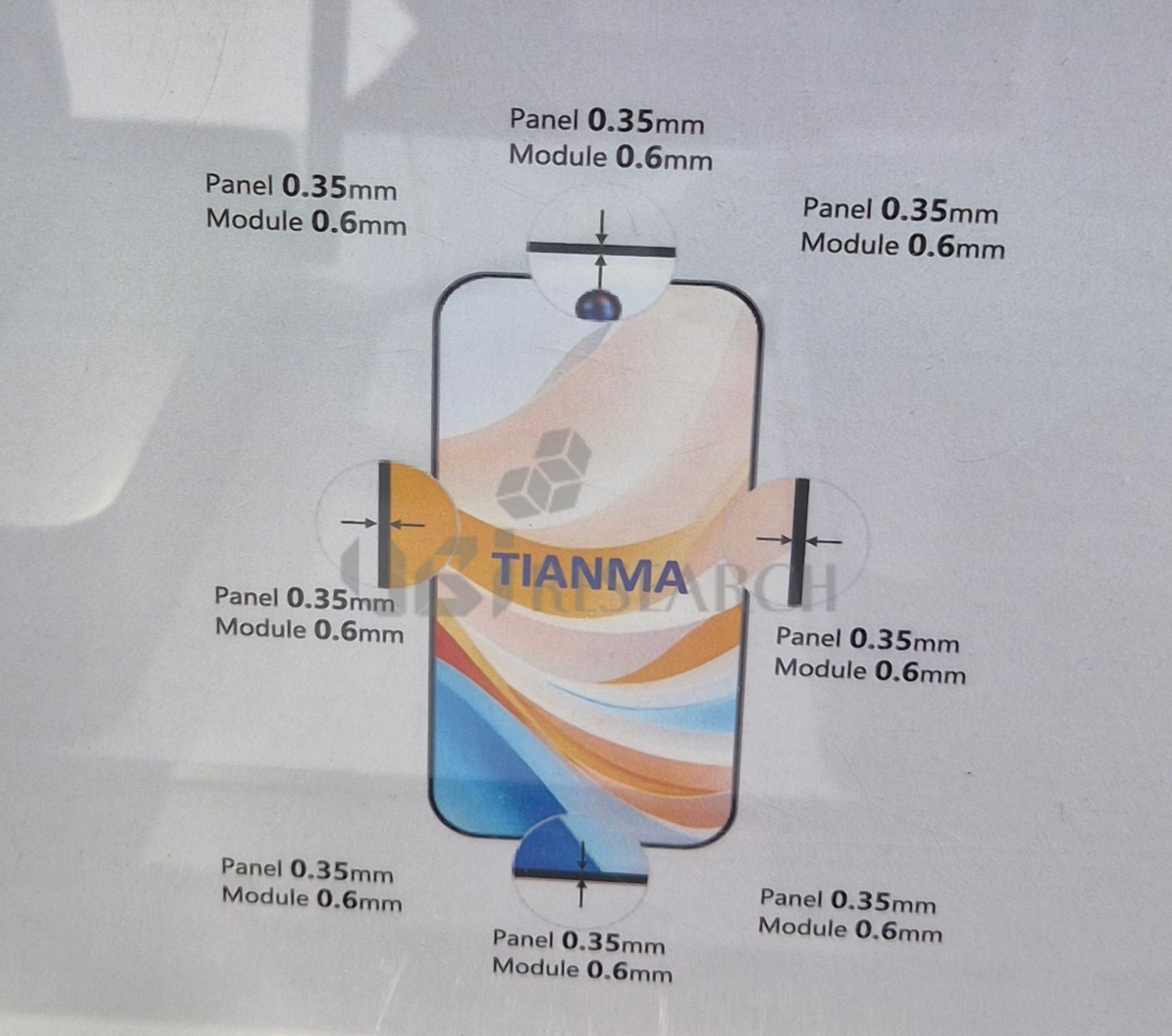
Diagram of Tianma's FSD (Full Screen Display) technology achieving 0.35mm panel and 0.6mm module bezel thickness on all four sides

Tianma’s FSD (Full Screen Display) AMOLED technology. It achieves a 98.5% screen-to-body ratio by reducing the bezel to 0.35mm for the panel and 0.6mm for the module on all four sides. (Source: UBI Research)

The FSD (Full Screen Display) AMOLED, on the other hand, focuses on bezel reduction. By adopting an integrated panel-module structure, Tianma achieved a uniform ultra-narrow bezel on all four sides. The bezel width was reduced to 0.35 mm at the panel level and 0.6 mm at the module level, resulting in a screen-to-body ratio of up to 98.5%. This represents a further reduction beyond the physical bezel limitations of conventional smartphone OLED displays.

Demonstration of Tianma's 6.32-inch smartphone AMOLED panel integrating FSD and 240Hz ultra-high refresh rate

Tianma’s integrated AMOLED panel demonstrated at ICDT 2026. It combines a 240Hz ultra-high refresh rate and FSD technology in a single 6.32-inch panel. (Source: UBI Research)

The most notable exhibit was the integrated panel combining both technologies. Tianma demonstrated a 6.32-inch AMOLED panel achieving both a 240Hz refresh rate and a 98.5% screen-to-body ratio, indicating that mobile OLED development is moving beyond a trade-off between performance and design toward simultaneous advancement of both.

Considering that a representative premium smartphone such as the Galaxy S26 Ultra offers a 120Hz refresh rate and approximately a 90.7% screen-to-body ratio, Tianma’s exhibited panel surpasses it in terms of specifications.

However, whether such performance can be maintained in mass production with competitive yield and cost remains uncertain. Ultra-high refresh rate operation and extreme bezel reduction impose significant challenges in power consumption, heat generation, process complexity, and profitability. Nevertheless, Tianma’s exhibition demonstrates that Chinese OLED makers have moved beyond a catch-up phase and, in certain areas, have reached a level comparable to leading players.

Junho Kim, Analyst at UBI Research (alertriot@ubiresearch.com)

▶2026 Small OLED Display Annual Report

▶2026 Medium & Large Size OLED Display Annual Report

※ This article is produced by UBIResearchNet.

Unauthorized reproduction or citation without source attribution is prohibited.

When quoting, please clearly indicate the source (UBIResearchNet) and provide a link.

Visual data charts comparing BT.2020 color gamut achievements of BOE, Visionox, and Tianma at the ICDT conference.

China OLED Competition Intensifies on BT.2020… Technology Showdown at ICDT

At the ICDT (International Conference on Display Technology), held in Chongqing, China from March 31 to April 3, BOE, Visionox, and Tianma showcased AMOLED technologies emphasizing BT.2020 color gamut as a key performance metric. This demonstrated that competition among Chinese OLED manufacturers is increasingly centered on ultra-wide color gamut performance. While premium OLED displays were previously benchmarked at 100% DCI-P3 coverage, the industry is now pushing toward mid-90% coverage of the BT.2020 standard.

BOE Achieves 94% BT.2020 with TSF-Based AMOLED

BOE exhibited a smartphone AMOLED panel based on TSF (TADF-sensitized fluorescence) technology, achieving approximately 94% BT.2020 color gamut coverage. The panel features high resolution, HBM brightness of 2,000 nits, and peak brightness of 7,000 nits, maintaining strong color performance even under high-luminance conditions.

From a technical standpoint, the TSF structure improves exciton utilization efficiency, particularly enhancing color purity in the green region. This enables color reproduction that closely approaches the BT.2020 color coordinates.

BOE's TSF-based BT.2020 94% color gamut AMOLED smartphone panel revealed at ICDT

BOE Achieves 94% BT.2020 with TSF-Based AMOLED (Source: UBI Research)

Visionox Presents High-Efficiency, Mass-Production Strategy Based on pTSF

Visionox introduced an AMOLED based on pTSF (Phosphor-assisted TADF Sensitized Fluorescence), highlighting a color gamut strategy focused on high efficiency. pTSF combines a phosphorescent sensitizer with a TADF mechanism to improve exciton utilization, while maintaining the color purity characteristic of fluorescence and compensating for efficiency loss.

Rather than emphasizing color gamut figures alone, Visionox focused on achieving high color gamut while reducing power consumption by more than 6% and improving lifetime by 20% at the same time. Through its symposium presentation, the company also announced plans to mass-produce high-efficiency AMOLED panels with around 94% BT.2020 coverage in 2026, signaling that the competition has moved beyond the development stage and into commercialization.

Visionox's pTSF structure-based BT.2020 94% high-efficiency AMOLED technology revealed at ICDT

Visionox Targets 94% BT.2020 with pTSF-Based AMOLED (Source: UBI Research)

Tianma Leads Color Gamut Competition with Over 96% BT.2020

Tianma unveiled a panel achieving more than 96% BT.2020 color gamut coverage by combining PSF (Phosphor-Sensitized Fluorescence) technology with improved blue emission characteristics. By enhancing color purity in the green region through PSF and optimizing overall RGB color balance, Tianma further expanded the ultra-wide color gamut.

Tianma's PSF-based BT.2020 96%+ ultra-high color gamut OLED technology revealed at ICDT

Tianma Achieves 96% BT.2020 with PSF-Based AMOLED (Source: UBI Research)

BT.2020 Competition Enters the Commercialization Phase

What became clear at this year’s ICDT is that competition among Chinese OLED makers over BT.2020 performance is moving beyond simple technology demonstrations and entering a commercialization phase aimed at mass production.

Changwook Han, Executive Vice President of UBI Research, stated, “The competitive landscape among Chinese OLED manufacturers is rapidly shifting from a focus on resolution and brightness to color gamut performance based on BT.2020. In particular, competition in the 94% to 96% range is no longer just about numerical superiority, but is evolving into a broader performance race encompassing efficiency and lifetime as well.”

He added, “In the premium OLED market going forward, the key competitive advantage will lie in technologies that can simultaneously achieve ultra-wide color gamut, power efficiency, and reliability.”

Changwook Han, Executive Vice President/Analyst at UBI Research (cwhan@ubiresearch.com)

▶2026 Small OLED Display Annual Report

▶2026 Medium & Large Size OLED Display Annual Report

※ This article is produced by UBIResearchNet.

Unauthorized reproduction or citation without source attribution is prohibited.

When quoting, please clearly indicate the source (UBIResearchNet) and provide a link.

Presentation slide showing the application fields of printing technology for medium to large OLED displays at Display Korea 2026.

TCL CSOT Targets Medium and Large Display Market with Inkjet OLED… Proving Mass Production Competitiveness Remains Key Challenge

At the keynote session of Display Korea 2026, held on March 12–13 and organized by UBI Research, Fu Dong, General Manager of Guangdong Juhua Printed Display Technology (Juhua), delivered a presentation titled “Development of Printed Display Technology.” He introduced the current development status of inkjet OLED technology and outlined its pathway toward commercialization.

Juhua General Manager Fu Dong presenting 'Application Field of Printing Technology' regarding medium-to-large inkjet printed OLEDs at Display Korea 2026

Fu Dong of Juhua introducing the application fields and industrialization direction of printed OLED technology during a keynote speech at ‘Display Korea 2026’ hosted by UBI Research. (Source: UBI Research)

Juhua, an affiliate of TCL CSOT, is a specialized R&D company focused on printed OLED technology. The company is actively advancing solution-processed OLED development while securing mass production capabilities. Centered in Guangzhou, Juhua is building both an R&D platform and an 8.6-generation production infrastructure, positioning itself to lead the commercialization of printed OLED.

Fu Dong emphasized that printed OLED represents a next-generation manufacturing technology capable of replacing conventional vacuum deposition processes. By depositing organic and inorganic materials in ink form, the process enables significant simplification and offers strong cost competitiveness, particularly for large-area applications.

In terms of technical achievements, he highlighted that a printing-based RGB architecture enables high-resolution implementation. Improvements in light efficiency and reductions in internal optical loss have enhanced power efficiency, while advancements in material performance have extended device lifetime.

TCL CSOT officially announced the mass production of printed OLED in 2024 and is establishing a production system based on its Guangzhou 8.6-generation line in 2025. This marks a clear transition of printed OLED from the R&D phase to early-stage mass production.

However, inkjet OLED still faces several technical challenges. These include film stability during ink deposition and drying, precision limitations in high-resolution patterning, the lifetime and efficiency of blue emitters, and achieving uniformity and yield in large-area processes. To address these issues, key approaches include improving printhead precision, advancing compensation algorithms, developing multi-component ink systems, introducing solution-processable blue materials, and adopting tandem structures. These are considered optimal strategies for simultaneously improving performance and ensuring production stability.

Since these challenges cannot be resolved through process innovation alone, they are expected to become critical factors determining future mass production competitiveness. Ultimately, the success of printed OLED will depend not merely on process simplification or cost reduction, but on the ability to translate these advantages into stable yield and product reliability.

As the 8.6-generation IT OLED market continues to expand, how TCL CSOT addresses these technical challenges will be a key point of industry attention.

Changwook Han, Executive Vice President/Analyst at UBI Research (cwhan@ubiresearch.com)

▶2026 Medium & Large Size OLED Display Annual Report

▶2026 Small OLED Display Annual Report

※ This article is produced by UBIResearchNet.

Unauthorized reproduction or citation without source attribution is prohibited.

When quoting, please clearly indicate the source (UBIResearchNet) and provide a link.

Diagram comparing Traditional OLED and Plasmon OLED, highlighting the paradigm shift where photons are created outside the OLED pixel.

UDC Presents Phosphorescent OLED Innovation at Display Korea 2026: Plasmonic OLED Signals Next Leap Toward Next-Generation Displays

Comparison between traditional OLED and UDC's Plasmonic OLED, illustrating the paradigm shift of light being generated outside the OLED pixel

UDC’s Plasmonic OLED architecture presented at Display Korea 2026. It presents a paradigm shift where photons are created outside the OLED, drastically improving efficiency and lifespan. (Source: UDC)

Universal Display Corporation (UDC) Vice President Mike Hack delivered a keynote address at Display Korea 2026 on March 12th, presenting the current state of phosphorescent OLED (PHOLED) technology and the key achievements of its next-generation Plasmonic OLED architecture under the theme “Accelerating Industry Growth through Advances in Phosphorescent OLED Performance.”

UDC outlined how the OLED display ecosystem is rapidly diversifying — from single-stack PHOLEDs to Tandem OLEDs, phosphorescent-sensitized fluorescence (PSF), expanded pixel structures, and Plasmonic OLEDs. Across all of these architectures, UDC’s phosphorescent emitter materials serve as the central enabler of energy efficiency.

According to UDC, its red and green PHOLED materials have achieved more than an 8x improvement in efficiency and over a 60,000x increase in lifetime since initial commercialization. On a 5-inch smartphone display basis, this has translated into approximately 72% lower power consumption in 2025 compared to 2015. The company projects an additional ~25% power reduction when blue PHOLED is introduced alongside red and green.

UDC has also integrated AI and machine learning across its entire materials discovery cycle to accelerate development. Through a stepwise screening funnel — from molecular generation through ML filtering, quantum chemical evaluation, synthesis, and device qualification — the company can efficiently identify optimal candidate molecules from an enormous chemical design space.

The centerpiece of the presentation was UDC’s proprietary Plasmonic OLED architecture. In conventional OLEDs, photons are generated inside the emissive device. In the Plasmonic OLED, excitons couple to plasmons at a metal surface and are converted into photons outside the device. This mechanism dramatically shortens exciton lifetime, improving device stability, while a novel outcoupling structure recovers energy that would otherwise be lost — fundamentally raising the theoretical efficiency ceiling beyond what chemistry alone can achieve.

Data presented by UDC demonstrated that the green Plasmonic PHOLED achieves greater than 25% external quantum efficiency (EQE) while delivering a 5x lifetime improvement over the 2024 commercial specification. Efficiency roll-off under high-bright conditions was also significantly reduced compared to conventional PHOLEDs, confirming the architecture’s suitability for high-luminance applications. Additionally, color shift versus viewing angle was shown to be imperceptible, a meaningful advantage over conventional top-emitting microcavity structures.

According to UBI Research analysis, UDC’s announcement clearly signals that leadership in the OLED materials industry is shifting beyond conventional molecular chemistry design toward device architecture innovation that redefines the very physics of light emission. The Plasmonic OLED is notable for offering a structural solution that simultaneously improves efficiency, lifetime, and viewing angle characteristics — with the potential to reach performance levels comparable to Tandem OLED designs without the associated process complexity and cost burden. As UDC advances both the commercialization of phosphorescent blue PHOLED and the mass-production readiness of Plasmonic OLED structures in parallel, the timing of technology collaboration and adoption by major panel makers such as Samsung Display and LG Display will be among the most closely watched developments in the industry.

Changho Noh, Senior Analyst at UBI Research (chnoh@ubiresearch.com)

▶OLED Emitting Material Market Tracker Sample

▶2025 OLED Emitting Materials Report Sample

※ This article is produced by UBIResearchNet.

Unauthorized reproduction or citation without source attribution is prohibited.

When quoting, please clearly indicate the source (UBIResearchNet) and provide a link.

Bar chart showing the medium-large OLED market revenue reaching $20 billion by 2030 with a 74% growth rate.

Medium & Large Size OLED Market to Reach $20 Billion… Monitor and Automotive Lead Growth, IT Faces Price Constraints

Bar chart forecasting a 74% increase in medium-large OLED market revenue from 2026 to 2030

Medium-large OLED market revenue forecast. It is expected to grow by 74%, from approximately $11.5 billion in 2026 to $20 billion in 2030. (Source: UBI Research)

According to UBI Research’s “2026 Medium & Large Size OLED Display Annual Report,” the medium and large size OLED market is projected to grow from approximately $11.5 billion in 2026 to around $20 billion by 2030. This represents about 74% growth, with a compound annual growth rate (CAGR) of 14.8%.

While LCD still dominates the medium and large size display market, OLED adoption is rapidly increasing as demand rises for premium performance such as high resolution, high refresh rates, and superior contrast. However, the future growth trajectory is expected to diverge significantly by application. The key distinction lies in the structural differences in consumption between Monitor and Automotive versus Notebook and Tablet PC segments.

Monitors are a representative product category where OLED’s advantages directly translate into purchasing decisions, particularly in gaming and content consumption environments. Features such as high refresh rates, fast response times, and high contrast are clearly perceptible to consumers, making OLED a compelling choice. As a result, OLED for monitors is expected to account for approximately 26% of the total medium and large size OLED market by 2030, emerging as a core growth driver.

The automotive segment also has a favorable structure for OLED adoption. Since display costs account for a relatively small portion of the total vehicle price, the impact of increased panel costs on the final vehicle price is limited. In addition, trends toward larger, curved, and multi-display configurations—especially in premium vehicles—are driving demand for differentiated design and higher-end display solutions. Consequently, automotive displays are considered a market where the transition to OLED can proceed relatively smoothly despite higher panel costs.

In contrast, Notebook and Tablet PC markets are expected to experience relatively limited OLED expansion. This is because performance and price competitiveness in these segments are primarily determined by key components such as CPUs, memory, and storage. As a result, cost management at the overall BOM level is critical. When the cost of major components such as memory increases, manufacturers often adjust display specifications to maintain overall product pricing.

Moreover, even though OLED offers clear improvements in image quality, contrast, thickness, and design, the added value perceived by consumers may not fully offset the increase in retail price. In other words, the key factor for market expansion is whether the performance benefits of OLED can justify the price premium.

This structural limitation has also been observed in recent cases. Apple attempted to accelerate OLED adoption in the tablet market by introducing OLED in the iPad Pro; however, sales performance fell short of expectations due to higher set prices. This serves as a representative example showing that technological competitiveness alone does not necessarily translate into increased demand when price factors are involved.

Changwook Han, Executive Vice President of UBI Research, stated, “The medium and large size OLED market will continue to show strong overall growth through 2030, but the pace of growth will clearly differ by application. Monitor and Automotive will lead the transition to OLED, while Notebook and Tablet PC are expected to show relatively moderate growth due to pricing structures and the influence of key component costs.”

Changwook Han, Executive Vice President/Analyst at UBI Research (cwhan@ubiresearch.com)

▶2026 Medium & Large Size OLED Display Annual Report

▶2026 Small OLED Display Annual Report

※ This article is produced by UBIResearchNet.

Unauthorized reproduction or citation without source attribution is prohibited.

When quoting, please clearly indicate the source (UBIResearchNet) and provide a link.

Attendees exploring the latest Micro LED and OLED ecosystem technologies at the Display Korea 2026 exhibition booths.

Display Korea 2026 Brings Together the Next-Generation Display Ecosystem… Comprehensive Technology Competition from Materials to Equipment and Applications

Hosted by UBI Research, Display Korea 2026 drew attention as a platform where the latest technology trends and value chain of the next-generation display industry—centered on OLED and Micro LED—could be examined at a glance. The exhibition featured a wide range of companies spanning materials, equipment, inspection solutions, and finished products, presenting the expansion trajectory of the display ecosystem.

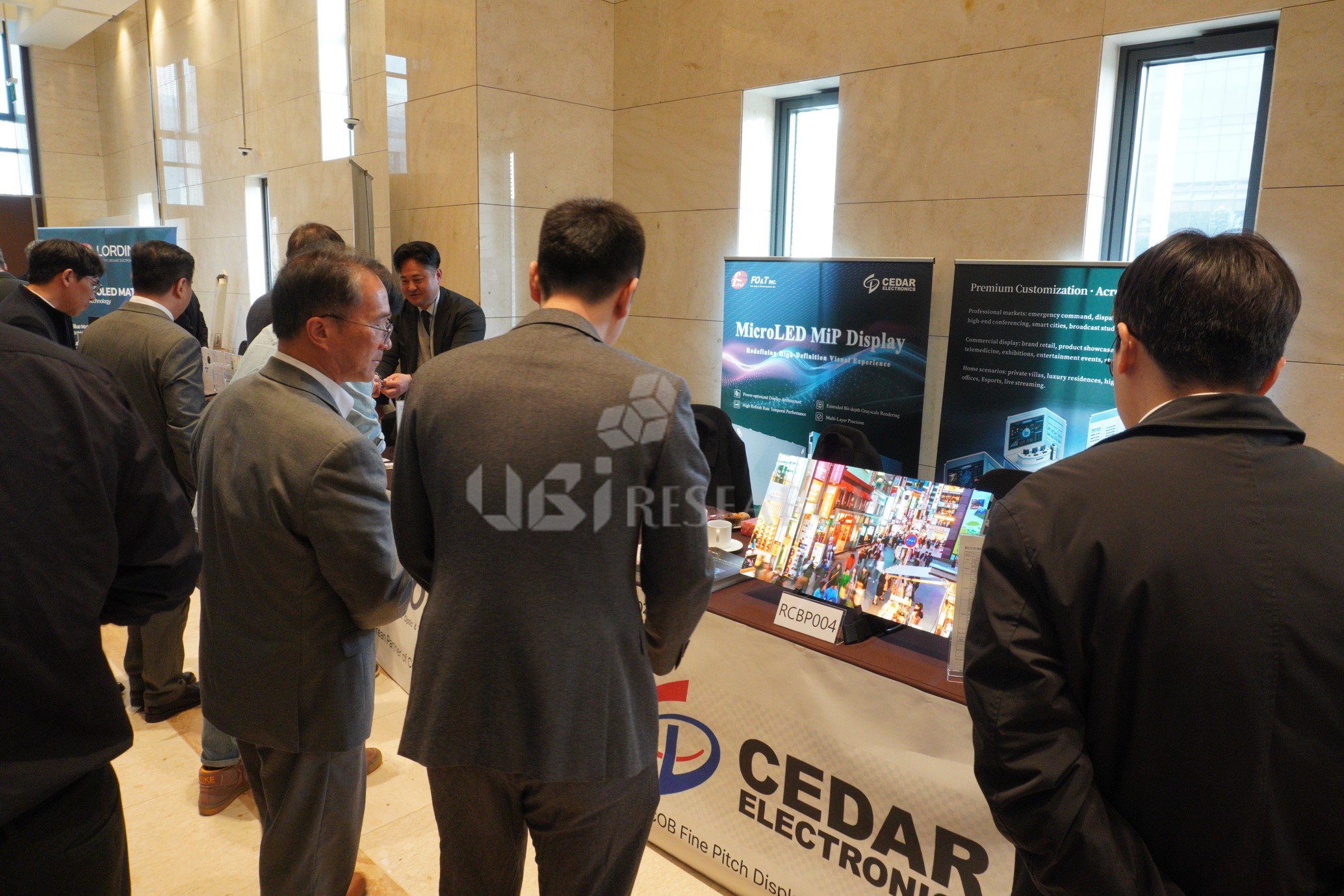
Cedar Electronics demonstrating COB-based Micro LED MiP (Micro-LED in Package) ultra-fine pitch display technology at Display Korea 2026. (Source: UBI Research)

Cedar Electronics demonstrating COB-based Micro LED MiP (Micro-LED in Package) ultra-fine pitch display technology at Display Korea 2026. (Source: UBI Research)

In terms of finished products and display technologies, Micro LED and next-generation applications emerged as key themes. Cedar Electronics showcased an ultra-fine pitch display based on COB-type Micro LED MiP (Micro-LED in Package) technology, highlighting solutions targeting commercial displays as well as control room and broadcasting markets, leveraging high brightness and contrast. Its Korean partner, FO&T, served as a key channel for expanding this technology within Korea.

Samsung Display presented Micro LED displays for wearables along with next-generation form factor technologies, outlining its expansion strategy toward automotive and ultra-small display applications.

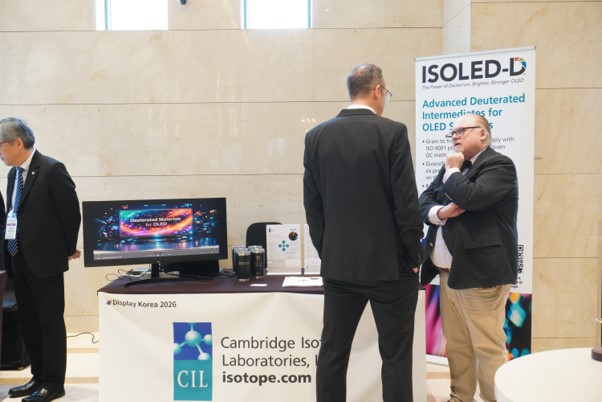
Cambridge Isotope Laboratories (CIL) booth introducing Deuterium-based materials to improve OLED lifespan and efficiency

Cambridge Isotope Laboratories (CIL) presenting Deuterium-based materials and global supply capabilities for OLED performance improvement. (Source: UBI Research)

In the materials sector, core chemical technologies that determine OLED performance were emphasized. Cambridge Isotope Laboratories (CIL) introduced its global supply capabilities centered on deuterium-based materials, which can enhance OLED lifetime and efficiency. In particular, the company highlighted its cost competitiveness and environmental sustainability through deuterated compound recovery technologies and production infrastructure.

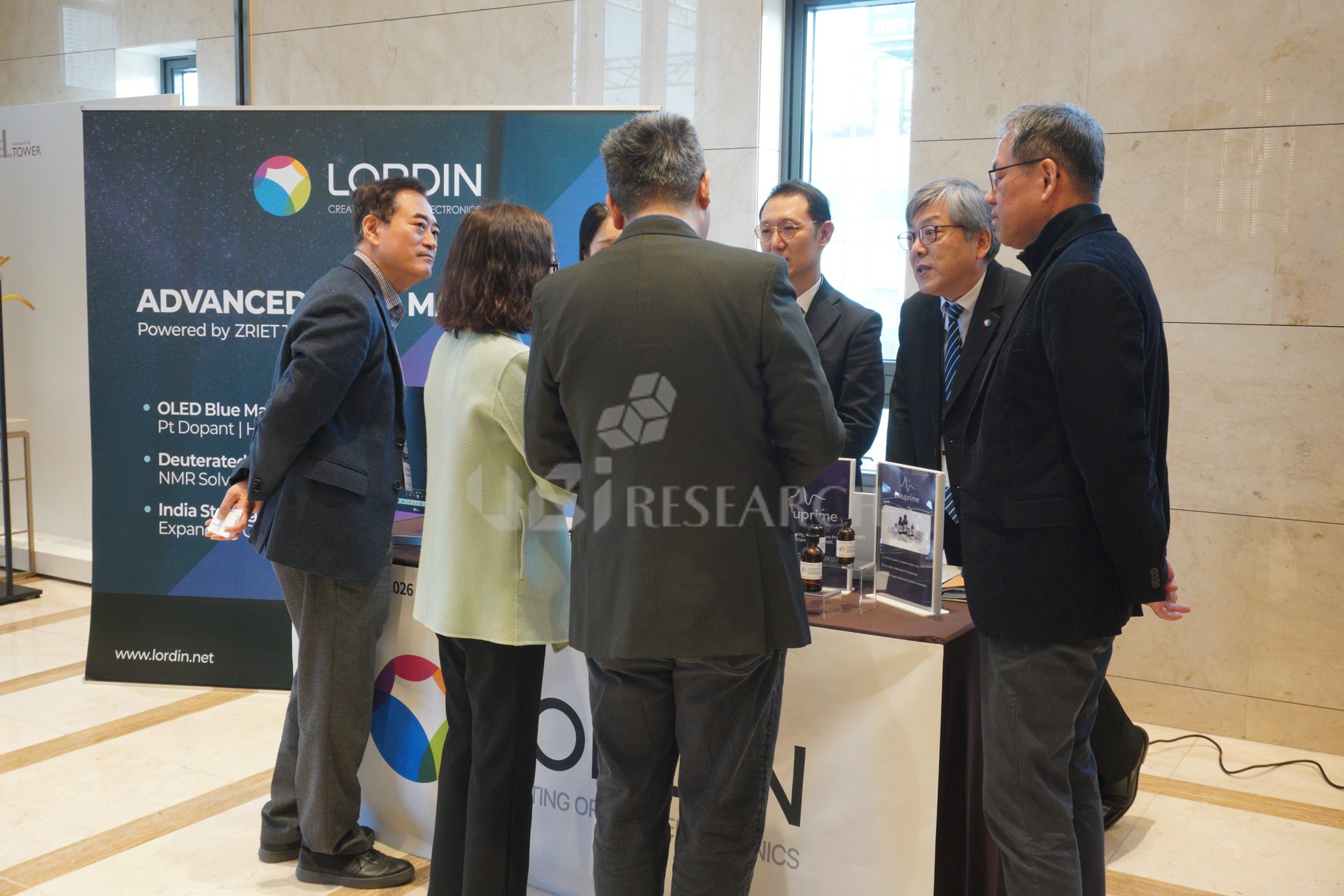
LORDIN booth exhibiting next-generation high-efficiency OLED materials, including blue emitting materials and Pt dopants

LORDIN outlining strategies to secure next-generation high-efficiency OLED materials, including blue emitting materials, Pt dopants, and Deuterium-based compounds. (Source: UBI Research)

LORDIN also demonstrated its presence in OLED emissive materials, presenting Pt dopants and host materials—including blue emissive materials—alongside deuterium-based compounds. The company outlined its strategy for securing next-generation high-efficiency OLED materials and expanding its global supply chain.

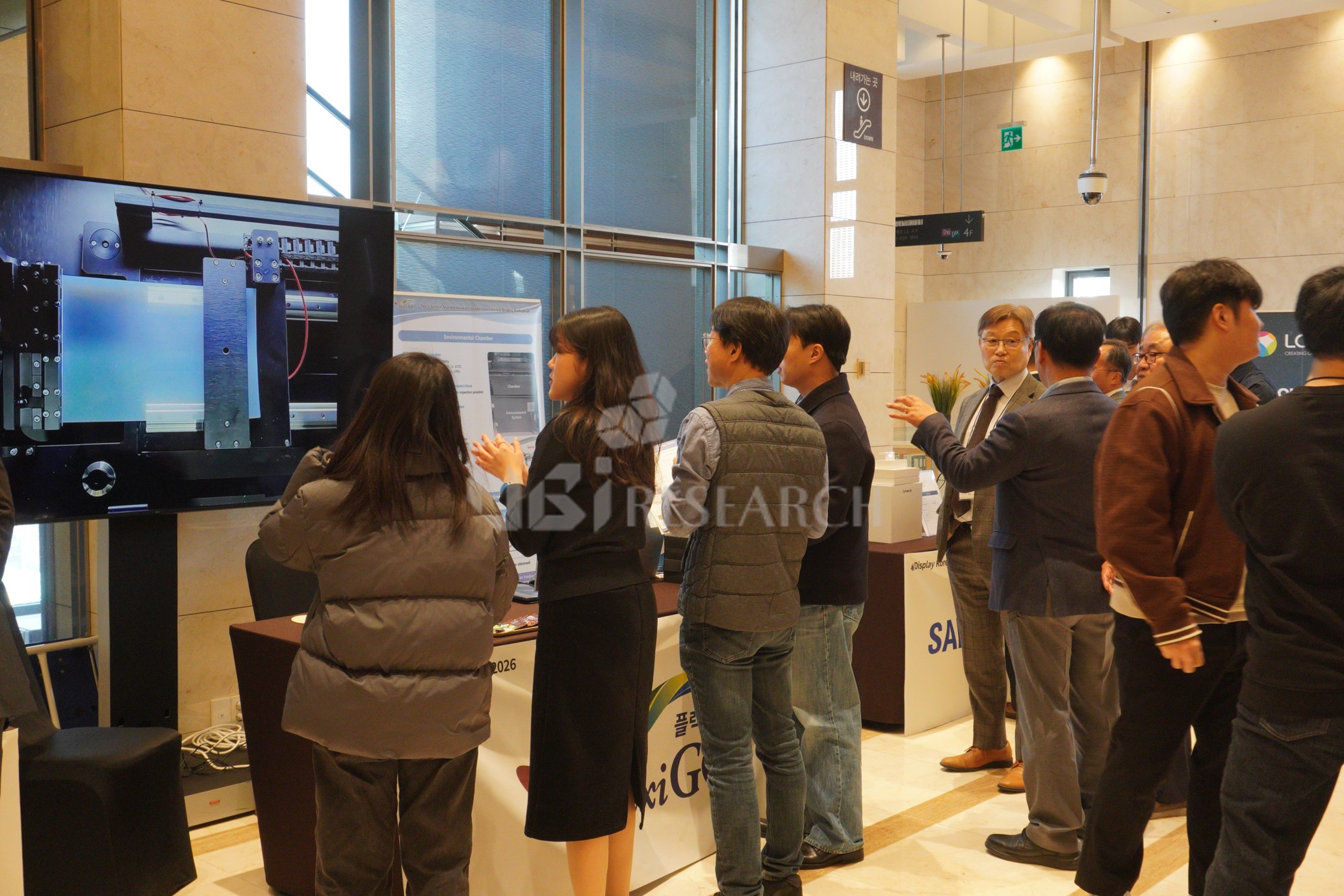
FlexiGO booth demonstrating environmental test equipment to verify the durability of foldable and rollable displays

FlexiGO showcasing repetitive rolling and sliding environmental test equipment for reliability evaluation of foldable and rollable displays. (Source: UBI Research)

In the equipment and inspection solution segment, technologies addressing evolving form factors stood out. FlexiGO introduced environmental reliability testing equipment designed for foldable and rollable displays. The system enables repeated rolling and sliding tests under controlled temperature and humidity conditions, offering a solution optimized for durability validation of next-generation displays.

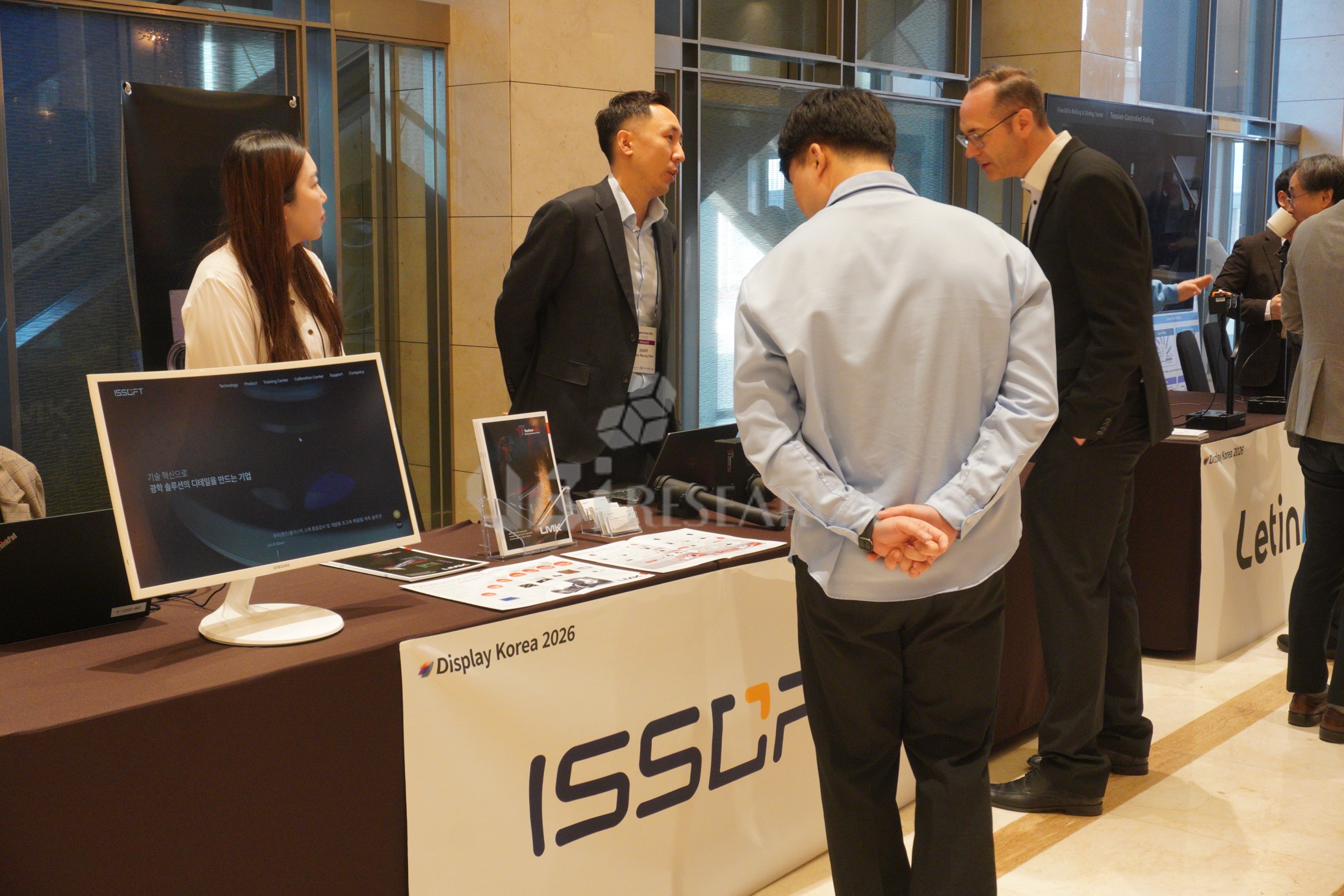
ISSOFT booth exhibiting imaging photometry and colorimetry measurement equipment for precise analysis of display luminance and uniformity

ISSOFT introducing precision measurement technology for analyzing OLED and Micro LED luminance and uniformity based on imaging photometry and colorimetry. (Source: UBI Research)

ISSOFT showcased imaging-based luminance and chromaticity measurement equipment capable of precise analysis of brightness, uniformity, and mura characteristics, emphasizing the growing importance of quality evaluation for OLED and Micro LED displays.

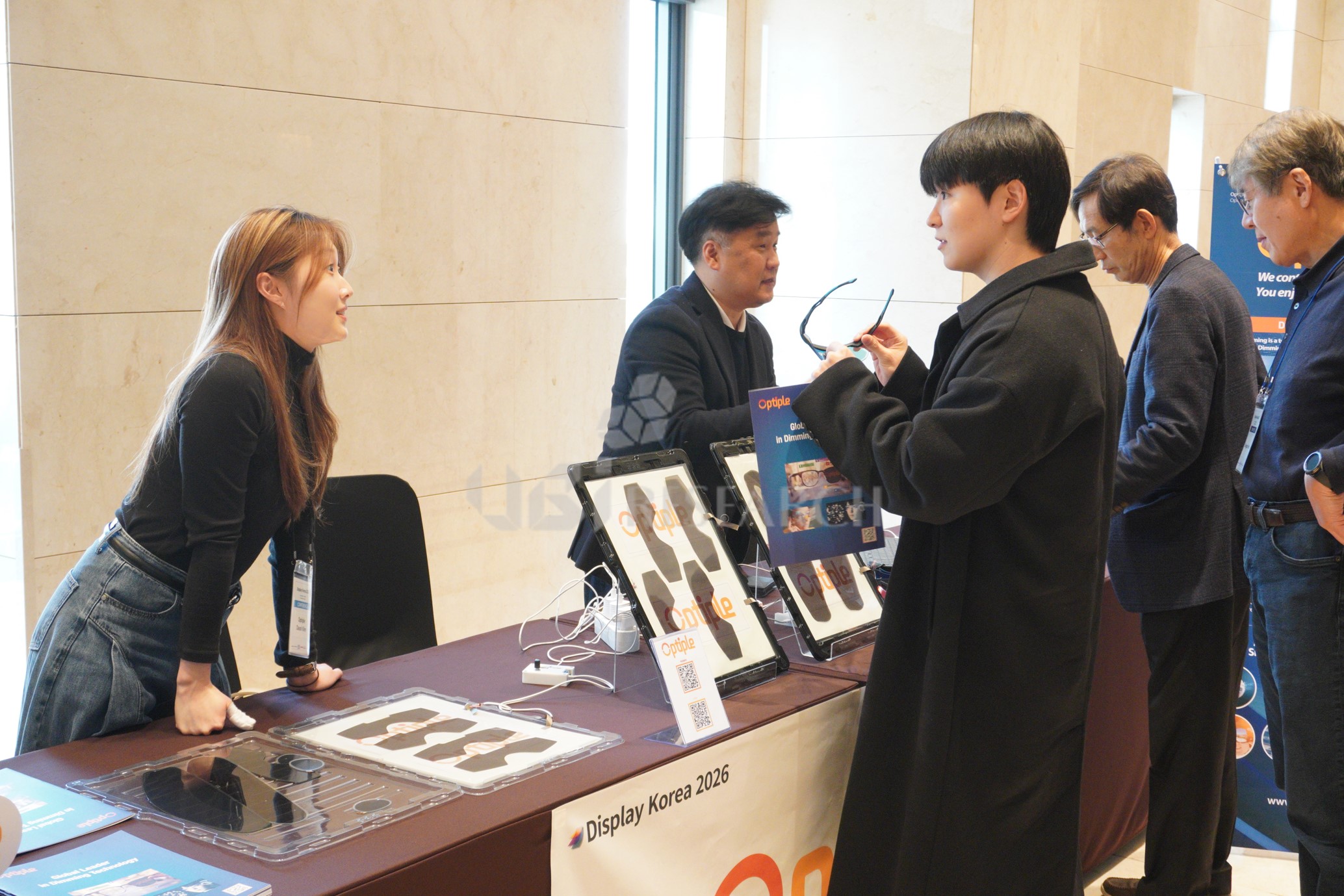
Optiple booth demonstrating light transmittance control dimming film technology to improve visibility for XR devices and smart eyewear

Optiple revealing dimming film technology that actively controls light transmittance based on the external environment to improve the UX of XR devices. (Source: UBI Research)

Optical and user experience enhancement technologies also gained attention. Optiple unveiled a dimming film capable of actively controlling light transmittance based on ambient conditions. This technology improves visibility and reduces glare in XR devices, smart eyewear, and automotive displays, positioning itself as a key enabler of next-generation user experience.

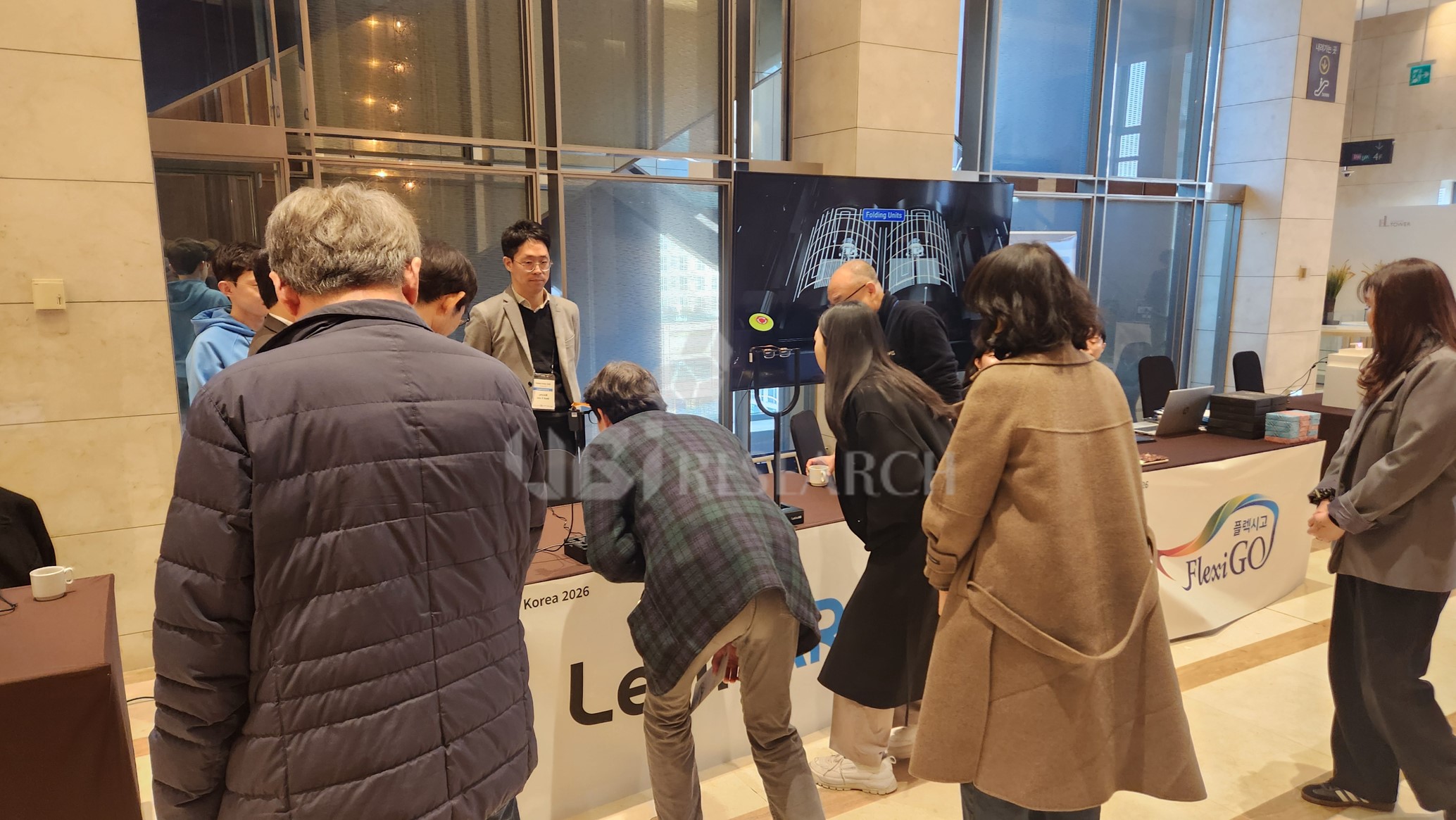
Visitors experiencing AR glasses based on PinTILT optical technology at the LetinAR booth

LetinAR showcasing AR glasses equipped with hybrid PinTILT optical technology, which combines the advantages of waveguide and Birdbath methods. (Source: UBI Research)

LetinAR introduced two AR glasses incorporating its proprietary optical technology, presenting a new direction for XR optics. Its PinTILT technology combines the advantages of waveguide and birdbath optics in a hybrid structure, enabling low power consumption, lightweight design, and slim eyewear form factors. The technology is compatible with various display types—including commercial OLEDoS, Micro LED, LCOS, and LCD—enhancing flexibility for future AR glasses commercialization.

Display Korea 2026 ultimately provided a comprehensive view of the technological trends and value chain shaping the next-generation display industry, centered on OLED and Micro LED. Participating companies presented advancements in high-efficiency materials, reliability testing equipment, optical performance enhancement, and applications across XR, wearables, and automotive displays. The event underscored a clear shift in industry competition—from individual panel performance toward the overall technological completeness and application scalability of the entire ecosystem.

Junho Kim, Analyst at UBI Research (alertriot@ubiresearch.com)

▶2026 Small OLED Display Annual Report

▶101 inch Micro-LED Set BOM Cost Analysis For TVs

※ This article is produced by UBIResearchNet.

Unauthorized reproduction or citation without source attribution is prohibited.

When quoting, please clearly indicate the source (UBIResearchNet) and provide a link.

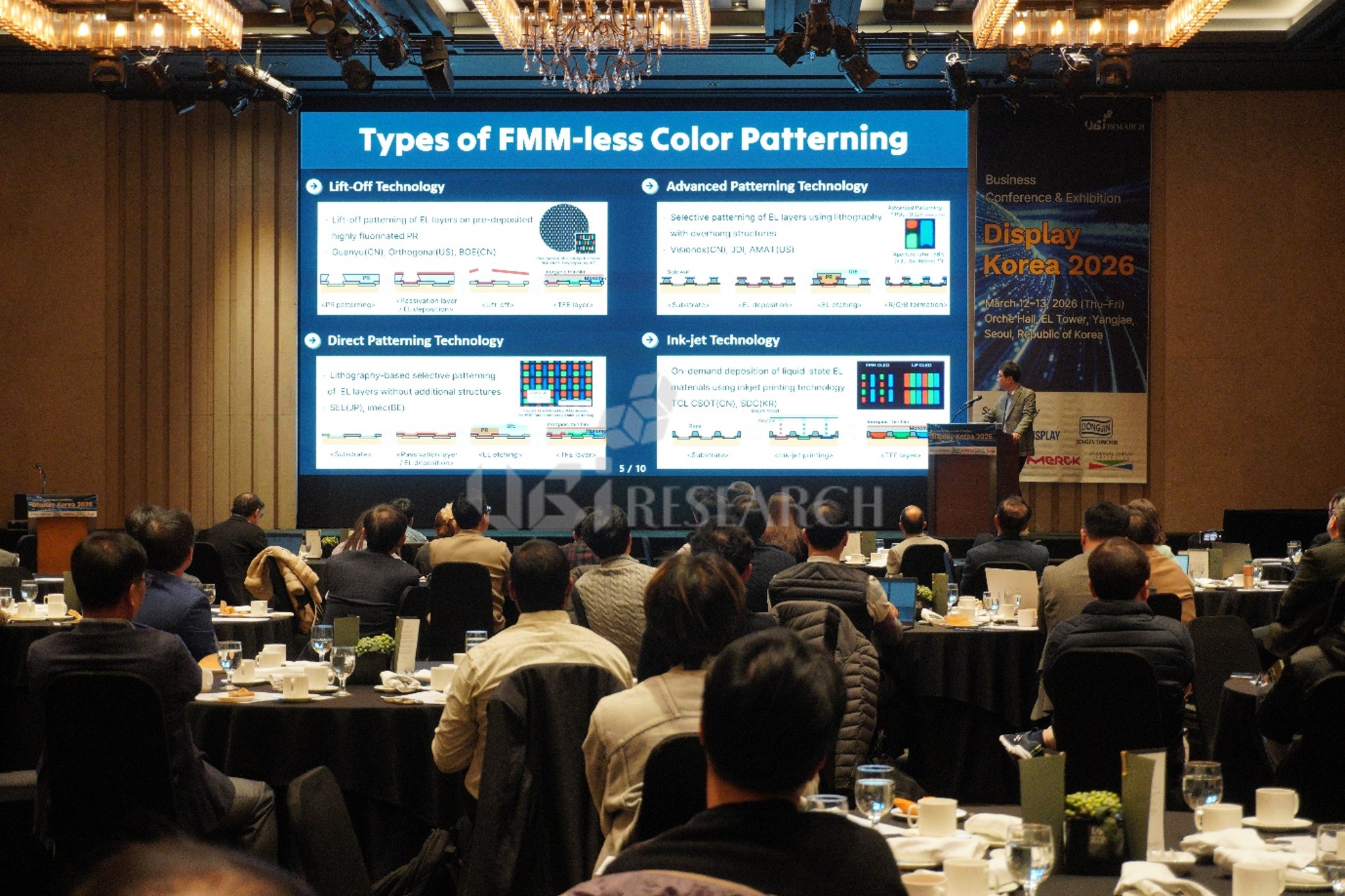
Samsung Display executive presenting various types of FMM-less color patterning technologies to an audience at the Display Korea 2026 conference.

[Display Korea 2026] Limitations of FMM in OLED Processes Become Clear, Samsung Display Presents ‘FMM-less’ Solution

Samsung Display presenting 'Types of FMM-less Color Patterning' including Lift-Off and Ink-jet technologies at Display Korea 2026

Samsung Display Vice President So Byung-soo presenting the types and directions of FMM-less patterning technology for next-generation OLED manufacturing at ‘Display Korea 2026’ hosted by UBI Research. (Source: UBI Research)

Samsung Display has outlined the necessity and direction of FMM-less patterning as a next-generation OLED manufacturing technology. At Display Korea 2026, hosted by UBI Research, Executive Vice President Byungsoo So of Samsung Display highlighted the technological evolution of the OLED industry, pointing out the limitations of conventional FMM (Fine Metal Mask)-based processes and emphasizing the importance of next-generation patterning technologies to replace them.

OLED displays are rapidly evolving toward ultra-high resolution, large-area IT applications, higher luminance and improved power efficiency, as well as free-form form factors. In line with these trends, high brightness and power efficiency have become key competitive factors, while curved and free-form designs are emerging as important trends in automotive displays.

These technological demands are exposing structural limitations in conventional FMM-based deposition processes. FMM processes face constraints in achieving high aperture ratios and encounter difficulties in reducing the PDL (Pixel Define Layer) gap. In addition, physical issues such as mask sagging, shadow effects, tensile deformation, and frame deformation limit both high-resolution implementation and large-area scalability. Furthermore, complex mask handling and high operational costs remain ongoing challenges.

Against this backdrop, Samsung Display expects FMM-less patterning technologies to become a core enabler of next-generation OLED manufacturing. FMM-less approaches enable more flexible pixel design, reduce PDL gaps, and achieve higher aperture ratios. They are also advantageous for large-area OLED production, making them critical for the expansion of IT and TV markets.

So also presented three key directions for future OLED technology development: “Value Up,” “New Generation,” and “ECO+.” “Value Up” refers to high resolution, high brightness, and long lifetime. “New Generation” indicates expansion into large-area 8.x generation substrates, large panels, and free-form displays. “ECO+” focuses on reducing IR drop and improving power efficiency to enable low-power operation.

He further illustrated the limitations of FMM by analyzing the relationship between resolution and PDL gap. As resolution increases, reducing the PDL gap becomes essential; however, FMM processes face limitations in scaling below a certain threshold, restricting high-resolution implementation. These limitations are particularly pronounced in ultra-high-resolution applications such as VR/AR, making the transition to FMM-less technologies inevitable.

In conclusion, Samsung Display defined the transition from FMM to FMM-less as a critical evolution in the OLED industry. To simultaneously meet the performance and productivity requirements of next-generation displays, the adoption of new patterning technologies that overcome the limitations of conventional processes is essential, with FMM-less technologies expected to play a central role.

Junho Kim, Analyst at UBI Research (alertriot@ubiresearch.com)

▶2026 Small OLED Display Annual Report

▶101 inch Micro-LED Set BOM Cost Analysis For TVs

※ This article is produced by UBIResearchNet.

Unauthorized reproduction or citation without source attribution is prohibited.

When quoting, please clearly indicate the source (UBIResearchNet) and provide a link.

TCL's 163-inch X11H Max Micro LED TV highlighting China's aggressive pricing strategy in the premium display market.

Micro LED TVs Breaking the 100 Million Won Barrier, Shaking the Dominance of “K-Display”

TCL's 163-inch X11H Max Micro LED TV launched at an aggressive price of 799,999 RMB

China’s TCL targeting the high-end market with its aggressively priced (799,999 RMB) 163-inch Micro LED TV, the ‘X11H Max’. (Source: TCL)

Chinese Firms Launch Price Reduction Offensive Despite Limitations of “Thin Line”… Mass Production Technology Gap is Ramped Up, Korean Government Accelerates Micro-LED Fostering Policy… Will the “Golden Time” Come at the End of 2026?

Korean industry insiders’ expressions were mixed when they saw a 160-inch micro-LED TV from a Chinese company unveiled at a global consumer electronics exhibition. Only a year or two ago, the dominant evaluation was that “it is still far away,” but now there is a sense of crisis in the air, as if “if it continues like this, they will really overtake us.”

Specs are on par, details are lacking…but what is frightening is capacity.

The micro-LED TVs launched by major Chinese companies such as TCL are not inferior to their Korean counterparts in terms of numerical specifications alone: brightness exceeding 10,000 nits and 4K resolution indicate that hardware performance has reached its limits.

Of course, a closer look with the eye reveals that differences in technical perfection still exist. Seam-lines at the joints of the unit panels are noticeable at certain angles and on bright screens, and the phenomenon of microscopic irregularities (mura), which occurs when the uniformity of the entire screen is reduced, is also noticeable. This is evidence that Samsung and LG are still one step ahead of the competition when it comes to image quality algorithms and fine process control technology.

The problem, however, is that China is breaking through these technological imperfections with its “overwhelming mass production capacity (CAPA)” and “unbeatable prices.” At half the price of Korean products, which easily exceed 100 million won and even offer premiums, aggressive marketing is rapidly lowering the barriers to entry in the high-end market. The company is not resting on its technological superiority.

No time to rest on technological superiority…Vertical integration of SCM is an urgent issue 

Historically, market share in the display industry has been directly related to the speed of development of mass production technology. If China gets a head start on market share by launching a mass production offensive, the problems of shim lines and speckles currently pointed out are likely to improve more rapidly than expected.

This is precisely why Korean firms cannot stand still, content with their current technological superiority. They must now move beyond their overwhelming differences in the laboratory and focus their destiny on productivity innovations that can win in the real marketplace.

  • Vertical integration of SCM: The supply chain from the micro-LED chip to the transfer (Transfer) process to the drive IC must be brought in-house to ensure cost competitiveness.
  • Bold investment: Preemptive investment in next-generation transfer technology and mass production lines for large backplanes is needed to shake off China’s pursuit.

The fateful moment at the end of 2026 when the true strength of K-display will be tested

The Korean government-led micro-LED fostering policy is set to begin in earnest at the end of 2026, and expectations in the industry are rising. However, the market situation is not optimistic enough to view this as mere optimism. This is because China is already accumulating learning effects from mass production, using its overwhelming scale of production to compensate for the shortcomings of details such as seam lines and spots.

In the end, the end of 2026 is expected to be the “turning point” that will determine whether Korean firms will be able to keep their technological pride or follow the LCD rut, said UBI Research analyst Joohan Kim. The end of 2026 will not be a time for celebration, but the toughest period, when Korean companies will have to prove whether the SCM and productivity improvement initiatives they have built can hold off China’s onslaught.

Joohan Kim, Senior Analyst at UBI Research (joohanus@ubiresearch.com)

▶101 inch Micro-LED Set BOM Cost Analysis For TVs

▶Industry Trends and Technology of Micro-LED Displays for XR Report

※ This article is produced by UBIResearchNet.

Unauthorized reproduction or citation without source attribution is prohibited.

When quoting, please clearly indicate the source (UBIResearchNet) and provide a link.

LG Display executive presenting GIP technology and next-generation large OLED strategies at the Display Korea 2026 conference.

LG Display Accelerates Evolution of Large OLED TVs with Tandem WOLED… “Technology Accumulation Is the Essence of Competitiveness”

OLED TV Competition Shifts from ‘Size’ to ‘Completeness’

LG Display is strengthening its technological competitiveness in the large OLED TV market. At the keynote session of Display Korea 2026 (March 12–13, EL Tower, Seoul), hosted by UBI Research, LG Display presented the technological evolution path and next-generation strategy for large OLEDs in detail.

Shin Hong-jae, Research Fellow at LG Display, introduced a product roadmap expanding from 55-inch OLED TVs in 2013 to 97-inch models under the theme “From 55 to 97 Inches.” He emphasized that the essence of competition in large OLED is no longer simply about scaling up size, but about achieving overall completeness, including image quality, efficiency, reliability, and driving stability.

Shin stated, “The technological evolution of large OLED is not yet complete,” and outlined key future tasks, including high-mobility oxide TFTs, high-efficiency OLED structures, real-time compensation technologies, and bezel-less design. This suggests that large OLED remains a technologically demanding field requiring both process stabilization and performance improvement simultaneously.

LG Display Research Fellow Shin Hong-jae presenting next-generation large OLED development directions, including GIP technology, at Display Korea 2026

LG Display Research Fellow Shin Hong-jae introducing the development direction and key tasks for next-generation large OLEDs during a keynote speech at ‘Display Korea 2026’ hosted by UBI Research. (Source: UBI Research)

Tandem WOLED: A Core Pillar of OLED TV Competitiveness

Shin announced that LG Display has developed a large OLED panel achieving a peak brightness of 4,500 nits and a reflectance of 0.3%, significantly improving visibility even under ambient light conditions. This performance improvement is enabled by combining a tandem emission structure, pixel design, and compensation algorithms, allowing individual control of all 33 million pixels.

Large OLED: From ‘Panel Technology’ to ‘System Technology’

The evolution of LG Display’s large OLED should be understood not as a single technological advancement but from an integrated system perspective. LG Display has improved not only the emission structure but also Oxide TFT, GIP (Gate Driver In Panel), compensation circuits, and driving schemes to enhance overall performance.

Since large panels are highly sensitive to process variations that directly impact image quality, compensation technologies and driving algorithms play a critical role. LG Display has achieved simultaneous improvements in brightness, viewing angle, and bezel reduction through structural innovations. This demonstrates that OLED TV competition is shifting from panel performance to system-level design that determines actual viewing quality.

Next-Generation OLED: Balancing Performance and Cost

Shin also addressed the direction of next-generation W-OLED technology. While additional stacking of emission layers has already been secured technically, commercialization will be determined based on a comprehensive evaluation of performance and cost. This indicates that the large OLED market has entered a phase where both manufacturing efficiency and cost competitiveness are as critical as technological advancement.

Although OLED TVs have grown based on the premium segment, intensifying competition with Mini-LED LCD is making price competitiveness an increasingly important factor. Future technological directions are expected to focus not only on structural advancements but also on achieving an optimal balance between market viability and manufacturing efficiency.

Application Expansion: Key to Restructuring Profit Model

The expansion of application areas for large OLED was also highlighted as a key strategy. Transparent displays were presented as a promising application for integrating space and information in show windows, exhibitions, transportation, and smart buildings. Gaming OLED was also emphasized as a high-value-added market.

LG Display set a shipment target of approximately 7 million OLED units, including TVs and monitors, representing about a 10% increase year-over-year, with a plan to gradually increase the share of monitor OLED. This indicates that LG Display’s large OLED business is evolving from a TV-centric structure toward diversified applications, reshaping its profit model.

Conclusion: The Essence of OLED Competition Lies in Continuous Technological Accumulation

LG Display’s evolution in large OLED technology clearly demonstrates that it is not the result of a single breakthrough, but rather long-term technological accumulation and process stabilization. Only through the organic integration of emission structures, TFTs, circuits, algorithms, design, and applications can a highly complete product be realized.

LG Display is expected to further solidify its leadership in the large OLED market by enhancing the performance of Tandem WOLED and expanding its application scope.

Changwook Han, Executive Vice President/Analyst at UBI Research (cwhan@ubiresearch.com)

▶2026 Small OLED Display Annual Report

▶101 inch Micro-LED Set BOM Cost Analysis For TVs

※ This article is produced by UBIResearchNet.

Unauthorized reproduction or citation without source attribution is prohibited.

When quoting, please clearly indicate the source (UBIResearchNet) and provide a link.

Samsung Display Develops ‘Quantum Black’, a Low-Reflection and High-Strength Film for QD-OLED Monitors

Light reflectance reduced by 20%, panel hardness strengthened to 3H… Full application to 2026 new models

□ Secured ‘Deep Black’ expression in any environment… Doubling gaming immersion

□ Surface hardness increased from 2H to 3H, enhancing panel durability

□ ASUS, Gigabyte, MSI, and others to launch QD-OLED monitors featuring ‘Quantum Black’… Actively promoting low-reflection features

□ Samsung Display: “Quantum Black is a premium technology that further strengthens QD-OLED’s inherent black expression while offering high durability… It will present a new user experience”

Samsung Display is developing and applying a low-reflection, high-strength film that further reduces light reflectance on monitors while enhancing display durability for its new products.

Samsung Display announced on the 26th that it has developed ‘QuantumBlack™’, a low-reflection and high-strength film that reduces light reflection on monitor screens by 20% compared to its previous films while increasing panel hardness to 3H. The technology will be applied to all new QD-OLED monitor products launching this year. To promote the differentiated value of this technology, Samsung Display named it ‘Quantum Black’ and recently completed trademark registration.

QD-OLED, a self-emissive display, can achieve ‘True Black’ by completely cutting off pixel power. However, in actual usage environments, ambient bright light reflecting off the screen can make it difficult to experience perfect black. To solve this, Samsung Display has developed and applied low-reflection films since the early stages of its QD-OLED monitor business. This year, the company developed ‘Quantum Black’, which reduces reflectance by an additional 20% compared to previous in-house films, and plans to expand its application, centered on new products.

Black expression is a particularly crucial specification for gaming monitors. In game content, perfect black clarifies the boundary between objects and backgrounds, adding depth and a sense of three-dimensionality to the space, thereby doubling immersion. Especially in FPS (First-Person Shooter) or survival games, it can influence win rates by clearly showing the silhouettes of enemies or the location of items.

Applying Quantum Black also strengthens panel durability. Internal evaluations showed that with Quantum Black, the hardness of QD-OLED improved from the existing 2H to a 3H level. Low display hardness can lead to scratches during moving or cleaning; 3H represents excellent strength that leaves no scratches even when scraped with a fingernail.

In line with Samsung Display’s development of ‘Quantum Black’ film, global clients are announcing the launch of monitors featuring the new technology. Notably, ASUS has launched ‘Black Shield’, Gigabyte ‘Obsidian Shield’, and MSI ‘Dark Armor’—successive technical brands emphasizing enhanced low-reflection features to actively promote their new products.

According to market research firm Omdia, the global self-emissive monitor display market is projected to grow more than twofold, from 3.4 million units in 2025 to 7.6 million units in 2030. Industry experts expect that differentiated technologies carefully reflecting consumer needs, such as Quantum Black, Penta Tandem, and V-Stripe, will lead market growth. Samsung Display is leading the market with a 75% share in the self-emissive monitor display sector as of 2025.

Meanwhile, Jung Yong-wook, Vice President and Head of the Strategic Marketing Team for the Large Display Business, stated, “Quantum Black is a premium technology that provides a differentiated sense of immersion by further strengthening the deep and perfect black expression—the essential advantage of QD-OLED—while also increasing panel durability. We will continue to create new user experiences in both gaming and content environments through innovative technologies.”

Bar chart showing Apple leading global smartphone OLED shipments with over 250 million units.

Apple Maintains No.1 Position in Smartphone OLED Panel Purchases for Five Consecutive Years… Chinese Vendors Accelerate Catch-Up

Bar chart comparing annual smartphone and foldable OLED shipments by major global brands like Apple, Samsung Electronics, and Xiaomi

Smartphone and foldable OLED shipments by major brands. Apple leads the market with over 250 million units, followed by Samsung Electronics and Xiaomi. (Source: UBI Research)

According to UBI Research’s recently published “2026 Small OLED Display Annual Report,” Apple ranked first among smartphone OEMs in OLED panel procurement, securing over 250 million smartphone OLED panels and maintaining the top position for five consecutive years. Samsung Electronics followed, with Chinese vendors such as Xiaomi, Vivo, and Huawei trailing behind.

Apple’s procurement of smartphone OLED panels began to increase significantly starting with the iPhone 12 series in 2020. As OLED adoption expanded to include standard iPhone models, Apple received more than 100 million OLED panels in 2020 from the iPhone 12 series alone, which was launched in the second half of the year. In 2021, when both existing and new models adopted OLED, procurement volume increased by 72% year-on-year, making Apple the largest buyer of OLED panels among smartphone OEMs.

Since then, Apple has maintained its position as the largest purchaser of smartphone OLED panels from 2021 through 2025. UBI Research forecasts that Apple is likely to retain its leading position in OLED panel procurement until Samsung Electronics significantly expands OLED adoption in its entry-level smartphone lineup.

Excluding Apple and Samsung Electronics, Xiaomi is identified as the largest OLED panel purchaser among Chinese OEMs. As Chinese panel makers continue to expand supply in line with OEM demand and panel prices steadily decline, the transition to OLED in China’s mid- to low-end smartphone market is expected to accelerate further.

Changwook Han, Vice President of UBI Research, stated, “Following Apple and Samsung Electronics, Chinese smartphone vendors such as Xiaomi, Huawei, Oppo, and Vivo are rapidly increasing OLED adoption, which is becoming a key driver of market growth. Although there may be temporary fluctuations due to component supply issues, OLED adoption is quickly expanding into mid- and low-end models. As a result, the overall smartphone OLED market is expected to maintain steady growth in the mid- to long-term.”

The “2026 Small OLED Display Annual Report” by UBI Research provides comprehensive insights into the small OLED industry, including supply chain relationships between OEMs and panel makers, market share by company, yearly market trends, and future outlook. The report is available on the UBI Research website.

Changwook Han, Executive Vice President/Analyst at UBI Research (cwhan@ubiresearch.com)

▶2026 Small OLED Display Annual Report

※ This article is produced by UBIResearchNet.

Unauthorized reproduction or citation without source attribution is prohibited.

When quoting, please clearly indicate the source (UBIResearchNet) and provide a link.

Beyond ‘Repair’, First Pass Yield (FPY) is the Ultimate Decider for Micro-LED Mass Production

Official logo of LG Display

(Source: LG Display)

As the era of Micro-LED, the pinnacle of next-generation display technology, approaches, the Korean display industry stands at a critical crossroads regarding “mass production viability.” While LG Display (LGD) has recently embarked on developing inspection and repair technologies with domestic equipment manufacturers, a heated debate persists among industry experts regarding the tradeoff between technical integrity and economic compromise.

1. Repair: A ‘B-Plan,’ Not the ‘Solution’

Some argue that repair technology is essential due to the inherent structural challenges of Micro-LED, where defects seem unavoidable. However, from the traditional perspective of manufacturing engineering, a “mass production technology predicated on repair” has fundamental limitations. The bedrock of mass production lies in securing First Pass Yield (FPY), preventing defects at the source within the process itself.

Field experts, including Ph.Ds in electronic engineering, warn that “adding repair processes inevitably increases tact time, raises costs, and leaves the reliability of repaired chips in question.” Ultimately, the true measure of mass production technology is not the ‘skill of reviving dead chips,’ but the ‘technology that prevents dead chips from entering the production line’ in the first place.

2. The PL Inspection Controversy and LGD’s Pragmatic Choice

The PL (Photoluminescence) inspection method by Huvio, a focal point in this national R&D project, is not free from correlation controversies. Optical inspection (PL), which fails to capture electrical defects like leakage current or contact failure during actual operation, carries a significant risk of ‘defect escape.’ This explains the skepticism surrounding LGD’s reconsideration of PL, especially after they experienced the absolute necessity of EL (Electroluminescence) inspection during past high-stakes projects, such as the global smartwatch initiative.

Nevertheless, LGD’s move to collaborate with domestic SMEs (small and medium-sized Enterprise) is interpreted as a strategic attempt to establish a ‘Korean Mass Production Standard’ while acknowledging current technical hurdles. This hybrid strategy, using high speed, non-contact PL for primary screening and precision repair to calibrate yield, is both a desperate measure and a bold attempt to overcome the ‘economic barriers’ encountered in the early stages of mass production.

3. Big Tech’s Commitment Fueling the Materials, Components, and Equipment Ecosystem

While questions remain regarding its technical perfection, the fact that a major Korean corporation has proactively moved to secure Micro-LED mass production technology is an overwhelmingly positive signal for the entire industry. As LGD joins Samsung Electronics in accelerating the Micro-LED ecosystem, it is simultaneously elevating the technical capabilities of domestic equipment and material companies.

Providing companies like Justem and Huvio with the opportunity to verify their precision control and optical analysis solutions on an actual mass production line will serve as a foundation for Korea’s future global dominance. The data accumulated through this cycle of trial and error will eventually become a core asset in transitioning toward a ‘repair-free, zero-defect process.’

4. Conclusion: A Journey Toward Technical Integrity

The road to Micro-LED commercialization is long and arduous. However, the Korean display industry’s obsession with securing mass production viability is a powerful declaration of its intent to maintain leadership in the post OLED era.

An industry insider emphasized, “Repair is merely a secondary means to support yield in the early stages; ultimately, we must aim for perfection in transfer and bonding processes. The true victory for the Korean Micro-LED industry will begin when these current studies evolve beyond mere repair into original technologies that radically enhance First Pass Yield.”

Joohan Kim, Senior Analyst at UBI Research (joohanus@ubiresearch.com)

▶101 inch Micro-LED Set BOM Cost Analysis For TVs

▶Industry Trends and Technology of Micro-LED Displays for XR Report

※ This article is produced by UBIResearchNet.

Unauthorized reproduction or citation without source attribution is prohibited.

When quoting, please clearly indicate the source (UBIResearchNet) and provide a link.

The new OPPO Find N6 foldable smartphone showcasing its ultra-thin 8.93mm profile and Zero-Feel Crease technology

OPPO Unveils Next-Generation Foldable “Find N6” Globally… Opening the Zero-Crease Era Through the “Tianqiong” Alliance

Smartphone manufacturer OPPO has officially unveiled its next-generation premium foldable smartphone, the Find N6, setting a new industry benchmark in solving the most critical challenge of foldable displays—the screen crease.

The most notable feature of the Find N6 is the integration of advanced technologies through the “Tianqiong” partnership, formed with globally leading component and material companies. Through close collaboration with Samsung Display (panel), Amphenol Phoenix (hinge), BLT (3D printing), Shanghai Jiao Tong University (advanced materials research), and Lead (precision manufacturing), OPPO has developed an innovative hinge and display system that significantly enhances durability while drastically reducing weight and crease formation.

List of Tianqiong partnership companies, including Samsung Display and Amphenol Phoenix, contributing to the OPPO Find N6 development

The ‘Tianqiong’ partnership companies and their expertise, collaborating to achieve the Zero-Feel Crease on the OPPO Find N6. (Source: UBI Research)

The “2nd-generation Titanium Flexion Hinge” applied in the Find N6 introduces major innovations in manufacturing. By adopting “3D Liquid Printing” technology and applying UV curing more than 20 times, microscopic surface gaps are eliminated. As a result, hinge height deviation has been reduced by 75% compared to industry standards, reaching approximately 0.05 mm.

In addition, the newly applied “Auto-Smoothing Flex Glass” improves shape recovery by 100% and deformation resistance by 338% compared to previous solutions. This enables up to 82% reduction in crease formation over long-term use, achieving a near “Zero-Feel Crease” experience. The display and hinge have received TÜV Rheinland certification for 600,000 and 1,000,000 folding cycles, respectively.

The Find N6 features an ultra-slim design, measuring 8.93 mm when folded and 4.21 mm when unfolded. Despite its slim form factor, it is equipped with Qualcomm’s latest Snapdragon 8 Elite Gen 5 processor and a large 6,000 mAh silicon-carbon battery, delivering both high performance and power efficiency.

The device uses premium LTPO AMOLED panels supplied by Samsung Display. The main display is 8.12 inches, while the cover display is 6.6 inches. Both support a 1–120 Hz adaptive refresh rate and peak brightness of up to 1,800 nits, providing an exceptional visual experience.

In addition, the Find N6 features a triple-camera system including a 200 MP Hasselblad main camera. It also supports a smart stylus (OPPO AI Pen) powered by Google’s latest Gemini AI models (Gemini 2.5 Pro and Flash), significantly enhancing productivity.

The OPPO Find N6 will be available in two colors—Stellar Titanium and Blossom Orange—and is scheduled for global release on March 20. The starting price is set at S$2,699 (approximately KRW 2.6 million).

Key specifications of the OPPO Find N6, highlighting the 8.93mm thickness, 6000mAh battery, and Zero-Feel Crease

Key specifications of the OPPO Find N6, featuring an ultra-slim 8.93mm folded design, ‘Zero-Feel Crease’ display, and a massive 6,000mAh battery. (Source: OPPO)

Changho Noh, Senior Analyst at UBI Research (chnoh@ubiresearch.com)

▶2026 Small OLED Display Annual Report

※ This article is produced by UBIResearchNet.

Unauthorized reproduction or citation without source attribution is prohibited.

When quoting, please clearly indicate the source (UBIResearchNet) and provide a link.

Lee Cheong, President of Samsung Display, Elected as SID Fellow

□ “Leading OLED technology innovations, including the development of the world’s first foldable display”

□ “Driving the development of a sustainable display ecosystem through improved energy efficiency”

□ CTO Lee Chang-hee receives the ‘Jan Rajchman’ Award for EL-QD development contributions

Samsung Display announced on the 19th that its President and CEO, Lee Cheong, has been elected as a ‘Fellow’ of the Society for Information Display (SID).

As the world’s most prestigious display society, SID elects Fellows once a year through a rigorous process involving nominations from existing Fellows and review by the Fellow Selection Committee. The number of new Fellows is strictly limited to within 0.1% of the total membership for that year.

Regarding the election of President Lee Cheong as a Fellow, SID stated, “We recognize his contributions in leading various OLED technology innovations, starting with the development of the world’s first foldable display, and driving the advancement of the display ecosystem toward improved energy efficiency and sustainability.”

President Lee Cheong, who joined Samsung in 1992 and holds a Ph.D. in Chemical Engineering from POSTECH, was promoted to an executive in panel development in late 2012, contributing to the development of Samsung Electronics’ Galaxy S series and flexible OLEDs. In particular, he laid the foundation for Samsung Display to mass-produce foldable OLEDs for the first time in the world in 2019. Since then, he has served as ▲Head of the Module Center for the Small & Medium Display Business (’20), ▲Head of the Development Office for the Small & Medium Display Business (’21), and ▲Head of the Small & Medium Display Business (’23), enhancing the durability and technical completeness of foldable OLEDs.

President Lee also led the development of ‘LEAD™’, a polarizer-less technology that Samsung Display commercialized for the first time in the world in 2021. ‘LEAD™’ is an innovative technology that internalizes the function of blocking external light reflection into the pixels, removing the polarizer previously essential in OLED panels. This improves light efficiency to increase luminance while reducing power consumption. Its thinner profile also enhances design and engineering flexibility. Currently, ‘LEAD™’ is featured in various flagship products, supporting display innovation in mobile devices.

Furthermore, President Lee has led the world-first mass production of technologies such as ▲flexible displays with integrated touch sensors (’16), ▲full-screen OLEDs with camera holes (’18), and ▲OLEDs supporting Always On Display (AOD) with variable refresh rates of 1–120Hz (’22), establishing OLED as the dominant technology in the mobile display market.

Meanwhile, Lee Chang-hee, Executive Vice President and CTO of Samsung Display, received the Jan Rajchman Award, one of the individual honors bestowed by SID. The Jan Rajchman Award is given to individuals who have made outstanding academic achievements and breakthrough technical developments in the field of display technology. EVP Lee was recognized for his pioneering contributions to the development of innovative displays and components using OLED, Quantum Dot (QD), and Nano LED.

Bar and line graph showing the global OLED TV annual supply tightening, with the glut dropping to 1.4 percent by 2030.

The Premium TV Market Enters the Era of Price Competition Between OLED and Mini LED

Samsung Electronics is accelerating its strategic transition by redefining OLED as the clear flagship axis in its TV portfolio. Until 2024, OLED was introduced only in limited lineups within a premium volume strategy centered on Neo QLED. However, in 2025, OLED was elevated to the upper-tier lineup, strengthening its role as a flagship. In 2026, while adding Micro RGB as an ultra-premium category, Samsung continues to position OLED as a core pillar. This shift indicates a clear transition from LCD-based advancement to a self-emissive display-centric strategy.

Pyramid charts showing Samsung's TV technology portfolio shift from Neo QLED-centric in 2024 to OLED flagship and Micro RGB addition by 2026

Samsung’s TV technology portfolio shift. Moving from a Neo QLED-centric strategy in 2024, OLED is elevated in 2025, and Micro RGB is added to the top tier in 2026, marking a transition toward self-emissive displays. (Source: UBI Research)

The pricing structure is also changing rapidly. OLED TVs have historically maintained a price premium of around 30–40% over Mini LED TVs, but this gap is expected to narrow significantly with LG Display’s SE OLED strategy gaining traction. If SE OLED TV prices for 65-inch models are formed at around $1,300, the gap with Mini LED TVs from TCL and Hisense (approximately $1,100–$1,200) could shrink to just 5–10%. As a result, the premium TV market is moving from a technology-driven competition—“OLED vs. Mini LED”—to a direct head-to-head battle where price differences are minimal from the consumer’s perspective.

In this context, the adoption of LG Display’s SE OLED panels by major set makers such as LG Electronics, Samsung Electronics, and Panasonic is particularly significant. It suggests that OLED is no longer confined to brand-specific differentiation but is evolving into a broader industry platform across the premium TV segment. Samsung, in particular, is maintaining its QD-OLED strategy while simultaneously expanding its OLED positioning to support market growth. Consequently, OLED is transitioning from an ultra-premium niche into the mainstream premium segment.

Meanwhile, the Mini LED camp remains highly competitive. Chinese manufacturers such as TCL and Hisense are aggressively expanding their presence in the premium segment by leveraging high brightness, larger screen sizes, and strong price competitiveness. As a result, the market is shifting from a simple competition in display performance to a more complex battle involving price-to-performance, brand positioning, and perceived consumer value. As the price gap narrows to single digits, OLED’s advantages in contrast and design will compete directly with Mini LED’s strengths in brightness and affordability.

On the supply side, the need for additional investment is becoming increasingly evident. As OLED TV shipments continue to grow and more production capacity is allocated to OLED monitors on the same lines, available capacity is tightening rapidly. According to the data, supply headroom is projected to decline from 22.3% in 2026 to 17.1% in 2027, 11.8% in 2028, 6.6% in 2029, and just 1.4% by 2030. This suggests that supply capacity will be nearly fully utilized around 2030, highlighting the necessity of preemptive capacity expansion to sustain the growth of the OLED TV market.

Chart displaying the annual supply and demand for OLED TVs from 2026 to 2030, with the supply glut decreasing from 22.3% to 1.4%

Annual supply and demand analysis for OLED TV. Due to rising demand and expanded production of monitor OLEDs, the supply glut is forecast to drop sharply from 22.3% in 2026 to just 1.4% by 2030. (Source: UBI Research)

Changwook Han, Executive Vice President at UBI Research, stated, “The premium TV market is shifting beyond a technology competition between OLED and Mini LED into a price-driven competition, with cost reduction through SE OLED emerging as a key driver for market expansion.” He added, “As adoption by major set makers increases while supply headroom tightens, the competitiveness of OLED will increasingly depend on price stabilization and the timely expansion of production capacity.”

Changwook Han, Executive Vice President/Analyst at UBI Research (cwhan@ubiresearch.com)

▶ Quarterly Small OLED Display Market Tracker Sample

▶Quarterly Medium & Large OLED Display Market Tracker Sample

※ This article is produced by UBIResearchNet.

Unauthorized reproduction or citation without source attribution is prohibited.

When quoting, please clearly indicate the source (UBIResearchNet) and provide a link.

Co-Packaged Optics (CPO) packaging technology roadmap showing the integration of Micro-LEDs for AI data centers.

Expanding into new markets through an integrated solution combining Micro-LED and CPO technology

Generative AI has ignited a global race for computing power, with high-speed transmission bottlenecks in data centers emerging as a key obstacle constraining AI infrastructure upgrades. While chip-internal computation speeds have accelerated dramatically, the copper wiring connecting chips cannot keep pace with data transmission speeds due to resistance and heat generation issues. Next-generation ultra-high-speed, ultra-low-power optical interconnect solutions are establishing themselves as the core alternative to traditional copper cable interconnects, offering a new solution to the transmission challenges facing AI computing centers and data centers. Micro-LEDs are gaining attention as the optimal light source to solve this problem and could become a key technology for overcoming the ‘energy barrier’ in AI infrastructure.

In early March, Chinese micro-LED-related stocks saw significant gains. The surge in buying pressure, driven by capital inflows, stems from the rise of micro-LED CPO (Co-Packaged Optics) technology. Recently, micro-LED companies, including those in Taiwan and China, are accelerating development not only in display products but also in the ‘non-display sector’—specifically the optical communication and optical sensor markets.

PlayNitride is strengthening its R&D efforts to develop communication-specific Micro-LED chips capable of high-speed modulation and to convert ultra-high-resolution LEDos technology into arrays for optical interconnects. In January this year, it announced a partnership with Brillink to jointly develop micro-LED-based optical interconnect solutions. AUO is preparing to enter the CPO market for next-generation AI servers by leveraging its display supply chain. It is attempting to establish a vertical integration by combining the micro-LED resources of its subsidiary, LED chip manufacturer Ennostar, with the receiver technology of Tyntek. China’s largest display manufacturer, BOE, has established an 8-inch GaN-on-Si-based Micro-LED mass production system in collaboration with its subsidiary HC-Semitek. Aligned with the Chinese government’s ‘semiconductor self-reliance’ strategy, it is building a low-cost light source supply chain for optical interconnects between AI chipsets.

Co-Packaged Optics (CPO) packaging technology roadmap for high-speed AI data centers

Co-Packaged Optics (CPO) packaging technology roadmap designed to resolve high-speed transmission bottlenecks in data centers. (Source: Micromachines 2025, 16, 1037)

Micro-LEDs are gaining attention as an optimal light source for the following reasons.

  • Ultra-high-speed modulation principle: Smaller micro-LEDs reduce RC delay and allow higher current density, enabling ultra-high-speed modulation bandwidths exceeding several GHz. This facilitates data transmission of several Gbps per pixel.
  • Energy Efficiency: Unlike laser light sources (VCSELs: Vertical Cavity Surface Emitting Lasers), they do not require a resonator structure, resulting in extremely low drive power. Efficiency levels around ~1 pJ/bit could be the only viable alternative to dramatically reduce power consumption in AI data centers.
  • High-density packaging: Thousands of light sources can be directly integrated (monolithic/hybrid integration) onto HBM (High Bandwidth Memory) or GPU dies with pitches in the micrometer range, maximizing data transmission density per unit area.

While existing micro-LEDs for displays focused on color reproduction and brightness, the key for optical interconnect solutions lies in compatibility with semiconductor processes. Moving beyond the traditional 4-inch and 6-inch sapphire wafer methods, the introduction of 8-inch and 12-inch GaN-on-Si (Gallium Nitride on Silicon) processes enables the direct use of existing semiconductor fab equipment. This not only lowers manufacturing costs but also enables ‘Monolithic Integration’—packaging the CMOS driver IC and micro-LED together in a single package—accelerating the commercialization of optical interconnect solutions.

Experts anticipate a future where micro-LEDs transcend being mere ‘screens’ and are recognized as key components determining the performance of AI semiconductors. If the micro-LED industry achieves breakthroughs in two core areas—reducing mass production costs and validating the technical feasibility of optical interconnection application scenarios—micro-LEDs will gradually open new markets beyond consumer electronics displays like smartwatches and AR smart glasses, with significant potential for substantial market expansion.

Namdeog Kim, Senior Analyst at UBI Research (ndkim@ubiresearch.com)

▶Pre-register for Display Korea 2026

▶101 inch Micro-LED Set BOM Cost Analysis For TVs

▶Industry Trends and Technology of Micro-LED Displays for XR Report

※ This article is produced by UBIResearchNet.

Unauthorized reproduction or citation without source attribution is prohibited.

When quoting, please clearly indicate the source (UBIResearchNet) and provide a link.

Samsung Galaxy Z TriFold smartphone demonstrating the latest ultra-thin, multi-fold technology at MWC 2026

MWC 2026 Wrap-up: Zero Crease, Ultra-Slim, Trifold… Technological parity and intensifying competition in the foldable phone market

Samsung's Galaxy Z TriFold smartphone featuring Galaxy AI, showcasing the multi-fold display technology

Samsung Electronics showcased the Galaxy Z TriFold at MWC 2026, highlighting next-generation multi-fold form factors and enhanced durability. (Source: Samsung Electronics)

The biggest talking point at MWC 2026, the world’s largest mobile exhibition that just wrapped up in Barcelona, Spain, was undoubtedly the evolution of foldable smartphones. Beyond the first-generation technology of simply folding the screen, the competition for technological supremacy among global manufacturers reached its peak, showcasing ultra-thin thickness surpassing conventional bar-style smartphones, near-perfect crease reduction, and even the tri-fold form factor that folds the screen twice.

The common weapon of the Chinese manufacturers that stood out at this event was the next-generation technology of display supplier BOE.

Honor’s unveiled ‘Magic V6’ achieved the world’s thinnest thickness at 4.0mm when unfolded and 8.75mm when folded. Notably, by applying BOE’s next-generation Q10 light-emitting material and ‘Tandem OLED’ structure to the smartphone, it achieved a high peak brightness of 6,000 nits on the external screen.

OPPO has unveiled its foldable smartphone, the Find N6, expected to launch in 2026. The device is anticipated to bring a 6.62-inch cover display using BOE’s Q10 OLED and an 8.12-inch main display based on Samsung’s E7 OLED. The internal panel is expected to deliver a large, nearly crease-free foldable screen, and it appears to incorporate an improved titanium alloy hinge structure for enhanced crease reduction and durability.

Huawei, after launching the world’s first mass-produced tri-fold phone, the Mate XT, unveiled its successor and more sophisticated hinge technology at this MWC. The Mate XT, featuring a large 10.2-inch Z-fold display, measures a mere 3.6mm thick when fully unfolded.

Samsung Electronics countered with refinement and user experience (UX). Its flagship model, the ‘Galaxy Z Fold7’, maintained its position as the lightest at 215g, offering superior portability even amid aggressive competition from Chinese manufacturers. Samsung displayed the Galaxy Z Tri-fold phone in person and demonstrated its durability by striking a golf ball directly against the screen.

According to UBI Research analysis, the entry barriers for consumers who previously hesitated to purchase foldable phones due to concerns over durability, thickness, and battery life are expected to significantly improve starting with MWC 2026. This year, global foldable smartphone shipments are projected to follow a steep upward trajectory, driven by form factor innovation, and break through double-digit market share in the overall premium smartphone market.

Notably, as thickness shrinks to the 4mm range while high-density silicon-carbon batteries exceeding 6,000mAh and extreme IP69-level water/dust resistance become industry standards, foldable phones have now firmly established themselves as the mainstream in the high-end smartphone market, perfectly replacing traditional bar-type devices. Attention is focused on how Samsung Electronics’ overwhelming software ecosystem and technological sophistication, combined with the fierce hardware innovation competition from Chinese smartphone manufacturers rapidly catching up through display panel self-reliance (e.g., BOE), will shake up the global smartphone market landscape and panel supply chain by 2026.

Changho Noh, Senior Analyst at UBI Research (chnoh@ubiresearch.com)

▶Pre-register for Display Korea 2026

▶ Quarterly Small OLED Display Market Tracker Sample

▶Quarterly Medium & Large OLED Display Market Tracker Sample

※ This article is produced by UBIResearchNet.

Unauthorized reproduction or citation without source attribution is prohibited.

When quoting, please clearly indicate the source (UBIResearchNet) and provide a link.

Chart depicting the acceptable price premium for OLED displays to successfully penetrate the mainstream laptop market.

The Key Growth Path for the OLED Market After Smartphones: “IT OLED”… Industry Strategy to Be Presented at Display Korea 2026

Display Korea 2026 (https://display-korea.com/), which will be held from March 12 to 13 at EL Tower in Seoul, is a global business event where industry professionals gather to exchange insights on next-generation display technologies such as OLED, Micro-LED, XR, and automotive displays. Organized by UBI Research, the event will feature both technical presentations and exhibitions. A total of 24 presentations are scheduled, including 15 from Korea, 3 from the United States, 5 from China and Taiwan, and 1 from Europe. With 10 presentations each dedicated to OLED and Micro-LED, the event is expected to serve as a comprehensive forum for discussing key technological trends shaping the next-generation display industry. In particular, major companies and organizations from Korea, the United States, and Greater China—including Samsung Display, LG Display, the Korea Display Industry Association, Juhua (a TCL affiliate), UDC, Vistar, and PlayNitride—will participate in both presentations and exhibitions. The event is expected to provide a valuable networking platform where global display industry stakeholders can share technology strategies and explore business collaboration opportunities.

At the event, Changwook Han, Executive Vice President of UBI Research, will deliver a presentation titled “Latest OLED Market and Industry Trends.” His presentation will focus on how the OLED industry, which has grown primarily on the back of the smartphone market, may expand into new application areas and what conditions are required for the next phase of OLED market growth.

Over the past decade, the OLED industry has experienced rapid expansion driven largely by smartphones. Even today, smartphones account for the majority of global OLED panel shipments and remain the primary application sustaining industry growth. However, further expansion of the OLED market will require extending beyond smartphones into the IT device segment. Apple’s plans to gradually adopt OLED displays in tablets and notebook computers, along with panel makers’ investments in Gen 8.6 IT OLED production lines, are regarded as positive signals for this transition.

Nevertheless, the adoption rate of OLED in IT devices remains relatively low. OLED penetration is currently estimated at about 5.9% for tablet PCs, 4.4% for laptop PCs, and 2.0% for monitors. In the case of laptops in particular, OLED adoption is largely limited to high-end and certain premium models, indicating that the technology is still at an early stage from a broader market perspective. This is primarily because, despite its technological advantages, OLED panels still carry a significant price premium compared with LCD.

Bar chart showing the share of OLED vs LCD across applications: Smart Phone 52.9%, Tablet PC 5.9%, Laptop PC 4.4%, and Monitor 2.0%

While OLED accounts for 52.9% of the smartphone market, its adoption in IT devices like Tablet PCs (5.9%) and Laptop PCs (4.4%) remains in the early stages. (Source: UBI Research)

For OLED adoption to expand meaningfully in the laptop market, reducing the price premium over LCD panels is a critical challenge. Structural cost reduction will be necessary for OLED to expand beyond the premium segment and penetrate the mainstream market. In the notebook segment, OLED panels can command a price premium of approximately 1.8–2.5 times that of LCD in high-end models and about 1.5–2.0 times in premium models. However, to expand into the mainstream segment, which represents the largest portion of the market, the price gap will need to be reduced to roughly 1.2–1.5 times that of LCD.

Diagram illustrating the acceptable OLED vs LCD price ratio across High-End (1.8~2.5x), Premium (1.5~2.0x), and Mainstream (1.2~1.5x) laptop markets

For OLED to expand beyond the High-End and Premium segments into the Mainstream laptop market (65-75% share), the price gap with LCD must be reduced to 1.2~1.5x. (Source: UBI Research)

The first cost-reduction lever is the transition to Gen 8.6 substrates. Moving from Gen 6 to Gen 8.6 increases the number of 14.5-inch notebook panels produced from a single mother glass by approximately 2.17 times. This improves substrate utilization and spreads fixed costs more efficiently. Even when accounting for depreciation, yield factors, and material scaling, the overall panel manufacturing cost can be reduced by roughly 32%. This step is considered the most fundamental approach to narrowing the price gap between OLED and LCD.

The second strategy is the transition from tandem OLED structures to single-stack OLED. However, this shift is only feasible if emitter material performance improves significantly. In tandem structures, two emissive stacks share the burden of brightness and lifetime, whereas in a single-stack structure this burden is concentrated in one layer. Therefore, applying a single-stack structure to notebook OLED panels requires substantial improvements in the lifetime of red and green emitters, while blue must transition from fluorescent systems to high-efficiency phosphorescent blue in order to meet both efficiency and lifetime requirements. If these material conditions are achieved, reducing the number of stacks will lower material consumption and process complexity, resulting in additional cost reductions.

The third strategy involves removing the polarizer and adopting a COE (Color filter on Encapsulation) structure. By integrating the color filter directly onto the encapsulation layer, the optical stack becomes simpler and recurring material costs can be reduced. At the same time, optical efficiency improves, reducing the current required to achieve the same display brightness. This improvement in light extraction efficiency not only lowers module costs but also supports the implementation of single-stack OLED structures. Higher optical efficiency enables the same luminance to be achieved at lower current density, reducing lifetime stress on the emissive layer and improving the feasibility of single-stack structures. Although COE requires upfront investment, its cost advantages become more apparent as depreciation progresses and patterning yields stabilize.

In summary, the combination of Gen 8.6 substrate scaling, single-stack OLED transition, and polarizer removal with COE adoption represents a practical pathway for improving the cost competitiveness of IT OLED panels. Once these structural cost reductions are realized, OLED technology is expected to expand beyond premium notebook models into the mainstream segment. This transition could mark a major turning point for the OLED industry, shifting its growth driver from smartphones toward IT displays.

The presentation at Display Korea 2026 is expected to provide comprehensive insights into these structural changes in the OLED industry and outline strategies for future market expansion, offering valuable perspectives for global display companies and industry stakeholders.

Changwook Han, Executive Vice President/Analyst at UBI Research (cwhan@ubiresearch.com)

▶Pre-register for Display Korea 2026

▶ Quarterly Small OLED Display Market Tracker Sample

▶Quarterly Medium & Large OLED Display Market Tracker Sample

※ This article is produced by UBIResearchNet.

Unauthorized reproduction or citation without source attribution is prohibited.

When quoting, please clearly indicate the source (UBIResearchNet) and provide a link.

Chart displaying the growth of Samsung and LG OLED TV shipments reaching millions of units by 2025

LG and Samsung and Expand OLED TV Competition… Premium TV Market Landscape Shifts

The influence of OLED TVs in the premium TV market is rapidly expanding. While the OLED TV market has historically been shaped largely by LG Electronics, the competitive landscape of the global premium TV market is gradually changing as Samsung Electronics actively expands its OLED TV strategy. In particular, Samsung has repositioned OLED TVs as core, image-quality–focused products within its premium TV lineup, signaling that the OLED TV market is entering a new phase of growth.

Bar chart comparing OLED TV shipments of LG Electronics and Samsung Electronics from 2023 to 2025

OLED TV shipments by LGE and SEC. LG maintains around 3.2 million units, while Samsung rapidly increases its volume to 2 million units in 2025. (Source: UBI Research)

According to an analysis by UBI Research, LG Electronics’ OLED TV shipments have remained stable at around 3 million units annually in recent years. Shipments, which were about 3 million units in 2023, increased to approximately 3.2 million units in 2024 and remained at a similar level in 2025. Since the early stages of the OLED TV market, LG Electronics has fostered OLED as a central pillar of its premium TV strategy, strengthening its competitiveness through ultra-large models and a wide range of design-oriented products. This strategy demonstrates that LG continues to maintain a significant leadership position in the OLED TV market.

Meanwhile, Samsung Electronics has shown rapid growth in the OLED TV segment within a relatively short period since entering the market. Samsung’s OLED TV sales increased from about 1 million units in 2023 to approximately 1.4 million units in 2024, and reached around 2 million units in 2025. This growth reflects Samsung’s aggressive expansion of its OLED TV product lineup. In particular, starting in 2025, Samsung began actively adopting WOLED panels from LG Display, enabling the company to expand its OLED TV supply more rapidly. Previously focused mainly on Samsung Display’s QD-OLED panels, Samsung is now utilizing both QD-OLED and WOLED panels to broaden its product lineup and strengthen market responsiveness.

Samsung has also repositioned OLED TVs as image-quality–focused flagship models within its 4K premium TV lineup. While the company’s Neo QLED series—based on Mini-LED LCD technology—has traditionally been recognized for its strengths in brightness and large-screen formats, OLED TVs emphasize superior picture quality through perfect blacks, high contrast ratios, and exceptional color reproduction. As Samsung increasingly positions OLED TVs above Neo QLED models in its lineup, the status of OLED in the premium TV market is gradually rising.

The expansion of the OLED TV market is also aligned with strategic shifts among major global TV manufacturers. In addition to LG Electronics and Samsung Electronics, Sony has strengthened its OLED TV lineup, further increasing the share of OLED in the premium TV segment. As demand for high-quality video content grows and large-screen TV adoption expands, OLED technology—based on self-emissive displays capable of delivering outstanding picture quality—is gaining greater recognition in the premium TV market. These characteristics are further reinforcing the competitiveness of OLED TVs.

At the panel technology level, developments are also underway to improve the cost competitiveness of OLED TVs. At CES 2026, LG Display introduced a new OLED panel structure known as the SE model. This model reportedly reduces panel costs by approximately 20% by removing the polarizer and reducing the number of tandem layers compared with the conventional WOLED structure. Such structural improvements are expected to lower panel prices while enabling OLED TVs to expand into a broader range of price segments. If panel cost reductions materialize, OLED TVs could extend beyond ultra-premium products into a wider portion of the premium TV market.

At the same time, competition between OLED and LCD-based technologies in the premium TV segment is intensifying. Recently, premium LCD TVs using RGB Mini-LED backlights have emerged, introducing a new technological trend that competes with OLED in terms of brightness and color reproduction. These products improve color accuracy and brightness performance compared with conventional Mini-LED LCD TVs, creating a new competitive dynamic with OLED in the premium TV market. Nevertheless, OLED continues to hold advantages in contrast and picture quality derived from its self-emissive structure, maintaining its position as a key technology in the premium TV segment.

Overall, the OLED TV market is expected to continue its growth as Samsung’s aggressive market expansion strategy combines with LG’s stable market leadership and ongoing efforts to reduce panel costs through technological innovation. As Samsung rapidly increases its OLED TV sales, the gap with LG is gradually narrowing. At the same time, the expansion of OLED TV lineups among major global TV manufacturers suggests that the overall OLED TV market is likely to grow further. Even amid continued competition with premium LCD technologies, OLED TVs are expected to remain a central pillar of the premium TV market.

Changwook Han, Executive Vice President at UBI Research, stated, “Samsung Electronics has recently been aggressively expanding OLED TVs as core products in its premium TV lineup, while LG Display is advancing panel structure improvements that reduce manufacturing costs. As a result, the market competitiveness of OLED TVs is expected to strengthen further.” He added, “With LG Electronics, Samsung Electronics, and Sony leading the expansion of OLED TV shipments, the share of OLED TVs in the premium TV market is expected to steadily increase.”

Changwook Han, Executive Vice President/Analyst at UBI Research (cwhan@ubiresearch.com)

▶Pre-register for Display Korea 2026

▶ Quarterly Small OLED Display Market Tracker Sample

▶Quarterly Medium & Large OLED Display Market Tracker Sample

※ This article is produced by UBIResearchNet.

Unauthorized reproduction or citation without source attribution is prohibited.

When quoting, please clearly indicate the source (UBIResearchNet) and provide a link.

Visual comparison showing BOE's foldable OLED reducing the display crease by over 40 percent

BOE to Unveil Crease-Free Foldable OLED at MWC 2026

Comparison demonstrating over 40% improvement in display crease with BOE's new foldable OLED

BOE’s ‘Mirror-sense 0-Crease’ foldable OLED unveiled at MWC 2026 improves the visible crease by over 40% compared to conventional panels. (Source: BOE)

BOE unveiled its ‘Mirror-sense 0-Crease’ foldable OLED display technology at MWC 2026, marking a new phase in the competition to solve the crease issue—a core challenge for foldable displays. According to BOE, this technology employs a multi-neutral plane structure and an integrated hinge-display design, improving crease lines by over 40% compared to existing foldable panels. It achieves visual flatness where crease lines are barely visible even under strong lighting or side angles. Furthermore, the tactile feel in the folding area has been improved to a level like flat smartphones, significantly enhancing the user experience of foldable displays.

The core of BOE’s ‘Mirror-sense 0-Crease’ technology lies in its multi-neutral plane model and gradient modulus design. In conventional foldable OLED structures, bending stress tended to concentrate around a single neutral plane. BOE addressed this by applying a structure that gradually changes the material’s elastic properties from the display center toward the hinge area, dispersing tensile and compressive stresses. This reduces localized deformation during repeated folding and suppresses crease formation. Furthermore, through hinge-panel collaborative design that simultaneously optimizes the panel module and hinge, BOE implemented a structure that uniformly distributes stress transfer during the folding process.

The crease issue in foldable displays has recently emerged as a key area of technological competition among major panel companies. Samsung Display unveiled its ‘Creaseless’ foldable OLED concept at CES 2026, showcasing a design that minimizes fold lines.

BOE is rapidly expanding its influence in the OLED panel supply chain through collaborations with Chinese smartphone manufacturers. At MWC 2026, various smartphones and IT products featuring BOE panels were unveiled. Vivo’s X300 Ultra incorporates BOE’s advanced LTPO-based flexible OLED, while Honor’s foldable smartphone, the Magic V6, uses BOE panels for both its inner and outer displays.

BOE’s ‘Mirror-sense 0-Crease’ technology is highly likely to be adopted in future Chinese foldable smartphones. Chinese smartphone companies are focusing on thickness, weight, and crease suppression as key differentiators in the foldable product competition, making the adoption of this technology highly probable. Notable candidates for adoption include the Honor Magic V7 or Magic V8 series, Vivo’s next-generation X Fold series, the successor to OPPO’s Find N series, and the next model in Huawei’s Mate X series.

While the foldable smartphone market was initially driven by the novelty of the form factor itself, competition has recently shifted to focus on user experience and overall refinement. The crease issue is particularly regarded as a key technological challenge affecting the entire user experience, including display visibility, tactile feel, and long-term durability. As BOE and Samsung Display competitively unveil crease suppression technologies, the foldable display industry is rapidly advancing in various technical directions, such as hinge structure optimization, multi-neutral layer design, and ultra-thin display stack development.

UBI Research reports that if the issue is effectively resolved, foldable smartphones are highly likely to expand beyond the premium segment into the mainstream smartphone market. The recent technology announcements by BOE and Samsung Display are seen as examples demonstrating that foldable displays are evolving beyond a simple new design into high-quality next-generation smartphone displays.

Changho Noh, Senior Analyst at UBI Research (chnoh@ubiresearch.com)

▶Pre-register for Display Korea 2026

▶ Quarterly Small OLED Display Market Tracker Sample

▶Quarterly Medium & Large OLED Display Market Tracker Sample

※ This article is produced by UBIResearchNet.

Unauthorized reproduction or citation without source attribution is prohibited.

When quoting, please clearly indicate the source (UBIResearchNet) and provide a link.

Huawei's new foldable smartphone 'Mate X7' highlighting the rapid expansion of the Chinese foldable OLED supply chain.

China’s Foldable OLED Supply Chain Expands as Shipments Sustain High Growth

Exterior of Huawei's new foldable smartphone 'Mate X7', which utilizes Chinese foldable OLED panels from suppliers like BOE and Visionox

Huawei’s new foldable smartphone ‘Mate X7’, featuring foldable OLED panels from Chinese suppliers. (Source: GSMArena)

As China’s  smartphone market grows rapidly, the panel supply chain is entering a full-scale expansion phase. Companies currently supplying foldable OLED panels to Chinese set makers include Samsung Display, BOE, TCL CSOT, Tianma, and Visionox, forming a competitive landscape between global and Chinese suppliers.

In terms of shipments, Chinese panel makers are showing steep growth in foldable OLED supply. Shipments increased from around 1.3 million units in 2021 to over 10 million units in 2025, representing a CAGR of more than 70%. This reflects not only the expansion of China’s foldable smartphone market but also the rapid rise in localization of panel supply.

By company, BOE leads not only in conventional smartphone OLED panels but also in foldable OLED shipments. BOE maintains market leadership by supplying panels to major brands such as Huawei, Oppo, and Vivo. However, after rising sharply through 2024, BOE’s shipments slightly declined in 2025.

TCL CSOT ranks second in foldable OLED supply, shipping more than 3 million units in 2025. Its key customers include Motorola, Xiaomi, and Honor.

Visionox also supplies foldable OLED panels mainly to Huawei and Honor, while Tianma began limited shipments in 2025, marking its formal entry into the market.

Overall, China’s foldable OLED market is transitioning from an early expansion phase to a stage characterized by intensified competition and customer diversification. Going forward, yield stabilization and cost competitiveness are expected to become critical factors shaping the market landscape.

Detailed information on the foldable OLED supply chain structure, panel makers’ development trends, and shipment volumes by company can be found in UBI Research’s China Trend Report.

Junho Kim, Analyst at UBI Research (alertriot@ubiresearch.com)

▶Pre-register for Display Korea 2026

▶ China Trends Report Inquiry

※ This article is produced by UBIResearchNet.
Unauthorized reproduction or citation without source attribution is prohibited.
When quoting, please clearly indicate the source (UBIResearchNet) and provide a link.

Stacked bar chart illustrating the $2.27 billion global OLED emitting material market in 2025, broken down by purchasing panel makers like Samsung, LG, and BOE.

The global OLED emitting Materials market reaches USD 2.27 billion… Chinese suppliers begin a full-scale rise in market share

Stacked bar chart showing the trend of OLED emitting material sales by major panel makers including Samsung Display, LG Display, and BOE from 2023 to 2025

Trend of emitting material purchases by major OLED panel makers from 2023 to 2025. The total market reached $2.27 billion in 2025, with Chinese panel makers’ purchase volume surpassing Korea’s for the first time. (Source: UBI Research)

According to UBI Research’s recently published OLED Emitting Material Market Tracker, global revenues of OLED emitting Material suppliers totaled USD 2.27 billion in 2025, up 7.2% year-on-year.

From the third quarter—when mass production of OLED panels for Apple’s new products accelerated—Korean panel makers increased their purchases of emitting Materials. Purchases by Chinese panel makers also remained at a level similar to the previous quarter. As a result, the overall OLED emitting Materials market was larger in the second half than in the first half of the year.

By country, the share of emitting-material purchases by Korean OLED panel makers in 2025 was estimated at about 49.1%, and purchase spending by Chinese OLED panel makers surpassed that of Korean panel makers for the first time.

On the supplier side, revenue growth is becoming increasingly visible not only among Korean, U.S., and Japanese material companies, but also among Chinese OLED emitting Material vendors. UBI Research’s OLED Emitting Materials Market Tracker indicates that while established global suppliers such as UDC, LG Chem, and Samsung SDI continue to maintain high revenue levels, Chinese suppliers—including Beijing Summer Sprout, LTOM, Hyperions, and Jilin OLED—are rapidly expanding deliveries to new OLED panel makers, driving steep revenue increases.

In the mid to long term, the OLED emitting Materials market is expected to expand further. UBI Research forecasts continued growth of the global emitting Materials market, and expects revenue growth among Chinese suppliers—beyond the existing major global players—to accelerate even more.

However, it is expected to take additional time before new Chinese emitting-material suppliers begin supplying materials to Korean panel makers in earnest. In the near term, Chinese suppliers are likely to raise market share rapidly primarily through sales to Chinese panel makers.

Changho Noh, an analyst at UBI Research, commented: “The growth momentum of Chinese OLED emitting Material suppliers is clearly emerging as a threat to established global suppliers. However, for new suppliers to enter the supply chains of Korean panel makers, commercialization procedures such as quality validation, long-term reliability assessments, and customer qualification are essential. Therefore, a full-scale shift in a short period of time is likely to be limited.” He added, “For the time being, market share and revenues are highly likely to expand quickly, centered on supplies to domestic Chinese panel makers, and existing suppliers need to closely monitor the pace at which Chinese suppliers are spreading.”

Changho Noh,  Senior Analyst at UBI Research  (chnoh@ubiresearch.com)

▶Pre-register for Display Korea 2026

▶OLED Emitting Material Market Tracker Sample

※ This article is produced by UBIResearchNet.

Unauthorized reproduction or citation without source attribution is prohibited.

When quoting, please clearly indicate the source (UBIResearchNet) and provide a link.

Meta-Bounds 38g ultra-lightweight AR glasses equipped with Raysolve's single-chip full-color Micro-LED display

China’s Raysolve Accelerates Commercialization of Micro-LED Products

Raysolve is a company headquartered in Suzhou, China, possessing core technological capabilities in the field of ultra-high-resolution full-color Micro-LED micro-displays for AR glasses. Since its establishment in 2019, the company has been actively developing its technology and securing investments starting in 2021. Notably, since last year, Raysolve has showcased its AR glasses solutions at international exhibitions, demonstrating significant efforts to advance its single-panel full-color Micro-LED technology toward commercialization.

Raysolve developed a Color Display Panel for 0.39“ microdisplays in October 2022 and exhibited 0.11” (320*240) and 0.22″ (640*480, 7200PPI) Full-Color Micro-LED panels at SID 2023.  At the CIOE 2024 and CIOE 2025 exhibitions, it demonstrated production-ready products (PowerMatch®️). After bonding an 8“ Epi-Wafer to an 8” CMOS substrate, it proceeded with the LED process to achieve a single-chip full-color product. The core colorization technology involves color conversion using QD PR on Blue Micro-LEDs.

Raysolve's 0.13-inch single-chip full-color Micro-LED light engine (0.18cc, 0.5g) and display demo

Raysolve’s 0.13-inch full-color Micro-LED light engine (0.18cc, 0.5g) and display demo showcased at CIOE 2025.

As 2026 began, Raysolve participated in key exhibitions during the commercialization process of the micro-LED display field. The company’s AR glasses solution, featuring its PowerMatch® 1 single-chip full-color micro-LED display, was successively showcased at two top-tier international exhibitions: CES 2026 and SPIE Photonic West. This consecutive entry onto the international stage signifies that single-chip full-color Micro-LED technology has entered a critical phase of commercial validation and practical application. Its maturity and competitiveness are gradually gaining recognition from industry players.

Meta-Bounds' 38g ultra-lightweight AR glasses equipped with Raysolve's single-chip full-color Micro-LED

Meta-Bounds’ AI+AR glasses, achieving an ultra-light weight of 38g by adopting Raysolve’s single-chip full-color Micro-LED display. (Source: Meta-Bounds)

At CES 2026, Meta-Bounds unveiled the “38g World’s Lightest Full-Color, Full-Function AI+AR Glasses,” which won the CES Global Innovation Award for its groundbreaking product form and core performance. The core display of this pioneering product adopts Rayslve’s PowerMatch® 1 single-chip full-color micro-LED microdisplay, achieving the world’s first implementation of a single-chip full-color micro-LED + full-bonded resin waveguide solution. This optical engine and resin waveguide achieve the lightest glasses possible. Following CES, the new AR optical solution unveiled by global optics leader Zeiss at the SPIE Photonic West exhibition also adopted Raysolve’s single-chip full-color micro-LED display panel.

The application of Micro-LEDs in the AR field has always been constrained by technical barriers such as achieving full color and miniaturization. However, starting in 2025, technological evolution is beginning to break through these bottlenecks. Full-colorization has always been a core challenge for Micro-LED technology. The approach using RGB primary color chips, exemplified by JBD, has significantly improved the luminous efficiency of red chips through material system and process optimization. This has enabled full-color displays with high color gamut and high color accuracy. This solution is already being applied at scale in consumer AR glasses. Another approach, quantum dot (QD) conversion single-chip full-colorization, is being vigorously pursued for commercialization by several companies, with Raysove as a representative. Using quantum dot photolithography (QD PR) processes, they integrate red, green, and blue colors onto a single chip, achieving a high color gamut without complex three-color light-mixing structures while significantly simplifying optical engine design complexity. Raysolve’s achievements demonstrate that single-chip full-color technology can support the formation of differentiated competitive advantages in final products and possesses strong commercialization capabilities. However, long-term quality reliability verification related to product lifespan still requires further confirmation in eyewear products. The 2026 report published by UBI Research summarizes the development cases and technical issues of companies developing quantum dot (QD) conversion single-chip full-color technology.

Namdeog Kim, Senior Analyst at UBI Research (ndkim@ubiresearch.com)

▶Pre-register for Display Korea 2026

▶Industry Trends and Technology of Micro-LED Displays for XR Report

※ This article is produced by UBIResearchNet.

Unauthorized reproduction or citation without source attribution is prohibited.

When quoting, please clearly indicate the source (UBIResearchNet) and provide a link.

Samsung Display’s ‘Flex Magic Pixel™’ Passes UL Solutions’ ‘Privacy Display’ Validation

Next-generation OLED technology secures privacy from all directions; to be showcased at MWC 2026

□ ‘Sharp front view, blocked viewing angles from all directions’… Privacy performance proven through UL Solutions evaluation

□ Prevents personal information leaks and privacy exposure on smartphones in public or crowded spaces during the AI era of surging data usage

□ Completed an unrivaled panel-integrated privacy technology, ‘LEAD 2.0™’, by combining OLED multi-light shielding structure patents with high-brightness/low-power LEAD™ technology

□ Plans to operate an exhibition zone to experience ‘Flex Magic Pixel’ at ‘MWC 2026’

Samsung Display’s ‘Flex Magic Pixel™’ (FMP), a next-generation privacy technology, applied to smartphone OLEDs, has passed the ‘Privacy Display’ validation by UL Solutions. ‘FMP’ is a panel-integrated privacy technology that keeps the screen sharp from the front but makes it appear blurred or nearly invisible from the sides.

UL Solutions, a global leader in safety science, evaluated the smartphone OLED with Samsung Display’s ‘FMP’ technology and confirmed its superior viewing angle blocking performance across all directions—up, down, left, and right. UL Solutions stated, “To evaluate performance, we measured the reduction in screen brightness compared to the front while tilting the panel at 45 and 60 degrees and rotating it 360 degrees. The side luminance of the Samsung OLED with FMP was 3.5% of the front at 45 degrees and below 0.9% at 60 degrees.” This means that if front brightness is assumed to be 100, the brightness at a 45-degree angle drops to 3.5 (about 1/30th), and at 60 degrees, it falls below 0.9—becoming significantly dark at less than 1/100th of the front brightness.

In contrast, the side brightness of general smartphone products without FMP is approximately 40% of the front brightness, a level where the screen remains clearly identifiable from the side.

Samsung Display first unveiled the Flex Magic Pixel technology at MWC 2024. As concerns over personal data leaks and privacy exposure in public spaces grow due to increased data usage in the AI era, interest from global set manufacturers in this technology is rising. A company official explained, “Previously, many users purchased and attached separate privacy films, but these films have the disadvantage of reducing screen brightness even when the privacy function is not needed. FMP allows the privacy feature to be toggled on or off by controlling viewing angles at the pixel level, allowing users to enjoy superior image quality without brightness loss when the function is off.”

Since 2020, Samsung Display has filed approximately 150 patents for core technologies required for FMP to build its proprietary technical competitiveness. The core of Flex Magic Pixel lies in panel design technology and fine deposition processes that precisely control sub-pixels (the basic unit of a screen) measuring only a few micrometers to adjust light diffusion. Samsung Display modified the design structure of the Black Matrix (BM)1) to control the diffusion of light from specific sub-pixels. BM is a key OLED structure that distinguishes RGB sub-pixels and prevents color mixing. While it is typically a single layer, Samsung Display developed a ‘multi-light shielding structure’ with precisely arranged multiple BMs and combined it with ‘LEAD™’, a polarizer-less OLED technology with high brightness and low power consumption. Samsung Display is promoting this to customers as ‘LEAD 2.0™’, signifying it as an advanced version of LEAD™ technology.

Lee Ho-jung, Executive Vice President and Head of the Product Planning Team for the Small & Medium Display Business at Samsung Display, stated, “‘LEAD 2.0™’ is an innovative technology that maximizes security through all-direction viewing blocking while improving power efficiency, a top priority in the on-device AI era. We will continue to dedicate ourselves to developing new technologies to improve convenience for smartphone users.”

Samsung Display will showcase ‘LEAD 2.0™’ at MWC 2026, which opens in Barcelona, Spain, on March 2 (local time). At the event, visitors can experience the innovative ‘LEAD 2.0™’ firsthand, including the ‘Partial Privacy’ function that can be applied to specific areas rather than the entire screen.

[Terminology]

  1. Black Matrix: The black area that separates RGB sub-pixels in a display, commonly abbreviated as BM. It acts as a partition between sub-pixels to prevent color mixing.
  2. ‘LEAD™’: A polarizer-less OLED technology first developed by Samsung Display in 2021. It removes the polarizer traditionally required in OLED panels and internalizes the function of blocking external light reflection, resulting in higher brightness and reduced power consumption.
  3. ‘LEAD 2.0™’: A premium OLED technology that combines LEAD™ with the privacy technology FMP (Flex Magic Pixel™). It simultaneously realizes the high brightness and low power consumption of LEAD™ along with privacy protection features.
Samsung Display's Flex Magic Pixel operating in private mode to obscure banking information from side angles.

AI-based “Flex Magic Pixel” technology shows strong potential for expansion from the Galaxy S26 Ultra to automotive applications and high-end IT devices.

“Flex Magic Pixel” technology is set to be incorporated into Samsung Electronics’ next-generation flagship smartphone, the “Galaxy S26 Ultra,” with the unveiling scheduled for February 25 (local time), drawing intense industry attention. This marks a notable case of a technology originally spotlighted in the automotive sector for safety and security now being expanded to smartphones, directly addressing the rapidly growing demand for privacy protection across all categories of personal devices, from smartphones to laptops.

While privacy protection in the past was limited to simply applying security films, it has now evolved into a sophisticated approach that integrates in-cell panel structure, advanced optical stacks, and AI-based recognition technology. “Flex Magic Pixel” stands at the forefront of this trend as a hardware-based intelligent display solution. By embedding a light-transmittance control layer within the panel itself, it precisely modulates the OLED light output emitted at side angles. This not only enhances front-view image quality but also physically controls the side viewing angle to actively deliver privacy protection.

The core of the technology lies in its use of on-device AI-based usage-context analysis to automatically and customizably adjust the variable viewing angle. Even without any manual input from the user, the device’s internal AI instantly analyzes the real-time usage environment and the security sensitivity of the currently running apps, then proactively activates privacy mode. The moment a banking app launches or a password is entered, privacy mode engages immediately, enabling “context-adaptive pixel operation” that selectively restricts the viewing angle only for specific areas—such as ID photos or notification pop-ups. In automotive displays, this is combined with Eye/Gaze Tracking technology to prevent driver distraction.

Panel-integrated privacy control technologies of this kind are emerging as a major new trend across the entire display industry. For example, China’s Tianma recently showcased its “Switchable Privacy Display” at CES 2026—an in-cell integrated structure that achieves viewing-angle switching without any external film. This clearly signals that display-industry competition is moving beyond image-quality-centric battles toward intelligent systems that fuse optical stacks with advanced control logic.

Pixel-control architectures like “Flex Magic Pixel” not only boost response speed and security but also deliver substantial improvements in real-world user value, including OLED burn-in suppression and reduced power consumption. This is achieved by dynamically adjusting brightness and sub-pixel utilization ratios according to content and viewing conditions. Fully realizing this capability requires a close “Co-Design” partnership that tightly integrates the panel’s high-efficiency emissive stack with the device maker’s AI control algorithms.

As a result, the “Flex Magic Pixel” featured in the Galaxy S26 Ultra serves as a powerful signal flare announcing the display’s transformation from “static hardware” into an “AI-driven dynamic system that reconfigures in real time.” Looking ahead, this technology holds explosive potential to expand far beyond smartphones—into vehicle passenger displays that must prevent driver gaze dispersion, as well as high-end B2B notebook PCs and tablets where robust security is essential. At the very moment when the display industry’s paradigm is shifting toward intelligent control capabilities, the commercialization of this new technology is expected to become a core benchmark for measuring future market-structure changes.

Samsung Display Flex Magic Pixel (FMP) specs (13.8-inch, 1000/150 nits) and switchable privacy function demonstration

Samsung Display’s Flex Magic Pixel technology demonstration, showing the privacy mode (150 nits) that blocks side viewing and normal mode (1,000 nits). (Source: Samsung Display)

Changho Noh, Senior Analyst at UBI Research (chnoh@ubiresearch.com)

▶Pre-register for Display Korea 2026

▶XR Industry Trends and OLEDoS Display Technology & Industry Analysis Report

※ This article is produced by UBIResearchNet.
Unauthorized reproduction or citation without source attribution is prohibited.
When quoting, please clearly indicate the source (UBIResearchNet) and provide a link.

Bar chart showing the BOM cost components of a 101-inch Micro-LED TV by UBI Research.

UBI Research Publishes “101-inch Micro-LED TV Set BOM Analysis Report”… Signaling a Game Changer for the Consumer Electronics Market

– Premium TV market: an in-depth value analysis of Micro-LED that goes beyond conventional LCD approaches

– Yield simulation reflecting mass-transfer and tiling technologies, plus BOM cost analysis covering 46 process-material items

Today’s 100-inch-class ultra-large TV market is largely dominated by LCD displays using Micro RGB backlight technology. However, the emergence of true Micro-LED TVs, often regarded as the pinnacle of self-emissive display technologies, is expected to become a powerful “game changer” capable of reshaping the market paradigm.

UBI Research, a specialized display market research firm, has published a new report that provides a rigorous cost-structure analysis of Micro-LED TV sets, one of the key technologies expected to redefine the premium TV market.

The report includes a production yield analysis based on core manufacturing technologies such as mass transfer and tiling processes, along with a detailed BOM (Bill of Materials) cost breakdown that incorporates process material costs across as many as 46 items.

Dr. Joohan Kim (Senior Analyst) at UBI Research stated that, based on yield assumptions reflecting current equipment capabilities, material performance, and process maturity, the BOM cost of a 101-inch Micro-LED set using a TFT backplane is estimated to reach approximately US$52,000.

In the 101-inch Micro-LED set structure, the panel materials that include pixels account for 86.2% of total BOM cost, while the module accounts for 5.8% and the set accounts for 8.0%.

■ Key Technologies and Display Structure

According to the report, unlike conventional displays, Micro-LED adopts a self‑emissive structure without a backlight unit or color filter. In particular, modular tiling technology, well suited for ultra-large form factors, enables virtually unlimited scalability beyond 100 inches while delivering perfect black performance.

Micro-LED Display Structure:

■ Production Yield and BOM Cost Analysis

The report includes process-by-process yield simulation tables as well as cost analysis graphs by component and material category, providing practical indicators that can help estimate manufacturers’ future roadmaps for yield improvement and cost reduction.

Dr. Joohan Kim, Senior Analyst at UBI Research, noted: “For Micro-LED TVs to become mainstream in the large-size premium market, improving process yield and reducing cost through vertical integration will be essential. This report will serve as a strategic guideline for Korean companies that are already positioned with technological advantages to maintain global leadership.”

UBI Research expects the report to deliver essential insights to panel makers as well as equipment and material suppliers seeking to define future strategies for the ultra-large display market.

Joohan Kim, Senior Analyst at UBI Research (joohanus@ubiresearch.com)

▶Pre-register for Display Korea 2026

▶Industry Trends and Technology of Micro-LED Displays for XR Report

▶2025 Micro-LED Display Industry and Technology Trends Report

※ This article is produced by UBIResearchNet.
Unauthorized reproduction or citation without source attribution is prohibited.
When quoting, please clearly indicate the source (UBIResearchNet) and provide a link.

Hyundai Motor Group's Atlas humanoid robot showcasing functional and safety-oriented HMI for industrial environments.

Humanoid Display HMI: Korea – Standards, Systems, and Corporate Roadmap

Amidst the rapidly evolving global competition surrounding humanoid robots and displays, this series examines the role of displays and market outlook for human-machine interfaces (HMIs) for humanoid robots, by region. This installment focuses on Korea, examining HMI prospects, domestic standards, regulatory trends, and the activities of major companies like Hyundai, LG, and Samsung, along with specific robot case studies. Subsequent articles will cover China, the US, and Europe, with comparative analysis.

As humanoid robots expand into industry, services, and homes, the role of displays in HMI is expanding beyond simple information display to encompass trust, safety, and emotional interaction. As input channels, including voice, gesture, eye tracking, and tactile feedback, become more diverse, the importance of visual feedback—enabling users to immediately understand the robot’s status and intent—increases. Particularly in environments where people move alongside robots in the same space, functions such as mode switching, hazard warnings, next-action previews, remote control status, user authentication, and privacy are simultaneously required. In these situations, displays are no longer merely a “pretty UI,” but rather a crucial component of safety design. Humanoid robots present inherent risks such as falls, collisions, and entrapment. Furthermore, demands for visibility of warnings, minimal display delays, standardized icons and text, and synchronization with remote control are likely to intensify, preventing user misunderstandings in the event of power outages or control errors.

Applications are expected to broadly categorize into four categories. First, the emotional communication display, which serves as the “face” of the robot, will become a key interface for fostering intimacy and trust through facial expressions, status, and conversational assistance information. Second, auxiliary displays located throughout the body, such as the chest, arms, wrists, and waist, will handle function-focused UIs such as work instructions, progress, warnings, and access restrictions, significantly impacting efficiency in industrial, logistics, and hospital settings. Third, portable and foldable panels can be integrated with robots for remote operation, training, and customer service. Fourth, projection and AR integration can emerge as alternatives that reduce reliance on the robot’s own screen while ensuring on-site visibility. This differentiation will concretize robot-specific CTQs, and requirements such as low-power, always-on display, outdoor visibility, impact-resistant covers, surface treatment for contamination and disinfection, and minimizing optical interference with sensors are likely to become increasingly apparent.

Korea’s standards and regulatory trends can be summarized as a combination of service robot safety, collaborative safety, and functional safety. As humanoids operate in the same space as humans, safety requirements expand beyond the robot’s mechanisms and controls to include HMI design that accurately communicates risks to users. Therefore, establishing a consistent display system that ensures users immediately understand information such as emergency stops, access restrictions, operating modes, abnormal conditions, and remote operation becomes crucial. A standardized warning user experience is directly linked to product reliability during validation, procurement, and overseas expansion.

Companies are typically categorized as Hyundai, LG, and Samsung, each leveraging their respective core industries and representative robot platforms to expand their HMI experiences into “field-based,” “service-based,” and “ecosystem-based” categories. Hyundai, for its part, prioritizes safety and operational efficiency, leveraging platforms like Boston Dynamics’ Atlas and Spot, focusing on manufacturing, logistics, and field deployment scenarios. In this case, the HMI’s weight is increasing on the function-oriented UI, such as displaying work status, work instructions, hazard warnings, access restrictions, and remote control mode, rather than on full-scale emotional expression. Also, the display, like the battlefield components, is expected to have long-term reliability, durability in shock and polluted environments, and safe display in failure mode as key requirements.

Hyundai Motor Group's humanoid robot Atlas, featuring function-oriented HMI for industrial deployments

Hyundai Motor Group’s humanoid robot ‘Atlas’, which emphasizes function-oriented HMI (safety design) such as task instructions and hazard warnings in industrial and logistics fields. (Source: Hyundai Motor)

LG is well-positioned to focus on “friendly communication” in the service and home sectors, leveraging its experience with robot concepts like CLOi and CLOiD. User acceptance hinges on facial expressions, guidance, and conversation assistance via the front display, while operational UX, including content templates and remote updates, provides a competitive edge. Samsung’s strategy of integrating robots into a hub for multi-device experiences, based on mobile, wearable, and smart home platforms, could be a strength. For example, the robot screen could focus on explanations, guidance, and status displays, while smartphones, TVs, and tablets could handle large-screen control UIs such as settings, permission management, and remote control. Furthermore, the trend of accumulating domestic robot experiences, such as Ballie and the Samsung Bot series, extends to humanoids, sharing the common goal of “user-friendly, status visualization UI.” Consequently, all three companies are moving beyond displays as standalone components to become core elements of an integrated HMI competition encompassing safety, UX, durability, content, and connectivity.

LG Electronics' household service humanoid robot CLOiD expressing emotions through its front display

LG Electronics’ household humanoid ‘CLOiD’, focusing on emotional communication by providing friendly expressions and conversation assistance through its front display. (Source: LG Electronics)

UBI Research Executive Vice President Changwook Han said about this trend, “As humanoid robots move towards coexistence with humans, HMI will go beyond a competition of functions and become a competition of trust. Users must immediately understand what the robot is doing, why it is doing it, and whether it is safe. At that point, the display is not just a screen; it is the robot’s expression and a safety sign. Korean companies’ strengths in display, UX, and manufacturing reliability will become key catalysts for the industrialization of humanoids.”

Changwook Han, Executive Vice President/Analyst at UBI Research (cwhan@ubiresearch.com)

▶Pre-register for Display Korea 2026

※ This article is produced by UBIResearchNet.
Unauthorized reproduction or citation without source attribution is prohibited.
When quoting, please clearly indicate the source (UBIResearchNet) and provide a link.

Display Korea 2026 banner showing event dates (March 12-13), location (EL Tower), and sponsor logos.

UBI Research to Host ‘Display Korea 2026’ in March… Reorganized as a Global Hub for Next-Generation Displays

Official banner for the Display Korea 2026 Business Conference & Exhibition

Display Korea 2026, held at EL Tower, Seoul from March 12-13. (Source: UBI Research)

Display market research firm UBI Research announced that it will host the international display event ‘Display Korea 2026’ at El Tower in Seoul from March 12 to 13, 2026.

‘Display Korea 2026’ is a newly reorganized and expanded global event from the previous OLED & XR Korea. It is an international business conference and exhibition encompassing all areas of next-generation displays, including OLED, Micro-LED, Mini-LED, and XR.

Under the theme ‘Connecting Display Innovation — OLED, Micro-LED, XR,’ this event will be attended by global panel makers, materials and equipment companies, optical and component companies, research institutes, and academic experts to share the latest technology trends and industry strategies.

UBI Research has been operating Display Korea as the largest international conference specializing in OLED and Micro Displays in Korea. Through this rebranding, it has expanded its scope to include medium-to-large OLEDs, Micro-LEDs, microdisplays (XR), and related materials, equipment, and software fields.

The event program consists of △IT/TV/OLED displays, △Micro Display (AR/VR/XR) technologies, △QD and OLED components and materials, △Micro-LED processes and inspections, and △Micro-LED industry trends. Keynote speeches by global speakers, professional sessions, and networking programs will be provided.

An exhibition section will also be operated concurrently. Participating companies will exhibit their products and solutions and receive various benefits, including logo exposure on the official website and promotional materials, opportunities to participate in conference presentations, and free registration for two people.

UBI Research stated, “As the display industry expands beyond OLED to Micro-LED and diversifies into the Micro Display and Automotive sectors, Display Korea 2026 will serve as a core platform for global industry stakeholders to discuss technological innovation and market strategies.”

The pre-registration period for this event is until March 10. Program and speaker information, as well as event registration, are available through the official website.

▶Pre-register for Display Korea 2026

Diagram showing the series connection of nanowires in Aledia's FlexiNova Micro LED for 6V operation.

Aledia takes another major step forward in micro-LED technology

Aledia has announced the commercial launch of FlexiNova, the first patented high-voltage micro-LED platform. According to the company’s announcement, this platform enables the implementation of high-performance displays using smaller chips. Supported by CEA-Leti and France’s 2030 program, FlexiNova signifies the transition from the technical feasibility stage of micro-LEDs to the industrial production stage.

The industry’s first 3D nanowire-based micro-LED operating at 6V has been manufactured on a 200mm silicon wafer, demonstrating the maturity of silicon micro-LED mass production technology. Felix Marschall, Chief Sales and Marketing Officer at Aledia, stated, “FlexiNova transforms micro-LEDs from a technological promise into a scalable industrial reality.” The company emphasized that its FlexiNova platform can resolve industrial bottlenecks by supporting all voltages and chip sizes while maintaining stable, high luminous efficiency. The 6V operating principle of this device, as illustrated in the figure, consists of a structure connecting two nanowire blocks in series. The initial demo device was showcased at CES 2026, and the company announced that initial sample deliveries to major industrial players in the field have already been completed.

Aledia's 6V FlexiNova Micro LEDs assembled and operating on a 400µm pitch backplane

Aledia’s 6V FlexiNova Micro LEDs assembled and operating on a 400µm pitch backplane. (Source: Aledia)

Technical structure of FlexiNova achieving industry-first 6V high-voltage operation by connecting two nanowire blocks in series

Technical structure of FlexiNova achieving industry-first 6V high-voltage operation by connecting two nanowire blocks in series. (Source: Aledia)

FlexiNova manufacturing process on 200mm wafers, demonstrating the maturity of silicon Micro LED mass production technology

FlexiNova manufacturing process on 200mm wafers, demonstrating the maturity of silicon Micro LED mass production technology. (Source: Aledia)

According to UBI Research, Aledia is a French company possessing 3D WireLEDTM technology, with its core focus being Gan-on-Silicon 3D Nanowire LED technology on 200-300 mm wafers. In collaboration with Belgium’s QustomDot, it has combined nanowire LED and quantum dot color conversion technology to develop a full-color Micro-LED display. Aledia’s technology could serve as an alternative solution to address the steep efficiency decline issue faced by existing AlInGaP (red) based devices in ultra-small (2-3µm) pixels for future AR/VR applications. At the Touch Taiwan 2024 exhibition, Aledia showcased a display device using QD color conversion on a 1.5µm blue Micro-LED. For the 1.5µm blue chip device, Aledia announced an external quantum efficiency (EQE) exceeding 32%. At CES, Aledia presented its single-chip integrated RGB micro-display technology developed for augmented reality glasses.

Namdeog Kim, Senior Analyst at UBI Research (ndkim@ubiresearch.com)

▶Pre-register for Display Korea 2026

▶Industry Trends and Technology of Micro-LED Displays for XR Report

※ This article is produced by UBIResearchNet.
Unauthorized reproduction or citation without source attribution is prohibited.
When quoting, please clearly indicate the source (UBIResearchNet) and provide a link.

LG Electronics CLOiD robot folding laundry, highlighting the role of displays in humanoid robots.

The Dawn of the Physical AI Era… Humanoid HMI Opens a New Market for OLED

Robot technology is moving beyond simple repetitive automation and entering the era of so-called “Physical AI,” where artificial intelligence takes on a physical form and interacts directly with the real world. Humanoid robots that replicate human appearance and movement are no longer confined to research prototypes; they are expanding into industrial, service, and home environments. In this transition, the importance of HMI, Human-Machine Interface, as a medium for emotional interaction between humans and machines, is rapidly increasing. In particular, displays, which are responsible for visual expression, are being integrated with voice and motion recognition technologies, positioning themselves as the “face” and communication window of humanoid robots. As robots collaborate and coexist with humans in shared spaces, the screen is evolving from a simple information panel into a key medium for building trust and familiarity.

These changes were clearly demonstrated at CES 2026. LG Electronics introduced “CLOiD,” a home-oriented humanoid concept robot based on its service robot brand CLOi. Equipped with dual arms and multi-jointed hands, the robot demonstrated advanced household task capabilities. The display mounted on the robot’s head went beyond basic status indication, delivering real-time emotional expression and task feedback, thereby narrowing the psychological distance between user and machine. The demonstration highlighted how “expression” and “responsiveness,” alongside mechanical precision, directly influence user trust in humanoid systems.

LG Electronics' humanoid robot 'CLOiD' performing household chores and displaying status via its face screen

LG Electronics’ home humanoid ‘CLOiD’ interacting with users by expressing emotions and status through its display interface. (Source: LG Electronics)

Samsung Display presented another direction for humanoid HMI through its “AI OLED Bot” concept, featuring a circular OLED panel of approximately 13 inches, 13.4 inches. Breaking away from the conventional rectangular format, the non-traditional form factor enables eye, facial expression, and icon-based interfaces, underscoring the design role displays can play in shaping a robot’s identity. At the exhibition, high-brightness operation and low reflectance characteristics were emphasized, and practical brightness levels exceeding 1,000 nits, combined with low-power operation, were presented as key requirements for real-world humanoid deployment.

Samsung Display's AI OLED Bot concept featuring a round OLED display to show expressions and information

Samsung Display’s ‘AI OLED Bot’ implementing unique robot design and HMI using a non-rectangular round form factor. (Source: Samsung Display)

LG Display showcased a 7-inch P-OLED, Plastic OLED solution designed to wrap around curved robotic facial structures. Compared with glass-based substrates, plastic-based OLED offers advantages in weight reduction and impact durability, while enabling tighter curvature radii to naturally replicate human facial contours. The exhibit demonstrated how reliability technologies accumulated in automotive OLED, including tolerance to high and low temperatures and long operational lifetimes, are being extended into the robotics sector.

Today, humanoid robots can be categorized into industrial, service, public, and home-use segments, with display adoption patterns varying accordingly. Industrial robots, where safety and efficiency are prioritized, still rely mainly on small panels or LED indicators. However, in service and home-oriented humanoids, display adoption rates have expanded to approximately 60 to 80 percent. Multi-display configurations, incorporating auxiliary panels on the chest or arms in addition to facial displays, are also increasing. As robots evolve into interactive platforms, the display is becoming a standard component rather than an optional feature.

For the display industry, a key opportunity lies in extending automotive-proven Tandem OLED and Flexible OLED technologies into humanoid applications. Humanoid robots require long continuous operation and exposure to diverse environmental conditions. Tandem structures, which reduce current density at the same luminance level, provide advantages in lifetime stability and thermal management. With two-stack or higher configurations, peak brightness levels around 1,500 nits can be achieved, contributing to visibility in outdoor or high-ambient-light environments. Flexible OLED further enhances structural stability by reducing breakage risk under impact, making it particularly suitable for humanoids that operate in close physical proximity to humans.

Nevertheless, several challenges must be addressed before full-scale commercialization. Ensuring durability against repetitive joint motion, vibration, and unexpected collisions is critical. Improvements in power efficiency for always-on displays, cost optimization for mass production, and integration with intuitive UI and UX systems synchronized with robotic motion, voice, and AI decision-making are also essential. Without these elements, displays may struggle to serve as true differentiators in humanoid platforms.

Changwook Han, Executive Vice President of UBI Research, commented, “In humanoid robots, displays are no longer just components; they are evolving into core elements that define a robot’s identity. How effectively the lifetime stability of Tandem OLED and the durability of flexible technologies developed for automotive applications can be transferred will determine competitiveness in the emerging humanoid HMI market.”

Changwook Han, Executive Vice President/Analyst at UBI Research (cwhan@ubiresearch.com)

▶Pre-register for Display Korea 2026

※ This article is produced by UBIResearchNet.
Unauthorized reproduction or citation without source attribution is prohibited.
When quoting, please clearly indicate the source (UBIResearchNet) and provide a link.

Samsung Display Launches Premium Tech Brand ‘QD-OLED Penta Tandem’

Organic material layers increased from 4 to 5… Leading high-picture quality technology with 1.3x higher luminous efficiency

□ Energy dispersion via 5-layer stack structure… Significantly improves efficiency, lifespan, and brightness

□ Core technology for realizing high-definition products such as ‘Industry’s only 27-inch 160PPI’

□ 31.5-inch UHD monitor with Penta Tandem is the only one of its size to receive ‘True Black 500’ certification

□ Expanded application to all flagship models this year… “Best technology to prove QD premium”

Samsung Display announced on the 12th that it has released ‘QD-OLED Penta Tandem™’, a trademarked brand for its unique 5-layer stacking structure of QD-OLED. Samsung Display is applying an organic material light-emitting structure consisting of 5 layers to QD-OLED panels mounted on premium monitors and TVs, and has launched a new technology brand and completed trademark registration to publicize the unrivaled value of this technology. ‘Penta’ means the number ‘5’ in Greek.

QD-OLED expresses colors using Quantum Dots that react to light, utilizing blue OLED, which has the strongest energy among visible lights, as the light source. Since last year, Samsung Display has innovated the stacking structure of this blue OLED from the existing 4 layers to 5 layers and applied the latest organic materials to complete high-definition, high-efficiency, and high-brightness QD-OLEDs.

In particular, organic material stacking technology is attracting attention as a key factor determining the fierce high-definition competition in the recent monitor market. To implement higher resolution within the same panel size, increasing pixel density causes the light-emitting area of individual pixels to become smaller. To stably achieve high brightness even under these technical constraints, technology that effectively disperses energy applied to organic materials is essential. The pixel density of the 27-inch UHD (3840×2160) monitor product launched by Samsung Display last year reaches 160 PPI (Pixels Per Inch), the highest among self-emissive gaming monitors, and Penta Tandem technology served as the core foundation for this product development. Currently, Samsung Display is the only company mass-producing self-emissive displays with 27-inch UHD and 160PPI specifications.

Furthermore, increasing the number of stacked organic material layers improves luminous efficiency, allowing for higher brightness with the same power or the same brightness with less power. It is similar to five people sharing a load that four people used to carry, allowing them to carry it longer or lift a heavier load. Penta Tandem has 1.3 times higher luminous efficiency and 2 times longer lifespan compared to the previous year’s QD-OLED developed with a 4-layer structure. As a result, the maximum screen brightness of products applied with Penta Tandem technology reaches the industry’s highest level of 4,500 nits for TVs and 1,300 nits for monitors, based on 3% OPR (On Pixel Ratio, the ratio of operating pixels among total pixels constituting the screen).

Panels applied with Penta Tandem technology support clients in obtaining VESA’s ‘DisplayHDR™ True Black 500’ certification. True Black certification is an indicator evaluating the HDR performance of displays capable of expressing deep blacks; to obtain the True Black 500 grade certification, a display must express black at 0.0005 nits or less while simultaneously achieving a peak brightness of 500 nits (based on 10% OPR). Among the currently released 31.5-inch UHD monitors, the only product that has received True Black 500 certification is equipped with Samsung Display’s Penta Tandem panel.

This year, Samsung Display plans to expand Penta Tandem to product lines of all sizes and supply them to flagship products of major clients. Following the 27-inch UHD last year and the 31.5-inch UHD and 34-inch WQHD products early this year, it is scheduled to be expanded to 49-inch Dual QHD (5120×1440) products in the second half of the year. For TVs, it has been mounted on the top-tier products of major clients’ OLED lineups since last year.

Jung Yong-wook, Vice President and Head of the Strategic Marketing Team for Large Display Business, stated, “Organic material stacking technology is not simply about increasing the number of layers, but is completed only when know-how on which materials to stack, at what thickness, and in what combination is integrated.” He added, “Penta Tandem technology, which integrates about 5 years of QD-OLED mass production experience since ’21, will be the best choice for customers who want to prove the premium value of QD-OLED.”

View of the topped-out factory structure of Anhui Hongxi (Metaways) for OLEDoS production.

Sunic System to Supply Mass-Production Deposition Equipment for China’s Accelerating 12-Inch OLEDoS Investment, Signing Supply Agreement with Anhui Hongxi Weixian Technology

Metaways' Wholly-Owned Subsidiary (12-inch OLEDoS) Officially Topped Out" ceremony, where Sunic System's equipment will be installed

Metaways’ Wholly-Owned Subsidiary (12-inch OLEDoS) Officially Topped Out! Sunic System’s equipment is set to be installed here. (Source: Metaways)

Sunic System, a Korean OLED deposition equipment company, has signed a contract to supply deposition equipment for mass production of Micro OLED (OLED on Si, OLEDoS) displays with Chinese microdisplay manufacturer Anhui Hongxi Weixian Technology Co., Ltd. (安徽宏禧微显科技有限公司). This is interpreted as evidence that the ultra-high resolution microdisplay market for XR/AR is moving beyond technology validation into the stage of building commercial mass production infrastructure.

According to Sunic Systems’ disclosure, the contract was signed on February 4, 2026, with a contract value of KRW 20.5758 billion (USD 14.2M). The contract period runs from February 4, 2026, to September 15, 2026, with delivery dates subject to mutual agreement between the parties. Payment terms stipulate 50% within 30 days after contract signing, 40% prior to shipment, and 10% via T/T after installation and inspection completion.

OLEDoS is a technology that deposits organic materials onto a silicon wafer-based backplane to achieve ultra-high resolution, high brightness, and low power consumption. It is gaining attention as a core display for next-generation devices such as XR/AR headsets and smart glasses. Particularly in OLEDoS manufacturing, the deposition process determines critical quality indicators (CTQs) like yield, uniformity, and stack stability. Therefore, the order for ‘mass-production deposition equipment’ is seen as a signal reflecting the customer’s commitment to transitioning their production system.

The background to this contract includes the investment by Anhui Hongxi, a subsidiary of the Metaways (Zhejiang Hongxi Technology) Group, and the local Chinese government in establishing a 12-inch OLEDoS production base. Metaways, as the group’s parent company, has been advancing OLEDoS technology and business, while Anhui Hongxi Micro-Display/Weixian is interpreted as the structure materializing through agreements with the local government in Anhui Province and project promotion entities. According to the publicly announced Chinese announcement, the company signed a 12-inch OLEDoS project investment agreement with the Chuzhou City government in Anhui Province, China, in August 2024. The first-phase investment amount was stated as 2 billion yuan. The agreement’s target goals include an annual production capacity of 72,000 12-inch wafers (72K) and an annual production value of 3 billion yuan, clearly indicating this is a CAPEX investment for mass production, not merely a pilot project. Chuzhou is a city in Anhui Province, and the project is reportedly being pursued within a local high-tech industrial park.

According to UBI Research’s analysis, the flow of actual equipment orders following the establishment of this ‘government-agreement-based CAPEX framework’ demonstrates that the Chinese OLEDoS ecosystem is rapidly transitioning and expanding to 12-inch-based OLEDoS, alongside the swift introduction of core process (deposition) equipment.

From Sunic System’ perspective, this contract secures an additional reference for mass-production equipment for OLEDoS used in XR/AR. OLEDoS is an area with high panel manufacturing difficulty, where process stability, yield, and material/stack optimization act as entry barriers. Consequently, securing mass-production equipment orders not only contributes to short-term sales but can also serve as leverage for future additional CAPEX (line expansion/process scaling) and securing new customers.

This case is seen as a signal that China’s OLEDoS ecosystem is materializing through large-scale line construction based on government agreements and the introduction of core process equipment. Simultaneously, it demonstrates that Korean equipment suppliers are securing meaningful supply references within this trend.

Changho Noh,  Senior Analyst at UBI Research (chnoh@ubiresearch.com)

▶Pre-register for Display Korea 2026

▶XR Industry Trends and OLEDoS Display Technology & Industry Analysis Report

※ This article is produced by UBIResearchNet.
Unauthorized reproduction or citation without source attribution is prohibited.
When quoting, please clearly indicate the source (UBIResearchNet) and provide a link.

Graphic showing the strategic pillars of Korea, China, and Taiwan in the Micro LED industry.

Global Micro-LED Competitive Landscape Reshaped… A Critical Moment for Korea’s Strategy

The Micro-LED industry is no longer at the stage of being merely a “next-generation display technology candidate.” The discussion has moved beyond technical feasibility to a phase of full-scale, nation-level competition over who can secure mass-production experience and supply-chain leadership first. While China and Taiwan are simultaneously advancing markets and technologies through distinct strategic approaches, Korea—despite its clear strengths—is increasingly viewed as accumulating risk factors related to the speed and direction of industrialization.

Infographic comparing Micro LED strategies: Korea (Technology), China (Mass Production), and Taiwan (Ecosystem)

Comparison of national strategies for Korea, China, and Taiwan as the Micro LED market enters the mass production phase. (Created by ChatGPT)

China’s Micro-LED strategy can be summarized as “speed and scale.” Backed by strong policy support from both central and local governments, investment is being made across the entire value chain, from LED chips and transfer processes to backplanes, modules, and end products. Large panel makers are leading system integration and application-market development, while LED chip suppliers are rapidly improving supply stability through capacity expansion and cost reduction. Rather than targeting perfect products from the outset, China is securing volume in relatively low-entry-barrier markets such as large-format signage and commercial displays, using these deployments to improve yields and accumulate process know-how. This approach is particularly threatening, as it enables rapid narrowing of technology gaps in the short term while building cost competitiveness over the mid to long term.

Taiwan is building its Micro-LED competitiveness through a different path. Centered on panel makers, Taiwan benefits from a tightly connected industrial structure linking LED chip suppliers, driver IC companies, packaging firms, and equipment vendors, enabling a step-by-step expansion focused on high resolution and high reliability. In particular, the mass-production experience accumulated in small-size, ultra-high-resolution applications is considered a key asset of Taiwan’s ecosystem. Rather than pursuing immediate large-scale output, Taiwan prioritizes process stability and quality credibility, then gradually expands into high-value applications such as wearables, XR, and automotive displays—an approach that translates into strong competitiveness in terms of technological trustworthiness.

By contrast, Korea’s Micro-LED industry is increasingly criticized for lacking clear direction relative to its potential. Korea possesses a strong foundation applicable to Micro-LEDs, including process expertise accumulated through OLED and LCD production, competitive materials and equipment capabilities, and strengths in system semiconductors. However, at the industrialization stage, large-scale mass-production investment remains limited, technology development is fragmented across companies, and clear target markets have yet to be firmly defined. Even when R&D results exist, technological advantages can quickly lose significance if the linkage to products and markets is weak. Micro-LED is an industry where yield and cost structure are decisive, and the gap between “having technology” and “having industrial competitiveness” is particularly wide.

There is also a risk of strategic confusion if Micro-LED is viewed simply as a replacement for OLED. Micro-LED differs fundamentally from OLED in manufacturing methods, cost structures, and supply-chain composition. It is not merely a display technology but a system-level industry that integrates semiconductors, optics, equipment, and software. As a result, the success formulas that proved effective in the OLED era cannot be directly applied. From the outset, focused choices regarding applications, form factors, and process segments are required. While China and Taiwan continue to accumulate mass-production experience in their own ways, if Korea maintains a wait-and-see posture, market leadership is likely to shift outward naturally.

What Korea’s Micro-LED industry needs now is not technological optimism, but a sober strategic reset. Rather than attempting to attack the entire market at once, Korea must establish clear mass-production references in areas where it can secure competitive advantage, and then design expansion strategies based on those footholds. At the same time, without concrete collaboration structures and customer-validated demonstrations among materials, equipment, component, and set makers, the industrial ecosystem will inevitably remain fragmented.

Joohan Kim, Senior Analyst at UBI Research, notes: “Micro-LED is still a market whose outcome has not yet been decided, but those who secure mass-production experience and supply-chain leadership will also lead subsequent application expansion. If Korea does not act now, it risks drifting away from the center of the market despite having strong technology.”

Joohan Kim, Senior Analyst at UBI Research (joohanus@ubiresearch.com)

▶Pre-register for Display Korea 2026

▶Industry Trends and Technology of Micro-LED Displays for XR Report

▶2025 Micro-LED Display Industry and Technology Trends Report

※ This article is produced by UBIResearchNet.
Unauthorized reproduction or citation without source attribution is prohibited.
When quoting, please clearly indicate the source (UBIResearchNet) and provide a link.

Conceptual illustration of the iPhone Air display market showing Samsung and LG as primary suppliers and BOE as a future contender.

iPhone 18 Air Maintains a Conservative Display Strategy… COE Adoption Delayed

The iPhone 18 Air supply chain led by Samsung and LG Display, with BOE expected to enter after 2028

Samsung and LG will dominate the iPhone 18 Air supply chain as it retains existing panels, while BOE’s entry with COE tech is expected after 2028. (Created by Google Gemini 3)

The iPhone 18 Air, scheduled for release in the second half of 2026, is reportedly being developed with the same OLED panel used in its predecessor, the iPhone 17 Air. Rather than changing the panel itself, Apple is leaning toward a strategy that replaces only part of the module while reusing the existing panel. The fact that inventory of the previous-generation panels still remains is also believed to have influenced this decision.

Specification changes are likewise expected to focus more on usability improvements than on a full overhaul of display specifications. Industry sources suggest that the iPhone 18 Air will feature a dual-camera setup and increased speaker capacity. As a result, the Air model is likely to enhance overall product appeal by optimizing key components, without undergoing major structural changes.

This approach is closely linked to the timeline for adopting COE (Color on Encapsulation) technology. While COE application had previously been discussed for iPhones around 2027, current expectations point to a delay, pushing adoption to 2028 or later. In particular, the iPhone 17 Air series reportedly recorded annual panel shipments only slightly above 10 million units—the lowest volume among the iPhone lineup—making early adoption of new processes and technologies a potential burden. Given the limited volume of the Air series, prioritizing stable supply and cost efficiency over taking early process-transition risks appears to be a natural decision.

The panel supply chain is expected to remain centered on Samsung Display and LG Display, as in previous years. OLED panels for the iPhone 18 Air are likely to be supplied by Samsung Display and LG Display, while BOE is widely seen as having a low likelihood of entering the supply chain at this stage. BOE is preparing to supply Apple OLED panels with COE applied from 2028 onward, and accordingly, expectations are that BOE’s participation in supplying panels for the Air series would also come after 2028 at the earliest.

Changes in the launch strategy are also drawing attention. Starting with the iPhone 18, the “normal” model is expected to move away from the traditional simultaneous fall launch alongside other models. Instead, it is likely to be released together with the iPhone e series in the first half of the following year, with two models launching simultaneously. By reorganizing the lineup on a semiannual basis, Apple appears to be aiming to spread demand more evenly and improve efficiency in production and inventory management across models.

Junho Kim, Analyst at UBI Research (alertriot@ubiresearch.com)

▶Pre-register for Display Korea 2026

▶ China Trends Report Inquiry

※ This article is produced by UBIResearchNet.
Unauthorized reproduction or citation without source attribution is prohibited.
When quoting, please clearly indicate the source (UBIResearchNet) and provide a link.

Timeline chart showing the release schedule of AI and AR glasses from major tech companies.

AI/AR Glasses Trends and Future Outlook

Meta’s Ray-Ban Display smart glasses, launched in 2025, recorded significantly higher-than-expected demand in the US market, marking a crucial turning point for AI glasses with display functionality entering the mainstream market. CES 2026 further highlighted the industry’s accelerating growth. Over 50 companies showcased AI/AR hardware products and related technology solutions. The smart glasses exhibition was vibrant, featuring not only eyewear product companies like RayNeo, Lenovo, Rokid, INMO, and XREAL, but also component suppliers like Himax, Cellid, JBD, Goertek.

Since the latter half of last year, Ubi Research has been analyzing trends and company technology developments related to AI/AR glasses and microdisplays. Alongside CES 2026, we aim to examine where the recent trends and technological direction of AI/AR glasses are heading. First, the global smart (AI/AR) glasses market landscape, led by Meta, is expected to see intensified competition starting in the latter half of this year with the participation of more big tech players. According to announcements and media reports in 2025, Snap, Google, and Apple have signaled roadmap-like developments for their AI/AR glasses. Snap’s Specs and the ‘Aura’ project glasses from Google and Xreal are scheduled for release this year, 2026. Samsung launched the Galaxy XR headset in October 2025 and is developing an AI/AR-based smart glasses project. Alibaba also announced its ‘Quark AI Glasses’ and began sales in the Chinese market in November 2025. The global smart glasses market has seen a full-scale entry. Apple, recognizing limitations in the weight and price of its existing Vision Pro, is reportedly shifting strategy toward developing lightweight AI/AR glasses suitable for everyday consumer wear. There is even mention of a possible introduction as early as 2026. Behind the AI/AR glasses push, big tech companies are pursuing strategies to secure platform dominance for their respective independent AI technologies.

Estimated roadmap for AI and AR glasses releases by Big Tech companies like Meta, Apple, Google, and Samsung from 2025 to 2028

Global AI/AR glasses development roadmap showing intensifying competition from 2026 with entries from Big Tech firms like Meta, Google, and Apple. (Source: UBI Research)

The smart glasses industry has reached a turning point in its technological evolution. The era of competing on performance specifications in the lab has passed, and the focus has shifted to market and industry fundamentals: mass production that is commercially viable for consumers. Regarding trends in AI/AR glasses performance, first, we are seeing an increase in products that reflect consumer-desired features at achievable technological stages, rather than focusing solely on display elements or the ultimate AR implementation. For example, products are getting closer to consumer needs through features like hands-free texting, hands-free calling, and simple operation via smart rings and wristband sensors. Furthermore, products like the RayNeo X3 Pro introduced at CES 2026 integrate an eSIM communication module and 4G protocol support. This enables functions such as making and receiving calls, multi-mode AI, real-time AI translation, and streaming music playback without requiring a phone connection. AI/AR glasses are progressively establishing themselves as devices fulfilling the role of a Super Intelligent Assistant in daily life. Another trend is the ‘form factor differentiation and product diversification’ strategy for smart glasses. For example, manufacturers are addressing the consumer market with two distinct product series: models without displays and models with displays. These can be broadly categorized into glasses focused on outdoor visibility and ultra-lightweight design with built-in AI functionality, and glasses designed for high-definition large-screen replacement and movie viewing. The former primarily uses LCoS and Micro-LED displays, while the latter mainly employs Micro-OLED displays. Notably, nearly all companies entering the AI glasses market operate both product lines simultaneously. This is because there are significant differences in the user needs they fulfill, usage environments, core values, and aspects like glasses weight and price positioning. Ray-Ban Meta is a typical AI glasses product emphasizing high-definition filming, AI multi-mode understanding, and audio capabilities, priced at $299. Conversely, Ray-Ban Display is a display-centric AR glasses product emphasizing information display, interaction, and immersive sensory experiences, priced at $799. Rokid also addresses consumers with three product families.

Rokid's three glasses product lines segmented by consumer needs: AI-only, lightweight AR (Micro-LED), and immersive AR (Micro-OLED)

Rokid’s AI/AR glasses lineup demonstrating a ‘form factor differentiation’ strategy based on usage scenarios and display integration. (Source: Rokid/UBI Research)

In the market perspective, AI glasses have established themselves as a flagship product due to their relatively low price, ease of mass production, and user-friendly habits. However, their lack of visual information provision may make them less appealing compared to AR/VR solutions, potentially putting them at a competitive disadvantage against other wearable devices. AR glasses with displays are expected to initially target niche markets, gradually increasing their market share as costs decrease and technological advancements occur. Augmented Social: Increased utilization is anticipated across diverse fields including social interaction, education, industry, and commerce. Furthermore, the advancement of AR glasses necessitates the concurrent development of optical systems that are highly light-efficient, low-loss, and lightweight. At CES 2026, next-generation optical technologies capable of bringing significant change to the AR glasses industry were unveiled. For all-day wear glasses, products utilizing low-power, lightweight, and compact LEDoS technology are expected to increase, and they are anticipated to gradually evolve into products featuring wide fields of view (FOV) through high-resolution panels. According to Ubi Research’s analysis, the future of AR glasses lies in the convergence of micro-displays and optical technologies, supported by the stabilization of the material and component supply chain and continuous technological advancement.

Namdeog Kim, Senior Analyst at UBI Research (ndkim@ubiresearch.com)

▶Pre-register for Display Korea 2026

▶Industry Trends and Technology of Micro-LED Displays for XR Report

▶XR Industry Trends and OLEDoS Display Technology & Industry Analysis Report

※ This article is produced by UBIResearchNet.
Unauthorized reproduction or citation without source attribution is prohibited.
When quoting, please clearly indicate the source (UBIResearchNet) and provide a link.

Conceptual illustration showing bright, vivid deep-blue screens, representing the future of OLED technology.

SNU-Samsung Electronics SAIT, Elucidate Next-Gen OLED Material Design Principles for Extending Deep-Blue OLED Lifetime

A research team led by Professor Jaesang Lee at Seoul National University (SNU) and the Samsung Advanced Institute of Technology (SAIT) have identified key device design principles to extend the lifespan of ‘Deep-Blue OLEDs,’ a core technology for next-generation displays.

This study is significant as it quantitatively analyzes the causes of degradation in high-efficiency blue devices—which had been unclear until now—and implements devices with significantly improved lifespans based on these findings.

In the current OLED display market, green and red pixels already utilize high-efficiency phosphorescent (PH) emitters, but blue OLEDs remain stuck with low-efficiency 1st-generation fluorescent emitters. While high-efficiency blue materials and devices are being researched, they face difficulties meeting industrial requirements due to short lifespans.

High-efficiency Phosphorescent (PH) and Thermally Activated Delayed Fluorescence (TADF) emitters, considered as alternatives, suffer from the disadvantage of lower color purity due to broad emission spectra. Securing efficiency, stability, and color purity simultaneously in Deep-Blue OLEDs remains a long-standing challenge for the OLED industry.

The SNU-Samsung research team focused on Phosphor-Sensitized Fluorescence (PSF) technology as a promising alternative.

Diagram illustrating the exciton energy transfer and RISC activation mechanism in Deep-Blue OLED devices identified by SNU and Samsung.

Structural diagram of the energy transfer path (FRET dominant) and RISC activation energy design principles, key to lifespan extension in PSF devices. (Source: Advanced Optical Materials)

To understand the complex exciton transfer processes within PSF devices, the team combined cryogenic (135K) analysis with modeling and identified two key factors affecting lifetime.

First, they confirmed that a higher ‘Reverse Intersystem Crossing (RISC)’ activation energy in the final MR-TADF emitter is advantageous for device lifetime. High activation energy inhibits the generation of high-energy excitons capable of breaking molecular bonds, thereby helping to increase device durability.

Second, they proved that designing devices so that ‘Förster Resonance Energy Transfer (FRET)’ dominates over ‘Dexter transfer’ in the energy transfer path extends lifetime. In an environment where FRET is dominant, the accumulation of unnecessary triplet excitons within the emitter is prevented, reducing degradation.

Applying these design principles, the research team achieved a T90 lifetime of 141 hours at a luminance of 1,000 nits (cd/m²) while maintaining deep-blue color coordinates (CIE_y < 0.15). This result is approximately 4-fold improvement compared to existing unoptimized comparison devices (35 hours).

This research is evaluated as a meaningful step toward the commercialization of Deep-Blue OLEDs, as it provides important clues to improve the lifetime problem of blue OLEDs—previously considered a material limitation—through the control of internal energy flow within the device.

The results of this study were published in the latest 2026 issue of ‘Advanced Optical Materials,’ a renowned journal in the materials and optics field (Adv. Optical Mater. 2026, e03267).

Conceptual image of futuristic displays incorporating next-generation long-lifespan Deep-Blue OLED technology.

Future concept of vibrant, long-lasting next-gen Deep-Blue OLED displays enabled by the SNU-Samsung research breakthrough. (Created by Gemini)

Changho Noh, Senior Analyst at UBI Research (chnoh@ubiresearch.com)

▶Pre-register for Display Korea 2026

▶2025 OLED Emitting Materials Report Sample

※ This article is produced by UBIResearchNet.
Unauthorized reproduction or citation without source attribution is prohibited.
When quoting, please clearly indicate the source (UBIResearchNet) and provide a link.

Charts displaying Samsung Display and LG Display's dominance in the 2025 OLED revenue market.

UBI Research Q1 ’26 Market Tracker: Samsung 48% Revenue Share, LG Display 21%…China Expands Shipment Share

According to UBI Research’s Q1 2026 Market Tracker report, the 2025 OLED panel market maintained a clear leader: Samsung Display held the No. 1 position with a 38% share by shipments and a 48% share by revenue. BOE ranked second in shipments at around 14%, while LG Display ranked second in revenue, with its revenue share rising sharply from 14% in 2024 to 21% in 2025. The combined shipment share of Chinese panel makers expanded from roughly 47% in 2024 to above 50% in 2025, intensifying volume competition. However, while “volume expansion” accelerated, “value (revenue) leadership” remained clearly concentrated among the top players.

Pie charts comparing 2025 global OLED panel shipments and revenue share by company

2025 OLED market statistics showing Korean dominance in revenue (Samsung 48%, LG 21%) despite growing shipment volumes from Chinese makers. (Source: UBI Research)

Samsung Display not only recorded the largest shipment share but also showed a revenue share that significantly exceeded its shipment share, reinforcing its value leadership through a premium product mix and strong pricing power. The fact that it maintained a wide revenue gap even as Chinese makers expanded structurally in shipments indicates that the 2025 OLED market was not merely a shipment-driven contest, but one in which value continued to be redistributed toward higher-end products.

LG Display’s rise in revenue share from 14% to 21% was driven by simultaneous shipment growth across key application segments in 2025. OLED panel shipments for smartwatches increased from 28.51 million units in 2024 to 38.76 million units in 2025; monitor panels grew from 0.28 million to 0.40 million units; and TV panels rose from 5.24 million to 6.35 million units. In other words, LG Display achieved meaningful volume growth in wearables (smartwatches) while also expanding shipments in monitors and TVs, creating a broader base for revenue contribution. In particular, smartwatches, monitors, and TVs tend to show wider ASP dispersion depending on specifications and lineup positioning, making shipment growth more likely to translate into revenue-share gains. As a result, LG Display moved up to No. 2 in revenue in 2025, strengthening its presence in the market regardless of its shipment ranking.

BOE maintained second place in shipments at 14%, underscoring its role as a key driver of China’s expanding OLED supply. However, with LG Display taking second place in revenue, the market’s profit structure continued to be shaped primarily by premium product segments and pricing competitiveness. While China’s influence has grown on a shipment basis, revenue remains concentrated among top-tier suppliers—highlighting a widening gap between “volume expansion” and “value capture.”

Changwook Han, Executive Vice President at UBI Research, commented, “The key variable going forward is how quickly Chinese panel makers can move beyond shipment growth to improve their high-value product mix and pricing competitiveness.” He added, “At the same time, a key point to watch will be how long Korean suppliers can sustain their revenue advantage by leveraging portfolio strength spanning premium smartphones, wearables, IT, and large-area OLED.”

Changwook Han, Executive Vice President/Analyst at UBI Research (cwhan@ubiresearch.com)

▶Pre-register for Display Korea 2026

▶ Quarterly Small OLED Display Market Tracker Sample

▶Quarterly Medium & Large OLED Display Market Tracker Sample

※ This article is produced by UBIResearchNet.
Unauthorized reproduction or citation without source attribution is prohibited.
When quoting, please clearly indicate the source (UBIResearchNet) and provide a link.

Exterior of the CODA office in Beijing, where the interview on China's display strategy took place.

The Present and Future of China’s Display Industry… CODA: “Sustained Innovation through Korea–China Cooperation Is Key”

As China’s display industry expands beyond LCD into OLED, Micro-LED, IT, and automotive displays – broadening its presence and influence in the global market – the background behind its growth and its future development direction have been outlined.

On January 23, our publication visited the Beijing office of CODA (China Optics and Optoelectronics Manufactures Association LCB) and met with Xinqing Liang Executive Vice Chairman and Secretary General, Chunming Hu, Executive Vice Secretary General, to discuss the overall state of China’s display industry and the role of CODA. CODA is a national-level industry organization representing the “new-type display” industry, a term that encompasses all flat panel displays developed after CRT, and plays a role spanning industrial policy, technology, markets, and international cooperation.

Exterior view of the China Optics and Optoelectronics Manufactures Association LCB (CODA) office in Beijing

The CODA office in Beijing, serving as a hub for China’s display industry policy and international cooperation. (Source: CODA)

“China’s Growth: Combined Effects of Objective and Subjective Factors”

Secretary General Liang explained that the current state of China’s new-type display industry is “the result of a combination of objective and subjective factors.” From an objective perspective, he noted that the development of China’s display industry followed the general trend of technology diffusion and industrial value-chain migration observed during the globalization process. From a subjective perspective, Chinese entrepreneurs continuously pursued development strategies centered on investment and innovation, maximizing corporate vitality, which in turn led to the formation of regional industrial clusters and the realization of economies of scale.

“Being No.1 Was Not the Goal, but the Result… The Starting Point Was Resolving the ‘Panel Shortage’”

Liang emphasized that becoming the world’s largest display-producing country was not an initial goal for China’s industry, nor is it a goal in itself going forward. The fundamental reason China began to foster the new-type display industry in earnest was to address the “panel shortage” that emerged during the technological transition from CRT to LCD. After more than 20 years of sustained effort, China not only resolved this issue but also made meaningful contributions to the stable development of the global display industry. As a result, the global new-type display industry has been able to maintain continuous growth.

“In a Reorganization of Globalization, the Next Challenges Are ‘Technology Creation’ and the ‘Supply Chain’”

He pointed out that the global economic structure is currently undergoing a reorganization of globalization, which is also affecting the healthy and sustainable development of the new-type display industry. China’s display industry still has areas that need improvement in terms of technology creation capabilities and the completeness of the supply chain, including core materials and equipment. Strengthening these areas is necessary to secure technological leadership, expand application fields, and build a safer and more efficient industrial ecosystem. He added that China’s future development goal is to play a greater role in elevating the global display industry to a new stage by fostering a sound competitive environment in the global market.

CODA: “Serving Members and Government”… A Bridge for International Exchange Platforms

Regarding CODA’s role, Liang explained that since the establishment of its dedicated secretariat, CODA has consistently adhered to the principle of “serving members and government” as a national-level industry organization. CODA has maintained an approach centered on “product orientation, internationalization, specialization, and market focus,” building various international exchange platforms and serving as a bridge connecting stakeholders inside and outside the industry.

He noted that CODA’s core role has been to comprehensively, timely and profoundly grasp trends and developments across markets, technology, competition, investment, and trade in the new-type display industry. This information has served as important reference material for member companies’ strategic decision-making and for government industrial policy formulation.

“Conditions for Sustainability… Balance across Technology, Market, Competition, Investment, and Trade”

Liang stressed that healthy and sustainable development is a common challenge faced not only by China but by the global new-type display industry as a whole, requiring collective efforts from the global industry. He stated that sound and sustainable development depends on maintaining balance across five dimensions: technology, market, competition, investment, and trade.

From a technological standpoint, China’s industry defines TFT-LCD and AMOLED as the “two mainstream technologies.” Over the next three to five years, TFT-LCD is expected to remain a key technology for absorbing excess capacity and mitigating volatility, while AMOLED will play a central role in reshaping competitive dynamics through technological innovation. He emphasized that new display technologies require repeated and continuous innovation, and that proactive, in-house innovation will determine the industry’s sustainability.

In parallel, China’s industry has identified MLED, microdisplays, e-paper, and laser displays as future-oriented technologies and is promoting industrialization with a five- to ten-year outlook. On the market side, China aims to leverage its large-scale domestic market and infrastructure to expand applications into automotive, industrial control, medical, and public electronics sectors.

From a competition perspective, Liang stressed that fair and orderly competition is inseparable from the industry’s sound and sustainable development, with “fairness, order, openness, and inclusiveness” as core principles. China has already implemented measures to curb redundant investment and disorderly capacity expansion, and plans to further strengthen intellectual property protection while advancing standardization and integration.

From an investment perspective, he explained that China will maintain a “counter-cyclical investment” approach, expanding integrated investments centered on new technologies, new processes, and new materials, while accelerating the commercialization of R&D outcomes. In terms of trade, China emphasizes the global nature of the new-type display industry and intends to expand cooperation with overseas partners.

CODA: “Platform Function”… Addressing Common Challenges and Reflecting Industry Needs

Regarding the role that industry organizations such as CODA can uniquely play in the next stage of China’s display industry, Liang highlighted the importance of the “platform function.” He explained that the core characteristic of such platforms is commonality: resolving common industry problems, recognizing shared challenges, organizing collective experience, clarifying industry trends, and reflecting common demands in policy and the market.

CODA has consistently adhered to the principles of “productization, internationalization, specialization, and marketization,” and believes that recognizing the prosperity of the global industry as its own responsibility is a critical foundation for the healthy and sustainable development of China’s industry.

“Sustained Innovation through Korea–China Cooperation Is Key”… Emphasizing Shared Global Challenges

In closing, Liang delivered a message to global industry stakeholders watching China’s display industry and CODA. He emphasized that the display industry has already formed a massive global market and supplies products that are essential worldwide. The display industry has developed primarily around Northeast Asia, during which China and South Korea have established themselves as the most important production bases. Within this context, it is expected that the roles China and South Korea will play in the global display industry will become even more significant going forward.

He stressed that cooperation between China and Korea – particularly at the corporate level – is critically important going forward. Through cooperation, sustained innovation can be achieved, strengthening industrial competitiveness. Ultimately, he said, joint efforts between the two countries should contribute to making human life more convenient and improving quality of life overall, which he described as a personal vision.

He also referenced his past interactions with LG Display and Samsung, expressing a desire to further expand Korea–China cooperation based on these experiences. At the same time, he acknowledged that China faces challenges such as excess capacity and redundant investment, and emphasized that it is important for both countries to work together to provide high-quality products to the global market, achieve healthy and orderly development, and foster a fair and well-ordered competitive environment.

Changwook Han, Executive Vice President/Analyst at UBI Research (cwhan@ubiresearch.com)

▶Pre-register for Display Korea 2026

※ This article is produced by UBIResearchNet.
Unauthorized reproduction or citation without source attribution is prohibited.
When quoting, please clearly indicate the source (UBIResearchNet) and provide a link.

CYVISION 3D AR-HUD augmented reality display projected onto a road, showing a bright red "NO ENTRY" warning sign and lane guidance.

As Level 3 Autonomous Driving Expands, AR-HUD and DMS Emerge as Core Pillars of “Safe Takeover”

As the industry moves from Level 2 driver assistance to Level 3 (L3, conditional automation), the role of in-vehicle displays is rapidly shifting from convenience and infotainment toward safety-critical HMI (human–machine interface). In L3, the vehicle performs the driving task within a defined ODD (operational design domain), but the driver must retake control when the system requests a takeover. What the driver is told, when they are told it, and how clearly it is communicated during this takeover window directly affects safety. As a result, both the display systems that deliver these messages and DMS (driver monitoring systems) that verify driver readiness are becoming increasingly important.

Summary table of Level 3 autonomous driving deployment status and plans by major automakers

Roadmap for Level 3 autonomous driving deployment by Hyundai, Kia, and Sony Honda Mobility, accelerating from 2026. (Source: UBI Research)

L3 commercialization has already begun, but most deployments operate under strict constraints such as geofencing (limited to specific road sections), speed caps, and restrictions related to road type, weather, and traffic conditions. Consequently, the perceived quality of L3 depends not only on autonomous driving performance itself, but also on how clearly the system communicates when L3 is available, why it becomes unavailable, and when a takeover is required. L3 cannot be completed by driving algorithms alone; information architecture that enables drivers to instantly understand system status, limitations, and takeover requests is emerging as a core success factor.

From this perspective, AR-HUD (augmented reality head-up display) is one of the most intuitive ways to communicate takeover requests and hazard context. Because drivers may be disengaged from the driving task during L3 operation, relying only on a cluster or center display can delay attention recovery and situational awareness. AR-HUD can reinforce takeover requests by overlaying guidance directly in the driver’s forward field of view, while spatially aligning hazards such as construction zones, blocked lanes, or stopped vehicles to help the driver quickly understand not only that a takeover is needed, but also why. As L3 expands to broader and more complex scenarios, AR-HUD requirements become more stringent, including high luminance for daytime readability, low latency, stable registration to minimize drift, and consistent optical performance across different driver heights and seating positions. In effect, AR-HUD is moving beyond a convenience feature toward a safety-grade display interface.

CYVISION's 3D AR-HUD intuitively displaying driving paths and hazard warnings (NO ENTRY) on the road

AR-HUD technology demo intuitively conveying hazard situations to the driver during Level 3 control handover. (Source: CYVISION)

DMS functions as a safety layer that determines whether the driver is in a condition to execute a takeover request in L3. While the driver can delegate the driving task to the system in L3, they must still be able to take over within a defined time window when requested. This requires verification that the driver is awake and capable of perceiving the road environment. DMS assesses driver availability using signals such as gaze direction, eyelid behavior, head pose, and distraction indicators. If the driver is not attentive, takeover requests may be issued earlier and escalated more aggressively. If the driver fails to respond, an additional safety scenario is designed to transition toward a minimum risk maneuver (MRM). For these reasons, DMS is becoming a key component that completes the functional safety logic of L3 beyond mere regulatory compliance. Alert delivery is also being reinforced through multi-channel redundancy, combining the cluster, center display, and AR-HUD with audio, haptics, and ambient lighting.

At CES 2026, this trend was further illustrated through the convergence of DMS and display technology. LG Display showcased an Under-Display Camera (UDC) concept for DMS implementation, presenting a direction in which the camera is placed beneath the display to enable driver monitoring while maintaining a seamless cockpit design. In particular, applying UDC to an OLED cluster could integrate driver gaze and attention monitoring without visually exposing the camera module, offering a solution that supports both minimalist interior design trends and rising safety requirements.

LG Display's OLED Cluster with Under Display Camera (UDC) and DMS features unveiled at CES 2026

LG Display’s UDC technology secures both seamless design and Driver Monitoring System (DMS) by embedding the camera under the display. (Source: LG Display)

Changwook Han, Executive Vice President at UBI Research, emphasized that the transition to L3 elevates display performance into a part of system safety performance. He noted that cockpit displays must be engineered not as infotainment devices but as safety systems, encompassing safety-message prioritization, deterministic and predictable behavior, cybersecurity, and graceful degradation under failures. He also added that L3 competitiveness is not determined solely by how long a vehicle can drive itself, but by how accurately it guides the driver, prepares them, and enables a safe and reliable takeover when responsibility is handed back. In this context, if AR-HUD serves as the front-facing interface that delivers takeover messages most rapidly, DMS becomes the essential safety element that validates driver readiness to execute those messages, and the combination of UDC-based DMS with an OLED cluster presented at CES 2026 symbolically demonstrates the direction of L3 cockpit evolution.

Changwook Han, Executive Vice President/Analyst at UBI Research (cwhan@ubiresearch.com)

▶2025 Automotive Display Technology and Industry Trends Analysis Report

※ This article is produced by UBIResearchNet.
Unauthorized reproduction or citation without source attribution is prohibited.
When quoting, please clearly indicate the source (UBIResearchNet) and provide a link.

Concept illustration of next-generation AR glasses featuring advanced waveguide and dimming lens technology.

The Evolution of Optical Technologies for AR Glasses at CES 2026… Next-Generation Displays, Emphasis on Stabilizing the Component Supply Chain and Optical Solutions

At CES 2026, next-generation optics technologies capable of bringing significant change to the AR glasses industry were unveiled. Moving beyond the display competition that previously focused on image quality and brightness, optics technology—which determines wearability akin to actual eyeglasses and outdoor usability—is now emerging as the new battleground. The convergence of ‘Waveguide’ technology and ‘Smart Dimming’ technology to realize true daily AR glasses is drawing attention.

The AR optics market is led by ‘Birdbath’, which boasts high light efficiency (around 20%) and the best compatibility with OLEDoS, and ‘Waveguide’, which achieves the thinnest profile most similar to glasses when applied to LCoS/LEDoS. Until now, while waveguides could achieve a perfect form factor, their low light efficiency (around 1%) caused blurry outdoor displays, limiting their use primarily to text-focused smart glasses.

At CES 2026, LUMUS announced its new product ‘ZOE’, featuring proprietary geometric waveguide technology. ZOE expands the field of view (FOV) beyond the previous 30-degree limit to over 70 degrees. This enables immersion beyond simple text notifications, allowing for video viewing and multitasking. Notably, LUMUS improved upon the inherent issues of conventional diffractive waveguides—specifically ‘color uniformity degradation’ and ‘low efficiency’—through its geometric reflective structure design.

Manufacturing process of LUMUS's next-generation reflective waveguide lenses

Manufacturing process of LUMUS’s proprietary reflective (geometric) waveguide lenses, achieving over 70-degree FOV. (Source: LUMUS)

Of course, the drop in optical efficiency when implementing a 70-degree ultra-wide angle remains a challenge. To address this, the industry is adopting ‘Dimming Lenses’ as a solution. Instead of simply increasing the panel’s brightness, these lenses block external light to enhance the contrast ratio. At CES 2026, dimming lens technologies were showcased, including Optiple’s ultra-fast LC film with a 0.1-second response time and Povec’s electrochromic technology, which now offers a 1-second response time while maintaining natural color transitions. Even if the dimming lens blocks only half of the external light, it can save 20-40% of the energy the display needs to consume.

For the long-term development of smart AR glasses with high viewing angles and immersive visuals, the development of next-generation optical systems must proceed in parallel. These include Freeform Prism Combiner, Birdbath Slim, Pin Mirror, and Holographic methods, which offer high light efficiency, low loss, and lightweight capabilities.

According to UBI Research’s analysis, the solution to the display technology competition surrounding OLEDoS, LEDoS, and LCoS lies in convergence with optical technology, coupled with stabilizing the supporting material and component supply chain and enhancing core technological capabilities. This is because even innovative optical solutions like high-efficiency waveguides cannot fully realize their potential without high-performance materials and a robust component ecosystem. Market supremacy will now be determined not by mere panel specifications, but by who first secures the ultra-competitive technological edge achieved through the perfect trinity of ‘panel-optics-materials’.

Future concept image of next-generation AR glass optical technology presented at CES 2026

Future concept of next-generation AR glasses where panel, optics, and material technologies are perfectly fused. (Created by Gemini)

Changho Noh,  Senior Analyst at UBI Research (chnoh@ubiresearch.com)

▶Industry Trends and Technology of Micro-LED Displays for XR Report

▶XR Industry Trends and OLEDoS Display Technology & Industry Analysis Report

▶2025 Micro-LED Display Industry and Technology Trends Report

※ This article is produced by UBIResearchNet.
Unauthorized reproduction or citation without source attribution is prohibited.
When quoting, please clearly indicate the source (UBIResearchNet) and provide a link.

Bar chart showing the rapid increase in OLED monitor shipments from 2026 to 2030.

OLED Monitor Market Sees Rapid Growth… Shipments Up 64% in 2025

Global OLED monitor panel shipment forecast graph from 2026 to 2030

OLED monitor market trends with over 50% growth expected in 2026, following a 64% surge in 2025. (Source: UBI Research)

Global OLED monitor shipments in 2025 are estimated at approximately 3.2 million units, marking a sharp year-on-year increase. According to UBI Research’s Medium & Large OLED Display Market Tracker, OLED monitor shipments in 2025 rose by about 64% from 1.95 million units in 2024. Growth of more than 50% is also expected in 2026, positioning OLED monitors as the fastest-growing application segment within the mid- to large-sized OLED industry.

This strong growth is closely linked to strategic shifts by panel makers. Samsung Display is focusing on expanding shipments of OLED panels for monitors—centered on its QD-OLED mass production lines—where unit prices and profitability are relatively higher than for TV panels. As adoption of QD-OLED expands across premium gaming monitors and creator-focused products, monitors are taking up an increasing share of Samsung Display’s mid- to large-sized OLED strategy.

LG Display is also maintaining its supply of WOLED TV panels while intensifying efforts to expand OLED monitor shipments. After beginning OLED monitor panel supply at around 100,000 units in 2023, LG Display increased shipments to roughly 200,000 units in 2024 and is estimated to have reached about 400,000 units in 2025. In 2026, shipments are expected to continue rising through new customer acquisitions and improved line utilization.

Behind the panel makers’ growing focus on OLED monitors rather than TVs are production efficiency and profitability considerations. On 8.5-generation glass substrates, TV panels typically achieve a utilization rate of around 60–70%, and even with MMG (Multi Model Glass) technology applied, utilization often remains near 80%. In contrast, monitor panels—based on IT-standard sizes such as 27-inch and 34-inch—can be laid out to achieve utilization rates exceeding 90%. Moreover, on a price-per-area basis, OLED monitor panels offer relatively higher profitability than TV panels, making them an attractive option in terms of both line efficiency and margins.

This trend is not limited to Korean manufacturers. Chinese panel makers are also accelerating their entry into the IT OLED market. BOE is gradually increasing shipments of IT OLED panels, while TCL CSOT is planning shipments of OLED monitor panels based on its in-house inkjet-printed OLED technology. Over the mid to long term, the entry of Chinese players is likely to enhance both price competitiveness and product diversity in the OLED monitor market.

Changwook Han, Vice President of UBI Research, commented, “In the mid- to large-sized OLED market, panel makers’ strategic focus is gradually shifting from TVs to monitors.” He added, “OLED monitors offer both high glass utilization and a relatively stable profit structure.” He further noted, “Not only Korean companies but also Chinese panel makers are actively entering the OLED monitor market with their own technologies, and the OLED monitor segment is expected to continue growing as applications expand across gaming, creator, and premium IT devices.”

Changwook Han, Executive Vice President/Analyst at UBI Research (cwhan@ubiresearch.com)

▶ Quarterly Small OLED Display Market Tracker Sample

▶Quarterly Medium & Large OLED Display Market Tracker Sample

※ This article is produced by UBIResearchNet.
Unauthorized reproduction or citation without source attribution is prohibited.
When quoting, please clearly indicate the source (UBIResearchNet) and provide a link.

Samsung Display Supplies 3 Types of Automotive OLEDs for Zeekr’s Flagship SUV ‘9X’

Supplying CID∙PID and RSE… ‘9X’ ranks #1 in 500,000 Yuan-class SUVs for two consecutive months starting November

□ Optimized large-screen OLED for 6-seater space completes interior befitting a luxury SUV

□ 16-inch CID and PID each feature ▲thin bezels and ▲True Black, realizing a natural large screen resembling a single panel

□ OLED’s inherent wide viewing angle, high contrast ratio, and perfect True Black… transforms vehicle into a high-class cinema space

□ First OLED supply for Zeekr ‘009’ model in ’24… Strengthening continuous cooperative relationship

Samsung Display announced on the 21st that it is supplying three types of automotive OLEDs for Zeekr’s luxury flagship SUV, the ‘9X’. Zeekr is the premium electric vehicle brand of Geely, the flagship automaker of China’s Geely Group. Samsung Display began full-scale OLED supply in the second half of ’25, once again proving its leadership in the premium automotive display sector.

The Zeekr ‘9X’ is a popular model that has ranked first in sales in the 500,000 yuan (approx. 100 million KRW) class large SUV sector in China for two consecutive months since last November. Samsung Display is supplying a total of three types of OLEDs for this vehicle: ▲16-inch CID (Center Information Display), ▲16-inch PID (Passenger Information Display), and ▲17-inch RSE (Rear Seat Entertainment).

The 16-inch CID and PID, arranged side-by-side from the driver’s seat to the passenger seat, allow users to enjoy a natural, large screen that looks like a single panel thanks to OLED’s unique ▲thin bezels and ▲True Black. They can also be utilized as independent screens according to taste or necessity.

In particular, the 17-inch RSE mounted on the vehicle ceiling attracts attention with the ‘Wing-Style Sliding Screen’, jointly developed by Samsung Display and Zeekr for the first time in the world. The ‘Wing-Style Sliding Screen’ allows the screen position to be adjusted via rails on the left and right sides of the vehicle interior, capable of moving up to 88cm between the second and third rows. This perfectly compensates for the issue where fixed RSE displays in 3-row, 6-seater SUVs are not well visible from the third row. Additionally, the 17-inch large screen, combined with OLED’s inherent wide viewing angle, high contrast ratio, and perfect ‘True Black’, instantly transforms the 6-seater SUV into a high-class cinema space.

Choi Yong-seok, Vice President of Automotive Sales at Samsung Display, stated, “Samsung Display’s automotive OLED is the optimal solution for completing a high-class mobility experience, equipped with high brightness as well as perfect True Black image quality.” He added, “We will continue to introduce high-performance products with differentiated value to strengthen partnerships with global automaker clients and lead the growth of the automotive OLED market.”

Xu Yun, Head of Zeekr Intelligent Technology R&D, said, “Through Samsung Display’s OLED, considered the best, we were able to realize a luxurious cinema space and interior befitting the 9X,” adding, “Especially, the large screen optimized for the 6-seater space will provide a special driving experience to customers.”

Meanwhile, Samsung Display has maintained a cooperative relationship with Zeekr since first supplying OLED panels for the ‘009’ model in ’24. Zeekr, which is growing rapidly in the global EV market, is drawing consumer attention by implementing a digital cockpit based on high-performance driving capabilities and premium displays in the ‘9X’, a 6-seater flagship SUV concentrated with cutting-edge technology.

Tianma SLOD device showing 96% BT.2020 coverage at CES 2026.

Chinese panel companies increasingly adopting tandem structure/PSF-based OLED technology for smartphones

The focus of smartphone OLED technology development is shifting from resolution and driving technology to attempts to simultaneously apply new light-emitting materials and tandem stack (layered) architectures. Recently, Chinese panel companies like Tianma, BOE, and Visionox have successively unveiled next-generation OLED technologies combining PSF (Phosphor-Sensitized Fluorescence) series emitting materials—a fourth-generation OLED technology—with tandem structures at major exhibition stages such as CES 2026 and Display Week 2025. These technologies collectively aim to achieve ultra-wide color gamut, high brightness, and improved power efficiency.

At CES 2026, Tianma demonstrated its NFT (New Fluorescence Technology) and SLOD (Stacked Layer OLED Device) concepts applying PSF principles. NFT enhances energy transfer efficiency while maintaining the color purity of fluorescence-based emitting materials. Combined with the SLOD structure, it emphasizes optimizing low-voltage CGL (Charge Generation Layer) and emitting unit designs. According to Tianma’s explanation, SLOD technology is closer to a direction of boosting efficiency by co-designing the light-emitting material–CGL–stack structure, rather than simply expanding the stacking of layers in a Tandem structure.

Tianma's SLOD and 96% BT.2020 Coverage Device displayed at CES 2026

Tianma showcases its SLOD (Stacked Layer OLED Device) achieving 96% BT.2020 color coverage at CES 2026. (Source: Tianma)

BOE exhibited a smartphone OLED solution at Display Week 2025 that combines a Tandem (2-stack) structure with COE (Color filter on Encapsulation) on PSF-based light-emitting materials. BOE demonstrated a direction to achieve a color gamut approaching BT.2020 through spectrum width reduction (FWHM reduction) and peak coordinate shift, while simultaneously improving efficiency and lifespan by lowering current density at the same luminance through the Tandem structure. This is evaluated as an example proposing the light-emitting material, structure, and optical elements as a single integrated package. Meanwhile, Huawei officially announced the Mate 80 RS, featuring BOE’s PSF-based light-emitting material combined with a Tandem (2-stack) structure, in late November 2025, with sequential launches beginning in late November. The industry notes that this timing marks the beginning of ‘Tandem OLED + BT.2020’ specifications being applied to actual flagship products. This is interpreted as a case where the commercialization of technology combining high-color-purity new light-emitting materials (PSF/TADF/pTSF series) with Tandem architecture is spreading in earnest.

Visionox also officially declared the mass production success of pTSF (Phosphor-assisted Thermally Activated Delayed Fluorescence Sensitized Fluorescence), its fourth-generation OLED light-emitting technology, at a technology forum jointly held with Tsinghua University in December 2025.

According to UBI Research’s analysis, applying next-generation high-color-purity emitting materials and tandem structures in smartphones is evaluated as a powerful means to mitigate OLED’s physical limitations. However, expanding layered structures and introducing new materials may lead to increased costs, yield management challenges, and greater difficulty in driving and calibration. There is also the possibility that ultra-wide color gamut and ultra-high brightness could become excessive specifications relative to the average user’s perceived experience. The industry views the recent trend not as a complete shift, but rather as a phase where certain technologies are entering mass production and being selectively adopted.

Changho Noh,  Senior Analyst at UBI Research (chnoh@ubiresearch.com)

▶2025-2026 Beyond Mobile: IT OLED Technology and Industry Analysis Report

※ This article is produced by UBIResearchNet.
Unauthorized reproduction or citation without source attribution is prohibited.
When quoting, please clearly indicate the source (UBIResearchNet) and provide a link.

TCL CSOT signage representing the company's entry into the Samsung Galaxy supply chain.

TCL CSOT Supplies Flexible OLED to Galaxy A57 for the First Time, Marking Entry into Samsung Electronics’ Supply Chain

Samsung Galaxy A56 smartphone (Source: Samsung Electronics)

Samsung Galaxy A56 smartphone (Source: Samsung Electronics)

TCL CSOT company logo and booth

TCL CSOT successfully enters Samsung’s supply chain. (Source: TCL CSOT)

TCL CSOT has successfully supplied flexible OLED panels to Samsung Electronics smartphones for the first time.

According to industry sources, TCL CSOT has begun supplying flexible OLED panels for the Galaxy A57 model and produced approximately 400,000 panels by 2025. Full-scale mass production is expected to expand from 2026, centered on Galaxy A57-bound products.

Historically, the Galaxy A series mainly adopted rigid OLED panels, with Chinese panel makers such as BOE Technology Group having supplied panels in the past. However, as Chinese OLED suppliers streamlined their smartphone rigid OLED lines and Samsung Electronics shifted to single sourcing from Samsung Display for the Galaxy A series, rigid OLED panels for the A series were effectively supplied exclusively by Samsung Display for a period.

With the decision to apply flexible OLED starting from the higher-tier Galaxy A57, Samsung Electronics is understood to have adopted TCL CSOT’s panels to reduce panel costs for the Galaxy A series.

In volume terms, however, the initial supply remains limited. TCL CSOT’s smartphone OLED shipments in 2025 are estimated at approximately 81 million units, meaning the 400,000 units for the Galaxy A57 account for only about 0.5% of its total shipments. The gap is even more pronounced when compared with the volume supplied by Samsung Display to the Galaxy A series.

Nevertheless, the achievement is viewed as notable given the symbolic significance of entering Samsung Electronics’ supply chain and the potential for future expansion in mid-range smartphone lineups.

Currently, Xiaomi is TCL CSOT’s largest customer, accounting for more than 50% of its smartphone panel shipments, followed by Vivo, Motorola, and Huawei.

Industry observers are closely watching whether the Galaxy A57 supply will serve as a catalyst for TCL CSOT to gradually expand its flexible OLED supply opportunities within Samsung Electronics’ mid-range smartphone lineup. While initial volumes are modest, securing Samsung Electronics as a customer is seen as a factor that could enhance TCL CSOT’s competitiveness in the smartphone OLED market over the longer term.

Junho Kim, Analyst at UBI Research (alertriot@ubiresearch.com)

▶ China Trends Report Inquiry

※ This article is produced by UBIResearchNet.
Unauthorized reproduction or citation without source attribution is prohibited.
When quoting, please clearly indicate the source (UBIResearchNet) and provide a link.

LG Display's Dual View technology allowing different content for driver and passenger, symbolizing the shift to cockpit platforms.

CES 2026: The Evolution of Automotive Displays, Beyond Screens to Platforms

On January 6, CES 2026 officially opened in Las Vegas, the United States. At this year’s exhibition, automotive displays clearly demonstrated their evolution beyond simple information panels into core interfaces that integrate and intelligently orchestrate the in-vehicle experience. Alongside advances in OLED, Micro LED, and Mini LED technologies, innovations in form factors, transparency, and AI-driven interaction converged to define the future direction of the smart cockpit.

Korean companies highlighted their technological competitiveness by focusing on ultra-large displays, form flexibility, and differentiated user experiences. LG Display redefined the vehicle interior as a continuous digital space by showcasing its pillar-to-pillar (P2P) OLED display extending from the driver’s side to the passenger side. The single-panel P2P OLED, reaching up to 51 inches, delivers high resolution and excellent touch sensitivity while addressing concerns over image quality degradation in large-format displays. LG Display also unveiled a sliding OLED concept that can retract into the dashboard, presenting a cockpit vision in which screen size and function adapt dynamically to driving conditions. In addition, automotive OLEDs incorporating under-display camera (UDC) technology and Dual View functionality emphasized a direction in which a single screen can provide different information simultaneously to the driver and the passenger.

LG Display's 12-inch UDC IR OLED Cluster and Dual View Display showing different content to driver and co-driver

LG Display’s Dual View technology providing different information to driver and co-driver, featured with UDC cluster. (Source: LGD)

LG Electronics showcased applications of transparent OLED based on LG Display’s panel technology, presenting the potential of “invisible interfaces” in automotive displays. Transparent OLED technology enables both open visibility and information display, demonstrating its potential expansion into future applications such as HUDs, panoramic displays, and in-vehicle and vehicle-to-outside communication.

LG Electronics' Transparent OLED Windscreen and Side-Window display concept for vehicles

LG Electronics’ Transparent OLED Windscreen and Side-Window solutions displaying info while maintaining openness. (Source: LGE)

Samsung Display also emphasized spatial efficiency and installation flexibility through layout-adaptive automotive OLED solutions. Its 18.1-inch “Flexible L” center information display can be bent into an L-shape to conform to dashboard structures, while the 13.8-inch passenger information display (PID) can be hidden beneath the dashboard when the seat is unoccupied, enhancing space utilization. Samsung Display further highlighted the integration of a robust OLED panel with a 500R curvature on a glass substrate, achieving both visual sophistication and ease of installation.

Chinese companies placed strong emphasis on ultra-large integrated displays and advanced HUD technologies, showcasing their system-level integration capabilities alongside aggressive performance specifications. BOE introduced its HERO 2.0 smart cockpit, emphasizing scenario-based in-vehicle experiences centered on displays. The Micro LED PHUD panoramic head-up display, delivering up to 50,000 nits of brightness, ensures high visibility even under strong ambient light and integrates AI-based voice and gesture recognition to further enhance cockpit intelligence. HERO 2.0, which also includes a 15.6-inch UB Cell central display, an AI audio system, and an integrated digital broadcasting function, clearly illustrates BOE’s strategy of transforming vehicles from transportation tools into living spaces. At the same time, BOE highlighted low-power IGZO oxide displays and carbon-reduction achievements, reinforcing its commitment to environmentally sustainable manufacturing.

Demo of BOE's HERO 2.0 Smart Cockpit featuring Micro LED Panoramic HUD

BOE demonstrating the HERO 2.0 Smart Cockpit with a 50,000-nit Micro LED Panoramic HUD. (Source: BOE)

TCL CSOT made a strong impression with its 28-inch inkjet-printed OLED applied to a sliding center console and curved armrest, demonstrating notable innovation in form factor design. At its booth, TCL CSOT also conducted live demonstrations of a projection-based HUD (P-HUD). The HVA Ultra P-HUD projects information onto the vehicle’s front windshield using a multi-LCD projection structure, positioning itself as either a replacement for or a complement to conventional dashboard displays. This demonstrated TCL’s strategy of pursuing cockpit integration not only through large OLED panels but also through HUD solutions.

HVA Ultra P-HUD (Panoramic HUD) projection demo displayed at TCL CSOT booth

TCL CSOT’s Panoramic HUD solution projecting info on the windshield to replace dashboards. (Source: TCL CSOT)

Tianma presented a next-generation cockpit centered on a 49.6-inch C-shaped panoramic display positioned as an information hub, integrating the instrument cluster, center display, passenger display, and side-mirror areas into a single visual architecture. By leveraging more than 210,000 independent dimming units to achieve a 100,000:1 contrast ratio and suppressing reflectance to below 0.55 percent, Tianma emphasized both readability and safety in ultra-large displays. The company’s multi-screen ecosystem, including a 43.7-inch IRIS PHUD panoramic display, a flexible pull-out display, and a small OLED integrated into the steering wheel, highlighted its strengthening capabilities in system-level cockpit design. Visionox also showcased a dynamic bending display using dual flexible AMOLED panels, presenting an approach that simultaneously improves the stowability and visibility of large screens.

Tianma's 43.7-inch IRIS Panoramic HUD and integrated cockpit display revealed at CES 2026

Tianma’s next-gen cockpit and Panoramic HUD system integrating instrument cluster and center display. (Source: Tianma)

Taiwanese companies pursued differentiation through transparent displays and system integration. AUO, through its subsidiary AUO Mobility Solutions, showcased transparent Micro LED displays, INVISY stealth displays, and an AI-based cockpit domain control platform, defining displays as core nodes connected to vehicle computing systems. The integration with a glass-substrate satellite antenna suggested a future in which automotive displays are directly linked to external networks. Innolux emphasized integrated cockpit solutions combining visual and audio technologies through collaboration with CARUX and Pioneer, and unveiled an ultra-high-brightness Micro LED HUD delivering 50,000 nits of direct brightness and 10,000 nits in reflected image brightness, highlighting stable HUD performance even under extreme conditions.

AUO's automotive Transparent Micro LED display showcased at CES 2026

AUO’s Transparent Micro LED display presented as a key node connecting vehicles with external networks. (Source: AUO)

From the automaker perspective, the direction of change was equally clear. BMW presented a panoramic HUD concept for its next-generation iX3, proposing a future HUD architecture that utilizes the entire windshield as an information interface and emphasizing tighter integration between display technology and vehicle design.

BMW iDrive Surround View System and Panoramic HUD concept demonstrated at the booth

BMW’s futuristic Panoramic HUD and iDrive system utilizing the entire windshield as an information interface. (Source: BMW)

Commenting on the automotive display trends observed at CES 2026, Changwook Han, Executive Vice President at UBI Research, stated, “Automotive displays have entered a phase of cockpit platform competition, where form factors, systems, AI, and content converge, rather than remaining a field of individual component competition.” He added, “The advancement toward ultra-large displays, transparency, and sophisticated HUDs will ultimately serve as key indicators of how deeply display makers can engage in shaping the user experience of automakers.”

Changwook Han, Executive Vice President/Analyst at UBI Research (cwhan@ubiresearch.com)

▶2025 Automotive Display Technology and Industry Trends Analysis Report

※ This article is produced by UBIResearchNet.
Unauthorized reproduction or citation without source attribution is prohibited.
When quoting, please clearly indicate the source (UBIResearchNet) and provide a link.

Table comparing TCL's SQD-Mini LED technology with RGB Mini LED displays from Samsung and Hisense.

TCL defines SQD(Super Quantum Dot )-Mini LED as its flagship at CES 2026

At CES 2026, while Samsung Electronics and Hisense positioned RGB Mini LED as the top tier of their existing QLED lineup, TCL presented a diametrically opposed strategy, placing Super Quantum Dot (SQD)—an evolution of QD technology—at the core of its flagship offerings. This signals a shift in the competition within the LCD-based ultra-large premium TV market, which is expected to expand around RGB backlighting. It also marks a stage where the role and status of QD are being redefined.

Specification comparison table of TCL SQD-Mini LED (X11L), Hisense RGB Mini LED (116UX), and Samsung Micro RGB TV (130")

Comparison of TCL’s SQD-Mini LED flagship strategy against RGB approaches from Samsung and Hisense at CES 2026. (Source: UBI Research)

TCL’s decision to showcase SQD-Mini LED as its flagship at CES 2026 reveals an intent to redefine the very concept of QD. Whereas QD was primarily perceived as a “material that expands color gamut,” TCL has repositioned Super Quantum Dot (SQD) as the core technology responsible for ‘color purity and control stability’ as QD evolves toward high brightness and ultra-high zone-count local dimming.

As Mini LED TVs evolve with ultra-high zone-count local dimming and ultra-high brightness, phenomena like color blooming/color crosstalk at high-brightness boundaries become more sensitive, not just simple brightness bleed (halo). TCL has prioritized addressing this issue in its flagship models, proposing a solution combining SQD (High-Purity QD) + filter + color purity algorithms.

TCL positioned SQD-Mini LED not as a new technology, but as an extension of the Halo Control System introduced at CES 2025. At CES 2025, TCL defined Halo not as a single backlight issue, but as a systemic challenge requiring a holistic solution encompassing optical distance (OD), drive timing, backlight control precision, local dimming algorithms, and panel characteristics. The key change at CES 2026 is that while maintaining this framework, the flagship’s problem definition has been expanded to a dual challenge of “brightness blooming + color blooming.”

Diagram of TCL's Halo Control System technology designed to manage light bleeding and color blooming

TCL’s Halo Control System addresses picture quality issues by integrating backlight control with advanced optical structures. (Source: TCL)

What’s interesting is that TCL didn’t deny the RGB trend itself. TCL positioned RGB Mini LED as a high-end lineup beneath its flagship SQD-Mini LED. This approach directly impacts consumer experience. High-end TV buyers care not only about the impact of ‘peak moments’ but are more dissatisfied when quality falters during specific content (subtitles, night scenes, high-contrast edges, fast-moving sports/gaming scenes). TCL’s decision to anchor SQD in its flagship models is interpreted as a strategic choice to align with premium buyers’ psychology—prioritizing “minimum dissatisfaction” over “peak perceived quality.”

At CES 2026, LG Display emphasized that OLED TVs offer more stable control over light and color compared to LCD-based premium TVs. This highlights the awareness that as competition intensifies in high brightness and ultra-high zone-count local dimming, ‘consistency of control’ could emerge as the core premium value, surpassing ‘highest specs’.

The premium TV market is expected to evolve into a multi-front competition for some time, with RGB-based (LCD) models offering perceived impact, QD/SQD models emphasizing color purity and control stability, and OLED maintaining its self-emissive control advantage. Ultimately, the decisive factor will not be competition over single metrics (brightness, number of dimming zones), but rather how stably light and color are maintained across diverse content environments as experienced by consumers, thereby minimizing dissatisfaction risks.

Changho Noh,  Senior Analyst at UBI Research (chnoh@ubiresearch.com)

▶2025-2026 Beyond Mobile: IT OLED Technology and Industry Analysis Report

※ This article is produced by UBIResearchNet.
Unauthorized reproduction or citation without source attribution is prohibited.
When quoting, please clearly indicate the source (UBIResearchNet) and provide a link.

CES 2026: The Evolution of RGB Mini LEDs and Manufacturer Strategies

At CES 2026, RGB Mini LED emerged not as a single technology trend, but as a symbolic technology demonstrating the maturation of the premium TV market and the different approaches being adopted by each manufacturer. Amidst the existing competitive landscape centered on QD Mini LED and OLED, RGB Mini LED emerged as an attempt to go beyond the competition of “brightness and number of zones” and redesign the color production method and control structure itself. However, the significance of RGB Mini LED revealed at CES 2026 differed significantly across companies.


Samsung Electronics: Micro RGB Reshaping Neo QLED’s Flagship Position

Samsung Electronics redefined the pinnacle of its LCD premium strategy at CES 2026, highlighting its 130-inch Micro RGB TV. Micro RGB utilizes micrometer-sized RGB LEDs as backlights and employs a structure that independently controls R, G, and B. This approach differs from blue LED-based QD Mini LED (Neo QLED) in its color production method. Samsung’s Micro RGB is positioned not as a technology intended to directly replace OLED, but rather as a strategic technology to reclaim the ultra-large premium segment, where Neo QLED struggled to expand. Specifically, in the ultra-large market (100 inches and above), the company aims to redefine LCD’s strengths, such as high brightness potential and durability (avoiding burn-in concerns), as “ultra-premium,” while prioritizing color reproduction and control precision to reset the standard for the upper end of the premium market. Samsung has announced plans to focus on 130-inch displays, but expand to 55-, 65-, 75-, 85-, 100-, and 115-inch lineups by 2026, demonstrating its strategy to gradually expand Micro RGB beyond its flagship lineup.

Samsung Electronics' 130-inch Micro RGB TV unveiled at CES 2026

Samsung’s 130-inch Micro RGB TV, redefining the ultra-large premium market and positioning itself at the top of the Neo QLED lineup. (Source: Samsung Electronics)

LG Electronics: OLED for Flagship, Micro RGB evo for Ultra-Premium LCD

LG Electronics unveiled its RGB Mini LED under the name Micro RGB evo at CES 2026, revealing its strategy to further layer its premium TV portfolio. LG’s key strategy is to maintain the status of OLED. In other words, OLED remains the absolute flagship in terms of picture quality and brand symbolism, and the company defines Micro RGB evo not as a replacement technology for OLED, but as an “ultra-premium LCD” positioned between OLED and QNED (QD Mini LED-based premium LCD).

Micro RGB evo features LG’s α AI processor integrated into an RGB backlight-based LCD structure, enhancing color accuracy and tone reproduction. LG has emphasized “Triple 100% Color Coverage,” which 100% covers BT.2020, DCI-P3, and Adobe RGB. Unlike QD Mini LED, which has primarily competed on the basis of “brightness, local dimming, and price-to-performance ratio,” Micro RGB evo is seen as an attempt to redefine the premium upper echelon by emphasizing “color accuracy and control precision.” At CES 2026, LG unveiled 100-, 86-, and 75-inch product lines. This strategy aims to capture ultra-large and premium demand from LCD while maintaining OLED’s top-tier position. This strategy reorganizes its premium lineup into a three-tier structure: OLED (top-tier), Micro RGB evo (ultra-premium LCD), and QNED (QD Mini LED).

LG Electronics' 100-inch Micro RGB evo TV displayed at CES 2026

LG’s 100-inch Micro RGB evo TV, positioned as a ‘Super Premium LCD’ between OLED and QNED lines. (Source: LG Electronics)

Hisense: RGB Mini LED Built on QD Mini LED

Hisense further evolved its RGB Mini LED strategy at CES 2026. While CES 2025 showcased its technological direction with the debut of its RGB Mini LED TV, CES 2026 emphasized its position as a premium product with its improved second-generation RGB Mini LED. At this exhibition, Hisense showcased its 116-inch RGB Mini LED flagship (116UXS), once again highlighting “RGB backlight-based color control” as a key differentiating factor in its ultra-large premium lineup. Of particular note is the 4-subpixel (RGB+Cyan) backlight structure, which adds cyan to RGB. Hisense has adopted this approach to not only expand the color gamut but also further enhance color resolution and color control precision. This is interpreted as an evolved design that mitigates color boundary and fringing issues that can arise with existing RGB structures and maintains color purity even in ultra-high brightness ranges. Strategically, for Hisense, RGB Mini LED is not a replacement for QD Mini LED. QD Mini LED (U8/U9 series) remains the core technology responsible for sales volume and price competitiveness, while RGB Mini LED (including RGB+Cyan) serves as a symbolic flagship, targeting ultra-large, ultra-premium models.

Hisense's 116-inch 4-subpixel RGB Mini LED TV revealed at CES 2026

Hisense’s 116-inch flagship RGB Mini LED TV featuring RGB+Cyan structure for enhanced color control precision. (Source: Hisense)

TCL: RGB Mini LED as an “Optional High-End”, SQD Mini LED as the Top-of-the-Line

TCL showcased RGB Mini LED TVs at CES 2026, but did not promote it as its core flagship technology. TCL has adopted a strategy of maintaining SQD Mini LED as its top technology, while positioning RGB Mini LED as an optional complement to its high-end lineup. This approach appears to reflect an intention to moderate the adoption rate of RGB backlighting while acknowledging its potential, taking into account structural complexity, cost, and tuning difficulty.

In terms of RGB Mini LED products, TCL presented its lineup with the RM9L, a product line focused on ultra-large screens extending to 85, 98, and 115 inches. Furthermore, TCL emphasized high brightness (up to 9,000 nits) and high-zone (local dimming) configurations through RGB Mini LED, demonstrating its commitment to securing a presence in the ultra-large premium LCD market. However, RGB Mini LED is not the sole top-tier technology within TCL’s overall portfolio; rather, it serves as a complement to TCL’s flagship strategy, which focuses on SQD Mini LED.

TCL's lineup of 115, 98, and 85-inch RGB Mini LED TVs showcased at CES 2026

TCL’s RGB Mini LED TV lineup offered as a high-end option, supporting up to 9,000 nits brightness. (Source: TCL)

Shenzhen MIC: Entering the Premium Market with a 65-inch True RGB Mini LED

SMIC officially announced its entry into the premium TV market at CES 2026, unveiling a 65-inch RGB Mini LED TV. This product features a True RGB backlight, where the R, G, and B elements directly emit light, emphasizing its exceptional color purity, 100% satisfying the BT.2020 color gamut without a filter. Specifically, the company boasted that it simultaneously achieves a brightness of over 4,000 nits and OLED-level black expression through precise control via thousands of local dimming zones. Furthermore, the company emphasized durability, eliminating burn-in concerns due to the absence of organic materials. Furthermore, SMIC explained that its proprietary RGB-dedicated AI chipset optimizes image quality. SMIC plans to launch this model in the second half of 2026, fully targeting the premium TV market.

Comparison demo of 65-inch standard Mini LED (left) vs. True RGB Mini LED (right) at SMIC booth

SMIC’s 65-inch True RGB Mini LED comparison demo, achieving 100% BT.2020 without filters, signaling entry into the premium market. (Source: SMIC)

UBI Research Executive Vice President Changwook Han explained, “RGB Mini LED at CES 2026 is closer to an indicator of how far the premium TV market has come rather than a ‘next-generation TV technology.’ Mini LED has reached its limit of numerical expansion, and OLED is also having difficulty covering all segments. RGB Mini LED is the clearest example of how each company is redefining its portfolio in the meantime. Ultimately, RGB Mini LED at CES 2026 is most appropriately interpreted as a technological signal confirming that the premium TV market has entered a multi-strategy phase rather than a single evolutionary path, rather than declaring a new standard.”

Changwook Han, Executive Vice President/Analyst at UBI Research (cwhan@ubiresearch.com)

▶2025-2026 Beyond Mobile: IT OLED Technology and Industry Analysis Report

※ This article is produced by UBIResearchNet.
Unauthorized reproduction or citation without source attribution is prohibited.
When quoting, please clearly indicate the source (UBIResearchNet) and provide a link.

Samsung 130-inch Micro RGB TV showcasing (a) Timeless Frame and (b) Layered Wall design concepts.

At CES 2026 Samsung Electronics’ Next-Generation Display Strategy Revealed

Focus on Product Completeness and Premium Design

The display lineup unveiled by Samsung Electronics at CES 2026 focused on form factor innovation that considers usability in actual home and commercial environments, alongside the stabilization of next-generation panel technology. It is analyzed that Samsung Electronics has secured a level of completeness suitable for commercialization by supplementing technical challenges with mechanical engineering and design through its 130-inch Micro RGB TV, 140-inch Micro LED TV, and transparent Micro LED displays.

Targeting the B2C Market with Diversified Design Options: 130-inch Micro RGB TV

With this 130-inch Micro RGB TV, Samsung Electronics has solidified design choices tailored to the installation environment, going beyond just technical specifications. The two design concepts revealed at the Unpacked event present how this product can be applied to actual residential spaces.

First, the Timeless Frame is characterized by emphasizing frame elements so that the display is perceived as an independent piece of furniture (Object). On the other hand, the Layered Wall design is designed to provide a sense of unity, like architectural interior materials, by reducing the visual gap between the wall and the display. This appears to be a strategy to optimize hardware configurations to match consumers’ interior tastes and installation environments in the ultra-high-end display market.

Exhibition view of the 130-inch Micro RGB TV featuring (a) Timeless Frame and (b) Layered Wall designs (Source: Samsung Electronics)

Exhibition view of the 130-inch Micro RGB TV featuring (a) Timeless Frame and (b) Layered Wall designs (Source: Samsung Electronics)

Converting Structural Limitations of Modular Construction into Features: 140-inch Micro LED TV

The 140-inch Micro LED TV functionally reinterprets the structural characteristics inherent in modular (tile) displays. Typically, the tiling method of connecting multiple panels has the disadvantage of increased side thickness due to driver components and thermal design.

Samsung Electronics introduced a design that utilizes this side area as an extended display zone rather than leaving it as dead space. By utilizing it as an information bar that displays ambient light synchronized with the main screen or provides simple information such as video descriptions, they have reduced the visual burden caused by the thickness and increased hardware utility. This is an engineering solution that goes beyond simply hiding a disadvantage to converting it into a new user experience (UX).

Operational view of the side extension display area on Samsung's 140-inch Micro LED TV

The 140-inch Micro LED TV reinterprets modular thickness as an information display area, enhancing hardware utility. (Source: Samsung Electronics)

Securing Transparency to Enhance Spatial Value: Transparent Micro LED

The Transparent Micro LED display focused on delivering information while maintaining the openness of the space based on high transmittance characteristics.

Unlike conventional displays that block the view with a black screen when the power is turned off, the Transparent Micro LED sought harmony with the surrounding interior through a bezel-less design and high transparency. Samsung emphasized that this is a solution that can minimize visual obstruction and create a luxurious atmosphere in luxury residential spaces or high-end retail stores. This demonstrates that the display can function as an architectural and interior element beyond a simple output device.

Samsung Transparent Micro LED display demo at CES 2026 showing high transparency and information overlay

Transparent Micro LED display delivering information while maintaining spatial openness with high transparency and bezel-less design. (Source: Samsung Electronics)

Regarding this, UBI Research Analyst, Joohan Kim evaluated, “Samsung Electronics is focusing on securing a level of product completeness suitable for actual mass production rather than simply showing off Micro LED and Micro RGB technologies”.

He specifically assessed that “they have presented a concrete product roadmap capable of appealing to the premium consumer market by complementing physical hardware limitations, such as thickness or installation constraints, with design and mechanical engineering”.

Joohan Kim, Senior Analyst at UBI Research (joohanus@ubiresearch.com)

▶2025 Micro-LED Display Industry and Technology Trends Report

※ This article is produced by UBIResearchNet.
Unauthorized reproduction or citation without source attribution is prohibited.
When quoting, please clearly indicate the source (UBIResearchNet) and provide a link.

Graphic illustrating the split between XR devices using OLEDoS/LCD and AR glasses using Micro-LED/LCoS.

XR Devices and Smart Glasses Exhibition Trends at CES 2026: Display Technologies and Product Line Diversification

At CES 2026, various XR devices and related display products were introduced.

Summary table of display specifications and technology types for key XR and AR glasses at CES 2026

CES 2026 display trends showing clear technology segmentation (LCD, OLEDoS, Micro-LED) based on device characteristics (VR/MR, AR Glasses).

For XR headsets, LCD offers advantages in supply chain stability and cost, along with relatively easier productization. Valve’s Steam Frame utilizes dual 2160×2160 LCD panels, emphasizing affordability for gaming and practical use.

Conversely, OLEDoS is emerging as a key differentiator in premium XR (VR/MR) and AR glasses for video viewing. During CES 2026, Pimax highlighted Crystal Super micro-OLED for its sharpness and immersion. Among panel manufacturers, Samsung Display unveiled a 1.4-inch, 5,000 PPI-class RGB OLEDoS not just as a panel exhibit, but in a headset demo form.

Samsung Electronics’ ‘Galaxy XR’ was selected as a CES Innovation Awards 2026 Honoree, incorporating white OLEDoS from Sony and Samsung Display.

The AR glasses segment featured two product types: see-through AR glasses based on waveguides and AR glasses focused on video viewing.

In see-through AR glasses, micro-LED projectors and LCoS are competing based on their distinct advantages. JBD introduced an ultra-compact full-color AR projector with its Hummingbird II Polychrome Projector, a CES Innovation Awards 2026 winner. Cellid presented its 2026 reference design combining a micro-LED projector with its own waveguide, explaining its approach to simultaneously achieve lightweight and optical performance.

The LCoS camp attempts differentiation by quantifying outdoor readability and efficiency. Himax and AUO demonstrated maximum brightness, output, and efficiency while driving front-lit LCoS (720×720) at 200mW, presenting it as an integrated solution combined with AUO’s waveguide. This trend indicates that the AR glasses market is shifting beyond individual component specification competition towards proposing and evaluating systems that bundle projectors, waveguides, and driving conditions.

AR glasses for video viewing prioritize immersive viewing experiences, emphasizing perceptible metrics like resolution, FOV, refresh rate, and connectivity first. Xreal unveiled its entry-level Xreal 1S priced at US$449. This represents a $50 price reduction from the previous model, the $499 Xreal One, enhancing accessibility. Key display specifications have been improved: 1200p resolution (up from 1080p), 700 nits brightness, a 52-degree field of view, and a 120Hz refresh rate. Competitiveness is further strengthened by adding various new features like auto-dimming and 2D-3D conversion.

According to UBI Research, at CES 2026, XR devices will differentiate themselves by using LCDs for entry-level products, while premium VR/MR devices and AR devices for video viewing will adopt OLEDoS. Meanwhile, see-through AR devices will see competition between micro-LED projectors and LCoS at the system level (display, optics, and driver).

Visual segmentation of display technology ecosystems for XR devices (LCD, OLEDoS) and AR glasses (See-Through, Media Viewing)

Next-gen wearable display ecosystem dividing into OLEDoS for Premium VR/MR and Micro-LED/LCoS for See-through AR. (Created by ChatGPT)

Changho Noh,  Senior Analyst at UBI Research (chnoh@ubiresearch.com)

▶XR Industry Trends and OLEDoS Display Technology & Industry Analysis Report

▶2025 Micro-LED Display Industry and Technology Trends Report

※ This article is produced by UBIResearchNet.
Unauthorized reproduction or citation without source attribution is prohibited.
When quoting, please clearly indicate the source (UBIResearchNet) and provide a link.

LG Display showing off its "Advanced New META" OLED technology with 4,500 nits brightness at CES 2026.

LG Display’s Two-Track Strategy for OLED TVs Presented at CES 2026, Simultaneous targeting of the premium market with leading-edge technology and the mass market with ‘Special Edition’ OLEDs

At CES 2026, LG Display presented a so-called “two-track” approach for its OLED TV panel strategy. One track focuses on a premium strategy emphasizing top-tier image quality, while the other targets the mass market with Special Edition OLEDs that improve cost and power efficiency. Through comparative demonstrations at its invitation-only exhibition booth, LG Display emphasized that these two strategies are designed to address different market demands.

At the heart of the premium strategy is a next-generation OLED TV panel utilizing a 4-stack tandem WOLED structure with MLA (Micro Lens Array). LG Display achieved a peak brightness level of 4,500 nits with this structure and conducted a direct image quality comparison demonstration with an RGB Mini LED TV featuring approximately 3,000 dimming zones. The company explained that this comparison was not simply a competition of brightness figures, but rather intended to showcase the fundamental differences in color reproduction methods and dimming structures.

LG Display's world's first 4,500-nit Tandem WOLED TV panel unveiled at CES 2026

LG Display’s next-gen OLED TV achieves a world-first peak brightness of 4,500 nits, delivering superior premium picture quality. (Source: LG Display)

The demonstration highlighted that while RGB Mini LED offers improved color reproduction compared to conventional LCDs, its structural characteristics, particularly the local dimming method, can lead to color accuracy issues under certain conditions. When bright objects or white elements are present, limitations in backlight control in adjacent areas can cause color shifts and a decrease in color reproduction accuracy. In contrast, OLED uses pixel dimming, which directly controls light emission at the pixel level, ensuring that the content maintains its intended colors regardless of changes in screen conditions.

The differences were also clearly demonstrated in terms of interference from surrounding colors. With RGB Mini LED, a moving white object showed subtle color changes influenced by the background color, while the OLED EX panel maintained the object’s original color stably, regardless of the background. In terms of skin tone representation, RGB Mini LED showed subtle variations depending on the background color, while OLED reproduced the colors exactly as intended by the content creator. The characteristic halo effect of RGB Mini LED, where light spills around bright areas against a dark background, was also mentioned as a remaining limitation.

Through these comparisons, LG Display conveyed its position that while RGB Mini LED attempts to achieve the black levels and color reproduction of OLED, fundamental differences in image quality still exist due to structural differences. Premium OLED offers perfect black levels and high brightness simultaneously, possessing image quality characteristics that are on a different level from local dimming-based LCDs.

Meanwhile, the Special Edition OLED, presented as a strategy for the mass market, was introduced through another comparative demonstration with Mini LED. The Special Edition OLED is a product with reduced costs achieved by adjusting some specifications, such as removing the polarizer, aiming to maintain the core image quality values ​​of OLED while securing price competitiveness. In a video demonstration of fast-moving images, the Mini LED display showed trailing effects and blurring in numbers and detailed outlines, while the special edition OLED maintained relatively clear and sharp image quality. The presentation also highlighted that the new model consumes approximately 20% less power compared to previous models.

CES 2026 Comparison: LG Display Special Edition OLED TV (Left) vs. Mini LED TV (Right)

Picture quality comparison demo between the ‘Special Edition OLED’ (Left), designed for mass market expansion, and a Mini LED TV (Right). (Source: LG Display)

Through CES 2026, LG Display clearly demonstrated its strategy of positioning OLED TVs not as a single premium technology, but as an expandable platform encompassing both premium and mainstream segments. Their strategy is to cater to the market demanding the highest image quality with ultra-high brightness OLEDs based on MLA technology, while addressing price-sensitive markets with special edition OLEDs, maintaining a differentiated image quality advantage over Mini LED.

Regarding this, Changwook Han, Executive Vice President of UBI Research, commented, “LG Display’s OLED TV strategy clearly distinguishes between premium and mass-market segments, and it’s evident that they intend to lead the picture quality competition against Mini LED in both areas.  Specifically, in the premium segment, they aim to maintain technological leadership by emphasizing structural differences, and in the mass-market segment, their strategy involves expanding the reach of the OLED market by improving cost and power efficiency through special edition OLEDs.”

Changwook Han, Executive Vice President/Analyst at UBI Research (cwhan@ubiresearch.com)

▶2025-2026 Beyond Mobile: IT OLED Technology and Industry Analysis Report

※ This article is produced by UBIResearchNet.
Unauthorized reproduction or citation without source attribution is prohibited.
When quoting, please clearly indicate the source (UBIResearchNet) and provide a link.

Sharp HDR Quality on Laptops with up to 22% Lower OLED Power Consumption! Samsung Display Develops Next-Gen Low-Power Technology ‘SmartPower HDR™’ in Collaboration with Intel

□ Battery worries Down, Picture quality satisfaction Up… The complete HDR ‘SmartPower HDR™’

□ Differentiated from existing fixed-voltage HDR modes by applying optimal voltage per content via variable driving

□ Can reduce OLED emission power consumption by up to 22% for web browsing/document work, and 17% for high-quality viewing environments

□ Intel: “This collaboration represents a significant step forward in performance improvement and power optimization”

Samsung Display announced on the 7th that it has jointly developed ‘SmartPower HDR™’, a technology capable of reducing OLED emission power consumption by up to 22% in laptop HDR mode, in collaboration with Intel. As the adoption of AI PCs gains momentum, this is expected to significantly improve not only laptop battery efficiency but also the HDR high-quality viewing environment.

‘SmartPower HDR™’ is a low-power technology that allows users to enjoy HDR mode on laptops with relatively low power consumption. Display power consumption is greatly influenced by driving voltage; while existing HDR modes caused power loss by fixing the driving voltage at a high level regardless of content, ‘SmartPower HDR™’ saves power by varying the voltage according to the content.

In general laptop usage environments such as web browsing and document work, the display can be driven with low voltage. However, when running high-quality games or videos, high voltage is required as luminance increases. Existing HDR modes are fixed at high voltage for maximum luminance regardless of the content, leading to unnecessary power consumption in general usage environments. This is why many laptop products provide SDR (Standard Dynamic Range), which has limited color gamut and brightness, as the default picture quality mode, despite the advantages of HDR (High Dynamic Range) mode which expresses content like videos and games more vividly and dynamically.

However, compared to existing HDR modes, ‘SmartPower HDR™’ can reduce OLED emission power consumption by 22% in general usage environments (web browsing/document work) and up to 17% in high-quality driving environments. In particular, power consumption in general usage environments is at a level similar to SDR mode.

Samsung Display has continued cooperation for technology development since signing a memorandum of understanding (MOU) with Intel in February 2025. The two companies revealed that they implemented ‘SmartPower HDR™’ by having the laptop SoC (System on Chip) analyze the maximum luminance value per frame in real-time and transmit it to the T-CON (Timing Controller) that controls the OLED panel. The T-CON then analyzes this brightness data and the ‘OPR (On Pixel Ratio, the ratio of operating pixels among total pixels)’ to adjust the driving voltage suitable for the content.

Jung Yong-wook, Vice President and Head of the IT Strategic Marketing Team at Samsung Display, stated, “‘SmartPower HDR™’ is a ‘complete HDR’ that allows consumers to feel and experience the excellence of HDR beyond the spec sheets in actual usage environments.” He added, “While further advancing ‘SmartPower HDR™’ technology, we will continue technology development so that many consumers can enjoy sharp HDR high-quality content on laptops through various OLED low-power technologies.”

Todd Lewellen, Vice President and General Manager of the PC Ecosystem and AI Solutions at Intel, said, “As displays account for more than half of the total power consumption of a laptop, they are a key target for efficiency improvement,” adding, “This collaboration goes beyond the limits of visual innovation and represents a significant step forward in performance improvement and power optimization.”

LG will unveil its AI strategy and product direction at its world premiere event at CES 2026.

On January 5, 2026, the day before the opening of CES 2026, LG Electronics held a World Premiere event in Las Vegas, USA, and announced its AI-centric technology strategy and key product directions. The World Premiere was introduced as LG’s annual event held the day before the opening of CES, and this year’s event also included presentations and demonstrations related to robots, displays, home appliances, and mobility.

LG presented “Innovation in Tune With You” as the core message of this announcement. The presentation focused on explaining how technology connects with users’ living environments and the structure in which artificial intelligence is involved in product operation and service experience.

Official image featuring the core slogan 'Innovation in tune with you' for LG Electronics' CES 2026 World Premiere (Source: LG Electronics)

Official image featuring the core slogan ‘Innovation in tune with you’ for LG Electronics’ CES 2026 World Premiere (Source: LG Electronics)

AI in Action Concept and Affectionate Intelligence Direction Presented

LG explained its vision for artificial intelligence through the concept of “AI in Action,” describing how AI is expanding beyond conversational capabilities to include situational awareness and execution. They also introduced the term “Affectionate Intelligence,” indicating their goal of developing AI that considers the user’s situation and context.

The keynote address showcased how AI is moving beyond operating within a single device to being utilized in an environment where multiple devices and services are connected within the home. The presentation included details on inter-device connectivity, user environment awareness features, and directions for service expansion.

Demonstration of a Home AI Robot and Introduction of Household Task Support Scenarios

A home AI robot was presented as a key demonstration case at the event. LG showcased scenarios of tasks the robot can perform in a home environment, demonstrating basic physical capabilities such as recognizing, picking up, and moving objects. The robot operates based on voice commands while simultaneously recognizing its surroundings to perform tasks.

The presentation mentioned the concept of a “Zero Labor Home,” introducing the idea of ​​AI assisting with repetitive household chores. This concept was described as a scenario that combines robot technology and a smart home environment to provide life support functions.

Introduction of AI Cabin Platform and SDV Response Direction in the Mobility Sector

LG also introduced its direction for applying artificial intelligence in the mobility sector. According to the information released, LG will exhibit its AI Cabin Platform, which operates based on a high-performance computing system for vehicles, at CES 2026, presenting scenarios for an AI-centric in-car experience. The AI ​​Cabin Platform was described as utilizing generative AI and is implemented based on Qualcomm’s Snapdragon Cockpit Elite.

The exhibition will be held from January 6th to January 9th, 2026, at booth 15004 in the Central Hall of the Las Vegas Convention Center. LG also introduced an in-cabin experience under the keyword “Ride in Tune,” presenting a personalized passenger experience in a software-defined vehicle environment, with functions extended to each seating area.

Introduction of Ultra-Slim OLED TV and Wireless Connectivity Structure

In the display sector, the ultra-slim OLED TV was a major announcement. The unveiled product prominently featured a wallpaper-type OLED concept, emphasizing its thinness of approximately 9 millimeters. A separate device responsible for video signal processing and external input was also introduced.

Furthermore, the use of wireless connectivity technology to reduce installation constraints was explained. A wireless transmission distance of approximately 30 feet between the screen and the separate device was mentioned, and sizes of 77 inches and 83 inches were introduced.

Smart Home Concept through Home Appliance and Platform Connectivity

In the home appliance sector, LG presented AI-based functions and inter-product connectivity as key directions. The presentation showcased a structure where home appliances recognize usage patterns and adjust their operation, and how TVs, home appliances, and mobile devices are interconnected. This explained a service delivery method that focuses on a connected environment of multiple devices rather than individual products.

This presentation went beyond individual product announcements for AI, robotics, mobility, displays, and home appliances, instead presenting them together within a connected service structure. The event highlighted how artificial intelligence is incorporated into the functional elements of each product, and how its application scope is expanding to encompass all living spaces, including smart homes and vehicle interiors.

Changwook Han, Executive Vice President/Analyst at UBI Research (cwhan@ubiresearch.com)

▶2025-2026 Beyond Mobile: IT OLED Technology and Industry Analysis Report

※ This article is produced by UBIResearchNet.
Unauthorized reproduction or citation without source attribution is prohibited.
When quoting, please clearly indicate the source (UBIResearchNet) and provide a link.

Sony Honda Mobility presentation slide showing Afeela's interior features like Rich Cluster and Dynamic Wallpapers.

Sony Honda Mobility’s vision unveiled at CES 2026 Media Day: The future of mobility as envisioned by Afeela

At CES 2026 Media Day press conference in Las Vegas on January 5th, Sony Honda Mobility reiterated its long-term vision of transforming mobility from a simple means of transportation into a “Creative Entertainment Space.” Sony Honda Mobility, a joint venture between Sony Group and Honda, shared updates on the development of its first mass-produced model, the “AFEELA 1,” and its future roadmap.The company announced that the vehicle is currently in the pre-production phase, with customer deliveries scheduled to begin in California in 2026, followed by expansion to Arizona and other regions in 2027.  They also unveiled the “AFEELA Prototype 2026” as a world premiere, showcasing the design and technological direction for a potential mass-produced model in the US around 2028.  Sony Honda Mobility reaffirmed its plan to adopt a next-generation automotive architecture based on Qualcomm’s Snapdragon Digital Chassis and introduced the “AFEELA Co-Creation Program,” which opens development documentation to external creators to expand the in-car entertainment content ecosystem. They also mentioned plans for an on-chain mobility service platform utilizing token-based incentives, suggesting the possibility of a new service economy model centered around automobiles. At the CES exhibition, various color options of the AFEELA 1 pre-production vehicle and concept models were displayed, emphasizing Sony Honda Mobility’s identity with key keywords such as autonomous driving, augmentation, and human-centered design (Affinity).

Presentation of Afeela's digital cockpit and key features at the CES 2026 Media Day press conference

Sony Honda Mobility presents the Afeela infotainment system and digital cockpit vision at CES 2026 Media Day. (Source: SHM)

A particularly noteworthy aspect of this announcement was the in-car display and infotainment system, presented as a key differentiating factor of the Afeela platform. While the official CES 2026 press release did not disclose specific display specifications in detail, the Afeela interior is designed with multiple digital displays tailored to the location and purpose of each driver and passenger, providing an environment where various applications and video content can be freely utilized. According to industry and media reports, the Afeela vehicle aims for an interior “swimming in displays,” focusing on personalized UI and diverse entertainment experiences. In particular, LG Display has officially stated that the mass-produced Afeela vehicle will feature an approximately 40-inch pillar-to-pillar (P2P) display spanning the entire dashboard, symbolically demonstrating the evolution of in-car displays from simple information displays to immersive interfaces. This large, integrated display integrates the driver’s instrument panel, navigation, and passenger entertainment area into a single continuous screen, representing an attempt to redefine the car interior as a single digital space. Furthermore, Afeela directly incorporates Sony’s strengths by supporting PlayStation Remote Play, allowing users to stream PS4 and PS5 games within the vehicle. This is a clear example of Sony Honda Mobility’s strategy to expand the vehicle into a mobile entertainment platform.

In summary, the message conveyed by Sony Honda Mobility and the Afeela project at CES 2026 clearly demonstrates that the automotive industry is moving away from hardware-centric competition and towards a “software-defined mobility” era where software, displays, and content are integrated. According to Changwook Han, Executive Vice President of UBI Research, “The Afeela electric vehicle is the result of an attempt to redesign the user experience, going beyond driving performance and traditional vehicle specifications, focusing instead on large displays and an entertainment ecosystem. This is a symbolic example of the combination of Sony’s content and digital capabilities with Honda’s automotive manufacturing expertise.” He continued, “Afeela is less of a single electric vehicle and more of a platform that transforms the vehicle’s interior into a digital experience space.” He predicted that this direction would shift the axis of differentiation in the premium electric vehicle market from driving performance to the digital cockpit experience, and that it would also likely bring about a certain level of impact and change to the overall automotive display industry in the medium to long term.

Changwook Han, Executive Vice President/Analyst at UBI Research (cwhan@ubiresearch.com)

▶2025 Automotive Display Technology and Industry Trends Analysis Report

※ This article is produced by UBIResearchNet.
Unauthorized reproduction or citation without source attribution is prohibited.
When quoting, please clearly indicate the source (UBIResearchNet) and provide a link.

Samsung presenting the 130-inch Micro RGB TV at the CES 2026 First Look event.

CES 2026 ‘The First Look’… Samsung strengthens its ultra-premium TV strategy with 130-inch Micro RGB and AI.

At Samsung Electronics’ “The First Look” event held ahead of CES 2026, SW Yong, head of the Visual Display Business Division, redefined the role of TVs and displays, moving beyond simply “devices that display images” to becoming “entertainment companions” that understand the user’s daily context and suggest actions. He emphasized that expanding AI experiences based on “visual intelligence,” rather than simply competing on hardware specifications, is at the heart of Samsung’s display strategy.

Samsung Electronics 'The First Look' stage at CES 2026 unveiling the 130-inch Micro RGB TV

Samsung unveils the 130-inch ultra-premium Micro RGB TV and its AI vision strategy at CES 2026 ‘The First Look’. (Source: Samsung Electronics)

A product that symbolically embodies this message is the 130-inch ‘Micro RGB’ display. Following the world’s first launch of a 115-inch Micro RGB TV last August, Samsung Electronics unveiled a 130-inch model at CES 2026, raising the bar for the ultra-large premium display market. The key feature of this new product is not simply its large size, but rather the combination of a 130-inch LCD panel with an RGB micro-LED backlight (=RGB color backlight), establishing a new category called “Ultra-Premium Micro RGB.”  While the panel is LCD, the strategy is to overcome the limitations of the existing premium LCD structure—which primarily uses a “blue/white backlight + QD (or color filter) + local dimming”—by precisely controlling color and contrast through the separation of R, G, and B light sources at the backlight stage.

The Micro RGB TV uses a fine array of micro-sized RGB LEDs on the back of the screen, precisely controlling red, green, and blue independently.  In particular, by applying Micro RGB technology that reduces the size of the RGB LED chips to less than 100㎛, the control units are made even more precise, maximizing the local dimming effect that finely adjusts dark and bright areas.  The smaller the elements, the more subtly deep blacks and strong highlights can be expressed, providing the foundation for a significant improvement in contrast, color, and detail on a super-large screen.

The design also extends the concept of “super-large” into a spatial experience. The 130-inch Micro RGB TV features a “Timeless Frame” inspired by architectural window frames, giving the impression that the super-large screen is floating in mid-air.  With its ultra-slim frame and enhanced audio performance, the TV appears not as a home appliance, but as a work of art that adorns the center of a space, emphasizing an immersive viewing experience that expands the sense of space like a giant “window.”

At the heart of the image and sound optimization is the latest AI engine, the “Micro RGB AI Engine Pro.”  “Micro RGB Color Booster Pro” and “Micro RGB HDR Pro” use AI technology to optimize each scene. The display is designed with precise color and contrast adjustments to deliver vivid colors and detail in scenes of any brightness. It also achieves 100% BT.2020 color gamut coverage, earning the “Micro RGB Precision Color 100” certification from VDE in Germany.  Glare-free technology minimizes reflections, maintaining consistent color and contrast ratios in various lighting environments. Support for HDR10+ Advanced and Eclipsa Audio, co-developed with Google, further enhances the immersive experience, which is especially crucial for extra-large displays.

Samsung goes a step further by placing AI at the forefront of the user experience. The 130-inch Micro RGB TV features a “Vision AI Companion (VAC)” that understands user needs, interacts with them, and provides services.  It also supports major AI services such as Microsoft Copilot and Perplexity. For example, during viewing, users can give voice commands like, “Summarize the plot of the movie I’m watching,” or “What movies have surpassed 10 million viewers?”, and the AI ​​will provide context-based answers. Samsung also positions the TV not as a standalone device, but as an ecosystem hub, demonstrating multi-device connectivity by allowing users to explore and recommend recipes from content and then transfer them to other devices (such as the portable display “The Movingstyle”). The announcement of a 7-year Tizen OS upgrade support plan further demonstrates Samsung’s commitment to updating the platform experience throughout the entire product lifecycle.
“Micro RGB represents the peak of our picture quality innovation, and the new 130-inch model takes that vision even further,” said Hun Lee, Executive Vice President of the Visual Display (VD) Business at Samsung Electronics. “We’re reviving the spirit of our original design philosophy introduced more than a decade ago to deliver an unmistakably premium display, engineered with technology for a new generation.”

Changwook Han, Executive Vice President/Analyst at UBI Research (cwhan@ubiresearch.com)

▶2025-2026 Beyond Mobile: IT OLED Technology and Industry Analysis Report

※ This article is produced by UBIResearchNet.
Unauthorized reproduction or citation without source attribution is prohibited.
When quoting, please clearly indicate the source (UBIResearchNet) and provide a link.

Logo of Xian Smart Materials, a key supplier of TFE ink for BOE, Visionox, and CSOT.

Xian Smart Materials Expands TFE Ink Supply to BOE and Visionox… Secures 100% Share at CSOT

Official logo of Xian Smart Materials (Source: Xian Smart Materials)

Official logo of Xian Smart Materials (Source: Xian Smart Materials)

Chinese display materials supplier Xian Smart Material (思摩威) is rapidly increasing its supply share to major panel makers, centered on TFE (Thin Film Encapsulation) ink. Founded in 2017, the company has developed and manufactured TFE ink, low-temperature Over Coat (OC), organic insulating layers, and binders, and is understood to have invested RMB 350 million to build a new manufacturing plant.

Its flagship TFE ink is supplying approximately 70% of the volume for BOE’s B12 line, and pilot production is reportedly underway for BOE’s B7 line. In addition, Xian Smart Material supplies 100% of the volume for Visionox’s V2 and V3 lines, and is also estimated to have secured a 100% share for TCL CSOT starting in December 2025. As panel makers place greater emphasis on encapsulation-process stability and supply-chain optimization, the company’s strengthening line-level supply dominance has become a notable differentiator.

Meanwhile, the company is also expanding its customer base in low-temperature OC (Over Coat). Qualification evaluations are underway with BOE B7 and Tianma, increasing the likelihood of adoption in product categories where reliability under low-temperature operating conditions is critical. Given the narrow process window and stringent reliability requirements for low-temperature OC, the scope of adoption and supply volume will depend on the evaluation outcomes.

On the financial side, 2025 revenue is expected to reach approximately RMB 110 million. With capacity expansion investment and rising share among key customers, near-term growth is likely to be driven by increased shipments of TFE ink, while mid-term growth could be supported by portfolio expansion into low-temperature OC, organic insulating layers, and binders.

Additional SCM-related insights on the Chinese display industry can be found in UBI Research’s China trends report.

Junho Kim, Analyst at UBI Research (alertriot@ubiresearch.com)

▶ China Trends Report Inquiry

※ This article is produced by UBIResearchNet.
Unauthorized reproduction or citation without source attribution is prohibited.
When quoting, please clearly indicate the source (UBIResearchNet) and provide a link.

AI Meets Display… Smarter OLED is Coming

Samsung Display to Showcase AI-Era OLED at ‘CES 2026’

□ Proposing AI-Display convergence lifestyle with futuristic devices like ‘AI OLED Bot’

□ High-definition OLED for offices and homes… Infinite expansion of IT OLED in the AI era

□ “Thought it was a dashboard”… Imagined luxury car interiors realized with Samsung OLED

□ Bouncing basketballs on foldable panels and freezing them… Samsung OLED durability is fundamental

□ Wristwatch size, 3x pixels of 4K TV… Experience RGB OLEDoS image quality right before your eyes

Samsung Display will unveil a wide range of next-generation OLED products designed to multiply AI experiences at ‘CES 2026’. In a lifestyle exhibition where visitors can experience not only existing electronic devices but also new concept products never seen before, they can imagine AI enriched further by convergence with OLED.

Samsung Display announced on the 4th that it will hold an exhibition for customers under the theme ‘A New Era of Experience, Powered by AI & Display’ at ‘CES 2026’, held in Las Vegas, USA, from the 6th to the 9th (local time).

At this exhibition, Samsung Display will showcase various OLED concept products, such as the ‘AI OLED Bot’, which can serve as a platform for communication between humans and AI. The company will also present a blueprint for how Samsung’s OLED technology, embedded in various IT devices like tablets, laptops, and monitors, can create synergy with AI in everyday life.

In addition, Samsung Display plans to introduce various new solutions that can enhance the luxury of vehicle interiors based on OLED’s high design freedom, or Free-Form characteristics. The company has also prepared various attractions to verify the unrivaled durability of Samsung OLED, such as a robot shooting hoops at a basketball backboard attached with 18 foldable panels or displaying a display inside a refrigerator.

□ ‘OLED Face’ AI Robot Guides Classrooms… “AI Agents to Become More Powerful with OLED”

Samsung Display will exhibit various concept products, ‘Edge Devices’, which have not been disclosed until now, in the ‘AI Edge Vision Station’ space, introducing an AI lifestyle that is further amplified when OLED is integrated into AI devices.

The ‘AI OLED Bot’, equipped with a 13.4-inch OLED in place of a face, was developed as a small robot concept capable of freely moving around designated spaces and communicating with users based on AI. In this exhibition, it will be introduced as a robot teaching assistant supporting students at universities, guiding classroom locations, or providing information such as professor profiles. Since it is equipped with a display, students can easily inquire about assignment details or class cancellation plans and check answers even in class environments where voice commands and speaker usage are difficult. The advantage is that unlike LCDs, OLEDs can be freely designed in curved, spherical, or circular shapes, allowing manufacturers’ intentions or consumers’ tastes to be reflected in various ways, like a robot face.

Several speaker concept products capable of acting as assistants, such as AI-based music recommendations, will also be showcased. While existing Bluetooth speakers were used by connecting to separate smart devices, the exhibited speaker-type demo products allow users to receive music recommendations or make selections directly on the device while watching the display, and even create interior effects through images and videos. Among them, the ‘AI OLED Mood Lamp’, equipped with a 13.4-inch circular OLED, can create lighting with different atmospheres depending on the playing music, while the ‘AI OLED Cassette (1.5-inch circular OLED)’ and ‘AI OLED Turntable (13.4-inch circular OLED)’ embody analog sentiment in their appearance.

□ Office, Business Trip, Travel, Home ‘All OLED’… “Over 300 IT Products with Samsung OLED & QD-OLED”

Samsung Display also provides opportunities to experience scenarios according to usage environments such as offices, business trip locations, and homes, demonstrating how OLED elevates the utility of AI. This setup emphasizes the recent ‘mainstream’ trend where OLED adoption is increasing across various consumers and all product groups.

In the exhibition space decorated with the theme of an architecture firm, visitors can verify Samsung OLED’s excellent color reproduction, dark area expression, brightness, and viewing angle strengths. In a digital design environment utilizing AI, employees share various blueprints, material drafts, and colors on the screen; here, OLED is the optimal display that reflects and delivers the designer’s conception and design without distortion.

Samsung Display also offers the optimal solution for AI laptops with light and slim designs that will increase work efficiency on business trips. The ‘UT One’ technology is a prime example. Unlike existing products that use two glass substrates, OLED with an ‘Ultra Thin (UT)’ structure applies a glass substrate at the bottom and an organic/inorganic thin film at the top, making it 30% thinner and 30% lighter. Furthermore, applying Oxide TFT technology allows flexible switching of refresh rates from 1Hz to 120Hz depending on the usage environment, effectively reducing power consumption and securing extra power for AI. In terms of image quality, UT One expresses deeper blacks as there is no air layer between glass substrates, satisfying 100% of both the DCI-P3 color gamut used in the film and game industries and the Adobe RGB color gamut, the standard for printing, photography, and professional output.

For the home, the company proposes scenarios where monitors and TVs act as AI hubs. QD-OLED monitors function as wall clocks or art frames through low-power technology-based AoD (Always On Display) functions, then support AI operations such as showing user health information or briefing today’s schedule in specific situations. QD-OLED, which boasts excellent color reproduction and wide viewing angles, has the strength of providing optimal image quality regardless of viewing position.

The ’26 model TV QD-OLED, unveiled for the first time at this exhibition, supports 4,500 nits brightness, a first for self-emissive displays, based on organic material optimization. QD-OLED, which configures peak brightness by combining the brightness of each RGB, has higher color reproduction and perceived brightness compared to competing products of the same luminance, enabling further enhancement of image quality improvement technologies utilizing AI.

A Samsung Display representative explained, “Samsung OLED and QD-OLED are being widely adopted not only for gamers and experts but also for general office and home use, proving to be the optimized technology for the AI era,” adding, “Actually, the number of tablet, laptop, and monitor products launched last year equipped with Samsung Display panels exceeded 300, a more than threefold increase compared to three years ago.”

□ “Thought it was a dashboard, but it’s a display”… Imagined Vehicle Interiors Completed with Samsung OLED

The newly designed ‘Digital Cockpit’ demo product offers a time to imagine future autonomous vehicles armed with advanced displays of various designs and form factors.

In the center fascia between the driver and passenger seats, the CID (Center Information Display) ‘Flexible L’ with a design that naturally connects to the front dashboard is exhibited. The screen size has increased to 18.1 inches compared to the 14.4 inches shown in previous exhibitions, enhancing aesthetic and functional completeness. The Flexible L, which bends flexibly in an alphabet ‘L’ shape, not only accentuates the vehicle interior but also supports intuitive operation of functions frequently used by drivers, such as the climate control system.

The 13.8-inch PID (Passenger Information Display) is a product designed for the passenger to enjoy content; it is a solution that can be hidden under the dashboard when the driver is alone, expanding the vehicle’s internal space and enhancing interior aesthetics. In addition, products that increase interior luxury, such as a curved cluster realizing 500R curvature despite being a Rigid OLED using a hard glass substrate, and a 30-inch RSE (Rear Seat Entertainment) with a 32:9 wide aspect ratio mounted on the rear seat ceiling, are exhibited in large numbers.

The OLED Tail Lamp, designed by combining a 34-inch wide display and an 8-inch display, is the highlight of the new digital cockpit design. Based on the strength of OLED, which has excellent visibility even under sunlight (external light), it can convey visual information related to driving, such as traffic conditions ahead and vehicle status, to the vehicle behind, in addition to the turn signal function of existing tail lamps. For example, when an accident situation is detected ahead, it can display the text ‘Accident Ahead’ to send a warning message.

Visitors inspired by Samsung Display’s various form factor products can also design future vehicle interiors directly through AI. By using a tablet PC provided in the booth to select colors and themes, sketch the desired display shape, and then use the generative editing function, visitors can complete their own vehicle interior design equipped with Samsung OLED.

□ Throwing Basketballs at Foldables and Dropping Steel Balls… Attractions Including In-Fridge Displays

Samsung Display has also prepared various attractions where visitors can feel the durability of OLED.

In the ‘Robot Basketball’ zone, 18 foldable panels are attached to the goal backboard to display target images, and a robot arm continuously throws basketballs at the target to conduct a foldable panel impact test. An exhibition comparing durability with competing products by dropping steel balls on foldable panels from a height of about 30cm is also prepared. Samsung foldable OLED is expected to prove its durability by operating stably without screen distortion or structural damage even under impacts from basketballs and steel balls.

In particular, automotive displays requiring high reliability are exhibited inside a refrigerator to prove ultimate image quality that remains unaffected even in extreme environments. OLED, which reacts instantly to electrical signals, has a response speed of 0.2 milliseconds (ms, 1ms is 1/1000th of a second) even in severe cold environments of -20 degrees Celsius, showing little difference from room temperature, whereas Liquid Crystal Displays (LCD), where liquid crystals must physically rotate, slow down to a response speed of 200ms. This results in a time gap capable of traveling a distance of about 2.8m when driving at 100km/h. This means OLED can assist the driver’s driving more stably.

Meanwhile, Samsung Display will also showcase various ultra-high-resolution micro-displays for Extended Reality (XR) devices. In particular, a headset demo product equipped with RGB OLEDoS will be exhibited for the first time. The screen size is 1.4 inches, similar to a wristwatch dial, but the pixel density reaches 5,000 PPI (Pixels Per Inch), meaning the number of pixels approaches three times that of a 4K TV. While previous exhibitions mainly introduced OLEDoS products by embedding panels in walls or boxes, this year, visitors can experience the superior image quality of RGB OLEDoS more vividly through a headset demo product optimized for enjoying immersive content.

OLEDoS (OLED on Silicon) is a display that implements pixel sizes at the level of tens of micrometers (㎛) by depositing organic materials on a silicon wafer. Among them, the RGB method OLEDoS deposits red, green, and blue OLEDs individually to implement colors without a separate color filter, offering a wide color gamut and no color shift even at various viewing angles.

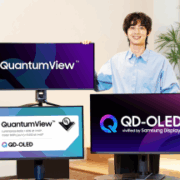
RGB Mini-LED, Beyond Demos and into the Marketplace: A Key Inflection Point at CES 2026

CES 2026 (January 6–9, Las Vegas) is an event where AI takes center stage, but it’s also likely to be a turning point where the premium picture quality competition in TVs, monitors, and electronics shifts to RGB Mini-LED. With image quality demos expected to be first showcased during Media Day (January 4–5) followed by comparative experiences at the main exhibition, this year’s RGB Mini-LED market is likely to be influenced by “how much of a difference can be felt on-site,” rather than by the specifications presented in the presentation.

CES 2026 official logo (Source: CES)

CES 2026 official logo (Source: CES)

RGB Mini-LED is attracting attention not because it’s simply an extension of increasing the number of dimming zones, but because it separates the R/G/B light sources at the backlight stage to create color and expand control freedom. While existing premium Mini-LEDs optimized “blue/white light source + QD (or color filter) + local dimming,” RGB Mini-LED reorders priorities across evaluation criteria, including color accuracy, color volume, low-level stability, and power/heat management, by altering the light source structure itself. Even when using the same LCD panel, a different combination of light source and algorithm results in a different product. At this point, RGB Mini-LED is not simply a “brighter LCD,” but rather an attempt to shift the definition of premium picture quality from “panel” to “light source + algorithm.” Exhibition trends support this, with TV brands clearly positioning their RGB offerings as a “live experience.” LG is showcasing its “Micro RGB evo” at the forefront of its 75/86/100-inch models, demonstrating a strategy that directly links its RGB strategy to “large living room” displays. Samsung is expanding its 2026 Micro RGB lineup to 55-115 inches, demonstrating a strong approach to RGB across all sizes, rather than focusing solely on ultra-large demos. Hisense is also emphasizing RGB MiniLED for core living room sizes (e.g., 55-100 inches), reinforcing its premium appeal by integrating viewing convenience and efficiency beyond simple image quality. Ultimately, the RGB competition at CES 2026 is likely to unfold not simply as a product launch, but as a battle over how each company defines its “standard of premium” within a given size range and convinces audiences with its compelling experience. Furthermore, the messages from Sony and TCL are also attracting market attention. Sony has consistently been hinting at the possibility of presenting its perspective on the “standard of color reproduction” at CES, with terms like “True RGB” related to RGB backlighting being discussed in the industry. TCL has been pushing the advancement of Mini-LED technology, particularly through TCL CSOT, so it will be interesting to see how the company will articulate its premium LCD strategy at CES 2026. In other words, whether RGB Mini-LED remains the exclusive domain of a select few leading brands or expands into a standard competitive premium LCD market will depend on whether these players can communicate their message at CES with a “market message” (lineup/price/channel) rather than a “technology demo.”

The impact of RGB Mini-LED may not be limited to TVs. In the monitor market, RGB backlighting is also emerging as a strategy to capture premium demand by integrating messages like high-brightness HDR, color expression, and burn-in risk avoidance. From a market perspective, the key question is whether RGB Mini-LED will remain a “flagship-only technology” or become a standardized platform where components, modules, drives, and algorithms all work together. If manufacturers at CES begin to talk about RGB not as a single model but as a portfolio, linking it to regional distribution (North America/Europe/Asia) and price positioning, it will signal that RGB has transitioned from a “demo” to a “market.”

Ubi Research Executive Vice President Changwook Han summarizes this perspective in a single sentence: “The most important signal at CES is not the flashiness of the demo, but the concreteness of the lineup and launch plan.” He emphasized, “For RGB Mini-LED to truly reshape the market, the key will be how quickly it can lower the barriers to price, yield, and supply stability beyond ultra-large showcases to core living room sizes (75–100 inches).” He continued, “The key to real-world experience is not flashy demo videos, but the naturalness and consistency of real-world content, such as low-gray tones, nighttime HDR, subtitles, and skin tones.” He added, “If RGB Mini-LED can gain traction in this segment, it will be able to fully compete with OLED in the premium market and shift the competitive axis of the premium TV and monitor market from ‘panel specs’ to a system competition combining ‘light sources, algorithms, and supply chains’ after 2026.”

Ultimately, RGB Mini-LED at CES 2026 is entering a phase where it must simultaneously demonstrate both marketability and perceived quality, rather than simply presenting a ‘well-made demonstration.’ Looking solely at size strategies, companies are taking different approaches: focusing on the ‘large living room’ segment, like LG (75/86/100 inches), expanding to ‘cover all segments’, like Samsung (55-115 inches), and reinforcing their message based on the ‘living room volume size (55-100 inches)’, like Hisense. Add to this the language in which Sony and TCL CSOT redefine the standard for premium LCDs, and the landscape of the premium TV and monitor markets after 2026 could be rearranged more quickly than expected.

Changwook Han, Executive Vice President/Analyst at UBI Research (cwhan@ubiresearch.com)

▶2025-2026 Beyond Mobile: IT OLED Technology and Industry Analysis Report
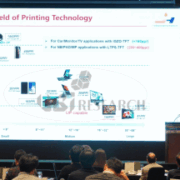
※ This article is produced by UBIResearchNet.
Unauthorized reproduction or citation without source attribution is prohibited.
When quoting, please clearly indicate the source (UBIResearchNet) and provide a link.

Samsung Display Begins Full-Scale Supply of World’s First 360Hz ‘V-Stripe’ QD-OLED

To be equipped in new 2026 monitor models from 7 clients including ASUS and MSI

□ ‘High Performance’ QD-OLED monitor anticipated for ’26 debut featuring new pixel structure, 21:9 ultra-wide aspect ratio, 360Hz high refresh rate, and 1,300 nits peak brightness

□ ‘V-Stripe’ pixel application significantly strengthens text readability… Provides optimal gaming experience with wide screen, smooth transitions, and fast response speed

□ QD-OLED solidifies #1 spot with 75% market share in the self-emissive monitor market in ’25

□ “Will continue technical innovation with QD-OLED in the ‘high-end monitor’ market, a battleground for the latest displays”

Samsung Display announced on the 1st that it is launching the world’s first 34-inch 360Hz QD-OLED featuring a ‘V (Vertical)-Stripe’ pixel structure. Samsung Display began mass production of the new product last December and is now fully supplying it to a total of seven global monitor manufacturers, including ASUS, MSI, and Gigabyte.

While conventional QD-OLEDs utilized a triangular arrangement for the Red (R), Green (G), and Blue (B) sub-pixels, the ‘V-Stripe’ arranges the R, G, and B sub-pixels in a vertical stripe pattern. Although commonly referred to in the industry as a stripe structure or RGB stripe structure, Samsung Display developed a stripe pixel structure optimized for Quantum Dot elements in-house and named it ‘V-Stripe’. Applying this pixel structure expresses text edges more clearly, offering an optimal monitor solution for users sensitive to text readability in tasks such as document work, coding, and content creation.

In addition, this new product combines the ▲‘V-Stripe’ structure with a ▲21:9 ultra-wide aspect ratio, a ▲360Hz high refresh rate enabling smooth transitions and fast response speeds, and ▲high brightness characteristics with a peak of 1,300 nits. It is gathering high expectations among consumers who enjoy speedy and immersive games such as sports and racing.

Generally, a 21:9 aspect ratio significantly increases the number of horizontal pixels and data processing volume compared to 16:9, increasing the burden on driving components such as power consumption and heat generation even at the same refresh rate. Also, it is known that implementing high refresh rates is difficult because it is hard to uniformly match the signal timing between left and right pixels.

A Samsung Display representative stated, “The biggest technical hurdles in mass-producing high-refresh-rate products with a new pixel structure are reduced organic material lifespan, heat generation, and brightness degradation.” The representative added, “Since QD-OLED adopts a top-emission method, it is advantageous in terms of brightness. Through efficiency improvement of organic materials and design optimization, we were able to mass-produce a ‘high performance’ monitor display equipped with all four specs: ▲‘V-Stripe’ pixel structure, ▲ultra-wide aspect ratio, ▲high refresh rate, and ▲high brightness.”

The ‘V-Stripe’ QD-OLED monitor, considered a highly anticipated product in the new year’s monitor market, can be seen at ‘CES 2026’ opening in Las Vegas, USA on the 6th (local time). This is because ASUS and MSI will unveil new monitor products equipped with the ‘V-Stripe’ structure QD-OLED for the first time at CES. Samsung Display also plans to reveal the panel at a private booth operated at the Encore at Wynn hotel during the CES period.

According to market research firm Omdia, the transition from LCD to OLED continues, with the proportion of products equipped with self-emissive panels in the premium monitor market of $500 or more expected to rise from 14% in ’24 to 23% in ’25 and 27% in ’26. Amidst this, Samsung Display’s QD-OLED shipments in the monitor OLED panel market for ’25 are estimated at approximately 2.5 million units, expecting to maintain an overwhelming number one position in the market with a share exceeding 75%.

Jung Yong-wook, Vice President and Head of the Strategic Marketing Team for Large Display Business at Samsung Display, stated, “The high-end monitor market, including gaming, can be called a battleground for the latest display technologies as consumers’ sensitivity and expectations for display image quality are high.” He added, “As QD-OLED is receiving overwhelming support from consumers in this market, we will continue to maintain market leadership by showcasing even more innovative technologies in the future.”

Technical diagram illustrating INT-Tech's 100,000-nit Native RGB OLEDoS technology compared to standard White OLED.

AI Smart Glasses Era Shifts OLEDoS Competitive Landscape: SeeYA Expands Mass Production, INT-Tech Unveils High-Brightness Native RGB Sample

The OLEDoS (OLED-on-Silicon, micro-OLED) market for XR (AR/VR/MR) devices is undergoing simultaneous realignment of its supply chain and technological competition as the year draws to a close. For XR OLEDoS, Sony’s W-OLEDoS (White OLED + color filter) technology and supply have long served as the ‘de facto benchmark’. However, the landscape is shifting towards a competitive multi-supplier structure as mass production supply from Chinese companies, including SeeYA, has already expanded.

SeeYA (视涯科技), considered one of China’s leading OLEDoS companies, passed the final review for listing on the Shanghai STAR Market on December 24 and is expected to list in Q1 2026. SeeYA plans to use approximately 2 billion yuan in raised funds to expand production capacity and strengthen R&D. OLEDoS production involves high process complexity and stringent quality requirements, making yield stability in 12-inch wafer-based mass production a key competitive factor. SeeYA’s IPO progress is interpreted as contributing to the long-term supply commitments, supply stability, and medium-to-long-term cost structure improvements demanded by XR customers.

SeeYA is currently executing a two-phase investment at its Hefei production base, with each phase reportedly possessing a monthly capacity of around 9K units. The Phase 1 line is already operating at full capacity, while Phase 2 setup is scheduled for completion by the end of January 2026, with full-scale operation commencing in February. Regarding customers, overseas efforts include pursuing cooperation with Apple and responding to Meta. Domestically in China, the supply portfolio is expanding to include Insta360 sports cameras, RayNeo AR glasses, DJI, and Xiaomi.

Meanwhile, Taiwan’s INT-Tech has drawn technical interest with its new OLEDoS (uNEEDXR) unveiled on December 22. INT-Tech presented high-performance metrics, including 100,000 nits ultra-high brightness, in its 0.39-inch XGA (1024×768) class product, directly targeting system brightness, power consumption, and thermal management issues—key constraints identified for AR adoption. Particularly, the performance enhancement of the Native RGB (side-by-side) method is seen as a catalyst shifting the nature of OLEDoS competition from a ‘display spec’ focus to one centered on ‘smart glasses’ user experience (UX) and AI functionality implementation. Smart glasses, as “always-worn” products featuring AI assistants, real-time translation, and situational awareness (e.g., navigation, notification summaries), must ensure sufficient readability in real-world environments while suppressing battery drain and heat generation. The development of high-brightness OLEDoS presents a competitive advantage over Micro LED and LCoS in the race for brightness, efficiency, and resolution demanded by AI-based smart glasses displays. However, since no lifespan data for uNEEDXR under ultra-high brightness conditions has been provided, additional verification of its stability is required for product application.

INT-Tech, a major shareholder of OLEDOS manufacturing company KT&T based in Taizhou City, Zhejiang Province, China, is pursuing market expansion by combining ‘INT-Tech’s technology and product roadmap’ with ‘KT&T’s China-based manufacturing and customer support system’.

Demonstration screen of high-definition OLEDoS display using INT-Tech's uNEEDXR technology

INT-Tech’s OLEDoS demo delivering vivid colors and high brightness using Native RGB technology. (Source: INT-Tech uNEEDXR™ Technology)

Diagram comparing traditional White OLED structure vs. INT-Tech's uNEEDXR (Native RGB) technology structure

INT-Tech’s Native RGB structure achieving 100,000 nits brightness with a single junction and no MLA. (Source: INT-Tech uNEEDXR™ Technology)

According to UBI Research’s analysis, China’s expansion of OLEDoS production scale and new technology development are expected to be key variables for the XR OLEDoS market in 2026. First, as Chinese companies, including SeeYA, increase supply and capital investment, XR device makers are gaining broader options to select suppliers based on performance, price, and customization conditions. Second, the focus of technological competition is shifting beyond simple resolution comparisons. It is now centered on the ability to secure the capabilities required by AI-based smart glasses: ‘outdoor readability, low power consumption and low heat generation for extended wear, and system efficiency integrated with the optical system’.

As Chinese OLEDoS manufacturing companies accelerate mass production and enhance product performance, this is expected to directly impact XR brand companies’ supply chain strategies and product launch timings.

Changho Noh,  Senior Analyst at UBI Research (chnoh@ubiresearch.com)

▶XR Industry Trends and OLEDoS Display Technology & Industry Analysis Report
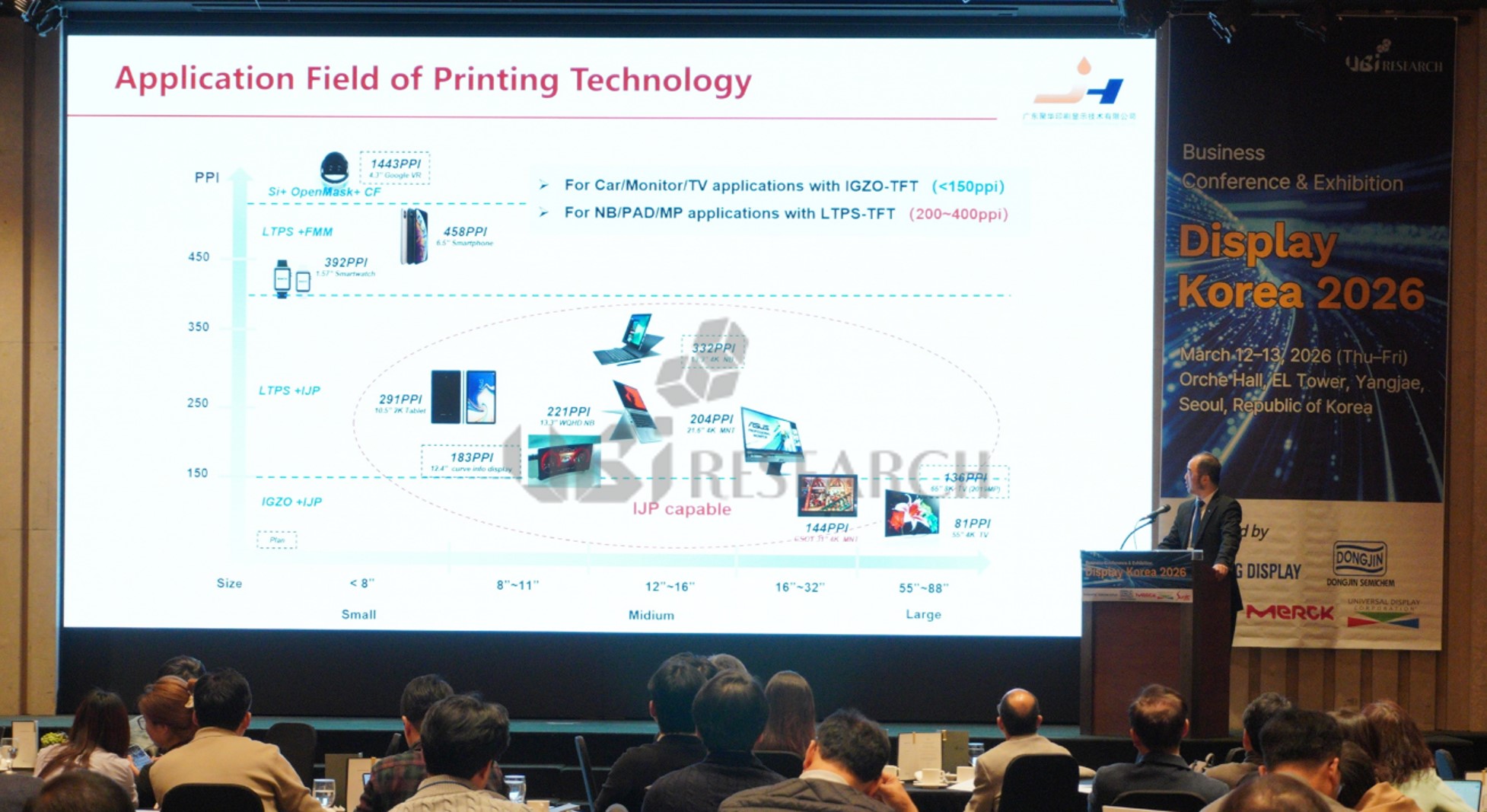
※ This article is produced by UBIResearchNet.
Unauthorized reproduction or citation without source attribution is prohibited.
When quoting, please clearly indicate the source (UBIResearchNet) and provide a link.

Samsung’s “Intelligent Living” vs. LG’s “Visual Essence”: The Contrast at CES 2026

CES 2026 official logo (Source: CES)

CES 2026 official logo (Source: CES)

CES 2026 The world’s largest consumer electronics show, CES 2026, is expected to become a watershed moment clearly demonstrating the strategic pivot of South Korea’s two major home appliance giants. While the 2025 show just one year prior was a stage for showcasing technological maturity, 2026 will be a stage where the future TV visions defined by each company fundamentally diverge. Samsung Electronics will boldly pivot toward an AI living platform beyond TV, while LG Electronics will postpone form factor experimentation and return to the core of overwhelming picture quality—a fundamental super-gap.

1. LG Electronics: Transcending Form Factor Disruption to Overcome LCD Limitations

In 2025, LG Electronics’ booth featured the morphological evolution of displays as its main attraction, showcasing transparent OLED (Signature T) and freely bendable panels. The world cheered as displays became furniture, nullifying spatial constraints. Yet at CES 2026, LG returned to the fundamental challenge of “light control.”

LG Electronics’ 2026 OLED TV prominently features ‘Tandem 2.0’, a hardware structural innovation. This technology, which stacks the existing light-emitting layer into a 4-stack configuration, has resolved the maximum brightness issue—long considered OLED’s sole weakness. LG claims this model achieves brightness exceeding 4,000 nits while dramatically extending the lifespan of the elements. This appears to demonstrate confidence that OLED remains the brightest and clearest self-emissive display.

Meanwhile, the biggest reversal in LG Electronics’ exhibition this time is the introduction of Micro RGB Evo. LG Electronics is undertaking a groundbreaking attempt to transplant its OLED precision light source control DNA into LCD. This method uses RGB micro-LEDs directly as the backlight, pushing the physical limits of LCD panels to OLED levels. It is analyzed as a countermeasure to check Chinese companies dominating the premium LCD market.

2. Samsung Electronics: The End of Picture Quality Competition and the Dawn of “Intelligent Living”

Meanwhile, Samsung Electronics’ direction is moving beyond displays. Having focused on AI‑based upscaling and quantum dot picture quality innovations until 2025, Samsung will fully shift its 2026 exhibition theme to the “Intelligent Living Platform.” The TV will be redefined not as a screen-displaying device, but as an AI hub that manages the home’s energy, learns user preferences, and curates daily life.

Samsung Electronics plans to showcase a seamless home where product boundaries dissolve, extending beyond the LVCC main exhibition hall to a massive standalone pavilion at the Wynn Hotel. The TV will adjust lighting as users move through rooms, display washing machine completion notifications, and suggest recipes in the kitchen. Samsung’s strategy is clear. Chinese manufacturers may be able to match picture quality specs, but they cannot replicate the SmartThings ecosystem that connects hundreds of millions of devices worldwide.

3. Market Shifts Suggested by the “X-Shaped Intersection”

These contrasting moves by the two companies can be interpreted as a clash between defensive leadership (Samsung) and aggressive essentialism (LG). The dynamic where LG once proclaimed “changing the world through form factor” while Samsung insisted “picture quality is paramount” has now completely reversed. LG pursues technological depth to solidify its hardware dominance as the OLED TV pioneer, while Samsung, as the world’s top home appliance maker, focuses on the breadth of connectivity to platformize its hardware. Their approaches to MicroLED also diverge. Samsung treats it as an extension of its “ultra-large intelligent displays,” while LG plans to focus on demonstrating practical mass-production feasibility and pixel-level control for home TVs through its “Magnet Active” technology.

CES 2026 presents consumers with two choices: “A screen so perfect it hurts your eyes (LG)” or “A smart home that understands and manages my life (Samsung).”

While LG Electronics returns to the essence of technology to redefine display industry standards, Samsung Electronics seeks to transform the very definition of home appliances through lifestyle intelligence. The world’s attention is focused on Las Vegas, watching how this head-to-head race between two giants sprinting in opposite directions will reshape the global home appliance market landscape in 2026.

Joohan Kim, Senior Analyst at UBI Research (joohanus@ubiresearch.com)

▶2025 Micro-LED Display Industry and Technology Trends Report
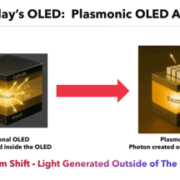
※ This article is produced by UBIResearchNet.
Unauthorized reproduction or citation without source attribution is prohibited.
When quoting, please clearly indicate the source (UBIResearchNet) and provide a link.

Samsung TV’s Dual Strategy: “Exhibition Hall Change” and Micro-LED From Luxury Models in the Tens of Millions to the Mainstream Market

Samsung Electronics is reshaping the TV market landscape starting with CES 2026. Moving beyond the traditional “appliance show” format, Samsung’s clear strategy is evident in its standalone exhibition hall spanning approximately 4,645 square meters at the Wynn Hotel. It centers on a dual-pronged approach: self-emitting Micro-LED pursuing technological perfection and Micro RGB leading market mainstream adoption.

1. The Pinnacle of High-End: 2026 Micro-LED Luxury Line

Samsung positions its 2026 self-emissive Micro-LED luxury model, embodying the pinnacle of self-emissive technology, in the private room at the very heart of this showcase.

  • Technical Reality: Tens of millions of ultra-small LED chips emit light and color without a backlight. Using inorganic materials fundamentally solves the burn-in limitations inherent in organic OLEDs while achieving infinite contrast ratios.
  • The Arrival of Super-Large Flagships: Models over 110 inches (such as 140 inches), priced in the hundreds of millions, take center stage. Through this, Samsung redefines the standard for private home cinemas for VVIPs.
  • Commercialization of Transparent Displays: The transparent Micro-LED, which garnered attention as a prototype in 2025, will be showcased with further improved transmittance and brightness. Transparent Micro-LED technology enables intelligent spatial scenarios where window glass itself becomes a display to show information.

2. Democratizing Premium: Micro RGB TV Lineup with 6 Models

While self-emitting technology holds symbolic significance, the Micro RGB (R95H) product line is the main driver of substantial market share. Samsung will showcase this lineup across all sizes, from 55 inches to 115 inches, at this exhibition.

  • Strategic Positioning: By adopting advanced LCD technology that utilizes self-emitting elements as backlights, price competitiveness is secured. Samsung thereby establishes a new standard: “Premium TVs should deliver micro-level picture quality regardless of size.”
  • Overwhelming Specifications: Reportedly achieving 100% BT.2020 color gamut coverage—an industry first—and delivering high brightness exceeding 4,000 nits.
  • Confirmed Lineup: Six models in total—55, 66, 75, 85, 100, and 115 inches—offer consumers a wide selection tailored to their living room sizes.

3. “Agentic AI” Completes Smart Living

Both lineups feature Samsung’s next-generation AI engines: the Micro RGB AI Engine Pro and Agentic AI. The TV is no longer just a screen; it functions as an AI butler that contextually understands user speech through Gemini and Copilot, autonomously controlling home appliances throughout the house.

Samsung Electronics’ exhibition is said to demonstrate the results of a meticulous dual-track strategy: showcasing the pinnacle with Micro-LED while securing the mainstream with Micro RGB. The enclosed, luxurious space of the Win Hotel serves as the perfect stage to demonstrate both the awe-inspiring presence of the billion-dollar Micro-LED model and the sophisticated lifestyle proposed by the Micro RGB TV. Through this, Samsung is expected to block the low-price offensive from Chinese manufacturers and reaffirm its overwhelming dominance in the premium TV market.

Comparison table of Samsung's 2026 self-emissive Micro-LED (Luxury) and Micro RGB (Premium) TV lineups

Comparison table of Samsung’s 2026 dual-track TV strategy, dividing into Self-emissive Micro-LED (Luxury) and Micro RGB (Premium). (Source: UBI Research)

Joohan Kim, Senior Analyst at UBI Research (joohanus@ubiresearch.com)

▶2025 Micro-LED Display Industry and Technology Trends Report
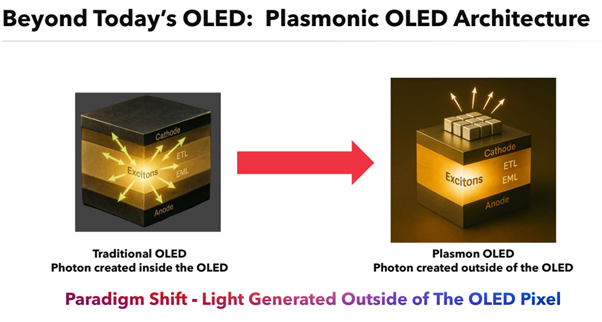
※ This article is produced by UBIResearchNet.
Unauthorized reproduction or citation without source attribution is prohibited.
When quoting, please clearly indicate the source (UBIResearchNet) and provide a link.

Bar chart illustrating the rapid growth of Mini-LED and OLED in the automotive display market through 2030.

Automotive Display Premiumization Accelerates… Mini-LED and OLED Revenue Share Expected to Exceed 10% in 2026, Expanding Further by 2030

As the adoption of electric vehicles and the transition to software-defined vehicles (SDVs) gain momentum, automotive displays are rapidly being elevated from simple information panels to core components that shape user experience (UX) and enable brand differentiation. Amid this shift, the adoption of Mini-LED—capable of delivering both premium image quality and high readability—is expanding, with clear growth trends emerging across shipment volume and key market indicators.

According to UBI Research’s “2025–2026 Automotive Display Technology and Industry Trend Analysis Update Report,” shipments of automotive Mini-LED displays totaled approximately 4.5 million units in 2024 and are expected to increase to around 6.75 million units in 2025. The key drivers behind this demand are rising requirements for high brightness, enhanced readability, and high contrast, as applications expand to larger center information displays (CIDs), center displays, panoramic displays, and integrated screen configurations.

From a technology perspective, Mini-LED is considered an attractive option for automakers because it maintains an LCD-based structure while enabling premium image quality through local dimming, making it easier to secure both performance and supply stability. As a result, its influence within the market is expected to grow. The revenue share of Mini-LED displays is projected to increase from around 3.0% in 2024 to surpass 10% for the first time in 2026, and to exceed 20% from 2030 onward.

Forecast graph of automotive display shipments by technology (Mini-LED, OLED) from 2023 to 2030 (Source: UBI Research)

Graph showing the growth of the premium automotive display market, with Mini-LED projected to reach 6.75 million and OLED 4.5 million units in 2025. (Source: UBI Research)

In addition to Mini-LED, OLED is also showing strong growth momentum. Automotive OLED display shipments are projected to reach approximately 4.5 million units in 2025, and in the mid- to long-term are expected to form an annual market of around 13 million units by 2030. As a self-emissive technology, OLED delivers deep blacks and high contrast, making it advantageous for enhancing premium UI readability and overall visual quality. In terms of design, adoption is expanding primarily in high-end vehicles. OLED’s revenue share is forecast to exceed 10% in 2026 and expand to approximately 17% by 2030.

Changwook Han, Executive Vice President at UBI Research, stated, “Recently, automakers have been redefining the vehicle interior as a ‘brand experience space,’ and as competition intensifies in premiumization, display specification upgrades are becoming the most direct means of differentiation.” He added, “As demand grows for premium image-quality elements such as high brightness, high contrast, and wide color reproduction, both Mini-LED and OLED are benefiting from expanding adoption. Mini-LED is increasingly adopted for readability and stable mass-production applicability in large-area screens, while OLED is expanding primarily for premium emotional appeal and design differentiation.”

Changwook Han, Executive Vice President/Analyst at UBI Research (cwhan@ubiresearch.com)

▶2025 Automotive Display Technology and Industry Trends Analysis Report
※ This article is produced by UBIResearchNet.
Unauthorized reproduction or citation without source attribution is prohibited.
When quoting, please clearly indicate the source (UBIResearchNet) and provide a link.

HKC RGB Mini LED automotive dashboard display representing the company's market expansion.

HKC Expands RGB Mini LED to TVs, Monitors, and Automotive Displays

In the Chinese display industry, HKC has long been known as a leading panel manufacturer, fueled by its large-scale LCD-based mass production capabilities. However, its recent move to focus on RGB Mini LED is seen as a strategic shift that transcends its traditional identity. While existing Mini LEDs improved image quality through a combination of blue LED backlights and quantum dot film, HKC has adopted a structure that directly uses red, green, and blue (RGB) LEDs as the backlight source, demonstrating a technological advancement in color reproducibility, contrast control, and operating precision. RGB Mini LED is attracting attention as a next-generation display technology due to its ability to separate and control colors from the backlight stage, resulting in higher color purity and reduced light loss. Its scalability to large-area, high-brightness environments is also remarkable. This technological advancement has first become visible in the ultra-large-screen TV market. HKC has proven its large-area display capabilities by supplying 100-inch and larger RGB Mini LED TV panels to the global TV brand Hisense. In particular, the RGB Mini LED panel used in Hisense’s 116-inch UX series reportedly achieves a peak brightness of approximately 8,000nits, features 3,584 local dimming zones, and achieves color reproduction performance that meets over 95% of the BT.2020 color gamut. Simultaneously achieving high brightness and color uniformity on ultra-large screens is a technically challenging task. HKC is satisfying these requirements with RGB Mini LED, establishing a unique technological edge in the ultra-large TV market.

In the monitor market, the precision control capabilities of RGB Mini LED are expected to be further highlighted. HKC plans to officially announce its next-generation premium monitor lineup based on RGB Mini LED at CES 2026, expanding its large-area TV picture quality technology to high-resolution, high-refresh-rate desktop environments. The 31.4-inch 4K RGB Mini LED monitor, the “M10 Ultra,” is expected to be unveiled at CES 2026. It features a total of 1,596 physical local dimming zones and employs cluster-based operation, individually controlling RGB elements within each zone. This RGB cluster-based control is a key factor in effectively suppressing the halo effect, a problem faced by existing Mini LED monitors. Its performance targets the premium market, with a peak brightness of approximately 1,600nits, a native refresh rate of 165Hz, and up to 330Hz in FHD mode. Color reproduction is also expected to reach 98% to 100% of the BT.2020 standard, making it ideal for gaming environments as well as video editing and professional monitors where color accuracy is crucial.

The automotive display sector is also a key area where HKC is strategically expanding its RGB Mini LED offerings. With the spread of electrification and autonomous driving technologies, in-vehicle displays are becoming larger and more multiplexed. Stable visibility even under direct sunlight and reliability over long periods of use are emerging as key requirements. HKC’s automotive display solution, utilizing RGB Mini LEDs, has reportedly achieved a power consumption reduction of approximately 20% compared to conventional methods while maintaining high brightness of over 1,000nits. In particular, in large-scale integrated display structures that integrate the cluster and CID into a single screen, RGB Mini LEDs are recognized as a technology suitable for next-generation dashboard design due to their ability to easily maintain brightness and color uniformity.

HKC's 12.3-inch RGB Mini LED automotive display prototype

HKC’s 12.3-inch RGB Mini LED display optimized for automotive use with over 1,000 nits brightness and low power consumption. (Source: HKC)

A key enabler of this comprehensive product expansion is large-scale investment in Mini LED and M-LED production infrastructure. HKC is pursuing a dedicated Mini LED production base project worth approximately 9 billion yuan in Liuyang, China, with an annual production capacity of over 500 million Mini LED backlight modules. This production base integrates LED chips, backlight modules, and panel assembly into a single value chain, serving as a strategic base for simultaneously securing cost and supply stability, key challenges for RGB Mini LEDs. Furthermore, through the operation of its direct-view LED factory in Mianyang, HKC is accumulating experience in ultra-fine LED processes and laying the foundation for expansion into next-generation LED-based displays. According to Changwook Han, Executive Vice President of UBI Research, “HKC’s RGB Mini LED strategy is a strong mid- to long-term technology roadmap encompassing TVs, monitors, and automotive displays. Key to this is that it has simultaneously secured the core elements of high brightness, high color reproduction, and precision control, and is expanding these to large-area displays and high-reliability environments. With this, coupled with large-scale investments in Mini LED and M-LED production infrastructure, HKC is establishing a unique position in the next-generation LED-based display ecosystem.”

Changwook Han, Executive Vice President/Analyst at UBI Research (cwhan@ubiresearch.com)

▶2025 Automotive Display Technology and Industry Trends Analysis Report
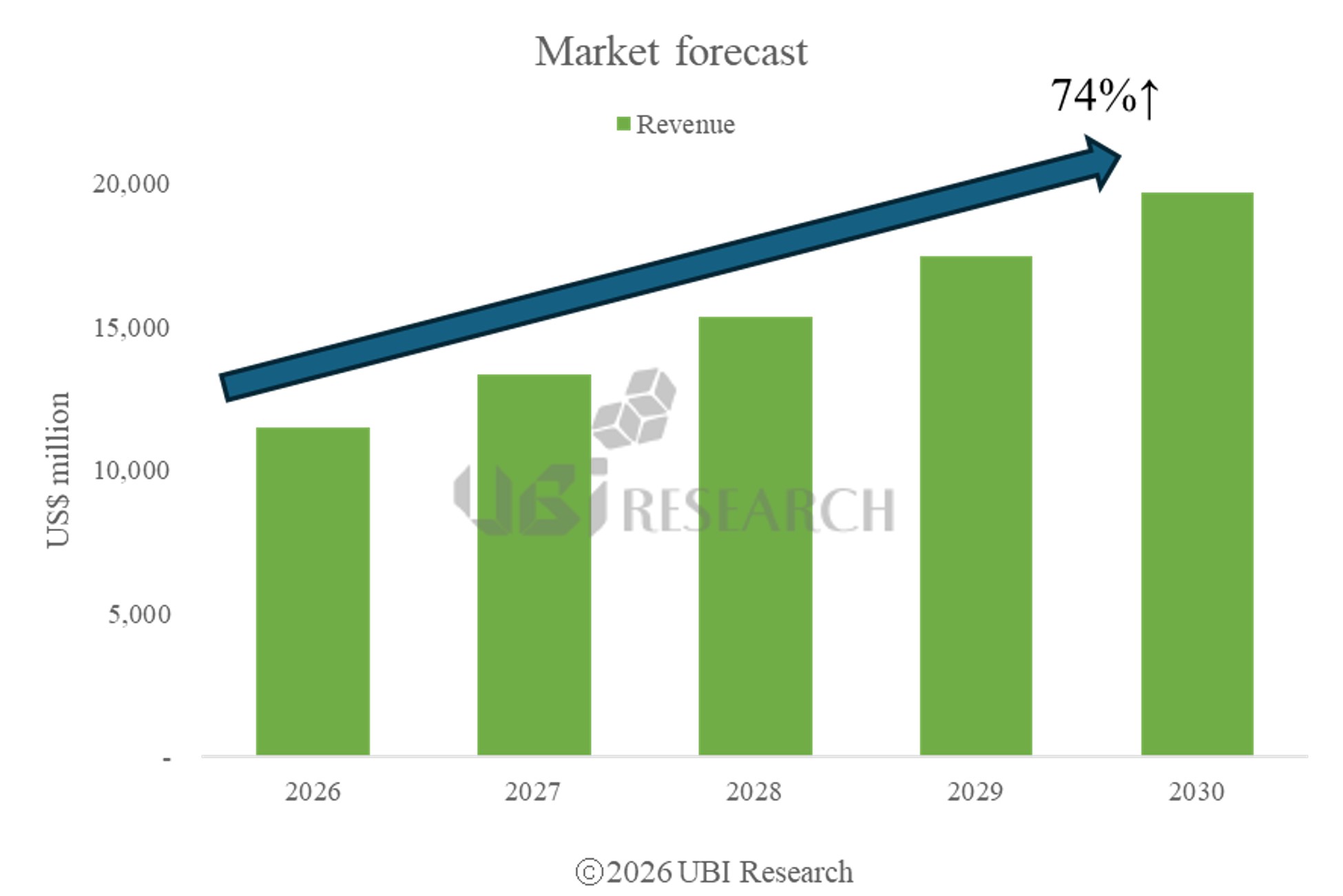
※ This article is produced by UBIResearchNet.
Unauthorized reproduction or citation without source attribution is prohibited.
When quoting, please clearly indicate the source (UBIResearchNet) and provide a link.

OMNIVISION's new LCoS panel OP03021, highlighting its compact size and high resolution.

Next Generation AR and AI Glass Display Innovation: OMNIVISION LCoS Panel and JBD MicroLED New Products

OMNIVISION, which supplies LCoS to Meta’s smart glasses ‘Ray-Ban Display’, unveiled a high-resolution LCoS panel ‘OP03021’ for next-generation AR (augmented reality) glasses on December 16, 2025, and predicted mass production of the panel in the first half of 2026.

OMNIVISION's next-gen LCoS panel OP03021 for AR glasses

OMNIVISION’s 0.26-inch LCoS panel ‘OP03021’ with 2.5x higher resolution than previous models. (Source: Omnivision OP03021)

The newly released panel supports 1632 x 1536 resolution in a 0.26-inch optical format. This is an increase of about 2.5 times in resolution and nearly 6 times in total number of pixels compared to the existing 0.14-inch model (648p). When this panel is applied, it can secure a wide viewing angle of 30 to 40 degrees beyond the existing narrow viewing angle (20 degrees) limit, or dramatically increase the number of pixels per angle (PPD) to read web pages or e-mail text clearly. The volume of the optical engine equipped with the corresponding panel by integrating the driver IC is estimated to be about 1.5cc and the weight is about 4g.

Specification comparison table between the existing model and the new OP03021 model

The new OP03021 model features approx. 2.5x higher resolution and 1.85x larger panel size. (Source: UBI Research)

Meanwhile, JBD also officially announced that Hummingbird II, a next-generation microLED projector scheduled to be released in the first half of 2026, won the CES 2026 Innovation Award. It supports 500 × 380 resolution and 480Hz scan rate, and is an ultra-small and ultra-light product of 0.2cc and 0.5g that halves the volume and weight compared to previous generations. It emphasized that it is a full-color display solution optimized for AI and AR smart glasses for consumers by operating at low power of 95mW while implementing high luminance of up to 4,000 nits.

JBD Hummingbird II MicroLED projector on a fingertip

JBD’s ultra-compact MicroLED projector ‘Hummingbird II’, winner of the CES 2026 Innovation Award. (Source: JBD Hummingbird II)

The next-generation wearable display market is expected to clearly distinguish application fields according to technology characteristics.

  • MicroLED: Ultra-small size of 0.2cc is the strength, suitable for ‘everyday AI glasses’ that display simple data while maintaining the original design of glasses
  • LCoS: Responsible for the ‘universal AR glass’ market, which is suitable for web surfing or augmented reality information delivery, with high resolution and favorable characteristics for securing viewing angles.
  • OLEDoS: Based on high contrast ratio and color reproduction, market in the ‘MR headset and media glass’ area where video content consumption and immersion are important.

The industry is paying attention to the possibility of dualizing the smart glass lineup into ‘light AI glasses’ and ‘display-oriented AR glasses’ in the future. Expectations are growing for the possibility that new technologies such as OMNIVISION’s LCoS panel and JBD’s microLED will be applied to next-generation AR glasses of various global companies such as Meta, Apple, Google/Samsung.

Changho Noh,  Senior Analyst at UBI Research (chnoh@ubiresearch.com)

▶XR Industry Trends and OLEDoS Display Technology & Industry Analysis Report

▶2025 Micro-LED Display Industry and Technology Trends Report

※ This article is produced by UBIResearchNet.
Unauthorized reproduction or citation without source attribution is prohibited.
When quoting, please clearly indicate the source (UBIResearchNet) and provide a link.

Bar chart illustrating BOE B11's 72.9% operating ratio, signaling stable mass production for Apple.

BOE B11 Achieves 35 Million iPhone Panel Shipments…72.9% Utilization and Approximately 89% Yield Demonstrate Stable Apple Supply Capability

Graph showing the monthly operating ratio of BOE's B11 OLED line (Source: UBI Research)

BOE B11 proves iPhone supply stability with a 72.9% operating ratio. (Source: UBI Research)

BOE has been gradually expanding its presence as a supplier of OLED panels for Apple’s iPhones. Building on deliveries centered on the standard models from the iPhone 12 through iPhone 16 series, BOE has broadened its coverage to the iPhone 16e, and more recently, a trend has been observed in which its coverage extends even to the iPhone 17 Pro. This suggests that BOE is moving beyond a secondary supplier role limited to specific generations or base models, and is entering a phase where it can play a meaningful role within Apple’s supply allocation strategy.

This trend can also be explained by operating indicators for BOE’s B11 OLED line. B11 is said to have a monthly capacity of 45K and an average annual utilization rate of 72.9%, implying an annual effective input of approximately 390,000 glass substrates. Assuming a Gen-6 OLED line produces 6.1-inch iPhone-class panels with 220 cuts per glass, the annual theoretical output capacity is estimated at roughly 86.6 million panels. In other words, even under conditions where Apple-bound volume fluctuates and product changeovers recur, the line structure appears to retain a degree of operational headroom.

Given that BOE’s iPhone OLED panel shipments in 2025 are around 35 million units, it is more reasonable to take a conservative view that reflects product mix rather than simply back-calculating with a single yield assumption. For example, if LTPS volume is assumed at 32 million units with a 90% yield, and LTPO volume at 3 million units with a 60% yield, the required total process input (in cut terms) comes to approximately 40.56 million cuts. Converting this using 200 cuts per glass results in an annual required input of around 200,000 glass substrates—an amount that can be interpreted as being within B11’s effective input capability.

From a technology mix perspective, BOE currently appears to be driving shipments primarily in segments with a high LTPS share, while keeping LTPO contributions limited. This can be read as an operating strategy that prioritizes mass-production stability and delivery responsiveness, rather than aggressively expanding the share of higher-difficulty processes. At the same time, indications that BOE’s supply scope is extending to the Pro lineup align with a direction that gradually opens the door to entry into higher-spec segments.

In addition, there is a gap between B11’s annual effective input capability (about 390,000 glass substrates) and the conservatively converted iPhone-related required input (about 200,000). It would be premature to label this simply as “idle capacity,” but at a minimum, it suggests a structure that could allow partial parallel operation of additional product mix—such as non-Apple models, samples/pilot runs, or volumes used for line balancing—depending on conditions. In other words, B11 can be viewed more cautiously as having a certain buffer that helps optimize line utilization amid recurring demand swings and product transitions, while still prioritizing Apple-bound supply.

Overall, BOE’s strength lies less in any single technology point and more in its ability to run stable high-volume production with competitive performance in quality control and delivery execution. While sustaining volume primarily through LTPS, BOE has also retained room to expand LTPO adoption step by step, and B11’s operating flexibility can function as a buffer against demand volatility and product changeovers. As a result, BOE can be interpreted as steadily strengthening its position in Apple’s supply chain—from short-term volume supplementation toward a more sustainable long-term supply partner.

Junho Kim, Analyst at UBI Research (alertriot@ubiresearch.com)

▶ China Trends Report Inquiry

※ This article is produced by UBIResearchNet.
Unauthorized reproduction or citation without source attribution is prohibited.
When quoting, please clearly indicate the source (UBIResearchNet) and provide a link.

TCL CSOT's 163-inch X11H Max Micro-LED TV representing the company's push for mass adoption.

Breaking the KRW 100 Million Barrier?” TCL CSOT’s Bold Bet on Micro-LED Mass Adoption

Micro-LED, the pinnacle of “self-emissive” display technology where each pixel generates its own light, is finally shedding its laboratory skin and attempting to enter the living room. At the forefront is TCL CSOT, which has thrown down a bold technical roadmap in a market once considered the exclusive domain of Samsung Electronics. We analyze their three-stage evolution—from CES 2025 through the recent DTC 2025 to the upcoming CES 2026—through the lens of display engineering.


1. [CES 2025] The 10,000-Nit Shock: Pushing the Limits of Inorganic Elements

At CES 2025, TCL CSOT’s 163-inch Micro-LED TV, the ‘X11H Max’, injected significant technical tension into the industry. It wasn’t just about the size; the device achieved a staggering peak brightness of 10,000 nits by individually controlling approximately 24.88 million inorganic RGB chips at the pixel level. This was a landmark event that redefined the standards of “super-gap” picture quality, using the durability of inorganic materials to directly overcome the brightness degradation and burn-in issues inherent in organic-based OLEDs.

TCL CSOT's 163-inch X11H Max Micro-LED TV and pricing unveiled at CES 2025 (Source: TCL CSOT)

TCL’s 163-inch Micro-LED TV ‘X11H Max’ achieving 10,000 nits brightness, surpassing the limits of inorganic devices. (Source: TCL CSOT)

2. [DTC 2025] Technical Maturity in Driving Algorithms and Grayscale Expression

The key takeaway from DTC 2025 (TCL Global Display Tech Ecosystem Conference) was the “evolution of internal substance.” TCL addressed the chronic challenge of Micro-LEDs—color distortion in low-light areas—through its proprietary ‘Hybrid PWM+PAM Driving Architecture.’ This method, which sophisticatedly combines Pulse Amplitude Modulation (PAM) and Pulse Width Modulation (PWM), achieved a 24-bit color depth. It demonstrated technical maturity by perfectly resolving the shapes of objects even in pitch-black darkness through 16.77 million steps of grayscale.

TCL CSOT's 219-inch 36:9 ultra-wide Micro-LED display showcased at the exhibition (Source: TCL CSOT)

A 219-inch ultra-large Micro-LED display supporting 98% DCI-P3 color gamut and 120Hz refresh rate. (Source: TCL CSOT)

3. [CES 2026 Outlook] Crushing the “100 Million Won” Wall via Mass Transfer Innovation

At the upcoming CES 2026, TCL is expected to move beyond technical posturing and place a practical bet on “price destruction.” Experts predict that TCL will drastically lower the production cost of 100-inch+ models by significantly increasing the yield of the Mass Transfer process—the method of moving millions of microscopic chips onto a substrate. In particular, process efficiency linked with Inkjet Printing (IJP) technology is projected to be the detonator that pulls down Micro-LED TV prices, once exceeding hundreds of thousands of dollars, to the tens of thousands range (approx. 50–80 million KRW).

While past Micro-LEDs were merely “expensive display pieces densely packed with small LEDs,” today’s TCL CSOT is attempting to democratize “nanosecond-level response speeds” and “infinite contrast ratios” by perfectly grafting semiconductor micro-processes onto displays. CES 2026 will serve as the “technological singularity” where Micro-LED moves beyond being a luxury for the ultra-wealthy to become the new standard for premium home appliances.

Joohan Kim, Senior Analyst at UBI Research (joohanus@ubiresearch.com)

▶2025 Micro-LED Display Industry and Technology Trends Report

※ This article is produced by UBIResearchNet.
Unauthorized reproduction or citation without source attribution is prohibited.
When quoting, please clearly indicate the source (UBIResearchNet) and provide a link.

Li Auto's 'Livis' AI glasses representing the trend of automakers entering the wearable display market.

Automakers: Exploring AI Glasses for Vehicles or Competing for Future Market Entry?

As in-vehicle displays grow larger and more numerous, automotive HMI (Human–Machine Interface) is facing another turning point. The information display methods, which have evolved around instrument panels, center displays, and HUDs, are now expected to expand into driver wearable personal devices—specifically, AI smart glasses.

Recently, as the AI glasses market is expected to expand, participating companies are gradually increasing. From existing smart glasses manufacturers to internet companies and smartphone makers, even Chinese firms like Xiaomi, Li Auto, and Geely Auto subsidiaries are positioning AI smart glasses as part of the vehicle ecosystem.

In 2024, BMW showcased technology at CES that enhances the driving experience using XREAL Air 2 augmented reality glasses. This product can display navigation instructions, hazard warnings, entertainment content, and charging station information. In June this year, Xiaomi launched its first AI smart glasses capable of linking with automotive devices. Xiaomi views AI glasses as an extension of its ‘Human × Car × Home’ strategy, linking smartphones, IoT, and electric vehicles. In August, Geely announced its AI technology would be fully applied to the vehicle smart cabin sector. Geely acquired Meizu to establish DreamSmart company. Geely is pursuing a strategy to connect its vehicle OS and extend the vehicle display experience externally. In 2023 and 2024, DreamSmart released three types of AR glasses that can be linked to vehicles through its system. Geely also invested in LEDoS micro-display company JBD in 2024. In November this year, GAC Motor jointly conducted an ‘AI smart glasses + vehicle’ application test with Rokid. In December, Li Auto officially launched its first AI glasses, ‘Livis’, having reportedly been advancing its AI glasses project since 2024. According to the announcement, ‘Livis’ core functionality includes seamless integration with the car system. A light touch upon entering the vehicle completes the initial pairing, enabling automatic connection thereafter. It also supports voice commands to control vehicle functions like the air conditioner and heated steering wheel.

Li Auto's automotive-integrated AI glasses 'Livis' (Source: lixiang.com)

Li Auto’s first AI glasses ‘Livis’, seamlessly integrated with vehicle systems for voice control and information display. (Source: lixiang.com)

Realistically, AI glasses are unlikely to replace instrument panels or HUDs in the short term. This is because numerous challenges remain, including potential visual obstruction during driving, safety regulations, and fatigue from prolonged wear. Accordingly, the proposed usage scenarios could be as follows.

First, as a supplementary display to the HUD, showing only limited information like navigation directions, basic driving data, and warning alerts to minimize eye movement.

Second, as an AI voice-centric auxiliary interface. The emphasis is on controlling vehicle functions through voice commands and simple visual feedback rather than visual information.

Third, usage focused on specific situations. Limited scenarios like traffic jams, parking, activities outside the vehicle, or checking information during non-driving situations are priority application targets.

This approach suggests AI glasses are more likely to first establish themselves as auxiliary devices rather than the ‘primary vehicle display’.

The widespread adoption of AI glasses in vehicles ultimately depends on the maturity of the technology. The core challenge lies in micro-display technology, where improvements are still needed in power efficiency, cost, and mass-production stability. Another critical condition is deep integration with the vehicle OS and AI. As the Software Defined Vehicle (SDV) environment expands, AI glasses can link in real-time with vehicle sensors, navigation, and ADAS data. In this scenario, AI glasses could evolve beyond simple information displays into ‘personalized HMI nodes’ providing context-aware information to drivers. In the future, advancements in AI interaction technology and computing power are expected to transform smart glasses from mere accessories dependent on vehicle display devices into ‘AI assistants’.

Namdeog Kim, Senior Analyst at UBI Research (ndkim@ubiresearch.com)

▶2025 Micro-LED Display Industry and Technology Trends Report

▶Micro-LED Display Technologies for XR Applications Report

※ This article is produced by UBIResearchNet.
Unauthorized reproduction or citation without source attribution is prohibited.
When quoting, please clearly indicate the source (UBIResearchNet) and provide a link.

Bar chart illustrating the significant reduction in chip and package size of Smartkem's MiP4 technology compared to POB and COB methods.

Smartkem unveils next-generation Mini-LED backlight technology at IDW 2025… Announces ‘MicroLED-in-Package (MiP4)’ structure featuring proprietary RDL technology

UK-based advanced materials company Smartkem announced its next-generation Mini-LED backlight technology at International Display Workshops 2025, held at the Hiroshima International Conference Center in Japan from December 3 to 5. Co-developed with National Yang Ming Chiao Tung University (NYCU) in Taiwan and Coretronic, this technology is named ‘MiP4 (MicroLED-in-Package 4-in-series).’ It is characterized by solving the challenges of micro LED processes and maximizing price competitiveness through the convergence of advanced semiconductor and display process technologies.

While Mini-LED backlight technology currently leads the premium TV and tablet markets by providing excellent contrast ratios and color reproduction, it faces structural limitations. Mini LED chips like the existing ‘0820’ model (0.2mm x 0.5mm) cannot be miniaturized further, limiting cost reduction potential. Furthermore, while backlight driver circuits typically use 12V as the standard voltage, individual LED chips operate at around 3V, necessitating separate step-down converters. This was a major cause of power loss and complicated driver board design.

The MiP4 technology presented by the Smartchem research team at this year’s Hiroshima IDW ‘25 solved these issues with a novel approach called ‘series connection packaging’. The team placed four ultra-small micro-LED chips, each under 85µm (micrometers), onto a glass substrate and electrically connected them in series to form a single package (0.6mm x 0.6mm).

Comparison graph of Chip size (black) and Package size (blue) for POB, COB, and MiP4 technologies (Source: Smartkem)

Comparison showing significantly reduced chip and package sizes of MiP4 compared to conventional POB and COB methods (Source: Smartkem)

The most notable aspects of this research result are material efficiency and luminance performance. Smartchem announced that in testing a backlight module composed of 400 zones, MiP4 technology reduced the amount of GaN (gallium nitride) epitaxial material used by a remarkable 84% compared to the existing COB (Chip-on-Board) method. While the conventional COB method uses 73.6mm² of GaN area per backlight unit, MiP4 uses only 11.56mm², dramatically lowering material costs.

The MiP4 manufacturing process integrates advanced semiconductor and display process technologies. The research team adopted a method where the GaN LED structure grown on a sapphire substrate is separated via a ‘Chemical Lift-off’ process and then transferred onto a glass substrate. On the glass substrate, a redistribution layer (RDL) composed of a polymer insulating film and metal wiring was formed, electrically connecting four micro LEDs in series.

(a) Schematic of RDL routing for uLED series integration on glass substrate (Source: Smartkem)

(a) Schematic illustrating the RDL routing process for integrating micro-LEDs in series on a glass substrate (Source: Smartkem)

This ‘Chip-first’ and RDL-based integration process not only ensures 12V compatibility at the chip level but also provides a package form immediately applicable to SMT (Surface Mount Technology) processes, enhancing manufacturing reliability.

Material usage decreased while performance actually improved. The MiP4-based backlight module achieved a maximum luminance of 34,047 nits with an optical film applied, demonstrating significantly higher luminous efficiency compared to commercial COB products that recorded 25,619 nits.

Smartchem and the research team anticipate that once commercialized, this technology will become a powerful weapon capable of competing with OLED in the small-to-medium high-definition display market, including notebooks, tablets, and automotive displays.

Smartkem MiP4 details: (a) MiP4-based 400-zone on FR-4 PCB, (b) laminated optical film stack with 12V driving, (c) Performance comparison table between COB and MiP4 (Source: Smartkem)

(a) MiP4-based 400-zone backlight unit, (b) demonstration with laminated optical films under 12V driving, and (c) table comparing brightness and efficiency between COTS (COB) and MiP4 (Source: Smartkem)

Changho Noh,  Senior Analyst at UBI Research (chnoh@ubiresearch.com)

▶2025 Micro-LED Display Industry and Technology Trends Report

▶XR Industry Trends and OLEDoS Display Technology & Industry Analysis Report

※ This article is produced by UBIResearchNet.
Unauthorized reproduction or citation without source attribution is prohibited.
When quoting, please clearly indicate the source (UBIResearchNet) and provide a link.

LG Display's advanced automotive OLED technology representing the smart cockpit trends at CES 2026.

Smart Cockpit Competition Accelerates… Automotive Displays to be Showcased at CES 2026

At CES 2026, it became clear that automotive display technology has emerged as a core competitive factor amid the broader transition of vehicles from mere means of transportation to intelligent living spaces. As the shift toward autonomous driving and Software Defined Vehicles (SDVs) accelerates, the amount of information and content required inside vehicles continues to increase. Accordingly, displays are no longer simple screens but have evolved into central technologies that define interior architecture and user experience. At this year’s exhibition, LG Display, Hyundai Mobis, AUO, and Corning each presented distinct technological approaches that together outlined the future direction of the smart cockpit.

LG Display showcased its “Automotive Dual View OLED” and “Automotive UDC (Under Display Camera)-IR OLED” at CES 2026, earning a CES Innovation Award in the In-Vehicle Entertainment category. Dual View OLED enables different content to be viewed simultaneously by the driver and the front passenger on a single panel, providing driving-related information exclusively to the driver while delivering entertainment content to the passenger. This technology is seen as an effective solution to information interference in increasingly large automotive displays, while significantly enhancing cockpit design flexibility. The UDC-IR OLED integrates an infrared camera beneath the display to support driver monitoring systems (DMS) without compromising screen continuity or image quality. Together, OLED’s inherent advantages in contrast and color reproduction, combined with advanced sensor integration, demonstrate a clear direction toward strengthening both in-vehicle entertainment and safety functions.

LG Display's CES 2026 Innovation Award-winning automotive Dual View OLED and UDC-IR OLED technology (Source: LG Display)

LG Display’s CES 2026 Innovation Award-winning automotive Dual View OLED and UDC-IR OLED technology (Source: LG Display)

Hyundai Mobis took center stage at CES 2026 after winning a CES Innovation Award for its holographic windshield display (HWD), integrated into its cockpit integration solution “M.BiCS 7.0.” Developed in collaboration with German optics company ZEISS, the HWD is the world’s first technology to apply a holographic film to the entire windshield, enabling the front glass to function as a large-scale transparent display. While conventional HUD systems face limitations in size, thermal management, and design due to their reflective optical architectures, holographic displays leverage diffractive optics to precisely control light paths, allowing the system to be realized with a compact optical engine of approximately 1.2 liters. In addition, the holographic film maintains a high transparency of over 95%, minimizing visual obstruction while driving, and supports customized eyebox designs that enable different information to be presented independently to the driver and front passenger. This technology is regarded as an effective solution for managing the rapidly increasing information density of the autonomous driving era, while simultaneously maximizing cockpit integration and design coherence.

Demonstration of Hyundai Mobis's CES 2026 Innovation Award-winning Holographic Windshield Display (HWD) (Source: Hyundai Mobis)

Demonstration of Hyundai Mobis’s CES 2026 Innovation Award-winning Holographic Windshield Display (HWD) (Source: Hyundai Mobis)

At CES 2026, AUO officially launched its new subsidiary, AUO Mobility Solutions Corporation (AMSC), declaring its transition beyond displays toward becoming a system-integrated smart cockpit solution provider. AMSC was established through the integration of AUO’s mobility solutions business with the climate control systems and HMI design expertise of Germany-based BHTC GmbH. At the exhibition, AMSC unveiled next-generation smart cockpit solutions that integrate immersive display experiences, intelligent sensing, and scalable computing platforms. By delivering visual elements, computing, and connectivity within a unified architecture, the company aims to realize cockpit environments optimized for software-defined vehicles, a strategy widely interpreted as an effort to strengthen both rapid development cycles and mass-production readiness demanded by OEMs.

In the materials segment, Corning drew attention with its advanced anti-reflective surface treatment technology for automotive displays. As large-format in-vehicle displays continue to expand toward pillar-to-pillar configurations, sunlight-induced reflections have emerged as a major challenge affecting visibility. Corning’s solution dramatically reduces surface reflections while enabling deep black performance, simultaneously enhancing image quality and driving safety. The technology offers high compatibility with a wide range of panel types, including OLED and Mini-LED, and is therefore regarded as a key enabler supporting the broader adoption of next-generation large automotive displays.

The technologies unveiled at CES 2026 collectively demonstrate that automotive displays are evolving beyond individual components into core platforms that integrate space, user experience, and safety. From OLED-driven image quality advancements and holographic displays that redefine interior space, to system-integrated smart cockpit strategies and the material innovations that underpin them, each company is pursuing a distinct approach. Yet all are converging toward a shared objective: delivering new user experiences tailored to the era of intelligent mobility.

Changwook Han, Executive Vice President/Analyst at UBI Research (cwhan@ubiresearch.com)

▶2025 Automotive Display Technology and Industry Trends Analysis Report

※ This article is produced by UBIResearchNet.
Unauthorized reproduction or citation without source attribution is prohibited.
When quoting, please clearly indicate the source (UBIResearchNet) and provide a link.

BOE 14-inch OLED laptop prototype displayed to showcase B16 line capabilities.

BOE Completes Internal Lighting for Chengdu B16 8.6-Generation OLED Line… Accelerating Its Entry Into Large-Scale IT OLED Mass Production

BOE 240Hz LTPO OLED Laptop Prototype based on 8.6 Gen Line (Source: BOE)

BOE’s 240Hz LTPO OLED Prototype (Source: BOE)

BOE has reportedly completed internal lighting for its 8.6-generation (2290×2620 mm) IT OLED production line, known as B16, which is currently under construction in Chengdu, Sichuan Province. The project, launched in March 2024 with a total investment of 63 billion RMB (approximately 12.4 trillion KRW), is progressing rapidly and is designed to support a monthly capacity of 32,000 glass substrates. Although BOE has not officially announced the lighting milestone, sources indicate that a formal public announcement is planned for December 2025.

The prototype used for the lighting test is a 14-inch OLED notebook panel intended for Acer, marking a strategic reference win aligned with the global trend toward wider OLED adoption in laptops. BOE had also planned to develop smartphone panels for Oppo using the B16 line, but the development schedule has reportedly been delayed.

The B16 line will expand further through a Phase 2 investment, and Sunic Systems has been selected as the supplier for the key deposition equipment. The first tool is expected to be delivered in the fourth quarter of 2026, positioning BOE to strengthen its competitiveness in IT OLED mass production as the additional capacity comes online.

With IT device OLED demand rising rapidly, BOE’s B16 project is regarded as a symbolic investment accelerating China’s entry into the high-resolution, large-area OLED market. The establishment of an 8.6-generation line in particular is expected to serve as a crucial inflection point for Chinese panel makers seeking to narrow the technology gap with Korean competitors in the notebook and tablet OLED segments.

Junho Kim, Analyst at UBI Research (alertriot@ubiresearch.com)

▶ China Trends Report Inquiry

※ This article is produced by UBIResearchNet.
Unauthorized reproduction or citation without source attribution is prohibited.
When quoting, please clearly indicate the source (UBIResearchNet) and provide a link.

Display of Visionox's 4th generation pTSF OLED technology on smartphones at SID 2025.

Tsinghua-Visionox Officially Announces Mass Production of 4th-Generation OLED ‘pTSF’… “Beyond Catching Up with Korea, Achieving Technological Independence”

China’s display industry has set a milestone beyond leading global production volume, advancing toward self-reliance in core material technologies. Tsinghua University and Visionox officially announced the successful mass production of Phosphor-assisted Thermally Activated Delayed Fluorescence Sensitized Fluorescence (pTSF) technology—a fourth-generation OLED light-emitting technology—at a jointly hosted technology forum held at Tsinghua University in Beijing on the 7th. They also unveiled achievements utilizing this technology. This announcement is considered a significant event, to announce that next-generation material technology, previously confined to the realm of academic possibility, has been successfully introduced into actual mass production lines and entered the commercialization stage.

The Phosphor-assisted Thermally Activated Delayed Fluorescence Sensitized Fluorescence (pTSF) technology developed by the joint research team is a fourth-generation solution that resolves the ‘Impossible Triangle’ challenge faced by conventional OLEDs—the difficult task of simultaneously achieving high efficiency, long lifetime, and high color purity. This technology operates on the principle of maximizing efficiency and lifespan by establishing a unique triple energy transfer system composed of a TADF host, a phosphorescent sensitizer, and a fluorescent emitter. It captures internal energy without loss and rapidly transfers it to the emitter.

Particularly noteworthy at this forum was the reconfirmed mass production performance data for the Green Phosphor-assisted Thermally Activated Delayed Fluorescence Sensitized Fluorescence (pTSF) device. This device garnered significant academic attention at ‘SID 2025’, the world’s largest display conference, held last May.

Visionox's low-power 'Product A' (left) and ultra-high image quality 'Product B' (right) pTSF OLED panels demonstrated at SID 2025 (Source: SID 2025)

Visionox’s low-power ‘Product A’ (left) and ultra-high image quality ‘Product B’ (right) pTSF OLED panels demonstrated at SID 2025 (Source: SID 2025)

Visionox has disclosed the performance of two panel types (Product A, Product B) manufactured on its G6 mass production line. The low-power specialized model ‘Product A’ reduces power consumption by 12% compared to existing phosphorescent OLED products and improves lifetime (LT95) by over 15%. Furthermore, Product B’, an ultra-high-definition specialized model, achieved a color reproduction rate exceeding 99.5% for both DCI-P3 and AdobeRGB color gamuts, demonstrating significant progress in image quality. This was achieved by applying the research team’s independently developed Exciplex host and optimizing the device structure to enhance energy transfer efficiency, while also reducing the usage of expensive dopant materials by approximately 10%.

The newly unveiled technology is expected to be brought to Honor’s Magic series or Nubia’s latest models. Honor and Nubia are longstanding core partners of Visionox, with a history of being the first to adopt Visionox’s new technologies (such as high refresh rates and UDC) in their flagship lineups. Therefore, it is highly likely they have also secured priority supply for this 4th-generation technology.

Building on the success of mass-producing these green phosphors, Tsinghua University and Visionox have outlined a roadmap to expand the application of Phosphor-assisted Thermally Activated Delayed Fluorescence Sensitized Fluorescence (pTSF) technology into the red and blue phosphor domains. The research team is currently focusing on securing the stability of red MR emitters and blue auxiliary phosphors, which are considered major technical challenges. Through this, they plan to achieve complete independence in material technology across the entire OLED spectrum. The Chinese side views this achievement as a significant turning point for the Chinese display industry, marking its transition from a follower to a technology leader.

Visionox's high-efficiency pTSF OLED device displayed at SID 2025 (Source: Visionox)

Visionox’s high-efficiency pTSF OLED device displayed at SID 2025 (Source: Visionox)

Changho Noh,  Senior Analyst at UBI Research (chnoh@ubiresearch.com)

▶2025 OLED Emitting Materials Report Sample

▶OLED Emitting Material Market Tracker Sample

※ This article is produced by UBIResearchNet.
Unauthorized reproduction or citation without source attribution is prohibited.
When quoting, please clearly indicate the source (UBIResearchNet) and provide a link.

Ford 1.1m integrated screen showcasing the future of automotive cockpit design with unified cluster and CID.

Ford Unveils 1.1m Integrated Screen… Cluster-CID Integrated Display to Become Popular in Global Vehicles

Minimalism in automotive displays has gained even more traction amidst the shift from traditional physical button-centric control systems to a “digital-based single interface.” According to UBI Research’s “2025 Automotive Display Technology and Industry Trend Analysis Report,” OEMs are actively adopting a structure that integrates the cluster and CID (Center Infotainment Display) under a single cover glass. This reduces visual density within the vehicle interior, avoids complex segmentation of the driver’s field of vision, and allows for flexible UI reconfiguration in response to software updates. This integrated screen not only simplifies the interior horizontally, but also allows key vehicle information to be managed in a single visual layer, making it an interface optimized for electrification and software-defined vehicle (SDV) environments.

The Ford Evos and Mondeo exemplify this trend with a 1.1m-wide integrated screen. This configuration integrates a 12.3-inch digital cluster and a 27-inch 4K CID under a single, ultra-wide cover glass, functioning as a single display. This panel, constructed with a super-flat, wide structure rather than a curved one, enhances the continuity of information transmission and minimizes visual disruption, maximizing the benefits of a software-centric UX. Furthermore, its simplified internal structure significantly improves space efficiency and design stability.

Ford’s 1.1m integrated cluster and CID display (Source: Ford)

Ford’s 1.1m integrated cluster and CID display (Source: Ford)

In the European premium market, the BMW i4 is a prime example of an integrated screen. BMW’s curved display, which has been widely adopted by the i4, iX, 3 Series LCI, and i7, integrates a 12.3-inch digital cluster and a 14.9-inch central display (CID) under a single piece of curved glass. While the internal panels are two-piece, they appear as a single, continuous digital interface from the user’s perspective, and the curvature achieves a driver-centric UI layout. This configuration minimizes physical buttons while ensuring operability and visibility, and is considered a prime example of BMW’s digital UX direction.

BMW Curved Display with integrated cluster and CID (Source: BMW)

BMW Curved Display with integrated cluster and CID (Source: BMW)

Among Korean brands, the Genesis GV80 facelift has adopted a full-fledged integrated screen strategy. The GV80 integrates the instrument cluster and CID under a single 27-inch OLED cover glass, completely breaking away from the traditional standalone instrument panel and central display structure. The OLED panel’s unique contrast ratio and color reproducibility maximize UI readability, and combined with the horizontal, minimalist interior design, it sets a new standard for premium SUV UX.

Genesis GV80 27-inch OLED integrated display (Source: Genesis)

Genesis GV80 27-inch OLED integrated display (Source: Genesis)

While few models currently feature an integrated screen (a structure combining the cluster and CID under a single sheet of cover glass) on the market, its adoption is rapidly accelerating, with major global brands, including Ford, BMW, and Genesis, strategically adopting it. The integrated screen is not simply a design innovation; it serves as a core platform for integrating vehicle functions into a single digital layer and integrating them with a software-centric operating system. As the boundaries between the instrument panel and infotainment system blur and the scope of OTA-based UI reconfiguration expands, the integration of clusters and CIDs is likely to expand beyond luxury vehicles to mid-size electric vehicle lineups.

UBI Research Executive Vice President Changwook Han emphasized, “The integrated screen is a key piece of hardware for realizing the digital UX of the electrification and SDV era. By integrating the cluster and CID into a single visual layer, the entire vehicle interface can be redefined based on software. Its application will gradually expand to the mid-size and mass-market segments.” Ultimately, the integrated screen is positioned as a guiding light for a transformation of the entire vehicle interface architecture, transcending technology and design.

Changwook Han, Executive Vice President/Analyst at UBI Research (cwhan@ubiresearch.com)

▶2025 Automotive Display Technology and Industry Trends Analysis Report

※ This article is produced by UBIResearchNet.
Unauthorized reproduction or citation without source attribution is prohibited.
When quoting, please clearly indicate the source (UBIResearchNet) and provide a link.

Bar chart showing the quarterly growth of OLED smartphone panel shipments in 2025, highlighting Q4 peak.

OLED Smartphone Panel Shipments to Reach 900 Million Units in 2025…Q4 Production Drives Annual Growth

Quarterly OLED Shipments Forecast for Smartphones by Manufacturer in 2025 (Source: UBI Research)

UBI Research forecast trend for quarterly OLED smartphone panel shipments and manufacturer share in 2025 (Source: UBI Research)

According to UBI Research’s quarterly publication, the OLED Display Market Tracker, OLED panel shipments for smartphones and foldable phones are expected to reach approximately 900 million units in 2025. By shipment share, Chinese panel makers are projected to account for about 48.8% of the annual total, nearly matching the level of Korean manufacturers. While shipment volumes between the two countries are similar, Korean companies maintain a revenue advantage due to their higher proportion of premium-tier orders for flagship models such as Apple’s iPhone and Samsung’s Galaxy.

In particular, Korean panel makers saw a significant surge in smartphone and foldable panel shipments in the fourth quarter, marking their strongest performance of the year. Panel supply expanded sharply from the third quarter with the launch of new Apple products, and shipments peaked as Samsung Electronics began full-scale production of Galaxy S26 series panels.

Samsung Display continued its solid growth into the fourth quarter, driven by increasing demand for panels for the iPhone 17 series and Samsung’s Galaxy S25 FE. With mass production for both the iPhone lineup and Galaxy S26 series in full swing, Samsung Display is expected to post its highest annual shipment volume to date. LG Display also achieved a strong rebound in the third quarter with shipments of roughly 20 million units, representing a sharp quarter-over-quarter increase, and its Q4 shipments are forecast to rise by an additional 20%.

Chinese panel makers showed quarterly fluctuations depending on demand conditions but maintained stable supply across major smartphone brands. BOE expanded its customer base by diversifying its supply portfolio from entry-level to upper-mid-range smartphone models. TCL CSOT and Visionox continued to grow shipments to both the domestic Chinese market and global brands, while Tianma focused on enhancing technological competitiveness by increasing the share of high value-added products such as LTPO.

In terms of set makers, Apple secured the largest volume of OLED panels, followed by Samsung Electronics, Xiaomi, Vivo, and Huawei. Executive Vice President Changwook Han of UBI Research commented, “As the industry enters the second-half peak season, Korean display manufacturers are showing clear improvements in both shipments and revenue. In particular, Samsung Display is expected to ship around 150 million panels in the fourth quarter driven by increased demand for iPhone panels.” He added, “Chinese panel makers are also maintaining stable momentum by adjusting their supply strategies in line with shifting market demand.”

Changwook Han, Executive Vice President/Analyst at UBI Research (cwhan@ubiresearch.com)

▶ Quarterly Small OLED Display Market Tracker Sample

▶Quarterly Medium & Large OLED Display Market Tracker Sample

※ This article is produced by UBIResearchNet.
Unauthorized reproduction or citation without source attribution is prohibited.
When quoting, please clearly indicate the source (UBIResearchNet) and provide a link.

Samsung Display Wins “Korea Technology Award” for QD-OLED Innovation

Recognized with Minister’s Commendation for developing high-resolution monitor and high-brightness TV QD-OLED panels

□ Leading innovation in large-scale panels with the world’s first 160PPI QD-OLED for monitors and 4,000-nit QD-OLED for TVs.

□ Winning products showcased at the “2025 Korea Tech Festival” at COEX (Dec. 3–5).

□ Choi Yeol, Executive Vice President, receives Presidential Commendation for contributions to industrial technology promotion.

Samsung Display announced that it has received the Minister’s Commendation at the “Korea Technology Award” for its development of the world’s first 160PPI (Pixels Per Inch) QD-OLED for high-resolution monitors and 4,000-nit QD-OLED for high-brightness TVs.

The company is currently showcasing its award-winning QD-OLED products, along with its foldable display lineup, at the “2025 Korea Tech Festival” held at COEX in Seoul from December 3rd to 5th. Established in 1992, the “Korea Technology Award” is considered the country’s most prestigious technology honor. It is awarded by the Ministry of Trade, Industry and Energy (MOTIE) and the Korea Institute for Industrial Technology Planning and Evaluation (KIET) after evaluating leading domestic companies on technological value, development capabilities, and commercialization potential.

Earlier this year, Samsung Display launched its 160PPI QD-OLED for monitors and 4,000-nit QD-OLED for TVs, spearheading technological innovation in the large-sized display sector. The 160PPI monitor panel features an ultra-high-density pixel arrangement, packing 160 pixels into every inch. Higher PPI allows for a greater amount of data to be displayed within the same resolution, resulting in significantly sharper and more detailed imagery.

The 4,000-nit TV panel boasts extreme brightness and clarity that were previously difficult to achieve, delivering an exceptional viewing experience even in very bright environments. Optimized for High Dynamic Range (HDR) content, this product offers delicate expression in dark scenes while providing powerful contrast in bright scenes for lifelike picture quality.

Meanwhile, Choi Yeol, Executive Vice President and Head of Small & Medium Display Development at Samsung Display, was selected as a person of merit for the promotion of industrial technology at the festival, receiving the Presidential Commendation. EVP Choi was recognized for his pivotal role in the development of foldable displays.

A bar chart illustrating the forecast growth of XR devices equipped with OLEDoS displays between 2025 and 2031, highlighting AR dominance.

XR Headset Shipments Set to Top 10 Million in 2025… AR Expansion Drives OLEDoS Growth

Forecast chart of XR device shipments with OLEDoS from 2025 to 2031 (Source: UBI Research)

UBI Research forecast trend for XR device (MR/VR and AR) shipments equipped with OLEDoS from 2025 to 2031 (Source: UBI Research)

The rapid expansion of the AI and XR device market has intensified competition in next-generation microdisplay technologies. According to a new report published by UBI Research titled ” XR Industry Trends and OLEDoS Display Technology & Industry Analysis” XR headset shipments are expected to exceed 10 million units by 2025. Notably, AR smart glasses alone saw over a 50% year-on-year increase in the first half of this year, clearly shifting the market’s center of gravity.

The AR market is diversifying, expanding its application range from AI glasses focused on information display to business-use AR glasses and content-viewing devices. In the consumer AI glasses market, primarily focused on information display, monochrome displays with resolutions around 640 x 480 (VGA) and microdisplays under 0.3 inches are commonly used, with LCoS and micro LED competing for position. Workplace AR glasses require resolutions of 1280×720 (HD) or higher, while content-viewing AR demands resolutions of 1920×1080 (FHD) or higher.  As industry’s expansion focus shifts from VR to AR, the demand for simultaneously meeting ultra-high resolution, high brightness, and lightweight requirements has grown significantly. Consequently, OLEDoS is evaluated as the fastest-growing display technology within the XR ecosystem.

Global manufacturers are also accelerating OLEDoS development and supply chain expansion. Samsung Display joined the OLEDoS market, previously led by Sony, BOE, and Seeya, by supplying OLEDoS panels for Samsung Electronics’ Galaxy XR, released in October 2025, following Sony. In China, companies like BOE, Seeya, and SIDTEK have commenced mass production of 12-inch OLEDoS panels, marking the most notable shift in the supply chain. Chinese firms are strengthening their in-house capabilities in core processes such as high-resolution patterning, Si-backplane design, and tandem OLED structures, suggesting their global supply share will rapidly expand in the future.

UBI Research analyst Changho Noh predicted, “The OLEDoS market is projected to grow from approximately $285 million in 2025 to $840 million by 2031, driven by supply chain expansion and diverse demand bases.”

He further analyzed, “Shipments of OLEDoS-equipped XR devices are expected to increase from 1.2 million units in 2025 to 8.86 million units by 2031, with AR devices anticipated to account for approximately 90% of total OLEDoS shipments by 2031.”

Changho Noh,  Senior Analyst at UBI Research (chnoh@ubiresearch.com)

▶XR Industry Trends and OLEDoS Display Technology & Industry Analysis Report

※ This article is produced by UBIResearchNet.
Unauthorized reproduction or citation without source attribution is prohibited.
When quoting, please clearly indicate the source (UBIResearchNet) and provide a link.

2026 Outlook (1) Premium TV: OLED TV Cost Improvement and Mini-LED Expansion Strategy

In the 2025 TV market, the proliferation of large-size RGB Mini-LED products has significantly broadened technological options. Manufacturers, led by TCL and Hisense, have actively expanded their product lineup to 85- to 115-inch sizes, increasing affordability in the ultra-large market. In particular, leveraging the efficiency of large-area panel production using 10.5th-generation LCD production lines, they have introduced products at a variety of price points. This shift has diversified the competitive landscape in the ultra-large market, particularly those 80 inches and above.

According to a table analyzing the selling prices of OLED and RGB Mini-LED TVs by UBI Research, factors other than price still play a significant role in consumer selection in the 60- to 70-inch segment. While RGB Mini-LED TVs have become more accessible, with prices dropping to around $1,000, OLED TVs are also selling at similar price points, thanks to sales promotions and a mature supply chain, maintaining a balanced technological landscape. In particular, OLED’s unique picture quality characteristics, such as black expression, viewing angle, and response time, continue to be a key factor in the premium 65- to 77-inch market.

2025 OLED TV and RGB Mini-LED TV Price Comparison by Size (Source: UBI Research)

2025 OLED TV and RGB Mini-LED TV Price Comparison by Size (Source: UBI Research)

A key variable in the 2026 market outlook is structural improvements in OLED TV panel manufacturing costs. With the end of depreciation of LG Display’s Guangzhou 8.5th-generation OLED line in the second half of 2025, fixed costs will be reduced. Furthermore, process stabilization and material cost reductions are expected to streamline the overall cost structure. This will allow manufacturers to pursue a broader range of pricing strategies and is highly likely to strengthen OLED’s price competitiveness, particularly in the premium 65- to 77-inch market.

Meanwhile, the Mini-LED camp is expected to adopt various strategies to address this trend. Major manufacturers are seeking to maintain competitiveness through improvements in backlight structures, refinement of operating algorithms, and product portfolio restructuring. Based on production structures that leverage the 10.5th-generation LCD line, they are likely to expand their product line options in ultra-large and mid- to large-sized products. Analysts suggest that RGB Mini-LED TVs will continue to offer advantages in terms of production efficiency, particularly in the ultra-large market (80 inches and above). UBI Research Vice President Han Chang-wook predicted, “In 2026, the premium TV market will become more structured, with each technology’s strengths differing across segments, driven by a complex mix of consumer demands, pricing conditions, and manufacturers’ product strategies.” He continued, “OLED is expected to strengthen its competitiveness in key premium segments based on cost improvements, while Mini-LED will expand its response strategy based on production efficiency in ultra-large areas. This will strengthen the multi-layered market structure, where the two technologies each demonstrate competitiveness in different areas.”

Changwook Han, Executive Vice President/Analyst at UBI Research (cwhan@ubiresearch.com)

▶Quarterly Medium & Large OLED Display Market Tracker Sample

※ This article is produced by UBIResearchNet.
Unauthorized reproduction or citation without source attribution is prohibited.
When quoting, please clearly indicate the source (UBIResearchNet) and provide a link.

Meizu StarV Air2 Micro-LED AR glasses illustrating the trend of lightweight and AI-integrated eyewear.

Micro-LED AR glasses market is set for significant expansion… ‘Lightweight design, outdoor visibility, and AI integration’ emerge as core competitive factors

Meizu StarV Air2 Lightweight Micro-LED AR Glasses (Source: MEIZUWORLD)

Meizu StarV Air2, a mass-market AR glass featuring lightweight design and AI capabilities (Source: MEIZUWORLD)

A comprehensive review of major AR glasses released between 2023 and 2025 confirms that the global XR market is rapidly restructuring around ultra-lightweight AR glasses based on Micro-LED technology. Notably, lightweight AR glasses combining Micro-LED and waveguide technology have been successively launched, primarily in China. This trend clearly shifts the AR market’s focus from high-priced, high-performance MR headsets toward information-centric AR glasses suitable for everyday use.


Market Expansion: Rapid Commercialization Centered on Chinese OEMs

2024 marks the turning point where Micro-LED AR glasses began entering the actual consumer market. Chinese manufacturers including Orion AR from Southeast University, INMO, Dreame, and Thunderbird simultaneously launched numerous Micro-LED AR glasses around April 2024. Subsequently, in August and September, mass-market models like the Sihe G1 and Meizu StarV Air2 appeared at reasonable price points. Global brands such as Vuzix and Rokid also expanded their industrial and consumer models, joining the market expansion trend. This continuous product launch demonstrates that Micro-LED is no longer primarily a research and development technology, but has entered the market application phase as a practical technology.


Technical Direction: Monochrome Micro-LED + Waveguide Becoming Mainstream

The core technology combination in currently commercialized products is monochrome Micro-LED and waveguide. This structure offers significant advantages: high luminous efficiency, low power consumption, thin and lightweight optical structures, and excellent outdoor visibility.

Major models like the Meizu StarV Air2, INMO GO 2, and Vuzix Z100 all adopt monochrome Micro‑LED, making monochrome-based solutions the likely mainstream for consumer AR glasses in the near term.

On the other hand, prototypes like the ThunderBird X3 Pro and Meta Orion AR utilize full-color Micro‑LED. However, due to process complexity, yield issues, and cost concerns, they remain in the research and prototyping phase. While big tech companies are strategically developing this technology, indicating its high medium-to-long-term importance, short-term commercialization remains limited.


Price Structure: The US$100–500 range forms the mass-market segment.

Based on the Chinese market, the primary price range for Micro-LED AR glasses is established at US$100–500. This price range is advantageous for positioning AR glasses as an extension device for smartphones and smartwatches, indicating the potential for Micro-LED-based AR glasses to expand into a market of 10 million units.

  • Entry-level (Sihe G1, INMO GO 2)
  • Mid-range (Meizu StarV Air2)
  • Global Mid-Range Model (Vuzix Z100)


Player Landscape: A Tripartite Ecosystem of Local Chinese, Global, Niche, and Big Tech Players

Currently, the Micro-LED AR glasses ecosystem is led by three groups. The product ecosystem formed by Chinese OEMs intersects with the platform strategies of global companies, creating a multi-layered growth structure in the AR market across technology, price, and ecosystem.

1) Chinese Local OEMs (Meizu, INMO, Dreame, Sihe, Thunderbird, etc.)

→ Rapid productization, price competitiveness, platform expansion strategy based on JBD engine

→ Pioneering the mass market centered on domestic Chinese demand

2) Global Niche/Industrial Companies (Vuzix, Rokid, etc.)

Bridge role between industrial AR demand and lightweight consumer AR

→ Increasing Micro-LED adoption in B2B-centric markets

3) Big Tech Platforms (Google, Meta)

→ Building OS-SDK (Software Development Kit)-Cloud-based AR platforms

→ Technology development at the exhibition product stage to preempt next-generation interfaces based on Micro-LED


Market Outlook: Toward an ‘All-day AR’ Era with Ultra-Lightweight, Outdoor Visibility Foundations

Analyzing product specifications and launch trends, Micro-LED AR glasses are likely to evolve in the following directions:

  • Expansion from monochrome to full-color AR
  • Ultra-lightweight designs in the 40-50g range will become the de facto market baseline.
  • Accelerated standardization of engine-optics modules and design modularization
  • Intensified competition in the AR OS-AI-app ecosystem centered around Big Tech

The 44g Meizu StarV Air2, in particular, prominently features a practical price point, lightweight design, outdoor visibility, and wearable AI capabilities, positioning it as a likely benchmark model for mass-market AR glasses. The StarV Air2 has launched sales not only domestically in China but also on select global online channels, with a known price point around US$300-400. This represents a competitive price range within the existing, high-price-focused AR market and is expected to accelerate the adoption of ultra-lightweight AR devices.


UBI Research analyzed that “maximizing lightness and practicality instead of implementing full-color, high-resolution MR is the key differentiator,” adding that “this demonstrates the potential for information-assistance-focused AR glasses to enter the mass market.”

Joohan Kim, Senior Analyst at UBI Research (joohanus@ubiresearch.com)

▶2025 Micro-LED Display Industry and Technology Trends Report

※ This article is produced by UBIResearchNet.
Unauthorized reproduction or citation without source attribution is prohibited.
When quoting, please clearly indicate the source (UBIResearchNet) and provide a link.

eatured image for TCL CSOT’s T8 Gen-8.6 inkjet-printed OLED line indicating equipment ordering and 2027 mass-production target (Source: TCL CSOT, UBI Research)

CSOT T8 8.6G IJP OLED Project Nears Key Equipment Orders…Despite Scheduling Variables, Mass-Production Target Remains Intact

TCL CSOT inkjet-printed OLED monitor panel on display (Source: TCL CSOT)

Demonstration of TCL CSOT’s IJP OLED monitor panel (Source: TCL CSOT)

TCL CSOT’s T8 project, the world’s first Gen 8.6 inkjet printing (IJP) OLED mass-production line, has officially entered the equipment-ordering phase. Following a series of IJP OLED and oxide TFT roadmap disclosures at DTIC 2025 that demonstrated the company’s technical readiness, the project is now showing visible progress on the investment timeline as well.

According to industry sources, orders for core T8 equipment, including inkjet printing systems and deposition tools, are scheduled to begin in December 2024. Inkjet printing, the central platform of the T8 process, determines panel quality, yield, and material utilization; the tool alone is said to account for more than half of the total investment. CSOT is currently engaged in detailed price and specification negotiations with major tool suppliers, while aiming to complete all remaining equipment orders by February 2025. However, with key tool prices trending higher than initially expected, the pace of early investment execution may be adjusted.

CSOT plans to bring in the first batch of equipment for the T8 line in October 2026, though there is a high likelihood that actual delivery could slip toward the end of 2026. Several tool categories still require mass-production-level validation, and negotiations with the inkjet equipment supplier may take longer than anticipated. Even so, the company is maintaining its official target of beginning mass production in the fourth quarter of 2027. Internally, CSOT is said to be preparing mitigation measures to ensure that a 2–3 month delay in tool delivery does not materially impact the overall project schedule.

The strategic significance of the T8 project extends well beyond the addition of a new production line. Inkjet-printed OLED structurally overcomes the process constraints of the conventional FMM (Fine Metal Mask) approach for large-size panels, offering advantages such as material utilization above 90 percent, elimination of large-mask issues, and strong scalability toward high resolution. T8 is designed as a multi-product platform spanning 14–17-inch notebooks, 27–32-inch monitors, and 65–77-inch TVs. Once mass production stabilizes, the T8 line is expected to reshape price-competition dynamics across the IT, monitor, and TV markets.

Junho Kim, Analyst at UBI Research (alertriot@ubiresearch.com)

▶ China Trends Report Inquiry

※ This article is produced by UBIResearchNet.
Unauthorized reproduction or citation without source attribution is prohibited.
When quoting, please clearly indicate the source (UBIResearchNet) and provide a link.

Featured graphic of 2024–2025 OLED shipment share by application highlighting smartphone dominance and China’s rising supply share (Source: UBI Research)

Dual Axes of the 2025 OLED Market: Korea’s Premium Focus and China’s Expansion in Shipments

The OLED market in 2024 and 2025 witnessed marked changes in both the demand structure by application and the supply structure by panel manufacturer. The smartphone-centric demand base became more robust, while major Korean and Chinese panel manufacturers, leveraging their distinct strengths, expanded their market contributions, leading to continued diversification in the OLED industry.

By application, smartphones dominated the OLED market in 2024, accounting for 82% of total shipments, reaching 833.8 million units. Watches accounted for 119.7 million units (12%), while other product groups, including tablets, laptops, monitors, and TVs, remained small markets. This structure continued in 2025, with smartphone shipments increasing to 920.7 million units, representing 84% of the total. Watches remained relatively stable at 113.4 million units, and the share of other product groups remained largely unchanged.

Pie charts of OLED shipments by application for 2024 and 2025 showing larger smartphone share (Source: UBI Research)

OLED shipment share by application, 2024 (left) and 2025 (right) (Source: UBI Research)

In 2024, the roles of Korea and China in OLED panel supply were clearly divided. Samsung Display maintained its position as the largest supplier with 410 million units (41%), while LG Display recorded 100 million units (11%). In the same year, Chinese panel makers continued their quantitative expansion, accounting for 48% of the total, with a combined shipment of 490 million units: BOE with 138 million units, Visionox with 114 million units, Tianma with 102 million units, CSOT with 83 million units, and EverDisplay with 43 million units.

This structure was further strengthened in 2025. Chinese panel makers, including BOE, Tianma, Visionox, CSOT, and EverDisplay, combined to ship 555 million units annually, accounting for over 51% of the global supply, emerging as a key player in the global supply chain. In the same year, Samsung Display maintained its technology-focused responsiveness, with shipments reaching 411 million units (37%), while LG Display reached 128 million units (12%).

The differences in sales strategies between the two countries were also clear. In 2024, Samsung Display solidified its premium-focused structure with $25.6 billion (57%), while LG Display also achieved $7 billion. Conversely, Chinese companies such as BOE, Visionox, and Tianma demonstrated a trend of expanding sales based on mass production. In 2025, LG Display grew significantly to $11.6 billion, and BOE’s shipments also expanded to $7.1 billion, further separating the two countries’ technology and production strategies.

In summary, the OLED market in 2025 saw a strengthened smartphone-centric demand structure, while Chinese companies accounted for over half of panel shipments, demonstrating a clear shift in regional composition. Korean companies maintained a sales structure centered on high-value-added products, while Chinese companies continued to expand their market presence based on increased shipments. UBI Research Executive Vice President Changwook Han said, “The 2025 OLED market is a period in which the supply structure by region and company is expanding simultaneously, with each company broadening its market response based on its product portfolio and technological capabilities.”

Changwook Han, Executive Vice President/Analyst at UBI Research (cwhan@ubiresearch.com)

▶ Quarterly Small OLED Display Market Tracker Sample

▶Quarterly Medium & Large OLED Display Market Tracker Sample

※ This article is produced by UBIResearchNet.
Unauthorized reproduction or citation without source attribution is prohibited.
When quoting, please clearly indicate the source (UBIResearchNet) and provide a link.

Composite image of Garmin Fenix 8 Pro Micro-LED smartwatch showing front face and side view for outdoor visibility (Source: Garmin)

When will the commercialization competition of Micro-LED smartwatch products become feasible?

The development of Micro-LED-based smartwatches has continued since 2020 through prototype exhibitions, and their high brightness characteristics led to high expectations for commercialization. Previously, companies like KONKA, AUO, Innolux, and Apple had attempted development or commercialization. However, when Apple halted its own development in early 2024, the difficulties of the Micro-LED manufacturing process and high cost issues came to the fore, suggesting that commercialization of Micro-LED smartwatches would require more time.

Assorted Micro-LED smartwatch prototypes from multiple vendors

Assorted Micro-LED smartwatch prototypes from multiple vendors

However, sports smart wearable brand Garmin launched the world’s first Micro-LED smartwatch, the ‘Fenix 8 Pro’, in September this year. It is currently retailing for approximately 13,000 yuan on Chinese online shopping platforms. Garmin’s September launch sent a significant signal to the market, demonstrating that Micro-LED technology has secured commercial viability in the smartwatch sector.  Of course, there are still many areas requiring improvement. Nevertheless, beyond AUO, which is already in mass production, companies like PlayNitride, Innolux, Samsung Display, TCL CSOT, and Tianma are actively entering the market and accelerating efforts to commercialize Micro-LED smartwatches. By late 2023, AUO had already achieved mass production of Micro-LED watch panels. In its subsequent production plans, AUO’s 4.5-generation Micro-LED production line is scheduled to enter mass production this year, with products covering smartwatches and large TVs. At CES 2025, Samsung Display showcased a watch prototype (2.1 inches, 418×540 resolution, 326 ppi) developed over years of Micro-LED technology advancement. Chinese home appliance company KONKA also unveiled its Micro-LED watch, the APHAEA Watch, in 2020. The Chongqing KONKA Optoelectronics Technology Research Institute is enhancing core technologies to reduce manufacturing costs. PlayNitride has positioned smartwatches as a key growth driver this year, exhibiting a 1.39-inch smartwatch panel at Touch Taiwan 2025. This product applies high-efficiency, low-power ‘Tantium’ chip technology to achieve high resolution and 5,000 nits peak brightness, presenting a new solution that simultaneously delivers low power consumption and high image quality for wearable devices. Innolux has also developed 1.1-inch and 1.39-inch Micro-LED displays with integrated touch sensors. Tianma has established a dedicated Micro-LED research institute and is exploring new application areas like smartwatches, in addition to automotive applications.

Garmin Fenix 8 Pro Micro-LED smartwatch (Source: Garmin)

Garmin Fenix 8 Pro Micro-LED smartwatch (Source: Garmin)

Garmin has pioneered Micro-LED in smartwatches, but who will be the next contender for Micro-LED smartwatches? When will commercialization competition become feasible? Significant hurdles remain. Developed watch panels (326~338 PPI) achieve high brightness levels of 4,000~6,000 nits. However, to compete with existing OLED products, Micro-LED chip and manufacturing costs must be reduced, and power consumption characteristics must be improved. Recent announcements from Micro-LED technology companies clearly outline and are actively pursuing solutions to overcome these cost challenges. The mid-to-long-term strategy for Micro-LED smartwatches is to build integrated technological capabilities combining Micro-LED technology with health monitoring sensors. Long-term, as chip miniaturization technology matures and the advantages of sensor integration are fully realized, Micro-LED is expected to break free from its niche market limitations and expand into the broader wearable product market. UBI Research analyzed that the Micro-LED smartwatch market will fully open starting in 2028.

Namdeog Kim, Senior Analyst at UBI Research(ndkim@ubiresearch.com)

▶2025 Micro-LED Display Industry and Technology Trends Report

※ This article is produced by UBIResearchNet.
Unauthorized reproduction or citation without source attribution is prohibited.
When quoting, please clearly indicate the source (UBIResearchNet) and provide a link.

Shoei GT-Air 3 Smart featuring an OLEDoS HUD that projects navigation and speed in the rider’s field of view

Smart Helmet Evolved with OLEDoS Technology: Shoei GT-Air 3 Smart Unveiled

Japanese premium helmet manufacturer Shoei has set a new standard in the smart helmet market by announcing the GT-Air 3 Smart, the world’s first fully integrated augmented reality head-up display (HUD) helmet, developed in collaboration with French augmented reality specialist Airight. The core feature of this new product is its HUD, which utilizes Sony’s OLEDoS microdisplay.

Shoei GT-Air 3 Smart helmet with HUD info projected inside the visor

GT-Air 3 Smart projecting riding data in the rider’s view (Source: SHOEI)

Conventional LCD or projection systems face limitations in size, weight, power consumption, and brightness. Within the confined space of a helmet, delivering clear information without obstructing the rider’s vision required a solution that was ultra-compact, high-resolution, and energy efficient. OLEDoS, built on a silicon substrate with OLED pixels, achieves full-color FHD resolution and 3,000nits’ brightness even in a miniature form factor. This ensures perfect visibility under direct sunlight and allows riders to intuitively access speed, navigation, and alerts without taking their eyes off the road.

HUD information is projected approximately 3 meters ahead, reducing eye focus adjustment and shortening reaction time by 32%. Battery efficiency is improved, enabling over 10 hours of mixed use, while low heat generation enhances the reliability of internal electronics. Above all, OLEDoS miniaturization enables full integration of HUD, audio, and communication modules without significantly increasing helmet weight.

Shoei has combined its AIM (Advanced Integrated Matrix) shell structure, ventilation system, and face shield with EyeLights’ communication technology, including unlimited distance and user intercom, active noise-canceling microphone, and Siri/Google Assistant support.

According to UBI Research’s analysis, this announcement is closely linked to the relevant patents held by Shoei (including US Patent 12,342,893 and EP3888482). These patents protect rights to the optical structure integrating a HUD into the helmet and the screen device. The structure describes forming virtual images within the rider’s field of view using light sources and reflective optical systems. It is designed to allow for various implementations, including OLED and MicroLED, without restricting the display elements to specific technologies. In practice, OLEDoS was chosen as the optimal solution to meet the structural requirements defined in the patents, delivering ultra-compact, high-brightness, and low-power performance.

The GT-Air 3 Smart was unveiled at EICMA 2025 and will be released in summer 2026 at a price of approximately $1,199 in the US. Shoei aims to achieve sales of 3 billion yen and operating profits of several hundred million yen within three years.

The GT-Air 3 Smart is the first commercial helmet to fully integrate HUD, communication, audio, and AI functions. With OLEDoS technology, it revolutionizes rider visibility and reaction speed, marking a milestone in innovation and leading the future of the smart helmet industry.

EyeLights HUD module with Sony OLED microdisplay

EyeLights HUD implementation using a Sony OLED microdisplay (Source: EyeLights)

Changho Noh,  Senior Analyst at UBI Research (chnoh@ubiresearch.com)

▶UBI Research’s Micro Display Report

※ This article is produced by UBIResearchNet.
Unauthorized reproduction or citation without source attribution is prohibited.
When quoting, please clearly indicate the source (UBIResearchNet) and provide a link.

Featured graphic highlighting 6.2% QoQ rise in OLED emitter purchases to $521M in Q3 2025, driven by iPhone 17 and iPad Pro (Source: UBI Research)

3Q25 OLED Emitting Material Purchases Rise 6.2%… Driven by iPhone 17 and iPad Pro Demand

Q3 2025 OLED emitter total sales chart (Source: UBI Research)

Q3 2025 OLED emitter total sales by UBI Research

According to UBI Research’s recently published OLED Emitting Material Market Tracker, global OLED panel makers recorded USD 521 million in emitting material purchases in the third quarter of 2025, marking a 6.2% increase QoQ. Purchases increased across most applications—including smartphones, notebooks, tablet PCs, and monitors—and all major panel makers except CSOT posted higher spending during the quarter.

The ramp-up of iPhone 17 series OLED panel shipments in Q3 significantly boosted small-sized OLED production by Korean panel makers, while most Chinese panel makers also saw rising shipment volumes. Tablet PC OLED shipments, which had been weak in Q2, began to recover as supply of new iPad Pro OLED panels increased.

The emitting material market is expected to expand further over the mid- to long-term. UBI Research forecasts global emitting material purchases to grow from USD 2.93 billion in 2025 to USD 3.47 billion in 2029. Growth in the mid-to-large-sized OLED segment is projected to outpace that of small-sized OLEDs, driven largely by Apple’s adoption of tandem OLED structures across major IT products such as the iPad Pro and MacBook. This shift is accelerating structural demand for higher-performance OLED materials.

OLED adoption in the automotive display market is also emerging as a key structural growth driver. As vehicles increasingly demand high brightness and durability, the adoption of 2-stack tandem OLED structures is expected to expand, leading to steady increases in emitting material consumption for automotive applications.

Structural changes are also evident in the demand outlook by OLED architecture. The share of RGB single-stack OLED, currently the dominant structure, is expected to decline by around 10% by 2029. In contrast, emitting material purchases for RGB 2-stack tandem OLEDs are projected to grow at the fastest pace. This trend aligns with the rapid expansion of IT and automotive OLED markets, where high-reliability and high-brightness performance requirements favor tandem structures.

Investment strategies among panel makers are further contributing to the expansion of the emitting material market. Major Korean and Chinese panel makers are actively investing in 8.6-generation IT-oriented OLED production lines, accelerating a long-term shift from a small-sized OLED–centric market toward a structure in which IT and automotive OLEDs account for a larger share. Beginning in 2026, Samsung Display, BOE, and Visionox are expected to begin full-scale mass production on their 8.6G 2-stack tandem OLED lines, which will drive a rapid increase in related emitting material consumption.

UBI Research analyst Noh Chang-ho stated, “Once full-scale mass production begins after 2026, emitting material consumption for RGB 2-stack tandem OLEDs will grow rapidly.” However, he also cautioned that “as Chinese emitting material suppliers begin providing low-cost materials to domestic panel makers, the growth rate of emitting material purchase value may not fully match the increase in consumption volume,” highlighting rising concerns over intensifying price competition.

Changho Noh,  Senior Analyst at UBI Research  (chnoh@ubiresearch.com)

▶OLED Emitting Material Market Tracker Sample

Tianma Unveils Future Display Roadmap at TIC 2025

On November 18th, the 2025 Tianma Microelectronics Global Innovation Conference (TIC 2025) was held in Wuhan, under the theme of “Innovation, New Horizons.” UBI Research summarized the key findings and technological trends presented at the event. This year’s TIC was attended by approximately 1,000 participants, including government and academic officials, global industry chain partners, investment institutions, and the media, who discussed the future direction of next-generation display technology. The conference served as a meaningful platform to showcase Tianma’s technological innovation achievements and simultaneously announce its ecological cooperation, technological standards, and sustainable development strategies.

The event featured specialized sessions on five key technology areas strategically strengthened by Tianma: the intelligent cockpit ecosystem, OLED technology, IT display technology, Micro LED, and intelligent sensing. A panoramic exhibition space encompassing smartphones, vehicles, IT, wearables, and professional displays was also unveiled. The “Tiangong Screen” experience zone showcased premium OLED technology, featuring eye protection, high resolution, and high refresh rates. The “Tianxuan Screen” exhibition area showcased advanced vehicle display experiences, showcased in real vehicles, including the Yangwang U9 and U7, ZEEKR 009 Glory Edition and 9X, NIO ES6, and Xpeng X9.

OLED technology for smartphones garnered significant attention at the presentation. Tianma unveiled the world’s first “Full Ambient Light Sensing Display,” which integrates fingerprint recognition, ambient light detection, and panel life monitoring into a single panel. This significantly enhances the user experience by reducing sensor thickness by 99% and improving light detection performance by 40x. Furthermore, the company unveiled “Super Narrow Bezel” technology, which utilizes circuit optimization based on LTPO 3.0 Pro to reduce the bezel by 20% for enhanced immersion, and the “Premium Health Display” solution, which improves blue and green light emission efficiency to reduce power consumption. In the automotive display sector, a number of technologies that best portray the future of cockpits have emerged. The 49.6-inch ultra-wide-angle panoramic screen integrates the instrument panel, side mirrors, rearview mirror, and center console into a single large screen. Its ACRUS-based pixel-level dimming technology delivers a contrast ratio of 100,000:1 and low reflectivity. Furthermore, the “IRIS HUD Panoramic Screen,” with its 12,000nit brightness, projects driving information clearly onto the windshield, garnering attention as a HUD solution that simultaneously addresses power and thickness issues. Adding to this a 13-inch central display with an L-shaped curved panel and a dynamic roll-up screen that can expand or hide a 17-inch screen in just six seconds, the possibilities for in-vehicle UX have been significantly expanded.

Tianma IRIS HUD Panoramic Automotive Display System (Source: Tianma)

Tianma IRIS HUD Panoramic Automotive Display System (Source: Tianma)

Tianma 49.6-inch Curved ACRUS Panoramic Screen for Automotive (Source: Tianma)

Tianma 49.6-inch Curved ACRUS Panoramic Screen for Automotive (Source: Tianma)

IT display technology targets next-generation PCs and esports demand. “LEAF 2.0” technology, which significantly reduces logic power consumption even at 1Hz through oxide-based ultra-low frequency operation, addresses the power efficiency demands of the AIPC era. The world’s first esports panel with a 610Hz refresh rate aims to optimize the screen for professional gaming environments with ultra-fast response and minimal afterimages.

Finally, in the Micro LED field, Tianma unveiled its flagship products, symbolizing the company’s technological prowess. The first exhibit to catch the eye was the 19-inch IRIS HUD Micro-LED, a HUD solution that delivers over 2,000 nits of brightness to the driver’s field of vision through precision tiling and a high-brightness design. Featuring a compact structure and non-reflective design, it suggests the potential for lighter and smaller HUDs for luxury vehicles.

Furthermore, the 19-inch transparent Micro-LED tiling panel demonstrates next-generation HMI technology, combining 60% transparency with 5,000nits of brightness to display information while maintaining a clear view from inside the vehicle. The 7.05-inch ultra-slim bezel transparent Micro-LED, displayed alongside the display, boasts a bezel of less than 0.1mm, emphasizing the design perfection of the transparent display.

At the center of the exhibition was a 108-inch 4K Seamless Tiling Micro-LED. This all-laser transmission-based display features 1,500nits peak brightness, a 0mm bezel, and a sophisticated LTPS-based structure. The seamless implementation ensured that the module boundaries were virtually invisible during actual playback.

This exhibition demonstrated the rapid expansion of Micro-LED technology and its potential for implementation in diverse applications, including automotive, IT, and large commercial screens. Tianma showcased its extensive portfolio, encompassing HUDs, transparent panels, and large tiling screens, clearly demonstrating its Micro-LED R&D strategy and signaling its potential to shape a new competitive landscape in the premium display market.

Changwook Han, Executive Vice President/Analyst at UBI Research (cwhan@ubiresearch.com)

▶2025 Automotive Display Technology and Industry Trends Analysis Report

▶2025 Micro-LED Display Industry and Technology Trends Report

TIC 2025: Tianma Unveils Dual Micro LED Roadmap Targeting AR, Automotive, and IT

At the 2025 Tianma Microelectronics Global Innovation Conference (TIC 2025) held on November 18, Tianma garnered attention from the industry by unveiling its Micro LED technology roadmap and future strategy. The presentation began by emphasizing that Micro LED has passed the technology verification stage and entered a full-fledged growth phase. Tianma explained that Micro LED’s unique values ​​of high resolution, high brightness, and low power consumption are precisely aligned with the demands of major application fields such as AR and MR, automotive, IT, and TV, and are emerging as a key axis driving industrial change. In particular, Tianma clearly presented the future product development direction by presenting a two-track roadmap: completing a mass production platform based on high-speed laser transfer by 2025, and then simultaneously expanding ultra-high PPI AR Micro LED and mid- to large-sized IT and automotive panels.

Tianma Micro-LED Industrialization Layout and Prospects Roadmap (Source: Tianma)

Tianma’s Micro-LED Industrialization Layout and Prospects (Source: Tianma)

Tianma highlighted its rapid internalization of the entire value chain, encompassing chip, transfer, panel, and calibration technologies, as a key strength. According to the announcement, Micro LED chip sizes have been reduced from 20μm to less than 5μm, and efficiency has improved to 65-90%. At the module level, Demura-based ultra-high uniformity correction technology has secured screen uniformity of over 99%. A high-speed, large-area transfer platform has been established, laying the technological foundation for precise placement of millions of chips. Furthermore, chip-on-glass-based pixel repair technology supports its yield maximization strategy.

In terms of manufacturing structure, Tianma announced a hybrid roadmap that utilizes three manufacturing strategies: RGB precision transfer, bump structures, and QD color conversion, tailored to each application. RGB is optimized for large-scale, high-resolution panels for IT applications, while the blue single-chip-based QD color conversion method, with its high yield and simplified process, is emerging as a key solution for ultra-high PPI displays for AR and MR. Tianma predicts that ultra-high-resolution Micro LEDs focused on AR and MR, and mid- to large-sized panels focused on automotive and IT, will become the two pillars of the future Micro LED market, and announced that it will continue to strengthen its “dual strategy” to secure competitiveness in both markets.

The Micro LED products on display at TIC 2025 were a symbolic demonstration of Tianma’s technological maturity. The 108-inch 4K “Borderless Giant Screen” in particular attracted great attention. This screen, realized through a combination of Full Laser Mass Transfer (FLM) and Seamless Splicing technologies, has virtually invisible seams of less than 20μm. With a maximum brightness of 1,500 nits, a reflectivity of less than 2%, and a contrast ratio of 1,000,000:1, it demonstrated that Micro LED technology can achieve OLED-level picture quality while also offering higher brightness and durability than LCD. It is evaluated as a representative example that shows the potential of Micro LED in various fields such as large commercial spaces, high-end home cinema, and professional video environments.

Tianma 108-inch 4K Micro-LED Borderless Giant Screen (Source: Tianma)

Tianma’s 108-inch 4K Micro-LED Borderless Giant Screen displayed at TIC 2025 (Source: Tianma)

UBI Research Vice President Changwook Han evaluated this conference, saying, “What is particularly impressive is that Tianma is rapidly internalizing the entire Micro LED process technology.” He analyzed that in the Micro LED market, which is being reorganized into two axes of ultra-high-resolution AR/MR and medium- to large-sized IT/vehicle displays, Tianma is establishing a technological foundation that can compete in both areas. He also said, “The 108-inch borderless screen on display this time is a symbolic result that shows that Tianma has moved beyond the R&D stage and entered the actual product implementation stage,” and predicted that the completion of the entire process, yield, and large-area technology to secure future mass production competitiveness will be a significant inflection point in the global Micro LED market.

Changwook Han, Executive Vice President/Analyst at UBI Research (cwhan@ubiresearch.com)

▶2025 Micro-LED Display Industry and Technology Trends Report

Featured image illustrating global IT OLED shipment growth forecast through 2029 (Source: UBI Research)

“Beyond Mobile” Era Begins… IT OLED to More Than Double by 2029

IT OLED shipment forecast chart for 2025–2029 (Source: UBI Research)

IT OLED shipment forecast (Source: UBI Research)

According to UBI Research’s recently published report, “Beyond Mobile: IT OLED Technology and Industry Analysis,” global shipments of IT OLEDs are expected to more than double from 24 million units in 2025 to 53 million units in 2029. The report states that OLED adoption in tablets, notebooks, and monitors is entering a structural growth phase over the next four years.

Company-level shipment projections also show clear shifts. Samsung Display, currently the largest producer of OLED panels for notebooks, tablets, and monitors, is expected to maintain a stable market share of more than 60%. LG Display, Everdisplay, BOE, and Visionox are projected to follow, shaping a competitive global landscape in the IT OLED market.

Because most IT OLED products use medium-to-large panel sizes, large-substrate production lines that maximize glass utilization rates are essential. As global device makers—especially Apple—accelerate their adoption of OLED across IT product categories, panel manufacturers are positioning 8.6-generation (8.6G) OLED line investments as a core strategic priority.

The investment landscape reflects this trend. After Samsung Display announced the industry’s first 8.6G OLED line investment worth approximately KRW 4 trillion in April 2023, BOE, Visionox, and TCL CSOT soon followed. More recently, Tianma has also begun reviewing 8.6G OLED investment, drawing attention across the industry. This shift signals that the OLED market is moving beyond a smartphone-centered structure and into a phase of expanding demand driven by notebooks, tablets, and monitors.

As the market grows, technology requirements for IT OLEDs are also becoming more stringent. The report highlights that IT products have longer replacement cycles and a higher percentage of white-background usage for document work, making them more vulnerable to burn-in than smartphones. As a result, 2-stack tandem OLED, known for long lifetime, high brightness, and high efficiency, is evaluated as essential. Samsung Display, BOE, and Visionox are therefore investing in production lines capable of mass-producing 2-stack tandem OLED.

Customer acquisition competition is another critical factor. Samsung Display has secured Apple as a key customer and is building its strategy around mass production for the OLED “MacBook Pro.” In contrast, Chinese panel makers are prioritizing markets for OLED panels used in notebooks, tablets, and smartphones among Chinese and global brands, rather than targeting Apple’s supply chain as their first objective.

UBI Research Vice President Changwook Han stated, “As Chinese OLED panel makers rush into 8.6G OLED investments in an effort to catch up with Samsung Display, the industry is closely watching how effectively Samsung Display can leverage its technology leadership to secure additional IT customers beyond Apple.”

Changwook Han, Executive Vice President/Analyst at UBI Research (cwhan@ubiresearch.com)

Visualization of TCL CSOT’s 0.28-inch 5,131 PPI Micro LED and 2.56-inch 1,500 PPI OLED microdisplay technologies

0.28-inch 5,131 PPI Micro LED and 1,500 PPI OLED… TCL CSOT Takes the Micro-display Market to the Next Level

TCL CSOT is further solidifying its presence in the next-generation near-field display market and driving changes in the AR and VR ecosystem. Unveiled at the 2025 Global Display Ecology Conference, the two latest micro-displays – a silicon-based Micro LED that delivers ultra-high resolution and a glass-based Real RGB OLED that achieves high PPI – target key requirements for the development of AR and VR devices, respectively. This announcement is particularly noteworthy because TCL CSOT has achieved breakthroughs in both silicon-based and glass-based technologies, creating a significant shift in the technological landscape of the micro-display market.

The most noteworthy product is a 0.28-inch full-color silicon-based Micro LED micro-display. This product delivers full color with high color accuracy on a single chip, and with an ultra-high pixel density of 1280 x 720 and 5,131 PPI, it achieves a “retina-level clarity.” The high-density structure, which makes pixel particles completely imperceptible on small screens, offers significant advantages, particularly in devices with extremely close eye-to-screen distances, such as AR glasses. Furthermore, the silicon-based self-luminous structure facilitates high brightness and a high contrast ratio, enabling a clear image even in small displays prone to brightness loss. Combining Micro LED’s high-efficiency light-emitting characteristics with ultra-high brightness, its ability to maintain clarity even outdoors or in high-light environments is considered a clear competitive advantage over existing OLED-based micro displays.

TCL CSOT 0.28-inch 5,131 PPI silicon-based Micro-LED display (Source: TCL CSOT)

TCL CSOT 0.28-inch 5,131 PPI Micro-LED display (Source: TCL CSOT)

TCL CSOT’s proprietary quantum dot-based color conversion material is also significant. Combining a single blue Micro LED with a quantum dot color conversion layer, rather than individual RGB chips, for full-color implementation offers significant technological value in terms of simplified manufacturing processes, stable yields, and improved color reproducibility. In particular, managing luminous efficiency and color uniformity is crucial for AR displays, which are undergoing extreme miniaturization. TCL CSOT’s material technology is believed to have significantly addressed these limitations. This high-efficiency material-based approach demonstrates the potential for improved cost structure in future mass production and is a key step toward resolving the color process challenges that have hindered the commercialization of Micro LED AR devices.

On another front, the 2.56-inch glass-based Real RGB OLED is noteworthy. VR and MR displays have relied on silicon-based OLEDs to achieve high PPI, but their high manufacturing costs have limited their adoption in mainstream products. TCL CSOT’s achievement of over 1,500 PPI on a glass substrate goes beyond simple high-resolution performance and signals a potential shift in the VR and MR market structure itself. Adopting a Real RGB pixel structure ensures color accuracy and color coordinate stability, while specifications like a refresh rate of over 120Hz and a contrast ratio of 1,000,000:1 fully meet the demands of high-end VR and MR devices.

TCL CSOT 2.56-inch glass-based Real RGB OLED display (Source: TCL CSOT)

TCL CSOT 2.56-inch glass-based Real RGB OLED display (Source: TCL CSOT)

Global big tech companies, in particular, are embracing this same technological trend. Apple, following the launch of its “Vision Pro” in 2024, which uses silicon-based OLEDoS, is reportedly preparing a glass-based MR display for its next entry-level model to reduce costs. This demonstrates a growing shift in the high-resolution VR and MR market, moving away from a silicon-based, single-resolution strategy and toward diversifying substrate structures based on application and price range. The attention given to TCL CSOT’s glass-based, high-PPI OLED is aligned with this industry shift. Glass substrates, with their high cost competitiveness, play a crucial role in popularizing VR and MR. Their ability to lower price barriers while maintaining high resolution is likely to impact the entire global supply chain.

TCL CSOT’s technological advancements in both silicon-based Micro LED and glass-based OLED demonstrate the growing emphasis on high-density, low-power, and high-brightness requirements for future AR and VR devices. Micro LEDs, with their high brightness, peak performance, low power consumption, and long lifespan, are particularly suited for ultra-compact and lightweight devices centered around AR glasses. OLEDs, with their wide color gamut and high-quality image quality, enhance the immersive experience of VR and MR headsets. As the complementary nature of these two technologies becomes more evident, the micro-display market, which had stagnated in recent years, is rapidly expanding again.

UBI Research Executive Vice President Changwook Han commented on this technology announcement, saying, “Micro LED and high-resolution OLED are key technologies that determine the completeness and user experience of AR and MR devices.” He added, “Micro LED, in particular, is at a critical turning point that will accelerate the commercialization of AR glasses in terms of brightness, power, and lifespan. The proliferation of glass-based, high-PPI OLEDs will lower the cost barriers in the VR and MR markets, rapidly accelerating the expansion of mass-market models.” He summarized the future direction of the micro-display ecosystem as “lightweight, low power, and high definition,” predicting that companies that comprehensively optimize not only technology but also optics, materials, and actuator quality will secure future competitiveness.

Changwook Han, Executive Vice President/Analyst at UBI Research (cwhan@ubiresearch.com)

▶2025 Micro-LED Display Industry and Technology Trends Report

Illustration summarizing China’s display industry response to EU PFAS REACH restrictions

China’s Display Industry prepares for EU PFAS regulations

EU REACH PFAS restriction proposal timeline

EU PFAS REACH restriction proposal timeline

China’s display panel industry is accelerating its transition to PFAS-free production in response to the European Union’s (EU) strengthened regulations on PFAS (Per- and Polyfluoroalkyl Substances, persistent harmful chemicals). The EU’s REACH (Registration, Evaluation, Authorization and Restriction of Chemicals) PFAS substance restriction regulation is based on an initial proposal submitted in January 2023 by five member states: Denmark, Germany, the Netherlands, Norway, and Sweden. Following a public consultation from March to September 2023, which gathered over 5,600 comments, an updated Background Document was published on August 20, 2025.

This regulation proposes restriction options due to the environmental and health hazards posed by PFAS’s persistence, mobility, and bioaccumulation. Concentration limits were set at 25 ppb for individual PFAS, 250 ppb for group totals, and 50 ppm for all PFAS (including polymers). The Commission will publish the amended REACH regulation in December 2025. Following deliberation by the Parliament and Council, full implementation will commence in 2027. Essential use exemptions (e.g., medical devices, safety-related applications) will undergo strict scrutiny and will only be permitted when no alternatives exist. Penalties, determined by member state laws, include administrative and criminal sanctions, posing a significant risk of export bans for violations. This regulation forms part of the EU’s ‘Chemical Strategy for Sustainability’ (2020), aiming for an 80% phase-out of PFAS by 2030.

These regulations are expected to directly impact OLED and LCD processes in the display industry (cleaning agents, coating agents, etc.), prompting major Chinese companies to reassess supply chains and develop alternatives. For the display industry, developing PFAS-free alternatives (such as silicon-based coatings) for OLED deposition and cleaning processes is a key challenge. China’s display industry, with its high export share to the EU, is expected to face impacts across its entire supply chain.

BOE is reevaluating key materials for its European exports—including photoresist (PR), polarizers, and cleaning solutions—to comply with EU REACH standards. It has requested suppliers like Japan’s JSR and Shin-Etsu Chemical to switch to non-fluorinated alternatives and is testing silicon-based coatings on a pilot line at its Hefei plant. Considering the EU market’s 22% share of its total sales, non-compliance by 2026 could risk halting exports. BOE is concurrently improving its AMOLED processes, primarily at its Chongqing and Hefei plants, while constructing an 8.6-generation AMOLED line (B16) with a target lighting-up date of late 2025. The LCD product line, with its lower process complexity, plans to prioritize the transition to PFAS-free materials by 2027. Notably, for Apple supply, PFAS-free materials are scheduled for application starting with the iPhone 18 series. BOE is evaluating PFAS-free options from Rouxian (柔显) and Mitsubishi Chemical to replace the Black PDL (Pixel Definition Layer) material. Black PDL is a core material in the Pol-less OLED structure, contributing to reduced device thickness and improved efficiency.

TCL CSOT is enhancing its process to minimize PFAS usage by leveraging inkjet printing (IJP) technology. Its 8.6-generation OLED factory, which broke ground in Guangzhou in November 2025, applies IJP to directly print RGB materials without fluorine-based vapor deposition processes, expecting a 20% cost reduction and improved energy efficiency. TCL CSOT highlighted the potential for minimizing PFAS use, reducing costs by 20%, and improving energy efficiency at SID Display Week 2025.

Visionox is reducing PFAS dependency with its FMM-free ‘ViP (Visionox intelligent Pixelization)’ technology. This photolithography-based pixel patterning reduces PFAS exposure during cleaning and coating steps. Construction of its Hefei 8.6-generation OLED factory commenced in late February 2025.

China’s Ministry of Industry and Information Technology (MIIT) set a 70% domestic substitution rate target for PFAS alternatives by 2026 in its ‘PFAS Usage Restriction Roadmap’ announced in December 2024, while expanding R&D subsidies for companies like BOE and TCL CSOT. This represents national-level support linked to semiconductor and display self-sufficiency policies, bolstering China’s OLED shipment expansion. The MIIT roadmap prioritizes banning specific PFAS like PFHxA and PFOA, similar to the EU REACH regulation, aiming for full implementation by 2027.

Changho Noh,  Senior Analyst at UBI Research  (chnoh@ubiresearch.com)

▶ China Trends Report Inquiry

Illustration of the Peugeot Polygon Concept Car featuring Micro-LED HUD, front lighting, rear & C-pillar displays (Source: UBI Research)

Peugeot Polygon Concept Car: Micro LED Unlocks the Next-Generation UX Experience

Peugeot has unveiled its new “Polygon” concept car, a model that embodies the brand’s future design direction and signals a major leap forward in next-generation automotive displays. Positioned as a representative model of Peugeot’s post-2027 identity, the Polygon concept blends futuristic design language with production-ready engineering, drawing industry attention as a prototype that goes beyond the typical inspirational show car.

Inside the vehicle, the Polygon concept redefines the traditional in-car interface. The conventional instrument cluster has been removed, and key driving information is projected directly onto the windshield through a Micro LED module positioned behind the Hypersquare® steering controller. The projected display area measures approximately 24 × 74 cm, equivalent to about 31 inches, allowing drivers to view critical information without shifting their gaze-an evolution of AR-based HUD technology.

Micro LED technology is also extensively incorporated into the exterior lighting system. At the front, Peugeot’s signature Three-Claw Lighting design is arranged horizontally and powered by Micro LED to achieve high brightness and high-density illumination. Both the headlights and taillights utilize Micro LED screens capable of rendering dynamic graphics, creating a cohesive visual identity across the vehicle while enabling advanced personalization.

A dedicated Micro LED display is mounted on the rear C-pillar near the charging connector, allowing users to check the vehicle’s charging status without entering the cabin. Despite its small size, the display delivers outstanding visibility and energy efficiency-core strengths of Micro LED-offering both functional value and refined design aesthetics.

Peugeot Polygon Concept Car 31-inch Micro-LED HUD (Source: Peugeot)

31-inch Micro-LED HUD of the Polygon Concept Car (Source: Peugeot)

Peugeot Polygon Concept Car Micro-LED Front Lighting System (Source: Peugeot)

Micro-LED front lighting on the Polygon Concept Car (Source: Peugeot)

Peugeot Polygon Concept Car Micro-LED Rear & C-Pillar Displays (Source: Peugeot)

Rear & C-Pillar Micro-LED displays in the Polygon Concept Car (Source: Peugeot)

Micro LED stands at the center of this transformation. With its high brightness, long-term durability, and programmable graphic capability, the technology is emerging as a key enabler of next-generation automotive lighting and HMI. In particular, transparent PHUDs benefit from Micro LED’s high transparency and ultra-high luminance, ensuring excellent outdoor visibility and robust performance in harsh environments.

Automotive Micro-LED market revenue forecast graph (Source: UBI Research)

Automotive Micro-LED market revenue forecast (Source: UBI Research)

Major panel manufacturers are accelerating their Micro LED strategies in line with this trend. Companies such as AUO, BOE, Tianma, and TCL CSOT are actively showcasing transparent display and PHUD-oriented Micro LED solutions, signaling rapid expansion into the automotive Micro LED market.

According to UBI Research Executive Vice President Changwook Han, “Micro LED is a next-generation display technology optimized for automotive environments through its application to transparent displays and PHUD.” He further noted that “widespread adoption is expected to begin around 2028.” Based on UBI Research’s 2025 Micro-LED Display Industry and Technology Trends Report, the automotive Micro LED display market is forecast to exceed USD 110 million by 2030.

The Polygon concept symbolizes this broader industry shift, demonstrating how Micro LED technology can redefine the future of in-vehicle UX, lighting, and information visualization-positioning Peugeot at the forefront of next-generation automotive display innovation.

Changwook Han, Executive Vice President/Analyst at UBI Research (cwhan@ubiresearch.com)

▶2025 Automotive Display Technology and Industry Trends Analysis Report

▶2025 Micro-LED Display Industry and Technology Trends Report

Tianma’s 8.07-inch HUD, 8.07-inch low-reflection transparent, 9.38-inch adjustable-transparency, and 7.05-inch narrow-bezel transparent Micro-LED displays showcased at CIIE 2025 (Source: Tianma)

Tianma Unveils ‘Next-Generation Transparent Micro-LED’ at CIIE… Technology to Watch in the Premium Mobility Market

At the 2025 China International Import Expo (CIIE), Tianma Microelectronics Co. (Tianma) garnered attention from the industry by unveiling its latest Micro LED transparent display technology. CIIE is a national-level import expo led by the Chinese government, where global companies showcase their latest technologies and products to the Chinese market. This year’s event showcased a wide range of digital industry solutions, particularly next-generation display solutions. Tianma’s Micro LED technology received high praise for its diverse applications in automotive, commercial spaces, and smart homes.

Tianma has long been a competitive player in flexible OLED and mobile/automotive displays, and has been actively developing Micro LED technology since 2017. In particular, its glass-based Micro-LED transparent display technology has seen tangible results in recent years, overcoming technical challenges. The company has achieved high mass production by establishing the industry’s first G3.5 generation fully automated mass transfer production line, and its self-developed transfer equipment reportedly achieves a production efficiency of up to 40 million units per hour. This foundation has enhanced the industrial potential of transparent displays and contributed to meeting the key characteristics of transparent displays, including high brightness, high transparency, and low reflectivity.

At this year’s CIIE, Tianma demonstrated technological advancements centered on four key Micro-LED transparent displays. First, the 8.07-inch HUD was introduced, featuring high brightness of 10,000nits, a thin structure, wide color reproducibility, and a fast response speed, making it optimized for vehicle windshield HUD applications.

Tianma 8.07-inch HUD Micro-LED display (Source: Tianma)

Tianma 8.07-inch HUD Micro-LED (Source: Tianma)

The 8.07-inch transparent, low-reflection display has the industry’s highest resolution of 167 PPI, a transmittance of over 50%, and a low reflectance of less than 3%, demonstrating its potential for use in automotive windows and instrument displays.

Tianma 8.07-inch transparent low-reflection Micro-LED display (Source: Tianma)

Tianma 8.07-inch transparent low-reflection Micro-LED (Source: Tianma)

The 9.38-inch transparency-adjustable display can automatically adapt to the surrounding light environment by changing the transparency from 0.1% to 24%, ensuring high visibility even in complex lighting conditions.

Tianma 9.38-inch transparency-adjustable Micro-LED display (Source: Tianma)

Tianma 9.38-inch adjustable-transparency Micro-LED (Source: Tianma)

Lastly, the 7.05-inch narrow bezel transparent display has an ultra-thin bezel of less than 0.1mm and transparency of over 60%, suggesting expandability in various environments such as large commercial displays, smart homes, and vehicle interfaces.

Tianma 7.05-inch narrow-bezel transparent Micro-LED display (Source: Tianma)

Tianma 7.05-inch narrow-bezel transparent Micro-LED (Source: Tianma)

Automaker Xpeng also participated in the event, discussing how Micro LED technology will transform future vehicle display configurations. An expert from Xpeng stated that displays are evolving beyond simple information displays into interactive spaces, and transparent displays will be key to this transformation. He emphasized that Tianma’s technology holds the potential to deliver new user experiences in advanced vehicles, but noted that cost and energy consumption remain major obstacles to commercialization. He noted that the current technology is likely to be initially applied to luxury vehicles priced at 500,000 yuan (approximately $70,000) or more, and that further cost reductions and process optimization are needed to expand to mass-market vehicles.

Changwook Han, Executive Vice President of UBI Research, commented, “This collaboration demonstrates the expanding role of display technology in the future intelligent mobility market.” He added, “Transparent Micro-LED is a key technology that will transform vehicle interiors into platforms that combine information and interaction, and will be a crucial element in strengthening the differentiation of luxury vehicles in particular.” He also analyzed, “While there are still challenges to address in terms of cost and process efficiency, the technological achievements confirmed at this CIIE demonstrate the potential for new application markets to open up in various fields, including vehicle displays and smart spaces.”

Changwook Han, Executive Vice President/Analyst at UBI Research (cwhan@ubiresearch.com)

▶2025 Automotive Display Technology and Industry Trends Analysis Report

▶2025 Micro-LED Display Industry and Technology Trends Report