LG Display Accelerates Evolution of Large OLED TVs with Tandem WOLED… “Technology Accumulation Is the Essence of Competitiveness”
OLED TV Competition Shifts from ‘Size’ to ‘Completeness’
LG Display is strengthening its technological competitiveness in the large OLED TV market. At the keynote session of Display Korea 2026 (March 12–13, EL Tower, Seoul), hosted by UBI Research, LG Display presented the technological evolution path and next-generation strategy for large OLEDs in detail.
Shin Hong-jae, Research Fellow at LG Display, introduced a product roadmap expanding from 55-inch OLED TVs in 2013 to 97-inch models under the theme “From 55 to 97 Inches.” He emphasized that the essence of competition in large OLED is no longer simply about scaling up size, but about achieving overall completeness, including image quality, efficiency, reliability, and driving stability.
Shin stated, “The technological evolution of large OLED is not yet complete,” and outlined key future tasks, including high-mobility oxide TFTs, high-efficiency OLED structures, real-time compensation technologies, and bezel-less design. This suggests that large OLED remains a technologically demanding field requiring both process stabilization and performance improvement simultaneously.

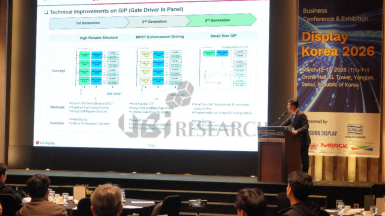
LG Display Research Fellow Shin Hong-jae introducing the development direction and key tasks for next-generation large OLEDs during a keynote speech at ‘Display Korea 2026’ hosted by UBI Research. (Source: UBI Research)
Tandem WOLED: A Core Pillar of OLED TV Competitiveness
Shin announced that LG Display has developed a large OLED panel achieving a peak brightness of 4,500 nits and a reflectance of 0.3%, significantly improving visibility even under ambient light conditions. This performance improvement is enabled by combining a tandem emission structure, pixel design, and compensation algorithms, allowing individual control of all 33 million pixels.
Large OLED: From ‘Panel Technology’ to ‘System Technology’
The evolution of LG Display’s large OLED should be understood not as a single technological advancement but from an integrated system perspective. LG Display has improved not only the emission structure but also Oxide TFT, GIP (Gate Driver In Panel), compensation circuits, and driving schemes to enhance overall performance.
Since large panels are highly sensitive to process variations that directly impact image quality, compensation technologies and driving algorithms play a critical role. LG Display has achieved simultaneous improvements in brightness, viewing angle, and bezel reduction through structural innovations. This demonstrates that OLED TV competition is shifting from panel performance to system-level design that determines actual viewing quality.
Next-Generation OLED: Balancing Performance and Cost
Shin also addressed the direction of next-generation W-OLED technology. While additional stacking of emission layers has already been secured technically, commercialization will be determined based on a comprehensive evaluation of performance and cost. This indicates that the large OLED market has entered a phase where both manufacturing efficiency and cost competitiveness are as critical as technological advancement.
Although OLED TVs have grown based on the premium segment, intensifying competition with Mini-LED LCD is making price competitiveness an increasingly important factor. Future technological directions are expected to focus not only on structural advancements but also on achieving an optimal balance between market viability and manufacturing efficiency.
Application Expansion: Key to Restructuring Profit Model
The expansion of application areas for large OLED was also highlighted as a key strategy. Transparent displays were presented as a promising application for integrating space and information in show windows, exhibitions, transportation, and smart buildings. Gaming OLED was also emphasized as a high-value-added market.
LG Display set a shipment target of approximately 7 million OLED units, including TVs and monitors, representing about a 10% increase year-over-year, with a plan to gradually increase the share of monitor OLED. This indicates that LG Display’s large OLED business is evolving from a TV-centric structure toward diversified applications, reshaping its profit model.
Conclusion: The Essence of OLED Competition Lies in Continuous Technological Accumulation
LG Display’s evolution in large OLED technology clearly demonstrates that it is not the result of a single breakthrough, but rather long-term technological accumulation and process stabilization. Only through the organic integration of emission structures, TFTs, circuits, algorithms, design, and applications can a highly complete product be realized.
LG Display is expected to further solidify its leadership in the large OLED market by enhancing the performance of Tandem WOLED and expanding its application scope.
Changwook Han, Executive Vice President/Analyst at UBI Research (cwhan@ubiresearch.com)
 2026 Small OLED Display Annual Report
101 inch Micro-LED Set BOM Cost Analysis For TVs
※ This article is produced by UBIResearchNet.
Unauthorized reproduction or citation without source attribution is prohibited.
When quoting, please clearly indicate the source (UBIResearchNet) and provide a link.