TCL CSOT Targets Medium and Large Display Market with Inkjet OLED… Proving Mass Production Competitiveness Remains Key Challenge
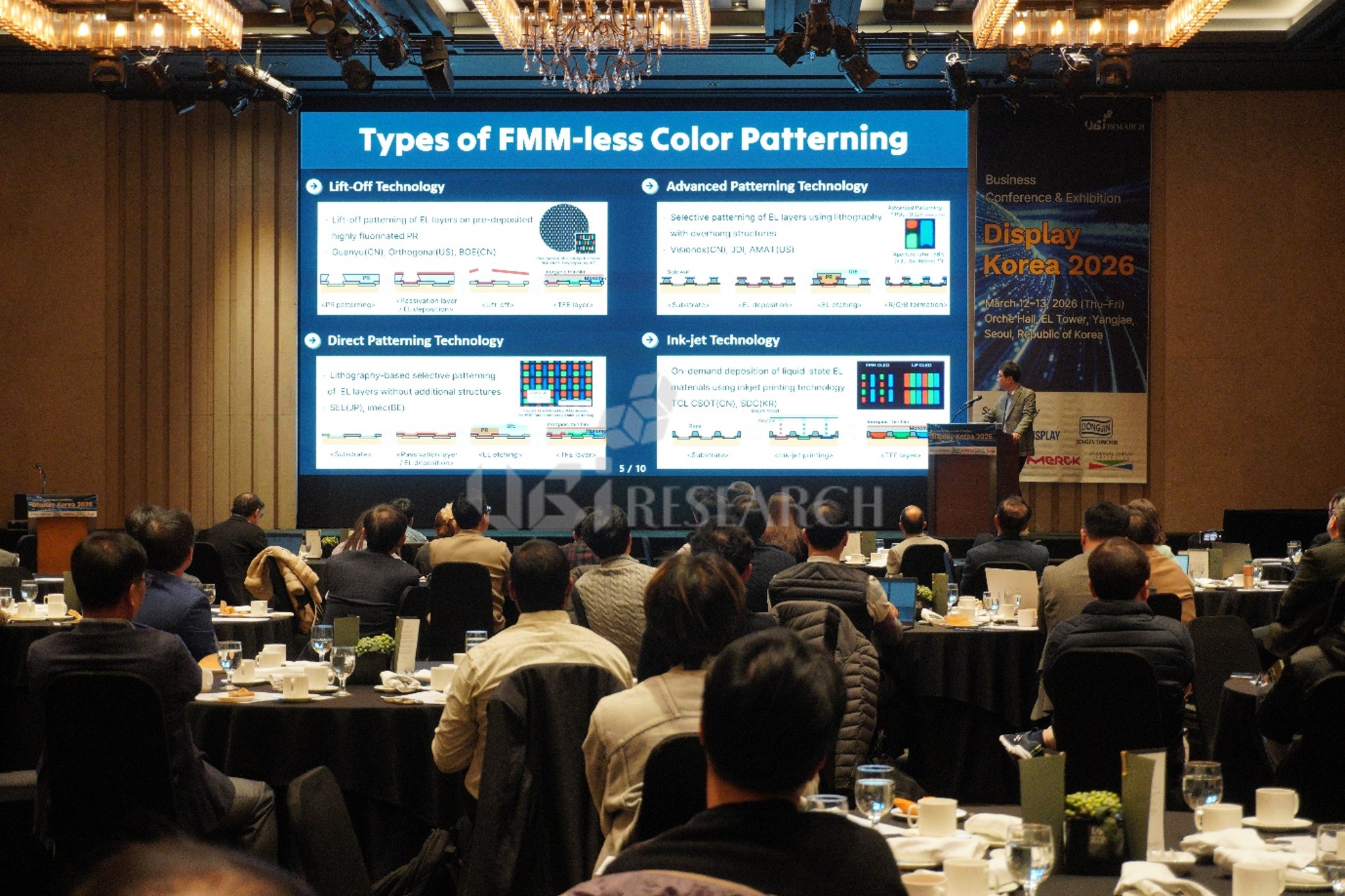
At the keynote session of Display Korea 2026, held on March 12–13 and organized by UBI Research, Fu Dong, General Manager of Guangdong Juhua Printed Display Technology (Juhua), delivered a presentation titled “Development of Printed Display Technology.” He introduced the current development status of inkjet OLED technology and outlined its pathway toward commercialization.
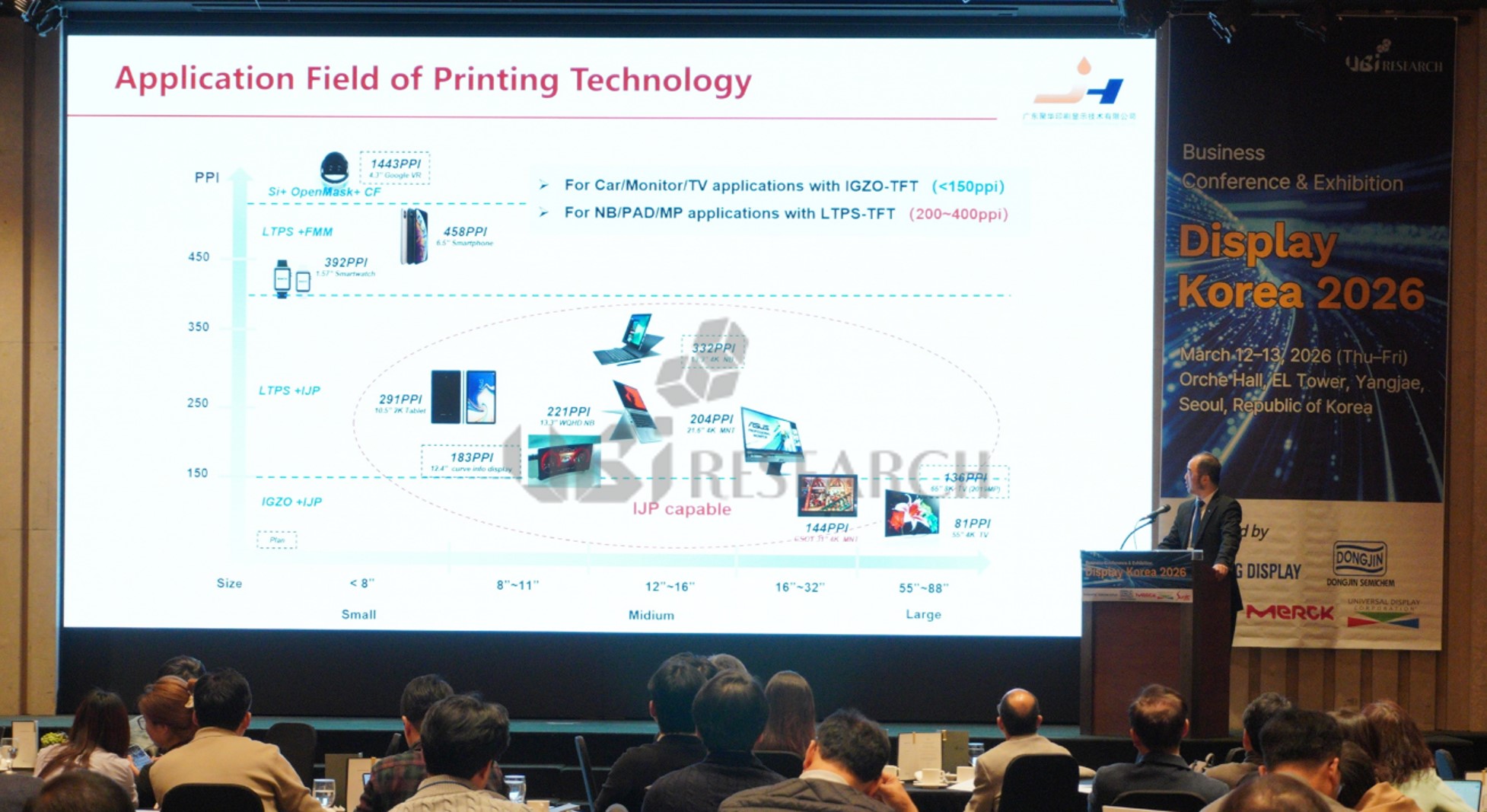
Fu Dong of Juhua introducing the application fields and industrialization direction of printed OLED technology during a keynote speech at ‘Display Korea 2026’ hosted by UBI Research. (Source: UBI Research)
Juhua, an affiliate of TCL CSOT, is a specialized R&D company focused on printed OLED technology. The company is actively advancing solution-processed OLED development while securing mass production capabilities. Centered in Guangzhou, Juhua is building both an R&D platform and an 8.6-generation production infrastructure, positioning itself to lead the commercialization of printed OLED.
Fu Dong emphasized that printed OLED represents a next-generation manufacturing technology capable of replacing conventional vacuum deposition processes. By depositing organic and inorganic materials in ink form, the process enables significant simplification and offers strong cost competitiveness, particularly for large-area applications.
In terms of technical achievements, he highlighted that a printing-based RGB architecture enables high-resolution implementation. Improvements in light efficiency and reductions in internal optical loss have enhanced power efficiency, while advancements in material performance have extended device lifetime.
TCL CSOT officially announced the mass production of printed OLED in 2024 and is establishing a production system based on its Guangzhou 8.6-generation line in 2025. This marks a clear transition of printed OLED from the R&D phase to early-stage mass production.
However, inkjet OLED still faces several technical challenges. These include film stability during ink deposition and drying, precision limitations in high-resolution patterning, the lifetime and efficiency of blue emitters, and achieving uniformity and yield in large-area processes. To address these issues, key approaches include improving printhead precision, advancing compensation algorithms, developing multi-component ink systems, introducing solution-processable blue materials, and adopting tandem structures. These are considered optimal strategies for simultaneously improving performance and ensuring production stability.
Since these challenges cannot be resolved through process innovation alone, they are expected to become critical factors determining future mass production competitiveness. Ultimately, the success of printed OLED will depend not merely on process simplification or cost reduction, but on the ability to translate these advantages into stable yield and product reliability.
As the 8.6-generation IT OLED market continues to expand, how TCL CSOT addresses these technical challenges will be a key point of industry attention.
Changwook Han, Executive Vice President/Analyst at UBI Research (cwhan@ubiresearch.com)
 2026 Medium & Large Size OLED Display Annual Report
2026 Small OLED Display Annual Report
※ This article is produced by UBIResearchNet.
Unauthorized reproduction or citation without source attribution is prohibited.
When quoting, please clearly indicate the source (UBIResearchNet) and provide a link.