UDC Presents Phosphorescent OLED Innovation at Display Korea 2026: Plasmonic OLED Signals Next Leap Toward Next-Generation Displays
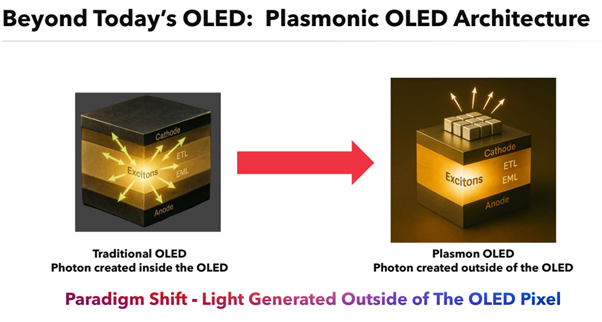
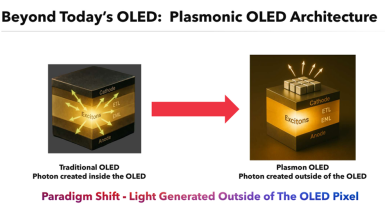
UDC’s Plasmonic OLED architecture presented at Display Korea 2026. It presents a paradigm shift where photons are created outside the OLED, drastically improving efficiency and lifespan. (Source: UDC)
Universal Display Corporation (UDC) Vice President Mike Hack delivered a keynote address at Display Korea 2026 on March 12th, presenting the current state of phosphorescent OLED (PHOLED) technology and the key achievements of its next-generation Plasmonic OLED architecture under the theme “Accelerating Industry Growth through Advances in Phosphorescent OLED Performance.”
UDC outlined how the OLED display ecosystem is rapidly diversifying — from single-stack PHOLEDs to Tandem OLEDs, phosphorescent-sensitized fluorescence (PSF), expanded pixel structures, and Plasmonic OLEDs. Across all of these architectures, UDC’s phosphorescent emitter materials serve as the central enabler of energy efficiency.
According to UDC, its red and green PHOLED materials have achieved more than an 8x improvement in efficiency and over a 60,000x increase in lifetime since initial commercialization. On a 5-inch smartphone display basis, this has translated into approximately 72% lower power consumption in 2025 compared to 2015. The company projects an additional ~25% power reduction when blue PHOLED is introduced alongside red and green.
UDC has also integrated AI and machine learning across its entire materials discovery cycle to accelerate development. Through a stepwise screening funnel — from molecular generation through ML filtering, quantum chemical evaluation, synthesis, and device qualification — the company can efficiently identify optimal candidate molecules from an enormous chemical design space.
The centerpiece of the presentation was UDC’s proprietary Plasmonic OLED architecture. In conventional OLEDs, photons are generated inside the emissive device. In the Plasmonic OLED, excitons couple to plasmons at a metal surface and are converted into photons outside the device. This mechanism dramatically shortens exciton lifetime, improving device stability, while a novel outcoupling structure recovers energy that would otherwise be lost — fundamentally raising the theoretical efficiency ceiling beyond what chemistry alone can achieve.
Data presented by UDC demonstrated that the green Plasmonic PHOLED achieves greater than 25% external quantum efficiency (EQE) while delivering a 5x lifetime improvement over the 2024 commercial specification. Efficiency roll-off under high-bright conditions was also significantly reduced compared to conventional PHOLEDs, confirming the architecture’s suitability for high-luminance applications. Additionally, color shift versus viewing angle was shown to be imperceptible, a meaningful advantage over conventional top-emitting microcavity structures.
According to UBI Research analysis, UDC’s announcement clearly signals that leadership in the OLED materials industry is shifting beyond conventional molecular chemistry design toward device architecture innovation that redefines the very physics of light emission. The Plasmonic OLED is notable for offering a structural solution that simultaneously improves efficiency, lifetime, and viewing angle characteristics — with the potential to reach performance levels comparable to Tandem OLED designs without the associated process complexity and cost burden. As UDC advances both the commercialization of phosphorescent blue PHOLED and the mass-production readiness of Plasmonic OLED structures in parallel, the timing of technology collaboration and adoption by major panel makers such as Samsung Display and LG Display will be among the most closely watched developments in the industry.
Changho Noh, Senior Analyst at UBI Research (chnoh@ubiresearch.com)
 OLED Emitting Material Market Tracker Sample
2025 OLED Emitting Materials Report Sample
※ This article is produced by UBIResearchNet.
Unauthorized reproduction or citation without source attribution is prohibited.
When quoting, please clearly indicate the source (UBIResearchNet) and provide a link.