

Creaseless Foldable Technology Competition Intensifies
Following Samsung Display’s demonstration of a laser-drilling-based creaseless panel at CES 2026 and BOE’s disclosure of its creaseless technology at MWC 2026, Visionox unveiled a creaseless foldable module at ICDT 2026 — signaling an intensifying technological competition at the panel supplier level.
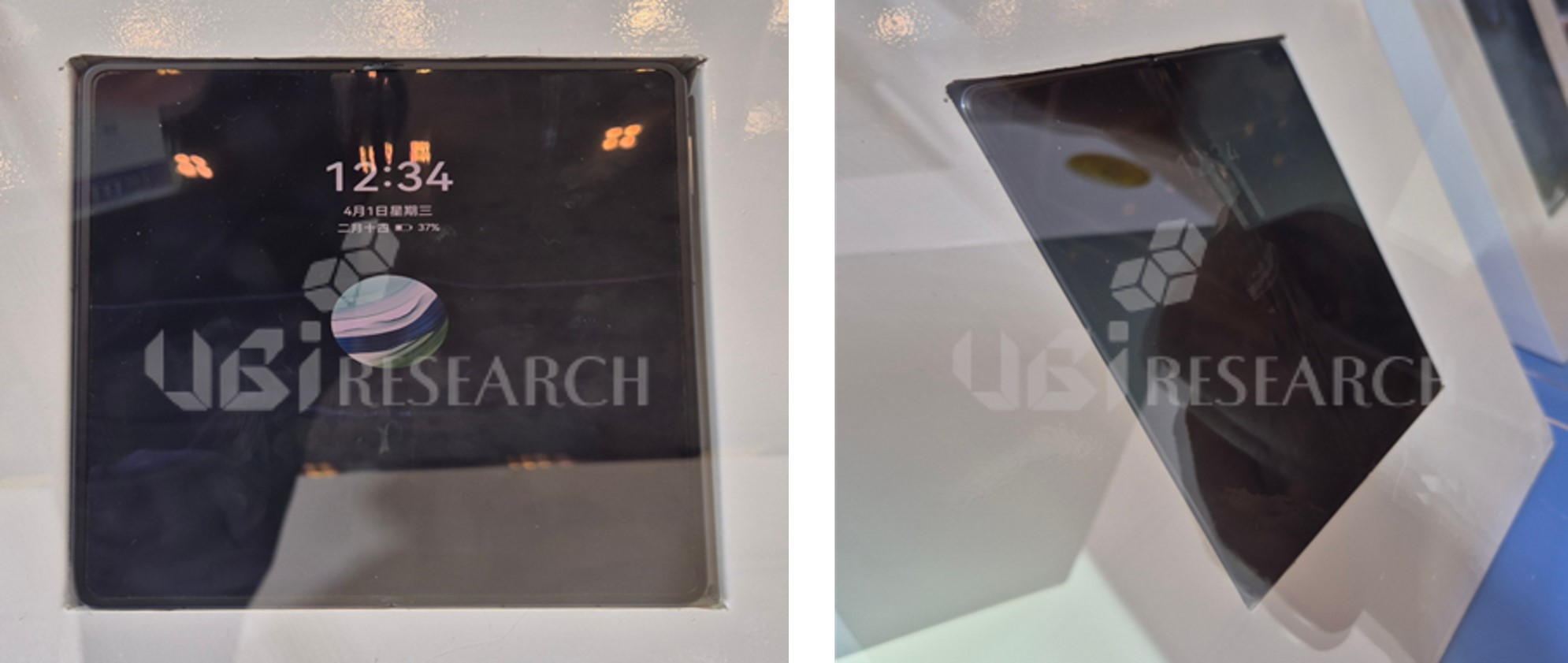
Visionox’s Creaseless foldable module showcased at ICDT 2026. By replacing the internal PET film with high-rigidity non-plastic materials, the crease depth change remains under 20μm even after 200,000 folds. (Source: UBI Research)
Samsung Display changed its approach to the metal support plate at the bottom of the panel — replacing chemical etching with laser drilling to form dozens of microscopic holes, distributing bending stress across the fold line rather than concentrating it at a single point. At CES 2026, a side-by-side “Crease Test” demonstration using a Galaxy Z Fold 7 panel showed no visually perceptible crease. The technology is expected to be adopted for the Galaxy Z Fold 8 and Apple’s foldable iPhone panels.
BOE redesigned the panel’s internal stack from a single neutral layer to a multi-neutral-layer architecture and applied a gradient modulus approach, distributing and absorbing stress across multiple layers — achieving a crease reduction of over 40% compared to conventional panels. Because only the design was changed without adding external components, manufacturing costs are reduced. The technology has already been applied to Honor Magic V6 and has completed mass-production validation.
Visionox’s creaseless foldable module takes a fundamentally different path from the two approaches above. While Samsung Display controls stress through support plate processing and BOE through internal layer redesign, Visionox addresses the physical root cause of crease at the materials level. The key is the complete removal of the PET (polyethylene terephthalate) film previously used as the internal support material in foldable modules. PET is the root cause of crease formation, as plastic deformation accumulates with repeated folding. Visionox has replaced it entirely with a high-rigidity, non-plastic material, creating a structure in which no permanent deformation occurs even after folding. In addition, a high-recovery OCA (optically clear adhesive) is applied, improving the module’s shape recovery speed after unfolding by 1.6x compared to conventional designs, thereby suppressing the accumulation of local stress.
Visionox has further stacked a multilayer composite cover structure — comprising glass, an ultra-thin protective film, and a nano-reinforced layer — along with a gradient stiffness support plate, minimizing the surface height difference between the folding region and the flat region. Measured results confirm a surface height differential of within 30μm between the folding and flat regions, and a crease depth change of less than 20μm after 200,000 repeated folding cycles. The overall module thickness is 0.4mm or less — 20% thinner than conventional designs — while front impact resistance is improved by 1.3x and rear pressure resistance by 1.25x.
In summary, the three companies are taking distinct physical approaches toward the creaseless goal: Samsung Display through support plate processing, BOE through internal panel stack redesign, and Visionox through direct materials substitution.
With Apple’s foldable iPhone launch expected in the second half of 2026 projected to significantly boost demand for foldable panels, which customers each company secures through its respective creaseless approach will be a critical variable in the reshaping of the supply chain.
Changho Noh, Senior Analyst at UBI Research (chnoh@ubiresearch.com)
 2026 Small OLED Display Annual Report
2026 Medium & Large Size OLED Display Annual Report
※ This article is produced by UBIResearchNet.
Unauthorized reproduction or citation without source attribution is prohibited.
When quoting, please clearly indicate the source (UBIResearchNet) and provide a link.