Posts

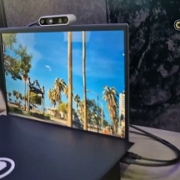
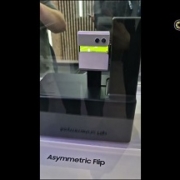
LG Display's Dual View technology allowing different content for driver and passenger, symbolizing the shift to cockpit platforms.

CES 2026: The Evolution of Automotive Displays, Beyond Screens to Platforms

On January 6, CES 2026 officially opened in Las Vegas, the United States. At this year’s exhibition, automotive displays clearly demonstrated their evolution beyond simple information panels into core interfaces that integrate and intelligently orchestrate the in-vehicle experience. Alongside advances in OLED, Micro LED, and Mini LED technologies, innovations in form factors, transparency, and AI-driven interaction converged to define the future direction of the smart cockpit.

Korean companies highlighted their technological competitiveness by focusing on ultra-large displays, form flexibility, and differentiated user experiences. LG Display redefined the vehicle interior as a continuous digital space by showcasing its pillar-to-pillar (P2P) OLED display extending from the driver’s side to the passenger side. The single-panel P2P OLED, reaching up to 51 inches, delivers high resolution and excellent touch sensitivity while addressing concerns over image quality degradation in large-format displays. LG Display also unveiled a sliding OLED concept that can retract into the dashboard, presenting a cockpit vision in which screen size and function adapt dynamically to driving conditions. In addition, automotive OLEDs incorporating under-display camera (UDC) technology and Dual View functionality emphasized a direction in which a single screen can provide different information simultaneously to the driver and the passenger.

LG Display's 12-inch UDC IR OLED Cluster and Dual View Display showing different content to driver and co-driver

LG Display’s Dual View technology providing different information to driver and co-driver, featured with UDC cluster. (Source: LGD)

LG Electronics showcased applications of transparent OLED based on LG Display’s panel technology, presenting the potential of “invisible interfaces” in automotive displays. Transparent OLED technology enables both open visibility and information display, demonstrating its potential expansion into future applications such as HUDs, panoramic displays, and in-vehicle and vehicle-to-outside communication.

LG Electronics' Transparent OLED Windscreen and Side-Window display concept for vehicles

LG Electronics’ Transparent OLED Windscreen and Side-Window solutions displaying info while maintaining openness. (Source: LGE)

Samsung Display also emphasized spatial efficiency and installation flexibility through layout-adaptive automotive OLED solutions. Its 18.1-inch “Flexible L” center information display can be bent into an L-shape to conform to dashboard structures, while the 13.8-inch passenger information display (PID) can be hidden beneath the dashboard when the seat is unoccupied, enhancing space utilization. Samsung Display further highlighted the integration of a robust OLED panel with a 500R curvature on a glass substrate, achieving both visual sophistication and ease of installation.

Chinese companies placed strong emphasis on ultra-large integrated displays and advanced HUD technologies, showcasing their system-level integration capabilities alongside aggressive performance specifications. BOE introduced its HERO 2.0 smart cockpit, emphasizing scenario-based in-vehicle experiences centered on displays. The Micro LED PHUD panoramic head-up display, delivering up to 50,000 nits of brightness, ensures high visibility even under strong ambient light and integrates AI-based voice and gesture recognition to further enhance cockpit intelligence. HERO 2.0, which also includes a 15.6-inch UB Cell central display, an AI audio system, and an integrated digital broadcasting function, clearly illustrates BOE’s strategy of transforming vehicles from transportation tools into living spaces. At the same time, BOE highlighted low-power IGZO oxide displays and carbon-reduction achievements, reinforcing its commitment to environmentally sustainable manufacturing.

Demo of BOE's HERO 2.0 Smart Cockpit featuring Micro LED Panoramic HUD

BOE demonstrating the HERO 2.0 Smart Cockpit with a 50,000-nit Micro LED Panoramic HUD. (Source: BOE)

TCL CSOT made a strong impression with its 28-inch inkjet-printed OLED applied to a sliding center console and curved armrest, demonstrating notable innovation in form factor design. At its booth, TCL CSOT also conducted live demonstrations of a projection-based HUD (P-HUD). The HVA Ultra P-HUD projects information onto the vehicle’s front windshield using a multi-LCD projection structure, positioning itself as either a replacement for or a complement to conventional dashboard displays. This demonstrated TCL’s strategy of pursuing cockpit integration not only through large OLED panels but also through HUD solutions.

HVA Ultra P-HUD (Panoramic HUD) projection demo displayed at TCL CSOT booth

TCL CSOT’s Panoramic HUD solution projecting info on the windshield to replace dashboards. (Source: TCL CSOT)

Tianma presented a next-generation cockpit centered on a 49.6-inch C-shaped panoramic display positioned as an information hub, integrating the instrument cluster, center display, passenger display, and side-mirror areas into a single visual architecture. By leveraging more than 210,000 independent dimming units to achieve a 100,000:1 contrast ratio and suppressing reflectance to below 0.55 percent, Tianma emphasized both readability and safety in ultra-large displays. The company’s multi-screen ecosystem, including a 43.7-inch IRIS PHUD panoramic display, a flexible pull-out display, and a small OLED integrated into the steering wheel, highlighted its strengthening capabilities in system-level cockpit design. Visionox also showcased a dynamic bending display using dual flexible AMOLED panels, presenting an approach that simultaneously improves the stowability and visibility of large screens.

Tianma's 43.7-inch IRIS Panoramic HUD and integrated cockpit display revealed at CES 2026

Tianma’s next-gen cockpit and Panoramic HUD system integrating instrument cluster and center display. (Source: Tianma)

Taiwanese companies pursued differentiation through transparent displays and system integration. AUO, through its subsidiary AUO Mobility Solutions, showcased transparent Micro LED displays, INVISY stealth displays, and an AI-based cockpit domain control platform, defining displays as core nodes connected to vehicle computing systems. The integration with a glass-substrate satellite antenna suggested a future in which automotive displays are directly linked to external networks. Innolux emphasized integrated cockpit solutions combining visual and audio technologies through collaboration with CARUX and Pioneer, and unveiled an ultra-high-brightness Micro LED HUD delivering 50,000 nits of direct brightness and 10,000 nits in reflected image brightness, highlighting stable HUD performance even under extreme conditions.

AUO's automotive Transparent Micro LED display showcased at CES 2026

AUO’s Transparent Micro LED display presented as a key node connecting vehicles with external networks. (Source: AUO)

From the automaker perspective, the direction of change was equally clear. BMW presented a panoramic HUD concept for its next-generation iX3, proposing a future HUD architecture that utilizes the entire windshield as an information interface and emphasizing tighter integration between display technology and vehicle design.

BMW iDrive Surround View System and Panoramic HUD concept demonstrated at the booth

BMW’s futuristic Panoramic HUD and iDrive system utilizing the entire windshield as an information interface. (Source: BMW)

Commenting on the automotive display trends observed at CES 2026, Changwook Han, Executive Vice President at UBI Research, stated, “Automotive displays have entered a phase of cockpit platform competition, where form factors, systems, AI, and content converge, rather than remaining a field of individual component competition.” He added, “The advancement toward ultra-large displays, transparency, and sophisticated HUDs will ultimately serve as key indicators of how deeply display makers can engage in shaping the user experience of automakers.”

Changwook Han, Executive Vice President/Analyst at UBI Research (cwhan@ubiresearch.com)

▶2025 Automotive Display Technology and Industry Trends Analysis Report

※ This article is produced by UBIResearchNet.
Unauthorized reproduction or citation without source attribution is prohibited.
When quoting, please clearly indicate the source (UBIResearchNet) and provide a link.

Samsung Display Begins Full-Scale Supply of World’s First 360Hz ‘V-Stripe’ QD-OLED

To be equipped in new 2026 monitor models from 7 clients including ASUS and MSI

□ ‘High Performance’ QD-OLED monitor anticipated for ’26 debut featuring new pixel structure, 21:9 ultra-wide aspect ratio, 360Hz high refresh rate, and 1,300 nits peak brightness

□ ‘V-Stripe’ pixel application significantly strengthens text readability… Provides optimal gaming experience with wide screen, smooth transitions, and fast response speed

□ QD-OLED solidifies #1 spot with 75% market share in the self-emissive monitor market in ’25

□ “Will continue technical innovation with QD-OLED in the ‘high-end monitor’ market, a battleground for the latest displays”

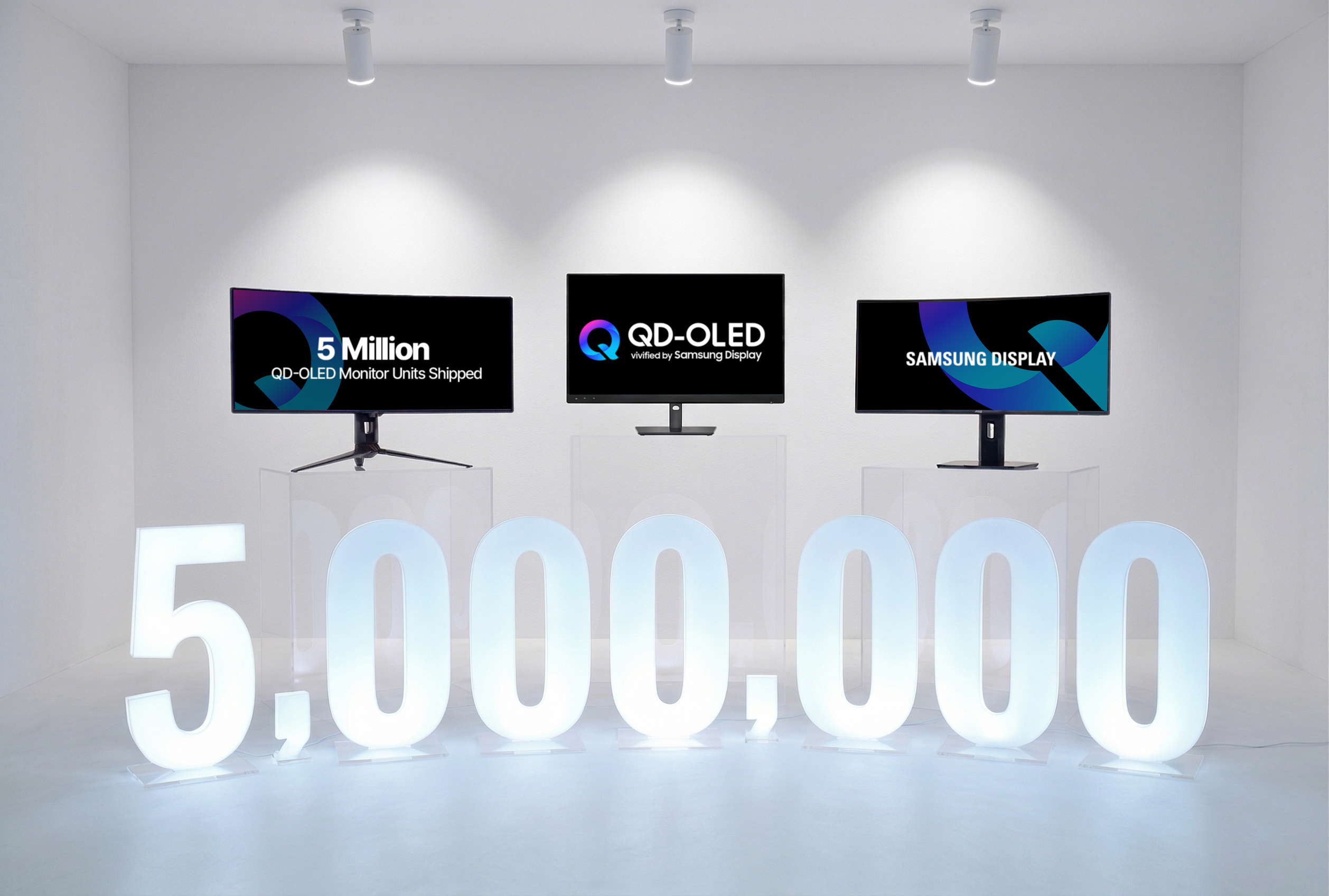
Samsung Display announced on the 1st that it is launching the world’s first 34-inch 360Hz QD-OLED featuring a ‘V (Vertical)-Stripe’ pixel structure. Samsung Display began mass production of the new product last December and is now fully supplying it to a total of seven global monitor manufacturers, including ASUS, MSI, and Gigabyte.

While conventional QD-OLEDs utilized a triangular arrangement for the Red (R), Green (G), and Blue (B) sub-pixels, the ‘V-Stripe’ arranges the R, G, and B sub-pixels in a vertical stripe pattern. Although commonly referred to in the industry as a stripe structure or RGB stripe structure, Samsung Display developed a stripe pixel structure optimized for Quantum Dot elements in-house and named it ‘V-Stripe’. Applying this pixel structure expresses text edges more clearly, offering an optimal monitor solution for users sensitive to text readability in tasks such as document work, coding, and content creation.

In addition, this new product combines the ▲‘V-Stripe’ structure with a ▲21:9 ultra-wide aspect ratio, a ▲360Hz high refresh rate enabling smooth transitions and fast response speeds, and ▲high brightness characteristics with a peak of 1,300 nits. It is gathering high expectations among consumers who enjoy speedy and immersive games such as sports and racing.

Generally, a 21:9 aspect ratio significantly increases the number of horizontal pixels and data processing volume compared to 16:9, increasing the burden on driving components such as power consumption and heat generation even at the same refresh rate. Also, it is known that implementing high refresh rates is difficult because it is hard to uniformly match the signal timing between left and right pixels.

A Samsung Display representative stated, “The biggest technical hurdles in mass-producing high-refresh-rate products with a new pixel structure are reduced organic material lifespan, heat generation, and brightness degradation.” The representative added, “Since QD-OLED adopts a top-emission method, it is advantageous in terms of brightness. Through efficiency improvement of organic materials and design optimization, we were able to mass-produce a ‘high performance’ monitor display equipped with all four specs: ▲‘V-Stripe’ pixel structure, ▲ultra-wide aspect ratio, ▲high refresh rate, and ▲high brightness.”

The ‘V-Stripe’ QD-OLED monitor, considered a highly anticipated product in the new year’s monitor market, can be seen at ‘CES 2026’ opening in Las Vegas, USA on the 6th (local time). This is because ASUS and MSI will unveil new monitor products equipped with the ‘V-Stripe’ structure QD-OLED for the first time at CES. Samsung Display also plans to reveal the panel at a private booth operated at the Encore at Wynn hotel during the CES period.

According to market research firm Omdia, the transition from LCD to OLED continues, with the proportion of products equipped with self-emissive panels in the premium monitor market of $500 or more expected to rise from 14% in ’24 to 23% in ’25 and 27% in ’26. Amidst this, Samsung Display’s QD-OLED shipments in the monitor OLED panel market for ’25 are estimated at approximately 2.5 million units, expecting to maintain an overwhelming number one position in the market with a share exceeding 75%.

Jung Yong-wook, Vice President and Head of the Strategic Marketing Team for Large Display Business at Samsung Display, stated, “The high-end monitor market, including gaming, can be called a battleground for the latest display technologies as consumers’ sensitivity and expectations for display image quality are high.” He added, “As QD-OLED is receiving overwhelming support from consumers in this market, we will continue to maintain market leadership by showcasing even more innovative technologies in the future.”

Bar chart showing the quarterly growth of OLED smartphone panel shipments in 2025, highlighting Q4 peak.

OLED Smartphone Panel Shipments to Reach 900 Million Units in 2025…Q4 Production Drives Annual Growth

Quarterly OLED Shipments Forecast for Smartphones by Manufacturer in 2025 (Source: UBI Research)

UBI Research forecast trend for quarterly OLED smartphone panel shipments and manufacturer share in 2025 (Source: UBI Research)

According to UBI Research’s quarterly publication, the OLED Display Market Tracker, OLED panel shipments for smartphones and foldable phones are expected to reach approximately 900 million units in 2025. By shipment share, Chinese panel makers are projected to account for about 48.8% of the annual total, nearly matching the level of Korean manufacturers. While shipment volumes between the two countries are similar, Korean companies maintain a revenue advantage due to their higher proportion of premium-tier orders for flagship models such as Apple’s iPhone and Samsung’s Galaxy.

In particular, Korean panel makers saw a significant surge in smartphone and foldable panel shipments in the fourth quarter, marking their strongest performance of the year. Panel supply expanded sharply from the third quarter with the launch of new Apple products, and shipments peaked as Samsung Electronics began full-scale production of Galaxy S26 series panels.

Samsung Display continued its solid growth into the fourth quarter, driven by increasing demand for panels for the iPhone 17 series and Samsung’s Galaxy S25 FE. With mass production for both the iPhone lineup and Galaxy S26 series in full swing, Samsung Display is expected to post its highest annual shipment volume to date. LG Display also achieved a strong rebound in the third quarter with shipments of roughly 20 million units, representing a sharp quarter-over-quarter increase, and its Q4 shipments are forecast to rise by an additional 20%.

Chinese panel makers showed quarterly fluctuations depending on demand conditions but maintained stable supply across major smartphone brands. BOE expanded its customer base by diversifying its supply portfolio from entry-level to upper-mid-range smartphone models. TCL CSOT and Visionox continued to grow shipments to both the domestic Chinese market and global brands, while Tianma focused on enhancing technological competitiveness by increasing the share of high value-added products such as LTPO.

In terms of set makers, Apple secured the largest volume of OLED panels, followed by Samsung Electronics, Xiaomi, Vivo, and Huawei. Executive Vice President Changwook Han of UBI Research commented, “As the industry enters the second-half peak season, Korean display manufacturers are showing clear improvements in both shipments and revenue. In particular, Samsung Display is expected to ship around 150 million panels in the fourth quarter driven by increased demand for iPhone panels.” He added, “Chinese panel makers are also maintaining stable momentum by adjusting their supply strategies in line with shifting market demand.”

Changwook Han, Executive Vice President/Analyst at UBI Research (cwhan@ubiresearch.com)

▶ Quarterly Small OLED Display Market Tracker Sample

▶Quarterly Medium & Large OLED Display Market Tracker Sample

※ This article is produced by UBIResearchNet.
Unauthorized reproduction or citation without source attribution is prohibited.
When quoting, please clearly indicate the source (UBIResearchNet) and provide a link.

Samsung Display Wins “Korea Technology Award” for QD-OLED Innovation

Recognized with Minister’s Commendation for developing high-resolution monitor and high-brightness TV QD-OLED panels

□ Leading innovation in large-scale panels with the world’s first 160PPI QD-OLED for monitors and 4,000-nit QD-OLED for TVs.

□ Winning products showcased at the “2025 Korea Tech Festival” at COEX (Dec. 3–5).

□ Choi Yeol, Executive Vice President, receives Presidential Commendation for contributions to industrial technology promotion.

Samsung Display announced that it has received the Minister’s Commendation at the “Korea Technology Award” for its development of the world’s first 160PPI (Pixels Per Inch) QD-OLED for high-resolution monitors and 4,000-nit QD-OLED for high-brightness TVs.

The company is currently showcasing its award-winning QD-OLED products, along with its foldable display lineup, at the “2025 Korea Tech Festival” held at COEX in Seoul from December 3rd to 5th. Established in 1992, the “Korea Technology Award” is considered the country’s most prestigious technology honor. It is awarded by the Ministry of Trade, Industry and Energy (MOTIE) and the Korea Institute for Industrial Technology Planning and Evaluation (KIET) after evaluating leading domestic companies on technological value, development capabilities, and commercialization potential.

Earlier this year, Samsung Display launched its 160PPI QD-OLED for monitors and 4,000-nit QD-OLED for TVs, spearheading technological innovation in the large-sized display sector. The 160PPI monitor panel features an ultra-high-density pixel arrangement, packing 160 pixels into every inch. Higher PPI allows for a greater amount of data to be displayed within the same resolution, resulting in significantly sharper and more detailed imagery.

The 4,000-nit TV panel boasts extreme brightness and clarity that were previously difficult to achieve, delivering an exceptional viewing experience even in very bright environments. Optimized for High Dynamic Range (HDR) content, this product offers delicate expression in dark scenes while providing powerful contrast in bright scenes for lifelike picture quality.

Meanwhile, Choi Yeol, Executive Vice President and Head of Small & Medium Display Development at Samsung Display, was selected as a person of merit for the promotion of industrial technology at the festival, receiving the Presidential Commendation. EVP Choi was recognized for his pivotal role in the development of foldable displays.

A bar chart illustrating the forecast growth of XR devices equipped with OLEDoS displays between 2025 and 2031, highlighting AR dominance.

XR Headset Shipments Set to Top 10 Million in 2025… AR Expansion Drives OLEDoS Growth

Forecast chart of XR device shipments with OLEDoS from 2025 to 2031 (Source: UBI Research)

UBI Research forecast trend for XR device (MR/VR and AR) shipments equipped with OLEDoS from 2025 to 2031 (Source: UBI Research)

The rapid expansion of the AI and XR device market has intensified competition in next-generation microdisplay technologies. According to a new report published by UBI Research titled ” XR Industry Trends and OLEDoS Display Technology & Industry Analysis” XR headset shipments are expected to exceed 10 million units by 2025. Notably, AR smart glasses alone saw over a 50% year-on-year increase in the first half of this year, clearly shifting the market’s center of gravity.

The AR market is diversifying, expanding its application range from AI glasses focused on information display to business-use AR glasses and content-viewing devices. In the consumer AI glasses market, primarily focused on information display, monochrome displays with resolutions around 640 x 480 (VGA) and microdisplays under 0.3 inches are commonly used, with LCoS and micro LED competing for position. Workplace AR glasses require resolutions of 1280×720 (HD) or higher, while content-viewing AR demands resolutions of 1920×1080 (FHD) or higher.  As industry’s expansion focus shifts from VR to AR, the demand for simultaneously meeting ultra-high resolution, high brightness, and lightweight requirements has grown significantly. Consequently, OLEDoS is evaluated as the fastest-growing display technology within the XR ecosystem.

Global manufacturers are also accelerating OLEDoS development and supply chain expansion. Samsung Display joined the OLEDoS market, previously led by Sony, BOE, and Seeya, by supplying OLEDoS panels for Samsung Electronics’ Galaxy XR, released in October 2025, following Sony. In China, companies like BOE, Seeya, and SIDTEK have commenced mass production of 12-inch OLEDoS panels, marking the most notable shift in the supply chain. Chinese firms are strengthening their in-house capabilities in core processes such as high-resolution patterning, Si-backplane design, and tandem OLED structures, suggesting their global supply share will rapidly expand in the future.

UBI Research analyst Changho Noh predicted, “The OLEDoS market is projected to grow from approximately $285 million in 2025 to $840 million by 2031, driven by supply chain expansion and diverse demand bases.”

He further analyzed, “Shipments of OLEDoS-equipped XR devices are expected to increase from 1.2 million units in 2025 to 8.86 million units by 2031, with AR devices anticipated to account for approximately 90% of total OLEDoS shipments by 2031.”

Changho Noh,  Senior Analyst at UBI Research (chnoh@ubiresearch.com)

▶XR Industry Trends and OLEDoS Display Technology & Industry Analysis Report

※ This article is produced by UBIResearchNet.
Unauthorized reproduction or citation without source attribution is prohibited.
When quoting, please clearly indicate the source (UBIResearchNet) and provide a link.

Featured graphic of 2024–2025 OLED shipment share by application highlighting smartphone dominance and China’s rising supply share (Source: UBI Research)

Dual Axes of the 2025 OLED Market: Korea’s Premium Focus and China’s Expansion in Shipments

The OLED market in 2024 and 2025 witnessed marked changes in both the demand structure by application and the supply structure by panel manufacturer. The smartphone-centric demand base became more robust, while major Korean and Chinese panel manufacturers, leveraging their distinct strengths, expanded their market contributions, leading to continued diversification in the OLED industry.

By application, smartphones dominated the OLED market in 2024, accounting for 82% of total shipments, reaching 833.8 million units. Watches accounted for 119.7 million units (12%), while other product groups, including tablets, laptops, monitors, and TVs, remained small markets. This structure continued in 2025, with smartphone shipments increasing to 920.7 million units, representing 84% of the total. Watches remained relatively stable at 113.4 million units, and the share of other product groups remained largely unchanged.

Pie charts of OLED shipments by application for 2024 and 2025 showing larger smartphone share (Source: UBI Research)

OLED shipment share by application, 2024 (left) and 2025 (right) (Source: UBI Research)

In 2024, the roles of Korea and China in OLED panel supply were clearly divided. Samsung Display maintained its position as the largest supplier with 410 million units (41%), while LG Display recorded 100 million units (11%). In the same year, Chinese panel makers continued their quantitative expansion, accounting for 48% of the total, with a combined shipment of 490 million units: BOE with 138 million units, Visionox with 114 million units, Tianma with 102 million units, CSOT with 83 million units, and EverDisplay with 43 million units.

This structure was further strengthened in 2025. Chinese panel makers, including BOE, Tianma, Visionox, CSOT, and EverDisplay, combined to ship 555 million units annually, accounting for over 51% of the global supply, emerging as a key player in the global supply chain. In the same year, Samsung Display maintained its technology-focused responsiveness, with shipments reaching 411 million units (37%), while LG Display reached 128 million units (12%).

The differences in sales strategies between the two countries were also clear. In 2024, Samsung Display solidified its premium-focused structure with $25.6 billion (57%), while LG Display also achieved $7 billion. Conversely, Chinese companies such as BOE, Visionox, and Tianma demonstrated a trend of expanding sales based on mass production. In 2025, LG Display grew significantly to $11.6 billion, and BOE’s shipments also expanded to $7.1 billion, further separating the two countries’ technology and production strategies.

In summary, the OLED market in 2025 saw a strengthened smartphone-centric demand structure, while Chinese companies accounted for over half of panel shipments, demonstrating a clear shift in regional composition. Korean companies maintained a sales structure centered on high-value-added products, while Chinese companies continued to expand their market presence based on increased shipments. UBI Research Executive Vice President Changwook Han said, “The 2025 OLED market is a period in which the supply structure by region and company is expanding simultaneously, with each company broadening its market response based on its product portfolio and technological capabilities.”

Changwook Han, Executive Vice President/Analyst at UBI Research (cwhan@ubiresearch.com)

▶ Quarterly Small OLED Display Market Tracker Sample

▶Quarterly Medium & Large OLED Display Market Tracker Sample

※ This article is produced by UBIResearchNet.
Unauthorized reproduction or citation without source attribution is prohibited.
When quoting, please clearly indicate the source (UBIResearchNet) and provide a link.

Composite image of Garmin Fenix 8 Pro Micro-LED smartwatch showing front face and side view for outdoor visibility (Source: Garmin)

When will the commercialization competition of Micro-LED smartwatch products become feasible?

The development of Micro-LED-based smartwatches has continued since 2020 through prototype exhibitions, and their high brightness characteristics led to high expectations for commercialization. Previously, companies like KONKA, AUO, Innolux, and Apple had attempted development or commercialization. However, when Apple halted its own development in early 2024, the difficulties of the Micro-LED manufacturing process and high cost issues came to the fore, suggesting that commercialization of Micro-LED smartwatches would require more time.

Assorted Micro-LED smartwatch prototypes from multiple vendors

Assorted Micro-LED smartwatch prototypes from multiple vendors

However, sports smart wearable brand Garmin launched the world’s first Micro-LED smartwatch, the ‘Fenix 8 Pro’, in September this year. It is currently retailing for approximately 13,000 yuan on Chinese online shopping platforms. Garmin’s September launch sent a significant signal to the market, demonstrating that Micro-LED technology has secured commercial viability in the smartwatch sector.  Of course, there are still many areas requiring improvement. Nevertheless, beyond AUO, which is already in mass production, companies like PlayNitride, Innolux, Samsung Display, TCL CSOT, and Tianma are actively entering the market and accelerating efforts to commercialize Micro-LED smartwatches. By late 2023, AUO had already achieved mass production of Micro-LED watch panels. In its subsequent production plans, AUO’s 4.5-generation Micro-LED production line is scheduled to enter mass production this year, with products covering smartwatches and large TVs. At CES 2025, Samsung Display showcased a watch prototype (2.1 inches, 418×540 resolution, 326 ppi) developed over years of Micro-LED technology advancement. Chinese home appliance company KONKA also unveiled its Micro-LED watch, the APHAEA Watch, in 2020. The Chongqing KONKA Optoelectronics Technology Research Institute is enhancing core technologies to reduce manufacturing costs. PlayNitride has positioned smartwatches as a key growth driver this year, exhibiting a 1.39-inch smartwatch panel at Touch Taiwan 2025. This product applies high-efficiency, low-power ‘Tantium’ chip technology to achieve high resolution and 5,000 nits peak brightness, presenting a new solution that simultaneously delivers low power consumption and high image quality for wearable devices. Innolux has also developed 1.1-inch and 1.39-inch Micro-LED displays with integrated touch sensors. Tianma has established a dedicated Micro-LED research institute and is exploring new application areas like smartwatches, in addition to automotive applications.

Garmin Fenix 8 Pro Micro-LED smartwatch (Source: Garmin)

Garmin Fenix 8 Pro Micro-LED smartwatch (Source: Garmin)

Garmin has pioneered Micro-LED in smartwatches, but who will be the next contender for Micro-LED smartwatches? When will commercialization competition become feasible? Significant hurdles remain. Developed watch panels (326~338 PPI) achieve high brightness levels of 4,000~6,000 nits. However, to compete with existing OLED products, Micro-LED chip and manufacturing costs must be reduced, and power consumption characteristics must be improved. Recent announcements from Micro-LED technology companies clearly outline and are actively pursuing solutions to overcome these cost challenges. The mid-to-long-term strategy for Micro-LED smartwatches is to build integrated technological capabilities combining Micro-LED technology with health monitoring sensors. Long-term, as chip miniaturization technology matures and the advantages of sensor integration are fully realized, Micro-LED is expected to break free from its niche market limitations and expand into the broader wearable product market. UBI Research analyzed that the Micro-LED smartwatch market will fully open starting in 2028.

Namdeog Kim, Senior Analyst at UBI Research(ndkim@ubiresearch.com)

▶2025 Micro-LED Display Industry and Technology Trends Report

※ This article is produced by UBIResearchNet.
Unauthorized reproduction or citation without source attribution is prohibited.
When quoting, please clearly indicate the source (UBIResearchNet) and provide a link.

Featured image illustrating global IT OLED shipment growth forecast through 2029 (Source: UBI Research)

“Beyond Mobile” Era Begins… IT OLED to More Than Double by 2029

IT OLED shipment forecast chart for 2025–2029 (Source: UBI Research)

IT OLED shipment forecast (Source: UBI Research)

According to UBI Research’s recently published report, “Beyond Mobile: IT OLED Technology and Industry Analysis,” global shipments of IT OLEDs are expected to more than double from 24 million units in 2025 to 53 million units in 2029. The report states that OLED adoption in tablets, notebooks, and monitors is entering a structural growth phase over the next four years.

Company-level shipment projections also show clear shifts. Samsung Display, currently the largest producer of OLED panels for notebooks, tablets, and monitors, is expected to maintain a stable market share of more than 60%. LG Display, Everdisplay, BOE, and Visionox are projected to follow, shaping a competitive global landscape in the IT OLED market.

Because most IT OLED products use medium-to-large panel sizes, large-substrate production lines that maximize glass utilization rates are essential. As global device makers—especially Apple—accelerate their adoption of OLED across IT product categories, panel manufacturers are positioning 8.6-generation (8.6G) OLED line investments as a core strategic priority.

The investment landscape reflects this trend. After Samsung Display announced the industry’s first 8.6G OLED line investment worth approximately KRW 4 trillion in April 2023, BOE, Visionox, and TCL CSOT soon followed. More recently, Tianma has also begun reviewing 8.6G OLED investment, drawing attention across the industry. This shift signals that the OLED market is moving beyond a smartphone-centered structure and into a phase of expanding demand driven by notebooks, tablets, and monitors.

As the market grows, technology requirements for IT OLEDs are also becoming more stringent. The report highlights that IT products have longer replacement cycles and a higher percentage of white-background usage for document work, making them more vulnerable to burn-in than smartphones. As a result, 2-stack tandem OLED, known for long lifetime, high brightness, and high efficiency, is evaluated as essential. Samsung Display, BOE, and Visionox are therefore investing in production lines capable of mass-producing 2-stack tandem OLED.

Customer acquisition competition is another critical factor. Samsung Display has secured Apple as a key customer and is building its strategy around mass production for the OLED “MacBook Pro.” In contrast, Chinese panel makers are prioritizing markets for OLED panels used in notebooks, tablets, and smartphones among Chinese and global brands, rather than targeting Apple’s supply chain as their first objective.

UBI Research Vice President Changwook Han stated, “As Chinese OLED panel makers rush into 8.6G OLED investments in an effort to catch up with Samsung Display, the industry is closely watching how effectively Samsung Display can leverage its technology leadership to secure additional IT customers beyond Apple.”

Changwook Han, Executive Vice President/Analyst at UBI Research (cwhan@ubiresearch.com)

Graph illustrating 2025 foldable OLED shipment decline and anticipated 2026 market recovery driven by Apple’s foldable iPhone (Source: UBI Research)

Slow Growth in Foldable Phones Due to High Prices and Weak Demand… The 2026 Foldable iPhone Expected to Be a Turning Point

OLED shipment trend for foldable smartphones in 2025 by quarter showing QoQ and YoY changes (Source: UBI Research)

OLED Shipment Trend for Foldable Phones (Source: UBI Research)

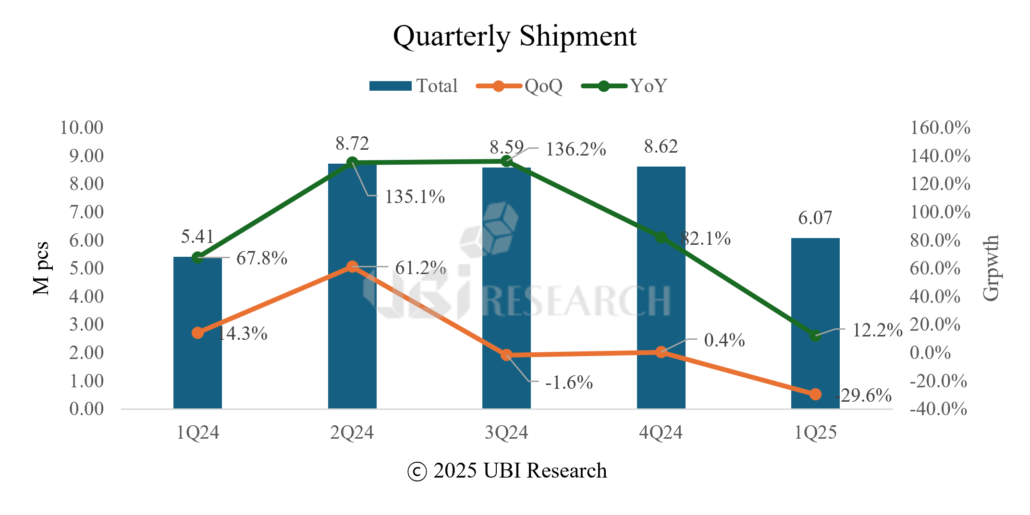
According to UBI Research’s recently published Small OLED Display Market Tracker, global shipments of OLEDs for foldable phones continued to show weak year-on-year performance for three consecutive quarters.

Cumulative shipments for January–September 2025 totaled 16.7 million units, down about 20 percent from 21 million units during the same period last year. On an annual basis, foldable OLED shipments in 2025 are expected to reach 21.3 million units, a 14.4 percent decrease from the previous year.

The foldable-phone market, now in its fifth year since launch, has entered a mature stage but faces limitations in expanding its consumer base. Although leading brands such as Samsung Electronics and Huawei continue to release new products, new demand beyond replacement purchases has slowed.

The biggest constraint is price. While high-end bar-type smartphones remain in the 1.3 to 1.7 million-won range, Samsung’s Galaxy Z Fold series sells for over 2 million won, and Huawei’s tri-fold model exceeds 3 million won. The foldable iPhone, expected to launch next year, is also likely to be priced above 2.5 million won, making it less accessible to consumers.

As a result, even within the premium market, the perception that “technological innovation does not bring enough practical benefit” is spreading, deepening consumers’ hesitation to buy.

The foldable OLED market is expected to stagnate through 2025, but structural change is likely to begin in 2026. Samsung Display is reportedly set to be the sole supplier of OLED panels for Apple’s foldable iPhone, and once full-scale mass production begins, Samsung’s foldable OLED shipments are expected to rise sharply.

Meanwhile, Chinese panel makers are responding mainly through domestic brands. BOE, CSOT, and Visionox are working to increase market share by improving next-generation hinge structures, enhancing UTG (ultra-thin glass) durability, and expanding low-cost foldable lineups. In particular, Huawei, Oppo, and Vivo are pursuing both “vertical integration” and “domestic-market-focused strategies” to secure price competitiveness.

UBI Research Executive Vice President Changwook Han said, “Foldable phone shipments are stagnant in both Korea and China, but 2026, when Apple enters the market, will be a turning point. Samsung Display is expected to strengthen its influence in the market by maintaining technological superiority and exclusively supplying foldable OLEDs to Apple.”

He added, “Chinese companies are expanding their market share through strong domestic bases, but in terms of panel performance and reliability, they still have not fully closed the technological gap with Samsung.”

The industry expects that although growth in foldable phones will remain stagnant through 2025, it will recover double-digit growth from 2026 after Apple’s market entry.

Changwook Han, Executive Vice President/Analyst at UBI Research (cwhan@ubiresearch.com)

▶ Quarterly Small OLED Display Market Tracker Sample

▶Quarterly Medium & Large OLED Display Market Tracker Sample

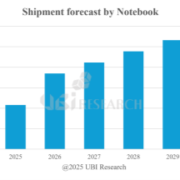
Graph showing forecasted growth of OLED notebook shipments from 2025 to 2029 based on UBI Research data

OLED Notebook Market Stagnant in 2025, Poised for Strong Growth from 2026

Forecast graph showing OLED notebook panel shipments from 2025 to 2029 (Source: UBI Research)

OLED Shipment for Notebook Forecast (Source: UBI Research)

The global shipment of OLED notebooks in 2025 is expected to reach about 10 million units, remaining at a similar level to the previous year.

According to UBI Research’s “Mid-to-Large OLED Display Market Tracker”, cumulative shipments through the third quarter of 2025 are estimated at about 6.7 million units, and the total annual shipment is projected to be similar to that of 2024.

The OLED notebook market will remain in an adjustment phase through 2025, but it is evaluated as a period to strengthen the foundation for mid- to long-term growth. The market is currently led by Samsung Display, while LG Display and EverDisplay are also gradually expanding their shipments.

As OLED panel prices continue to fall, Chinese panel makers are expanding the supply of 2-Stack Tandem OLEDs and low-cost Single OLEDs, and steady market growth is expected to follow. Major Chinese companies such as BOE, Visionox, TCL CSOT, and EverDisplay are establishing mass-production lineups for global set makers such as Lenovo, Dell, HP, and Huawei, thereby enhancing their competitiveness.

In 2026, the market structure is expected to change significantly. Industry attention is focused on whether Apple will adopt OLED displays for the MacBook Pro. Apple introduced OLED for the first time in the iPad Pro in 2024 but experienced limited demand due to higher prices. Accordingly, the company is taking a cautious approach to applying OLED to the MacBook series, reportedly reviewing cost structure, demand elasticity, and supply-chain stability.

Changwook Han, Executive Vice President of UBI Research, said, “If Apple launches an OLED MacBook in 2026, the notebook OLED market is expected to grow by more than 30% year on year and to more than double by 2029 compared to 2025.” He added, “Not only Apple but also major global brands such as Acer, Dell, and HP are expanding OLED adoption in their high-end lineups, and OLED notebooks will gradually replace LCDs to become the mainstream premium display.”

Changwook Han, Executive Vice President/Analyst at UBI Research (cwhan@ubiresearch.com)

▶ Quarterly Small OLED Display Market Tracker Sample

▶Quarterly Medium & Large OLED Display Market Tracker Sample

Chart showing automotive OLED shipments and market shares with Porsche adopting curved OLED displays for premium EV models

Cumulative Automotive OLED Shipments Reach 2.7 Million Units in Q3 – Porsche Adopts Curved OLED in Its Premium EV

The presence of OLED technology in the global automotive display market is expanding rapidly. According to UBI Research’s “Q4 Display Market Tracker,” shipments of automotive OLED displays reached approximately 2.5 million units in 2024, and the cumulative shipments as of Q3 2025 have already totaled around 2.7 million units.

By panel maker, Samsung Display maintained a dominant lead with 1.71 million units (64%), followed by BOE with 570,000 units (21%). LG Display and Ever Display accounted for 220,000 (8%) and 180,000 units (7%), respectively, continuing their expansion in the premium vehicle segment.

Quarterly shipment trends of automotive OLED displays comparing Samsung Display, BOE, LG Display, and EverDisplay (Source: UBI Research)

Quarterly Automotive OLED Display Shipments (Source: UBI Research)

Q1–Q3 2025 Automotive OLED shipment and market share by vendor — Samsung Display 64%, BOE 21%, LG Display 8%, EverDisplay 7% (Source: UBI Research)

Automotive OLED Shipments and Market Share, Q1–Q3 2025 (Source: UBI Research)

The growth of automotive OLED adoption has been driven by premium electric vehicle (EV) manufacturers. A notable example is Porsche’s upcoming Cayenne Electric, scheduled for launch at the end of this year, which will feature a large 42-inch curved OLED display. The display system consists of a 14.25-inch driver cluster, a 12.25-inch center information display (CID), and a 14.9-inch co-driver display (CDD).

The 12.25-inch curved center OLED is expected to be supplied by either LG Display or Samsung Display. Both companies have previously supplied P-OLED (Plastic OLED) curved displays for premium European brands such as Audi and Mercedes-Benz, demonstrating their technological reliability and strong capabilities in curved-panel manufacturing.

In contrast, the cluster and CDD OLED panels are likely to be provided by BOE. The Chinese panel maker began mass-producing OLED instrument clusters in 2024 and has been supplying them to Volkswagen Group, Porsche’s parent company, thereby accelerating its penetration into the global premium OEM supply chain.

OLED technology is increasingly replacing conventional LCD panels, establishing itself as a core enabler for design differentiation and enhanced user experience in premium vehicles. Its self-emissive nature allows for superior contrast ratios, deep blacks, and flexible curved form factors-features particularly valued in electric and luxury cars. Furthermore, OLED displays align well with next-generation Human-Machine Interface (HMI) trends, supporting multi-display layouts, curved user interfaces, and integrated digital cluster designs that enhance both aesthetics and functionality inside vehicles.

Changwook Han, Executive Vice President/Analyst at UBI Research (cwhan@ubiresearch.com)

▶2025 Automotive Display Technology and Industry Trends Analysis Report

▶ Quarterly Small OLED Display Market Tracker Sample

▶Quarterly Medium & Large OLED Display Market Tracker Sample

Chart showing quarterly tablet OLED shipments by UBI Research with QoQ and YoY growth trends in 2024–2025

Tablet OLED Demand Rebounds… Mid- to Large-Size OLED Shipments Up 11% in Q3 2025

Quarterly OLED shipment trend for tablet PCs from 2024 to 2025, showing QoQ and YoY growth (Source: UBI Research)

Quarterly OLED Shipments for Tablet PCs (Source: UBI Research)

According to UBI Research’s Q4 Mid- to Large-Size OLED Display Market Tracker, the mid- to large-size OLED market in Q3 2025 rose 11% QoQ in shipments and 7.2% QoQ in revenue. This indicates that demand for mid- to large-size OLED panels is gradually recovering, exiting the slump that persisted since the second half of last year.

Within this segment, tablet PC OLED panels posted particularly strong growth. Q3 tablet OLED shipments increased 56% QoQ and 25.9% YoY, largely driven by the full-scale ramp of panel supply for Apple’s new iPad Pro. After a lull since Q3 last year, tablet OLED demand is rebounding quickly alongside the resumption of iPad Pro shipments.

By panel maker, Samsung Display supplied approximately 1.5 million OLED panels for tablets in the third quarter, while LG Display shipped about 1.3 million units. Among Samsung Display’s shipments, around 700,000 units were for the iPad Pro, whereas all of LG Display’s shipments were used exclusively in the iPad Pro. Both companies count Apple as a key client. In addition, Samsung Display solely supplies OLED panels for Samsung Electronics’ own Galaxy Tab S series.

Chinese panel makers are also increasing shipments of tablet OLEDs. Everdisplay (EDO) has been rapidly expanding its market share, recording 600,000–800,000 units per quarter since Q4 2024. BOE and Visionox are likewise supplying tablet OLED panels—albeit in smaller volumes—to Chinese device makers, steadily raising their output.

UBI Research’s Executive Vice President Chang-wook Han commented, “Today’s tablet OLED market is dominated by Apple, which supports the strong position of Korean panel makers. However, as OLED adoption expands beyond the iPad Pro to more affordable lineups such as iPad Air and iPad mini, Korean vendors could see their share pressured. At the same time, higher adoption among Chinese brands is expected to gradually lift the market share of Chinese panel makers.”

He added, “Amid these shifts, it remains to be seen whether Samsung Display and LG Display can maintain their technology lead and defend their market shares.

Changwook Han, Executive Vice President/Analyst at UBI Research (cwhan@ubiresearch.com)

▶ Quarterly Small OLED Display Market Tracker Sample

▶Quarterly Medium & Large OLED Display Market Tracker Sample

Hyundai Mobis rollable OLED display technology for Genesis GV90

The GV90’s Vehicle HMI Evolves with Rollable OLED

The luxury car market is emerging as a new stage for display innovation. Rollable OLED displays are gaining attention as a key technology for achieving both minimalism and cutting-edge sensibilities in vehicle interiors, and major manufacturers such as Hyundai Mobis and Forvia are competing to apply this technology to luxury vehicles.

In China, this technology has already become a reality. Hongqi’s ultra-luxury sedan, the Guoya (aka Hongqi L1), features a 14.2-inch rollable OLED display developed by Visionox. This display is designed to be stored within the dashboard and unfolds upward when needed. When off, it is completely hidden, maximizing the sense of integration within the interior. While driving, it displays limited information, but when stationary, it expands to display navigation and entertainment functions full-screen. The Hongqi Guoya is an ultra-luxury sedan priced at approximately 1.4 million to 1.86 million yuan (approximately 250 million won), serving as a Chinese flagship model competing with the Mercedes-Maybach and Bentley Flying Spur. The inclusion of a rollable OLED display in this vehicle goes beyond a simple luxury strategy and is interpreted as an attempt by the Chinese automaker to secure technological leadership in the premium market through advanced display technology.

Similar trends are being detected in Korea. Hyundai Mobis filed a patent (US12422892B2) in 2021 for a “rollable display for vehicles,” which features a structure that allows the OLED panel to be rolled up or unfolded around a rotating roller within the housing. According to the patent, horizontal and vertical supports are arranged on the back of the display panel to prevent panel deformation due to vibration or touch pressure while driving. It also includes a wing-shaped support structure that ensures the entire panel remains flat when unfolded. In other words, it’s not simply a “rollable” technology that simply rolls up, but a structural design that ensures stable visibility and rigidity even in driving conditions.

Rollable OLED display structure for vehicles based on US12422892B2 patent

Rollable OLED Display Architecture (US12422892B2) (Source: Hyundai Mobis)

Hyundai Mobis unveiled an actual rollable OLED prototype based on this patented technology at CES 2024. The product can be expanded up to 30 inches and the screen can be adjusted to 1/3, 2/3, and full modes. When the ignition is turned off, it completely retracts and disappears into the dashboard, and its structure shows the screen only when needed, suggesting the concept of “the most luxurious display when it is invisible.” The installation space is only about 12 cm, allowing for a high degree of freedom in interior design, and it has achieved automotive QHD (2560×1440) picture quality. Hyundai Mobis is preparing for mass production, and Samsung Display and LG Display are known to be competing to supply the panels.

Hyundai Mobis rollable OLED display prototype for vehicles

Hyundai Mobis rollable OLED display prototype for vehicles (Source: Hyundai Mobis)

The Genesis GV90 is being considered as a potential application for this technology. Hyundai Motor Group’s flagship electric SUV, the GV90, is attracting industry attention as a model likely to feature a rollable OLED display. Genesis’s reasons for considering a rollable display are clear. First, it aims to create a minimalist and luxurious interior by displaying digitalized driving information only when needed. Second, it has a functional purpose: the large screen can adjust its viewing area to avoid obstructing the driver’s view while driving. Third, it serves as a technological differentiation strategy to compete with global luxury brands. Being the world’s first “luxury SUV equipped with rollable OLED” could help Genesis narrow the gap with premium electrified models like the Mercedes-Benz EQS SUV and BMW iX.

Industry experts don’t view this trend as a simple design change. UBI Research Executive Vice President Changwook Han analyzed, “The application of rollable OLED to vehicles is not just a simple display innovation, but a technological evolution that will reorganize the paradigm of space design and user interface (UI).” He added, “The transition from large fixed screens to variable displays will emerge as an important option for premium vehicle interiors in the future.”

Changwook Han, Executive Vice President/Analyst at UBI Research (cwhan@ubiresearch.com)

▶2025 Automotive Display Technology and Industry Trends Analysis Report

Q3 OLED Panel Shipments Surge with iPhone 17 Effect

OLED panel shipments surge in Q3, with Korean companies showing a clear recovery thanks to the iPhone 17 launch

Bar chart of quarterly OLED panel shipments for smartphones in 2025

OLED panel shipments for smartphones by company in Q1–Q3 2025,  (Source: UBI Research)

According to the “OLED Display Market Tracker,” published quarterly by UBI Research, Korean panel manufacturers saw a significant increase in smartphone and foldable phone panel shipments in the third quarter. This is the result of a rapid recovery from a temporary decline in the second quarter, a period of weak smartphone demand, driven by the popularity of the iPhone series and Samsung Electronics’ new products.

Samsung Display saw a surge in panel shipments for the iPhone 17 series and the Galaxy S25 FE in the third quarter, significantly boosting flexible OLED shipments that had stagnated in the second quarter. Rigid OLED shipments remained stable, maintaining similar levels to the previous quarter.

LG Display’s panel shipments surged from approximately 10.8 million units in the second quarter to approximately 20 million units in the third quarter, nearly doubling forecasts. LG Display supplies smartphone panels exclusively to Apple, so the launch of the iPhone 17 series was the primary driver of shipment growth. Shipments for the iPhone 17 Pro Max, in particular, accounted for approximately 60% of total shipments, the largest share.

Chinese panel makers also saw shipment growth. BOE shipped approximately 5.4 million units, and Visionox increased shipments by approximately 6.7 million units compared to the second quarter. BOE’s main customer was Oppo, followed by Apple and Huawei. With the gradual expansion of iPhone panel supply, Apple is likely to emerge as a key customer for BOE in the fourth quarter. Visionox shipped the most refurbished panels, followed by Honor, Xiaomi, and Vivo.

“Korean panel makers have shown a clear recovery in shipments since the third quarter, and Chinese companies are also continuing to grow,” said  Changwook Han, Executive Vice President of UBI Research. “Securing stable shipments from Apple, their most important customer, will be a key challenge for Korean companies going forward. However, Samsung Display and LG Display have already established a solid presence in the global premium market, so we expect them to maintain their strategic advantage even amidst competition with BOE.”

Changwook Han, Executive Vice President/Analyst at UBI Research (cwhan@ubiresearch.com)

▶ Quarterly Small OLED Display Market Tracker Sample

▶Quarterly Medium & Large OLED Display Market Tracker Sample

Micro-LED smartwatch market forecast, 2023–2030 (Source: UBI Research)

Micro-LED Smartwatch Market Set to Bloom… Projected to Grow to $1.2 Billion by 2030

The world’s first Micro-LED smartwatch has arrived, sparking a new wave of change in the wearable display market. While Garmin’s Fenix 8 Micro-LED is hailed as a new milestone in wearable display technology, analysis suggests a full-scale market shift will still require time.

Micro-LED smartwatch market forecast chart, 2023–2030 (Source: UBI Research)

Micro-LED smartwatch market outlook, 2023–2030 (Source: UBI Research)

Garmin’s Challenge: Achievements and Limitations

The Garmin Fenix 8 Micro-LED features a 1.4-inch display with a peak brightness of 4,500 nits, delivering overwhelming visibility in outdoor environments compared to existing OLED smartwatches. It also supports satellite messaging, solving connectivity issues in remote locations. These features have earned it significant recognition in the outdoor-focused market. However, its battery life remains inferior to existing OLED smartwatches.

Joohan Kim, an analyst at UBI Research, attributes this to reduced external quantum efficiency (EQE) in miniaturized Micro-LED chips, unoptimized drive circuit designs, and power efficiency losses due to performance variations between chips. He emphasized that overcoming these technical limitations is essential for Micro-LED’s widespread adoption.

Premium Market Expansion: TAG Heuer and Samsung Display

TAG Heuer, a luxury watch brand with strong acceptance in the high-price market, is preparing to launch a Micro-LED smartwatch. UBI Research analyzes that TAG Heuer’s entry will solidify Micro-LED’s premium image.

Additionally, Samsung Display showcased a 6,000-nit-class watch-type Micro-LED display at K-Display 2025, demonstrating its technological prowess. This panel, achieved by precisely transferring approximately 700,000 RGB chips each under 30μm, achieves a resolution of 326 PPI. Its flexible structure with 4,000 nits brightness opens possibilities for diverse designs. It is particularly evaluated for simultaneously ensuring high brightness, low power consumption, and high reliability, thanks to the characteristics of its inorganic light-emitting structure that exhibits minimal brightness and color shift with viewing angle.

The Biggest Variable: Apple’s Entry Timing

Apple Watch is the world’s largest smartwatch platform, shipping over 40 million units annually. UBI Research predicts Apple is highly likely to adopt Micro-LED in its Apple Watch Ultra series by 2027-2028. If Apple fully enters the market, this could trigger supply chain investments and large-scale mass production, potentially becoming the decisive catalyst to propel Micro-LED into mainstream technology.

Market Outlook and Supply Chain Impact

Short-term barriers include high prices and low production capacity. The Garmin Fenix 8’s $1,999 price tag is approximately $700 higher than AMOLED models, indicating a focus on the premium market rather than general consumers.

However, the entry of TAG Heuer, Samsung Display, and Apple is expected to drive significant investment and technological advancement across the entire Micro-LED supply chain. This process is expected to create ripple effects across the entire display value chain, including chip manufacturers, transfer equipment makers, driver IC companies, and back-end packaging and module assembly firms.

Joohan Kim, an analyst at UBI Research, forecasts the Micro-LED smartwatch market will grow to approximately $1.2 billion by 2030. This indicates the potential to move beyond a mere niche market, disrupt the current OLED-centric landscape, and establish itself as the new standard for premium wearables.

Micro-LED smartwatches have only just taken their first steps. Garmin’s pioneering challenge, TAG Heuer’s symbolic entry, Samsung Display’s technological competitiveness, and Apple’s potential influence will collectively propel the market onto a full-fledged growth trajectory.

UBI Research emphasizes that the pace of resolving micro-LED technical challenges and supply chain restructuring over the next five years will be the core factors determining the wearable market’s competitive landscape.

Joohan Kim, Senior Analyst at UBI Research (joohanus@ubiresearch.com)

▶2025 Micro-LED Display Industry and Technology Trends Report

OLED emitting material market share by nation, Korea leading overall while China rises in smartphones

OLED Emitting Material Market Landscape Shifts… Korea Maintains Overall Lead While China Advances in Smartphones

OLED emitting material market share by nation, comparison of Korea and China (Source: UBI Research)

OLED emitting material market share trends by nation (Source: UBI Research)

According to the Q3 Emitting Material Market Tracker recently published by UBI Research, Korean panel makers maintained their lead over Chinese competitors in total OLED emitting material purchases in the first half of 2025. Korean panel makers purchased approximately 36.7 tons, accounting for 59.9% of the total, while Chinese panel makers purchased 24.6 tons, representing 40.1%. By quarter, Korea recorded 18.6 tons versus China’s 12.8 tons in Q1 2025, and 18.1 tons versus 11.8 tons in Q2, continuing a stable lead.

While Korea continues to dominate the overall OLED emitting material market, the smartphone segment shows a different trend. Since 2025, Chinese panel makers have consistently exceeded 50% market share on a quarterly basis, surpassing Korea in the first-half total as well. This indicates that although Korea remains ahead in the overall OLED emitting material market, China’s share is steadily expanding in smartphones, a core application segment. Backed by its strong domestic demand, China has rapidly increased shipments, suggesting that the balance between the two countries is gradually shifting in the medium to long term.

By company, Samsung Display accounted for about 40% of the total OLED emitting material purchases, maintaining the largest share, followed by LG Display, BOE, and Tianma. In contrast, in the smartphone OLED emitting material market, BOE closely followed Samsung Display, with Tianma, TCL CSOT, and LG Display trailing behind. Thus, while Korean panel makers still demonstrate clear strength in the overall market, Chinese panel makers are making notable strides in the smartphone sector.

UBI Research analyst Noh Chang-ho stated, “Although Korea has been overtaken by China in the smartphone OLED emitting material market, Samsung Display and LG Display remain ahead in the overall OLED market, supplying IT panels, QD-OLED, and WOLED,” adding, “However, as Chinese panel makers expand shipments of smartphones and foldables, along with increasing IT OLED production, the gap between Korea and China in the emitting material market is narrowing rapidly.”

Changho Noh,  Senior Analyst at UBI Research  (chnoh@ubiresearch.com)

▶OLED Emitting Material Market Tracker Sample

Samsung Display unveils new automotive OLED brand DRIVE™ with digital cockpit at IAA Mobility 2025

Samsung Display Unveils New Automotive OLED Brand, ‘DRIVE™’ at IAA Mobility 2025

Samsung Display’s OLED digital cockpit concept showcased at IAA Mobility 2025 (Source: Samsung Display)

Samsung Display unveils digital cockpit for future vehicles at IAA Mobility 2025 (Source: Samsung Display)

Samsung Display unveiled its next-generation automotive OLED technology and its new automotive OLED brand, “DRIVE™,” at IAA Mobility 2025, the world’s largest mobility exhibition held in Munich, Germany. As the only global panel manufacturer to participate, Samsung Display used this exhibition to accelerate its strategy to expand into the automotive display market, highlighting the design flexibility and differentiated image quality of its automotive OLED displays. Samsung Display unveiled a digital cockpit that incorporates OLED across all touchpoints for both driver and passengers. The driver’s seat features a 10.25-inch moving OLED cluster, an innovative design that functions as a dashboard during driving and hides beneath the dashboard when parked. A large 34-inch OLED display is positioned in front of the passenger seat. 14.5-inch and 13.8-inch OLED panels can be combined using multi-lamination technology to form a single large screen or two independent displays. Samsung Display’s “Flex Magic Pixel” technology blocks passenger content from the driver’s seat, enhancing driving safety. A 14.4-inch L-shaped flexible OLED panel is featured in the center fascia, allowing intuitive control of vehicle settings and the air conditioning system. A 9.4-inch circular OLED for rear-seat passengers and a 30-inch rooftop display were also unveiled, demonstrating OLED solutions that encompass the entire interior of the vehicle.

Samsung Display unveiled its first rigid OLED-based Off-The-Shelf (OTS) solution at this exhibition. With a total of seven standardized product lines ranging from 7 inches to 17 inches, the company aims to enable customers to quickly implement desired sizes, reducing development costs and time while also securing price competitiveness. Samsung Display also demonstrated its ability to meet the demand for large-screen displays in automobiles by demonstrating multi-lamination technology, which combines multiple OLED panels to create a single, large screen. Under the theme of “Upgrade to OLED,” Samsung Display highlighted the advantages of OLED over mini LED. The company showcased a rectangular mini LED cluster, a curved OLED cluster that can be molded into a curve, and a curved OLED cluster that maximizes immersion, highlighting design freedom. Visitors were also able to experience firsthand the display’s image quality advantages, such as true black, high contrast, and excellent outdoor visibility, essential for safe driving.

Samsung Display also unveiled a concept design for a future vehicle, created in collaboration with French designer Alban Lehaye. Using rollable, foldable, and stretchable OLEDs, the company proposed a V-shaped outfolding roof display, an extendable CID, and a flexible L-shaped panel, emphasizing the infinite expandability of OLED. A highlight of the exhibition was the debut of its new automotive OLED brand, “DRIVE™,” which embodies Samsung Display’s five core values: design differentiation, robust reliability, intelligent safety, visual excellence, and expandability. Lee Ju-hyung, Executive Vice President and Head of the Small and Medium Business Division at Samsung Display, stated, “OLED is a display optimized for the digital platform of the Software Defined Vehicle (SDV) era. Together with global customers, we will promote the differentiated value of automotive OLEDs through the DRIVE™ brand and strengthen our market leadership.”

Samsung Display recently signed a contract with Mercedes-Benz to exclusively supply automotive AMOLEDs for the 2028 Maybach S-Class. Negotiations are also reportedly underway with global electric vehicle manufacturers such as Tesla and BYD. Samsung Display’s automotive OLED shipments are projected to reach approximately 1.17 million units in the first half of 2025, and the IAA Mobility 2025 exhibition is expected to accelerate its global market share expansion.

Changwook Han, Executive Vice President/Analyst at UBI Research (cwhan@ubiresearch.com)

▶2025 Automotive Display Technology and Industry Trends Analysis Report

Global iPhone OLED panel supply forecast for 2026 by Samsung Display, LG Display, and BOE (Source: UBI Research)

2026 iPhone Panel Supply Outlook – Samsung Expands Foldable, LG Targets Bar-Type, BOE Aims to Prove Technology and Expand Supply

iPhone OLED panel supply forecast – Samsung, LG, BOE shipment volumes 2026 (Source: UBI Research)

iPhone OLED panel supply forecast 2026 (K pcs) (Source: UBI Research)

As the launch of the iPhone 17 series approaches, Samsung Display, LG Display, and BOE are accelerating their efforts in iPhone panel production. Samsung Display and LG Display are maintaining steady growth, while China’s BOE is seeking to expand its market share by supplying panels for the Pro models.

Samsung Display shipped 63.8 million units for the iPhone 16 series in 2024, with total iPhone shipments reaching 124 million units. In 2025, shipments for the iPhone 17 series are expected to rise to 78 million units, with total shipments projected at 125 million units. Leveraging stable quality and large-scale production capacity, Samsung is expected to firmly maintain its position as Apple’s largest panel supplier.

LG Display supplied 42 million panels for the iPhone 16 series in 2024, with total shipments reaching 67.42 million units. In 2025, these numbers are expected to increase to 45.6 million units for the iPhone 17 series and 75.1 million units in total. LG Display continues to solidify its standing as the second-largest supplier after Samsung, while also distinguishing itself in the high-end LTPO panel segment.

China’s BOE has secured LTPO production capacity (30K per month) at its Mianyang B11 line and began production of panels for the iPhone 17 Pro in 2025. Although BOE managed to supply panels for the iPhone 16 Normal model in 2024, initial setbacks limited its shipments to just 6.6 million units. Total shipments stood at 43 million units, with 2025 projections ranging between 45–50 million units, including approximately 5 million units for the iPhone 17 Pro.

2026 Outlook – All Three to Remain Core Suppliers

According to UBI Research’s Q3 Display Market Tracker, Samsung Display, LG Display, and BOE are all expected to remain Apple’s core panel suppliers in 2026. According to the 2026 outlook, Samsung Display is expected to supply around 120 million panels and LG Display about 85 million panels, continuing to provide a stable supply for all iPhone series. In particular, Samsung Display is projected to deliver approximately 10 million panels for the foldable iPhone in 2026, while LG Display is likely to secure additional orders for bar-type smartphones. BOE is also forecasted to ship around 55 million units, intensifying competition in the global OLED smartphone panel market.

Changwook Han, Executive Vice President of UBI Research, stated, “While Samsung and LG Display continue to lead the market with stable quality and supply capabilities, BOE is attempting to validate both its technology and reliability through its entry into the Pro models. Going forward, the technological competition and allocation of volumes among the three companies will become a critical factor in the global smartphone panel market.”

He added, “Particularly from 2026, as the launch schedule for the iPhone Normal models shifts to the first half of the following year, the global smartphone panel market is expected to enter a more fluid phase, making the strategic moves of the major suppliers a key focal point for the industry.”

Changwook Han, Executive Vice President/Analyst at UBI Research (cwhan@ubiresearch.com)

▶ Quarterly Small OLED Display Market Tracker Sample

▶Quarterly Medium & Large OLED Display Market Tracker Sample

Samsung Display Featured at K-Display 2025 with Micro-LEDs for Premium Watches

Samsung Display 6,000-nit Micro-LED smartwatch showcased at K-Display 2025

Samsung Display unveils Micro-LED smartwatch at K-Display 2025, Source: Samsung Display

Samsung Display flexible Micro-LED display showcased at K-Display 2025

Samsung Display introduces flexible Micro-LED display, Source: Samsung Display

Samsung Display unveiled an innovative product at the K-Display 2025 exhibition that will change the game in the next-generation smartwatch market. The 6,000nit class smartwatch Micro-LED display presented at the show boasts the highest level of brightness of any wrist watch display announced to date. It has a resolution of 326 PPI and was achieved by precision transferring approximately 700,000 red, green, and blue (RGB) LED chips of less than 30μm in size. A Micro-LED display with a 4,000nit flexible structure that can be bent freely was also shown, presenting a variety of design possibilities. In particular, the inorganic light-emitting structure, which has high brightness, low power consumption, and high reliability at the same time, with absolutely no change in brightness and color depending on the viewing angle even when the screen is bent, is regarded as having greatly increased the competitiveness of next-generation wearable displays.

Through this exhibition, Samsung Display presented the market potential of the fusion of flexible design and Micro-LEDs together. Flexible displays go beyond simple curved surface mounting and enable a variety of form factor designs such as folding (Foldable), rolling (Rollable), stretching ( Stretchable), and can expand the range of applications to include not only smartphones, tablets, and wearable devices, but also automotive and aircraft displays. Another advantage is the use of thin and light plastic substrates instead of glass to reduce thickness and weight, and to ensure durability against drop impact.

 These characteristics are also advantageous for integrated component designs such as on-sell touch and under-panel cameras, providing production efficiency and cost reduction benefits, and are strategic assets for design differentiation and brand image enhancement in the premium product market. The flexible Micro-LED display announced by Samsung Display inherits these technological and market values of flexible OLED displays and is attracting attention as a core driving force that will simultaneously drive technological superiority and premium image in the wearable display market in the future. The flexible OLED display is expected to be the core driving force for both technological superiority and premium image in the wearable display market.

Joohan Kim, Senior Analys at UBI Research (joohanus@ubiresearch.com)

▶2025 Micro-LED Display Industry and Technology Trends Report

Samsung Display Declares ‘Era of Smarter’ at K-Display 2025… Accelerating Display Paradigm Shift with AI

Samsung Display’s ‘Era of Smarter’ concept diagram and AI-driven display paradigm shift presented at K-Display 2025

Display paradigm shift with AI, Source: Samsung Display

At the K-Display 2025 Business Forum held from August 6 to 9 last week, Seongchan Cho, Vice President of Samsung Display, delivered a presentation titled “Display Paradigm Shift with AI,” explaining that, against the backdrop of evolving usage patterns across smartphones, tablets, and smart monitors and the advancement of communications and cloud infrastructure, the trend of “carry small, view big” is spreading and displays are being redefined as the core of the next-generation human–machine interface (HMI).

He noted that OLED has achieved major advances in perceived image quality—such as contrast, response, and color reproduction—and that it is now time to leap forward into a stage of intelligent optimization that simultaneously improves power, thermal, optical, and algorithmic performance. In particular, he outlined three clear pillars for AI.

First, with AI-designed OLED materials, the company will accelerate materials discovery and property prediction to improve key metrics such as lifetime, efficiency, and color purity more rapidly. Second, in panel architecture optimization, AI-driven design and simulation will shorten multivariable trade-offs across light extraction, encapsulation, and color conversion. Third, under “AI on Display,” the company will emphasize a strategy that dynamically operates features for health, security, and power saving by recognizing usage context. Power optimization and perceived user quality were also central messages.

The company introduced an approach that reduces unnecessary power consumption through control of the off-pixel ratio (OPR) and region-specific frequency optimization, while structurally lowering optical losses such as polarization loss. At the same time, based on the concept of “perceptual image quality”—that contrast and color optimization determine readability and fatigue even at the same luminance—the company stated it will comprehensively enhance contrast, color accuracy, and uniformity to elevate perceived sharpness.

The roadmap for the XR era was also made clear. By combining high-density, high-brightness OLEDoS microdisplays compatible with lightweight optics (such as pancake lenses) with ultra-low-latency driving and improvements in viewing angle and uniformity, the company aims to reduce fatigue in long-wear scenarios, while presenting practical use cases in which multimodal inputs—such as eye gaze, hand gestures, and voice—are processed by on-device AI. This aligns with the direction of “smart displays,” which integrate and optimize power, thermal, optical, and algorithmic factors under device battery constraints.

The health, security, and power-saving focus of “AI on Display” was also presented in concrete terms. On the health front, the company pointed to organic photodiode (OPD)-based biosignal sensing and adaptive contrast/color temperature control to reduce eye strain; on security, smart privacy displays and risk detection based on gaze and presence sensing; and on power saving, dynamic operation that reflects content, environment, and user status to maximize battery efficiency.

The company also demonstrated strong commitment to environmental and safety (ESG) goals. It is pursuing a roadmap to substitute hazardous gases and chemicals used in silicon-oxide-based multilayer structures with safer substances and to phase out and replace high-performing yet environmentally burdensome materials such as PFAS. The company plans to raise environmental and safety standards in parallel throughout large-format, high-integration, and wearable expansion.

At its exhibition booth, Samsung Display showcased exhibits that concretize this vision. Through microdisplay engines/modules for XR, lightweight-optics-compatible reference designs, and interaction demos under the “AI on Display” concept—such as gaze-based focusing and variable-resolution/brightness driving—the company highlighted its capabilities in the integrated optimization of panels, optics, and algorithms.

Changho Noh, Analyst at UBI Research  (chnoh@ubiresearch.com)

▶2025 Small OLED Display Annual Report Sample
▶2025 Mid-to-Large OLED Display Annual Report Sample

[K-Display 2025] Samsung Display, White OLEDoS

[K-Display 2025] Samsung Display, Automitive Display

[K-Display 2025] Samsung Display, Multi axis stretchable display

[K-Display 2025] Samsung Display, QD-OLED 49″ DQHD Monitor

[K-Display 2025] Samsung Display, Micro-LED (Curved, Watch)

[K-Display 2025] Samsung Display, FMP (Flex Magic Pixel)

[K-Display 2025] Samsung Display, RGB OLEDoS (5,000ppi, 20,000nit)

Sensor OLED Displays: Smartphones Evolve into Healthcare Platforms

Concept diagram of Samsung Display’s sensor-integrated OLED technology for mobile cardiovascular health monitoring, presented at SID 2025.

At SID 2025, Samsung Display unveiled its Sensor OLED technology that enables both biometric authentication and cardiovascular data monitoring on a single OLED screen.
Source: Samsung Display, SID 2025 Digest (Paper 80-1)

Display technology is evolving yet again. They’ve gone beyond just displaying images to detecting and analyzing vital signs and even diagnosing your health. Samsung Display’s paper “Sensor OLED Display-Based Mobile Cardiovascular Health Monitor” (SID 2025 Digest, Paper 80-1), presented at SID 2025, symbolizes this change. The paper introduces Sensor OLED technology, which integrates organic photodiodes (OPDs) into OLED displays at high resolution and down to the pixel level, and demonstrates the potential for smartphones to evolve into cardiovascular disease monitors and digital treatment platforms.

Traditionally, measuring biometric data has required the use of separate wearable devices or standalone sensors, but Sensor OLED is designed to simultaneously collect high-resolution image sensing and photoplethysmography (PPG) signals on the display itself, enabling fast and precise measurement of a variety of vital signs with the simple act of placing a finger on the smartphone display. It can simultaneously measure PPG signals from the left and right fingers and compare the features of the pulse waveforms to screen for cardiovascular disease with 90% accuracy, according to the paper. This method achieves similar levels of accuracy to Doppler or sphygmomanometers used in healthcare organizations but offers greater convenience in that it does not require a hospital visit or wearing any equipment.

The paper specifically focuses on the cuffless blood pressure measurement algorithm, which compares a single-point method that utilizes PPG signals from a single finger to a dual-point method that analyzes signals from both fingers together, demonstrating that both accuracy and reliability can be achieved. In a clinical trial involving 120 people and a four-week follow-up, medical device-level accuracy was achieved, and the signal loss rate was significantly reduced. As such, sensor OLED-based smartphones are expanding into mobile healthcare platforms that can analyze blood pressure, heart rate, stress, respiration rate, and even vascular structure and blood flow.

The best feature of sensor OLEDs is the interactive sensing experience. While measuring vital signs, the signal quality can be checked in real time, and users can adjust finger position or pressure on the screen to improve data accuracy. The paper defines this as ‘User Interactive Sensing’ and emphasizes its potential to evolve into a device-based solution that can replace existing complex biofeedback devices. High-resolution image-based blood flow analysis also makes it possible to visualize and measure the structure and flow of blood vessels in the finger. This technology paves the way for smartphones to replace existing hospital Doppler machines.

As such, sensor OLEDs are gaining traction as a key platform for next-generation smartphones and wearable devices because they can integrate displays and sensors into a single device, dramatically improving measurement performance while reducing the thickness and complexity of the device. In particular, its convergence with artificial intelligence (AI) and Internet of Things (IoT) technologies can be linked to a variety of digital therapeutics (DTx) services, including personalized health monitoring, early disease prediction, and telemedicine.

In the paper, the research team said that the technology is not just a technical experiment but has achieved medical device-level reliability in real-world clinical environments and has the potential for commercialization through large-scale clinical validation. This is expected to enable basic health care in areas where it is difficult to visit a hospital or where medical infrastructure is lacking.

Changho Noh, Analyst at UBI Research  (chnoh@ubiresearch.com)

▶2025 Small OLED Display Annual Report Sample
▶2025 Mid-to-Large OLED Display Annual Report Sample

Samsung Display’s Mid-Large Area OLED Shipments Surge 58.2% in Q2… Further Growth Expected in the Second Half

Bar and line graph showing Samsung Display’s OLED panel shipments from 1Q24 to 2Q25, including QoQ and YoY growth trends.

Samsung Display’s OLED panel shipments from 1Q24 to 2Q25

Samsung Display saw a significant increase in Mid-large area OLED panel shipments during the second quarter. According to UBI Research’s quarterly publication, OLED Display Market Tracker, the company shipped a total of 4.9 million large-area OLED panels in Q2 2025, marking a 58.2% rise from 3.1 million units in the first quarter.

By product category, OLED panel shipments for notebooks reached 2.5 million units, representing the largest share and more than double the volume of the previous quarter. UBI Research forecasts continued growth in notebook OLED shipments in the second half of the year, with total shipments in 2025 expected to reach around 10 million units. Furthermore, starting in 2026, Samsung Display is set to supply 2-stack tandem OLED panels for Apple’s MacBook Pro series, which is projected to drive notebook OLED shipments to over 15 million units annually.

OLED panel shipments for monitors also showed solid growth. Q2 shipments were estimated at 700,000 units, up approximately 44% from the first quarter. The annual shipment volume for 2025 is projected to reach about 2.5 million units.

In addition to notebooks and monitors, shipments of OLED panels for automotive displays, tablet PCs, and TVs remained similar to Q1 levels, with slight increases observed.

Chang Wook Han, Executive Vice President of UBI Research, commented, “Samsung Display experienced a temporary decline in shipments during Q1 due to reduced demand for tablet PC and notebook panels, but recovered to typical levels in Q2. From Q3 onward, panel shipments for the new iPad Pro models and notebook panels for DHL are expected to increase, further boosting Samsung Display’s shipment volume in the third and fourth quarters.”

Samsung Display is actively strengthening its presence in the large-area OLED market, accelerating business expansion across various sectors including notebooks, monitors, tablets, and automotive applications. Industry observers expect this trend to become a key growth driver for the overall OLED market.

Changwook Han, Executive Vice President/Analyst at UBI Research (cwhan@ubiresearch.com)

▶Quarterly Medium & Large OLED Display Market Tracker Sample

▶ Quarterly Small OLED Display Market Tracker Sample

The Evolution of Automotive Displays: OLED Leading the Premium Market

As digitalization accelerates in the automotive industry, the sophistication of in-vehicle displays is accelerating. OLED displays, in particular, are rapidly being adopted, particularly in premium vehicles, due to their superior image quality and flexible design possibilities.

The first automotive application of OLED displays was the instrument clusters of the 2016 Audi TT RS and Q7. These vehicles featured OLED panels supplied by Samsung Display, leading to the early commercialization of digital clusters. Following this, the 2017 Cadillac Escala concept car featured LG Display’s curved OLED display in its instrument cluster, demonstrating the potential of OLED in luxury vehicles.

OLEDs were first commercialized in the central information display (CID) with the 2021 Mercedes-Benz S-Class. This vehicle features a 12.8-inch vertical OLED touchscreen, which integrates with haptic feedback and Mercedes-Benz’s next-generation infotainment system, MBUX 2nd Generation, significantly enhancing the passenger experience. The 2022 EQS and EQS SUV will then see the introduction of the ‘MBUX Hyperscreen’, which integrates a 17.7-inch central OLED and a 12.3-inch passenger OLED under a curved glass panel.

Mercedes-Benz S-Class (12.8-inch OLED CID)

Mercedes-Benz S-Class (12.8-inch OLED CID)

MBUX Hyperscreen (17.7-inch OLED CID, 12.3-inch OLED CDD)

MBUX Hyperscreen (17.7-inch OLED CID, 12.3-inch OLED CDD)

Amidst this trend, LG Display was the first company to establish a mass production system for automotive OLEDs, steadily supplying OLED panels to various brands, including Mercedes-Benz. Notably, LGD has established itself as a key partner for Mercedes-Benz, leading the premium display market for its electric vehicle lineup, including the EQS and EQE.

Meanwhile, Samsung Display is actively expanding its supply of next-generation automotive OLED panels. Specifically, it plans to supply a 48-inch “pillar-to-pillar” OLED display for the 2028 Mercedes-Maybach S-Class, as well as future CLA, SL, and electric vehicle lineups. This display, with its integrated structure spanning the entire front of the vehicle, is attracting attention for its ability to deliver both immersive and design perfection.

Despite the high cost and limited supplier base compared to LCD, OLED is becoming a key element in providing differentiated user experiences and strengthening brand identity for luxury brands such as Mercedes-Benz, BMW, Genesis, Lucid, and BYD. “Automotive OLED panel shipments are expected to reach approximately 3 million units in 2025, and by 2030, they are expected to exceed 6 million units, accounting for 14.4% of the total automotive display market in terms of value,” said Changwook Han, Executive Vice President of UBI Research. “This demonstrates that in-car displays are evolving beyond a simple means of conveying information to become the center of UX that provides emotion and immersion.”

Changwook HAN, Executive Vice President/Analyst at UBI Research (cwhan@ubiresearch.com)

▶2025 Automotive Display Technology and Industry Trends Analysis Report

Application of Samsung Display’s ‘Flex Magic Pixel’ and CoE technology: Simultaneously delivers privacy protection and top-notch image quality

Samsung Display FMP OLED with switchable privacy mode and wide viewing angle protection

Flex Magic Pixel™ at MWC (Mobile World Congress) 2024

Samsung Display is expected to introduce Flex Magic Pixel™, a revolutionary viewing angle adjustment technology, to its next flagship smart device, bringing a new level of user privacy experience. Through synergies with Samsung Display’s core OLED technology, CoE (Color filter on Encapsulation), this technology is expected to secure even stronger competitiveness.

‘Flex Magic Pixel’ first garnered significant attention from the industry at the MWC (Mobile World Congress) 2024 exhibition. This proprietary Samsung Display technology combines artificial intelligence (AI) to dynamically control the display’s viewing angle. When a user runs sensitive applications like banking apps, the AI recognizes this and automatically adjusts the screen to be clearly visible only from a direct frontal view. From side angles, the screen appears blurry or invisible, effectively preventing the leakage of personal information.

Traditional privacy films, attached to the display, typically suffer from reduced screen brightness and degraded picture quality. Their fixed viewing angles also limit user convenience, and their thickness can restrict design flexibility. ‘Flex Magic Pixel,’ however, fundamentally resolves these issues. ‘Flex Magic Pixel’ is not merely a film technology that blocks light from certain angles, but a sophisticated technology that controls the viewing angle through precise manipulation of individual OLED pixels. This ensures users can experience top-tier picture quality while their privacy remains protected.

Furthermore, ‘Flex Magic Pixel’ maximizes its synergy when combined with Samsung Display’s OLED CoE technology. CoE technology removes the conventional polarizer from OLED panels and directly forms a color filter on the encapsulation layer. This dramatically reduces display thickness and enhances light transmittance, delivering exceptional brightness and superior power efficiency.

The high brightness and flexibility achieved with CoE technology are expected to have a positive impact on the functionality of Flex Magic Pixel. The high-bright screen based on CoE compensates for the slight light loss that may occur when Flex Magic Pixel is activated, enabling perfect privacy protection even in next-generation form factors such as foldable and rollable devices.

The combination of Flex Magic Pixel and CoE technology enables users to use smart devices with confidence anytime, anywhere, while providing overwhelming picture quality and design flexibility, and is expected to be expanded to next-generation displays such as automotive displays and IT devices.

The future application of ‘Flex Magic Pixel’ will once again demonstrate Samsung Display’s technology leadership in satisfying user convenience and security at the same time and is expected to set a new direction for the future display market.

Changho Noh, Analyst at UBI Research  (chnoh@ubiresearch.com)

▶2025 Small OLED Display Annual Report Sample
▶2025 Mid-to-Large OLED Display Annual Report Sample

Samsung Display Makes Full-Scale Entry into Micro LED… Changing the Ecosystem

Samsung Display logo

Samsung Display held its first employee communication event, Detox (D- Talks), since President Lee Chung took office. At this event, President Lee clarified the future strategic direction of Samsung Display and expressed his strong will to sustainably expand global competitiveness through securing ultra-differentiated technologies. In particular, he emphasized the need for business diversification beyond the conventional OLED-centered structure in a situation where the display industry is rapidly undergoing a transition, and clearly mentioned the technological advancement and product expansion in the Micro LED field as part of such diversification.

President Lee Chung’s statement is more than a simple statement of direction; it can be taken as a declaration that Samsung Display will secure a competitive advantage in panels, materials, and processes in general, rather than simply supplying backplanes for the Micro LED business. This is interpreted as a signal that the Micro LED TV business, which has been led by Samsung Electronics, may break away from its focus on set manufacturing and expand into the overall display sector.

Samsung Electronics has been leading the Micro LED industry ecosystem domestically, but in terms of actual device supply and panel production, it has had to work with partner companies in Taiwan and China. (Taiwan) and Sanan Optoelectronics (China), and backplane drive technology cooperation with AUO (Taiwan) and BOE (China), reflecting the situation where Korea’s core components and materials ecosystem has not been fully internalized. While such cooperation has the advantage of global technology integration, it has been a disappointing structure in terms of technological independence of the domestic Micro LED industry and the establishment of an independent ecosystem.

With Samsung Display’s full-scale expansion of technology investment and clarification of its position on applying ultra-differentiated technology to Micro LEDs, the Korean ecosystem is expected to reach a qualitatively different turning point. Samsung Display already possesses the world’s best TFE (thin film encapsulation), LTPO, low power design, and backplane drive technologies for OLEDs, and these technologies can be applied to driving high resolution, improving yield, and ensuring transfer accuracy of Micro LED devices. In particular, highly integrated drive circuit design, ensuring low current drive characteristics, and process automation are areas of relative advantage for Samsung Display, which is based on OLED technology.

Beyond simple technological sophistication, Samsung Display’s participation may serve as a signal to promote stronger cooperation with Korean material, component, and equipment manufacturers. This could serve as a foundation for Samsung Electronics to simultaneously strengthen its internal technological capabilities and promote domestic production of its supply chain in core areas such as chip supply and demand, company-wide equipment, and process equipment, on which it has long relied externally, and in the long run could serve as a catalyst for the formation of a domestic Micro LED cluster.

President Lee’s comments can be interpreted as a strategic declaration to redefine the next-generation technology initiative in the display industry within the domestic ecosystem, beyond simply strengthening the development of Micro LED technology. In that Samsung Display has begun to seriously nurture a new axis of Micro LED in preparation for OLED and beyond, the time has come when new opportunities may open up not only for changes in the industrial foundation but also for small and medium-sized Korean partners and investors in the future.

Joohan Kim, Analyst at UBI Research (joohanus@ubiresearch.com)

▶UBI Research’s Micro Display Report

Living Interface in Vehicles: The Future of UX Changed by Stretchable Micro LED

As displays have become a core interface that influences the overall user experience beyond a component of the vehicle interior, technological evolution is also reaching a new turning point. The technology at the center of this is ‘Stretchable Micro LED’. This display, which can be freely applied to curved surfaces as well as implemented with elasticity and three-dimensional physical manipulation, is drawing attention as the future of digital interfaces, especially in the automobile industry.

Initially, stretchable OLED based on organic materials was studied as a promising technology candidate. OLED has strengths in thin film and self-luminous structure, and is also relatively advanced in terms of yield. However, OLED has a structure that is vulnerable to moisture and oxygen, so TFE (Thin Film Encapsulation) is essential, and it is difficult for this encapsulation layer to secure both flexibility and stretchability. In particular, in an environment where the display is stretched, the encapsulation layer may crack or it is difficult to maintain uniformity, so the actual stretch ratio of OLED that can be stretched is limited to 10% or less. Accordingly, the industry has recently shifted its focus back to Micro LED, as research on stretchable displays that was once conducted based on OLED.

Stretchable OLED & Micro-LED

Stretchable OLED & Micro-LED

Micro LEDs are composed of inorganic-based components, so they can operate stably even in harsh environments inside a vehicle, such as high temperatures, vibrations, and ultraviolet rays. In fact, in 2023, Samsung Display unveiled an 11-inch stretchable micro LED prototype and demonstrated a stretch ratio of 25%.

However, stretchable micro LEDs are not yet technically complete. The most important challenge is productivity. Micro LED chips must be accurately transferred in millions of units, but if the substrate is a stretchable soft material, it is very difficult to secure transfer precision. Another challenge is cover fusion technology for implementing touch and operability. Since stretchable displays are implemented on soft substrates such as silicone rubber, they are fundamentally limited in terms of touch sensitivity and durability. In particular, to implement precise touch recognition or physical operability, a hard cover layer like glass is required. Accordingly, the industry is focusing on developing hybrid cover materials that can simultaneously satisfy flexibility and rigidity, and high-elasticity hard polymers and film-glass composite structures are being considered as viable alternatives.

A representative example that showed the practical possibility of stretchable displays is LG Display’s ‘3D interface type stretchable display’ unveiled at SID 2025. This technology has a structure in which the surface rises in response to the user’s movements, and has garnered attention as an HMI that can provide not only visual information but also physical feedback. Also, at CES 2025, AUO unveiled a ‘3D stretchable display’ with a similar concept. This display is composed of stretchable micro LEDs, and when the user touches or raises their hand, the display locally rises, allowing it to be operated like an actual button.

LGD 12-inch Stretchable Micro-LED@SID 2025

LGD 12-inch Stretchable Micro-LED@SID 2025

AUO 14.3-inch Stretchable Micro-LED @CES2025

AUO 14.3-inch Stretchable Micro-LED @CES2025

Automotive interiors are gradually evolving into ‘digital sculptures’, and displays are playing a central role in delivering real-time responsiveness and emotional experiences. Stretchable micro LEDs are not simply displays that can be stretched, but are evolving into ‘three-dimensional interfaces’ that can organically connect the entire physical space of a car. Although there are still technical challenges to be solved, if cover substrates, touch integration, and large-area precision transfer technologies are completed, this technology will become an essential core axis in future vehicle interior UX design.

Changwook HAN, Executive Vice President/Analyst at UBI Research (cwhan@ubiresearch.com)

▶2025 Automotive Display Technology and Industry Trends Analysis Report

Samsung Display Develops High-Resolution OLEDoS Microdisplay for Next-Generation XR

Samsung Display researchers revealed it in a recent paper published in J. Soc. Info. Display, the official journal of the Society for Information Display (SID), that they have developed a next-generation OLED-on-Silicon (OLEDoS) microdisplay with 4032 PPI (pixels per inch). This technology is optimized for the next generation of XR devices, including virtual reality (VR), mixed reality (MR), and augmented reality (AR), with panels that dramatically reduce system power consumption and crosstalk while maintaining high resolution and image quality.

This 1.3-inch panel has an ultra-high resolution of 4032PPI, delivering images so precise that pixels are indistinguishable to the naked eye. This minimizes the screen door effect in VR and AR glasses, enabling an immersive content experience. The display of the Apple Vision Pro, released in 2024, features a high-resolution display with a size of 1.42 inches and 3,391 PPI.

In this paper, a pixel compensation circuit structure with 7T1C (7 transistors and 1 capacitor) structure was introduced for high-resolution implementation, which complemented the shortcomings of the previous generation, 6T2C structure, and realized a design that was strong against voltage deviation.

Existing 6T2C pixel structures have caused problems with threshold voltage (Vth) deviations and image distortion between small transistors when implemented in high resolution. Accordingly, Samsung Display’s newly devised 7T1C structure provides the following major advantages.

  • Improved Vth compensation accuracy: Suppresses luminance imbalance caused by threshold voltage deviation to ±2.75% (previously ±10.6%)
  • Reduced horizontal crosstalk: 1.3% (previously 2.0%)
  • Area efficiency optimized with a single capacitor
  • Improved SRU (short range uniformity): 97.3% (previously 90.4%)

In addition, improvements have been made in the way data is driven. The existing 6T2C circuit consumes a lot of power because it has to charge and discharge a data line every frame, but the 7T1C greatly reduced power consumption by a single charging method. For example, in the same full gray pattern, the power consumption of the source IC decreased from 120 mW to 0.1 mW.

In addition, while lowering the operating voltage through the 8V CMOS-based design, it secured more than 50% of the power efficiency compared to the previous one.

Samsung Display officially announced its dual-track strategy to develop RGB OLEDoS and white-based OLEDoS simultaneously last year, and this 4032PPI panel is considered the result of that technological achievement. Although the mass production date for this newly developed product has not been announced, this technology is expected to serve as an important step in accelerating the development of the next-generation XR device market.


About the paper: J Soc Inf Display, 1–9(2025). 

                               SID 2025 Digest 1424 (P-8)

4032-PPI 1.3-inch OLEDoS Reference Image

4032-PPI 1.3-inch OLEDoS Reference Image

4032-PPI 1.3-inch OLEDoS Reference Image and Specifications

4032-PPI 1.3-inch OLEDoS Reference Image and Specifications

Changho Noh, Analyst at UBI Research  (chnoh@ubiresearch.com)

▶UBI Research’s Micro Display Report

Rollable Display Commercializes as Next-Generation Form Factor … Samsung Display Leads Technology with Material Innovation

Lenovo's ThinkBook Plus Gen 6 with Samsung Display's 16.7-inch Slidable Flex Solo

Lenovo’s ThinkBook Plus Gen 6 with Samsung Display’s 16.7-inch Slidable Flex Solo

“SID Display Week 2025,” the world’s largest display technology event held in San Jose, USA, in May 2025, was a stage where you can directly see the evolution of next-generation form factor technology. In particular, rollable and slidable displays are no longer concepts, but have become technologies that are about to be commercialized as actual products. At the same time, Samsung Display has significantly improved its technological completeness by announcing material technology innovations to solve the structural problems of rollable displays.

Rollable displays have been gaining attention as next-generation displays that simultaneously provide portability and large-screen experiences, with a structure that expands as if the screen is rolled up. At SID 2025 and CES 2025, major global companies drew attention by implementing these into actual products.

Lenovo’s ThinkBook Plus Gen 6 Slidable AI PC, which was commercialized in the first quarter of 2025, is equipped with Samsung Display’s slidable OLED and extends from 14 inches to a maximum of 16.7 inches and has passed durability tests more than 30,000 times.

 At CES 2025, Samsung Display unveiled a prototype of its vertically expanded “Slidable Flex Vertical” smartphone. It is evaluated as a new method that simultaneously provides portability and a large screen experience by sliding vertically from the basic 5.1-inch screen size to a 6.7-inch large screen. There is also interest in whether Samsung will commercialize a Galaxy Rollable Phone based on its own slidable OLED technology in the future.

 At SID 2025, BOE unveiled a rollable OLED prototype that extends from 12.3 inches to 17.3 inches. The product is characterized by an expansion ratio of 4 mm and 3.2:1 in roll radius and has been introduced to have a flexural durability of more than 100,000 times.

 Tianma entered the advanced form factor competition by introducing a 13-inch sliding AMOLED prototype. It was designed with a radius of curvature (R) of 5 mm, the screen can move 70 mm, and it was reported that there was little change in thickness and flatness before and after the slide.

Rollable and sliderable displays still face technical challenges such as durability, uniform resilience, and reliability of the drive mechanism, but structural design and material innovation are emerging as the key to solving these issues.

Samsung Display emphasized the importance of material development, a core technology of rollable displays, by publishing a paper titled “Highly Reversible and Robust Rollable AMOLED Display with Smart Elastomer Materials” at SID 2025. The paper was chosen as the Distinguished Paper for Display Week 2025.

Samsung Display has greatly increased the durability and resilience of rollable displays with its two-layered smart elastomer structure, which is highly elastic and low elastic. Thanks to the new structure, the deformation of the edge of the panel has been significantly reduced even after the pen drop test and repeated rolling. The elastomer layer significantly reduces deformation compared to conventional polyimide and showed excellent recovery even in repeated rolling. Anti-static treatment was added to effectively suppress panel image damage due to repetitive friction and charging.

Rollable and slidable OLED technologies are now entering various product markets such as smartphones, laptops, and vehicle displays beyond the technology demonstration stage.  At the same time, the mechanical stress, durability, external impact and electrostatic accumulation problems they experience cannot be solved without high-performance material technology. The smart elastomer-based double-layer design proposed by Samsung Display presents an answer to these problems, potentially giving the company a technological edge in the premium mobile device and automotive large-format display markets. The next initiative in the display industry will be completed through integrated technology that synergistically combines materials, structures, and processes for design innovation.

Changho Noh, Analyst at UBI Research  (chnoh@ubiresearch.com)

▶2025 Small OLED Display Annual Report Sample
▶2025 Mid-to-Large OLED Display Annual Report Sample

Samsung Display’s Foldable OLED Shipments Surge from May – Takes Q2 Market Share Lead

Monthly Smartphone & Foldable Phone OLED Display Market Tracker

Monthly Smartphone & Foldable Phone OLED Display Market Tracker

According to the Monthly Smartphone & Foldable Phone OLED Display Market Tracker published by UBI Research, a market research firm, Samsung Display’s shipments of foldable OLED panels surged starting in May, securing the top market share in the second quarter of 2025.

In the first quarter of 2025, Samsung Display shipped approximately 250,000 foldable OLED panels, trailing behind major Chinese panel makers such as BOE, CSOT, and Visionox. However, beginning in May, the company significantly ramped up mass production of panels for the upcoming Galaxy Z Flip/Fold 7 series, driving a sharp increase in shipments.

Samsung Display shipped 1.78 million units in May and 1.53 million units in June, accounting for 52% of total foldable OLED shipments in the second quarter, ranking first in the market. Following Samsung Display, BOE recorded shipments of 1.8 million units in the second quarter, CSOT 900,000 units, and Visionox 500,000 units.

Samsung Display is expected to maintain the top share in the third quarter as well. Furthermore, with its exclusive early supply of panels for Apple’s foldable iPhone in 2026, Samsung Display is projected to sustain its dominance in the foldable OLED market.

The global foldable OLED panel market continues to expand. Annual shipments grew from 15 million units in 2022 to 21.8 million in 2023, reaching 25 million units in 2024. The figure is forecasted to grow to 30.8 million in 2025. With Apple’s anticipated entry into the foldable phone market and the increasing number of foldable models launched by Chinese smartphone brands, annual shipments are expected to surpass 50 million units by 2029.

UBI Research Executive Vice President Chang Wook Han stated, “Thanks to the full-scale mass production of the Galaxy Flip/Fold 7 series, Samsung Display is expected to maintain the highest shipment volume in the third quarter,” and added, “The overall foldable phone market is likely to remain at a similar level to last year in 2025, but will begin significant expansion from 2026 with the anticipated release of Apple’s foldable phone.”

Changwook Han, Executive Vice President/Analyst at UBI Research (cwhan@ubiresearch.com)

▶Monthly Smartphone & Foldable Phone OLED Display Market Tracker 

OLED Panel Production for Next iPad Pro to Begin in July, Shipments Expected to Match 2024 Volumes

Apple iPad Pro 2024

Apple iPad Pro(2024)
(source: Apple)

Following the introduction of OLED displays in the 2024 iPad Pro series, Apple is set to continue using OLED panels in the 2025 iPad Pro lineup. Panel production for the next-generation iPad Pro is scheduled to begin in July.

In 2024, Samsung Display and LG Display supplied OLED panels for the iPad Pro. Samsung Display delivered 2.8 million units for the 11-inch model, while LG Display supplied 700,000 units for the 11-inch and 2.8 million units for the 13-inch model. However, total shipments fell short of the initially expected 9 million units, as high retail prices led to sluggish sales and reduced shipments in the third and fourth quarters.

In 2025, both Samsung Display and LG Display are expected to supply panels for both the 11-inch and 13-inch models. Notably, Samsung Display, which previously did not supply panels for the 13-inch model, is expected to begin production of 13-inch panels starting in July.

In Q1 2025, Samsung Display shipped 300,000 units and LG Display 700,000 units for the OLED iPad Pro. Overall shipments for the upcoming model are expected to remain at a similar level to 2024. Apple’s OLED tablet PC lineup is anticipated to expand beyond the iPad Pro starting in 2025, with OLED displays expected to be adopted in mid-range models such as the iPad mini and iPad Air.

Meanwhile, BOE is developing OLED panels for the iPad Pro at its B12 line, aiming for Apple’s approval. However, the company is reportedly facing technical difficulties in meeting Apple’s strict quality standards.

Junho Kim, Analyst at UBI Research (alertriot@ubiresearch.com)

▶Quarterly Medium & Large OLED Display Market Tracker Sample

▶ Quarterly Small OLED Display Market Tracker Sample

OLED TV Panel Shipments Expected to Surpass 10 Million Units in 2028… Production Line Expansion Needed

OLED Display Market Tracker

OLED Display Market Tracker

According to UBI Research’s quarterly publication, OLED Display Market Tracker, the global OLED TV market is projected to approach annual shipments of 10 million units by 2028. As the OLED TV market enters a full-fledged growth trajectory, attention is turning to the production expansion strategies of key panel manufacturers.

Recently, Samsung Electronics has expanded its OLED TV lineup featuring WOLED (White OLED) panels and is actively increasing panel purchases from LG Display. Currently, all WOLED TV panels used by Samsung Electronics are supplied exclusively by LG Display.

UBI Research’s analysis indicates that considering the current mass production capacities of LG Display’s WOLED panels and Samsung Display’s QD-OLED panels—along with yield rates—the actual annual output amounts to approximately 10 million units. While existing production capabilities are sufficient to meet current market demand, a surge beyond the 10 million unit mark in 2028 and continued growth thereafter will likely necessitate additional line expansions to satisfy panel demand.

Samsung Electronics is further strengthening its OLED strategy to counter the aggressive Mini-LED push by Chinese TV makers. Following its announcement of a goal to “become No.1 in the OLED TV market,” the company has steadily increased OLED adoption within its premium TV segment.

As a result, LG Display is expected to directly benefit from rising OLED TV demand. Samsung’s aggressive OLED strategy not only improves profitability for WOLED suppliers but also serves as a driving force for long-term production expansion.

UBI Research forecasts that global OLED TV shipments will surpass 10 million units in 2028 and predicts that leading panel manufacturers are highly likely to begin full-scale expansion of dedicated OLED TV production lines.

Changwook Han, Vice President of UBI Research, stated, “OLED has proven its superior picture quality and brand value in the premium TV market. As such, major panel makers will actively consider expanding large-size OLED lines,” adding, “2028 will mark a turning point for the OLED TV market’s resurgence.”

Changwook Han, Executive Vice President/Analyst at UBI Research (cwhan@ubiresearch.com)

▶Quarterly Medium & Large OLED Display Market Tracker Sample

▶ Quarterly Small OLED Display Market Tracker Sample

OLED Emitting Material Market Projected to Grow from $2.86 Billion in 2025 to $3.72 Billion by 2029

2Q25-Quaterly-OLED-Emitting-Material-Market-Tracker

‘2Q25_Quaterly OLED Emitting Material Market Tracker’

According to UBI Research’s “2Q25_Quarterly OLED Emitting Material Market Tracker”, the OLED emitting material market reached $490 million in the first quarter of 2025 and is expected to achieve a total of $2.86 billion for the full year. The market is projected to grow at a compound annual growth rate (CAGR) of 6.7%, reaching $3.72 billion by 2029.

By nation, due to the production cycle characteristics of Korean panel makers—whose shipments are concentrated in the second half of the year—Chinese OLED panel makers surpassed Korean makers in terms of emitting material revenue for the first time in Q1 2025. However, with the mass production of Apple’s iPhone 17 and iPad Pro panels beginning in Q2, Korean panel makers are expected to regain the lead in the second half of the year.

In terms of company-specific material usage in 2025, Samsung Display is projected to hold a 39.8% share, followed by LG Display with 19.9%, and BOE with 13.1%. Korean panel makers are expected to maintain a combined market share of 55% through 2029.

UBI Research analyst Changho Noh stated, “Although Chinese panel makers temporarily overtook their Korean counterparts in emitting material revenue in Q1 2025, Korean companies are expected to recover soon,” and added, “While Korean panel makers may fall behind Chinese makers in shipment volume from 2025, they will continue to dominate in terms of emitting material revenue for the time being.”

Chang Ho NOH, Analyst at UBI Research  (chnoh@ubiresearch.com)

▶OLED Emitting Material Market Tracker Sample

OLED shipments for medium-to-large panels in Q1 2025 increased by 12.2% year-over-year, driven by growth in tablet PCs, monitors, automotive displays, and TVs.

UBI Research-2Q25-Medium-to-Large-OLED-Display-Market-Track

2Q25 Medium-to-Large OLED Display Market Track

According to UBI Research’s “2Q25 Medium-to-Large OLED Display Market Track,” OLED panel shipments for medium-to-large displays in Q1 2025 increased by 12.2% year-over-year, while revenue grew by 17.1%.

By manufacturer, Samsung Display and LG Display saw year-over-year growth in their medium-to-large OLED shipments, whereas Chinese panel makers maintained a similar performance compared to Q1 2024.

By application, shipments increased across tablet PCs, monitors, automotive displays, and TVs, while notebook panel shipments experienced a slight decline. Notably, shipments for automotive OLED panels tripled, growing from 270,000 units in Q1 2024 to 810,000 units in Q1 2025. Samsung Display’s automotive OLED shipments surged from 100,000 to 540,000 units, while LG Display, BOE, and Everdisplay maintained levels similar to the previous year.

In addition to BOE and Everdisplay, Tianma has recently been actively promoting its automotive OLED panels and expanding its customer base. The 2025 shipment forecast for automotive OLED panels stands at 3 million units, reflecting a 20% increase from 2024.

For tablet PCs, OLED shipments in Q1 reached 1.95 million units, a decrease of 250,000 units from 2.2 million units in the previous quarter. While both Samsung Display and Chinese panel makers experienced slight quarter-over-quarter declines, LG Display more than doubled its shipments compared to Q4 (300,000 units), thanks to the resumption of panel production for the iPad Pro.

“Chang Wook Han, Executive Vice President at UBI Research, stated that the growing demand for high-end automotive displays, combined with the increasing adoption of OLED by premium brands, is expected to drive continued growth in the automotive OLED market.”

Chang Wook HAN, Executive Vice President/Analyst at UBI Research (cwhan@ubiresearch.com)

▶Quarterly Medium & Large OLED Display Market Track Sample

1Q25 Small OLED Panel Shipments Decline by 14% QoQ, but Hit All-Time High for First Quarter

2Q25 Small OLED Display Market Track

2Q25 Small OLED Display Market Track

According to UBI Research’s “2Q25 Small OLED Display Market Track,” which includes performance and forecasts for applications such as smartphones, foldable phones, and smartwatches, small OLED panel shipments in the first quarter of 2025 reached 243 million units. This represents a decrease of 40 million units compared to the fourth quarter of 2024, which recorded 284 million units.

While this marks a 14.3% decrease quarter-on-quarter, it reflects a 10.7% increase year-on-year, making 1Q25 the highest first-quarter shipment volume on record for small OLED panels.

Breaking down the 1Q25 results, shipments from Samsung Display and LG Display both declined compared to the previous quarter. Among Chinese panel makers, Visionox recorded the steepest decline in shipments from 4Q24.

Despite a decrease in shipment volume, Samsung Display’s shipment share rose by 2.9 percentage points compared to 4Q24. Similarly, LG Display’s market share dropped from 13.1% to 9.3%, largely due to the seasonal concentration of Apple-bound panel production in the second half of the year. However, this still marks a 3.3 percentage point increase from the 6% share in 1Q24. LG Display’s shipments of panels for Apple continue to grow annually, and 2025 shipments are expected to exceed those of 2024 by over 10%.

Chinese panel makers showed a downward trend in shipments compared to 4Q24. However, their year-on-year growth remains strong when comparing 1Q23 and 1Q24 data. Notably, BOE is undergoing evaluation to gain approval for supplying panels for Apple’s iPhone 17 Pro. If BOE passes the certification, it is projected to ship approximately 50 million iPhone panels in 2025.

Han Chang Wook, Vice President at UBI Research, stated, “All iPhone 17 models are expected to adopt LTPO panels, which will drive up the average panel price. Although Korean panel makers saw a decline in shipments compared to the previous quarter, performance is expected to improve in the second half of the year with the full-scale production of Apple panels, potentially resulting in higher revenue than in 2024.”

Chang Wook HAN, Executive Vice President/Analyst at UBI Research (cwhan@ubiresearch.com)

▶ Quarterly Small OLED Display Market Track Sample

[SID 2025] Samsung Display, QD-OLED 27-inch QHD 500Hz Monitor

With SID 2025, Samsung Display proved to be a pioneer in OLEDs.

Samsung Display proved itself as an OLED pioneer at SID 2025. Samsung Display presented the world’s best technology in three themes: the best technology possessed by OLED pioneer companies, and a three-dimensional exhibit that allowed visitors to experience in advance what tomorrow’s OLEDs will look like.

The ‘OLED Frontier’.

The world’s first QED 18.2-inch display applying environmentally friendly Cd-free field emission quantum dot (EL-QD) technology, EL-QD is a new technology that applies an electric field directly to quantum dots to emit inorganic light, realizing accurate color representation and accurate color representation of QD. It achieves BT2020 86% color reproduction and 400 nits performance without color filters. Samsung Display will further improve the performance and aims to launch the product within two years. The 27-inch QD-OLED monitor presented together will experience the world’s largest resolution of 220ppi with 5,120 x 2,880 pixels. With organic light diode bilo sensors built into every pixel in the display area, the Sensor OLED display can measure physical indicators such as heart rate, blood pressure, stress, and atrial fibrillation with a finger.The Sensor OLED display, which was named SID Outstanding Paper of the Year, was also featured in ” Nature Communications” and was also featured in the Nature Communications.

‘From Pixel to Perfection’.

With the introduction of new EL materials with improved blue organic materials, the 65″ UHD TV in 2025 achieves 4,000 nits of brightness, a 33% improvement over the previous model and the world’s highest brightness. The company also introduced the world’s first 27″ OLED gaming monitor with 500Hz drive technology. 6.8″ Bezel-less smartphone display with up to 0.6mm thin bezel creates an unrealistic illusion. 6.8″ OLED on top of a 14.6″ OLED panel The panels were displayed in such a way that they appeared to be a single panel, as their boundaries were not visible. LEAD technology, introduced for the first time in the world, is an OLED panel technology that has the same reflectivity and bright room contrast as before, even when the polarizer on the OLED surface is removed. LEAD technology is originally characterized by low power consumption, thinness and lightness.

‘Designing Tomorrow’

Future next-generation displays were also unveiled through Samsung Display, introducing unique form factors such as rollable and foldable displays. Stretchable displays with increased displacement from last year were also exhibited. RGB OLEDoS with up to 5,000ppi were shown as a solution for ‘new realities’.

Mr. Lee Chang-hee, Director (Vice President) of the Display Research Institute, expressed his pride in being able to showcase Samsung Display’s unparalleled technological capabilities and emphasized the company’s commitment to further pioneering the development of new technologies.

Joohan Kim, UBI Research Analyst(joohanus@ubiresearch.com)

▶2025 Small OLED Display Annual Report Sample
▶2025 Mid-to-Large OLED Display Annual Report Sample

Who will develop LEDoS for Samsung Electronics and Samsung Display and AR glasses?

The development of LEDoS for AR glasses by Samsung Electronics’ semiconductor (DS) division has been the focus of much attention. Last year, the DS division of Samsung Electronics established a department dedicated to micro-LEDs within the CSS (Compound Semiconductor Solutions) business team, but there have been ongoing discussions with Samsung Display regarding the selection of a business manager. In April last year, the company discussed the idea of transferring the department in charge of the project to Samsung Display. This year, the development of LEDoS will be in full swing, and the roles of the Mobile Experience (MX) Division, the DS Department, and Samsung Display are expected to become clearer.

According to industry experts, it would be efficient for Samsung Display to promote commercialization once the LEDoS base technology reaches the completion stage first, which is estimated to be in the middle of next year. For the time being, there will be no major changes, and the CMOS Backplane technology and micro-LED device technology will be developed by a department dedicated to micro-LEDs in the CSS business team.

Vice President Kwon Sang-deuk, who heads the division dedicated to micro-LEDs, is known as a circuit expert with a system LSI background. While Taiwan and China are the fastest-growing countries in the field of AR glasses, Samsung may be the fastest-growing.

Joohan Kim, UBI Research Analyst(joohanus@ubiresearch.com)

▶Micro-LED Display Technologies for XR Applications Report Sample

Visionox to Invest in Dual OLED Deposition Technologies at V5 Line – Supplier Conference Scheduled for May 22

Visionox’s ViP(Visionox intelligent Pixelization)

Visionox’s ViP(Visionox intelligent Pixelization)

According to UBI Research’s China Trend Report, Chinese display company Visionox has finalized the technical direction for its V5 OLED production line. The company will invest in two separate 7.5K capacities using its proprietary ViP (Visionox intelligent Pixelization) deposition technology and the conventional FMM (Fine Metal Mask) method. The investment in the ViP-based 7.5K capacity will be carried out first, followed by the FMM investment approximately six months later.

ViP is a high-precision deposition technology based on photolithography, enabling high-resolution OLED production without the need for FMM. Visionox has been intensively developing this technology as a core strategy to enhance its future manufacturing competitiveness. However, challenges related to yield have made mass production using ViP alone difficult. As a result, the company has decided to adopt a dual-track strategy for the V5 line, incorporating both ViP and FMM processes.

To support this plan, Visionox will host a supplier conference in Hefei, China, on May 22. Local government officials are also expected to attend, and the event is anticipated to help resolve outstanding funding issues for the V5 investment.

Visionox’s recent move is drawing attention in the context of the global OLED industry’s ongoing investments in 8.6-generation OLED lines. Samsung Display is currently building an 8.6-generation OLED line for IT applications (30K capacity) in Asan, South Korea, aiming to begin mass production in the second half of next year to supply panels for Apple’s iPads and MacBooks. BOE is also investing in its Chengdu-based 8.6-generation OLED line in China, targeting the production of OLED panels for smartphones as well as IT OLED panels for the domestic market.

Junho Kim, an analyst at UBI Research, commented, “Although there is still a need for significant improvements in yield and technology, Visionox appears to be pursuing enhanced production efficiency and differentiated technological competitiveness through its ViP technology.”

UBI Research’s China Trend Report provides the latest information on Chinese display companies, including shipment data from Chinese OLED panel makers, investment trends, and equipment disclosures.

Junho Kim, UBI Research analyst(alertriot@ubiresearch.com)

▶ China Trend Report Inquiry

Preview of SID 2025

Samsung Display’s ‘LEAD™’, the world’s first non-polarized OLED technology commercialized, has won the ‘Displays of the Year (DIA)’ award from the Society for Information Display (SID). ‘LEAD™’ is an OCF (On Cell Film) technology that replaces the polarizer, an opaque plastic sheet, and has been praised for improving brightness, enhancing outdoor visibility, and making the panel 20% thinner.
Samsung Display is actively marketing its proprietary technology to the market through the brand name ‘LEAD™’, which includes the four representative characteristics of this technology: ▲Low Power Consumption ▲Eco-Friendly ▲Augmented Brightness ▲Designed to Slim & Light.

SDC LEAD™ Technology

SDC LEAD™ Technology

LG Display plans to showcase the world’s best vehicle display optimized for future mobility under the theme of ‘Expanding business through new technology (Driving the future)’.
With ▲Vehicle stretchable display solution that can display all spaces in a vehicle, it proposes design innovation possibilities suitable for future mobility. The stretchable display, which implements high-resolution 100ppi (pixels per inch) and red, green, and blue (RGB) full colors at the same time as a general monitor while the screen can be stretched by up to 50%, has been applied to the center fascia area of ​​the vehicle to maximize aesthetics and convenience.
LG Display, which recently succeeded in commercializing the world’s first ’40-inch pillar-to-pillar’, is exhibiting ▲57-inch vehicle pillar-to-pillar, the world’s largest single panel. ▲18-inch sliderable OLED unfolds from the ceiling down only when needed. It implements entertainment functions with OLED’s unique three-dimensional picture quality and provides a new mobility experience. In the trend of larger vehicle displays, we introduce ▲SPM (Switchable Privacy Mode) mode, a key technology that enhances safety by controlling viewing angles.

LG Display Automotive Stretchable Micro-LED Display

LG Display Automotive Stretchable Micro-LED Display

Chang Wook HAN, VP/Analyst, UBI Research(cwhan@ubiresearch.com)

▶2025 Automotive Display Technology and Industry Trends Analysis Report

OLED emitting material usage will grow 28% year-over-year in 2025

UBI Research’s “2025 OLED Emitting Materials Report” analyzes the latest trends and key issues in the OLED industry and comprehensively analyzes the technological development direction of OLED panel companies and luminescent materials companies. It also analyzes the mass production capacities of OLED panel companies, supply chain and panel structure, and analyzes the performance of luminescent materials in detail and forecasts the market size.

In terms of technology trends, the competition for high-efficiency and long-life luminescent technologies such as hyperfluorescence and phosphorescent materials is intensifying, and improving the external quantum efficiency and lifetime of blue materials is emerging as a key challenge for market expansion. While material innovations such as deuterium-substituted and boron-based fluorescent materials are actively underway, Chinese companies are rapidly expanding their presence in the dopant and host sectors, deepening their penetration into the global supply chain.

In 2024, the use of luminescent materials was 129 tons. This was up nearly 30% from 101 tons in 2023, driven by simultaneous increases in shipments from Korean and Chinese panel makers. Samsung Display continues to account for the largest share, and its rigid OLED shipments have been increasingly driving material usage.

“OLED emitting material demand from Korean panel makers is expected to reach 111 tons in 2025 and 150 tons in 2029, while material demand from Chinese panel makers is expected to grow at a CAGR of 10.3% from 54.4 tons in 2025 to reach 80.6 tons in 2029,” said Changho Noh, a research director at UBI Research.

Chang Ho NOH, UBI Research Analyst(chnoh@ubiresearch.com)

▶2025 OLED Emitting Materials Report Sample

Apple iPhone 18 series, release schedule adjusted by specifications

Apple iPhone 16  (Source: Apple)

Apple iPhone 16 (Source: Apple)

It is anticipated that Apple will delay the launch of the standard model in the iPhone 18 series, which is expected to be released in 2026.

Until now, Apple has released four models for each iPhone series: the standard model, Max, Pro, and Pro Max. In the 2025 iPhone 17 series, the Max model is expected to be replaced by a new Air model, and the Air model is projected to be the most expensive among the four.

While four smartphone models are expected to be released through 2025, it is now anticipated that the standard model will not be launched in 2026 and will be postponed to 2027.

In 2026, when Apple is expected to release the iPhone 18 series, the company is also likely to introduce its first foldable phone. Since the launch of the foldable phone could disperse sales volume, this strategic move seems to be under consideration.

If the release of the iPhone 18 standard model is delayed to the first half of 2027, it is expected to launch alongside the successor to the iPhone 16e, which is also anticipated to debut around that time. In this scenario, Apple would release higher-end models—such as the Pro, Air, and foldable phone—in the second half of the year, and lower-priced models in the first half of the following year, thereby securing different sales routes throughout the year.

Should Apple adopt this biannual product release strategy, it may affect the performance of panel suppliers such as Samsung Display, LG Display, and BOE. Historically, the release of the iPhone series in Q3 boosted the earnings of Korean panel makers starting in the third quarter, peaking in Q4. However, if new iPhone models are also released in the first half going forward, the earnings gap between the first and second halves of the year may narrow. On the other hand, if BOE continues to fall short in technology and only supplies panels for the standard model, its strong performance in the second half may shift to the first half instead.

Junho Kim, UBI Research analyst(alertriot@ubiresearch.com)

▶2025 Small OLED Display Annual Report Sample
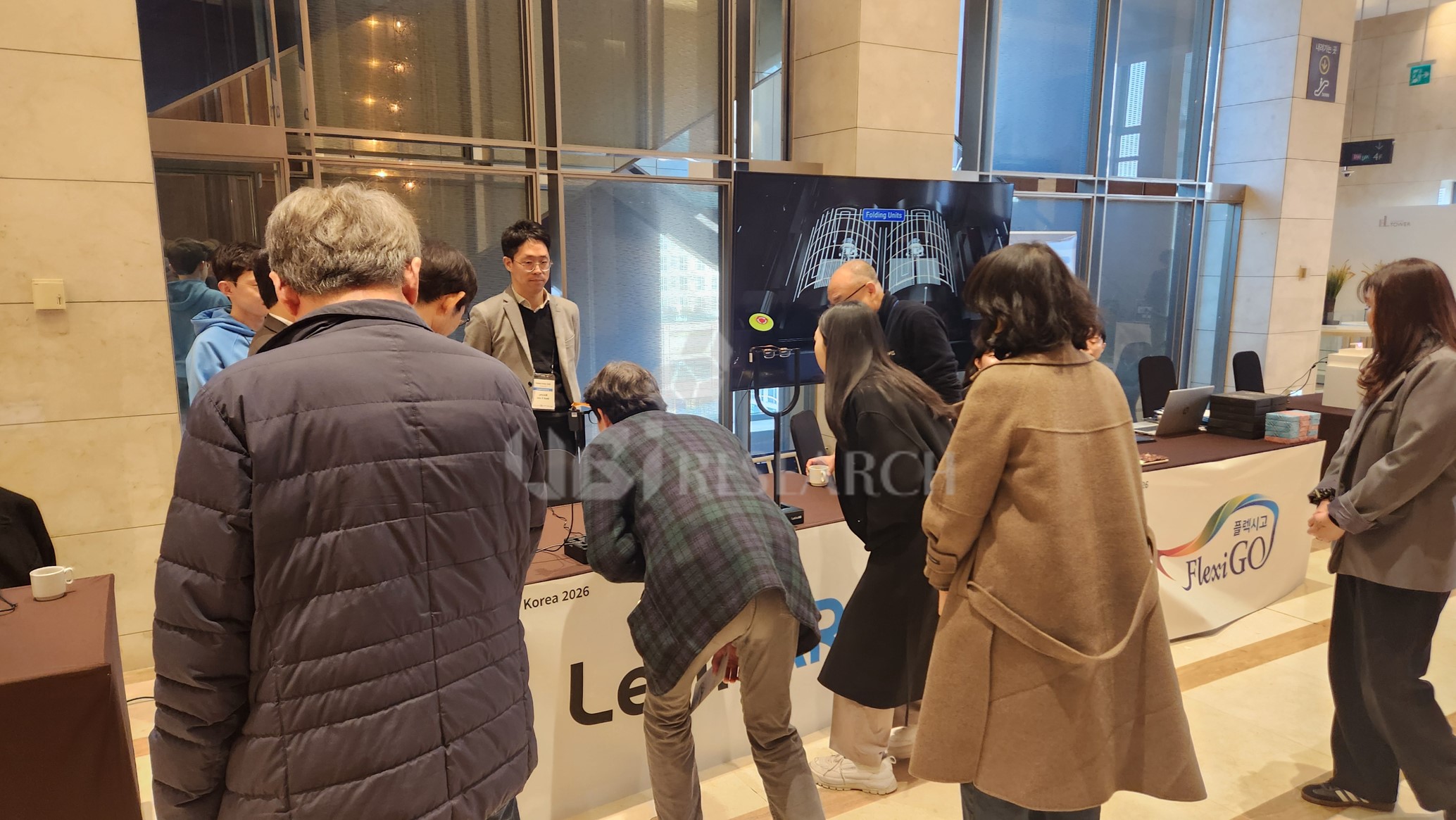
OLED material usage in 2024 will reach a record 130 tons, surpassing 200 tons in 2028

1Q25_Quarterly OLED Emitting Material Market Tracker

1Q25 Quarterly OLED Emitting Material Market Tracker

According to UBI Research’s “1Q25 Quarterly OLED Material Market Tracker,” the amount of emitting material used in 2024 was 130 tons. Shipments from Korean and Chinese panel makers increased simultaneously, up nearly 30% from 2023.
By company, Samsung Display continues to hold the largest share, and its rigid OLED shipments have been rising rapidly, driving material usage higher and higher. Samsung Display accounted for 42% of the total OLED emission materials market by volume, followed by LG Display at 20% and BOE at 13.2%.

While Korean panel makers still dominate in terms of material usage, Chinese panel makers are not far behind. In China, OLED shipments for smartphones from BOE, TCL CSOT, Tianma, Visionox, and EDO grew at a CAGR of 51% from 114 million units in 2021 to 394 million units in 2024. In addition, as Chinese panel makers such as BOE and EDO have recently begun supplying OLED panels for IT, the consumption of luminescent materials by Chinese panel makers is expected to increase even more steeply.

“In 2025, Samsung Display and LG Display are expected to ship more panels for iPhones than in 2024, and the overall shipments of IT devices such as tablet PCs, notebooks, and monitors are expected to increase significantly compared to 2024, so the growth of the luminescent material market is expected to continue for a while,” said Dr. Changho Noh of Ubi Research. “Additionally, with the expansion of mass production of OLEDs for IT by Chinese panel companies, the luminescent material market is expected to exceed 200 tons by 2028.”

Chang Ho NOH, UBI Research Analyst(chnoh@ubiresearch.com)

▶OLED Emitting Material Market Track Sample

Small OLED display shipments in 2024 are expected to increase by 200 million units compared to 2023 and exceed 1 billion units in 2025

‘1Q25 Small OLED Display Market Track’

‘1Q25 Small OLED Display Market Track’

According to UBI Research’s ‘1Q25 Small OLED Display Market Track’, which includes application performance and outlook for smartphones, foldable phones, smartwatches, etc., small OLED shipments in 2024 are expected to reach 980 million units, an increase of approximately 200 million units from 773 million units in 2023. The small OLED market is expected to exceed 1 billion units in 2025.

Looking at the 2024 performance, most panel manufacturers in Korea and China saw an increase in shipments of 40 to 50 million units, and in particular, Chinese panel manufacturers TCL CSOT, Tianma, Visionox, and Everdisplay saw shipments increase by more than 50% compared to 2023. BOE, China’s largest panel manufacturer, saw its panel shipments increase by only about 8% due to temporary production suspensions caused by disruptions in iPhone supplies throughout the year.

Not only Chinese panel makers, but also Korean panel makers have seen a significant increase in shipments. As rigid OLED panels began to be applied to Samsung Electronics’ Galaxy A series, Samsung Display’s shipments are expected to surge from 320 million units in 2023 to 380 million units in 2024. LG Display’s smartphone OLED shipments also increased from 52 million units in 2023 to 68 million units in 2024 as its supply of panels for iPhones expanded.

With Chinese panel makers’ shipments steadily increasing, and Samsung Display’s rigid OLED shipments and LG Display’s iPhone panel shipments also increasing, small OLED shipments in 2025 are expected to easily exceed 1 billion units.

“OLEDs are being widely applied to lower-end models of Samsung Electronics’ Galaxy A series and low-cost models from Chinese set manufacturers, and BOE and Visionox’s new 8.6G lines are also designed to produce panels for smartphones, so small-sized OLED shipments are expected to continue to rise for the time being,” said Han Chang-wook, Vice President of UBI Research.

Chang Wook HAN, VP/Analyst, UBI Research(cwhan@ubiresearch.com)

▶Small OLED Display Quarterly Market Track Sample

Samsung Display’s OLED panels for notebooks are expected to increase by 55% in 2024, with more than 10 million units shipped in 2025.

UBI Research ‘1Q25 mid-to-large OLED display market track’

UBI Research ‘1Q25 mid-to-large OLED display market track’

According to UBI Research’s ‘1Q25 mid- to large-sized OLED display market track’, Samsung Display’s shipments of OLED panels for notebooks in 2024 are approximately 8.4 million units, a 55% increase compared to 2023. The market is expanding as the volume of OLED panels for notebooks from Samsung Display, which supplies not only Samsung Electronics but also overseas notebook set makers such as Dell, HP, and Lenovo, increases.

Samsung Display shipped 8.4 million notebook OLED panels in 2024, and is expected to ship 10.7 million notebook OLED panels in 2025 and 18.3 million notebook OLED panels in 2026.

Just as it benefited from the application of OLED to Apple’s iPad Pro in 2024, the notebook OLED market is expected to grow rapidly by more than 40% in 2026, when OLED is applied to Apple’s MacBook Pro.

In addition to Apple, the number of OLED notebook products released by overseas notebook set companies is also increasing. The OLED notebook market, which was only 12 types released in 2020, is expanding with 33 types released in 2023 and 80 types in 2024.

In addition to regular notebooks, foldable notebooks released by Lenovo and Asus, and slideable notebooks scheduled to be released are also expected to contribute to market expansion.

Junho Kim, UBI Research analyst(alertriot@ubiresearch.com)

▶Medium & Large OLED Display Quarterly Market Track Sample

[MWC 2025] Samsung Display, Light Field Display

[MWC 2025] Samsung Display, Round Display

[MWC 2025] Samsung Display, Rollable Display

[MWC 2025] Samsung Display, Next Gen Foldable Display

[MWC 2025] Samsung Display, Micro LED Stretchable Display

[MWC 2025] Samsung Display, Foldable Display

[MWC 2025] Samsung Display, Bezel less Display

Samsung Display’s First Micro LED Watch

CES 2025 in Las Vegas set the stage for Samsung Display’s private booth at the Encore Hotel. Among its cutting-edge OLED technologies, the highlight was the rare appearance of Micro LED. After years of quiet development, Samsung Display debuted its Micro LED for watches for the first time

Samsung Display’s Micro LED features a 2.1-inch size, a resolution of 418×540, and a pixel density of 326 PPI, delivering a brightness of over 4,000 nits.

Samsung Display’s QD-OLED: Key Highlights at CES 2025

Samsung Display unveiled the winning keywords to strengthen its QD-OLED business at CES 2025: ‘Brightness, Highest, Fastest.

“Brightness” represents the industry’s first TV OLED to achieve 4,000 nits.”

In 2025, QD-OLED achieved an industry-first high brightness of 4,000 nits by altering its OLED structure. It is reported that the structure was changed from 4-stack to 5-stack. The 5-stack QD-OLED includes an additional green (G) layer to enhance efficiency, resulting in a composition of Blue-Blue-Green-Blue-Green.

‘Highest’ refers to a 27-inch OLED monitor manufactured using deposition technology, achieving a resolution of 160 PPI. Although JOLED (now part of JDI) previously achieved 204 PPI with inkjet printing, this is the world’s first high-resolution product using deposition technology. Samsung Display aims to achieve 220 PPI for 27-inch displays in the future.

Another innovation in monitors is ‘Fastest.’ To target the growing gaming audience, Samsung Display has developed an OLED monitor with a 500Hz refresh rate. This monitor features no motion blur and an extremely fast response time, allowing gamers to keep up with the rapid pace of gameplay seamlessly.

The purchase volume of OLED emitting materials in the third quarter of 2024 is expected to reach 32.7 tons, the highest ever purchase volume of emitting materials in 2024

According to UBI Research’s ‘4Q24_Quarterly OLED Emitting Material Market Tracker’, the purchase volume of emitting materials in the third quarter of 2024 was calculated to be 32.7 tons. Previously, material purchases were highest in 2021, when the market expanded due to COVID-19, but the all-time high was renewed in the third quarter of 2024. Considering the characteristics of OLED emitting materials, which show the highest usage in the fourth quarter of every year, it is expected that 2024 will see the highest usage ever.

Looking at each company, Samsung Display consistently holds the highest market share. Samsung Display had a 41.4% share in the entire OLED emitting material market based on purchase volume, followed by LG Display with 20.5%, BOE with 11.6%, and Visionox with 8.3%.

By substrate, RGB OLED still maintains the 80% level with a market share of 83.7% based on purchase volume, and as 8.6G lines begin to operate in earnest, RGB OLED’s market share is expected to gradually decline. WRGB-OLED’s market share was 11.3%, similar to the second quarter, and QD-OLED’s market share was 2.8%.

The market share of RGB 2 stack tandem OLED once rose to 6.4% in the second quarter due to a surge in iPad Pro OLED shipments but fell to the 2.2% range in the third quarter due to low demand. Compared to panel shipments, IT devices that use 2-stack tandem OLED for smartphone OLED, which uses single stack OLED, have large panel areas and have two light-emitting layers, so material purchase volume accounted for a higher share than shipment volume.

However, as BOE’s 8.6G line was confirmed to supply OLED for smartphones first, the growth of the 2 stack tandem OLED market was in the hands of Samsung Display. Starting in 2026, when OLED is expected to be applied to MacBook Pro, the purchase amount of light emitting materials applied to 2 stack tandem OLED is expected to more than double compared to 2024. The 2-stack tandem OLED panel supplied to MacBook Pro is expected to be supplied first by Samsung Display.

Junho Kim, UBI Research analyst(alertriot@ubiresearch.com)

▶OLED Emitting Material Market Track Sample

Samsung Display’s Auto OLED shipments surge, sales remain strong even as tablet PC panel shipments decrease

UBI Research ‘4Q24 Medium&Large OLED Display Market Track’

UBI Research ‘4Q24 Medium & Large OLED Display Market Track’

Samsung Display’s mid- to large-sized OLED shipments and sales in the third quarter were similar to those in the second quarter. Due to low sales of iPad Pro OLED, OLED shipments for tablet PCs decreased, but shipments increased in other applications and sales remained at a similar level. Samsung Display supplies mid- to large-sized OLED products for a variety of applications, including not only tablet PCs but also notebooks, monitors, and automotive OLEDs.

According to UBI Research’s recently published ‘4Q24 Medium & Large OLED Display Market Track’, as iPad Pro OLED panels began to be mass-produced in earnest in the second quarter, the shipments and sales of mid-to-large-size OLED panels from Samsung Display and LG Display surged. However, in the third quarter, panel shipments plummeted due to low sales of iPad Pro OLED, leading to a sharp decline in tablet PC OLED shipments and sales for both panel companies.

OLED shipments for TVs and OLEDs for tablet PCs increased rapidly at the same time, and LG Display’s shipments, which achieved its highest quarterly performance since the fourth quarter of 2021, decreased by 34% compared to the previous quarter, and sales decreased by 23%. However, because OLED shipments for TV recovered compared to the previous year, mid- to large-sized OLED shipments increased by 124% and sales increased by 111% compared to the same period last year.

In the case of Samsung Display, tablet PC shipments and sales also decreased. Samsung Display supplies OLED for tablet PCs to Samsung Electronics and Apple. Although OLED shipments for tablet PCs to Samsung Electronics did not change significantly, panel supply to Apple decreased. Accordingly, sales for tablet PCs also decreased by 38% compared to the previous quarter, but sales were able to be maintained similar to the previous quarter due to increased sales of other applications. Among Samsung Display’s applications, the one that has grown the most is automotive OLED. Automotive OLED shipments are rapidly increasing to 100,000 units in the first quarter, approximately 200,000 units in the second quarter, and approximately 500,000 units in the third quarter.

Samsung Display’s mid- to large-sized OLED shipments, which are investing in 8.6G, are expected to increase further from the end of 2025. As Samsung Display advances the mass production of its 8.6G line to the end of 2025, market expansion is expected to accelerate further. The notebook and monitor markets, as well as tablet PC and auto OLED, are expected to grow rapidly upon Apple’s entry into the market.

Junho Kim, UBI Research analyst(alertriot@ubiresearch.com)

▶Medium & Large OLED Display Quarterly Market Track Sample

Small OLED shipments in the third quarter increased by 7.8% compared to the previous quarter, and LG Display’s shipments surged

‘4Q24 Small OLED Display Market Track’

‘4Q24 Small OLED Display Market Track’

The small OLED market in the third quarter rose 7.8% compared to the previous quarter. Most panel companies recorded panel shipments at a similar level to the second quarter, but overall shipments increased as shipments from LG Display and China’s Everdisplay surged.

According to the ‘4Q24 Small OLED Display Market Track’ recently published by UBI Research, small OLED shipments in the third quarter of 2024 were 247 million units, up 7.8% compared to the previous quarter and 32.6% compared to the same quarter of the previous year. The shipments of Chinese panel companies, including Samsung Display and BOE, were similar to or slightly lower than the previous quarter, but as the shipments of LG Display and China’s Everdisplay surged, overall shipments increased.

Based on the iPhone 16 series, which began full-scale production, LG Display shipped 17.6 million iPhone panels, a 64% increase from the previous quarter, and smartwatch shipments increased 147% to 12.2 million units. Due to the impact of increased shipments, LG Display’s sales increased by 74% compared to the previous quarter and by 115% compared to the same quarter of the previous year.

LG Display’s shipments are expected to continue to increase next year following the fourth quarter. As LTPO TFT begins to be applied to the iPhone 17 series scheduled to be released in 2025, there are predictions that BOE’s initial panel supply will actually be difficult, and as BOE is unable to supply panels, the supply may be transferred to LG Display. However, since LG Display is currently producing panels close to full capacity, line expansion is necessary to produce more panels. There is an analysis that it is realistic to expand 6G lines because it is realistically difficult to quickly start investing in 8.6G.

Among Chinese panel companies, shipments of Everdisplay and Tianma increased. Tianma’s shipments increased, but only slightly, and Everdisplay’s shipments more than doubled to 13 million units compared to the previous quarter.

Samsung Display’s shipments decreased somewhat, but sales were similar to the second quarter, and BOE’s shipments were similar to the second quarter, but sales increased by 15%. In the fourth quarter, shipments from not only LG Display but also Samsung Display and BOE are expected to increase, and considering the characteristics of the OLED market with the highest shipment volume in the fourth quarter, global OLED shipments for smartphones are expected to exceed 800 million units in 2024.

Junho Kim, UBI Research analyst(alertriot@ubiresearch.com)

▶Small OLED Display Quarterly Market Track Sample

iPhone 17 series to be released in 2025, panels supplied by Samsung and LG Display, BOE still unknown

iPhone 17 Slim expected image (screen capture from @Apple Explained on YouTube)

iPhone 17 Slim expected image (screen capture from @Apple Explained on YouTube)

It is expected that only two companies, Samsung Display and LG Display, will supply panels for the iPhone 17 series to be released next year. It is unclear whether BOE will be able to supply the new model, but it is expected that it will be difficult to obtain panel approval within 2025.

BOE was previously supplying the normal model iPhone 13~16 series. Although panel production for the iPhone 15 was temporarily halted in the middle of this year due to panel quality issues, it has resumed, and panels for the iPhone 16 have also been approved and are being mass-produced. However, unlike existing models where LTPO TFT was applied only to the Pro model, LTPO TFT is expected to start being supplied to all models starting from the iPhone 17 series. Accordingly, BOE, which lacks technology, will not be able to produce the normal model iPhone 17 in the early stages. It is expected to be difficult. In addition, it is expected that low-dielectric TFE will begin to be applied starting with the iPhone 17 series, but BOE is expected to have setbacks in the development of this technology.

As BOE’s volume decreases, Samsung Display and LG Display’s volume is expected to increase. Samsung Display is expected to produce all models of the iPhone 17 series, and LG Display is expected to produce the 17, 17 Slim (tentative name), and 17 Pro Max models. In 2025, Samsung Display is expected to produce 130 million panels for Apple, and LG Display is expected to produce 72 million panels. BOE plans to supply 65 million panels to Apple in 2025, but in reality, it is expected to supply 40 to 50 million panels, which is less than this.

Junho Kim, UBI Research analyst(alertriot@ubiresearch.com)

▶Small OLED Display Quarterly Market Track Sample

Samsung Display advances mass production of 8.6G OLED line, Chinese panel companies are catching up

Hefei Visionox V5 groundbreaking ceremony held last September

Hefei Visionox V5 groundbreaking ceremony held last September

Recently, there is news that Samsung Display is moving up the mass production of the A6 8.6G OLED line to the end of 2025. Following Samsung Display, Chinese panel companies are also rapidly investing.

The biggest reason why OLED panel companies are rushing to invest in the 8.6G OLED line is the chamfer rate. Initially, OLED began to be applied to small and medium-sized products first, and when producing small and medium-sized products of 10 inches or less, a sufficient chamfering rate could be achieved even with the size of a 6G substrate. However, as OLED began to be applied to IT products with large panel areas, unlike small and medium-sized products, the unusable and discarded area in the 6G line increased, and to solve this, a line using a larger substrate was needed.

Samsung Display, the leader in the 8.6G OLED line, began building a production line early this year and plans to begin mass production at the end of 2025. Samsung Display invested in the 8.6G line to mass-produce 2-stack tandem OLED for Apple’s MacBook Pro, but mass-produced it earlier than originally planned, gaining time before mass-producing panels for MacBook Pro. Before mass producing panels to be supplied to Apple, Samsung Display is expected to first mass produce tandem OLEDs to be supplied to laptop set makers such as Samsung Electronics, Dell, HP, and Lenovo.

BOE, a latecomer, also began investing in the 8.6G line. BOE is expected to bring in two deposition machines from Sunic Systems in 2025 and begin mass production in the third quarter of 2026. BOE’s 8.6G line mass production period is from the third quarter of 2026, but like the iPhone, it is expected to be difficult to supply IT OLED panels to Apple in the early stages. Like other 6G lines, it is expected to initially mass produce panels for the Chinese domestic market and improve product quality to supply products to Apple. BOE is currently investing in module lines sequentially, and a total of 18 module lines are scheduled to be invested in Phase 1. Unlike Samsung Display, BOE is simultaneously investing in modules for smartphones and small and medium-sized OLEDs as well as IT OLEDs in the 8.6G line.

Following BOE’s lead, Visionox also invested in 8.6G. Last September, a groundbreaking ceremony was held for Visionox’s 8.6G OLED line, V5, in Hefei, and when Chinese President Xi Jinping visited Hefei’s V5 line in October, it received positive reviews. Additionally, it is understood that Visionox officials visited Korean equipment companies and held meetings this month. Visionox plans to attract government investment based on ViP (Visionox intelligent Pixelization), but due to technical difficulties in vertical deposition, it is likely to be used only as a pilot line.

It was discovered that TCL CSOT is also preparing to invest in an 8.6G line based on inkjet technology. There is a high possibility that an investment announcement will be made at the end of the year. The location is Guangzhou City, and the line capacity is 16K for the inkjet method and 16K for the FMM method, with a total investment of 32K likely to be made.

In addition to the companies mentioned above, Tianma also has the possibility of investing in the 8.6G line, and HKC is considering new investments in 6G OLED. Now that Chinese panel companies are following in the footsteps of Samsung Display, which made its first investment, attention is being paid to how Samsung Display will widen the technology gap.

Junho Kim, UBI Research analyst(alertriot@ubiresearch.com)

▶2024 OLED Technology and Industry Trend Analysis Report for IT Sample

Korean OLED Panel Makers’ Emitting Material Purchases Reach 51.2% in H1, with a Modest Recovery Expected in H2

According to UBI Research’s recently published “3Q24 OLED Emitting Materials Market Track,” the purchase of emitting materials by Korean OLED panel manufacturers in the first half of 2024 totaled $495 million, representing 51.2% of the market share—a 7.8% decrease compared to the same period last year. This is a notable shift. Meanwhile, Chinese companies held 48.8% of the market share, up 7.8% year-on-year, with purchases amounting to $471 million.

As Chinese panel manufacturers ramp up shipments, the gap in the purchase of emitting materials between Korean and Chinese companies is steadily narrowing. In the first quarter of 2024, for the first time, Korean OLED panel companies’ share of emitting material purchases fell to 47.4%, lower than that of Chinese companies.

However, from the second quarter onward, with the increase in OLED panel shipments for IT devices and the production of panels for the iPhone 16 by Korean manufacturers, their share rebounded to 54.7%. While BOE passed the sample certification for the iPhone 16, the delay in mass production is expected to result in smaller shipments this year. Additionally, certification for the iPhone 16 Max, which was expected to be produced at BOE’s B12 factory, was not approved.

With the reduction in BOE’s iPhone shipments, Korean panel makers are likely to see an increase in panel shipments. Thanks to growing OLED panel orders from Apple for products like the iPhone and iPad Pro, Korean purchases of emitting materials are expected to rise to a 55.6% market share by the end of 2024, a notable increase compared to the first half of the year.

▶AMOLED Emitting Material Market Track Sample

Due to the OLED iPad Pro for Tablet PC, shipments are rapidly increasing, and shipments are expected to increase by more than 6 times in 2024 compared to the previous year.

According to the “3Q24 Medium-Large OLED Display Market Track” published by UBI Research, more than 12 million OLEDs for tablet PCs are expected to be shipped in 2024 thanks to Apple’s entry into the OLED market for tablet PCs.

As mass production of iPad Pro OLEDs began in the first quarter of 2024, shipments of OLEDs for tablet PCs surged to 1.2 million units in the first quarter and 3.4 million units in the second quarter.

As not only Samsung Display and LG Display, but also Chinese panel manufacturers have begun mass production of OLEDs for tablet PCs, the OLED market for tablet PCs is expected to expand further. Among Chinese panel manufacturers, BOE is expected to ship about 1.5 million OLED panels for tablet PCs in 2024, and Visionox is expected to ship about 800,000 OLED panels for tablet PCs.

Due to the increase in panel shipments by Apple and Chinese companies, OLED shipments for tablet PCs are expected to exceed 30 million units in 2028.

▶Medium & Large OLED Display Market Track Sample

OLED market for Tablet PCs to grow 6-7 times by 2024 due to Apple’s entry

OLED panel shipment forecast for tablet PC

OLED panel shipment forecast for tablet PC

According to the ‘2024 Mid-Large OLED Display Annual Report’ recently published by UBI Research, shipments of OLED panels for tablet PCs are expected to grow from 12 million units in 2024 to 28.4 million units in 2028, with an average annual growth rate of 24.1%.

OLED panel shipments for tablet PCs were 1.3 million units in 2022 and 1.8 million units in 2023, forming a small market. However, with the decision to install OLED in the Apple’s iPad scheduled to be released in 2024, Samsung Display and LG Display are producing OLED panels for iPad-oriented table PCs.

Samsung Display produces panels for the 11-inch model and LG Display produces panels for the 12.9-inch model. Due to Apple’s entry, the OLED market for tablet PCs is expected to grow 6 to 7 times in 2024 compared to 2023.

In addition, panel companies are actively investing to apply OLED not only to tablet PCs but also to various IT products. Following Samsung Display’s recent investment in the 8.6G IT line, BOE also invested in the 8.6G IT line, and LG Display is also conducting a paid-in capital increase to secure funds for IT line investment and is planning to sell the Guangzhou LCD line. The OLED market for IT is expected to expand further due to the aggressive investment of panel companies.

▶ 2024 Mid-Large OLED Display Annual Report Sample Download
Samsung Display continues to dominate the OLED market for foldable phones

Foldable OLED shipment forecast

Foldable OLED shipment forecast

According to the ‘2024 Small OLED Display Annual Report’ recently published by UBI Research, OLED shipments for foldable phones are expected to increase from 27.4 million units in 2024 to 52.7 million units in 2028.

According to the report, Samsung Display’s OLED shipments for foldable phones in 2023 will be 13.4 million units, a 6.3% increase from 12.6 million units in 2022. Also, among Chinese panel makers, BOE shipped 6.2 million units of OLED for foldable phones, more than three times the 1.9 million units in 2022, while TCL CSOT and Visionox each shipped 1.1 million units of OLED for foldable phones.

Although there is fierce pursuit by Chinese companies, Samsung Display is expected to still take the lead in the foldable phone market. Samsung Electronics, to which Samsung Display supplies panels, is expected to expand the models of the Galaxy Fold series scheduled to be released this year, and Samsung Display’s foldable phone panels are expected to be applied first to Apple’s foldable iPhone to be released in the future. Based on such technological prowess and competitiveness, Samsung Display’s dominance in the foldable phone market is expected to continue for the time being.

▶ 2024 Small OLED Display Annual Report Sample Download
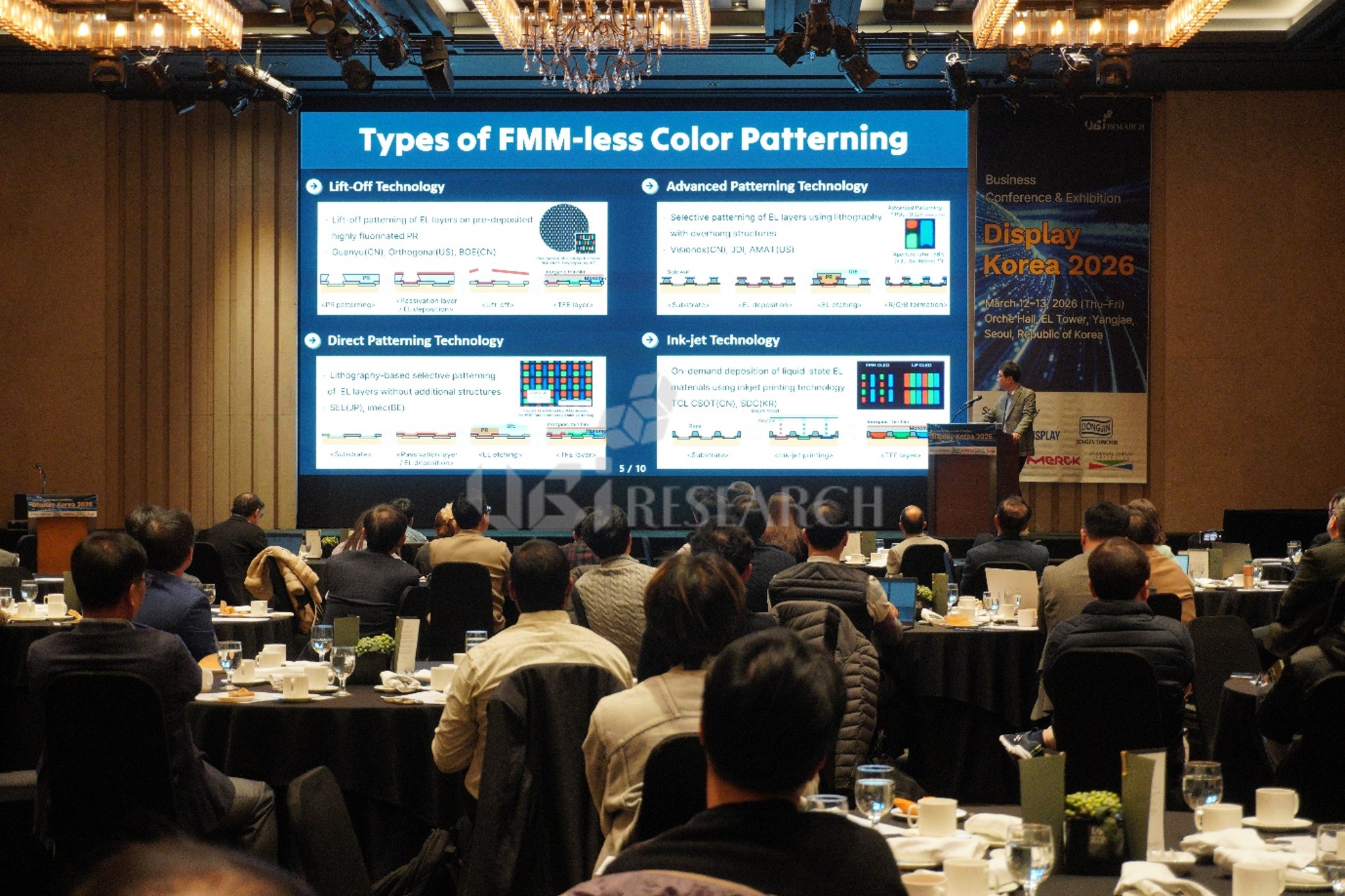
International Business Conference: 2024 OLED Korea & 2024 eXtended Reality Korea will be held in parallel!

UBI Research, a display specialist research company, will hold the international business conferences OLED Korea and eXtended Reality Korea in parallel at The-K Hotel in Yangjae, Seoul from March 27 to 29, 2024. This event is expected to be an opportunity for people from companies, academia, and research institutes related to the display industry around the world to attend, exchange the best information, and form a global network.

eXtended Reality Korea is the first XR industry-related business conference held by UBI Research and will cover trends and outlook on micro display, XR Hardware/Software, materials, equipment, etc.

This event aims to provide attendees with the opportunity to deeply explore the display and XR areas through a comprehensive program including tutorials, keynote presentations, and panel discussions.

The tutorial on March 27th will feature presentations on the future of XR, micro LED display technology, and key technologies to realize the next generation OLED display.

In addition, keynote presentations by ▲UBI Research, ▲Samsung Display, ▲LG Display, ▲Hyundai Mobis, and ▲Fortell Games are scheduled for the conference to be held on March 28th and 29th. Choong-Hoon Yi, CEO of UBI Research, will give a presentation on “OLED and XR industry outlook.” We will present the overall OLED industry, including OLED for IT, and the micro OLED industry that will be applied to MR equipment.

Samsung Display plans to introduce SDC’s roadmap for expanding the AR/VR market based on SDC’s plan to overcome technical obstacles in ultra-high-resolution displays under the title “AR/VR Development Strategy for Future Display.”

Under the theme of “Life with OLED,” LG Display will examine the field of OLED displays applied in daily life and present the continuous evolution and benefits of OLED technology.

Under the theme of “Automotive Display / HUD Trend and Future Display,” Hyundai Mobis presents trends and requirements for automotive displays, from Pillar To Pillar displays to Rollable displays, predicts future automotive displays, and announces development strategies.

Lastly, Fortell Games will discuss the topic of “Next-Gen Mixed Reality: New Horizons for Spatial Computing”, analyzing the latest developments in mixed reality technology and their impact on the future of the gaming industry.

In addition, it will be run by a total of 34 domestic and foreign speakers and programs, including AR/VR development and technology, automotive displays, OLED industry, backplane technology, and MicroLED display development.

Because it is a parallel event, attendees can attend both events even if they register for one event, and registration is possible at a special discount price during the early bird period until February 29th.

Detailed information can be found on the website (https://oledkoreaconference.com/, https://extendedrealitykorea.com/).

In 2028, the OLED emitting material market is expected to reach $2.43 billion with an average annual growth rate of 5.8%

According to the ‘4Q23_Quarterly OLED Emitting Material Market Tracker’ recently published by UBI Research, the market for emitting materials used in OLED is forecasted to grow from $1.84 billion in 2023 to $2.43 billion in 2028, with an average annual growth rate of 5.8%.

By country, Korean panel companies’ material purchases are expected to grow at an average annual growth rate of 4.2% from $1.11 billion in 2023 to $1.36 billion in 2028, and Chinese’ material purchases are expected to increase from $730 million in 2023 to $1.07 billion in 2028.

As forecasted, the material purchase ratio by country in 2028 will be 56% in Korea and 44% in China. However, Chinese panel companies are mainly mass producing panels for Chinese domestic use and white boxes, so even if panel shipments increase in the future, low-priced materials will be used. So, there is a possibility that the expansion of China’s emitting material market will be reduced further than currently expected.

Lastly, UBI Research predicted that Samsung Display’s purchase of emitting materials in 2028 will reach $810 million, LG Display’s will reach $550 million, and BOE will reach $440 million.

OLED emitting material market

OLED emitting material market

▶ 4Q23 OLED Emitting Material Market Track Sample Download

OLED shipments for IT are expected to reach 31 million units in 2027, with an average annual growth rate of 41%

According to the ‘IT OLED Technology and Industry Trend Analysis Report’ recently published by UBI Research, OLED shipments for tablet PCs, notebooks, and monitors are expected to reach 31 million units in 2027 with an average annual growth rate of 41%.

This forecast is based on Samsung Display’s 5.5G OLED line, 6G OLED line, 8.5G QD-OLED line, 8.6G (2290 x 2620 mm2) IT line, and LG Display, BOE, and Visionox’s 6G OLED line.

Shipment forecast for IT OLED

Shipment forecast for IT OLED

For IT products, OLED had been a market that received less attention than smartphones or TVs, but has began to receive significant attention due to the increase in demand for IT products in COVID-19 and the prospect of Apple using OLED for IT products.

Previously, Samsung Display was mass producing a small amount of OLED for IT from some of A2 as the 5.5G rigid OLED line and the 8.5G QD-OLED line, and some Chinese companies such as EDO were producing IT OLEDs in small quantities, but in 2024, Samsung Display and LG Display plan to mass produce OLED for Apple’s iPad in earnest from the 6G line, and BOE also plans to mass produce OLED for IT from the B12 line.

In addition, Samsung Display decided to invest in the 8.6G OLED line for IT early this year, and is expected to mass produce various IT products, including notebooks, from the first half of 2026.

Moreover, LG Display and BOE are planning to invest in the 8.6G line as soon as they secure investment funds and customers, and Visionox is also reportedly holding meetings with major equipment companies to invest in the 8.6G line.

If demand for OLED from set companies for IT increases in the future and panel companies invest in 8.6G lines, the IT market is expected to become a new high value-added market for OLED, following the smartphone market.

▶ IT OLED Technology and Industry Trend Analysis Report Sample

[IMID 2023] OLED exhibited by Samsung Display and LG Display

At ‘IMID 2023’ held in BEXCO, Busan on August 22, Samsung Display and LG Display exhibited a number of OLED products.

First, in ‘IMID 2023’, Samsung Display introduced 77-inch QD-OLED and light field display ‘2D↔3D Display’, ‘Slidable Flex Solo’ and ‘Slidable Flex Duet’, ‘Rollable Flex’, ‘Flex G’, ‘Flex It exhibited foldable and sliderable products such as ‘S’ and ‘Flex Note’. Products other than ‘2D↔3D Display’ were exhibited at ‘K-Display 2023’ held last week, and the exhibition scale was smaller than ‘K-Display 2023’.

Samsung Display 2D↔3D Display

Samsung Display 2D↔3D Display

Samsung DIsplay Light Field Display

Samsung DIsplay Light Field Display

The size of the ‘2D↔3D Display’ exhibited by Samsung Display was 16 inches, the panel resolution was 3840×2400, and eyetracking technology was inserted to support a 3D viewing angle of more than 40°.

LG Display’s 77-inch 8K OLED with ‘META Technology’ applied, 45-inch and 27-inch gaming OLED, ‘34” Full Dashboard OLED’, ‘18” Rollable OLED’, ‘15.6” Light Field Display’, ‘0.42” OLEDoS’ exhibited.

LG Display Rollable OLED

LG Display Rollable OLED

The 18-inch rollable OLED, which LG Display unveiled for the first time in Korea, realized a brighter screen by applying a tandem element structure, and passed more than 100,000 rolling tests. The resolution of the ‘18” Rollable OLED’ is 2560×1440, the brightness is 1,000nits, the rolling radius is 20R, and the cover window material is TPU (Thermoplastic Poly Urethane). An official from LG Display said, “There is no plan to mass-produce 18-inch rollable OLED yet, and the rolling radius will be between 5 and 10R when mass-producing actual products.”

‘0.42” OLEDoS (OLED on silicon)’, an ultra-high resolution product with 3500ppi, was the same as the product exhibited at ‘K-Display 2023’. It is a product that combines the optical system of LetinAR, a domestic optical module developer, with the panel of LG Display.

OLED panel makers’ 8.6G IT line investment trends, LG Display and BOE’s investment delays

Apple iPad Pro

Apple iPad Pro

Samsung Display and LG Display are investing in the 8.6th generation IT line with high added value to compensate for the decrease in sales due to the Chinese panel makers’ flexible OLED low-cost offensive and LCD withdrawal.

At the LG Display 2Q earnings announcement conference call held on the 26th, an official from LG Display said, “The announced 6th generation IT-related investments are proceeding as scheduled, and the investments will be made until the first half of next year.”

However, regarding the possibility of investing in the 8.6th generation IT OLED, it stated that “nothing has been confirmed yet”. LG Display emphasized, “We will carefully look at the possibility and progress of technology development and whether market demand is developing to a level that can contribute to the company’s profits before making an investment decision.”

LG Display’s 8.6th generation IT line investment is expected to be delayed compared to Samsung Display due to difficulties in securing new line investment funds due to operating losses, but it is expected to be able to supply panels to Apple from 2026.

Not only LG Display, but also Chinese panel maker BOE’s investment is being delayed. Samsung Display can secure Samsung Electronics and Apple, and LG Display can secure LG Electronics and Apple as customers, but BOE is expected to take at least two years to invest in the 8.6G line for IT because of uncertainty in securing customers.

Another Chinese panel maker, Visionox, is also preparing to invest in the 8.6G line for IT. Visionox plans to announce its investment in the 8.6th generation line with a total capacity of 30K in September.

On the other hand, Samsung Display’s investment in the 8.6th generation IT line has already been decided. Samsung Display plans to apply Oxide to the TFT of the 8.6th generation IT line and build it with 2 stack RGB OLED. Samsung Display had previously developed 8.6th generation vertical deposition 2 stack RGB OLED as an IT line, but the investment was decided for 8.6th generation horizontal deposition. Canon’s exposure machine is planned to be brought into Samsung Display’s IT line in April 2024, and negotiations on the price of the deposition machine with Canon Tokki have already been completed.

▶ 2023 Medium and Large OLED Display Annual Report Sample Download
Choong Hoon YI, CEO of UBI Research “Samsung Display will strengthen profitability by producing OLED for high value-added IT”

It is expected that Samsung Display will focus on producing panels for tablet PCs and notebooks to compensate for the reduced utilization rate of the A2 line due to the low-cost flexible OLED offensive of Chinese panel makers.

At the ‘2023 OLED & Micro Display Analyst Seminar’ held at the Federation of Korean Industries in Yeouido on the 5th, Choong Hoon YI, CEO of UBI Research, gave a presentation on ‘IT OLED industry trends and market prospects’.

Choong Hoon YI, CEO of UBI Research

Choong Hoon YI, CEO of UBI Research

CEO YI said, “Samsung Display is expected to focus on rigid OLED production for tablet PCs and notebooks to compensate for the reduced utilization rate of the A2 line due to the low-priced offensive of Chinese companies. As much as it focuses on IT OLED production, the shipment of rigid OLED for smartphones will drop sharply, but it is possible to maintain sales by producing rigid OLED for IT with high added value.” And he also said, “LG Display will start mass production one year later than Samsung Display, and BOE will start mass production at least two years later than Samsung Display.”

According to CEO Choong Hoon YI, LG Display’s decision is being delayed because it is difficult to secure funds for investment in new lines due to the deficit caused by the delay in switching from LCD lines to OLED lines. Nevertheless, LG Display is expected to be able to supply IT panels to Apple from 2026. However, there are still problems to be solved, such as stabilizing the process and securing yield of Sunic system equipment whose production capacity has not yet been verified.

BOE has invested in three OLED line factories for smartphones, but the operation rate is at a level of only one factory, and the Beijing city government is very dissatisfied with over-investment due to insufficient securing of Apple supplies. For the reasons mentioned above and because securing customers for IT OLED has not been decided, BOE’s IT OLED line investment is expected to take at least two years.

CEO YI said, “Chinese panel makers are trying to increase their market share with low-priced attacks, but domestic companies that have secured large customers such as Samsung Electronics and Apple have a significant advantage in competition. In the future, the OLED industry for TV and IT will be developed mainly by Korean companies.”

▶ 2023 Medium and Large OLED Display Annual Report Sample Download

OLED emitting materials market in 2027 expected to reach US$ 2.59 billion with an average annual growth rate of 7.7%

According to the ‘2023 OLED Emitting Material Report’ recently published by UBI Research, the total emitting material market is expected to reach US$ 2.59 billion in 2027 with an average annual growth rate of 7.7% from US$ 1.92 billion in 2023.

total emitting material market

total emitting material market

Analyst Yoon Daejeong of UBI Research said, “The small OLED material market is expected to grow at an average annual growth rate of 2.5% from 2023 to US$ 1.61 billion in 2027. And in 2027, Samsung Display’s purchase of small OLED materials is expected to be US$ 560 million, BOE US$ 430 million, and LG Display US$ 200 million.” and “the small OLED material market will change depending on how much the foldable OLED market replaces the sharp decline in rigid OLED shipments for smartphones.

Analyst Yoon continued, “As the shipments of LG Display’s WOLED and Samsung Display’s QD-OLED are expected to be 12 million units and 3 million units, respectively, in the large OLED material market in 2027, the purchase amount of emitting materials is also expected to be US$ 430 million and US$ 140 million, respectively”

Meanwhile, the report predicted that by OLED method in 2027, RGB OLED would occupy the largest share at 66.6%, followed by WOLED at 16.5%, RGB 2stack OLED at 11.4%, and QD-OLED at 5.5%.

▶ 2023 OLED Emitting Material Report Sample Download

Samsung Display Signs MOU with Ferrari, Enters ‘Samsung OLED’ in Supercars

Samsung Display will supply state-of-the-art OLEDs to the supercar Ferrari. Samsung Display announced that it signed a memorandum of understanding (MOU) with Ferrari at the Asan Campus on the 11th to develop display solutions to be installed in Ferrari’s next-generation car models. The signing ceremony was attended by Choi Joo-seon, president of Samsung Display, and Benedetto Vigna, CEO of Ferrari.

According to this MOU, Samsung Display will develop a luxurious and innovative automotive display solution suitable for a luxury supercar brand based on the world’s best OLED technology and support Ferrari’s digital transformation, which is currently speeding up.

Samsung Display, which has led the technology transition in the premium smartphone market from LCD to OLED over the past decade, is actively targeting the automotive display market based on its unrivaled OLED technology accumulated over a long period of time.

In particular, the ‘New Digital Cockpit’ was introduced for the first time at the last ‘CES 2023’. The 34-inch display mounted on the ‘New Digital Cockpit’ is equipped with bendable technology that bends left and right at 700R, and provides the driver with an optimal viewing distance to enhance concentration.

Samsung Display said, “Samsung OLED is a technology that can satisfy the needs of automobile manufacturers who want innovative and luxurious designs because it has excellent design scalability with a light and slim structure and thin bezel, and can express perfect black and deep contrast.” and “Especially, OLED’s low-power characteristics will increase the efficiency of automobiles and act as a more attractive factor.”

Regarding the agreement, Ferrari CEO Benedetto Viña said, “Ferrari is a luxury company that provides a special experience, not just a means of transportation.” and “We expect to maximize the value and completeness of Ferrari’s next-generation products through strategic cooperation with Samsung Display, which makes the best OLED,” he said.

Choi Ju-seon, president of Samsung Display, said, “Based on OLED technology that has been intensively developed over a long period of time, we will introduce a cutting-edge display solution suitable for ‘Ferrari’.” And “We plan to strengthen our OLED business for automobiles in cooperation with leading global automobile companies, including Ferrari, in the future,” he said.

▶ 2023 Medium and Large OLED Display Annual Report Sample Download

OLED panel shipments for TVs are expected to reach 14.1 million units in 2027 with an average annual growth rate of 11.6% from 9.1 million units in 2023

According to the ‘2023 Medium and Large OLED Annual Report’ recently published by UBI Research, OLED panel shipments for TVs are expected to grow from 9.1 million units in 2023 to 14.1 million units in 2027 with an average annual growth rate of 11.6%.

Shipment Forecast for OLED TV

Shipment Forecast for OLED TV

In 2022, it is analyzed that TV demand will decline due to the global economic deterioration, and global TV shipments will also stop at the early 200 million units. In the case of LG Display, it set a goal to ship more than 10 million WOLEDs in early 2022, including those for monitors, but released a total of 6.96 million units, recording a decrease of 880,000 units from 7.84 million units in 2021. Samsung Display’s QD-OLED shipments for TVs are also analyzed to have recorded 950,000 units.

As the economic situation is expected to gradually recover in 2023, LG Display’s TV WOLED shipments are expected to be 7.6 million units and Samsung Display’s QD-OLED shipments to be 1.5 million units.

Meanwhile, UBI Research predicted that LG Display’s micro lens array (MLA) applied ‘OLED.EX’ panel would be partially mass-produced from 2023, and Samsung Display’s QD-OLED monthly capacity of 36K is expected to be 41K per month by the second half of 2023 and 45K per month by the first half of 2024.

▶ 2023 Medium and Large OLED Display Annual Report Sample Download
2023 OLED KOREA Conference “OLED, a premium electronic product lineup and micro display, a promising future industry”

OLED KOREA, hosted by UBI Research, a market research company, will be held at the Central Park Hotel in Songdo, Incheon from April 12 to 14. OLED KOREA, which marks its 7th anniversary, is a business conference where top authorities in display from Korea, Japan, Asia, the United States, and Europe gather.

This conference will deal with the topics of OLED, which has become a premium electronic product, and micro-display for AR and VR, which are rapidly emerging as future industries.

In order for OLED to replace LCD, the emergence of phosphorescent blue materials is the most important. At this conference, Samsung Advanced Institute of Technology and UDC will introduce the direction of phosphorescent material development. Commercialization of phosphorescent blue materials will be an inflection point that can overturn the display industry.

There are two types of micro displays: micro OLED and micro LED. While micro OLED is leading the way for VR, micro LED is gradually taking its place in AR. In OLED KOREA, programs are composed of AR companies, micro display manufacturers, and related technology companies. It will be an important place to guess who will be the winner of the future micro display.

The pre-registration period for this conference is until April 7, 2023, and you can check program and speaker information and register for the event through the website (https://oledkoreaconference.com/).


Samsung Display’s foldable OLED expected to exceed 50 million units in 2027

Foldable OLED shipment ratio forecast

Foldable OLED shipment ratio forecast

According to the ‘2023 Small OLED Display Annual Report’ recently published by UBI Research, Samsung Display’s OLED shipments for foldable phones are expected to reach 50.9 million units in 2027 with an average annual growth rate of 28.1% from 18.9 million units in 2023.

According to the report, Samsung Display’s foldable OLED shipments in 2022 were analyzed to be 12.6 million units, accounting for 85.1% of global foldable OLED shipments in 2022. BOE, TCL CSOT, and Visionox mass-produced some foldable OLEDs, but Samsung Display led the foldable OLED market.

It is expected that Samsung Display will continue to dominate the foldable OLED market in the future. It seems difficult for TCL CSOT and Visionox to record annual shipments of more than 1 million units by 2027, and unless LG Display also secures a customer, the time for mass production of foldable phone panels is unclear.

Lastly, the report forecasted global OLED shipments for foldable phones to be 61.4 million units in 2027, with Samsung Display expected to account for 82.9% of the market with 50.9 million units and BOE with 9.6 million units and 15.7%.

▶ 2023 Small OLED Display Annual Report Sample Download
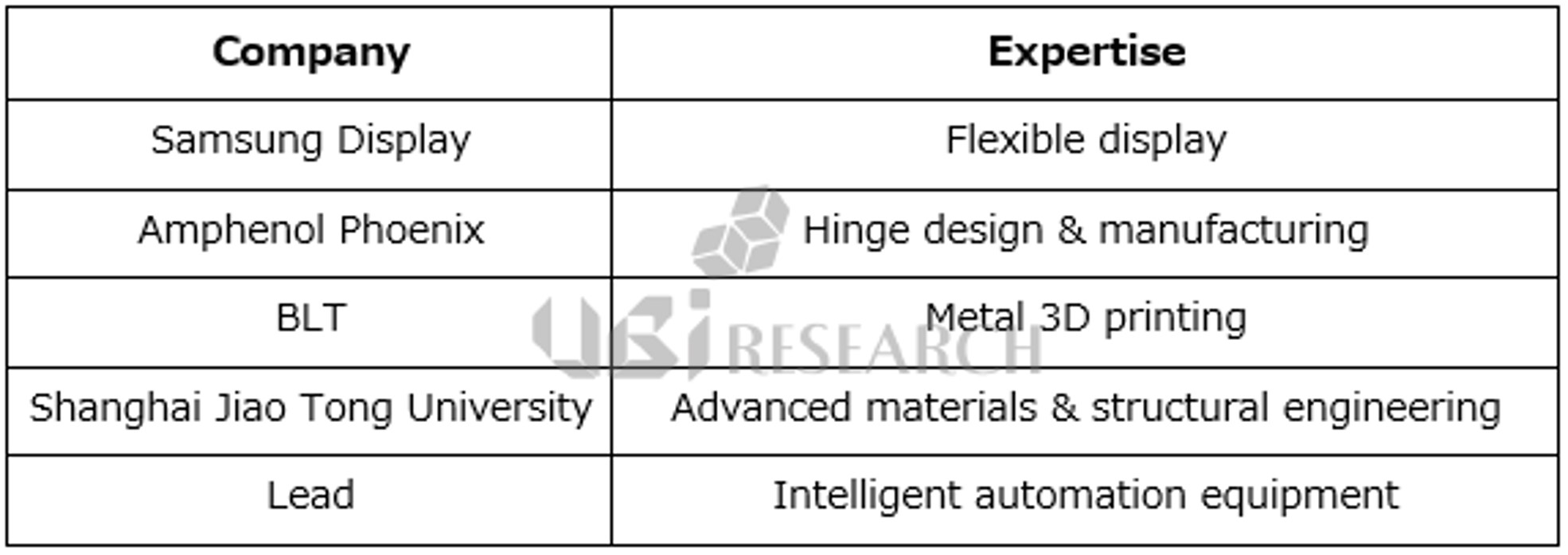
Samsung Display Develops the World’s First Large-sized, Touch-Integrated OLED Display

Applying touch-integrated panels in place of plastic touch film to boost Samsung Display’s competitiveness with simplified design and productivity

Applying touch-integrated panels in place of plastic touch film to boost Samsung Display’s competitiveness with simplified design and productivity

Samsung Display today announced the successful development of the world’s first large-sized OCTA (On-Cell Touch AMOLED) technology, expanding the technology’s application from smartphone OLED to the laptop OLED panel, with full-scale mass production starting in January.

Samsung Display developed OCTA, the world’s first touch-integrated OLED, for smartphones back in 2010. It is a technology that embeds the touch sensor inside the panel instead of attaching a TSP (Touch Screen Panel) film to recognize touch action on the panel surface. The panel is much friendlier to the environment because it doesn’t need additional plastic film for touch. Moreover, the thickness and the weight of the panel are reduced with a simplified structure.

Samsung display touch-Integrated OLED Display

Samsung display touch-Integrated OLED Display

Samsung Display explained that touch film generally accounts for 6-11 percent of the total panel thickness and that the thinner the panel, the better the design expandability and portability of the product. Also, the company has been focusing on developing large-sized OCTA technology as the recent demand for laptops with touchscreen functions has increased with the expansion of the OLED laptop market.

Samsung display touch-Integrated OLED Display

Samsung display touch-Integrated OLED Display

“The difficulty level of the touch-integrated technology surges greatly as the display area increases, which leads to the increased number of touch sensors required,” said Hojung Lee, Head of Product Planning Team for Small and Medium-sized Display Division at Samsung Display. “We were able to achieve the natural feel and touch responsiveness for larger displays through the development of new materials and process technologies.”

Samsung Display plans to first apply its large-sized OCTA technology to Samsung Electronics’ new high-end Galaxy Book model and expects to complement a chic design with high portability. In addition, Samsung Display showcases the panel performance of its products with display features 16:10 ratio, 120-Hz refresh rate and 3K resolution.

▶ AMOLED Manufacturing Process Report Ver.5 Sample Download

Fold, extend… Foldable IT device trends seen through exhibition trends

As panel makers have recently accelerated the development of foldable OLEDs, a variety of products, including foldable phones, foldable tablet PCs, and foldable laptops, are being exhibited. We look at the development trend based on the exhibited products of panel makers.

‘Flex Hybrid’ and ‘Slidable Flex Duet’ exhibited by Samsung Display

‘Flex Hybrid’ and ‘Slidable Flex Duet’ exhibited by Samsung Display

At CES 2023, which was held in January, Samsung Display, a leader in foldable displays, exhibited the ‘Flex Hybrid’, a combination of foldable and slider, and the ‘Slidable Flex Solo’, which extends on one side and, the ‘Slidable Flex Duo’, which extends on both sides. In the ‘Flex Hybrid’, the screen expands from the default 8 inches to 10.5 inches when the folded screen is unfolded, and to 12.4 inches when the right side is extended. Sliderable products can expand the screen from the basic 13 to 14 inches to 17 inches.

Prior to this, Samsung Display had exhibited S-type and G-type, double-folding ‘Flex S’ and ‘Flex G’, and ‘Slidable Wide’ that extends outward in 2022, and all three products had a maximum size of 12.4 inches. The size of the prototypes is 12.4 inches, which is the same as Samsung Electronics’ Galaxy Tab S8+. When mass-producing actual products, it is expected that mass-production will be carried out according to the needs of set makers.

Foldable OLED for laptops from Samsung Display, LG Display, and BOE

Foldable OLED for laptops from Samsung Display, LG Display, and BOE

In addition to tablet PCs, foldable laptops are also being developed. Samsung Display exhibited the 17.3-inch foldable OLED ‘Flex Note’ for laptops at IMID 2022 and SID 2022. Originally, Samsung Display was expected to supply this 17.3-inch foldable OLED to Samsung Electronics last year, but the schedule was delayed to this year.

LG Display is also developing a foldable OLED for 17.3-inch laptops. LG Display exhibited a 17.3-inch ‘Foldable OLED Laptop’ with an improved folding radius of 1.5R at IMID 2022. LG Display is currently developing foldable OLED for laptops with the goal of supplying HP.

BOE of China is also developing foldable OLED for IT. BOE exhibited a 12.3-inch foldable OLED for tablet PCs that double-folds into an S-type at SID 2022 in May of last year. It also unveiled a foldable OLED for 17.3-inch laptops, and this panel was mounted on Asus’s ‘ZenBook 17 Fold’ released in 2022.

Samsung Display, LG Display, and BOE are all developing foldable OLEDs for notebooks in the same size and resolution. When full-scale mass production begins, competition for panel supply between the three companies is expected to be fierce.

▶ AMOLED Manufacturing Process Report Ver.5 Sample Download

New emitting structure QM2 for QD-OLED will be applied to Samsung Electronics’ 2023 OLED TVs

According to ‘AMOLED Manufacturing Process Report Ver.5’ recently published by UBI Research, QM2, a new emitting structure of QD-OLED, has been applied from the end of 2022, and is expected to be applied to Samsung Electronics’ 2023 OLED TVs.

QD-OLED QM2 structure, Source: AMOLED Manufacturing Process Report Ver.5

QD-OLED QM2 structure, Source: AMOLED Manufacturing Process Report Ver.5

QD-OLED, which is being mass-produced by Samsung Display, consists of three blue emitting layers and one green emitting layer, and is a structure in which the three primary colors of RGB are expressed through quantum dots and color filters.

In the QM1 structure mass-produced by the end of 2022, there was no aETL and G’ in the green emitting layer, but it was confirmed that all of them were applied from the QM2 structure. In addition, the change cycle of the emitting structure is expected to be extended from one year to two years due to recycling of materials.

Meanwhile, Samsung Display is expected to expand its existing 30K monthly QD-OLED Capa. to 45K monthly by 2024. In addition, from 2023, it plans to further expand its lineup by mass-producing 49-inch and 77-inch panels in addition to 55-inch and 65-inch panels.

▶ AMOLED Manufacturing Process Report Ver.5 Sample Download

2023 Gram for the first time to be equipped with OLED, applied Samsung Display’s rigid OLED

Gram by LG Electronics

Gram by LG Electronics

Samsung Display’s rigid OLED panel is applied to Gram Style and Gram Ultraslim, the new 2023 Gram products to be released by LG Electronics. Samsung Display is producing rigid OLEDs for smartphones and IT products in the A2 line. This is the first time for Samsung Display to supply OLED panels to LG Electronics.

The representative product, Gram Style (model name: 16Z90RS, 14Z90RS), has an aurora white color that changes color depending on the angle and direction of light and Gorilla Glass material applied to the exterior. The space below the keyboard is equipped with a hidden touchpad that only lights up when touched.

Gram Style consists of two types, 14 and 16 type. The 16-inch adopts a 16-inch WQHD+ (3200×2000) OLED display with a 16:10 aspect ratio and meets the standard color gamut DCI-P3 of the Digital Cinema Initiatives (DCI). AGLR (Anti-Glare & Low Reflection), which reduces light reflection and glare, is applied to the panel.

One 15.6-inch Gram Ultraslim has been released, with a resolution of FHD (1920×1080), an ultra-light weight of 998g, and a thin thickness of 10.99 mm, making it the lightest and thinnest ever among the Gram series.

LG Electronics applied only IPS panels to the previous Gram series, but applied OLED panels for the first time starting with this new product. It is analyzed that LG Electronics adopted OLED for reasons such as not only the excellent picture quality and immersion of OLED, but also the ability to use proven Samsung Display panels and a price that is not significantly higher than that of IPS. In addition, from the standpoint of Samsung Display, it is an opportunity to recover the utilization rate of the A2 line, which has been sluggish due to China’s low-price offensive, and to secure new customers.

▶ AMOLED Manufacturing Process Report Ver.5 Sample Download

Samsung Display’s first slidable display was introduced!

Choi Joo-sun, CEO of Samsung Display Introducing a Slidable Display. Captured from Intel Newsroom Video

Choi Joo-sun, CEO of Samsung Display Introducing a Slidable Display.
Captured from Intel Newsroom Video

“Foldable is gone”

Samsung Display unveiled its 17-inch slidable display for the first time at the “Intel Innovation 2022” event held at the McEnery Convention Center in San Jose, California on September 27th.

When Intel CEO Pat Gelsinger announced Intel’s strategy for the user experience and said, “Let me introduce our Korean partner.” Samsung Display CEO Choi Joo-sun made a surprise appearance at the venue.

CEO Choi entered the stage and held a tablet PC-sized device in his left hand. “A few years ago, I saw this device and thought it was a good solution to the portability of a large monitor,” Pat Gelsinger said. CEO Choi added, “At the same time as demonstrating the demo version, we are here to prove that Samsung Display creates an innovative form factor through collaboration with ecosystem developers in software and hardware.”

Samsung Display's 17-inch Slidable Display Before Expansion(Left) and After Expansion(Right). Captured from Intel Newsroom Video.

Samsung Display’s 17-inch Slidable Display Before Expansion(Left) and After Expansion(Right). Captured from Intel Newsroom Video.

CEO Choi stated, “We sometimes need a big screen.” He went on to remark, “We will show you magic.” He then stretched the screen by pulling the slider display by hand. The 13-inch display screen has grown to 17 inches. It is a display for PCs that is applied with flexible OLED (organic light emitting diode). “Foldable is gone.” he declared and concluded that, “Slidable displays will meet the needs of large screens and portability.”

Gelsinger also introduced ‘Unison’, a software that can share information between smartphones and laptops using a slidable display. Unison supports both Android phones and iPhones.

[IMID 2022] Samsung Display to Start Mass Production of 49-inch and 77-inch QD-OLED Panels Early Next Year

At ‘IMID 2022’, which was held in BEXCO, Busan, from August 23rd to 26th, 2022, Samsung Display exhibited 77-inch QD-OLED and foldable OLED such as ‘Flex S’, ‘Flex G’, ‘Flex Note,’ ‘Flex Gaming’, and ‘Diamond Pixel’.

77-inch QD-OLED TV/ Samsung Display

77-inch QD-OLED TV/ Samsung Display

The 77-inch QD-OLED exhibited by Samsung Display was very similar to the previously released 65-inch QD-OLED TV with a resolution of 4K, a contrast ratio of 1,000,000:1, and a refresh rate of 120 Hz, but Samsung Display revealed that there was a slight improvement in luminance.

Following the existing 55-inch and 65-inch QD-OLEDs, Samsung Display plans to start mass production of 49-inch and 77-inch QD OLEDs from early next year. If the MMG (Multi model glass) process is used in the 8.5 generation (2200x2500mm) ledger used by Samsung Display, it is possible to produce two 77-inch panels and two 49-inch panels, a total of four panels.

Samsung Display concluded with, “Depending on the situation of the set makers, a new size QD-OLED TV is expected to be released as early as the second quarter of next year.”

▶ OLED Display Report Sample Download

[IMID 2022 Keynote] Samsung Display Announces OLED Big Step in 2022

At IMID 2022 held in BEXCO, Busan, from August 23rd to the 26th, Samsung Display CEO Joo-seon Choi gave a keynote speech, ‘Changing Display Industry with Disruptive Innovation’. He announced plans to expand the display business for automobiles and invest in micro-displays for AR/VR.

Samsung Display's mid- to long-term plans

Samsung Display’s mid- to long-term plans

First, President Choi mentioned the investment in 8.5G IT OLED and said, “When 8G ledger is used, glass efficiency is improved by more than 20% compared to the existing 6G half cut. This will accelerate the penetration of OLED in the IT market. Through this, we are also targeting the automotive display market in the future.”

Characteristics of premium OLED for automobiles

Characteristics of premium OLED for automobiles

Next, President Choi showed key features in Premium OLED in Automotive

 ‘Safety’ – accurate information with the characteristics of premium OLED for automobiles.

‘Interior Design’ – such as narrow bezel and multi-lamination.

‘Entertainment’ – high brightness through tandem structure and wide color gamut of OLED emphasized.

Samsung Display's AR/VR micro display

Samsung Display’s AR/VR micro display

Finally, “The AR/VR industry is a great opportunity to expand the display market. Samsung Display plans to develop micro-displays for AR/VR, such as micro-OLED and micro LED, to keep pace with the market needs. For the AR/VR industry to develop, cooperation across the ecosystem is important.”

According to the announcement, Samsung Display is aiming for commercialization in 2026 by mass-producing prototypes in 2024 and expanding the capacity in 2025. This is the first time that Samsung Display has revealed a specific time for AR/VR business.

In the announcement, CEO Joo-sun Choi predicted that the self-luminous display market would reach $100 billion in 2030 and that displays would penetrate all industries.

▶ OLED Display Report Sample Download

[K-Display 2022 Business Forum] Samsung Display, ‘QD-OLED, The New Display Industry Standard‘

Samsung Display's Vice President Seon Ho

Samsung Display’s Vice President Seon Ho

At the ‘K-display 2022 Business Forum’ held at COEX in Samseong-dong from Aug 11 to 12, Samsung Display’s Vice President Seon Ho and Marketing Team Manager Shah Chirag gave a keynote speech, ‘QD-OLED: Redefining Your Visual Experience’.

Vice President Seon Ho said, “As the COVID-19 situation has passed, online communication has become more active, and the era has come when daily life is done through displays.” He continued, “If the focus has been on increasing the size of the display so far, the display in the future will pursue better picture quality. Samsung Display is aiming for a display that has excellent color volume and purity, expands HDR, and does not change color depending on the viewing angle. QD-OLED will be the new standard for displays in pursuit of better picture quality.”

Marketing Team Manager Shah Chirag

Marketing Team Manager Shah Chirag

Shah Chirag presented, “QD-OLED is currently the display that can display the color closest to nature.” Samsung Display’s QD-OLED supports more than 125% of DCI-P3 and more than 90% of BT2020 color gamut due to the characteristics of quantum dots.

Shah Chirag also mentioned the excellent viewing angle characteristics of QD-OLED. He further explained, “Unlike general displays that have different colors or brightness depending on the viewing position, QD-OLED shows 50% improved luminance and color characteristics compared to conventional displays at a viewing angle of 60 degrees.”

excellent viewing angle characteristics of QD-OLED

excellent viewing angle characteristics of QD-OLED

Lastly, Vice President Seon Ho concluded with, “It has been half a year since QD-OLED TV came out as a set, and Samsung Electronics and Sony are selling them. Next year, we will continue to strive to create brighter and clearer displays so that more products can be launched in Korea. I hope the display industry develops in a better direction.”

Samsung Display mainly exhibited QD-OLED TVs at K-display 2022. Samsung Display has mass-produced QD-OLED panels since the end of last year. The production capacity is 30,000 sheets per month and the products produced are 55- and 65-inch TV panels and 34-inch monitor panels.

▶ OLED Display Report Sample Download

삼성디스플레이 Flex OLED

[K-Display 2022] Samsung Display’s Flex OLED lineup

This is Samsung Display’s Flex OLED lineup.
We were able to see the Flex S, which was made after the first letter S of Samsung, and the Flex G, which folds three times.
It was disappointing that I could not see the demonstration of the screens of Slidable products being stretched.

▶ UBI Research official website
https://ubiresearch.com/en/

▶Business, display report inquiry
marketing@ubiresearch.com
+82-2-577-4391

▶If you are curious about the latest news related to OLED?
https://en.olednet.com/

삼성디스플레이 QD-OLED

[K-Display 2022] Samsung Display’s QD-OLED

Samsung Display unveiled QD-OLED for the first time in Korea.
It is unfortunate that the camera cannot capture the advantages of QD-OLED, but I hope you enjoy it.

▶ UBI Research official website
https://ubiresearch.com/en/

▶Business, display report inquiry
marketing@ubiresearch.com
+82-2-577-4391

▶If you are curious about the latest news related to OLED?
https://en.olednet.com/

iPhone14에 적용되는 M12 구조의 Supply chain

Samsung Display’s New Material Structure M12, iPhone14 Pro Models Only

Samsung Display's M12 structure (to be applied to iPhone 14)

Supply Chain of M12 Structure Applied to iPhone14

Samsung Display will apply the new material structure M12 only to the top two Pro models of Apple’s iPhone 14 series, scheduled to be released in the second half of the year. For the lower two models, the M11 structure applied to the iPhone13 is used as it is.

Samsung Display supplies OLED to all four iPhone14 series. Samsung Display uses the same M11 structure applied to iPhone13 as it is for iPhone14 and 14 Max, the two lower models to which LTPS TFT is applied. Samsung Display applies a new structure, M12 structure, to 14 Pro and Pro Max to which LTPO TFT is applied.

The reason why Samsung Display applies a material structure differently to the iPhone series seems to be Apple’s cost-saving measure. In Samsung Electronics’ Galaxy S22 series released in the first half of the year, M11 was applied to Ultra and Plus models and M10 was applied to regular models.

Samsung Display’s new material structure M12 is applied to Apple’s iPhone14 series and Samsung Electronics’ foldable phones Z Fold4 and Z Flip4.

▶ 2022 OLED Emitting Material Report Sample Download

This Year’s OLED Mass Production Capacity Substrate Area is Expected to be 47.3 million ㎡

According to the ‘2022 OLED Components and Materials Report’ recently published by UBI Research (www.ubiresearch.com), a company specialized in OLED market research, the substrate area of ​​the total OLED mass production capacity in 2022 is expected to be 47.3milion ㎡. In 2022, the LTPO TFT line and EDO’s 6th-generation rigid OLED line, which Samsung Display invested in to supplement the idle capacity of the A3 line, are scheduled to be operated. In 2023, LG Display’s E6-4 line and BOE’s B12-3 line Line, Samsung Display’s 8.5G IT line are expected to be put into operation in 2024.

As for the substrate area of ​​small OLED for smart watch and smartphone, the line capacity for rigid OLED in 2022 is 5.29 million ㎡, accounting for 24.8% of the market share. Rigid OLED investment is not expected in the future. In 2022, the capacity for flexible OLED is 15.3 million ㎡, accounting for 71.5% of the total. From 2024, part of Samsung Display’s A3 line will be converted to an IT line, and the mass production capacity is expected to decrease. The line capacity for foldable OLED is expected to reach 0.79 million ㎡ in 2022 and 1.52 million ㎡ from 2023.       

Samsung Display’s IT line capacity is expected to expand to 2.69 million ㎡ by 2025 as part of the A3 line is converted to an IT line in the first half of 2024. A new 8.5G line is expected to be operated in 2024. From the second half of 2023, LG Display’s capacity is expected to be 0.75 and 0.52 million ㎡, respectively, with the E6-4 line operating and BOE’s B12-3 line operating.

OLED line capacity for TV is not expected to change until 2026 unless additional investment is made. From 2022, LG Display’s mass production capacity is 20.3 million ㎡, accounting for 85.5% of the total. Capacity is expected to increase further depending on whether additional customers are secured in the future. Samsung Display’s capacity is 3.3 million ㎡ and BOE’s is 0.13 million ㎡, accounting for 13.9% and 0.6% of market share, respectively.

Meanwhile, the ‘2022 OLED Components and Materials Report’ published this time dealt with the latest OLED industry issues analysis, development of components and materials for foldable devices, industry status, analysis of mass production capacity of OLED panel companies, and major component and material market forecasts. It is expected to help parts and materials companies to understand related technologies and predict future technology directions and markets.

▶ 2022 OLED Components and Materials Report Inquiry

Can VR replace TVs and Monitors?

VR devices have been on the rise since 2016 and were expected to be an important factor in IT business, but have not yet made a big impact. At CES 2016, Intel exhibited applications that enable creative activities such as education and art. In 2017, Samsung presented games and movies that can be felt with the body in 4D form at the IFA VR experiment zone.

VR features excellent immersion and presence. A 1-inch display can look like a 60-inch display. The display that provides information uses micro-display, but LCoS (liquid crystal on silicon) has a slow response speed, poor color, and low contrast ratio. So the trend is changing to OLEDoS (OLED on silicon). Sony is making its own micro OLED and Panasonic is working with US Kopin to make VR.
Recently, VR devices are preparing to replace monitors. If it is made in high resolution, about 10 screens can be displayed on each VR monitor screen. In the future, the monitor market will change to the VR market. VR can emerge as the best dark horse in the IT market. VR may possibly also replace TVs. A head speaker with a much better three-dimensional effect is essential. There may also be changes in the movie theaters as a VR device might provide a 60-inch screen and provide a high sense of immersion into the film for movie-goers.
Micro OLED composition consists of TFT designed on a silicon wafer and OLED is formed on it. LGD’s WOLED method is used for OLED. The RGB method requires a fine metal mask, but the AP system is preparing a mask capable of 2000ppi or more using a laser. Because WOLED uses a color filter, there is a loss of about 10%. RGB may be more advantageous in terms of luminance, but for commercialization, WOLED resolution can be much higher. Since it has been developed for a long time, WOLED is expected to be applied. Applications include military, medical, industrial, viewfinder, smart glasses, and the like.

Recently, Apple requested LG Display and Samsung Display to prepare Micro OLED. LG Display placed an order for the Sunic System evaporator in June and is moving quickly.
Samsung Electronics also has a request for VR. In 2025, it can be seen that LG Display and Samsung Display can produce many types of Micro OLED. We expect to see Apple’s VR devices around 2024.

Related Report : 2022 Micro-display REPORT

Samsung Display Unveils World’s First High Refresh Rate 240Hz OLED

□ OLED supporting 240Hz, installed in new MSI notebooks
□ Emerging as a ‘game changer’ in the gaming laptop market with high refresh rate OLED

<World’s first 240Hz OLED laptop from MSI featuring Samsung Display OLED delivers game changing lifelike immersiveness>


Samsung Display today announced the start of mass production of the world’s first OLED displays for laptops with high refresh rate of 240Hz. The new panel will make its debut in MSI’s latest 15.6-inch gaming laptop, Raider GE67 HX, upping the ante in the fiercely competitive gaming market for high-performance displays.
Samsung Display’s OLED exceptional advantages of wide color gamut, high contrast ratio, true black and low blue light are not only recognized by smartphone users but by discerning laptop users as well. Beyond visual elements, specifications that affect actual gameplay such as response time and refresh rate, are more critical to gaming laptop users and the reason many players are opting for OLED products.
Refresh rate, or the number of times a display can update its image in one second, is a key factor in display performance. The higher the refresh rate, the smoother the movements on a screen without afterimages. As displays featuring higher refresh rates present better image transitions, they are the tools of choice among first-person shooter (FPS) players who need to perceive fast-changing game situations as quickly as possible.
“OLED with high refresh rate is the perfect combination for a premium gaming experience, with super-low response time, super-wide color gamut, and super-high contrast ratio. In addition, it balances well between high resolution and high refresh rate performance,” said Clark Peng, Vice President of MSI Notebook Product Management Division. “Therefore, the latest 240Hz OLED display is suitable for high-performance enthusiasts and content creators as well as for gamers enjoying premium games,” he added.
“Our new 240Hz refresh rate OLED meets and exceeds the demand of consumers who have long been waiting for a laptop with a high refresh rate OLED panel,” said Jeeho Baek, Executive Vice President and Head of Samsung Display Strategic Marketing for Small and Medium Business. “The clear advantages offered by high refresh rate OLED panels compared to LCDs will be a game changer for the gaming industry.”
To introduce Raider GE67 HX to the world, MSI will hold a new product launching event on its YouTube channel on June 7, 2022, 10:00 a.m. PDT under the theme “MSIology: Ahead of the Curve.

What is the future change of WRGB OLED to respond to QD-OLED?


2As Samsung Display’s QD-OLED begins to be applied to TVs and monitors in earnest in 2022, technological changes are being detected for LG Display’s WRGB OLED, which has been leading the large OLED market.

LG Display’s WRGB OLED has produced a WBC structure consisting of two blue layers and one red+yellow green layer in Paju by the end of 2021, and a WBE structure consisting of two blue layers and one red+green+yellow green layer in Guangzhou. Deuterium substitution technology was applied to the blue of the WBE structure.

Since 2022, LG Display has stopped producing WBC panels from its Paju line and has been producing ‘OLED.EX’ panels with deuterium substitution technology applied additionally to green of WBE produced in Guangzhou.

<Photo of OLED.EX presented by LG Display at the 2022 OLED Korea Conference>

At SID 2022, LG Display also exhibited a large OLED panel with micro lens array technology. Micro lens array technology was applied to Samsung Electronics’ ‘Galaxy S Ultra’ series, and it is the first technology applied to large OLEDs. LG Display is known to expect a 20% improvement in luminance compared to the previous one by applying micro lens array technology. Panels which micro lens array technology is applied are expected to be produced in Paju from the second half of this year.

Lastly, it is known that LG Display is developing a structure in which yellow green is removed from WRGB OLED. By eliminating yellow green, material and processing costs can be saved, and color gamut is expected to be improved.

Attention is paid to how LG Display’s WRGB OLED will evolve to compete against QD-OLED.

<OLED panel with micro lens array technology exhibited by LG Display at SID 2022>

[SID2022] Samsung Display Tour 2 Display Week 2022

[SID 2022] Samsung Display Booth Display Week 2022

Introducing iPhone 14 Display Specifications and Panel Vendors

<Apple iPhone 14 Series Specifications>


Samsung Display, LG Display, and BOE are expected to supply panels to Apple’s new iPhone 14 series in 2022. It is expected that Samsung Display will supply panels to all models in addition to iPhone 13 series. LG Display will supply 6.12-inch LTPS models and 6.69-inch LTPO models. BOE will supply panels only to 6.12-inch LTPS models.

The existing 5.4-inch mini model has been removed from the iPhone 14 series and a 6.69-inch Max model has been added. The size and resolution of iPhone 14 Max are the same as iPhone 14 Pro Max and LTPS TFT is applied instead of LTPO TFT.

In terms of design, the iPhone14 Pro and 14 Pro Max will have a punch hole design instead of the conventional notch. Apple’s punch hole design is expected to be applied as a double punch hole design due to various sensors and cameras.

Meanwhile, the total OLED panel supply to Apple in 2022 is expected to be about 215 million units, with Samsung Display expected to supply 135 million units, LG Display 55 million units, and BOE 25 million units. However, shipments are expected to be organically controlled due to market conditions and Apple’s policies.


[2022 OLED KOREA CONFERENCE] Samsung Electronics Joins the OLED TV Market, and the TV Panel Market is Expected to Exceed 20 million Units in 2025

At UBI Researchs 2022 OLED Korea Conferenceheld on April 6th-8th, UBI Research CEO Choong-Hoon Lee gave a presentation on,OLED Market Review.

CEO Lee presented the status of the entire OLED industry, market, and outlook with a focus on issues in 2022.

CEO Lee first announced the OLED TV business, a major issue in the recent OLED industry. CEO Lee said, “The biggest issue that has been heating up the OLED industry since the end of last year is OLED TV. There are topics such as Samsung Display’s re-entry into the large OLED business, sales of QD-OLED TVs between Samsung Electronics and Sony, and visualization of collaboration between Samsung Electronics and LG Display.”

In the TV OLED panel demand and supply forecast, CEO Lee said, “If Samsung Electronics purchases OLED panels from LG Display and conducts OLED TV business, LG Display and Samsung Display can supply a total of 12 million TV OLED panels this year. Among them, demand is 11.7 million units, and oversupply accounts for only 3%.” In addition, “With the joining of Samsung Electronics, the demand for OLED TV panels is expected to expand to 13 million units in 2023 and 20 million units in 2025. According to the expanding market, companies need to expand their facilities by the third quarter of this year” he predicted.

CEO Lee continued, “LG ​​Display has been working hard to secure funds for 8.5 generation OLED line expansion since last year, and it is estimated that it will secure additional funds for 45K expansion within this year. With LG Display’s additional measures, the TV OLED panel market is expected to reach 13.5 million units in 2023 and 16 million units after 2024. However, to secure a market of more than 20 million units, it is necessary to plan to invest in the 10.5 generation by next year” he analyzed. He also said, “If Samsung Display invests, 10.5G investment is desirable, but 8.5G investment is expected.” He said, “Whether LG Display invests or Samsung Display invests, a long-term supply contract with Samsung Electronics for 10.5G investment should take precedence. If the investment proceeds, Samsung Display is expected to secure its own funds, but LG Display is expected to require joint investment with Samsung Electronics.”
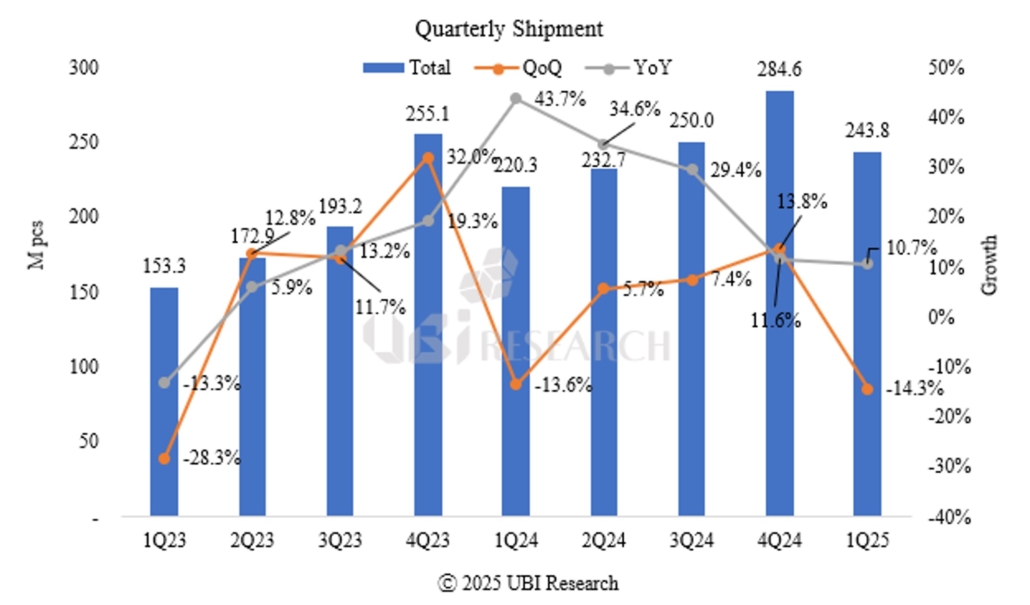
‘2022 OLED Korea Conference’ was a conference for exchange of ideas, business relationships, and partnerships with renowned speakers from major companies in the display industry from all over the world. ‘2022 OLED Korea Conference’ held a business conference on the 7th and 8th, beginning with a tutorial on April 6th.


2022 OLED KOREA Conference Day1 (Session highlights)