
Posts

Logo of Xian Smart Materials, a key supplier of TFE ink for BOE, Visionox, and CSOT.

Xian Smart Materials Expands TFE Ink Supply to BOE and Visionox… Secures 100% Share at CSOT

Official logo of Xian Smart Materials (Source: Xian Smart Materials)

Official logo of Xian Smart Materials (Source: Xian Smart Materials)

Chinese display materials supplier Xian Smart Material (思摩威) is rapidly increasing its supply share to major panel makers, centered on TFE (Thin Film Encapsulation) ink. Founded in 2017, the company has developed and manufactured TFE ink, low-temperature Over Coat (OC), organic insulating layers, and binders, and is understood to have invested RMB 350 million to build a new manufacturing plant.

Its flagship TFE ink is supplying approximately 70% of the volume for BOE’s B12 line, and pilot production is reportedly underway for BOE’s B7 line. In addition, Xian Smart Material supplies 100% of the volume for Visionox’s V2 and V3 lines, and is also estimated to have secured a 100% share for TCL CSOT starting in December 2025. As panel makers place greater emphasis on encapsulation-process stability and supply-chain optimization, the company’s strengthening line-level supply dominance has become a notable differentiator.

Meanwhile, the company is also expanding its customer base in low-temperature OC (Over Coat). Qualification evaluations are underway with BOE B7 and Tianma, increasing the likelihood of adoption in product categories where reliability under low-temperature operating conditions is critical. Given the narrow process window and stringent reliability requirements for low-temperature OC, the scope of adoption and supply volume will depend on the evaluation outcomes.

On the financial side, 2025 revenue is expected to reach approximately RMB 110 million. With capacity expansion investment and rising share among key customers, near-term growth is likely to be driven by increased shipments of TFE ink, while mid-term growth could be supported by portfolio expansion into low-temperature OC, organic insulating layers, and binders.

Additional SCM-related insights on the Chinese display industry can be found in UBI Research’s China trends report.

Junho Kim, Analyst at UBI Research (alertriot@ubiresearch.com)

▶ China Trends Report Inquiry

※ This article is produced by UBIResearchNet.
Unauthorized reproduction or citation without source attribution is prohibited.
When quoting, please clearly indicate the source (UBIResearchNet) and provide a link.
Bar chart illustrating BOE B11's 72.9% operating ratio, signaling stable mass production for Apple.

BOE B11 Achieves 35 Million iPhone Panel Shipments…72.9% Utilization and Approximately 89% Yield Demonstrate Stable Apple Supply Capability

Graph showing the monthly operating ratio of BOE's B11 OLED line (Source: UBI Research)

BOE B11 proves iPhone supply stability with a 72.9% operating ratio. (Source: UBI Research)

BOE has been gradually expanding its presence as a supplier of OLED panels for Apple’s iPhones. Building on deliveries centered on the standard models from the iPhone 12 through iPhone 16 series, BOE has broadened its coverage to the iPhone 16e, and more recently, a trend has been observed in which its coverage extends even to the iPhone 17 Pro. This suggests that BOE is moving beyond a secondary supplier role limited to specific generations or base models, and is entering a phase where it can play a meaningful role within Apple’s supply allocation strategy.

This trend can also be explained by operating indicators for BOE’s B11 OLED line. B11 is said to have a monthly capacity of 45K and an average annual utilization rate of 72.9%, implying an annual effective input of approximately 390,000 glass substrates. Assuming a Gen-6 OLED line produces 6.1-inch iPhone-class panels with 220 cuts per glass, the annual theoretical output capacity is estimated at roughly 86.6 million panels. In other words, even under conditions where Apple-bound volume fluctuates and product changeovers recur, the line structure appears to retain a degree of operational headroom.

Given that BOE’s iPhone OLED panel shipments in 2025 are around 35 million units, it is more reasonable to take a conservative view that reflects product mix rather than simply back-calculating with a single yield assumption. For example, if LTPS volume is assumed at 32 million units with a 90% yield, and LTPO volume at 3 million units with a 60% yield, the required total process input (in cut terms) comes to approximately 40.56 million cuts. Converting this using 200 cuts per glass results in an annual required input of around 200,000 glass substrates—an amount that can be interpreted as being within B11’s effective input capability.

From a technology mix perspective, BOE currently appears to be driving shipments primarily in segments with a high LTPS share, while keeping LTPO contributions limited. This can be read as an operating strategy that prioritizes mass-production stability and delivery responsiveness, rather than aggressively expanding the share of higher-difficulty processes. At the same time, indications that BOE’s supply scope is extending to the Pro lineup align with a direction that gradually opens the door to entry into higher-spec segments.

In addition, there is a gap between B11’s annual effective input capability (about 390,000 glass substrates) and the conservatively converted iPhone-related required input (about 200,000). It would be premature to label this simply as “idle capacity,” but at a minimum, it suggests a structure that could allow partial parallel operation of additional product mix—such as non-Apple models, samples/pilot runs, or volumes used for line balancing—depending on conditions. In other words, B11 can be viewed more cautiously as having a certain buffer that helps optimize line utilization amid recurring demand swings and product transitions, while still prioritizing Apple-bound supply.

Overall, BOE’s strength lies less in any single technology point and more in its ability to run stable high-volume production with competitive performance in quality control and delivery execution. While sustaining volume primarily through LTPS, BOE has also retained room to expand LTPO adoption step by step, and B11’s operating flexibility can function as a buffer against demand volatility and product changeovers. As a result, BOE can be interpreted as steadily strengthening its position in Apple’s supply chain—from short-term volume supplementation toward a more sustainable long-term supply partner.

Junho Kim, Analyst at UBI Research (alertriot@ubiresearch.com)

▶ China Trends Report Inquiry

※ This article is produced by UBIResearchNet.
Unauthorized reproduction or citation without source attribution is prohibited.
When quoting, please clearly indicate the source (UBIResearchNet) and provide a link.
BOE 14-inch OLED laptop prototype displayed to showcase B16 line capabilities.

BOE Completes Internal Lighting for Chengdu B16 8.6-Generation OLED Line… Accelerating Its Entry Into Large-Scale IT OLED Mass Production

BOE 240Hz LTPO OLED Laptop Prototype based on 8.6 Gen Line (Source: BOE)

BOE’s 240Hz LTPO OLED Prototype (Source: BOE)

BOE has reportedly completed internal lighting for its 8.6-generation (2290×2620 mm) IT OLED production line, known as B16, which is currently under construction in Chengdu, Sichuan Province. The project, launched in March 2024 with a total investment of 63 billion RMB (approximately 12.4 trillion KRW), is progressing rapidly and is designed to support a monthly capacity of 32,000 glass substrates. Although BOE has not officially announced the lighting milestone, sources indicate that a formal public announcement is planned for December 2025.

The prototype used for the lighting test is a 14-inch OLED notebook panel intended for Acer, marking a strategic reference win aligned with the global trend toward wider OLED adoption in laptops. BOE had also planned to develop smartphone panels for Oppo using the B16 line, but the development schedule has reportedly been delayed.

The B16 line will expand further through a Phase 2 investment, and Sunic Systems has been selected as the supplier for the key deposition equipment. The first tool is expected to be delivered in the fourth quarter of 2026, positioning BOE to strengthen its competitiveness in IT OLED mass production as the additional capacity comes online.

With IT device OLED demand rising rapidly, BOE’s B16 project is regarded as a symbolic investment accelerating China’s entry into the high-resolution, large-area OLED market. The establishment of an 8.6-generation line in particular is expected to serve as a crucial inflection point for Chinese panel makers seeking to narrow the technology gap with Korean competitors in the notebook and tablet OLED segments.

Junho Kim, Analyst at UBI Research (alertriot@ubiresearch.com)

▶ China Trends Report Inquiry

※ This article is produced by UBIResearchNet.
Unauthorized reproduction or citation without source attribution is prohibited.
When quoting, please clearly indicate the source (UBIResearchNet) and provide a link.
Bar chart showing the quarterly growth of OLED smartphone panel shipments in 2025, highlighting Q4 peak.

OLED Smartphone Panel Shipments to Reach 900 Million Units in 2025…Q4 Production Drives Annual Growth

Quarterly OLED Shipments Forecast for Smartphones by Manufacturer in 2025 (Source: UBI Research)

UBI Research forecast trend for quarterly OLED smartphone panel shipments and manufacturer share in 2025 (Source: UBI Research)

According to UBI Research’s quarterly publication, the OLED Display Market Tracker, OLED panel shipments for smartphones and foldable phones are expected to reach approximately 900 million units in 2025. By shipment share, Chinese panel makers are projected to account for about 48.8% of the annual total, nearly matching the level of Korean manufacturers. While shipment volumes between the two countries are similar, Korean companies maintain a revenue advantage due to their higher proportion of premium-tier orders for flagship models such as Apple’s iPhone and Samsung’s Galaxy.

In particular, Korean panel makers saw a significant surge in smartphone and foldable panel shipments in the fourth quarter, marking their strongest performance of the year. Panel supply expanded sharply from the third quarter with the launch of new Apple products, and shipments peaked as Samsung Electronics began full-scale production of Galaxy S26 series panels.

Samsung Display continued its solid growth into the fourth quarter, driven by increasing demand for panels for the iPhone 17 series and Samsung’s Galaxy S25 FE. With mass production for both the iPhone lineup and Galaxy S26 series in full swing, Samsung Display is expected to post its highest annual shipment volume to date. LG Display also achieved a strong rebound in the third quarter with shipments of roughly 20 million units, representing a sharp quarter-over-quarter increase, and its Q4 shipments are forecast to rise by an additional 20%.

Chinese panel makers showed quarterly fluctuations depending on demand conditions but maintained stable supply across major smartphone brands. BOE expanded its customer base by diversifying its supply portfolio from entry-level to upper-mid-range smartphone models. TCL CSOT and Visionox continued to grow shipments to both the domestic Chinese market and global brands, while Tianma focused on enhancing technological competitiveness by increasing the share of high value-added products such as LTPO.

In terms of set makers, Apple secured the largest volume of OLED panels, followed by Samsung Electronics, Xiaomi, Vivo, and Huawei. Executive Vice President Changwook Han of UBI Research commented, “As the industry enters the second-half peak season, Korean display manufacturers are showing clear improvements in both shipments and revenue. In particular, Samsung Display is expected to ship around 150 million panels in the fourth quarter driven by increased demand for iPhone panels.” He added, “Chinese panel makers are also maintaining stable momentum by adjusting their supply strategies in line with shifting market demand.”

Changwook Han, Executive Vice President/Analyst at UBI Research (cwhan@ubiresearch.com)

▶ Quarterly Small OLED Display Market Tracker Sample

▶Quarterly Medium & Large OLED Display Market Tracker Sample

※ This article is produced by UBIResearchNet.
Unauthorized reproduction or citation without source attribution is prohibited.
When quoting, please clearly indicate the source (UBIResearchNet) and provide a link.

A bar chart illustrating the forecast growth of XR devices equipped with OLEDoS displays between 2025 and 2031, highlighting AR dominance.

XR Headset Shipments Set to Top 10 Million in 2025… AR Expansion Drives OLEDoS Growth

Forecast chart of XR device shipments with OLEDoS from 2025 to 2031 (Source: UBI Research)

UBI Research forecast trend for XR device (MR/VR and AR) shipments equipped with OLEDoS from 2025 to 2031 (Source: UBI Research)

The rapid expansion of the AI and XR device market has intensified competition in next-generation microdisplay technologies. According to a new report published by UBI Research titled ” XR Industry Trends and OLEDoS Display Technology & Industry Analysis” XR headset shipments are expected to exceed 10 million units by 2025. Notably, AR smart glasses alone saw over a 50% year-on-year increase in the first half of this year, clearly shifting the market’s center of gravity.

The AR market is diversifying, expanding its application range from AI glasses focused on information display to business-use AR glasses and content-viewing devices. In the consumer AI glasses market, primarily focused on information display, monochrome displays with resolutions around 640 x 480 (VGA) and microdisplays under 0.3 inches are commonly used, with LCoS and micro LED competing for position. Workplace AR glasses require resolutions of 1280×720 (HD) or higher, while content-viewing AR demands resolutions of 1920×1080 (FHD) or higher.  As industry’s expansion focus shifts from VR to AR, the demand for simultaneously meeting ultra-high resolution, high brightness, and lightweight requirements has grown significantly. Consequently, OLEDoS is evaluated as the fastest-growing display technology within the XR ecosystem.

Global manufacturers are also accelerating OLEDoS development and supply chain expansion. Samsung Display joined the OLEDoS market, previously led by Sony, BOE, and Seeya, by supplying OLEDoS panels for Samsung Electronics’ Galaxy XR, released in October 2025, following Sony. In China, companies like BOE, Seeya, and SIDTEK have commenced mass production of 12-inch OLEDoS panels, marking the most notable shift in the supply chain. Chinese firms are strengthening their in-house capabilities in core processes such as high-resolution patterning, Si-backplane design, and tandem OLED structures, suggesting their global supply share will rapidly expand in the future.

UBI Research analyst Changho Noh predicted, “The OLEDoS market is projected to grow from approximately $285 million in 2025 to $840 million by 2031, driven by supply chain expansion and diverse demand bases.”

He further analyzed, “Shipments of OLEDoS-equipped XR devices are expected to increase from 1.2 million units in 2025 to 8.86 million units by 2031, with AR devices anticipated to account for approximately 90% of total OLEDoS shipments by 2031.”

Changho Noh,  Senior Analyst at UBI Research (chnoh@ubiresearch.com)

▶XR Industry Trends and OLEDoS Display Technology & Industry Analysis Report

※ This article is produced by UBIResearchNet.
Unauthorized reproduction or citation without source attribution is prohibited.
When quoting, please clearly indicate the source (UBIResearchNet) and provide a link.
Featured graphic of 2024–2025 OLED shipment share by application highlighting smartphone dominance and China’s rising supply share (Source: UBI Research)

Dual Axes of the 2025 OLED Market: Korea’s Premium Focus and China’s Expansion in Shipments

The OLED market in 2024 and 2025 witnessed marked changes in both the demand structure by application and the supply structure by panel manufacturer. The smartphone-centric demand base became more robust, while major Korean and Chinese panel manufacturers, leveraging their distinct strengths, expanded their market contributions, leading to continued diversification in the OLED industry.

By application, smartphones dominated the OLED market in 2024, accounting for 82% of total shipments, reaching 833.8 million units. Watches accounted for 119.7 million units (12%), while other product groups, including tablets, laptops, monitors, and TVs, remained small markets. This structure continued in 2025, with smartphone shipments increasing to 920.7 million units, representing 84% of the total. Watches remained relatively stable at 113.4 million units, and the share of other product groups remained largely unchanged.

Pie charts of OLED shipments by application for 2024 and 2025 showing larger smartphone share (Source: UBI Research)

OLED shipment share by application, 2024 (left) and 2025 (right) (Source: UBI Research)

In 2024, the roles of Korea and China in OLED panel supply were clearly divided. Samsung Display maintained its position as the largest supplier with 410 million units (41%), while LG Display recorded 100 million units (11%). In the same year, Chinese panel makers continued their quantitative expansion, accounting for 48% of the total, with a combined shipment of 490 million units: BOE with 138 million units, Visionox with 114 million units, Tianma with 102 million units, CSOT with 83 million units, and EverDisplay with 43 million units.

This structure was further strengthened in 2025. Chinese panel makers, including BOE, Tianma, Visionox, CSOT, and EverDisplay, combined to ship 555 million units annually, accounting for over 51% of the global supply, emerging as a key player in the global supply chain. In the same year, Samsung Display maintained its technology-focused responsiveness, with shipments reaching 411 million units (37%), while LG Display reached 128 million units (12%).

The differences in sales strategies between the two countries were also clear. In 2024, Samsung Display solidified its premium-focused structure with $25.6 billion (57%), while LG Display also achieved $7 billion. Conversely, Chinese companies such as BOE, Visionox, and Tianma demonstrated a trend of expanding sales based on mass production. In 2025, LG Display grew significantly to $11.6 billion, and BOE’s shipments also expanded to $7.1 billion, further separating the two countries’ technology and production strategies.

In summary, the OLED market in 2025 saw a strengthened smartphone-centric demand structure, while Chinese companies accounted for over half of panel shipments, demonstrating a clear shift in regional composition. Korean companies maintained a sales structure centered on high-value-added products, while Chinese companies continued to expand their market presence based on increased shipments. UBI Research Executive Vice President Changwook Han said, “The 2025 OLED market is a period in which the supply structure by region and company is expanding simultaneously, with each company broadening its market response based on its product portfolio and technological capabilities.”

Changwook Han, Executive Vice President/Analyst at UBI Research (cwhan@ubiresearch.com)

▶ Quarterly Small OLED Display Market Tracker Sample

▶Quarterly Medium & Large OLED Display Market Tracker Sample

※ This article is produced by UBIResearchNet.
Unauthorized reproduction or citation without source attribution is prohibited.
When quoting, please clearly indicate the source (UBIResearchNet) and provide a link.
Featured image illustrating global IT OLED shipment growth forecast through 2029 (Source: UBI Research)

“Beyond Mobile” Era Begins… IT OLED to More Than Double by 2029

IT OLED shipment forecast chart for 2025–2029 (Source: UBI Research)

IT OLED shipment forecast (Source: UBI Research)

According to UBI Research’s recently published report, “Beyond Mobile: IT OLED Technology and Industry Analysis,” global shipments of IT OLEDs are expected to more than double from 24 million units in 2025 to 53 million units in 2029. The report states that OLED adoption in tablets, notebooks, and monitors is entering a structural growth phase over the next four years.

Company-level shipment projections also show clear shifts. Samsung Display, currently the largest producer of OLED panels for notebooks, tablets, and monitors, is expected to maintain a stable market share of more than 60%. LG Display, Everdisplay, BOE, and Visionox are projected to follow, shaping a competitive global landscape in the IT OLED market.

Because most IT OLED products use medium-to-large panel sizes, large-substrate production lines that maximize glass utilization rates are essential. As global device makers—especially Apple—accelerate their adoption of OLED across IT product categories, panel manufacturers are positioning 8.6-generation (8.6G) OLED line investments as a core strategic priority.

The investment landscape reflects this trend. After Samsung Display announced the industry’s first 8.6G OLED line investment worth approximately KRW 4 trillion in April 2023, BOE, Visionox, and TCL CSOT soon followed. More recently, Tianma has also begun reviewing 8.6G OLED investment, drawing attention across the industry. This shift signals that the OLED market is moving beyond a smartphone-centered structure and into a phase of expanding demand driven by notebooks, tablets, and monitors.

As the market grows, technology requirements for IT OLEDs are also becoming more stringent. The report highlights that IT products have longer replacement cycles and a higher percentage of white-background usage for document work, making them more vulnerable to burn-in than smartphones. As a result, 2-stack tandem OLED, known for long lifetime, high brightness, and high efficiency, is evaluated as essential. Samsung Display, BOE, and Visionox are therefore investing in production lines capable of mass-producing 2-stack tandem OLED.

Customer acquisition competition is another critical factor. Samsung Display has secured Apple as a key customer and is building its strategy around mass production for the OLED “MacBook Pro.” In contrast, Chinese panel makers are prioritizing markets for OLED panels used in notebooks, tablets, and smartphones among Chinese and global brands, rather than targeting Apple’s supply chain as their first objective.

UBI Research Vice President Changwook Han stated, “As Chinese OLED panel makers rush into 8.6G OLED investments in an effort to catch up with Samsung Display, the industry is closely watching how effectively Samsung Display can leverage its technology leadership to secure additional IT customers beyond Apple.”

Changwook Han, Executive Vice President/Analyst at UBI Research (cwhan@ubiresearch.com)

Illustration summarizing China’s display industry response to EU PFAS REACH restrictions

China’s Display Industry prepares for EU PFAS regulations

EU REACH PFAS restriction proposal timeline

EU PFAS REACH restriction proposal timeline

China’s display panel industry is accelerating its transition to PFAS-free production in response to the European Union’s (EU) strengthened regulations on PFAS (Per- and Polyfluoroalkyl Substances, persistent harmful chemicals). The EU’s REACH (Registration, Evaluation, Authorization and Restriction of Chemicals) PFAS substance restriction regulation is based on an initial proposal submitted in January 2023 by five member states: Denmark, Germany, the Netherlands, Norway, and Sweden. Following a public consultation from March to September 2023, which gathered over 5,600 comments, an updated Background Document was published on August 20, 2025.

This regulation proposes restriction options due to the environmental and health hazards posed by PFAS’s persistence, mobility, and bioaccumulation. Concentration limits were set at 25 ppb for individual PFAS, 250 ppb for group totals, and 50 ppm for all PFAS (including polymers). The Commission will publish the amended REACH regulation in December 2025. Following deliberation by the Parliament and Council, full implementation will commence in 2027. Essential use exemptions (e.g., medical devices, safety-related applications) will undergo strict scrutiny and will only be permitted when no alternatives exist. Penalties, determined by member state laws, include administrative and criminal sanctions, posing a significant risk of export bans for violations. This regulation forms part of the EU’s ‘Chemical Strategy for Sustainability’ (2020), aiming for an 80% phase-out of PFAS by 2030.

These regulations are expected to directly impact OLED and LCD processes in the display industry (cleaning agents, coating agents, etc.), prompting major Chinese companies to reassess supply chains and develop alternatives. For the display industry, developing PFAS-free alternatives (such as silicon-based coatings) for OLED deposition and cleaning processes is a key challenge. China’s display industry, with its high export share to the EU, is expected to face impacts across its entire supply chain.

BOE is reevaluating key materials for its European exports—including photoresist (PR), polarizers, and cleaning solutions—to comply with EU REACH standards. It has requested suppliers like Japan’s JSR and Shin-Etsu Chemical to switch to non-fluorinated alternatives and is testing silicon-based coatings on a pilot line at its Hefei plant. Considering the EU market’s 22% share of its total sales, non-compliance by 2026 could risk halting exports. BOE is concurrently improving its AMOLED processes, primarily at its Chongqing and Hefei plants, while constructing an 8.6-generation AMOLED line (B16) with a target lighting-up date of late 2025. The LCD product line, with its lower process complexity, plans to prioritize the transition to PFAS-free materials by 2027. Notably, for Apple supply, PFAS-free materials are scheduled for application starting with the iPhone 18 series. BOE is evaluating PFAS-free options from Rouxian (柔显) and Mitsubishi Chemical to replace the Black PDL (Pixel Definition Layer) material. Black PDL is a core material in the Pol-less OLED structure, contributing to reduced device thickness and improved efficiency.

TCL CSOT is enhancing its process to minimize PFAS usage by leveraging inkjet printing (IJP) technology. Its 8.6-generation OLED factory, which broke ground in Guangzhou in November 2025, applies IJP to directly print RGB materials without fluorine-based vapor deposition processes, expecting a 20% cost reduction and improved energy efficiency. TCL CSOT highlighted the potential for minimizing PFAS use, reducing costs by 20%, and improving energy efficiency at SID Display Week 2025.

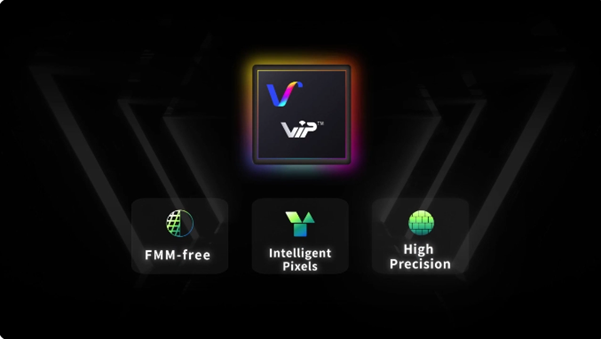
Visionox is reducing PFAS dependency with its FMM-free ‘ViP (Visionox intelligent Pixelization)’ technology. This photolithography-based pixel patterning reduces PFAS exposure during cleaning and coating steps. Construction of its Hefei 8.6-generation OLED factory commenced in late February 2025.

China’s Ministry of Industry and Information Technology (MIIT) set a 70% domestic substitution rate target for PFAS alternatives by 2026 in its ‘PFAS Usage Restriction Roadmap’ announced in December 2024, while expanding R&D subsidies for companies like BOE and TCL CSOT. This represents national-level support linked to semiconductor and display self-sufficiency policies, bolstering China’s OLED shipment expansion. The MIIT roadmap prioritizes banning specific PFAS like PFHxA and PFOA, similar to the EU REACH regulation, aiming for full implementation by 2027.

Changho Noh,  Senior Analyst at UBI Research  (chnoh@ubiresearch.com)

▶ China Trends Report Inquiry

Graphical summary of BOE’s conversion of its B1 line to Micro OLED (OLEDoS) production and its strategic move into micro-display market (Source: UBI Research)

BOE Establishes Micro OLED Production System on B1 Line… Strengthens ‘Micro Display’ Competitiveness with In-House Silicon Backplane Development

BOE IPC displayed 0.49-inch 4496 ppi Micro OLED (OLEDoS) AR glasses (Source: BOE)

BOE 0.49″ Micro OLED (OLEDoS) AR glasses (Source: BOE)

BOE will convert its Beijing B1 (LCD) line to complete an early-stage 12-inch silicon-based Micro OLED (OLEDoS) production cleanroom and establish a mass production system based on 5K resolution. Sunic system ‘s 12-inch deposition equipment is scheduled for delivery in November. Investment funds will be supported by the Beijing B20 line, maximizing utilization of the existing B1 line infrastructure. Additionally, the company has replaced its previously outsourced silicon (Si) backplane design with an in-house development approach, achieving shorter design cycles and rapid feedback loops. Future investment plans extend beyond Micro OLED modules to include optical modules such as optical waveguides.

The primary investment objective is to respond to Meta-oriented products, which are currently competing with Seeya. Phase 1 line capacity is 5K units per month based on 12-inch wafers. Depending on market conditions, plans include expanding Phase 2 with an additional 5K capacity line.

The B20 line is currently constructing Phase 1 for R&D and manufacturing of high-resolution, high-speed LCD displays. Layout plans and mass production schedules for a Micro LED pilot line are also being finalized.

BOE is reorganizing its portfolio centered on OLEDoS and LEDoS. It is strengthening its market responsiveness with a diversified lineup: high-resolution OLEDoS products for the premium AR/VR market and high-speed LCDs for the mid-to-entry-level XR market. Concurrently, it is actively developing LEDoS as a next-generation product.

BOE is developing and mass-producing micro-displays at multiple bases including Qingdao (BIOT), Ordos (B6), Chongqing (B12), and Kunming (BMOT). The Chongqing base operates R&D and production lines for VR AMOLED, while Kunming operates OLEDoS production lines. Notably, it is strategically repurposing existing LCD infrastructure to concurrently produce high-resolution LCDs exceeding 2,000 ppi. Ordos (B6) manufactures high-speed LCD panels, while Qingdao (BIOT) assembles and produces high-speed LCD modules. BOE is intensifying its competition for XR panel orders through rapid facility expansion compared to rivals like Sony and Seeya.

The global micro-OLED display market is expected to see intense competition for orders of next-generation products destined for XR devices within the next few years. Following Sony and Seeya, companies like BOE and SIDTEK are making large-scale investments to establish annual production capacities ranging from several million to tens of millions of units. This will enable global brands like Meta, Apple, and Samsung to utilize multiple supply chains. BOE’s in-house silicon-based design and mass production system are expected to enhance the group’s overall standing in terms of product specifications and cost competitiveness.

BOE’s recent strategic shift aims to strengthen technological independence within China’s industry while securing a core supplier position in the global XR display ecosystem. Initiatives like developing its own silicon backplane and establishing a 12-inch OLEDoS line are expected to improve performance, reduce mass production costs, and shorten product launch lead times.

Detailed information on China’s Micro OLED industry status can be found in UBI Research’s report.

Changho Noh,  Senior Analyst at UBI Research  (chnoh@ubiresearch.com)

▶ China Trends Report Inquiry

Chart showing automotive OLED shipments and market shares with Porsche adopting curved OLED displays for premium EV models

Cumulative Automotive OLED Shipments Reach 2.7 Million Units in Q3 – Porsche Adopts Curved OLED in Its Premium EV

The presence of OLED technology in the global automotive display market is expanding rapidly. According to UBI Research’s “Q4 Display Market Tracker,” shipments of automotive OLED displays reached approximately 2.5 million units in 2024, and the cumulative shipments as of Q3 2025 have already totaled around 2.7 million units.

By panel maker, Samsung Display maintained a dominant lead with 1.71 million units (64%), followed by BOE with 570,000 units (21%). LG Display and Ever Display accounted for 220,000 (8%) and 180,000 units (7%), respectively, continuing their expansion in the premium vehicle segment.

Quarterly shipment trends of automotive OLED displays comparing Samsung Display, BOE, LG Display, and EverDisplay (Source: UBI Research)

Quarterly Automotive OLED Display Shipments (Source: UBI Research)

Q1–Q3 2025 Automotive OLED shipment and market share by vendor — Samsung Display 64%, BOE 21%, LG Display 8%, EverDisplay 7% (Source: UBI Research)

Automotive OLED Shipments and Market Share, Q1–Q3 2025 (Source: UBI Research)

The growth of automotive OLED adoption has been driven by premium electric vehicle (EV) manufacturers. A notable example is Porsche’s upcoming Cayenne Electric, scheduled for launch at the end of this year, which will feature a large 42-inch curved OLED display. The display system consists of a 14.25-inch driver cluster, a 12.25-inch center information display (CID), and a 14.9-inch co-driver display (CDD).

The 12.25-inch curved center OLED is expected to be supplied by either LG Display or Samsung Display. Both companies have previously supplied P-OLED (Plastic OLED) curved displays for premium European brands such as Audi and Mercedes-Benz, demonstrating their technological reliability and strong capabilities in curved-panel manufacturing.

In contrast, the cluster and CDD OLED panels are likely to be provided by BOE. The Chinese panel maker began mass-producing OLED instrument clusters in 2024 and has been supplying them to Volkswagen Group, Porsche’s parent company, thereby accelerating its penetration into the global premium OEM supply chain.

OLED technology is increasingly replacing conventional LCD panels, establishing itself as a core enabler for design differentiation and enhanced user experience in premium vehicles. Its self-emissive nature allows for superior contrast ratios, deep blacks, and flexible curved form factors-features particularly valued in electric and luxury cars. Furthermore, OLED displays align well with next-generation Human-Machine Interface (HMI) trends, supporting multi-display layouts, curved user interfaces, and integrated digital cluster designs that enhance both aesthetics and functionality inside vehicles.

Changwook Han, Executive Vice President/Analyst at UBI Research (cwhan@ubiresearch.com)

▶2025 Automotive Display Technology and Industry Trends Analysis Report

▶ Quarterly Small OLED Display Market Tracker Sample

▶Quarterly Medium & Large OLED Display Market Tracker Sample

BOE logo and HKC display factory symbolizing China’s accelerating OLED industry shift through large-scale investment

China’s display industry accelerates OLED-centric restructuring – BOE accelerates technology and HKC enters the market

China’s panel industry is accelerating its restructuring around OLED technology through large-scale investments. BOE and HKC are each stepping up efforts to enhance OLED technologies for smartphones and IT applications, while establishing dual production systems that encompass both LTPS and OLED, aiming to strengthen their positions in the global display market.

BOE logo representing China’s leading OLED display company driving technological innovation (Source: BOE)

BOE (Source: BOE)

BOE – Diversifying Technology While Advancing Apple Certification

BOE, which is currently producing OLED panels for the iPhone 17 Pro, is also expected to obtain certification for the iPhone 17 standard model within this year. BOE’s Apple-dedicated module production consists of 26 lines, with each newly invested line approximately 400 meters long and costing about 300 million CNY. The total investment for the Mianyang (绵阳) plant, including both panel and module lines, is estimated at 55 billion CNY.

At the Chengdu B12 plant, R&D efforts are focused on next-generation processes such as COE (Color on Encapsulation), Black PDL (Positive Type), and MLA (Micro Lens Array). The current monthly capacity of B12 is about 30 K substrates, which is expected to increase to 40 K by year-end. COE applications are being evaluated primarily for general smartphone models, while Black PDL processes are planned to expand into IT panels. MLA products are currently being supplied at 3–5 K substrates per month, with BOE also securing high-refractive-index materials for the technology.

HKC display factory in China establishing dual LTPS and OLED production lines (Source: HKC)

HKC Factory (Source: HKC)

HKC – Diversifying Production Through Dual Investments in LCD and OLED

HKC is expanding its OLED investment through the new H7 project. Unlike previous projects, H7 is being executed under the corporate entity of the existing H4 Mianyang LCD plant rather than a newly established subsidiary—an arrangement linked to local government funding structures.

The project includes a 60 K used 6th-generation LTPS LCD line acquired from JDI and a new 32 K 6th-generation OLED ELEAP line (divided into 8 K + 24 K phases). Additionally, HKC is expanding its H4 IPS Photo process line and constructing a new Mini-LED factory with an investment of approximately 10 billion CNY. Through these projects, HKC is building a comprehensive display production system covering LCD, OLED, and Mini-LED technologies.

Strategic Transition in China’s Panel Industry

The initiatives of BOE and HKC mark not just an expansion of production capacity but a shift toward technology-driven competitiveness. With high-value OLED technologies such as COE and MLA gaining traction, and government-led capital structures supporting investment diversification, China’s display industry is transitioning from scale-driven growth to technology-driven competition.

UBI Research’s “China Trends Report” provides detailed information on BOE’s progress in developing panels for Apple, the progress of new technology development by panel manufacturers, the latest investment trends, panel shipment volumes and unit prices, and the materials supply chain. The “China Trends Report” is available on the UBI Research website.

Junho Kim, Analyst at UBI Research (alertriot@ubiresearch.com)

▶ China Trends Report Inquiry

Chart showing quarterly tablet OLED shipments by UBI Research with QoQ and YoY growth trends in 2024–2025

Tablet OLED Demand Rebounds… Mid- to Large-Size OLED Shipments Up 11% in Q3 2025

Quarterly OLED shipment trend for tablet PCs from 2024 to 2025, showing QoQ and YoY growth (Source: UBI Research)

Quarterly OLED Shipments for Tablet PCs (Source: UBI Research)

According to UBI Research’s Q4 Mid- to Large-Size OLED Display Market Tracker, the mid- to large-size OLED market in Q3 2025 rose 11% QoQ in shipments and 7.2% QoQ in revenue. This indicates that demand for mid- to large-size OLED panels is gradually recovering, exiting the slump that persisted since the second half of last year.

Within this segment, tablet PC OLED panels posted particularly strong growth. Q3 tablet OLED shipments increased 56% QoQ and 25.9% YoY, largely driven by the full-scale ramp of panel supply for Apple’s new iPad Pro. After a lull since Q3 last year, tablet OLED demand is rebounding quickly alongside the resumption of iPad Pro shipments.

By panel maker, Samsung Display supplied approximately 1.5 million OLED panels for tablets in the third quarter, while LG Display shipped about 1.3 million units. Among Samsung Display’s shipments, around 700,000 units were for the iPad Pro, whereas all of LG Display’s shipments were used exclusively in the iPad Pro. Both companies count Apple as a key client. In addition, Samsung Display solely supplies OLED panels for Samsung Electronics’ own Galaxy Tab S series.

Chinese panel makers are also increasing shipments of tablet OLEDs. Everdisplay (EDO) has been rapidly expanding its market share, recording 600,000–800,000 units per quarter since Q4 2024. BOE and Visionox are likewise supplying tablet OLED panels—albeit in smaller volumes—to Chinese device makers, steadily raising their output.

UBI Research’s Executive Vice President Chang-wook Han commented, “Today’s tablet OLED market is dominated by Apple, which supports the strong position of Korean panel makers. However, as OLED adoption expands beyond the iPad Pro to more affordable lineups such as iPad Air and iPad mini, Korean vendors could see their share pressured. At the same time, higher adoption among Chinese brands is expected to gradually lift the market share of Chinese panel makers.”

He added, “Amid these shifts, it remains to be seen whether Samsung Display and LG Display can maintain their technology lead and defend their market shares.

Changwook Han, Executive Vice President/Analyst at UBI Research (cwhan@ubiresearch.com)

▶ Quarterly Small OLED Display Market Tracker Sample

▶Quarterly Medium & Large OLED Display Market Tracker Sample

Q3 OLED Panel Shipments Surge with iPhone 17 Effect

OLED panel shipments surge in Q3, with Korean companies showing a clear recovery thanks to the iPhone 17 launch

Bar chart of quarterly OLED panel shipments for smartphones in 2025

OLED panel shipments for smartphones by company in Q1–Q3 2025,  (Source: UBI Research)

According to the “OLED Display Market Tracker,” published quarterly by UBI Research, Korean panel manufacturers saw a significant increase in smartphone and foldable phone panel shipments in the third quarter. This is the result of a rapid recovery from a temporary decline in the second quarter, a period of weak smartphone demand, driven by the popularity of the iPhone series and Samsung Electronics’ new products.

Samsung Display saw a surge in panel shipments for the iPhone 17 series and the Galaxy S25 FE in the third quarter, significantly boosting flexible OLED shipments that had stagnated in the second quarter. Rigid OLED shipments remained stable, maintaining similar levels to the previous quarter.

LG Display’s panel shipments surged from approximately 10.8 million units in the second quarter to approximately 20 million units in the third quarter, nearly doubling forecasts. LG Display supplies smartphone panels exclusively to Apple, so the launch of the iPhone 17 series was the primary driver of shipment growth. Shipments for the iPhone 17 Pro Max, in particular, accounted for approximately 60% of total shipments, the largest share.

Chinese panel makers also saw shipment growth. BOE shipped approximately 5.4 million units, and Visionox increased shipments by approximately 6.7 million units compared to the second quarter. BOE’s main customer was Oppo, followed by Apple and Huawei. With the gradual expansion of iPhone panel supply, Apple is likely to emerge as a key customer for BOE in the fourth quarter. Visionox shipped the most refurbished panels, followed by Honor, Xiaomi, and Vivo.

“Korean panel makers have shown a clear recovery in shipments since the third quarter, and Chinese companies are also continuing to grow,” said  Changwook Han, Executive Vice President of UBI Research. “Securing stable shipments from Apple, their most important customer, will be a key challenge for Korean companies going forward. However, Samsung Display and LG Display have already established a solid presence in the global premium market, so we expect them to maintain their strategic advantage even amidst competition with BOE.”

Changwook Han, Executive Vice President/Analyst at UBI Research (cwhan@ubiresearch.com)

▶ Quarterly Small OLED Display Market Tracker Sample

▶Quarterly Medium & Large OLED Display Market Tracker Sample

BOE unveiled a 10.18-inch triple fold OLED panel exclusively for Huawei at IPC 2025 (Source: UBI Research)

BOE Unveils 10.18-inch Triple-Fold Panel at IPC 2025…Strengthens Market Strategy with Exclusive Supply to Huawei

BOE’s 10.18-inch triple fold OLED panel showcased at IPC 2025 (Source: UBI Research)

Triple fold OLED panel unveiled at BOE IPC 2025 (Source: UBI Research)

BOE showcased a 10.18-inch triple-fold panel for foldable smartphones at its IPC (International Partner Conference) 2025. The panel has already been applied to Huawei’s Mate XT Ultimate and is confirmed to be adopted in the successor model Mate XTs Ultimate, which is scheduled for release at the end of September.

Earlier in August, at DIC 2025 (Display Innovation China), BOE did not exhibit the triple-fold panel. BOE’s decision not to unveil the panel at DIC, a public exhibition that highlights the latest display technologies across the industry, but instead to present it exclusively at IPC 2025, is interpreted as a strategic choice. While DIC serves as a stage for industry-wide technology sharing, IPC is a platform where BOE emphasizes its differentiated technologies and roadmap directly to global partners and clients. By selectively showcasing the triple-fold OLED panel at its own event, BOE sought to reinforce its brand image and highlight its leadership in the market with a product that requires high levels of technical maturity and reliability.

The triple-fold panel exhibited by BOE features a resolution of 2232×3184 and supports a variable refresh rate ranging from 1Hz to 90Hz. Structurally, it achieves an external folding radius of R3.8mm and an internal folding radius of R1.5mm, enabling a design that can fold three times.

Reliability tests confirmed durability of over 100,000 cycles at room temperature, 20,000 cycles under low temperatures, and more than 100,000 cycles in high-temperature and high-humidity environments. In addition, BOE applied a 10-inch UTG (Ultra Thin Glass) to balance mechanical strength and transparency, and reinforced durability by adopting a “Bamboo Book structure,” which places adhesive at the edges of the folding area.

Through this exhibition, BOE demonstrated its foldable display capabilities, differentiating itself from other Chinese OLED panel makers such as Visionox and Tianma. The triple-fold panel requires a combination of complex technologies, including structural design, reliability assurance, and advanced materials, making it a symbolic case that underscores its commercial potential. With this move, BOE is not only strengthening its technological competitiveness within China’s display industry but also reinforcing its independence and leadership in the global market.

Junho Kim, Analyst at UBI Research (alertriot@ubiresearch.com)

▶ China Market Trend Report Inquiry

BOE OLEDoS AR/VR Microdisplay at IPC 2025

BOE Establishes Microdisplay Development Infrastructure in Beijing… Unveils a Range of AR/VR Products and Roadmap at the 2025 BOE IPC

AR glasses with 0.49-inch 4496ppi OLEDoS displayed at BOE IPC 2025 (Source: BOE)

0.49-inch 4496ppi OLEDoS AR glasses unveiled at BOE IPC 2025 (Source: BOE)

BOE will convert the clean room of its fifth-generation B1 LCD line in Beijing, China, to create an OLEDoS (silicon-based OLED) production infrastructure. The investment will be funded by the Beijing B20 base and will utilize existing equipment and infrastructure to shorten process validation and yield ramp-up time. This is not a simple expansion, but rather a strategy to internalize silicon microdisplay in Beijing and secure an early mass production system.

BOE unveiled its microdisplay roadmap and new products at the 2025 International Partner Conference (IPC) and related events. BOE demonstrated its technology and commercialization commitment to next-generation applications such as high-resolution AR/VR devices, and BOE will focus its R&D and investment on high-resolution LCDs of 2,000 ppi and above, as well as LEDoS and OLEDoS. In addition, the company plans to establish a new microdisplay production base in Beijing and to secure technology independence by shifting from relying on external design houses to developing its own silicon (Si) backplane technology.

BOE has also reorganized its portfolio by market segment. The premium market will be served by LEDoS and OLEDoS, while the mid-range market will be served by developing and producing AMOLED panels for VR at its Chongqing base. For the entry-level market, a 2,000 ppi LTPS-LCD microdisplay line will be launched at Beijing B20 to enhance cost competitiveness and volume responsiveness. Separately, the transition to MLED backplanes is underway at the Ordos B6 line. The plan is to leverage Gen 5.5 assets to improve the uniformity and reliability of key processes such as sputtering-based metal-electrode thin-film formation, and to advance process maturity by optimizing low-resistance wiring and contact characteristics required for large-area operation.

BOE’s move is likely to change the competitive landscape with Sony, Samsung Display, and others in the AR/VR market. In-house development of the silicon backplane is expected to speed up product launches by shortening the feedback loop for design changes, performance improvements, and power optimization.

The infrastructure shift to Beijing is also expected to enhance supply chain stability and customization responsiveness. By consolidating design, optics, software, and solutions capabilities in Beijing, the plan is to reduce lead times for customization and product generation transitions.

Changho Noh,  Senior Analyst at UBI Research  (chnoh@ubiresearch.com)

▶UBI Research’s Micro Display Report

OLED emitting material market share by nation, Korea leading overall while China rises in smartphones

OLED Emitting Material Market Landscape Shifts… Korea Maintains Overall Lead While China Advances in Smartphones

OLED emitting material market share by nation, comparison of Korea and China (Source: UBI Research)

OLED emitting material market share trends by nation (Source: UBI Research)

According to the Q3 Emitting Material Market Tracker recently published by UBI Research, Korean panel makers maintained their lead over Chinese competitors in total OLED emitting material purchases in the first half of 2025. Korean panel makers purchased approximately 36.7 tons, accounting for 59.9% of the total, while Chinese panel makers purchased 24.6 tons, representing 40.1%. By quarter, Korea recorded 18.6 tons versus China’s 12.8 tons in Q1 2025, and 18.1 tons versus 11.8 tons in Q2, continuing a stable lead.

While Korea continues to dominate the overall OLED emitting material market, the smartphone segment shows a different trend. Since 2025, Chinese panel makers have consistently exceeded 50% market share on a quarterly basis, surpassing Korea in the first-half total as well. This indicates that although Korea remains ahead in the overall OLED emitting material market, China’s share is steadily expanding in smartphones, a core application segment. Backed by its strong domestic demand, China has rapidly increased shipments, suggesting that the balance between the two countries is gradually shifting in the medium to long term.

By company, Samsung Display accounted for about 40% of the total OLED emitting material purchases, maintaining the largest share, followed by LG Display, BOE, and Tianma. In contrast, in the smartphone OLED emitting material market, BOE closely followed Samsung Display, with Tianma, TCL CSOT, and LG Display trailing behind. Thus, while Korean panel makers still demonstrate clear strength in the overall market, Chinese panel makers are making notable strides in the smartphone sector.

UBI Research analyst Noh Chang-ho stated, “Although Korea has been overtaken by China in the smartphone OLED emitting material market, Samsung Display and LG Display remain ahead in the overall OLED market, supplying IT panels, QD-OLED, and WOLED,” adding, “However, as Chinese panel makers expand shipments of smartphones and foldables, along with increasing IT OLED production, the gap between Korea and China in the emitting material market is narrowing rapidly.”

Changho Noh,  Senior Analyst at UBI Research  (chnoh@ubiresearch.com)

▶OLED Emitting Material Market Tracker Sample

BOE begins supplying LTPO panels for iPhone 17 Pro, highlighting UBI Research seminar insights (Source: UBI Research)

BOE Begins Supplying LTPO Panels for iPhone 17 Pro…UBI Research Highlights Intensifying Price Pressure

Seminar presentation on BOE iPhone 17 Pro LTPO panel supply (Source: UBI Research)

BOE iPhone 17 Pro LTPO panel supply presented at UBI Research seminar (Source: UBI Research)

At the “2026 Display Strategy Seminar,” UBI Research analyst Junho Kim stated, “China’s BOE has started supplying LTPO OLED panels for the iPhone 17 Pro from August 2025, expanding its position as a supplier within Apple’s premium lineup.”

According to Analyst Junho Kim, BOE first entered Apple’s supply chain in 2021 with refurbished panels and has since supplied panels for the iPhone 12 through iPhone 16, primarily for standard models. Shipments increased from 18.7 million units in 2021 to 32 million in 2022, 41 million in 2023, and 43 million in 2024. In the first half of 2025 alone, BOE already shipped 23 million units, with full-year shipments projected to reach around 50 million units.

The supply of panels for the iPhone 17 Pro has been confirmed, but the situation differs for the iPhone 17 standard model. Certification schedules have been delayed, making mass production within the year unlikely. However, Apple has recently requested re-verification, leaving room for potential cooperation. Junho Kim added, “From 2026, the iPhone 18 series will adopt next-generation LTPO processes. Whether BOE can continue supplying will depend on yield performance, technological compatibility, and Apple’s stringent quality standards.”

Despite BOE’s expanding role in Apple’s supply chain, panel prices have continued to decline. The unit price peaked at around $55 during the iPhone 13 series but has fallen each year, reaching $40 for the iPhone 17 Pro LTPO panel—the lowest level to date. Junho Kim analyzed, “The fact that even high-complexity LTPO panels are being supplied at historically low prices underscores Apple’s strong bargaining power. Not only Samsung Display and LG Display but also BOE are under significant pricing pressure from Apple.”

Junho Kim, Analyst at UBI Research (alertriot@ubiresearch.com)

▶ China Market Trend Report Inquiry

Global iPhone OLED panel supply forecast for 2026 by Samsung Display, LG Display, and BOE (Source: UBI Research)

2026 iPhone Panel Supply Outlook – Samsung Expands Foldable, LG Targets Bar-Type, BOE Aims to Prove Technology and Expand Supply

iPhone OLED panel supply forecast – Samsung, LG, BOE shipment volumes 2026 (Source: UBI Research)

iPhone OLED panel supply forecast 2026 (K pcs) (Source: UBI Research)

As the launch of the iPhone 17 series approaches, Samsung Display, LG Display, and BOE are accelerating their efforts in iPhone panel production. Samsung Display and LG Display are maintaining steady growth, while China’s BOE is seeking to expand its market share by supplying panels for the Pro models.

Samsung Display shipped 63.8 million units for the iPhone 16 series in 2024, with total iPhone shipments reaching 124 million units. In 2025, shipments for the iPhone 17 series are expected to rise to 78 million units, with total shipments projected at 125 million units. Leveraging stable quality and large-scale production capacity, Samsung is expected to firmly maintain its position as Apple’s largest panel supplier.

LG Display supplied 42 million panels for the iPhone 16 series in 2024, with total shipments reaching 67.42 million units. In 2025, these numbers are expected to increase to 45.6 million units for the iPhone 17 series and 75.1 million units in total. LG Display continues to solidify its standing as the second-largest supplier after Samsung, while also distinguishing itself in the high-end LTPO panel segment.

China’s BOE has secured LTPO production capacity (30K per month) at its Mianyang B11 line and began production of panels for the iPhone 17 Pro in 2025. Although BOE managed to supply panels for the iPhone 16 Normal model in 2024, initial setbacks limited its shipments to just 6.6 million units. Total shipments stood at 43 million units, with 2025 projections ranging between 45–50 million units, including approximately 5 million units for the iPhone 17 Pro.

2026 Outlook – All Three to Remain Core Suppliers

According to UBI Research’s Q3 Display Market Tracker, Samsung Display, LG Display, and BOE are all expected to remain Apple’s core panel suppliers in 2026. According to the 2026 outlook, Samsung Display is expected to supply around 120 million panels and LG Display about 85 million panels, continuing to provide a stable supply for all iPhone series. In particular, Samsung Display is projected to deliver approximately 10 million panels for the foldable iPhone in 2026, while LG Display is likely to secure additional orders for bar-type smartphones. BOE is also forecasted to ship around 55 million units, intensifying competition in the global OLED smartphone panel market.

Changwook Han, Executive Vice President of UBI Research, stated, “While Samsung and LG Display continue to lead the market with stable quality and supply capabilities, BOE is attempting to validate both its technology and reliability through its entry into the Pro models. Going forward, the technological competition and allocation of volumes among the three companies will become a critical factor in the global smartphone panel market.”

He added, “Particularly from 2026, as the launch schedule for the iPhone Normal models shifts to the first half of the following year, the global smartphone panel market is expected to enter a more fluid phase, making the strategic moves of the major suppliers a key focal point for the industry.”

Changwook Han, Executive Vice President/Analyst at UBI Research (cwhan@ubiresearch.com)

▶ Quarterly Small OLED Display Market Tracker Sample

▶Quarterly Medium & Large OLED Display Market Tracker Sample

BOE Unveils Next-Generation LTPO OLED Roadmap at DIC 2025…Evolving into LTPO 2.x in 2025

BOE LTPO OLED roadmap unveiled at DIC 2025, showing evolution from LTPO 1.0 to LTPO 2.x

BOE’s LTPO Roadmap Exhibited at DIC 2025

From August 7 to 9, at the DIC EXPO 2025 (Display Innovation China), BOE unveiled its LTPO OLED technology development roadmap. The presentation provided a clear view of the company’s technological evolution, starting with the commercialization of LTPO 1.0 in 2021 and leading up to the upcoming launch of the next-generation LTPO 2.x in 2025.

From LTPO 1.0 to 2.0 – Enhanced Power Efficiency and Color Reproduction

In 2021, BOE began mass production of LTPO 1.0, commercializing technology that supports a variable refresh rate (1–120 Hz) and delivers up to 15% power savings. In the same year, the company developed LTPO 1.0+COE (Color on Encapsulation), improving color gamut performance from 83% to 92% (BT2020 standard) and ushering in the era of high color gamut displays.

In 2023, BOE commenced mass production of LTPO 2.0, which minimizes visual fatigue by reducing flicker. This product features 960 Hz PWM driving, supports high brightness of 500 nits, and achieves up to 71% power savings in low-brightness environments.

Tandem Structure Adoption – High Brightness and Low Carbon

Launched in 2024, LTPO 2.0+Tandem improves both transmittance and power efficiency. By adopting a tandem stacked structure, it delivers 24% power savings while simultaneously achieving high brightness and eco-friendliness.

LTPO 2.x in 2025 – Expanding Beyond Mobile to Laptops and Tablets

BOE plans to introduce its next-generation LTPO 2.x in 2025. This technology will further enhance resolution and transmittance, while adopting a thinner and lighter structure. It is expected to be applied not only to smartphones but also to various devices such as laptops (MB), notebooks (NB), and tablets (TPC).

Accelerating Next-Generation Mobile Display Competition

Industry experts believe BOE’s LTPO 2.x will serve as a critical weapon in next-generation OLED competition with Samsung Display and LG Display. With its emphasis on both energy efficiency and eco-friendly technology, BOE is expected to strengthen its position in the global premium smart device market.

Junho Kim, Analyst at UBI Research (alertriot@ubiresearch.com)

▶ China Market Trend Report Inquiry

BOE Clears Qualification for iPhone 17 Pro OLED Panels…Mass Production Expected to Begin in August

BOE iPhone 17

Chinese display maker BOE has reportedly cleared Apple’s qualification (Qual) process for producing OLED panels for the iPhone 17 Pro. Industry insiders had initially predicted that BOE would struggle to obtain approval for the premium model’s panels within this year, but the faster-than-expected qualification suggests the company is strengthening its readiness for Apple’s 2025 lineup.

While BOE has received panel-level qualification, it has yet to pass the module qualification stage. Nevertheless, the company is expected to begin risk production of iPhone 17 Pro panels as early as August. These early batches are believed to be for verification or initial delivery purposes.

With this additional qualification, BOE’s total shipment forecast for iPhone OLED panels in 2025 has been revised upward from 40 million units to approximately 45 million units, reflecting the newly approved volume for the iPhone 17 Pro.

BOE is currently operating its B11 facility in Mianyang, Sichuan Province, as a dedicated OLED production line for iPhones. The company has configured six module lines in total: two lines for iPhone 14 and 16e, two for iPhone 16, and two verification lines for the iPhone 17 Pro. Given the high complexity and stringent quality standards required for the Pro model, securing stable yield rates will be a key challenge moving forward.

Clearing this qualification marks a significant step for BOE toward entering Apple’s premium lineup in earnest. It also adds competitive pressure to the current iPhone OLED panel supply structure, which is largely dominated by Samsung Display and LG Display. However, since BOE has not yet secured module-level qualification, additional verification and technical stabilization will be necessary before full-scale deliveries can begin.

Junho Kim, Analyst at UBI Research (alertriot@ubiresearch.com)

▶ China Market Trend Report Inquiry

LG Display Sees Recovery in 2H OLED Shipments for iPhone and iPad – Positive Signal for Earnings

– OLED shipments expected to rise by approx. 70% in Q3 with the mass production of iPhone 17 series

2025 Panel Shipment Share For Apple

2025 Panel Shipment Share For Apple

LG Display is poised for a rebound in earnings in the second half of the year as it ramps up OLED panel shipments for iPhones and iPads. According to market research firm UBI Research, Apple’s new iPhone 17 series and iPad Pro models entered full-scale mass production in July, leading to a projected sharp increase in LG Display’s OLED panel shipments in Q3.

UBI Research reports that LG Display accounted for 21.3% of iPhone panel shipments in Q2, falling behind China’s BOE for the first time, which recorded a 22.7% share. Samsung Display remained the leader, commanding 56% of shipments for iPhones.

Currently, LG Display supplies small- and mid-sized OLED panels exclusively to Apple, primarily focusing on LTPO panels used in the iPhone Pro lineup. These panels are priced higher than the LTPS panels supplied by BOE for the standard iPhone models, which means LG Display still leads in revenue terms despite lower shipment volumes.

The Q2 decline in LG Display’s shipments is seen as a temporary setback. Since Apple’s new iPhone series typically enters mass production in July each year, shipments are expected to surge starting in Q3. In fact, LG Display’s iPhone panel shipments are forecasted to reach around 18.5 million units in Q3—a 70% increase from Q2—and exceed 25 million units in Q4.

In addition to iPhones, shipments for iPad panels are also expected to rebound in Q3. Production of new iPad Pro models, which had sluggish sales last year due to high retail prices, began in July. As a result, iPad OLED panel shipments are expected to double from 800,000 units in Q2 to 1.6 million units in Q3.

Changwook Han, Executive Vice President of UBI Research, stated, “With both the iPhone 17 series and the new OLED iPad Pro models entering mass production in July, LG Display’s performance is set to show a clear recovery starting in the third quarter.” He added, “On an annual basis, LG Display is expected to secure over 30% of total iPhone OLED panel shipments in 2025.”

Changwook Han, Executive Vice President/Analyst at UBI Research (cwhan@ubiresearch.com)

▶Quarterly Medium & Large OLED Display Market Tracker Sample

▶ Quarterly Small OLED Display Market Tracker Sample

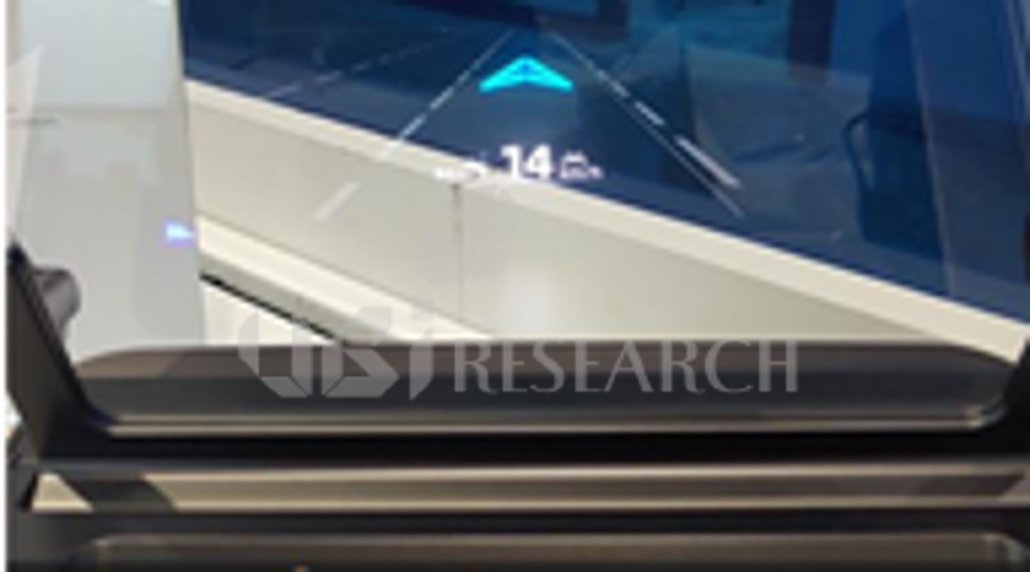
The Future of Panoramic HUDs, Led by Micro-LED

As in-vehicle display technologies continue to evolve rapidly, the head-up display (HUD), which projects various types of information into the driver’s forward field of view, is becoming an essential interface in modern vehicles. Recently, Panoramic HUDs (PHUDs) capable of displaying not only speed and navigation data but also augmented reality (AR) content have emerged, showcasing significant technological advancement. At the core of this evolution is Micro-LED technology, which is gaining traction as the key enabler of PHUDs.

PHUDs project information across the entire or a substantial portion of the windshield, requiring a wide field of view, high resolution, and high brightness. Currently, the most commercially viable implementation is the black strip reflection method. This approach utilizes the lower black band area of the windshield as a reflective surface, allowing for a simpler optical system and lower production costs—making it an attractive option for many automakers. However, to avoid obstructing the driver’s view, the image projection height is limited, typically restricted to a narrow vertical range of approximately 3 to 6 cm.

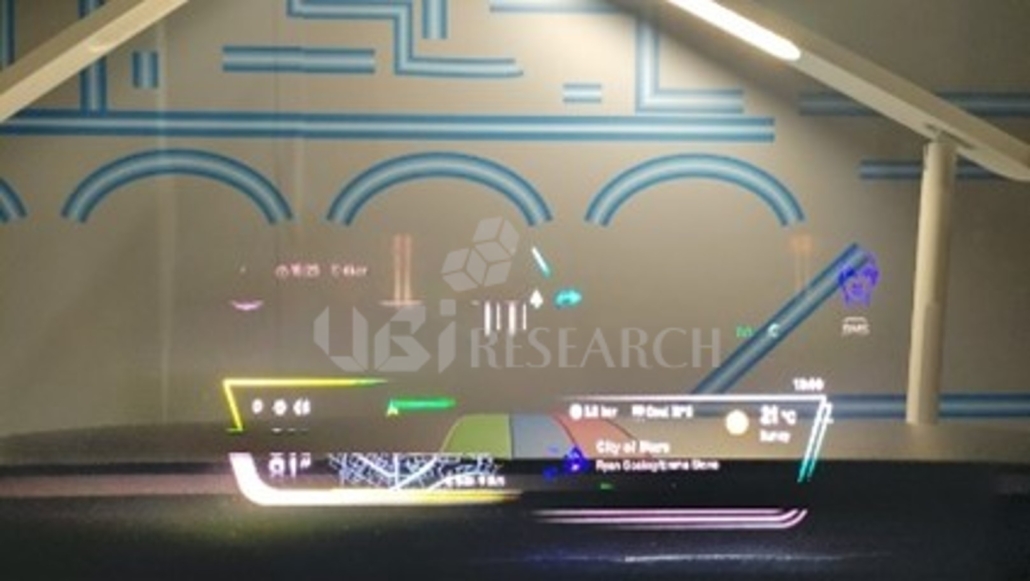
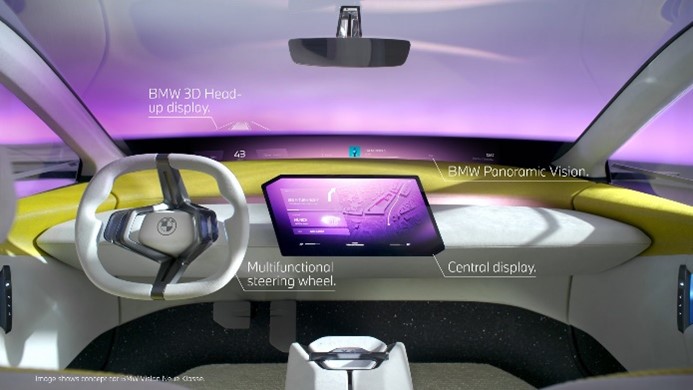
BMW Panoramic Vision

BMW Panoramic Vision

For a more immersive and premium experience, some high-end vehicles adopt a transparent reflection method. This involves embedding multilayer optical films or applying special structures within the windshield, allowing images to be reflected even in transparent areas without the need for a black band. While this method offers advantages in immersion and design, it poses significant challenges in optical complexity, higher costs, and low reflectivity—necessitating the use of ultra-bright displays.

Micro-LED provides a compelling solution to these structural and technological challenges. Thanks to its self-emissive pixel structure, Micro-LED can achieve brightness levels exceeding 1,000 nits, with ultra-high brightness capabilities reaching 30,000 to 50,000 nits—all while maintaining excellent power efficiency.

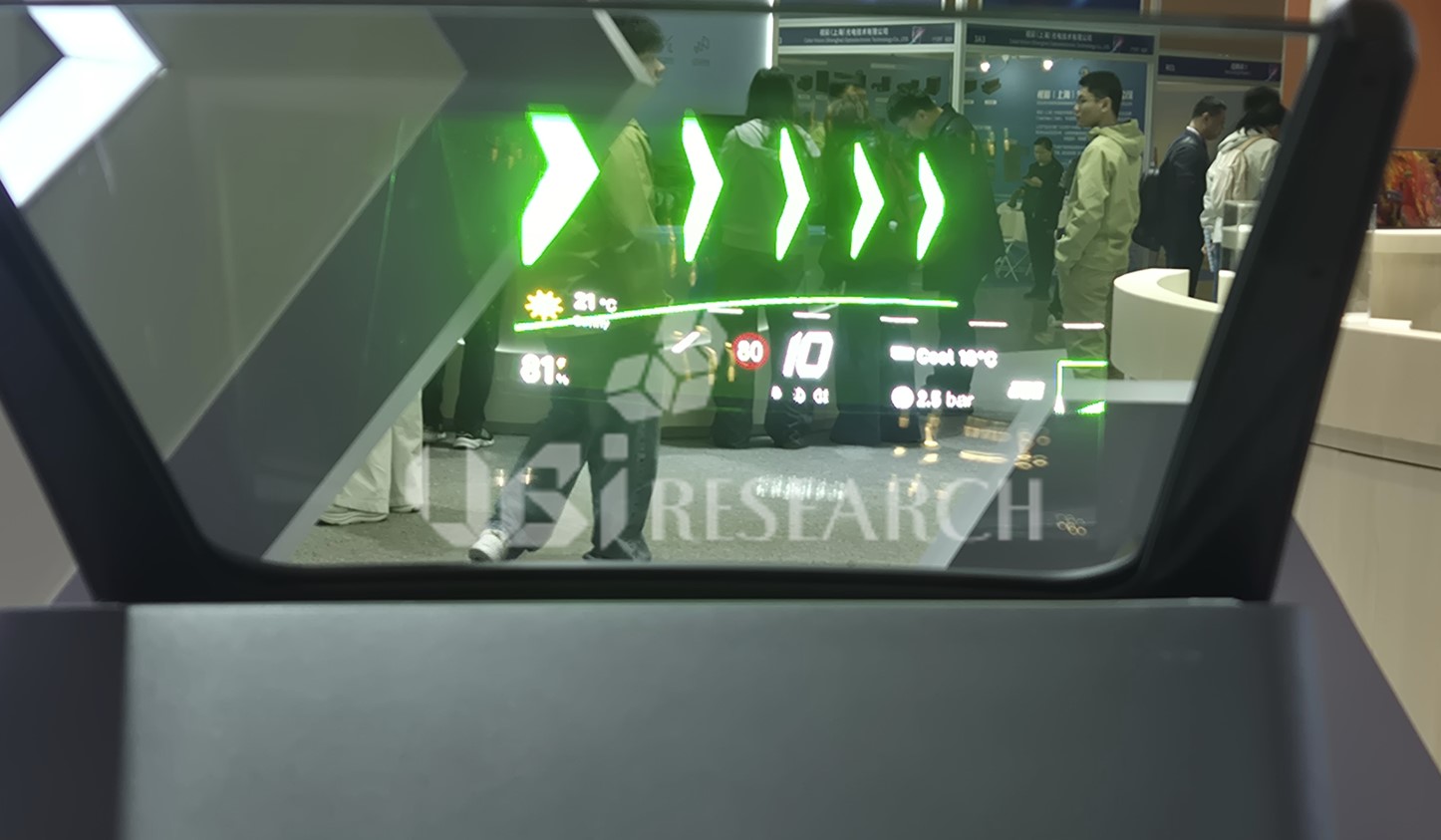
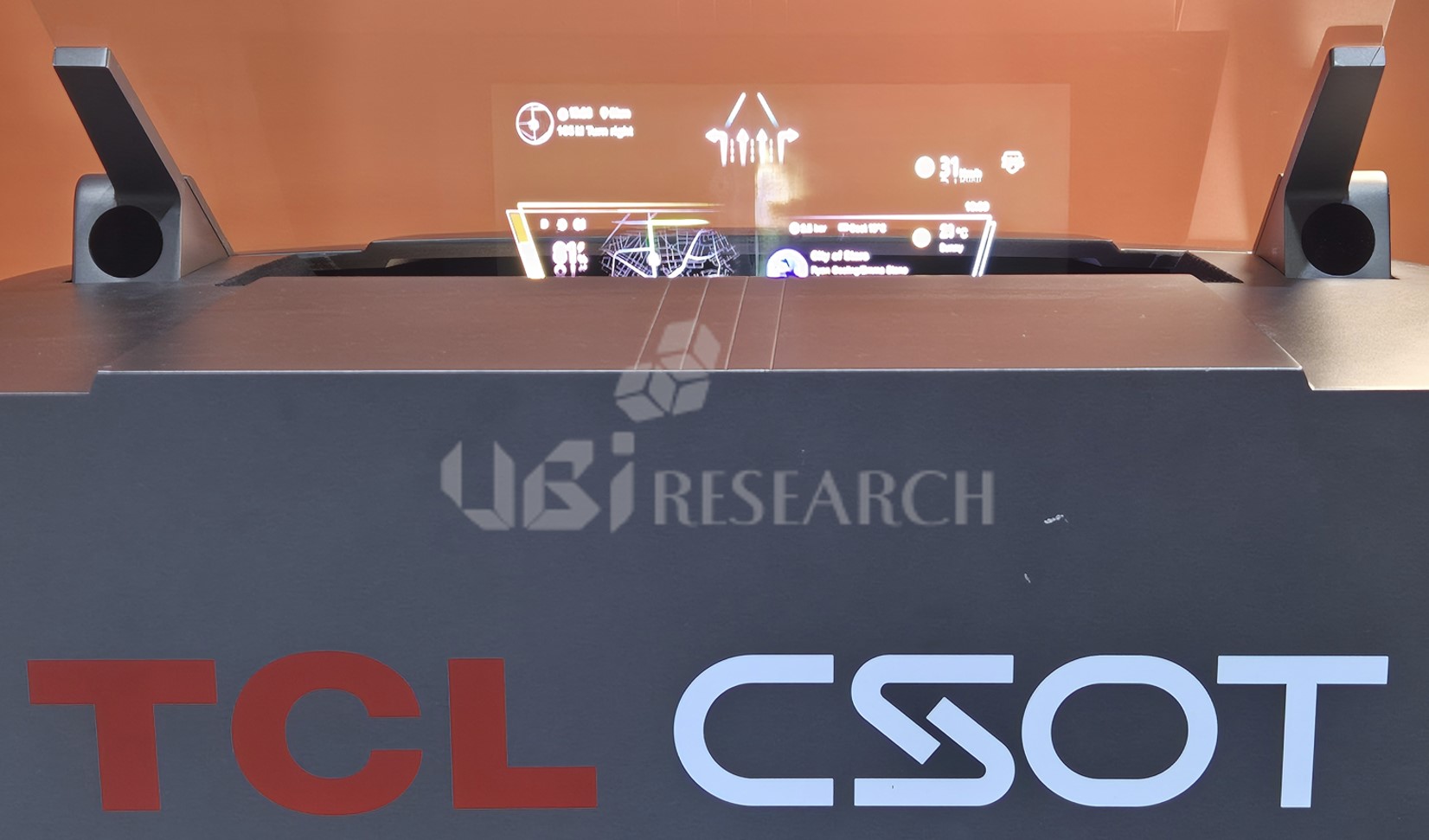
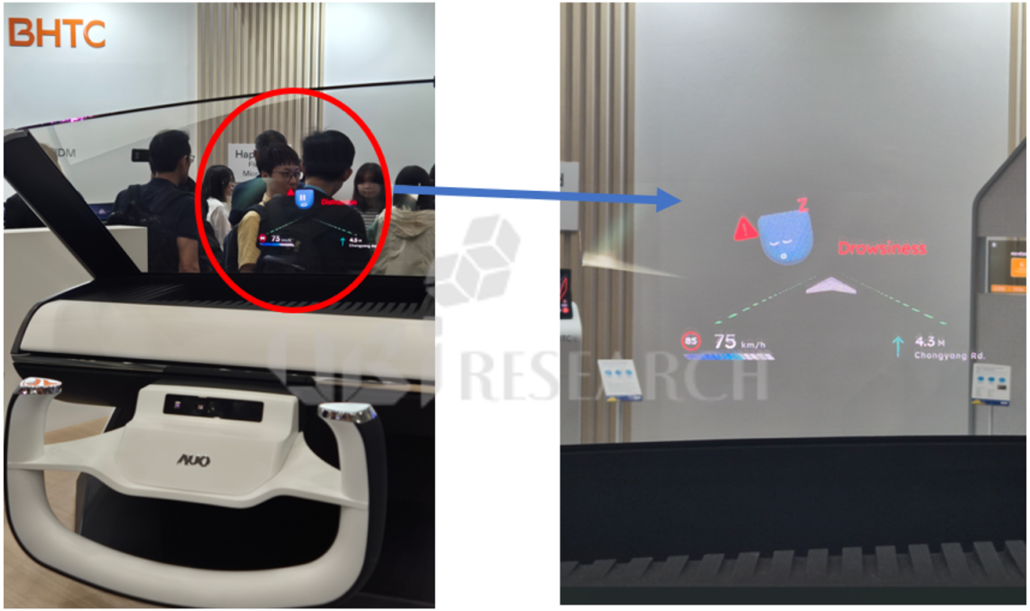
At SID 2025, major display companies such as AUO, BOE, and CSOT unveiled a range of Micro-LED-based PHUD prototypes. BOE showcased a 6.2-inch Micro-LED HUD with sub-0.2mm pixel pitch and 30,000 nits peak brightness (15,000 nits perceived brightness). CSOT presented a large 14.3-inch PHUD featuring 45,000 nits peak brightness (12,000 nits perceived brightness) and a wide viewing angle, while AUO demonstrated a 13-inch high-brightness PHUD with 12,000 nits of perceived brightness.

AUO 13” PHUD (12,000nits)

AUO 13” PHUD (12,000nits)

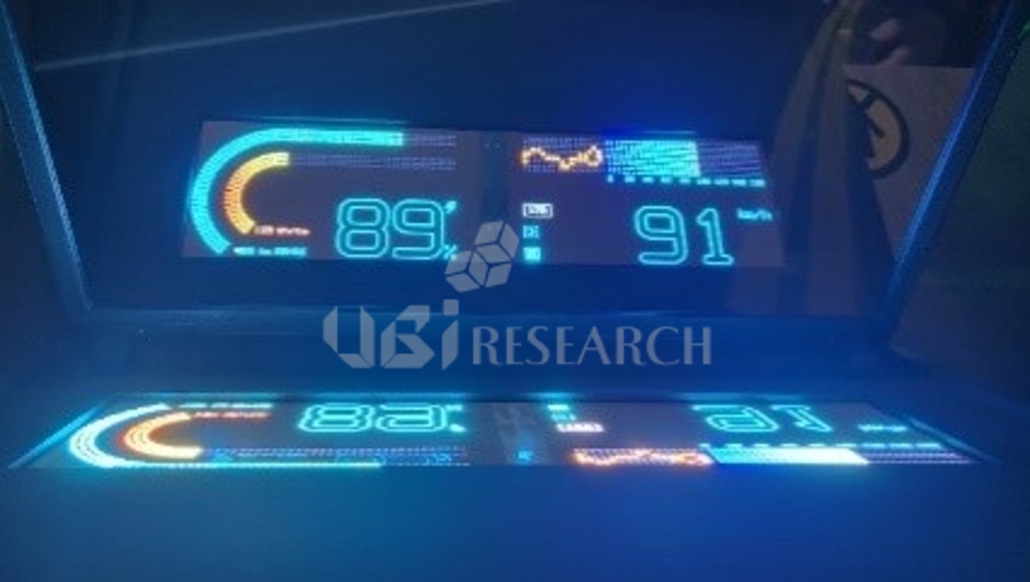
BOE 6.2” PHUD (15,000nits)

BOE 6.2” PHUD (15,000nits)

TCL CSOT 14.3” PHUD (12,000nits)

TCL CSOT 14.3” PHUD (12,000nits)

Micro-LED is not merely enhancing display performance—it is fundamentally transforming the structure and implementation of Panoramic HUDs. It overcomes the limitations of restricted reflection areas, enables the projection of high-brightness, high-resolution images onto various curved windshields, and meets the demands for transparency and design flexibility. As the commercialization of PHUDs becomes a reality, Micro-LED stands at the center of this transformation. The future of automotive vision and interface will unfold on Micro-LED.

Changwook HAN, Executive Vice President/Analyst at UBI Research (cwhan@ubiresearch.com)

▶2025 Automotive Display Technology and Industry Trends Analysis Report

BOE Chairman Chen Yanshun Holds High-Level Meeting with Samsung Electronics’ VD Division — Signs of Improving Relations

BOE Chairman Chen Yanshun met with senior executives from Samsung Electronics’ Video Display (VD) division on June 30, according to industry sources. The meeting was attended by Chen and other top BOE executives, and was reportedly held to explore ways to improve relations and seek potential strategic cooperation between the two companies.

BOE is China’s largest display manufacturer, producing large-size LCD and OLED panels. The company maintains a strong presence in the domestic TV and IT display markets and supplies products to global clients. Samsung Electronics’ VD division, which oversees its TV business, has maintained the No.1 position in the global TV market for several years, making stable panel procurement a key strategic focus.

The meeting was part of a formal consultation between the two companies and is seen as a move to reset relations that have been relatively distant in recent years. Specific details or outcomes of the discussion were not disclosed.

Industry observers note that the direct involvement of Chairman Chen highlights BOE’s strong interest in restoring its business ties with Samsung Electronics. With Samsung also reviewing and restructuring its display supply chain, this meeting could mark an inflection point in the relationship between the two firms.

Junho Kim, Analyst at UBI Research (alertriot@ubiresearch.com)

▶ China Market Trend Report Inquiry

BOE Opposes Hefei Government’s Withdrawal from B9 Stake… Sensitive to Potential Fund Shift to Visionox

BOE's OLED Panel Production Complex (Source: BOE)

BOE’s OLED Panel Production Complex (Source: BOE)

Concerns Rise That B9 Funds May Be Diverted to Visionox’s FMM-Based Line Following ViP Investments

BOE is strongly opposing the Hefei local government’s move to withdraw its stake in the B9 OLED plant. The Hefei government is reportedly seeking to divest its shares worth around 20 billion yuan, and there are growing concerns that the funds could be redirected to Visionox’s V5 line—a direct competitor. BOE is closely monitoring the direction of this potential fund reallocation.

Currently, Visionox is investing in a 7.5K production capacity line at the V5 plant, implementing its proprietary ViP (Visionox intelligent Pixelization) technology. Visionox initially planned to build a 15K production capacity line using a ViP + FMM (Fine Metal Mask) hybrid method. However, due to financial constraints, the FMM portion of the investment was put on hold. If the capital withdrawn from B9 is allocated to Visionox, the company could not only complete the ViP line but also proceed with the additional 7.5K FMM-based investment. This would pose a direct long-term threat to BOE’s market share and competitiveness.

For this reason, BOE is opposing the Hefei government’s withdrawal and aims to maintain its leadership in OLED investments in the Hefei region. BOE is also internally reviewing plans to reinvest the B9 equity into new production lines or expand existing ones. Meanwhile, the Hefei municipal government is reportedly considering new investment strategies to restructure the region’s display industry.

This issue of divestment and fund reallocation by the Hefei government signals more than just a financial adjustment—it indicates a potential realignment of technology, capital, and production capabilities within China’s OLED industry. The rivalry between BOE and Visionox is expected to intensify, possibly escalating into a broader strategic competition for OLED market leadership.

Junho Kim, Analyst at UBI Research (alertriot@ubiresearch.com)

▶ China Trend Report Inquiry

BOE Secures Annual Production Capacity of 100 Million iPhone OLED Panels with B11 Line… 350,000 Units per Module Line

BOE's panel shipments for iPhone

BOE’s panel shipments for iPhone

According to UBI Research’s China Industry Trends Report, BOE has established an annual production capacity of up to 100 million OLED panels for iPhones, primarily through its B11 line.

BOE currently operates 26 Apple-dedicated module lines, of which 11 lines are in mass production and 3 lines are being used for development purposes. With a tact time reduced to 5.5 seconds, each line can produce up to 350,000 modules per month, resulting in a total monthly capacity of around 8 million iPhone modules. If the B11 line is fully dedicated to iPhone production, BOE can produce 8–9 million panels per month, or approximately 100 million panels annually, based on a 90% utilization rate and 85% yield.

Despite this significant production capacity, BOE’s actual panel shipments remain well below this level. In the first half of 2025, BOE shipped approximately 21 million iPhone panels, marking a 13% increase compared to 18.6 million units during the same period in the previous year. The company is expected to ship 24 million units in the second half of 2025, with total annual shipments projected at 45 million units. Should BOE succeed in supplying panels for the iPhone 17 series, shipments could increase further. However, as with the iPhone 16, BOE is likely to face difficulties in the early phase of new model production.

Although BOE still lags behind Samsung Display and LG Display in terms of technology, industry analysts note that it is rapidly narrowing the gap.

UBI Research’s Analyst Junho Kim commented, “As BOE’s share of iPhone panel supply continues to grow, this is expected to put increasing pressure on Samsung Display and LG Display during pricing negotiations with Apple. With BOE aggressively catching up, it will be critical to see how the Korean companies maintain their technological lead and strategic partnership with Apple.”

Junho Kim, Analyst at UBI Research (alertriot@ubiresearch.com)

▶ China Industry Trend Report Inquiry

Samsung Display’s Foldable OLED Shipments Surge from May – Takes Q2 Market Share Lead

Monthly Smartphone & Foldable Phone OLED Display Market Tracker

Monthly Smartphone & Foldable Phone OLED Display Market Tracker

According to the Monthly Smartphone & Foldable Phone OLED Display Market Tracker published by UBI Research, a market research firm, Samsung Display’s shipments of foldable OLED panels surged starting in May, securing the top market share in the second quarter of 2025.

In the first quarter of 2025, Samsung Display shipped approximately 250,000 foldable OLED panels, trailing behind major Chinese panel makers such as BOE, CSOT, and Visionox. However, beginning in May, the company significantly ramped up mass production of panels for the upcoming Galaxy Z Flip/Fold 7 series, driving a sharp increase in shipments.

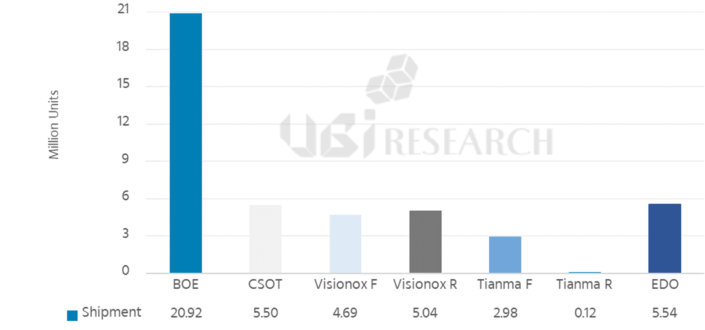
Samsung Display shipped 1.78 million units in May and 1.53 million units in June, accounting for 52% of total foldable OLED shipments in the second quarter, ranking first in the market. Following Samsung Display, BOE recorded shipments of 1.8 million units in the second quarter, CSOT 900,000 units, and Visionox 500,000 units.

Samsung Display is expected to maintain the top share in the third quarter as well. Furthermore, with its exclusive early supply of panels for Apple’s foldable iPhone in 2026, Samsung Display is projected to sustain its dominance in the foldable OLED market.

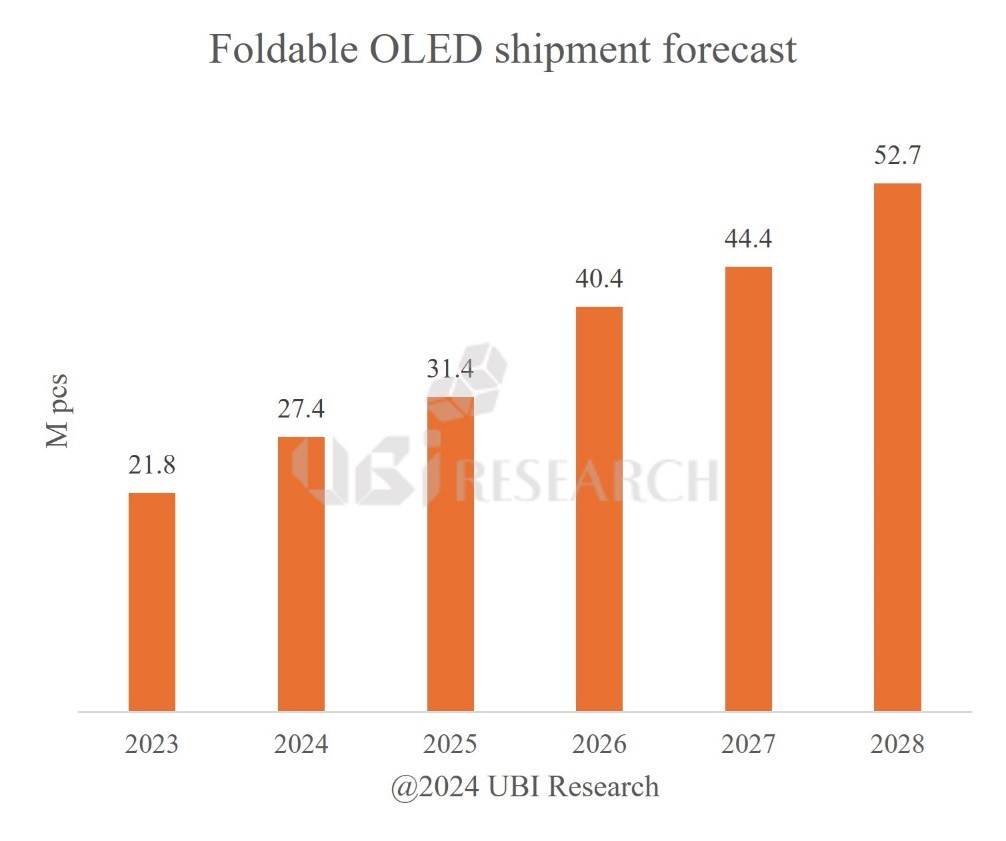
The global foldable OLED panel market continues to expand. Annual shipments grew from 15 million units in 2022 to 21.8 million in 2023, reaching 25 million units in 2024. The figure is forecasted to grow to 30.8 million in 2025. With Apple’s anticipated entry into the foldable phone market and the increasing number of foldable models launched by Chinese smartphone brands, annual shipments are expected to surpass 50 million units by 2029.

UBI Research Executive Vice President Chang Wook Han stated, “Thanks to the full-scale mass production of the Galaxy Flip/Fold 7 series, Samsung Display is expected to maintain the highest shipment volume in the third quarter,” and added, “The overall foldable phone market is likely to remain at a similar level to last year in 2025, but will begin significant expansion from 2026 with the anticipated release of Apple’s foldable phone.”

Changwook Han, Executive Vice President/Analyst at UBI Research (cwhan@ubiresearch.com)

▶Monthly Smartphone & Foldable Phone OLED Display Market Tracker 

OLED Panel Production for Next iPad Pro to Begin in July, Shipments Expected to Match 2024 Volumes

Apple iPad Pro 2024

Apple iPad Pro(2024)
(source: Apple)

Following the introduction of OLED displays in the 2024 iPad Pro series, Apple is set to continue using OLED panels in the 2025 iPad Pro lineup. Panel production for the next-generation iPad Pro is scheduled to begin in July.

In 2024, Samsung Display and LG Display supplied OLED panels for the iPad Pro. Samsung Display delivered 2.8 million units for the 11-inch model, while LG Display supplied 700,000 units for the 11-inch and 2.8 million units for the 13-inch model. However, total shipments fell short of the initially expected 9 million units, as high retail prices led to sluggish sales and reduced shipments in the third and fourth quarters.

In 2025, both Samsung Display and LG Display are expected to supply panels for both the 11-inch and 13-inch models. Notably, Samsung Display, which previously did not supply panels for the 13-inch model, is expected to begin production of 13-inch panels starting in July.

In Q1 2025, Samsung Display shipped 300,000 units and LG Display 700,000 units for the OLED iPad Pro. Overall shipments for the upcoming model are expected to remain at a similar level to 2024. Apple’s OLED tablet PC lineup is anticipated to expand beyond the iPad Pro starting in 2025, with OLED displays expected to be adopted in mid-range models such as the iPad mini and iPad Air.

Meanwhile, BOE is developing OLED panels for the iPad Pro at its B12 line, aiming for Apple’s approval. However, the company is reportedly facing technical difficulties in meeting Apple’s strict quality standards.

Junho Kim, Analyst at UBI Research (alertriot@ubiresearch.com)

▶Quarterly Medium & Large OLED Display Market Tracker Sample

▶ Quarterly Small OLED Display Market Tracker Sample

Automotive OLED Display Trends Seen Through SID 2025

As the development of intelligent and networked automobiles accelerates, the demand for various types of vehicle displays is rapidly increasing. In terms of display technology, the adoption rate of LTPS TFT LCD and OLED is increasing, and interest in Micro-LED is also growing.

In 2024, the shipment volume of OLED panels for vehicles is expected to increase by 126% year-on-year to approximately 2.48 million units. It is expected to increase to approximately 3 million units in 2025. This is because OLED is expanding its adoption, contributing to luxurious interiors and efficient space utilization, especially in premium vehicles.

LG Display, BOE, Visionox, Tianma, etc. recently presented various OLED vehicle display solutions at the SID 2025 and Shanghai Auto Show. As major automakers such as Mercedes-Benz, Audi, GAC, and Ideal are also installing OLED in their latest models, the market penetration is further expanding.

LG Display has organized an exhibition space dedicated to automobiles under the theme of ‘Driving the Future.’ The concept car on display featured a 57-inch pillar-to-pillar OLED that covers the entire dashboard and an 18-inch sliding OLED for the rear seats.

57-inch pillar to pillar OLED & 18-inch sliding OLED

LG-Display-57-inch-pillar-to-pillar-OLED-18-inch-sliding-OLED

BOE showcased a smart cockpit consisting of a total of eight OLED displays, including a 55-inch transparent OLED sunroof. Key specifications include a 12.3-inch instrument panel and CID (resolution 720×1920), a switchable privacy display with a relative brightness of less than 0.5% at a viewing angle of 48 degrees or more, a 1.5-inch circular OLED with a resolution of 466×466 and 310 PPI, and two CMS OLEDs.

55-inch OLED transparent sunroof

55-inch OLED transparent sunroof

BOE OLED smart cockpit

OLED smart cockpit

Visionox unveiled a smart C-type armrest flexible OLED, a dual-screen integrated flexible OLED, a UDIR flexible OLED for vehicles, and a switchable privacy display at SID 2025.

Visionox UDIR OLED

UDIR OLED

Visionox Dual screen

Dual screen

Visionox Privacy OLED

Privacy OLED

Tianma exhibited a 13-inch slider OLED and a dual 13-inch multi-curvature integrated black OLED display with a curvature range of R800~2000mm.

Tianma 13-inch slidable OLED

13-inch slidable OLED

Tianma 13-inch multi curvature OLED

13-inch multi curvature OLED

Changwook HAN, Executive Vice President/Analyst at UBI Research (cwhan@ubiresearch.com)

▶2025 Automotive Display Technology and Industry Trends Analysis Report

OLED Emitting Material Market Projected to Grow from $2.86 Billion in 2025 to $3.72 Billion by 2029

2Q25-Quaterly-OLED-Emitting-Material-Market-Tracker

‘2Q25_Quaterly OLED Emitting Material Market Tracker’

According to UBI Research’s “2Q25_Quarterly OLED Emitting Material Market Tracker”, the OLED emitting material market reached $490 million in the first quarter of 2025 and is expected to achieve a total of $2.86 billion for the full year. The market is projected to grow at a compound annual growth rate (CAGR) of 6.7%, reaching $3.72 billion by 2029.

By nation, due to the production cycle characteristics of Korean panel makers—whose shipments are concentrated in the second half of the year—Chinese OLED panel makers surpassed Korean makers in terms of emitting material revenue for the first time in Q1 2025. However, with the mass production of Apple’s iPhone 17 and iPad Pro panels beginning in Q2, Korean panel makers are expected to regain the lead in the second half of the year.

In terms of company-specific material usage in 2025, Samsung Display is projected to hold a 39.8% share, followed by LG Display with 19.9%, and BOE with 13.1%. Korean panel makers are expected to maintain a combined market share of 55% through 2029.

UBI Research analyst Changho Noh stated, “Although Chinese panel makers temporarily overtook their Korean counterparts in emitting material revenue in Q1 2025, Korean companies are expected to recover soon,” and added, “While Korean panel makers may fall behind Chinese makers in shipment volume from 2025, they will continue to dominate in terms of emitting material revenue for the time being.”

Chang Ho NOH, Analyst at UBI Research  (chnoh@ubiresearch.com)

▶OLED Emitting Material Market Tracker Sample

Accelerating competition in the development of next-generation HUD display products with Micro-LED technology

This year, companies are engaged in intense competition to develop Micro-LED HUD products for automotive use at display exhibitions such as CES, Touch Taiwan, and SID. Major panel manufacturers such as AUO and Innolux in Taiwan, and BOE, TCL CSOT, and Tianma in China have unveiled a host of new products. These companies are the main suppliers of LCD HUD products.

AUO exhibited a 13-inch micro LED AR HUD, while Innolux’s CarUX implemented a HUD on the windshield using a 9.6-inch Micro-LED reflective display solution with 9.6-inch Micro- LED.

AUO-13”-AR-HUD

AUO 13” AR HUD

BOE showcased two HUD display solutions at SID. One is a 6.2-inch (624×360) RGB Micro-LED HUD, and the other is a monochrome Micro-LED HUD achieving up to 300,000 nits. TCL CSOT unveiled a 14.3-inch (1700 x 650) Micro-LED PHUD, while Tianma showcased an 8-inch (1204×608) HUD.

BOE-6.2”-HUD

BOE 6.2” HUD

TCL-14.3”-HUD

TCL 14.3” HUD

Tianma-8”-HUD

Tianma 8” HUD

These products achieve high resolution and high contrast ratios based on the advantages of Micro-LEDs, offering differentiation and the potential to replace existing LCOS products. As a result, panel manufacturers are engaging in intense competition to secure a technological lead in the market.

According to UBI Research’s “2025 Automotive Display Technology and Industry Trend Analysis Report,” this year’s vehicle display shipments are expected to exceed 240 million units, with Mini-LED and OLED panels gradually increasing. As competing technologies, companies are actively developing differentiated technologies applied to Micro-LED HUD products.

In summary, automotive displays are one of the key areas of the future display market. As the importance of displays has grown as a key differentiating factor in smart cars, the automotive display market will become an essential competitive arena for panel manufacturers. In other words, with the smart evolution of vehicles, HUDs will become mainstream, and companies will need to respond and compete accordingly.

Namdeog Kim, Senior Analyst at UBI Research(ndkim@ubiresearch.com)

▶2025 Automotive Display Technology and Industry Trends Analysis Report

DNP Secures Exclusive Deal with BOE for 8.6G OLED FMM Supply, Strengthens Market Leadership Amid China’s Push for Localization

(Source: DNP)

(Source: DNP)

Japan’s Dai Nippon Printing (DNP) is reaffirming its dominance in the Fine Metal Mask (FMM) market, a key component in OLED manufacturing. Recently, DNP signed an exclusive supply agreement with China’s leading display company BOE for FMMs used in 8.6-generation OLED panels, signaling a proactive move into the expanding large-size OLED market.

This agreement is part of BOE’s strategy to begin mass production on its new 8.6-generation OLED lines. To support this, DNP has established a new FMM production line at its Kurosaki plant in Fukuoka, Japan. The facility is equipped to handle substrates over twice the size of those used in 6th-generation lines and is optimized for high-resolution, large-size OLED panel deposition processes. The new line has also been designed with flexibility in mind, capable of producing some 6th-generation products as needed.

Currently, DNP holds exclusive supply agreements with major Chinese panel makers—including BOE (excluding its 5.5-generation lines), CSOT, and Tianma—for 6th-generation lines, maintaining a 100% market share in that segment. However, some panel manufacturers have started trialing domestically produced FMMs, although the extent of their use has not been statistically verified. Despite ongoing efforts to localize FMM production in China, achieving the same level of precision and yield as DNP remains a significant challenge.

To ensure stable supply and expand production capacity, DNP is operating both its existing Mihara plant in Hiroshima and the new facility in Fukuoka. This dual-site strategy not only enhances production scalability but also improves customer trust by serving as a Business Continuity Plan (BCP) safeguard against natural disasters like earthquakes.

FMMs are critical materials used in the OLED deposition process to accurately pattern RGB subpixels, directly affecting panel resolution and production yield. Samsung Display also sources ultra-thin 25μm FMMs from DNP while pursuing diversification strategies through collaborations with Korean companies. Domestic suppliers such as Poongwon Precision are accelerating their FMM mass production efforts to challenge DNP’s market dominance.

By securing this major deal with BOE, DNP has solidified its position as a key partner in the transition to next-generation OLED mass production and once again demonstrated its strategic edge in the increasingly high-generation global OLED market.

Junho Kim,Analyst at UBI Research (alertriot@ubiresearch.com)

▶ China Trend Report Inquiry

1Q25 Small OLED Panel Shipments Decline by 14% QoQ, but Hit All-Time High for First Quarter

2Q25 Small OLED Display Market Track

2Q25 Small OLED Display Market Track

According to UBI Research’s “2Q25 Small OLED Display Market Track,” which includes performance and forecasts for applications such as smartphones, foldable phones, and smartwatches, small OLED panel shipments in the first quarter of 2025 reached 243 million units. This represents a decrease of 40 million units compared to the fourth quarter of 2024, which recorded 284 million units.

While this marks a 14.3% decrease quarter-on-quarter, it reflects a 10.7% increase year-on-year, making 1Q25 the highest first-quarter shipment volume on record for small OLED panels.

Breaking down the 1Q25 results, shipments from Samsung Display and LG Display both declined compared to the previous quarter. Among Chinese panel makers, Visionox recorded the steepest decline in shipments from 4Q24.

Despite a decrease in shipment volume, Samsung Display’s shipment share rose by 2.9 percentage points compared to 4Q24. Similarly, LG Display’s market share dropped from 13.1% to 9.3%, largely due to the seasonal concentration of Apple-bound panel production in the second half of the year. However, this still marks a 3.3 percentage point increase from the 6% share in 1Q24. LG Display’s shipments of panels for Apple continue to grow annually, and 2025 shipments are expected to exceed those of 2024 by over 10%.

Chinese panel makers showed a downward trend in shipments compared to 4Q24. However, their year-on-year growth remains strong when comparing 1Q23 and 1Q24 data. Notably, BOE is undergoing evaluation to gain approval for supplying panels for Apple’s iPhone 17 Pro. If BOE passes the certification, it is projected to ship approximately 50 million iPhone panels in 2025.

Han Chang Wook, Vice President at UBI Research, stated, “All iPhone 17 models are expected to adopt LTPO panels, which will drive up the average panel price. Although Korean panel makers saw a decline in shipments compared to the previous quarter, performance is expected to improve in the second half of the year with the full-scale production of Apple panels, potentially resulting in higher revenue than in 2024.”

Chang Wook HAN, Executive Vice President/Analyst at UBI Research (cwhan@ubiresearch.com)

▶ Quarterly Small OLED Display Market Track Sample

[SID 2025] Automotive Micro LED Displays (LG Display, AUO, BOE, TCL CSOT, TIANMA)

Progress of BOE’s 8.6-Generation OLED Line (B16) for IT Applications

In March 2024, China’s BOE began construction of B16, an 8.6-generation (2290×2620 mm) OLED production line for IT, in Chengdu, Sichuan Province, with a total investment of RMB 63 billion (approximately KRW 12.4 trillion).

In April 2024, BOE ordered a horizontal evaporator from Sunik Systems, and in May 2025, the B16 line will receive key equipment, including Abaco’s evaporator logistics system and Sunik Systems’ horizontal evaporator.

Unlike Samsung Display’s glass substrate-based hybrid OLED process at its 8.6 generation line, BOE has invested approximately three times the amount of Samsung Display’s investment of approximately KRW 4.1 trillion to introduce a process design that can support both flexible and glass substrates. As a result, it was expected that the B16 line would be able to produce flexible OLED panels for smartphones as well as panels for IT.

However, BOE reviewed the economics of smartphone production on the B16 line and concluded that the 8.6th generation line is less efficient than the existing 6th generation line because it is difficult to secure yields in the high-resolution FMM (Fine Metal Mask) process of 450ppi or higher, and the cost of FMM has also skyrocketed. 

The first mass-produced product of the B16 line is expected to be a panel for a laptop for a brand in China, and development of a 14.8-inch MacBook panel for Apple is also underway. Meanwhile, the 11-inch panel for the iPad is being developed on the B12 (6G) line.

BOE is looking for alternative applications, such as automotive displays, as the B16 line is not efficient enough to produce OLED panels for smartphones.

Chang Ho NOH, UBI Research Analyst(chnoh@ubiresearch.com)

▶ China Trend Report Inquiry

Visionox to Invest in Dual OLED Deposition Technologies at V5 Line – Supplier Conference Scheduled for May 22

Visionox’s ViP(Visionox intelligent Pixelization)

Visionox’s ViP(Visionox intelligent Pixelization)

According to UBI Research’s China Trend Report, Chinese display company Visionox has finalized the technical direction for its V5 OLED production line. The company will invest in two separate 7.5K capacities using its proprietary ViP (Visionox intelligent Pixelization) deposition technology and the conventional FMM (Fine Metal Mask) method. The investment in the ViP-based 7.5K capacity will be carried out first, followed by the FMM investment approximately six months later.

ViP is a high-precision deposition technology based on photolithography, enabling high-resolution OLED production without the need for FMM. Visionox has been intensively developing this technology as a core strategy to enhance its future manufacturing competitiveness. However, challenges related to yield have made mass production using ViP alone difficult. As a result, the company has decided to adopt a dual-track strategy for the V5 line, incorporating both ViP and FMM processes.

To support this plan, Visionox will host a supplier conference in Hefei, China, on May 22. Local government officials are also expected to attend, and the event is anticipated to help resolve outstanding funding issues for the V5 investment.

Visionox’s recent move is drawing attention in the context of the global OLED industry’s ongoing investments in 8.6-generation OLED lines. Samsung Display is currently building an 8.6-generation OLED line for IT applications (30K capacity) in Asan, South Korea, aiming to begin mass production in the second half of next year to supply panels for Apple’s iPads and MacBooks. BOE is also investing in its Chengdu-based 8.6-generation OLED line in China, targeting the production of OLED panels for smartphones as well as IT OLED panels for the domestic market.

Junho Kim, an analyst at UBI Research, commented, “Although there is still a need for significant improvements in yield and technology, Visionox appears to be pursuing enhanced production efficiency and differentiated technological competitiveness through its ViP technology.”

UBI Research’s China Trend Report provides the latest information on Chinese display companies, including shipment data from Chinese OLED panel makers, investment trends, and equipment disclosures.

Junho Kim, UBI Research analyst(alertriot@ubiresearch.com)

▶ China Trend Report Inquiry

Apple iPhone 18 series, release schedule adjusted by specifications

Apple iPhone 16  (Source: Apple)

Apple iPhone 16 (Source: Apple)

It is anticipated that Apple will delay the launch of the standard model in the iPhone 18 series, which is expected to be released in 2026.

Until now, Apple has released four models for each iPhone series: the standard model, Max, Pro, and Pro Max. In the 2025 iPhone 17 series, the Max model is expected to be replaced by a new Air model, and the Air model is projected to be the most expensive among the four.

While four smartphone models are expected to be released through 2025, it is now anticipated that the standard model will not be launched in 2026 and will be postponed to 2027.

In 2026, when Apple is expected to release the iPhone 18 series, the company is also likely to introduce its first foldable phone. Since the launch of the foldable phone could disperse sales volume, this strategic move seems to be under consideration.

If the release of the iPhone 18 standard model is delayed to the first half of 2027, it is expected to launch alongside the successor to the iPhone 16e, which is also anticipated to debut around that time. In this scenario, Apple would release higher-end models—such as the Pro, Air, and foldable phone—in the second half of the year, and lower-priced models in the first half of the following year, thereby securing different sales routes throughout the year.

Should Apple adopt this biannual product release strategy, it may affect the performance of panel suppliers such as Samsung Display, LG Display, and BOE. Historically, the release of the iPhone series in Q3 boosted the earnings of Korean panel makers starting in the third quarter, peaking in Q4. However, if new iPhone models are also released in the first half going forward, the earnings gap between the first and second halves of the year may narrow. On the other hand, if BOE continues to fall short in technology and only supplies panels for the standard model, its strong performance in the second half may shift to the first half instead.

Junho Kim, UBI Research analyst(alertriot@ubiresearch.com)

▶2025 Small OLED Display Annual Report Sample

BOE unveils its microdisplay development policy

At FPD China 2025’s “CDC Metaverse – Display on Silicon” on March 26, 2025, a group of experts presented on topics such as building AI and AR glass ecosystems, silicon-based display technology roadmaps, key process, equipment and material innovations, and industry and market trend forecasts.

 BOE presented “The Progress and Roadmap of BOE Si-Based Micro Display Technology,” revealing its plans to build a micro display base in Beijing and add silicon-based OLED and silicon-based LED technologies to form an ecosystem covering high-, medium-, and low-level micro displays of all required specifications.

In the high-speed LCD segment, the company is building a research and development line and manufacturing line for high-resolution (2000 ppi) LCDs for microdisplays at B20, the sixth-generation LTPS-LCD line in Beijing. Qingdao and Ordos, the regional bases for LCD, are manufacturing modules and panels for high-speed LCDs.

Beijing is also preparing R&D and production lines for OLEDoS and LEDoS for high-end applications. The company plans to design its own Si backplane after relying on design houses. In Chongqing, it is responsible for the development and production of AMOLED panels for VR, and BMOT, an OLEDoS line in Kunming, is producing 12-inch and 8-inch OLEDoS. 

Chang Ho NOH, UBI Research Analyst(chnoh@ubiresearch.com)

UBI Research’s micro display report

Small OLED display shipments in 2024 are expected to increase by 200 million units compared to 2023 and exceed 1 billion units in 2025

‘1Q25 Small OLED Display Market Track’

‘1Q25 Small OLED Display Market Track’

According to UBI Research’s ‘1Q25 Small OLED Display Market Track’, which includes application performance and outlook for smartphones, foldable phones, smartwatches, etc., small OLED shipments in 2024 are expected to reach 980 million units, an increase of approximately 200 million units from 773 million units in 2023. The small OLED market is expected to exceed 1 billion units in 2025.

Looking at the 2024 performance, most panel manufacturers in Korea and China saw an increase in shipments of 40 to 50 million units, and in particular, Chinese panel manufacturers TCL CSOT, Tianma, Visionox, and Everdisplay saw shipments increase by more than 50% compared to 2023. BOE, China’s largest panel manufacturer, saw its panel shipments increase by only about 8% due to temporary production suspensions caused by disruptions in iPhone supplies throughout the year.

Not only Chinese panel makers, but also Korean panel makers have seen a significant increase in shipments. As rigid OLED panels began to be applied to Samsung Electronics’ Galaxy A series, Samsung Display’s shipments are expected to surge from 320 million units in 2023 to 380 million units in 2024. LG Display’s smartphone OLED shipments also increased from 52 million units in 2023 to 68 million units in 2024 as its supply of panels for iPhones expanded.

With Chinese panel makers’ shipments steadily increasing, and Samsung Display’s rigid OLED shipments and LG Display’s iPhone panel shipments also increasing, small OLED shipments in 2025 are expected to easily exceed 1 billion units.

“OLEDs are being widely applied to lower-end models of Samsung Electronics’ Galaxy A series and low-cost models from Chinese set manufacturers, and BOE and Visionox’s new 8.6G lines are also designed to produce panels for smartphones, so small-sized OLED shipments are expected to continue to rise for the time being,” said Han Chang-wook, Vice President of UBI Research.

Chang Wook HAN, VP/Analyst, UBI Research(cwhan@ubiresearch.com)

▶Small OLED Display Quarterly Market Track Sample

CES 2025 becomes a competition hall for panoramic HUDs

We will introduce the contents of the “2025 Automotive Display Technology and Industry Trends Analysis Report” published by UBI Research in February 2025 as a series. As the first series, we will introduce Panoramic-HUD, which is included in the report.

Generally, automotive head up displays are projected on the windshield, the windshield of a car, and the driver can see a virtual image generated several meters away. Unlike general HUDs, Panoramic HUDs directly reflect the image projected from the display onto a black film coated on the lower surface of the windshield, but they are classified as HUDs because they allow the driver to maintain a head-up view while driving.

Panoramic HUDs are implemented using a direct image method, so their design is simple and the system cost is low. This reduces manufacturing costs while enabling the digital experience of premium vehicles. In addition, P-HUDs have the advantage of being able to use polarized sunglasses that prevent glare because they reflect p-polarization. Therefore, it is expected that panoramic HUDs will enter the market before AR-HUDs become widespread. At this year’s CES, several companies announced Panoramic HUDs, reminiscent of the P-HUD competition arena. BMW calls its panoramic HUD “Panoramic Vision” and announced that it will be installed in the Neue Klass model to be released from 2025. It uses TFT-LCD and has a brightness of about 5,000nits, but higher brightness is needed to improve outdoor visibility, and for this purpose, it is working closely with e-LEAD, a Taiwanese company that manufactures black films.

(Source: BMW)

(Source: BMW)

BOE introduced a P-HUD with a brightness of 5,000nits (normal) / 7,000nits (10% peak) by applying a 44.8-inch oxide TFT-LCD panel and 2,850 zone local dimming, and polarized sunglasses can be used because the P-polarization reflectance is 25%.

TCL-CSOT introduced a P-HUD with a brightness of 11,000 nit by applying three 11.98-inch TFT-LCD panels and 384 zone local dimming.

CarUX, a subsidiary established by Innolux in 2019, introduced a 48-inch P-HUD and boasted a high brightness of 14,000 nit by using a micro-LED panel.

Hyundai Mobis introduced a transparent P-HUD with a transmittance of 95% by introducing holographic technology from Zeiss in Germany, and plans to mass produce it in 2027. Continental also introduced the “Scenic View HUD,” a panoramic HUD with three TFT-LCD panels and local dimming, in 2023, and plans to release it in 2026.

Since the P-HUD is located in the vent, heating, ventilation, and air conditioning hardware must be rearranged, and heat dissipation issues must be resolved, so there are many issues to be resolved in addition to the display, so it took a long time, but 2025 is expected to be the first year of the P-HUD release.

This report covers the overall trends of vehicle display technology, including HUD, as well as the status of display development and vehicle application by finished vehicles, electrical equipment manufacturers, and panel manufacturers. If you are involved in the automobile and display industries, now is an important time to analyze market trends and prepare future strategies. We hope that you will gain insight one step ahead through this report so that you can understand the future trends of the vehicle display market in advance and proactively respond to industry changes.

UBI Research Chang Wook HAN Analyst(cwhan@ubiresearch.com)

▶2025 Automotive Display Technology and Industry Trends Analysis Report Sample

The purchase volume of OLED emitting materials in the third quarter of 2024 is expected to reach 32.7 tons, the highest ever purchase volume of emitting materials in 2024

According to UBI Research’s ‘4Q24_Quarterly OLED Emitting Material Market Tracker’, the purchase volume of emitting materials in the third quarter of 2024 was calculated to be 32.7 tons. Previously, material purchases were highest in 2021, when the market expanded due to COVID-19, but the all-time high was renewed in the third quarter of 2024. Considering the characteristics of OLED emitting materials, which show the highest usage in the fourth quarter of every year, it is expected that 2024 will see the highest usage ever.

Looking at each company, Samsung Display consistently holds the highest market share. Samsung Display had a 41.4% share in the entire OLED emitting material market based on purchase volume, followed by LG Display with 20.5%, BOE with 11.6%, and Visionox with 8.3%.

By substrate, RGB OLED still maintains the 80% level with a market share of 83.7% based on purchase volume, and as 8.6G lines begin to operate in earnest, RGB OLED’s market share is expected to gradually decline. WRGB-OLED’s market share was 11.3%, similar to the second quarter, and QD-OLED’s market share was 2.8%.

The market share of RGB 2 stack tandem OLED once rose to 6.4% in the second quarter due to a surge in iPad Pro OLED shipments but fell to the 2.2% range in the third quarter due to low demand. Compared to panel shipments, IT devices that use 2-stack tandem OLED for smartphone OLED, which uses single stack OLED, have large panel areas and have two light-emitting layers, so material purchase volume accounted for a higher share than shipment volume.

However, as BOE’s 8.6G line was confirmed to supply OLED for smartphones first, the growth of the 2 stack tandem OLED market was in the hands of Samsung Display. Starting in 2026, when OLED is expected to be applied to MacBook Pro, the purchase amount of light emitting materials applied to 2 stack tandem OLED is expected to more than double compared to 2024. The 2-stack tandem OLED panel supplied to MacBook Pro is expected to be supplied first by Samsung Display.

Junho Kim, UBI Research analyst(alertriot@ubiresearch.com)

▶OLED Emitting Material Market Track Sample

Small OLED shipments in the third quarter increased by 7.8% compared to the previous quarter, and LG Display’s shipments surged

‘4Q24 Small OLED Display Market Track’

‘4Q24 Small OLED Display Market Track’

The small OLED market in the third quarter rose 7.8% compared to the previous quarter. Most panel companies recorded panel shipments at a similar level to the second quarter, but overall shipments increased as shipments from LG Display and China’s Everdisplay surged.

According to the ‘4Q24 Small OLED Display Market Track’ recently published by UBI Research, small OLED shipments in the third quarter of 2024 were 247 million units, up 7.8% compared to the previous quarter and 32.6% compared to the same quarter of the previous year. The shipments of Chinese panel companies, including Samsung Display and BOE, were similar to or slightly lower than the previous quarter, but as the shipments of LG Display and China’s Everdisplay surged, overall shipments increased.

Based on the iPhone 16 series, which began full-scale production, LG Display shipped 17.6 million iPhone panels, a 64% increase from the previous quarter, and smartwatch shipments increased 147% to 12.2 million units. Due to the impact of increased shipments, LG Display’s sales increased by 74% compared to the previous quarter and by 115% compared to the same quarter of the previous year.

LG Display’s shipments are expected to continue to increase next year following the fourth quarter. As LTPO TFT begins to be applied to the iPhone 17 series scheduled to be released in 2025, there are predictions that BOE’s initial panel supply will actually be difficult, and as BOE is unable to supply panels, the supply may be transferred to LG Display. However, since LG Display is currently producing panels close to full capacity, line expansion is necessary to produce more panels. There is an analysis that it is realistic to expand 6G lines because it is realistically difficult to quickly start investing in 8.6G.

Among Chinese panel companies, shipments of Everdisplay and Tianma increased. Tianma’s shipments increased, but only slightly, and Everdisplay’s shipments more than doubled to 13 million units compared to the previous quarter.

Samsung Display’s shipments decreased somewhat, but sales were similar to the second quarter, and BOE’s shipments were similar to the second quarter, but sales increased by 15%. In the fourth quarter, shipments from not only LG Display but also Samsung Display and BOE are expected to increase, and considering the characteristics of the OLED market with the highest shipment volume in the fourth quarter, global OLED shipments for smartphones are expected to exceed 800 million units in 2024.

Junho Kim, UBI Research analyst(alertriot@ubiresearch.com)

▶Small OLED Display Quarterly Market Track Sample

Samsung Display advances mass production of 8.6G OLED line, Chinese panel companies are catching up

Hefei Visionox V5 groundbreaking ceremony held last September

Hefei Visionox V5 groundbreaking ceremony held last September

Recently, there is news that Samsung Display is moving up the mass production of the A6 8.6G OLED line to the end of 2025. Following Samsung Display, Chinese panel companies are also rapidly investing.

The biggest reason why OLED panel companies are rushing to invest in the 8.6G OLED line is the chamfer rate. Initially, OLED began to be applied to small and medium-sized products first, and when producing small and medium-sized products of 10 inches or less, a sufficient chamfering rate could be achieved even with the size of a 6G substrate. However, as OLED began to be applied to IT products with large panel areas, unlike small and medium-sized products, the unusable and discarded area in the 6G line increased, and to solve this, a line using a larger substrate was needed.

Samsung Display, the leader in the 8.6G OLED line, began building a production line early this year and plans to begin mass production at the end of 2025. Samsung Display invested in the 8.6G line to mass-produce 2-stack tandem OLED for Apple’s MacBook Pro, but mass-produced it earlier than originally planned, gaining time before mass-producing panels for MacBook Pro. Before mass producing panels to be supplied to Apple, Samsung Display is expected to first mass produce tandem OLEDs to be supplied to laptop set makers such as Samsung Electronics, Dell, HP, and Lenovo.

BOE, a latecomer, also began investing in the 8.6G line. BOE is expected to bring in two deposition machines from Sunic Systems in 2025 and begin mass production in the third quarter of 2026. BOE’s 8.6G line mass production period is from the third quarter of 2026, but like the iPhone, it is expected to be difficult to supply IT OLED panels to Apple in the early stages. Like other 6G lines, it is expected to initially mass produce panels for the Chinese domestic market and improve product quality to supply products to Apple. BOE is currently investing in module lines sequentially, and a total of 18 module lines are scheduled to be invested in Phase 1. Unlike Samsung Display, BOE is simultaneously investing in modules for smartphones and small and medium-sized OLEDs as well as IT OLEDs in the 8.6G line.

Following BOE’s lead, Visionox also invested in 8.6G. Last September, a groundbreaking ceremony was held for Visionox’s 8.6G OLED line, V5, in Hefei, and when Chinese President Xi Jinping visited Hefei’s V5 line in October, it received positive reviews. Additionally, it is understood that Visionox officials visited Korean equipment companies and held meetings this month. Visionox plans to attract government investment based on ViP (Visionox intelligent Pixelization), but due to technical difficulties in vertical deposition, it is likely to be used only as a pilot line.

It was discovered that TCL CSOT is also preparing to invest in an 8.6G line based on inkjet technology. There is a high possibility that an investment announcement will be made at the end of the year. The location is Guangzhou City, and the line capacity is 16K for the inkjet method and 16K for the FMM method, with a total investment of 32K likely to be made.

In addition to the companies mentioned above, Tianma also has the possibility of investing in the 8.6G line, and HKC is considering new investments in 6G OLED. Now that Chinese panel companies are following in the footsteps of Samsung Display, which made its first investment, attention is being paid to how Samsung Display will widen the technology gap.

Junho Kim, UBI Research analyst(alertriot@ubiresearch.com)

▶2024 OLED Technology and Industry Trend Analysis Report for IT Sample

Korean OLED Panel Makers’ Emitting Material Purchases Reach 51.2% in H1, with a Modest Recovery Expected in H2

According to UBI Research’s recently published “3Q24 OLED Emitting Materials Market Track,” the purchase of emitting materials by Korean OLED panel manufacturers in the first half of 2024 totaled $495 million, representing 51.2% of the market share—a 7.8% decrease compared to the same period last year. This is a notable shift. Meanwhile, Chinese companies held 48.8% of the market share, up 7.8% year-on-year, with purchases amounting to $471 million.

As Chinese panel manufacturers ramp up shipments, the gap in the purchase of emitting materials between Korean and Chinese companies is steadily narrowing. In the first quarter of 2024, for the first time, Korean OLED panel companies’ share of emitting material purchases fell to 47.4%, lower than that of Chinese companies.

However, from the second quarter onward, with the increase in OLED panel shipments for IT devices and the production of panels for the iPhone 16 by Korean manufacturers, their share rebounded to 54.7%. While BOE passed the sample certification for the iPhone 16, the delay in mass production is expected to result in smaller shipments this year. Additionally, certification for the iPhone 16 Max, which was expected to be produced at BOE’s B12 factory, was not approved.

With the reduction in BOE’s iPhone shipments, Korean panel makers are likely to see an increase in panel shipments. Thanks to growing OLED panel orders from Apple for products like the iPhone and iPad Pro, Korean purchases of emitting materials are expected to rise to a 55.6% market share by the end of 2024, a notable increase compared to the first half of the year.

▶AMOLED Emitting Material Market Track Sample

Due to the OLED iPad Pro for Tablet PC, shipments are rapidly increasing, and shipments are expected to increase by more than 6 times in 2024 compared to the previous year.

According to the “3Q24 Medium-Large OLED Display Market Track” published by UBI Research, more than 12 million OLEDs for tablet PCs are expected to be shipped in 2024 thanks to Apple’s entry into the OLED market for tablet PCs.

As mass production of iPad Pro OLEDs began in the first quarter of 2024, shipments of OLEDs for tablet PCs surged to 1.2 million units in the first quarter and 3.4 million units in the second quarter.

As not only Samsung Display and LG Display, but also Chinese panel manufacturers have begun mass production of OLEDs for tablet PCs, the OLED market for tablet PCs is expected to expand further. Among Chinese panel manufacturers, BOE is expected to ship about 1.5 million OLED panels for tablet PCs in 2024, and Visionox is expected to ship about 800,000 OLED panels for tablet PCs.

Due to the increase in panel shipments by Apple and Chinese companies, OLED shipments for tablet PCs are expected to exceed 30 million units in 2028.

▶Medium & Large OLED Display Market Track Sample

Samsung Display continues to dominate the OLED market for foldable phones

Foldable OLED shipment forecast

Foldable OLED shipment forecast

According to the ‘2024 Small OLED Display Annual Report’ recently published by UBI Research, OLED shipments for foldable phones are expected to increase from 27.4 million units in 2024 to 52.7 million units in 2028.

According to the report, Samsung Display’s OLED shipments for foldable phones in 2023 will be 13.4 million units, a 6.3% increase from 12.6 million units in 2022. Also, among Chinese panel makers, BOE shipped 6.2 million units of OLED for foldable phones, more than three times the 1.9 million units in 2022, while TCL CSOT and Visionox each shipped 1.1 million units of OLED for foldable phones.

Although there is fierce pursuit by Chinese companies, Samsung Display is expected to still take the lead in the foldable phone market. Samsung Electronics, to which Samsung Display supplies panels, is expected to expand the models of the Galaxy Fold series scheduled to be released this year, and Samsung Display’s foldable phone panels are expected to be applied first to Apple’s foldable iPhone to be released in the future. Based on such technological prowess and competitiveness, Samsung Display’s dominance in the foldable phone market is expected to continue for the time being.

▶ 2024 Small OLED Display Annual Report Sample Download

In 2028, the OLED emitting material market is expected to reach $2.43 billion with an average annual growth rate of 5.8%

According to the ‘4Q23_Quarterly OLED Emitting Material Market Tracker’ recently published by UBI Research, the market for emitting materials used in OLED is forecasted to grow from $1.84 billion in 2023 to $2.43 billion in 2028, with an average annual growth rate of 5.8%.

By country, Korean panel companies’ material purchases are expected to grow at an average annual growth rate of 4.2% from $1.11 billion in 2023 to $1.36 billion in 2028, and Chinese’ material purchases are expected to increase from $730 million in 2023 to $1.07 billion in 2028.

As forecasted, the material purchase ratio by country in 2028 will be 56% in Korea and 44% in China. However, Chinese panel companies are mainly mass producing panels for Chinese domestic use and white boxes, so even if panel shipments increase in the future, low-priced materials will be used. So, there is a possibility that the expansion of China’s emitting material market will be reduced further than currently expected.

Lastly, UBI Research predicted that Samsung Display’s purchase of emitting materials in 2028 will reach $810 million, LG Display’s will reach $550 million, and BOE will reach $440 million.

OLED emitting material market

OLED emitting material market

▶ 4Q23 OLED Emitting Material Market Track Sample Download

OLED shipments for IT are expected to reach 31 million units in 2027, with an average annual growth rate of 41%

According to the ‘IT OLED Technology and Industry Trend Analysis Report’ recently published by UBI Research, OLED shipments for tablet PCs, notebooks, and monitors are expected to reach 31 million units in 2027 with an average annual growth rate of 41%.

This forecast is based on Samsung Display’s 5.5G OLED line, 6G OLED line, 8.5G QD-OLED line, 8.6G (2290 x 2620 mm2) IT line, and LG Display, BOE, and Visionox’s 6G OLED line.

Shipment forecast for IT OLED

Shipment forecast for IT OLED

For IT products, OLED had been a market that received less attention than smartphones or TVs, but has began to receive significant attention due to the increase in demand for IT products in COVID-19 and the prospect of Apple using OLED for IT products.

Previously, Samsung Display was mass producing a small amount of OLED for IT from some of A2 as the 5.5G rigid OLED line and the 8.5G QD-OLED line, and some Chinese companies such as EDO were producing IT OLEDs in small quantities, but in 2024, Samsung Display and LG Display plan to mass produce OLED for Apple’s iPad in earnest from the 6G line, and BOE also plans to mass produce OLED for IT from the B12 line.

In addition, Samsung Display decided to invest in the 8.6G OLED line for IT early this year, and is expected to mass produce various IT products, including notebooks, from the first half of 2026.

Moreover, LG Display and BOE are planning to invest in the 8.6G line as soon as they secure investment funds and customers, and Visionox is also reportedly holding meetings with major equipment companies to invest in the 8.6G line.

If demand for OLED from set companies for IT increases in the future and panel companies invest in 8.6G lines, the IT market is expected to become a new high value-added market for OLED, following the smartphone market.

▶ IT OLED Technology and Industry Trend Analysis Report Sample

OLED panel makers’ 8.6G IT line investment trends, LG Display and BOE’s investment delays

Apple iPad Pro

Apple iPad Pro

Samsung Display and LG Display are investing in the 8.6th generation IT line with high added value to compensate for the decrease in sales due to the Chinese panel makers’ flexible OLED low-cost offensive and LCD withdrawal.

At the LG Display 2Q earnings announcement conference call held on the 26th, an official from LG Display said, “The announced 6th generation IT-related investments are proceeding as scheduled, and the investments will be made until the first half of next year.”

However, regarding the possibility of investing in the 8.6th generation IT OLED, it stated that “nothing has been confirmed yet”. LG Display emphasized, “We will carefully look at the possibility and progress of technology development and whether market demand is developing to a level that can contribute to the company’s profits before making an investment decision.”

LG Display’s 8.6th generation IT line investment is expected to be delayed compared to Samsung Display due to difficulties in securing new line investment funds due to operating losses, but it is expected to be able to supply panels to Apple from 2026.

Not only LG Display, but also Chinese panel maker BOE’s investment is being delayed. Samsung Display can secure Samsung Electronics and Apple, and LG Display can secure LG Electronics and Apple as customers, but BOE is expected to take at least two years to invest in the 8.6G line for IT because of uncertainty in securing customers.

Another Chinese panel maker, Visionox, is also preparing to invest in the 8.6G line for IT. Visionox plans to announce its investment in the 8.6th generation line with a total capacity of 30K in September.

On the other hand, Samsung Display’s investment in the 8.6th generation IT line has already been decided. Samsung Display plans to apply Oxide to the TFT of the 8.6th generation IT line and build it with 2 stack RGB OLED. Samsung Display had previously developed 8.6th generation vertical deposition 2 stack RGB OLED as an IT line, but the investment was decided for 8.6th generation horizontal deposition. Canon’s exposure machine is planned to be brought into Samsung Display’s IT line in April 2024, and negotiations on the price of the deposition machine with Canon Tokki have already been completed.

▶ 2023 Medium and Large OLED Display Annual Report Sample Download

Choong Hoon YI, CEO of UBI Research “Samsung Display will strengthen profitability by producing OLED for high value-added IT”

It is expected that Samsung Display will focus on producing panels for tablet PCs and notebooks to compensate for the reduced utilization rate of the A2 line due to the low-cost flexible OLED offensive of Chinese panel makers.

At the ‘2023 OLED & Micro Display Analyst Seminar’ held at the Federation of Korean Industries in Yeouido on the 5th, Choong Hoon YI, CEO of UBI Research, gave a presentation on ‘IT OLED industry trends and market prospects’.

Choong Hoon YI, CEO of UBI Research

Choong Hoon YI, CEO of UBI Research

CEO YI said, “Samsung Display is expected to focus on rigid OLED production for tablet PCs and notebooks to compensate for the reduced utilization rate of the A2 line due to the low-priced offensive of Chinese companies. As much as it focuses on IT OLED production, the shipment of rigid OLED for smartphones will drop sharply, but it is possible to maintain sales by producing rigid OLED for IT with high added value.” And he also said, “LG Display will start mass production one year later than Samsung Display, and BOE will start mass production at least two years later than Samsung Display.”

According to CEO Choong Hoon YI, LG Display’s decision is being delayed because it is difficult to secure funds for investment in new lines due to the deficit caused by the delay in switching from LCD lines to OLED lines. Nevertheless, LG Display is expected to be able to supply IT panels to Apple from 2026. However, there are still problems to be solved, such as stabilizing the process and securing yield of Sunic system equipment whose production capacity has not yet been verified.

BOE has invested in three OLED line factories for smartphones, but the operation rate is at a level of only one factory, and the Beijing city government is very dissatisfied with over-investment due to insufficient securing of Apple supplies. For the reasons mentioned above and because securing customers for IT OLED has not been decided, BOE’s IT OLED line investment is expected to take at least two years.

CEO YI said, “Chinese panel makers are trying to increase their market share with low-priced attacks, but domestic companies that have secured large customers such as Samsung Electronics and Apple have a significant advantage in competition. In the future, the OLED industry for TV and IT will be developed mainly by Korean companies.”

▶ 2023 Medium and Large OLED Display Annual Report Sample Download

OLED emitting materials market in 2027 expected to reach US$ 2.59 billion with an average annual growth rate of 7.7%

According to the ‘2023 OLED Emitting Material Report’ recently published by UBI Research, the total emitting material market is expected to reach US$ 2.59 billion in 2027 with an average annual growth rate of 7.7% from US$ 1.92 billion in 2023.

total emitting material market

total emitting material market

Analyst Yoon Daejeong of UBI Research said, “The small OLED material market is expected to grow at an average annual growth rate of 2.5% from 2023 to US$ 1.61 billion in 2027. And in 2027, Samsung Display’s purchase of small OLED materials is expected to be US$ 560 million, BOE US$ 430 million, and LG Display US$ 200 million.” and “the small OLED material market will change depending on how much the foldable OLED market replaces the sharp decline in rigid OLED shipments for smartphones.

Analyst Yoon continued, “As the shipments of LG Display’s WOLED and Samsung Display’s QD-OLED are expected to be 12 million units and 3 million units, respectively, in the large OLED material market in 2027, the purchase amount of emitting materials is also expected to be US$ 430 million and US$ 140 million, respectively”

Meanwhile, the report predicted that by OLED method in 2027, RGB OLED would occupy the largest share at 66.6%, followed by WOLED at 16.5%, RGB 2stack OLED at 11.4%, and QD-OLED at 5.5%.

▶ 2023 OLED Emitting Material Report Sample Download

Samsung Display’s foldable OLED expected to exceed 50 million units in 2027

Foldable OLED shipment ratio forecast

Foldable OLED shipment ratio forecast

According to the ‘2023 Small OLED Display Annual Report’ recently published by UBI Research, Samsung Display’s OLED shipments for foldable phones are expected to reach 50.9 million units in 2027 with an average annual growth rate of 28.1% from 18.9 million units in 2023.

According to the report, Samsung Display’s foldable OLED shipments in 2022 were analyzed to be 12.6 million units, accounting for 85.1% of global foldable OLED shipments in 2022. BOE, TCL CSOT, and Visionox mass-produced some foldable OLEDs, but Samsung Display led the foldable OLED market.

It is expected that Samsung Display will continue to dominate the foldable OLED market in the future. It seems difficult for TCL CSOT and Visionox to record annual shipments of more than 1 million units by 2027, and unless LG Display also secures a customer, the time for mass production of foldable phone panels is unclear.

Lastly, the report forecasted global OLED shipments for foldable phones to be 61.4 million units in 2027, with Samsung Display expected to account for 82.9% of the market with 50.9 million units and BOE with 9.6 million units and 15.7%.

▶ 2023 Small OLED Display Annual Report Sample Download

The groundbreaking ceremony for the BOE B20 line will be held on February 10, 2023.

BOE

BOE

BOE’s 6G LTPS LCD line, B20, will hold a groundbreaking ceremony in Beijing on February 10th.

The capacity of the B20 line is 45K per month, and it is mainly based on the LTPS TFT process, but since an oxide TFT line with a capacity of about 15K per month is also built, it is expected that oxide TFT technology will be applied to some products.

The approximate schedule is that the construction of the plant will be completed in the third quarter of 2024, and equipment will be brought in in the fourth quarter of 2024. It is expected that the module line will utilize existing lines from factories in Qingdao, Chongqing, and Chengdu.

Although B20 is an LCD line, investment in OLED evaporators is also being considered, so the possibility of using it as an OLED line is predicted in the future.

▶ AMOLED Manufacturing Process Report Ver.5 Sample Download

Fold, extend… Foldable IT device trends seen through exhibition trends

As panel makers have recently accelerated the development of foldable OLEDs, a variety of products, including foldable phones, foldable tablet PCs, and foldable laptops, are being exhibited. We look at the development trend based on the exhibited products of panel makers.

‘Flex Hybrid’ and ‘Slidable Flex Duet’ exhibited by Samsung Display

‘Flex Hybrid’ and ‘Slidable Flex Duet’ exhibited by Samsung Display

At CES 2023, which was held in January, Samsung Display, a leader in foldable displays, exhibited the ‘Flex Hybrid’, a combination of foldable and slider, and the ‘Slidable Flex Solo’, which extends on one side and, the ‘Slidable Flex Duo’, which extends on both sides. In the ‘Flex Hybrid’, the screen expands from the default 8 inches to 10.5 inches when the folded screen is unfolded, and to 12.4 inches when the right side is extended. Sliderable products can expand the screen from the basic 13 to 14 inches to 17 inches.

Prior to this, Samsung Display had exhibited S-type and G-type, double-folding ‘Flex S’ and ‘Flex G’, and ‘Slidable Wide’ that extends outward in 2022, and all three products had a maximum size of 12.4 inches. The size of the prototypes is 12.4 inches, which is the same as Samsung Electronics’ Galaxy Tab S8+. When mass-producing actual products, it is expected that mass-production will be carried out according to the needs of set makers.

Foldable OLED for laptops from Samsung Display, LG Display, and BOE

Foldable OLED for laptops from Samsung Display, LG Display, and BOE

In addition to tablet PCs, foldable laptops are also being developed. Samsung Display exhibited the 17.3-inch foldable OLED ‘Flex Note’ for laptops at IMID 2022 and SID 2022. Originally, Samsung Display was expected to supply this 17.3-inch foldable OLED to Samsung Electronics last year, but the schedule was delayed to this year.

LG Display is also developing a foldable OLED for 17.3-inch laptops. LG Display exhibited a 17.3-inch ‘Foldable OLED Laptop’ with an improved folding radius of 1.5R at IMID 2022. LG Display is currently developing foldable OLED for laptops with the goal of supplying HP.

BOE of China is also developing foldable OLED for IT. BOE exhibited a 12.3-inch foldable OLED for tablet PCs that double-folds into an S-type at SID 2022 in May of last year. It also unveiled a foldable OLED for 17.3-inch laptops, and this panel was mounted on Asus’s ‘ZenBook 17 Fold’ released in 2022.

Samsung Display, LG Display, and BOE are all developing foldable OLEDs for notebooks in the same size and resolution. When full-scale mass production begins, competition for panel supply between the three companies is expected to be fierce.

▶ AMOLED Manufacturing Process Report Ver.5 Sample Download

BOE is reviewing investment in a module line for certification evaluation for Apple iPhone

It was found that BOE is considering investing in the golden line of modules for Apple’s iPhone at the B11 Mianyang plant. The module golden line invested this time is a line for iPhone certification evaluation, and the investment is expected to be confirmed in early 2023. Since evaluation and verification take a lot of time, it is analyzed that the verification line is invested first before the full-scale module line investment. The line is expected to be used for verification when investing in new iPhone 15 or iPhone 16 models.

After investing in module lines for verification and evaluation in 2023, it was found that BOE is preparing additional investment plans for between 14 and 20 Apple-oriented module lines at the B11 Mianyang plant. If BOE’s 20 module lines are completed, the annual volume of iPhone modules that BOE can produce is about 120 million units. However, since Apple’s demand is less than this and there are variables in negotiations with Apple, the investment is likely to proceed gradually.

BOE’s total supply of iPhones to Apple in 2022 is expected to be around 30 million units. BOE is supplying Apple with panels for the iPhone 12, 13, and 14 basic models, and is expected to supply panels for the iPhone 15 basic models to be released in 2023. It is not yet decided whether BOE will supply panels for the 6.7-inch iPhone 15 max model.

▶ China Trend Report Inquiry

[China Trend Report] Further Delays to BOE Chengdu B16 Line Investment

BOE

BOE

There is a possibility that the investment in BOE’s B16 8.7G OLED line located in Chengdu will be further delayed. A member of the State Assets Commission, Beijing Municipal government’s regulations on BOE Group is the cause.

BOE organized staff for the B16 line earlier this year and secured a site around the Chengdu B7 line. According to the existing plan, equipment orders for the B16 line were expected to be placed around the end of 2022, but the plan is being put on hold as the Beijing city government tries to regulate the BOE group from investing in places other than Beijing.

Initially, BOE planned to invest in the B16 line according to the investment circumstances of the display market and Korean panel makers. However, they were faced with a situation in which they had to proceed with the investment while considering the regulations of the Beijing city government.

BOE is currently preparing to invest in B20 besides B16. B20 is a 6G LTPS LCD line and will be located in Beijing. Some speculate that B20 was invested in advance to obtain B16 investment approval.

However, even if the investment in the B20 line is completed, the investment in the B16 line is not certain. Just as the Beijing government’s regulations have changed, the number of clerks in Beijing have changed. Many variables are expected for the future in the B16 investment.

▶ China Trend Report Inquiry

[2022 Vehicle Displays] BOE

#BOE #automotive #display

▶ UBI Research website
https://ubiresearch.com/en/

▶If you are curious about the latest news related to OLED?
https://en.olednet.com/

▶Business, display report inquiry
marketing@ubiresearch.com
+82-2-577-4391

This Year’s OLED Mass Production Capacity Substrate Area is Expected to be 47.3 million ㎡

According to the ‘2022 OLED Components and Materials Report’ recently published by UBI Research (www.ubiresearch.com), a company specialized in OLED market research, the substrate area of ​​the total OLED mass production capacity in 2022 is expected to be 47.3milion ㎡. In 2022, the LTPO TFT line and EDO’s 6th-generation rigid OLED line, which Samsung Display invested in to supplement the idle capacity of the A3 line, are scheduled to be operated. In 2023, LG Display’s E6-4 line and BOE’s B12-3 line Line, Samsung Display’s 8.5G IT line are expected to be put into operation in 2024.

As for the substrate area of ​​small OLED for smart watch and smartphone, the line capacity for rigid OLED in 2022 is 5.29 million ㎡, accounting for 24.8% of the market share. Rigid OLED investment is not expected in the future. In 2022, the capacity for flexible OLED is 15.3 million ㎡, accounting for 71.5% of the total. From 2024, part of Samsung Display’s A3 line will be converted to an IT line, and the mass production capacity is expected to decrease. The line capacity for foldable OLED is expected to reach 0.79 million ㎡ in 2022 and 1.52 million ㎡ from 2023.       

Samsung Display’s IT line capacity is expected to expand to 2.69 million ㎡ by 2025 as part of the A3 line is converted to an IT line in the first half of 2024. A new 8.5G line is expected to be operated in 2024. From the second half of 2023, LG Display’s capacity is expected to be 0.75 and 0.52 million ㎡, respectively, with the E6-4 line operating and BOE’s B12-3 line operating.

OLED line capacity for TV is not expected to change until 2026 unless additional investment is made. From 2022, LG Display’s mass production capacity is 20.3 million ㎡, accounting for 85.5% of the total. Capacity is expected to increase further depending on whether additional customers are secured in the future. Samsung Display’s capacity is 3.3 million ㎡ and BOE’s is 0.13 million ㎡, accounting for 13.9% and 0.6% of market share, respectively.

Meanwhile, the ‘2022 OLED Components and Materials Report’ published this time dealt with the latest OLED industry issues analysis, development of components and materials for foldable devices, industry status, analysis of mass production capacity of OLED panel companies, and major component and material market forecasts. It is expected to help parts and materials companies to understand related technologies and predict future technology directions and markets.

▶ 2022 OLED Components and Materials Report Inquiry

Chinese Government’s Aggressive Movement Toward Domestic Product Exclusivity. What Next for Korean Companies?

Recently, there is a movement to manufacture display-related materials, materials, and equipment exclusively in China. According to the ‘2022 OLED Components and Materials Report’ recently published by UBI Research (www.ubiresearch.com), China National Development and Reform Commission(国家发展和改革委员会) or Ministry of Industry and Information Technology of the People’s Republic of China(中华人民共和国工业和信息化部) are providing investment funds to Chinese OLED display-related developers and are rapidly moving towards domestic demand.

The Ministry of Industry and Information Technology of China is planning a large-scale support project for display-related materials, equipment, and parts for domestic demand in China. The companies selected for the project will receive unprecedented subsidies from the Chinese government. Recently, the Ministry of Public Information and Security is believed to have supported FMM and related evaporators and other equipment. In addition, the items promoted by the National Development and Development Committee of China for domestic demand will be developed and mass-produced within three years, and all domestic production will be carried out within five years.

In addition to government projects, companies are also active in domestic demand. BOE, China’s largest display maker, has already made significant investments for domestic demand. In March, BOE CEO Gao Wenbao, who felt the pressures due to volume and cost, ordered a special policy directly for purchase planning. In the process of diversifying business partners for cost reduction, BOE reviewed only domestic companies, excluding overseas companies. Of BOE’s investment in materials, materials and equipment for domestic demand, about 70% of the capital has already been invested. The investment is expected to be completed by 2023.

The Chinese government has included display in the national high-tech strategic industry early on and has provided unprecedented support to display companies such as BOE and TCL CSOT. In addition, the Chinese government is raising import tariffs on materials and parts that can be produced in China and is meeting the needs of domestic demand.

In order to widen the gap with China, which is closely chasing Korea from LCD to OLED, the Korean government must take active measures. The Korean government will designate display as a national high-tech strategic technology in the ‘Special Act on National Advanced Strategic Industries’, which will be enforced on the 4th of next month and will provide tax support and various benefits to display companies.

 2022 OLED Components and Materials Report Inquiry

Will BOE Resume iPhone 13 Production?

iPhone13/Apple

It seems that BOE has started line operations for iPhone 13.
Back in March, most of the iPhone 13 shipments were canceled due to an issue with Apple. BOE will now resume production. With this new development, BOE’s forecast for iPhone 13 production this year is expected to increase after being adjusted down in March.
BOE has a total of 20 iPhone module lines at its B11 (Mianyang) plant. BOE’s production of the iPhone 13 is believed to have begun in early June and production of the iPhone 14 is expected to begin as well. The B11 factory has iPhone 13 line to produce iPhone 12 and 13 and iPhone 14 module line exclusively for iPhone 14, as the process is quite different from iPhone 13 line.
Details of BOE’s iPhone 13 and 14 production volume, panel unit price, and module line by product can be found in UBI Research’s ‘China Trend Report’. UBI Research’s ‘China Trend Report’ can be inquired on the UBI Research website.

Chinese Panel Makers in Crisis! Will the Display Business’s Deficit Increase This Year?

<Honor 70 With Panels Supplied by Visionox>

Chinese panel makers such as Visionox and BOE are expected to face losses due to cost pressures.
The operation rate of Visionox was analyzed to be high. This is because Visionox is exclusively producing 70-80% of Honor, a large Chinese smartphone manufacturer.
However, despite the high operation rate, Visionox’s business status is precarious at best. Through cooperative efforts, Visionox was allocated most of Honor’s panel production quantity, but it is known that Honor has requested additional panel price reduction. According to some sources, Visionox is currently facing a loss of about 200 million yuan per month due to the reduced panel price.
BOE, the largest panel maker in China is also facing trouble. BOE along with Visionox had previously been in charge of panel production for Honor but received almost no allocation of production volume from Honor. Earlier this year, BOE faced tremendous difficulty due to the cancellation of existing iPhone 13 shipments to Apple. In April, BOE’s CEO Gao Wenbao felt a sense of crisis due to pressure on OLED and LCD volume and price and gave direct orders on cost reduction. Currently, BOE’s OLED line operation rate is less than 40% and it is estimated that the OLED business unit may incur a loss of about 10 billion yuan this year.
LCD, which is one of the main businesses of Chinese panel makers, is continuously falling in prices and the supply and demand of panels from smartphone set makers are sluggish. If an appropriate countermeasure is not found, Chinese panel makers will continue to experience a growing deficit in the display business.

[SID 2022] BOE 8” Slidable OLED Display Week 2022

Resolution 2592 x 2176

Sliding Reel Radius 4.5mm

Machine Thickness 12.4mm

Sliding Distance 34mm

[UBI Research China Trend Report] Will BOE Provide UPC Panel with Transparent PI Substrate to Oppo?

BOE, the largest display maker in China, produces UPC (Under Panel Camera) panels with transparent PI substrates.

UPC is a technology that makes a full screen of a smartphone possible by placing the front camera under the screen. The UPC technology that is currently commercialized is a method of patterning the cathode electrode and changing the resolution near the camera. However, this time it is expected that a transparent PI substrate will be additionally applied to the UPC panel supplied by BOE to Oppo.

Existing transparent PI substrates had difficulties in mass production due to the high process temperature of LTPS TFT. Yet, the recent test results of the panels with the transparent PI substrate produced by BOE reached most conditions of satisfactory levels even at the LTPS TFT process temperature.

The UPC OLED panel with the transparent PI substrate developed by BOE is expected to be installed in Oppo’s upcoming products.
 

Introducing iPhone 14 Display Specifications and Panel Vendors

<Apple iPhone 14 Series Specifications>


Samsung Display, LG Display, and BOE are expected to supply panels to Apple’s new iPhone 14 series in 2022. It is expected that Samsung Display will supply panels to all models in addition to iPhone 13 series. LG Display will supply 6.12-inch LTPS models and 6.69-inch LTPO models. BOE will supply panels only to 6.12-inch LTPS models.

The existing 5.4-inch mini model has been removed from the iPhone 14 series and a 6.69-inch Max model has been added. The size and resolution of iPhone 14 Max are the same as iPhone 14 Pro Max and LTPS TFT is applied instead of LTPO TFT.

In terms of design, the iPhone14 Pro and 14 Pro Max will have a punch hole design instead of the conventional notch. Apple’s punch hole design is expected to be applied as a double punch hole design due to various sensors and cameras.

Meanwhile, the total OLED panel supply to Apple in 2022 is expected to be about 215 million units, with Samsung Display expected to supply 135 million units, LG Display 55 million units, and BOE 25 million units. However, shipments are expected to be organically controlled due to market conditions and Apple’s policies.


[China Trend Report] Honor Magic4 Series, Panel Supply from BOE and Visionox

According to the ‘China Trend Report’ published by UBI Research, Honor, a Chinese smartphone manufacturer, announced Magic4 and Magic4 Pro at MWC 2022 held on February 28th.

Both products are 6.81 inches in size. Magic4 has a resolution of 1224×2664 and Magic4 Pro has a resolution of 1312×2848. The peak brightness of both products is 1,000nits and the refresh rate is 120Hz. LTPO TFT and 1,920Hz high frequency PWM dimming technology are applied.

The display panel is supplied by Chinese panel makers BOE and Visionox. The DDIC is supplied by Taiwanese IC chip maker Novatek. BOE supplies panels of three models: Magic4, Magic4 Pro, and Magic4 Pro plus. Visionox supplies panels of two models, Magic4 and Magic4 Pro.

Detailed mass production line and quantity estimation of Honor Magic4 series are included in ‘China Trend Report’. The ‘China Trend Report’ provides various information on the Chinese display industry trends, such as the latest issues of major Chinese display companies, line trends and shipments, equipment disclosures by company, and introduction of new products in China. The report can be inquired on the UBI Research website.

[China Trend Report] Significant Reduction of BOE’s Panel Supply to Apple in February and March due to Touch IC Supply Issue

According to the ‘China Trend Report’ published by UBI Research, BOE B11 (Mianyang) plant is experiencing difficulties in supplying quantities to Apple due to the supply and demand problem of Touch IC. The report analyzed that BOE’s shipments to Apple have decreased significantly due to the supply and demand problem of Touch IC. As a result, shipments are expected to fall far short of the 2022 target set by BOE.

Along with the Touch IC supply issue, the overall shipments of major Chinese panel makers are also on the decline. According to the report, the total shipment of OLED panels for smartphones in China in January this year was 12.7 million units, a decrease of 27% compared to 17.4 million units in December last year.

The ‘China Trend Report’ provides various information on China’s display industry trends. It covers the latest issues of major Chinese panel makers, including BOE’s reduced shipments to Apple, line trends and shipments, equipment disclosures, and new product lists. The report can be inquired on the UBI Research website.

[UBI Research China Trend Report] Chinese Panel Makers’ Total Shipments of OLED Panels for Smartphones in the Fourth Quarter of 2021 Increased by 26% Compared to the Third Quarter

26% Increase in Total Shipments of Chinese OLED Panels for Smartphones in the Fourth Quarter compared to the Third Quarter


According to UBI Research’s ‘February 1st China Trend Report’, total shipments of OLED panels for smartphones by Chinese panel makers in the fourth quarter of 2021 were 44.8 million units, a 26% increase from 35.57 million units in the previous quarter. By company, BOE shipped 20.9 million units and occupied a 46.7% share, followed by Visionox with 9.7 million units, EverDisplay Optronics with 5.5 million units, CSOT with 5.5 million units, and Tianma with 3.1 million units.


By substrate, flexible OLED panel shipments were the highest for BOE with 20.9 million units, followed by CSOT with 5.5 million units, Visionox with 4.7 million units, and Tianma with 3 million units. BOE’s panel shipments increased the most compared to the previous quarter with an increase of 5.3 million units, followed by Visionox by 1.9 million units and Tianma by 1 million units. CSOT’s panel shipments decreased by 300,000 units from the previous quarter.

In the field of rigid OLED panel shipments, EverDisplay Optronics shipped 5.54 million units, a decrease of 80,000 units compared to the third quarter, but maintained the No. 1 position in rigid OLED panel shipments with a market share of 52%. Visionox, in second place, shipped 5.04 million units, up 43% QoQ, chasing EverDisplay Optronics. Tianma’s rigid OLED panel shipments were 120,000 units, accounting for only 1%.

The details can be found in the UBI Research China Trend Report, and inquiries can be made on the UBI Research website.

China Aims for the Foldable Phone Market with Multiple Foldable Phone Launches

Samsung Electronics widely successful release of its foldable phones, Galaxy Z Fold 3 and Flip 3 last year has risen expectations for establishing foldable phones into the mainstream. Chinese companies such as Huawei, Xiaomi, Oppo are also releasing multiple foldable phones.

As the first foldable phone in China, Huawei has been releasing the Mate X series every year since its launch in 2019. The Mate X and the Mate Xs released in 2020 are 8 inches in size and folds outward. The external display is 6.6 inches with a resolution of 1148×2480 and an aspect ratio of 19.5:9.

Mate X2 was introduced in February 2021 with 8 inches for the internal display and the external display is 6.45 inches OLED with a resolution of 1160 x 2700 and an aspect ratio of 21:9. Colorless PI was applied to the cover window. Mate X2 folds inward instead of Mate X’s outward folding display.

P50 Pocket released in December 2021 is a clamshell phone similar to the Samsung Flip 3. The internal display is 6.9 inches with 120Hz refresh rate and an aspect ratio of 21:9. The cover window is 1.1 inches circular type.

Honor released a foldable phone, Magic V on January 10th 2022.

The internal display is 8 inches with 90Hz refresh rate and the external display is 6.5 inches with 120Hz refresh rate. The cover window is colorless PI. Both internal and external panels are made in BOE B11(Mianyang) line. The initial production is estimated to be 50,000 and the estimated total production volume is 100,000 to 200,000.

According to the sales result, the Visionox panel might be applied to the product.

Vivo is about to release a new foldable, the NEX FOLD. Vivo filed patents for NEX FOLD, NEX ROLL, and NEX SLIDE.

NEX fold’s internal display is 8.03 inches with QHD 120Hz and the external display is 6.53 inches with FHD 120Hz. Both internal and external display has the same refresh rate. The display panel is Samsung Display’s LTPO, and the cover window is planned to be 30 um thickness UTG.

It is planned to be released in March 2022, but no official announcement has been made.

Samsung Display is using UTG(Ultra Thin Glass) for the cover window and most Chinese panel companies are using Colorless PI. Many Chinese companies are introducing foldable phones, but durability issues are reported on many social network media posts. Chinese panel makers still have much to go in terms of quality in technology and production cost when compared to Samsung Display.

[UBI Research China Trend Report] BOE Dominates OLED Shipments for Smartphones in October

According to the ‘China Trend Report for the 1st week of December’ published by UBI Research recently, Among Chinese companies, BOE maintained the No. 1 position with an overwhelming share in OLED panel shipments for smartphones in October.

According to the report, in the flexible OLED shipments by Chinese companies in October, BOE had the most with 5.2 million units, followed by CSOT with 1.6 million units, Tianma with 1 million units, and Visionox with 940,000 units. In terms of market share, BOE was 59%, followed by CSOT, Tianma, and Visionox with 18%, 12%, and 11%, respectively.

As for Rigid OLED shipments, EverDisplay Optronics had the most with 1.7 million units and Visionox mass-produced 950,000 units. In terms of market share, EverDisplay Optronics accounted for 65% and Visionox 35%. Tianma, which previously mass-produced a small amount of rigid OLED, did not mass-produce rigid OLED panels in October.

Merck’s Blue Ink Material Lifetime Announced 65% Improvement Year-over-Year.

At ‘Display Insight 2021’ held online on November 4th, ‘Joachim Kaiser’, global application manager of Merck, presented ‘Our OLED solutions – livilux®’. When presenting the ink portion of livilux’s OLED materials, Kaiser noted that “Inkjet printing is the only technology that combines RGB parallel pixel layout with scalability for large display sizes”.

Kaiser announced “Maximizing the performance of IJP devices requires a thorough understanding and optimization of state-of-the-art OLED materials, ink formulations optimized for each application, and the entire device stack” and “Merck can get a lot of benefits from IJP performance improvement from its experience in developing materials for deposition”.

Comparing the performance announced by Merck last year and this year, the luminous efficiency (cd/A) of red increased by 46% compared to the previous year, green by 10%, and blue did not change. External quantum efficiency (EQE) was 34.1%, increased by 20% for red, and 28%, increased by 5% for green, and there was no change in blue like the luminous efficiency. In terms of lifespan, 20% for green and 65% for blue were greatly improved. The lifespan of the red is 4,000 hours based on LT95 (last year’s red’s lifespan was 8,300 hours based on LT95), and it is being optimized to increase the lifetime reduced by improving efficiency.

Kaiser emphasized, “At Merck, we are constantly working to provide solutions to the problems of OLED panel design, such as improving the efficiency of Blue OLED, a new kind of emitter, and RGB side-by-side printing technology.”

BOE will start mass production of iPhone 13 panels from October.

BOE will supply OLED panels for Apple’s iPhone 13 in the US. Samsung Display and LG Display were supplying two 5.4-inch and 6.1-inch 60Hz panels with LTPS(Low-Temperature Polycrystalline Silicon) TFT for the existing iPhone 13 panels. And Samsung Display was exclusively supplying 6.1-inch and 6.7-inch 120Hz products to which LTPO(Low-Temperature Polycrystalline Oxid) TFT was applied. The panel that BOE is supplying with approval to Apple this time is a 6.1-inch LTPS TFT panel. BOE’s panel is expected to start mass production at the end of October if Apple approves it soon.

As for the panels that BOE supplied to the iPhone 12, EVEN process was carried out on the B7 (Chengdu) line, and the module process was carried out on the B11 (Myeonyang) line. The process was carried out separately due to the yield issue of the B7 module line, but from the iPhone 13, the deposition yield of the B11 line has improved and both the EVEN process and the module process are carried out on the B11 line. The total amount of panels that BOE will supply for iPhone 13 is estimated to be 15 million units, and although BOE has a target of producing more than 5 million units within this year, it is expected to be in the range of 2 to 3 million units in reality.

Meanwhile, it is known that BOE is also rapidly developing the LTPO line. The LTPO development speed of BOE’s B11 line is faster than that of the B7 line, and it is known that it already has mass production. At BOE, LTPO development is at a significant level, and attention is being paid to whether it will be able to supply LTPO panels to Apple’s next iPhone 14 (working title).

BOE has recently expanded its supply of flexible OLEDs to Samsung Electronics as well as Apple, and its influence in the flexible OLED market is growing. As BOE supplies new panels to Apple for the first time, attention is focused on how domestic panel makers will respond.

Small OLED performance in the second quarter of 2021

According to the market track on small OLED market performance of less than 10 inches published by UBI Research, Revenue and shipments in the second quarter were about $9.5 billion and 161.7 million units, respectively. QoQ(Quarter over Quarter) revenue and shipments decreased by -14.0% and -5.8%, respectively. Compared to the year over year (YoY), Revenue and shipments increased by 70.1% and 56.3%, respectively.

In 3Q, Samsung Display’s 6G LTPO TFT line capacity is expected to be increased to 60K units. LG Display decided to invest $15,000 in the LTPO TFT line for P6 ph3. The expected equipment installation time is the second quarter of 2022. BOE’s B15, which reviewed the investment in the 6G flexible OLED line, was changed to the 8.5G line for IT manufacturing. Revenue and shipments are expected to increase in the second half of 2021 with the mass production of Apple’s iPhone 13.

Medium & Large OLED performance in the second quarter of 2021

UBI Research has published a market track on the market performance of 10-inch and larger OLEDs. Applications include TVs, monitors, laptops, and tablet PCs.

According to UBI Research’s Medium & Large OLED market track, the total revenue in the second quarter were about $1.5 billion, which is a 6.5% (QoQ) increase from the previous quarter and 129.6% in the same quarter of the previous year (YoY). In the second quarter, shipments totaled 5.1 million units, an increase of -3.6% (QoQ) and 40.4% (YoY). Samsung Display’s notebook OLED shipments in the second quarter were about 900K units. LG Display shipped 1.8 million TV panels in the second quarter of 2021.

Although there were concerns about a decrease in the utilization rate of the rigid OLED line due to the decrease in OLED for smartphones sold to Samsung Electronics, the A2 line is gradually being converted to production of OLED for laptops due to the increase in rigid OLED demand. In the first half of the year, two 12K lines were put into OLED production for notebooks, and in the second half, it is planned to increase to three or four lines.

Apple’s iPad, which will be mass-produced by Samsung Display from the end of the year, will use LTPO TFT and hybrid OLED (rigid substrate + TFE).

Publication of China OLED industry trend analysis report

Despite the ongoing Corona-19 situation and the US government’s sanctions on Huawei, the adoption of OLED by Chinese smartphone makers is gradually increasing.

The Chinese market, which had been concentrated in the low-end smartphone market, has been expanding into the mid-to-high-end market as Huawei increased its global market share. In particular in the Chinese market, with only the iPhone remaining in the premium smartphone market, Huawei, Oppo, Vivo, and Xiaomi have rapidly increased their market share in the mid- to high-end market with OLED smartphones.

Based on this growth, following Royole and Huawei, Xiaomi also launched a foldable phone in 2021. Chinese display makers have risen to the top spot in LCD production, and their OLED production technology has reached a significant level, and they are also directly producing foldable OLED, which requires the highest level of difficulty in OLED production technology. Foldable OLEDs from BOE and CSOT are used in Huawei and Xiaomi’s foldable phones.

In the “Chinese OLED Trend Report for 2021” published by UBI Research, the OLED-equipped smartphone, TV, and watch industries produced in China were analyzed, and technology development/investment trends and market performance of OLED panel makers were analyzed. In addition, the size of the light emitting material and component material market used by Chinese OLED panel makers was analyzed and summarized.

57 types of OLED smartphones released in the first quarter of 2021 were counted. This number is more than double the number of 27 species in the same quarter last year. This is because Chinese smartphone makers such as Oppo, Vivo, and Xiaomi have mass-released new OLED smartphones to occupy Huawei’s smartphone market.

The OLED market by Chinese panel makers is also growing explosively due to the active use of OLED by Chinese smartphone makers. In the first quarter of 2021, OLED sales for smartphones were counted at 990 million dollars, which increased by 38.3% compared to the same quarter of 2020 (YoY). The reason for the rapid growth of OLED sales is the increase in selling prices as OLEDs produced by Chinese panel makers move from low resolution to high resolution.

The amount of light emitting materials used by Chinese panel makers has not seen a significant increase yet. In the meantime, production was low due to low yield due to low production technology, but now production is increasing even with the same amount of material used. In 2020, 13.8 tons of luminescent material was used.

Announcement of sale of Samsung LCD P8-2 line

Recently, Samsung’s announcement of the sale of the P8-2 LCD line in Tangjeong was posted (announced on June 29).

Samsung has been steadily selling the old LCD line until recently, but since it has never posted a sale announcement, it is unusual to post a notice on the sale of this P8-2 line.

Prior to this, some facilities of the P8-1 line were converted to the newly invested QD display line, and only about 30K of TFT and 200K of CF out of all 200K-scale process equipment were sold to companies in China.

Shenzhen EFONLONG OPTRONICS DISPLAY CO., LTD, which acquired Samsung P8-1 line equipment, was founded in 2008 as a manufacturer of LCD modules , located in shenzhen, China. Hefengtai is known to attract investment from the government of Zhejiang, China, and install and operate a relocation facility in Zhejiang.

On the other hand, this P8-2 is known to sell the entire 200K-scale facility, and it is known that Samsung C&T is in charge of it, and the sale amount reaches 500 billion won.

Samsung is known to preferentially convert existing LCD facilities in line with the investment of QD Display, but due to the announcement of the sale of all volumes, it is expected that most of the investment facilities will be newly purchased in the future.

In view of this information, it is possible to carefully predict the possibility of a delay in the investment schedule of an additional 90K scale after the current QD display 30K investment or a change in the investment direction associated with QNED development status.

78.6 tons of OLED emitting material demand increased by 5.6% in 2020

According to the 2020 OLED emitting material report published by UBI Research, the demand for emitting materials in 2020 is 78.6 tons, which is 4.2 tons higher than last year’s 74.4 tons. The material used for OLEDs for smartphones and mobile devices is 62.9 tons, and the OLED emitting material for TVs is expected to be 15.7 tons.

In 2019, the total emitting material market was totaled at $ 1.28 billion, and 43% of the total amount was purchased from Samsung Display. It was found that the amount purchased by LG Display was 19.4% and the BOE was 11.6%. LG Display’s purchase of emitting materials accounted for 60.8% of TV use. The order of purchase of emitting materials for mobile devices is in order of Samsung Display, BOE, and LG Display. This is because BOE has a large amount of OLED production for mobiles after Samsung Display.

The OLED panel for TV only produces LG Display, but Samsung Display is pursuing QD-OLED commercialization using blue light emitting material and QD. In addition, although BOE is a white OLED structure similar to LG Display, it is developing a top-emission structure that transmits light in the opposite direction of TFT, and it is expected that three companies will produce OLED panels for TV within a few years, and the emitting material market is expected to increase as well.

The market for emitting materials in 2020 is expected to increase by 7% from 2019 to $ 1.37 billion. Among the emitting materials, green and red hosts are expected to be $ 19.2 billion and $ 19 billion, respectively, and green dopants and P + are expected to be $ 1.37 billion and $ 1.35 billion, respectively.

[UBI Research China Trend Report] Will BOE Provide UPC Panel with Transparent PI Substrate to Oppo?

Reporter : Daejeong Yoon

As foldable smartphones begin to be sold by Samsung Electronics, the flexible OLED industry (including foldable OLED) is expected to continue to grow.

Yi Choonghoon, CEO of UBI Research, predicts that the flexible OLED panel market will grow to $ 18.92 billion this year and expand to $ 32.65 billion by 2023.

<Source: Flexible & Foldable OLED Report, UBI Research>

According to Yi, there are four types of flexible OLED products, including smartphones, foldable phones, watches and automobiles, and flexible OLEDs will be used in the monitor market next year. LG Electronics began to sell rollable OLED TVs, but the sales volume is so small that it will take much time to form the market. The foldable smartphones that Samsung started to sell are expected to be supplied to the market by 800,000 by the end of this year.

In addition, Yi predicted that Chinese panel companies’ flexible line production will expand very rapidly in line with the expansion of the flexible OLED market.

As of 2019, Korean display companies have an annual substrate area of 7.3 million square meters and China’s 4.6 million square meters, but by 2023, China’s production capacity will expand to 11 million square meters, accounting for 57% of the total production capacity.

China is expected to have the world’s largest facility for flexible OLED production following LCD.

<Source: Flexible & Foldable OLED Report, UBI Research>


Samsung and LG fight for 8K TV picture quality

In response to 8K LCD TV quality disputes that LG Electronics compared and exhibited at IFA2019, Samsung Electronics raised the problem of burning of OLED TVs.

At the exhibition hall, LG Electronics displayed the same screen on its NanoCell 8K LCD TV and other companies’ 8K LCD TVs, and magnified images taken by precision cameras on the same screen area, allowing 90% reproduction of CM (contrast modulation) of NanoCell TV. However, it emphasized that other companies’ 8K LCD TV is only 12%. The company did not say what kind of company it was, but LG was recently emphasized that LG Electronics disassembled Samsung’s QLED TV after IFA and talked that QD-LCD using QD sheet does not produce good image quality. Thus the other 8K can be estimated as SEC’s QLED TV.

In response, Samsung Electronics publicly reported to the press that 8K OLED TVs disappear due to image sticking.

There is a very confusing dispute for consumers who do not have expertise in picture quality. Putting the two companies together, Samsung’s 8K QLED TV and OLED TV are both less qualified products.

In reality, however, the two products seen by the IFA were among the best of all existing TVs. OLED TVs have very high contrast ratios, so even in two-dimensional flat screens, the perspective is displayed as well as three-dimensional TVs. QLED TVs have very high HDR, which are delicately expressed from bright to dark screens. Also, the two products must be TVs with the highest precision at 8K resolution.

Korean media have expressed a lot of negative views about noise marketing of Samsung and LG, but it seems that the two companies’ TVs have been developed.

In fact, when Apple criticized the Galaxy for its low resolution, Samsung Electronics has grown to the world’s best product by raising the resolution of OLED to QHD level. In addition, Samsung Electronics made a negative offensive by pointing to the burning of OLED TVs, but OLED TVs expanded the market to nearly 50% of the premium TV market of more than $ 2,000. Of course, most of the burning has been eliminated.

Therefore, Samsung Electronics is also expected to be an opportunity to grow 8K QLED TV’s image quality into the world’s best LCD TV.

The two companies have a negative fight because of their own grievances. If OLED TV market share continues to rise in the premium TV market, Samsung Electronics expressed a sense of crisis as the QLED TV market shrank by that much. If 8K QLED TVs lower prices and target the premium TV market, LG Electronics should prevent the expansion of the QLED TV market in order to accelerate the growth of the OLED TV market.

In a strategy battle in which the spear and shield alternate, the TV fight of the two companies will be a good opportunity for Korean TV to maintain the world’s best level.

2019 Chinese OLED panel maker equipment order status

As Korean OLED panel makers do not have a lot of investment, the OLED equipment industry is in a low-demand season. When Chinese OLED panel makers confirm the order status of equipment orders in 2019, orders are being made centering on equipment and module line equipment required for new technologies rather than new lines.

In China panel makers BOE and CSOT, some equipment was ordered in March of this year for the development of flexible on-cell touch technology, and Korean equipment makers seem to have received orders from Wonik IPS and Iruja. In addition, since last month, the BOE Chengdu line has begun full-scale mass production and ordering of modular products along with foldable product preparation. Korean equipment makers will also receive equipment orders from BOE and proceed with production.

Starting this month, Visionox Hebei Line, which is set to start full-fledged investment this year, has begun placing orders for long-term delivery equipment and automation equipment. In addition, Wuhan Tianma is making some complementary investments in flexible process equipment, and EDO, Royole, and Truly are expected to invest in the future depending on market conditions.

UBI Research AMOLED process equipment industry report, which is scheduled to be published in May 2019, will be covered in detail in investment situation and equipment supply chain in China panel makers.

[BOE Chengdu Module Line Order Status]

[Press Release] AMOLED components and materials market grew to $ 24.15 billion in 2023

Although Samsung Electronics and Apple’s OLED smartphone market are stalled, Chinese smartphone makers are gradually increasing their use of OLEDs based on the huge smartphone market in China. As a result, BOE and Chinese panel makers have aggressively established a Gen6n flexible OLED plant, which is driving the OLED industry.

As a result of UBI Research’s panel makers’ operation rate analysis due to OLED plant expansion and supply and demand, the market for various component materials (excluding light emitting materials) that make up OLEDs is expected to reach $13.9 billion in 2019 and expand to $ 24.15 billion in 2023.

Recently, as the production of foldable OLED has started, various kinds of films that are not applied to LCD are emerging as core materials.

In the [2019 OLED Components and Materials Report] published by UBI Research, we examined the foldable OLED structure of Samsung Display, LG Display, and BOE, and analyzed the thickness and characteristics of the films that make up the module.

In the OLED components and materials market, components for TV OLEDs will grow rapidly to reach $ 19.1 billion in 2023 and lead the OLED industry.

OLED Daily Issue, April 24, 2019

▶ ‘Other in 6 months’…BOE, 4th time to invest in flexible OLEDs. (Electronic Times Internet)
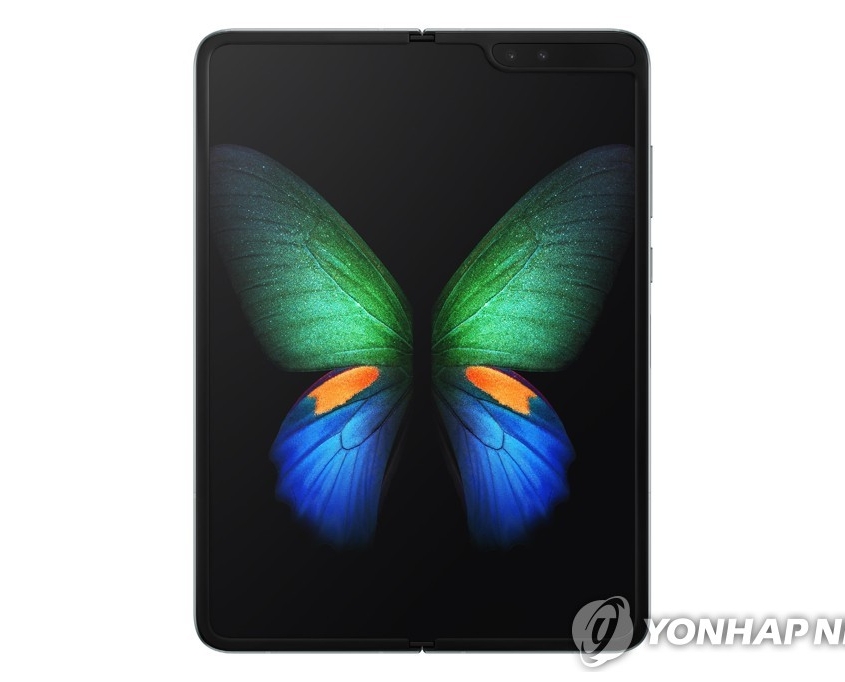
(Full text of articles: http://www.etnews.com/20190423000190)

BOE is going to start construction of its fourth 6th generation flexible OLED plant soon. It is planning to invest a total of 46.5 billion yuan (approximately 7.9 trillion won) to have a monthly production capacity of 48,000 sheets. Although the display market is slumping and demand for flexible OLEDs for smartphones is falling short of expectations, it is speeding up aggressive investments and expanding production capacity.

According to Chinese media on the 23rd, BOE is going to start constructing its fourth flexible OLED plant called ‘B15’ that will be invested in Fuzhou. It is heard that it will hold an event soon and make official investments.

As BOE is going to carry out its investments in B15, it has become clear that it will have production capacity of world’s largest 6th generation flexible OLEDs by beating Samsung Display.


▶ ” LCD TV panel price rebound…accelerates large OLED conversion” (The Korea Economic Daily)

(Full text of articles: https://www.hankyung.com/finance/article/2019042322206)

“The price of LCD TV panels increased +0.7% in second half of April compared to first half.” said KB Securities on 23rd.

“The price of LCD TV panels in the second half of April, which was announced by Witzview, has increased +0.7 percent compared to the first half,” said Dong-won Kim researcher. “The prices of 32-inch and 55-inch LCD panels increased +1.3% compared to the first half of April, and prices of 65-inch and 75-inch panels recorded 0.5% and 1.1% respectively, showing good trend of prices.” said a slight decrease in prices of PC panels compared to the previous quarter.

While positive trend of LCD prices is continuing in second quarter, it is predicted that businesses can convert large OLED panels faster. “If Samsung Display’s QD-OLED conversion investment for 8th generation LCD lines starts in earnest in the second quarter, price of 32-inch TV panels will continue to rebound slightly due to psychological impact on reduction of supply.” said Kim. “For 65-inch, 75-inch TV panel prices, production of Chinese panel manufacturers will expand, operation of 8th generation LCD lines of Samsung Display will slow down.”

OLED Daily Issue, April 22, 2019

▶ OLED is also worried about oversupply…” China factory size, twice that of Korea.” (YONHAP NEWS)

(Full text of articles: https://www.yna.co.kr/view/AKR20190419148900003?input=1195m)

Following LCD panels, there are predictions that oversupply can become a reality for OLED panels.

Concerns are growing as South Korean companies plan to grow OLEDs into new “cash cow” instead of LCDs that China has taken the lead.

According to a recent report released by Hana Financial Management Research Institute on 21th, the number of OLED panel factories currently under construction in China is 419,000 sheets per month, about twice the amount of 225,000 sheets per month, which is the size of South Korea’s expansion.

According to the report, China’s BOE, which ranks first in LCD panel market, is going to increase its size to 144,000 panels. In addition, Chinese panel manufacturers such as CSOT, Visionox, and TCL are also scrambling to expand their facilities on a large scale.

Among South Korean companies, LG Display is set to operate its 90,000-unit monthly plant in Guangzhou, China, and it is expected that there will be a total of 45,000 panels per month in Paju.

Industries predict that size of OLED plant that will be built by Samsung Display in Tangjeong, South Chungcheong Province, will reach 90,000 sheets per month.

“As speed of expansion of OLEDs in South Korea and China is much faster than rate of increase in demands, there is a high possibility that oversupply will worsen.” said Joo-wan Lee, a researcher.


▶ The screen shield that caused controversy over faulty Galaxy folds…Why do I need it? (Yonhap news)

(Full text of articles: https://www.yna.co.kr/view/AKR20190421010700017?input=1195m)

Samsung Electronics’ first foldable Smartphone was embroiled in controversy over its screen defects even before it was released. Samsung Electronics explains that this happened because early users removed “screen protection film,” which can be misunderstood as screen protection film.

<Samsung Electronics [Samsung Electronics Co., Ltd.]>

According to industries on the 21st, current Smartphones are going to protect displays by attaching cover windows with reinforced glass material on top of OLED display panels.

OLED panels themselves are very thin like vinyl and are weak against external shocks. Plastic OLED (Plastic OLED) that is used for foldable Smartphones is more vulnerable to scratch. However, it can’t put glass, which is a material that doesn’t fold, so it is finished by applying film of plastic material.

“Although screen protection films that we already know are additional products that prevent scratching, protective films that are used for flexible displays are very important for displays.” said Professor Hak-seon Kim of UNIST, who is a former vice president of Samsung Display. Ok-hyun Jeong, an electronic engineering professor at Sogang University, also said, “The fact that we took out a protective film from PLED is tantamount to ripping off the display parts themselves.”

OLEDs emit light as organic materials, and due to their characteristics, they are very susceptible to oxygen and moisture components. When a thin panel itself is subjected to strong pressure during a screen’s opening, it can cause the screen itself to become indigestion due to moisture in an empty space.

Plastic has a weaker hardness than glass, making it easier to scratch the surface.

In addition to screen glitches, the media that received Galaxy Folders for review such as Bloomberg and Derverge points out that the protective film is easily dented or scratched. One reviewer said, “I tapped the screen with my fingernails, but there are still permanent marks.”

Some point out that there is a gap between the protective film and the display, which makes it easier for dust and others to get rid of it. One reviewer suggested a photo showing the gap between the screen’s protective screen and bezel, suggesting that it could be misleading.

Due to this reason, Samsung Electronics explained that its screen shield is for ‘replacement’. Since there is a higher chance of damage such as scratch than conventional glass, they were made so that they could be replaced at that time. However, users should not replace them directly and go through a service center.

Experts point out that such precautions should be sufficiently notified to consumers before the launch, and that early users also need to follow basic precautions as they use first-generation products.

Jeong said, “Samsung Electronics seems to have lacked notice of screen protection. “We need to strengthen advance notice when it is officially released.” said a person who dropped it from the company, which is about 100 grams more than normal Smartphones, risks further damage when it is dropped from the same location. This part also requires the user to pay attention,” he pointed out.

“Since the film itself is a plastic material, even if it is attached with protective film, it can be pierced and torn if exposed to sharp needles, unlike glass,” Professor Kim said. “In fact, these precautions should be properly introduced when selling it.”


▶ SK is investing in OLED business? (etoday)

(Full text of articles: http://www.etoday.co.kr/news/section/newsview.php?idxno=1747027)

SK Corp. is considering investing into OLED material business. As OLED markets are rapidly growing, industries that are made of OLED materials are also increasing.

According to mid- and long-term management plan data that SK Corp. held a corporate briefing for analysts of securities companies on Wednesday, SK Corp. is also reportedly considering investing in OLED materials to expand its material business.

SK Corp. has set a mid- and long-term strategy for its material business to expand its high-growth area by utilizing its current material platform.

For OLED materials, LG Display is planning to develop its own technologies by linking current SK Trichem’s technologies such as precursors and others while also considering investing in them.

Industries predict that SK Corp. will be able to expand its business through investments as it is an investment-type holding company.

For battery materials, which are planning to enter markets with high-entry barrier materials through partner companies’ cooperation and investment in technology holding companies, it has quickly entered the market by investing 270 billion won into shares of related companies.

SK Corp. previously acquired the stake in Watson, China’s No. 1 company that manufactures the second-order essential part of the battery, in November last year.

A reason why SK is showing interest in OLED markets is because OLED markets are growing rapidly.

According to a market research company called Ubi Research, size of OLED display market was estimated to be $28.31 billion (31.9568 trillion KRW) last year, which is a 7.1% increase year-on-year and is expected to grow to $32.3 billion (36.457 trillion KRW) this year.

It is expected to grow to $59.5 billion by 2023.

As a result, many other companies are working on OLED materials. Earlier this month, LG Chem stepped up its related business by acquiring material technology for “Solid Organic Light Emitting Diodes,” a key platform for next-generation displays, from DuPont in the U.S.

Doosan also established a new company through division of its business sector to strengthen its material businesses such as OLED.

“We have no specific plan to invest in OLED materials yet.” said a representative for SK Corp.

LG Display “OLED TV will account for more than 20% in total TV sales revenue.”

LG Display OLED TV maintained sales revenue, it through conference call, stated it recorded annual sales revenue of 24.3 trillion won and 92.9 billion won operating profit in year of 2018.

LG Display despite of heightened global competition and downward panel price made an operating profit thanks to OLED TV, super large size TV and high resolution products.

Especially large size OLED TV maintained stable productivity and enlarged consumer bracket which enabled 2.9 million shipment on a yearly basis. It recorded gross profit within 5 years of product introduction which resulted in more than 20% in total sales revenue.

4th quarter 2018 revenue of LG display marked 6.95 trillion won TV panels accounts for 36%, mobile panels 28%, notebook and tablet panels 22% and 14% for monitor panels.

Operating profit recorded 279 billion won, 528% increase compared to the same quarter last year, 99% hike compared to last quarter thanks to high priced IT products, new introductions of small and medium size products and high added value products. LG Display aims to focus on OLED business reconstruction Seo Donghee CFO of the company said, “the ratio of OLED revenue was almost nothing 5years ago, now it is 30% this year and we estimate it is going to reach 50% of the total business.”

He also said “we will put in all assets to create new values focusing on OLED business.”

He replied to the question of large size QD-OLED of competitor, it will strengthen ecosystem and overall OLED industry. To the question of 8K and over 70inch large size OLED mass production, he replied that 8K technology is already secured as exhibited at CES2019 and said that large size OLED mass production will utilize the existing know-how of LCD production. In 2019, LG Display’s OLED demand outlook question suggests that demand for more than 14% of all flexible OLED smartphones is expected.

Regarding the large-area OLED and p OLED capacity in 2019, LGD said that the large-area OLED capacity will be completed at 70K per month in Paju and 60K in Q3 in Guangzhou, China and the pOLED capacity is expected to add 30K to the domestic 45K in 2020.

He announced that capex is estimated 8trillion won in 2019 and 4trillion won in 2020, a half of this year. 60% will be for large size OLED and 40% for pOLED. And he said pOLED mass production is currently concentrated on smart phone and cars. He expects good news from car pOLED by end of this year. He also targets over 3.8 million units large size OLED production this year.

OLEDON, is to announce belt-plane source deposition technology for manufacturing ultra-high resolution and ultra-area OLED

Plane source technology, which was first developed by OLEDON in the world, has the principle of depositing the first organic material on the metal surface and evaporating it upwards to produce fine pattern of 2250 ppi, which is ultrahigh resolution. In this plane source process, three processes such as the first deposition, the plane source inversion, and the second evaporation are necessary, and the number of the high vacuum chambers is increased when the mass production is applied. The belt plane source FMM deposition technology introduced by OLEDON has a concept of carrying out the above processes at a time in one evaporation equipment. This is a continuous plane source supplying deposition technology in which the metal surface is formed in a belt shape.

Hwang added, “Using vertical plane source enables smooth deposition process for the 12th generation class area substrate for QD-OLED TV without sagging problem. Vertical belt-plane source evaporation equipment adopts the concept of depositing the substrate in a standing-up position so that the load on the framed glass chuck and the open mask is very low. Thus, easy transportation of the substrate, and uniform deposition process of thin film over a very large area in the static state are possible.” This technology is expected to be applicable not only to the 8th generation but also to the cluster type mass-production evaporator with substrate sizes more than 10 generations in the future.

<Vertical belt plane source evaporator for QD-OLED, Source: OLEDON>

Commenting finally that the company has successfully completed the material denaturation test for blue materials and the blue dopant deposition test, Hwang expected the plane source deposition technology to be applied to both small & medium sized OLED and large area OLED manufacturing in future.

On the other hand, OLEDON holds more than 30 related patents including original patents of plane source and belt plane source evaporator. Also, the company recently filed a patent related to a vertical belt plane source evaporator for mass production.


CYNORA announced that it has extended its joint development agreement for TADF commercialization with LG Display.

TADF developer CYNORA has announced that it has extended its joint-development agreement with LG Display. The two companies have been co-developing deep-blue TADF OLED emitters for two years, and have now decided to continue the cooperation towards the commercialization of TADF emitters in OLED displays.

The performance of CYNORA’s latest deep-blue material was presented at IMID 2018 held in August of the year. Among the performance introduced, the CIEy is 0.13, the EQE is 20% based on 1000 nits, and the LT97 is 15 hours at 700 nits.

CYNORA CEO Gildas Sorin commented, “Currently, CYNORA focuses on the development of deep blue TADFs for OLED TVs. Through the accumulated know-how to develop deep blue TADF, it also has plans to develop a light blue TADF for lighting applications and a green TADF for displays.”

Market for OLED materials and components is forecast to grow to US$37 billion in 2022.

In the 2018 OLED material and component report and Market Track published by UBI Research, the entire market for OLED materials and components market is expected to grow at a CAGR of 29% by 2022, forming a market of US$ 37 billion in 2022.

<Market forecast for OLED materials and components>

The overall OLED material and component market forecasted in this report is calculated based on the panel makers’ available capacity and includes all the materials and components for OLED production.

The total OLED material and component market is counted as US$ 9,794 million in 2017 and is expected to grow by 35% to US$ 13,264 million in 2018.

Major growth drivers are mentioned as capacity expansion of Samsung Display and LG Display inclusive of Gen6 flexible OLED mass production lines of Chinese panel makers.

UBI Research commented “Utilization of Samsung Display in the first quarter of 2018 was poor, but it is turning to normal from the second quarter, and LG Display and Chinese panel makers are also aiming to mass-produce this year. In particular, it will have a major impact on the growth of the materials and components market in 2018 whether Samsung Display’s A4, LG Display’s E5, E6 and BOE’s B7 lines will be in full operation.”

In the 2018 OLED material and component report, the market is forecast for 20 kinds of major materials and components used in OLED for mobile devices and large-area OLED, including substrate glass, carrier glass, PI and organic materials for TFT. In addition, the report covers industry trends and key issues related to the core materials, while Market Track forecasts the expected purchase volume and purchase amount by panel makers.

[SID 2018] OLEDON, presented about X-mixing plane source deposition technology for AMOLED efficiency enhancement.

In SID 2018, Hwang Chang-Hoon, CEO of OLEDON, announced a new plane source FMM deposition technology that can produce ultra-high resolution AMOLED of 2,250 ppi.

According to the announcement, the linear source currently applied to mass production has a problem of causing superimposition of fine adjacent patterns in a high resolution implementation due to a shadow distance of 3 μm. But Hwang said he succeeded in reducing the shadow distance of the patterns by 0.18 um using plane source, which is the smallest shadow distance ever introduced.

<Shadow effect comparison between current process and the process applied with the plane source, Source: OLEDON>

Hwang added that he developed ‘X-mixing’ technology in which the host and dopant thin films were separately deposited on the metal surface and then the host molecules and dopant molecules were automatically diffused through the plane evaporation to form the light emitting layer. Hwang commented, “It is not easy to control the composition of the dopant by using the linear source evaporation technology, which vaporizes the host material and the dopant material at the same time. However, since X-mixing technology can control the composition, it is possible to achieve a material utilization rate up to 4 times higher than the conventional method.”

<SIMS data comparison between the emitting layer deposited by conventional method and the emitting layer deposited by the plane source, Source: OLEDON>

<Dopant gradient data of the emitting layer applied with X-mixing technology, Source: OLEDON>

Hwang said, “In case of green OLED produced by X-mixing technology, 40% improvement in the emitting efficiency was verified, compared to the existing technology. OLEDON is currently under development of the optimized X- mixing development for forming exciton and the mask aligner with new concept sub-micron precision.

<Luminance data for green OLED produced by X-mixing technology and green OLED produced by the conventional method, Source: OLEDON>

Finally, Mr. Hwang mentioned that based on the development results, he plans to install a plane source FMM evaporator capable of manufacturing ultra-high resolution micro OLED devices in Dankook University.  (Reference: OLEDON homepage: www.oledon.co.kr)

Following OLED, notch design to LCD becomes a marketing trend in 2018?

At the 6th China Information Technology Expo (CITE 2018) held in Shenzhen, Guangdong Province, China from April 8 to 11, 2018, a number of panel makers and set makers exhibited notch-designed display panels and smart phones.

In CITE 2018, five panel manufacturers exhibited in CITE 2018; BOE, EDO, GVO, Tianma and CSOT. Among them, BOE, Tianma and CSOT exhibited notch-designed display panels.

First, BOE introduced 6.2-inch OLED panels applied with notched design. The OLED panel exhibited by BOE has a resolution of 2992 x 1440 with 537 ppi and 400 nit brightness.

LCD panels also began to adopt Notch Design. Tianma presented a 6.18-inch LCD panel with a notch design. CSOT also exhibited two 6.25-inch LCD panels and a 6.18-inch LCD panel applied with notched design.

<’Notch design’ display panels exhibited in CITE 2018>

Vivo, a Smartphone maker, also exhibited the X21 with a notch design. The X21, released in March, has a resolution of 1080 x 2280 with 6.28 inch screen.

<Vivo X21, OLED Smartphone with notch design>

Since Apple first unveiled its OLED smart phone with the notch design on iPhone X, a number of smart phone makers such as Vivo, Oppo, and Huawei have begun to release OLED smart phones. In this exhibition, many panel makers presented a large number of LCD panels to which Notch Design is applied. Attention is growing whether Notch Design can become a trend in the small and medium sized display market in 2018.

AMOLED Display Market track – Investment & MP Line Status, just published

According to the investment trend data from AMOLED Display Market Track published by UBI research, the net area capacity of AMOLED production worldwide is expected to grow at a CAGR of 48% from 2018 to 2020.

As a result of analyzing the glass area based on the overall equipment capacity, the net area capacity of AMOLED mass production was 13 million square meters in 2017, and it is expected to grow more than three times to 40 million square meters in 2020.

The net area capacity of AMOLED mass production area is projected to grow from 4 million square meters in 2017 to 8.4 million square meters in 2020, and that of small and medium-sized AMOLED is to be increased about 3.5 times from 9.1 million square meters in 2017 to 32 million square meters in 2020.

Analysis shows that LG Display’s net area capacity will be increased by 6.9 million square meters from 2018 to 2020, followed by Samsung Display with 5.8 million square meters increase and BOE with 4.4 million square meters increase.

On the other hand, when compared to the net area capacity for small and medium-sized AMOLED, Samsung Display is expected to increase by 5.8 million square meters, with the largest investment, followed by BOE of 4 million square meters’ increase and LG Display of 2.9 million square meters increase.

<Net area capacity of AMOLED mass production by company>

According to Lee Choong Hoon, CEO of UBI Research, LG Display’s AMOLED mass production line investment in China will lead LGD to more than double BOE’s AMOLED production capacity in terms of net area capacity in 2020, however, BOE is expected to overtake LG Display at small and medium-sized panel capacity in 2019.

AMOLED Display Market Track consists of investment data, market performance, market forecast, ASP, cost analysis, competitiveness analysis and so on. The investment data in this report contains details of the investment history of the panel companies, current status, and investment prospects for the next three years. Also, the useful data and graphs analyzed in various aspects are provided in excel format.

Flexible OLED Leading the OLED Panel Market from 2019

■ Flexible OLED is expected to ship 480 million units in 2019, surpassing Rigid OLED shipments.

■ Full-screen OLED among Flexible OLED is expected to have an average market share of 78.3% by 2022, dominating the market.

■ Foldable OLED is expected to ship in earnest from 2019.

Flexible OLED shipments are expected to exceed rigid OLED shipments in 2019. According to the ‘2017 Flexible OLED Annual Report’ published by Ubi Research, flexible OLEDs are expected to ship 480 million units in 2019, surpassing 409 million units of rigid OLED shipments. In addition, flexible OLED shipments will grow at a CAGR of 41% starting in 2018, reaching 1,285 million units in 2022 with forecasted revenue of US$ 59.4 billion.

<OLED Market Share Forecast by Substrate in 2018 ~ 2022>

Recently, as the hardware technology of mobile devices has been leveled up, set makers targeting the premium market are trying to differentiate their products by adopting OLED. Especially, set makers are beginning to introduce flexible OLED capable of full screen, as the needs of consumers who want a wider screen in mobile devices (even in the same sizes) on the increase.


Accordingly, panel makers are continuing to invest in flexible OLED mass production. Since Chinese panel makers such as BOE, CSOT and Visionox are expected to start mass production of Gen6 flexible OLED starting in 2018, flexible OLED shipments will likely grow at an average growth rate of 59% per annum, reaching 354 million units by 2022.


This report compares the structure and process of rigid OLED and flexible OLED, and analyzes the trends of technology development for foldable OLED implementation by layer. It also compares the flexible OLED application technology of Samsung Electronics, Apple, and LG Electronics which released mobile devices with full screen OLED. The report also forecasts the flexible OLED market from 2018 to 2022 by categorizing into various perspectives including flexible type, country and generation.


According to the report, full screen OLEDs of flexible OLEDs will ship 265 million units in 2018 with a market share of 82.1%, and 1,022 million shipments will be made in 2022, accounting for 79.5% of the market, leading the flexible OLED market. In addition, the foldable OLED, which has been receiving a great deal of attention recently, is expected to ship 5 million units from 2019 and 53 million units by 2022.

<Foldable OLED Shipment Forecast in 2018~ 2022>


IoT Era – Smart interface focused on display

With the Google’s comments in 2015 that the new IoT era is coming, the 13th China International Display Conference started with the presentation of BOE, a large Chinese display company, with the topic of the era of smart interfaces to be developed in the future.

Randy Chen (BOE, Sales Marketing Executive) shared the overall IT market trend as the first presentation and delivered the BOE’s strategy within it. At the heart of the IOT industry, which is expected to account for around $ 10 trillion in 2050, smart interfaces that link 5G communications and electronics to displays will play a big role and emphasized 8K and flexible display as BOE’s survival strategy. For this, he announced that they are working to build the 8K Industry Alliance and continuing to invest in the production of flexible displays starting with Chendu’s G6 Flexible Line. OLED panels produced in the Chendu B7 line, which began operating in the second half of this year, will be supplied to a smartphone maker in Shenzhen and expected to be seen in the market early next year.

Next, Xiuqi Huang (GVO, Vice President) of Visionox, who first started producing OLEDs starting with PMOLED, mentioned the change of smartphone trend and said that a mobile device with a foldable and rollable type using a flexible panel will be introduced in the future. He said that the technological development is required not only in design but also in related equipment and materials and Visionox has also been actively developing its technology.

CSOT, which produces QD-LCDs together with Samsung Display, mentioned the development potential of QLED and OLED TV and said that it was spurring technological development and investment as a latecomer. Especially, it was developing large-area inkjet printing technology that has advantages of relatively high material utilization rate and price competitiveness, on the other hand, it shared the goal of developing a smartphone panel that minimizes Bezel.

Following the presentation of representative panel companies in China, Lee Choong-hoon of Ubi Research, a global OLED research company, forecasted the market size of the OLED market, which is already leading the small-medium-sized panel market and the premium TV panel market and discussed why OLEDs have grown rapidly as a next-generation display. Ubi Research, as an OLED professional research company, is suggesting directions for future growth of OLED based on years of data and research experience.

In current display industry, major global smartphone makers such as Apple, Samsung and Huawei already have plans to apply OLED to all flagship models and TV companies such as LG Electronics and Sony have also shown that OLED TVs can only succeed in the premium market. This is why we expect the development of various types of panels and various applications that maximize the advantages of OLED forward.

[iMiD 2017] JOLED announces printing-type OLED development trend and future road map

At the ‘IMID 2017 Business Forum’ held in COEX, Seoul from 18th to 19th, Toshiaki Arai, chief technologist of JOLED announced JOLED’s printing technology and future road map.

<JOLED’s Toshiaki Arai chief technologist>

Toshiaki Arai, chief technologist stated that a stable jetting technology at 220 ppi level has been currently secured; high resolution OLED with more than 300 ppi has been developed at Gen 8.5 but there are some issues such as jetting accuracy and stability.

Toshiaki Arai introduced TG-TAOS (top gate-transparent amorphous oxide semiconductors) TFT, which will contribute to saving the unit cost of OLED with excellent performance at low price.

He also announced the future strategy of JOLED, stressing that, instead of small and large OLED dominated by South Korean companies, the middle-sized OLED for tablet and monitor with more than 200 ppi. Joled is the only OLED panel maker that unveiled its 21.6 inch 4K RGB OLED in 2017, using printing process, and has pilot launched.

<JOLED’s 21.6 inch 4K OLED in application of printing method>

On the other hand, according to the Nihon Keizai newspaper in Japan, JOLED is reported to have invested 100 billion yen in mass production of printing-type OLED. In addition, Toshiaki Arai stated that the OLED test samples manufactured by printing process have been provided since this April and the mass production will realize in the second half of 2018.


How about the future OLED market performance?

At the seminar titled “OLED market analysis and the latest technology” host by the UBI Research at the FKI last June, the president, Lee Choong Hoon predicted the market through analyzing the OLED industry investment and mass production in the first half of 2017.

President Lee Choong Hoon emphasized that China will lead the OLED equipment market by 2021 due to increase in OLED demand of Chinese set makers. Accordingly, the Chinese equipment market is expected to account for about 48% of the entire equipment market in 2021, investing approx. US $ 40.5 billion.

It is anticipated that such movement of Chinese companies will affect the OLED smartphone market. In 2019, OLED smartphones will reverse the LCD smartphone market, accounting for 80% of the total smartphone market by 2021.

On the other hand, as for the flexible OLED, between 2017 and 2019, Samsung Electronics expects to invest heavily in BOE to be ranked second in the flexible OLED market, which should cope with the increasing demand on flexible OLED of Samsung Electronics and Apple.

President Lee analyzed that the premium TV market will be formed with larger than 65 inches as the 65-inch panels will be mass-produced at BOE’s Gen10.5 LCD plant from 2018. Consequently, panel makers without Gen10.5 will produce 65 inch panels on the Gen8 line in MMG (multi-model on a glass) method. On the other hand, LG Display is expected to continually produce TV OLED panel at Gen8, and since 2020 at Gen10.5 line.

According to ‘2017 OLED Manufacturing Equipment Annual Report’ published by the UBI research, from 2017 to 2021, it is anticipated that TFT equipment will account for 45% of the market share, followed by OLED pixel forming equipment 17%, encapsulation equipment 13%, cell equipment 13% and module equipment 12% respectively. As the demand on flexible OLEDs is expected to increase remarkably in the future, the market share of cell and module equipment will accordingly increase by 25% with high importance.

UBI Research , Published the Market Report on OLED Manufacturing Equipment

■The OLED equipmentmarket is expected to reach $84.9 billion in 5 years.

■Korean and Chinese panel companies will take over 90% of investment in panel equipment.


According to ‘2017 OLED Manufacturing Equipment Annual Report’ published by UBI Research, the entire equipment market of OLED is expected to total$84.9 billion(about 93trillion KRW) from 2017 to 2021. In 2017, $16.4 billion(about 18 trillion KRW) will be invested in OLED equipment.

The OLED equipment for the market analysis is largely categorized by process into 5 kinds of equipment; TFT, OLED, encapsulation, cell, and module. The investment costs including distribution equipment and test equipment of each process are calculated, and touch-related equipment is excluded from the market analysis.

Hyun Jun Jang, a senior researcher of UBI Research forecasts that the two countries will lead the OLED market due to the massive investment from both Korean panel companies occupying the OLED industry and latecomers Chinese panel companies.

According to this report, China and Korea will actively invest in OLED equipment from 2017 to 2017, showinga 48% and a 42% OLED market share, respectively. In particular, the two countries are expected to make the largest investment of $32.8 billion(about 36 trillion KRW) in 2017 and 2018.

Samsung Display has been expanding small and medium OLED lines to be applied to Galaxy series and Apple, and LG Display has been investing in both small & medium and large-size OLED lines. China’s BOE and CSOT are likely to invest heavily in OLED line because especially BOE has decided to invest more than 30K in small and medium OLED lines every year since 2017.

<left) OLED Equipment Market Share by Process,    right) OLED Equipment Market Share by Country>

From 2017 to 2021, itis forecast that TFT equipment, OLED pixel patterning equipment, encapsulation equipment, cell equipment, and module equipment will have a 45%, 17%,13%,13%, and 12% market share, respectively. In near future, the demand for flexible OLED will be likely to increase so that cell and module equipment will gain more importance having a 25% market share.

OLED Display Embellished CITE 2017

CITE 2017(China Information Technology Expo) was held in Shenzhen, China from April 9 to 11. As the Asia’s largest electronic and information exhibition hosted by the ministry of industry and information technology of the people’s republic of China and the local government of Shenzhen, the 5th CITE 2017 is the international IT event in which 1,600 companies participate annually, with 160,000 visitors.

At this expo, LG Display, BOE, CSOT, and Tianma exhibited OLED panel on one hand, and Changhong, Hisense, Konka, and Skyworth unveiled OLED-applied products on the other hand. Besides, many companies including Jilin OLED operated a shared exhibition hall under the name of China OLED Industry Alliance(COIA).

<Different Companies’ OLED Products at CITE 2017>

LG Display, the only large-area OLED panel manufacture unveiled its flagship 65-inch UHD Wall Paper OLED with an ultrathin and ultralight design of 3mm thickness and 7Kg weight, and Crystal Sound OLED displaying itself as a speaker. LG has received CES 2017 Innovation Award for its technology of Wallpaper TV OLED panel.

<LG Display’s Wall paper OLED(Left) & Crystal Sound OLED(Right)>

Besides, LG Display showcased various products applying OLED including OLED Pillar with six 77-inch UHD OLED panels and Dual-view flat with two 77-inich UHD OLED panels, while unveiling a 12.3-inch curved OLED for automobiles, two kinds of smartphones, and two kinds of plastic OLEDs for watches.

<LG Display’s OLED Pillar>

A Chinese OLED panel company, BOE boasted of its technology, demonstrating a 7.9-inch foldable OLED, a 5.5-inch edge bended OLED, and a 1.39-inch rounded OLED.

<BOE’s Foldable OLED(Left), Edge Bended OLED(Middle), Round OLED(Right)>

The other OLED TV set companies are all Chinese companies such as Changhong, Hisense, and Skyworth. They exhibited its flagship 65-inch OLED TV, a key size of premium TVs. Hisense exhibited the smartphone with OLED panel and e-ink panel on its both sides as well as OLED TV.

<Changhong(Left), Hisense(Middle), Skyworth’s OLED TV(Right)>

AMOLED panel for smart phones, just around the corner of 100million-unit shipment in a quarter

According to UBI Research, the shipment amount of AMOLED panel for smart phones in the 3rd quarter of 2016 was announced to be counted as 96million units.

It is the figure increased for 103% compared with the last quarter, and increased for 148% compared with the same period of last year, and it renewed the quarterly highest shipment amount once again, after the last quarter.

The person in charge of UBI Research mentioned that “The output of flexible AMOLED panels for Galaxy Note 7 was reduced compared to the plan due to the discontinuation of the production of Galaxy Note 7, however, the increase in shipments of AMOLED panels for China and Galaxy s7 series is seemed to play a important role in the increase of shipments in the third quarter.”

Currently, Samsung Display occupies more than 91% of the AMOLED panel market for smart phones, and Chinese panel makers such as BOE, EDO, Tianma, and Visionox are conducting mass production with small quantities.

In addition, Apple is expected to apply the flexible AMOLED panel to some models of the iPhone to be launched in 2017, therefore, future AMOLED panel market for smart phones will be increased continuously.

UBI Research expects that the annual shipment amount of AMOLED panel will form the market volume as about 1.4billion units by 2020 with the average annual growth rate of 41%, and flexible AMOLED panel among them will account for about 61%.

Smart Phone AMOLED Panel Shipment Forecast, Source : UBI research

BY HYUNJUN JANG, HANA OH

BOE and CSOT, Acquired the China first title through the panel for OLED TV

In ‘18th China High- Tech Fair,’ BOE collected a big topic by exhibiting 55” UHD OLED TV of Skyworth to which 55” UHD OLED Module was applied.

CSOT also publicized 31inch curved FHD OLED panel this time even though they have exhibited 31inch FHD OLED panel in the past.

About 80inch was realized by attaching 3 Curved OLED panels, and resolution was 5760*1080 along with 150nits brightness.

Two enterprises manufactured the product together by applying WRGB+CF structure having been produced massively in LG Display.

In this exhibition, BOE and CSOT became to have first tile in Chinese enterprises with 55inch UHD OLED and 31inch curved OLED, and it is expected that it could be new drive of WRGB OLED panel market afterwards.

BOE and CSOT are manufacturing the panel for OLED TV in Gen8 pilot line of Hefei and Gen4.5 R&D line of Shenzhen, China respectively, and two enterprises are under positive consideration about large-scale OLED mass production lines.

Currently LG Display possesses mass production lines uniquely in relation with large-scale OLED panel market, and is leading OLED panel market alone. In future, BOE and CSOT are expected to join in large-size OLED panel market, and it is anticipated that market expansion through competitions in large-size OLEF panel market could be made.

BOE’s Decision to Invest 46.5 Billion Yuan in Flexible OLED Line

According to a radio and TV source of Mianyang in Sìchuan Province, BOE has decided to invest 46.5 billion yuan(about 7.8 trillion KRW) in Gen6 flexible AMOLED production line.

BOE plans to begin construction in December 2016 and produce the items from 2019, and its capacity is 48K per month. It is expected to be used for producing high-end smartphones. BOE is carrying out 45K investment in Gen6 flexible AMOLED in Chengdu, and as part of this extension it is scheduled to put additional investment.

The investment in OLED has accelerated recently. Chinese panel companies including Visonox and EDO as well as BOE have decided to put investment in the production line of Gen6 flexible AMOLED panel and establish more lines.

BOE’s Gen6 flexible AMOLED panel production line where the investment has been decided or is still ongoing accounts for 75% of 120k that is total capacity of A3 Line, Gen6 flexible AMOLED production line of Samsung Display. If other Chinese panel companies’ investment that has been already decided or is ongoing is combined together, the investment exceeds Korea’s flexible AMOLED panel production capacity, even allowing for Samsung Display and LG Display’s additional investment.

With China’s active investment in flexible AMOLED panel production line, Chinese AMOLED panel market is expected to grow rapidly.

Not Only Samsung and LG, but BOE and JDI Also Shows OLED Surge in SID

a Flexible OLED Display at BOE Booth (San Francisco = OLEDNET)

During the SID 2016, not only Samsung Display and LG Display, but other companies including BOE, Japan Display (JDI), and Tianma also presented OLED. The extent of OLED by Korea, China, and Japan drew much attention.

In SID 2016 (22-27 May), these companies exhibited many new OLED panels for diverse devices such as smartphone, VR, and TV.

Samsung Display revealed rollable panel, diverse 5 inch level OLED panel products such as VR panel with 806 ppi, the highest value within the industry, and Bio Blue, a VR panel which minimized harmful blue light.

LG Display showed 77 inch UHD OLED panel for TV, 55 inch dual side panel for signage, 65 inch concave OLED, and demonstrated their strength as the leader in large size OLED panel.

a Flexible OLED Display at JDI Booth (San Francisco = OLEDNET)

At this exhibition, BOE revealed flexible OLED display for mobile device. Particularly, the 4.35 inch foldable panel is BOE’s first. The product’s bending radius of 5 mm and has the brightness of 350 nits.  

Tianma displayed 55 inch on-cell touch equipped TFT-HD AMOLED panel. The flexible display has 270 ppi and bending radius of 20 mm.

JDI exhibited flexible plastic OLED (POLED). The 5.2 inch product has 423 ppi with the resolution of 1080 x 1920.

an OLED Display for Mobile at Tianma Booth (San Francisco = OLEDNET)

Quantum dot sector also presented a strong front against OLED in SID 2016. Nanosys and QD Vision exhibited OLED TV and quantum dot TV next to each other and presented merits of quantum dot.

According to QD Vision, quantum dot could consume 50% less power compared to OLED. Nanosys explained that while white OLED panel TV shows brightness of only up to 500 nits, their own quantum dot TV can actualize 1,200 nits of brightness.

Not Only Samsung and LG, but Also BOE and AUO…Panel Profit Plunges due to LCD

Source = BOE

Source = BOE

 Hyunjoo Kang / Reporter / jjoo@olednet.com

Although Samsung and LG both had smooth Q1 2016 for set businesses including TV, display sectors were different. The majority of the industry believes that global oversupply of LCD’s effects was great. Key LCD players in China, who could be seen as responsible for the LCD oversupply, also showed bleak performance. Key global LCD panel companies, including BOE and AUO, also revealed much reduced Q1 2016 profit.

On 28 April, Samsung Electronics and LG Electronics announced that the business profit in Q1 2016 improved. Samsung Electronics recorded KRW 6.68 trillion business profit, a 12% increase compared to Q1 2015. LG Electronics also announced operating profit of KRW 505.2 billion, up 65.5% from last year. Both companies emphasized favorable TV business.

On the other hand, Samsung and LG both received significant damages in display sector. In Q1 2016, Samsung Display recorded operating loss of KRW 270 billion. Samsung Display recorded a profit against expectations. However, the business profit of KRW 39,500 million in Q1 2016 is a 94.7% fall from last year.

Not only Samsung and LG, but display leaders in Greater China region also showed much diminished performance. BOE, which has been aggressively investing in large area LCD mass production, showed a 6.7% increase from previous year with approximately CNY 12,300 million for Q1 2016 revenue. In Q1, BOE showed business profit of CNY 108 million, but profit ratio plummeted compared to the same period in 2015. The profit ratio in Q1 2016 fell to 0.8% from 8% in Q1 2015. On 28 April, Taiwan’s AUO also revealed TWD 5.58 trillion business loss in Q1 2016.

BOE and AUO are both key players within the global LCD TV panel industry, and within the top 5 in the Greater China region. BOE, in particular, is chasing the leader LG Display with aggressive product supply. The fact that BOE recorded dismal results despite this is analyzed to be due to price fall due to the oversupply of LCD and spread of OLED among others.

For global OLED leader for mobile device, Samsung Display, was known to have recorded deficit of approximately KRW 900 billion in LCD despite Samsung Electronics’ strength in OLED smartphone. Essentially, LCD eroded the profit that OLED brought. For LG Display, experts believe that as a leader of OLED for TV market, the company could avoid deficit by making up for the damages from the LCD price fall.

An expert of the display industry explained that LCD leaders such as BOE might have expanded market share with the product supply, but would have received significant damage in profit ratio. However, he explained that compared to 30 inch LCD panel, 50 inch and 60 inch level large area LCD panel received less fallout from the price fall. He then estimated that as the large size TV demand is increasing, the LCD industry could be improved in Q2.


Foxconn’s Large Size Panel Yield, Equal to Samsung·LG within 2016

Foxconn is expected to occupy approximately 22% of 2016 Q4 global large size panel yield(Source : Foxconn)

Hyunjoo Kang / Reporter / jjoo@olednet.com

Foxconn is expected to occupy approximately 22% of 2016 Q4 global large size panel yield, similar to the levels of Samsung Display and LG Display.

Foxconn, recently confirmed to buy 66% of Sharp’s stake for $ 3.5 billion, is estimated to actively invest in improving Sharp’s panel competitiveness against Samsung Display and LG Display.

DigiTimes recently reported their research indicates Sharp’s large size panel yield will occupy 5.3% of global market in Q4 2016. This places the company on the 7th place after Samsung Display, LG Display, Innolux, AUO, BOE, and CSOT.

However, Sharp and Innolux are under Hon Hai Precision (Foxconn Technology). If the Q4 2016 large size panel yield of Sharp and Innolux are combined, the global occupancy is added to 21.9%. This is approximately the same level as Samsung Display (23.7%) and LG Display (22.7%).

Foxconn is analyzed to be investing in Sharp mainly with focus on OLED. According to a recent DigiTimes article, Foxconn is planning to invest approximately US$ 1.8 billion in OLED development.

DigiTimes estimates that Foxconn will actively begin mass production of OLED for smartphone from 2018, and expand the production to large and medium-sized OLED panel for TV, notebook, etc. Foxconn is forecast to begin shipment of OLED for TV from 2021, and annually ship 7,200,000 units of OLED panel for TV in 2025.