Visionox Achieves 95% of BT.2020 with pTSF Technology Advancement
At ICDT 2026, Dr. Guomeng Li of Visionox presented the mass production roadmap for panels applying pTSF (Phosphor-assisted TADF-sensitized fluorescence) technology. He emphasized that by addressing key limitations of conventional phosphorescent OLEDs—such as broad emission spectra and shoulder peak issues—the technology marks a turning point in OLED color reproduction.
At SID 2025, Visionox had already demonstrated the feasibility of this approach by showcasing a pTSF-based green OLED achieving color gamut at the level of DCI-P3 and Adobe RGB.
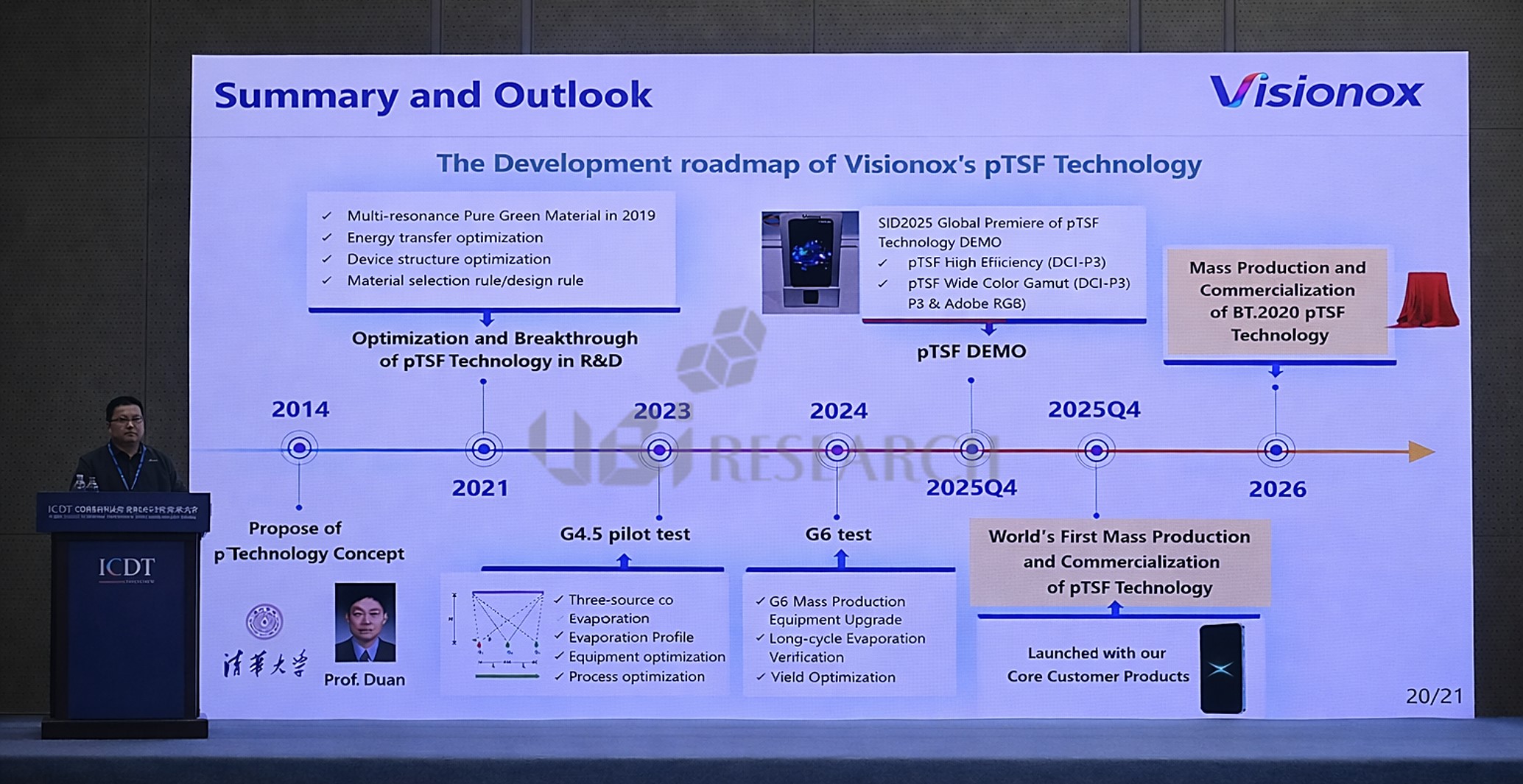
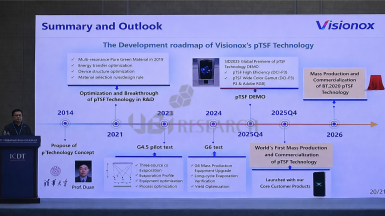
Visionox’s pTSF development roadmap presented by Dr. Guomeng Li at ICDT 2026. The goal is the full-scale mass production and commercialization of BT.2020 pTSF technology by 2026. (Source: UBI Research)
pTSF, a next-generation OLED emission technology, uses a phosphorescent material as a sensitizer to transfer energy to a narrow-spectrum fluorescent emitter, enabling 100% exciton utilization while improving color purity.
Visionox first presented pTSF performance at SID 2025 with a CIEx of less than 0.21. Less than a year later, at ICDT 2026, the company reported achieving a CIEx of 0.17 and approximately 95% of the BT.2020 color gamut. In addition, Visionox stated that, compared with its mass-produced phosphorescent OLEDs, the new structure delivered more than 30% higher efficiency and over 50% longer lifetime.
According to Visionox, these improvements were achieved by optimizing the combination of host materials, phosphor sensitizers, and narrow-spectrum fluorescent dopants, while also controlling the exciton recombination zone to reduce factors that degrade device performance. In particular, the company explained that expanding the recombination zone helped mitigate TTA and TPA, making it possible to improve both efficiency and lifetime at the same time. Visionox also added that stable characteristics were confirmed in evaluations including temperature-dependent IVL behavior, high-temperature driving stability, and capacitance variation.
Visionox also presented the development history and mass production plan for its pTSF technology. According to the presentation, the concept of pTSF was first proposed in 2014 by Professor Duan’s research team at Tsinghua University. By 2019, the company had established the technical foundation through the development of high-purity green materials based on multi-resonance structures, along with optimization of energy transfer and device architecture. It then proceeded with process and equipment validation as well as yield improvement through G4.5 pilot testing in 2021 and G6 testing in 2024, before unveiling a pTSF technology demonstrator at SID 2025. Visionox stated that in the second half of the same year, the technology entered the early stage of mass production and commercialization through customer products.
Visionox presented 2026 as the point at which BT.2020-level pTSF technology would be applied to mass production, and stated that it plans to further expand commercialization of the technology.
Changwook Han, Executive Vice President of UBI Research, commented, “The significance of pTSF lies not only in extending the color gamut, but in its ability to achieve BT.2020-level ultra-wide color reproduction while simultaneously securing both efficiency and lifetime. Competition in the premium OLED market is likely to become increasingly centered on color performance, and high-color-purity emission structures such as pTSF have strong potential to emerge as core technologies in the future.”
Changwook Han, Executive Vice President/Analyst at UBI Research (cwhan@ubiresearch.com)
 2026 Small OLED Display Annual Report
2026 Medium & Large Size OLED Display Annual Report
※ This article is produced by UBIResearchNet.
Unauthorized reproduction or citation without source attribution is prohibited.
When quoting, please clearly indicate the source (UBIResearchNet) and provide a link.