
High-efficiency pTSF-OLED made possible only by ViP™ technology
Visionox and the research team of Professor Lian Duan at Tsinghua University jointly presented research results demonstrating OLED efficiency improvements through ViP™ (Visionox intelligent Pixelization) technology at ICDT 2026 (International Conference on Display Technology). This presentation is particularly noteworthy as it marks the first co-authored paper between Visionox, which has led the ViP™ process innovations, and Prof. Lian Duan’s group, which developed the pTSF (phosphor-assisted TADF-sensitized fluorescence) mechanism and contributed to its mass production adoption.
OLED panels fabricated using the fine metal mask (FMM) process have a pixel aperture ratio (APR) of only 20–30%. This narrow emitting area forces high current densities through the device, fundamentally accelerating efficiency roll-off and material degradation. On large-area substrates of Gen 8 and above, mask sagging makes precise alignment increasingly difficult, creating serious yield challenges for producing high-resolution OLED panels at 400 ppi and beyond.
The ViP™ technology, disclosed by Visionox in May 2023, patterns pixels via photolithography, enabling an APR exceeding 50%. Furthermore, unlike FMM, it allows the common layers of each R, G, and B sub-pixel — including HIL, HTL, EBL, ETL, and others — to be designed and optimized in complete independence.
The research team systematically investigated the efficiency-improvement effects of ViP™ technology along three axes: materials, layer thickness, and emission mechanism. In the FMM process, the hole transport material (HTM) has traditionally been selected based on the performance requirements of the blue device. With ViP™, however, the common layers for each sub-pixel can be chosen independently to match their respective emission characteristics.
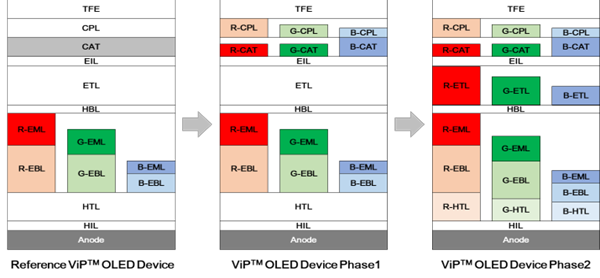
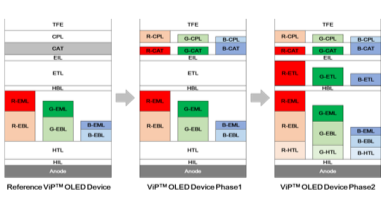
Structural optimization phases of ViP™ OLED devices revealed by Visionox and the Tsinghua University research team. It overcomes the limitations of FMM by independently designing the common layers of each subpixel to prove efficiency improvements. (Source: Visionox & Tsinghua University)
A comparison of three HTM materials sharing the same HOMO level (−5.2 eV) but differing in hole mobility revealed that a red device based on an HTM with significantly lower mobility degradation under high electric field conditions achieves an efficiency roll-off (G16/G255) of 101% — effectively zero — at high luminance, while extending LT95 lifetime by 48% relative to the reference device.
Two-stage optimization effects were quantitatively verified through SETFOS optical simulation. In Stage 1, individually tuning the cathode (CAT) and capping layer (CPL) thicknesses for the R and B devices alone improved white efficiency by 5%. In Stage 2, further optimizing the HTL, EBL, and ETL thicknesses for each of R, G, and B added an additional 9% (green), 3% (red), and 2% (blue) improvement. The combined white efficiency gain from both stages exceeds 7%, a magnitude comparable to a full year’s efficiency progress achievable through materials innovation (typically 5–10%).
ViP™ enables device structure optimization tailored to each emission color. A blue device based on the pTSF mechanism achieves theoretical efficiency 1.6–2.5× higher than that of a TTA (triplet-triplet annihilation) fluorescent device. Applying the pTSF mechanism across a white panel can boost overall efficiency by up to 55%. However, in FMM-based mass production lines, the HOMO/LUMO energy levels of the HTM and EBM required for pTSF green and pTSF blue pixels are mutually incompatible, making it practically impossible to raise efficiency within a single panel. ViP™ resolves this structural barrier and opens the path to integrating both a pTSF green device and a pTSF blue device within a single panel.
This study suggests that as ecosystem collaboration deepens between material suppliers and equipment manufacturers, the efficiency gains enabled by ViP™ technology will accelerate further. For next-generation applications demanding high resolution and low power consumption — large-format IT panels (monitors, laptops), AR/VR headsets, and automotive displays — the ViP™–pTSF technology combination is poised to emerge as a core source of differentiated competitive advantage that FMM-based mass production lines cannot replicate.
Changho Noh, Senior Analyst at UBI Research (chnoh@ubiresearch.com)
 2026 Medium & Large Size OLED Display Annual Report
2025 OLED Emitting Materials Report Sample
※ This article is produced by UBIResearchNet.
Unauthorized reproduction or citation without source attribution is prohibited.
When quoting, please clearly indicate the source (UBIResearchNet) and provide a link.