
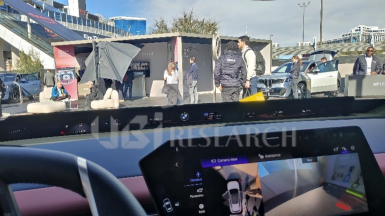
PHUD is The Future of The Automotive Cockpit
Panoramic Head-Up Displays (PHUDs) are once again accelerating the evolution of the automotive cockpit. While traditional HUDs displayed only limited information, such as speed and GPS, within a restricted area directly in front of the driver, PHUDs are next-generation interfaces that utilize a horizontal, pillar-to-pillar area along the bottom of the windshield to provide integrated driving information, safety warnings, vehicle status, and entertainment. As they can absorb most of the functions of physical instrument panels and central displays, PHUDs are emerging as a key pillar in realizing a “smart cockpit without a dashboard,” going beyond the role of a simple display device.
The primary reason PHUDs are garnering attention is their ability to simultaneously enhance safety and user experience. When driving, drivers must shift their gaze between road conditions and the display screen to check information mounted on the dashboard, leading to increased fatigue and distraction. In contrast, with PHUDs, the driver’s gaze remains directed toward the windshield even while driving, allowing driving information to enter their natural field of vision. This reduces the burden of shifting focus and enables more intuitive information perception. The elimination of the instrument cluster enables a minimalist interior, allowing automakers greater freedom in interior design. As the display area becomes wider and longer, it can efficiently provide different information to both the driver and passengers, serving as the foundation for expanding PHUD from a simple driving assistance system into an interaction hub for the entire vehicle.
PHUD has passed the proof-of-concept stage and is entering the mass production phase. BMW was the first to present the direction of PHUD as “Panoramic Vision,” and introduced the direction of the next-generation cockpit by unveiling the Neue Klasse-based iX, which incorporates BMW Panoramic Vision, at CES 2026. The Xiaomi YU7, a mid-size electric SUV set to go on sale in 2025, is equipped with a 1.1-meter panoramic display, accelerating the blossoming of the PHUD market. Major automakers such as Valeo and Marelli are also speeding up mass production of PUHD, meaning PHUD is rapidly moving beyond being a symbolic technology of concept cars and entering the realm of the actual market. While HUDs were imaging units providing information on a scale of merely a few inches, PHUDs require a much wider display area and advanced optical structures, so changes are expected across the entire supply chain for displays and optical components.
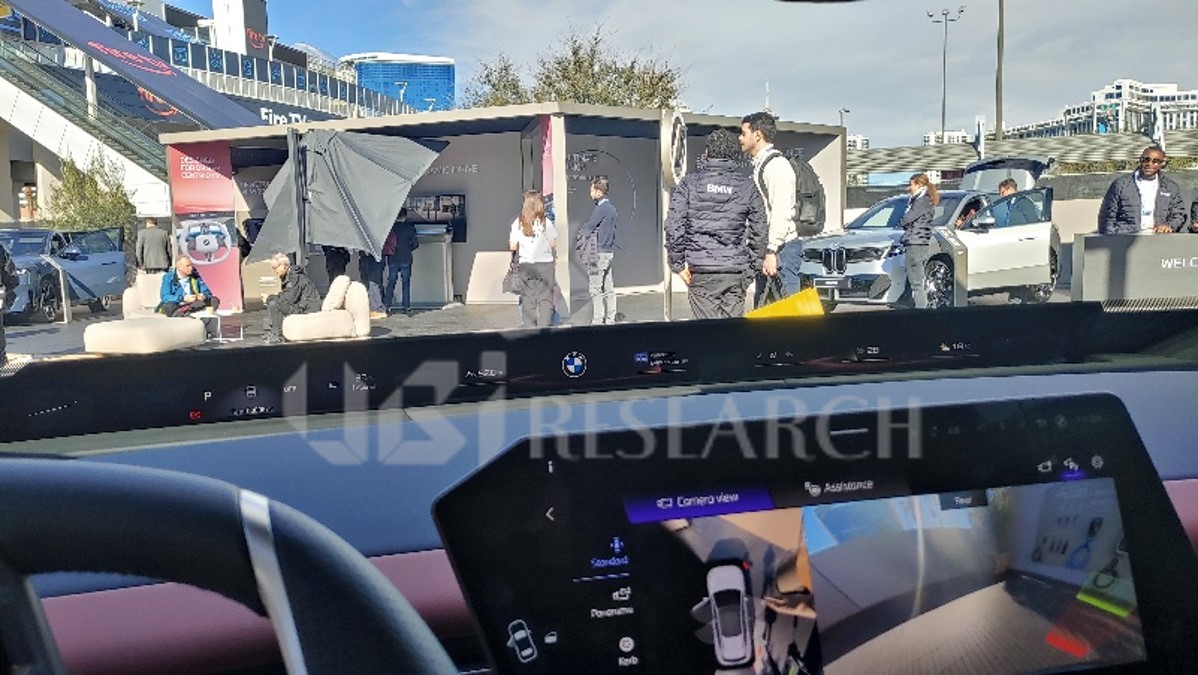
BMW iX3’s Panoramic Vision exhibited at CES 2026. It presents the direction of next-generation smart cockpits through PHUD technology that replaces the instrument cluster and stretches along the bottom of the windshield. (Source: UBI Research)
The evolutionary direction of PHUD will focus on replacing the instrument cluster and displaying ultra-wide information in the short term, but in the mid-to-long term, it will evolve into a form that combines with AR-HUD to overlay information onto the actual road. Furthermore, by integrating with in-vehicle IoT, AI-based personalized services, and safety warning systems, PHUD will transform beyond a mere information display function into a smart interaction platform that connects the vehicle, driver, passengers, and the external environment.
The competition for PHUD will not be a simple battle over display size, but rather a competition for cockpit dominance centered on how naturally and safely information can be delivered inside the vehicle.
Changwook Han, Executive Vice President/Analyst at UBI Research (cwhan@ubiresearch.com)
 2026 Medium & Large Size OLED Display Annual Report
2025-2026 Automotive Display Technology and Industry Trends Analysis Report
※ This article is produced by UBIResearchNet.
Unauthorized reproduction or citation without source attribution is prohibited.
When quoting, please clearly indicate the source (UBIResearchNet) and provide a link.