
Posts

BMW iX3 showcasing its pillar-to-pillar Panoramic Vision Head-Up Display at CES 2026, representing the future of dashboard-free car interiors.

PHUD is The Future of The Automotive Cockpit

Panoramic Head-Up Displays (PHUDs) are once again accelerating the evolution of the automotive cockpit. While traditional HUDs displayed only limited information, such as speed and GPS, within a restricted area directly in front of the driver, PHUDs are next-generation interfaces that utilize a horizontal, pillar-to-pillar area along the bottom of the windshield to provide integrated driving information, safety warnings, vehicle status, and entertainment. As they can absorb most of the functions of physical instrument panels and central displays, PHUDs are emerging as a key pillar in realizing a “smart cockpit without a dashboard,” going beyond the role of a simple display device.

The primary reason PHUDs are garnering attention is their ability to simultaneously enhance safety and user experience. When driving, drivers must shift their gaze between road conditions and the display screen to check information mounted on the dashboard, leading to increased fatigue and distraction. In contrast, with PHUDs, the driver’s gaze remains directed toward the windshield even while driving, allowing driving information to enter their natural field of vision. This reduces the burden of shifting focus and enables more intuitive information perception. The elimination of the instrument cluster enables a minimalist interior, allowing automakers greater freedom in interior design. As the display area becomes wider and longer, it can efficiently provide different information to both the driver and passengers, serving as the foundation for expanding PHUD from a simple driving assistance system into an interaction hub for the entire vehicle.

PHUD has passed the proof-of-concept stage and is entering the mass production phase. BMW was the first to present the direction of PHUD as “Panoramic Vision,” and introduced the direction of the next-generation cockpit by unveiling the Neue Klasse-based iX, which incorporates BMW Panoramic Vision, at CES 2026. The Xiaomi YU7, a mid-size electric SUV set to go on sale in 2025, is equipped with a 1.1-meter panoramic display, accelerating the blossoming of the PHUD market. Major automakers such as Valeo and Marelli are also speeding up mass production of PUHD, meaning PHUD is rapidly moving beyond being a symbolic technology of concept cars and entering the realm of the actual market. While HUDs were imaging units providing information on a scale of merely a few inches, PHUDs require a much wider display area and advanced optical structures, so changes are expected across the entire supply chain for displays and optical components.
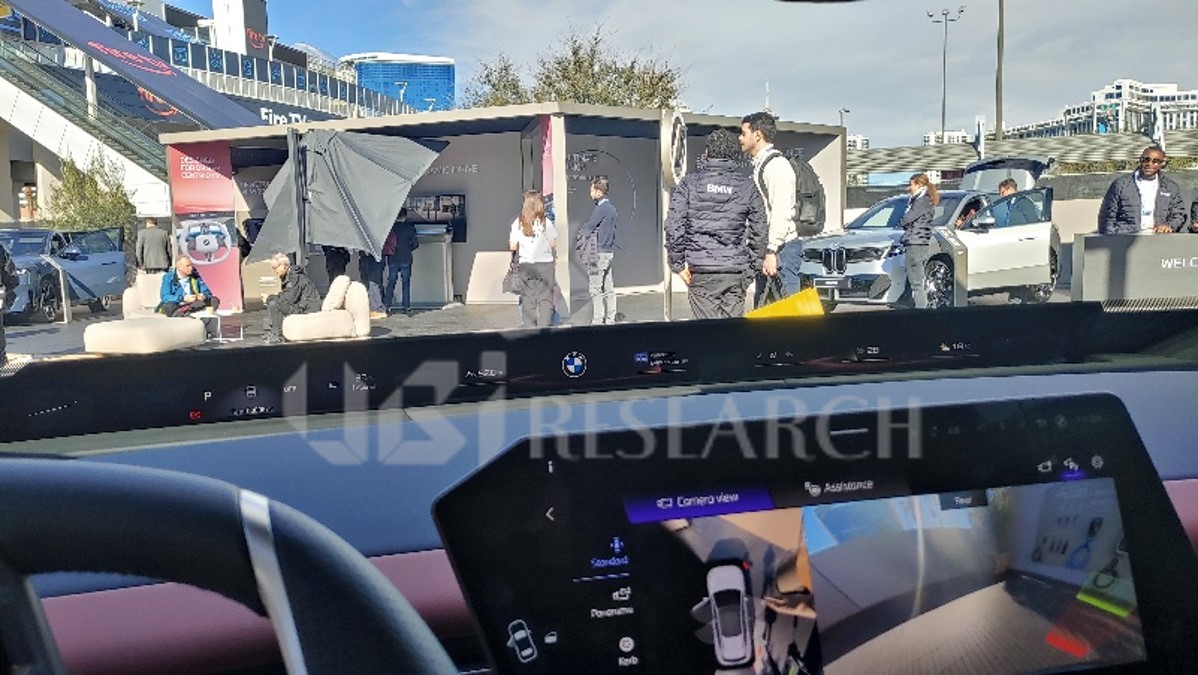
BMW iX3 featuring the Panoramic Vision PHUD technology exhibited at CES 2026

BMW iX3’s Panoramic Vision exhibited at CES 2026. It presents the direction of next-generation smart cockpits through PHUD technology that replaces the instrument cluster and stretches along the bottom of the windshield. (Source: UBI Research)

The evolutionary direction of PHUD will focus on replacing the instrument cluster and displaying ultra-wide information in the short term, but in the mid-to-long term, it will evolve into a form that combines with AR-HUD to overlay information onto the actual road. Furthermore, by integrating with in-vehicle IoT, AI-based personalized services, and safety warning systems, PHUD will transform beyond a mere information display function into a smart interaction platform that connects the vehicle, driver, passengers, and the external environment.

The competition for PHUD will not be a simple battle over display size, but rather a competition for cockpit dominance centered on how naturally and safely information can be delivered inside the vehicle.

Changwook Han, Executive Vice President/Analyst at UBI Research (cwhan@ubiresearch.com)

▶2026 Medium & Large Size OLED Display Annual Report

▶2025-2026 Automotive Display Technology and Industry Trends Analysis Report

※ This article is produced by UBIResearchNet.

Unauthorized reproduction or citation without source attribution is prohibited.

When quoting, please clearly indicate the source (UBIResearchNet) and provide a link.

LG Display's Dual View technology allowing different content for driver and passenger, symbolizing the shift to cockpit platforms.

CES 2026: The Evolution of Automotive Displays, Beyond Screens to Platforms

On January 6, CES 2026 officially opened in Las Vegas, the United States. At this year’s exhibition, automotive displays clearly demonstrated their evolution beyond simple information panels into core interfaces that integrate and intelligently orchestrate the in-vehicle experience. Alongside advances in OLED, Micro LED, and Mini LED technologies, innovations in form factors, transparency, and AI-driven interaction converged to define the future direction of the smart cockpit.

Korean companies highlighted their technological competitiveness by focusing on ultra-large displays, form flexibility, and differentiated user experiences. LG Display redefined the vehicle interior as a continuous digital space by showcasing its pillar-to-pillar (P2P) OLED display extending from the driver’s side to the passenger side. The single-panel P2P OLED, reaching up to 51 inches, delivers high resolution and excellent touch sensitivity while addressing concerns over image quality degradation in large-format displays. LG Display also unveiled a sliding OLED concept that can retract into the dashboard, presenting a cockpit vision in which screen size and function adapt dynamically to driving conditions. In addition, automotive OLEDs incorporating under-display camera (UDC) technology and Dual View functionality emphasized a direction in which a single screen can provide different information simultaneously to the driver and the passenger.

LG Display's 12-inch UDC IR OLED Cluster and Dual View Display showing different content to driver and co-driver

LG Display’s Dual View technology providing different information to driver and co-driver, featured with UDC cluster. (Source: LGD)

LG Electronics showcased applications of transparent OLED based on LG Display’s panel technology, presenting the potential of “invisible interfaces” in automotive displays. Transparent OLED technology enables both open visibility and information display, demonstrating its potential expansion into future applications such as HUDs, panoramic displays, and in-vehicle and vehicle-to-outside communication.

LG Electronics' Transparent OLED Windscreen and Side-Window display concept for vehicles

LG Electronics’ Transparent OLED Windscreen and Side-Window solutions displaying info while maintaining openness. (Source: LGE)

Samsung Display also emphasized spatial efficiency and installation flexibility through layout-adaptive automotive OLED solutions. Its 18.1-inch “Flexible L” center information display can be bent into an L-shape to conform to dashboard structures, while the 13.8-inch passenger information display (PID) can be hidden beneath the dashboard when the seat is unoccupied, enhancing space utilization. Samsung Display further highlighted the integration of a robust OLED panel with a 500R curvature on a glass substrate, achieving both visual sophistication and ease of installation.

Chinese companies placed strong emphasis on ultra-large integrated displays and advanced HUD technologies, showcasing their system-level integration capabilities alongside aggressive performance specifications. BOE introduced its HERO 2.0 smart cockpit, emphasizing scenario-based in-vehicle experiences centered on displays. The Micro LED PHUD panoramic head-up display, delivering up to 50,000 nits of brightness, ensures high visibility even under strong ambient light and integrates AI-based voice and gesture recognition to further enhance cockpit intelligence. HERO 2.0, which also includes a 15.6-inch UB Cell central display, an AI audio system, and an integrated digital broadcasting function, clearly illustrates BOE’s strategy of transforming vehicles from transportation tools into living spaces. At the same time, BOE highlighted low-power IGZO oxide displays and carbon-reduction achievements, reinforcing its commitment to environmentally sustainable manufacturing.

Demo of BOE's HERO 2.0 Smart Cockpit featuring Micro LED Panoramic HUD

BOE demonstrating the HERO 2.0 Smart Cockpit with a 50,000-nit Micro LED Panoramic HUD. (Source: BOE)

TCL CSOT made a strong impression with its 28-inch inkjet-printed OLED applied to a sliding center console and curved armrest, demonstrating notable innovation in form factor design. At its booth, TCL CSOT also conducted live demonstrations of a projection-based HUD (P-HUD). The HVA Ultra P-HUD projects information onto the vehicle’s front windshield using a multi-LCD projection structure, positioning itself as either a replacement for or a complement to conventional dashboard displays. This demonstrated TCL’s strategy of pursuing cockpit integration not only through large OLED panels but also through HUD solutions.

HVA Ultra P-HUD (Panoramic HUD) projection demo displayed at TCL CSOT booth

TCL CSOT’s Panoramic HUD solution projecting info on the windshield to replace dashboards. (Source: TCL CSOT)

Tianma presented a next-generation cockpit centered on a 49.6-inch C-shaped panoramic display positioned as an information hub, integrating the instrument cluster, center display, passenger display, and side-mirror areas into a single visual architecture. By leveraging more than 210,000 independent dimming units to achieve a 100,000:1 contrast ratio and suppressing reflectance to below 0.55 percent, Tianma emphasized both readability and safety in ultra-large displays. The company’s multi-screen ecosystem, including a 43.7-inch IRIS PHUD panoramic display, a flexible pull-out display, and a small OLED integrated into the steering wheel, highlighted its strengthening capabilities in system-level cockpit design. Visionox also showcased a dynamic bending display using dual flexible AMOLED panels, presenting an approach that simultaneously improves the stowability and visibility of large screens.

Tianma's 43.7-inch IRIS Panoramic HUD and integrated cockpit display revealed at CES 2026

Tianma’s next-gen cockpit and Panoramic HUD system integrating instrument cluster and center display. (Source: Tianma)

Taiwanese companies pursued differentiation through transparent displays and system integration. AUO, through its subsidiary AUO Mobility Solutions, showcased transparent Micro LED displays, INVISY stealth displays, and an AI-based cockpit domain control platform, defining displays as core nodes connected to vehicle computing systems. The integration with a glass-substrate satellite antenna suggested a future in which automotive displays are directly linked to external networks. Innolux emphasized integrated cockpit solutions combining visual and audio technologies through collaboration with CARUX and Pioneer, and unveiled an ultra-high-brightness Micro LED HUD delivering 50,000 nits of direct brightness and 10,000 nits in reflected image brightness, highlighting stable HUD performance even under extreme conditions.

AUO's automotive Transparent Micro LED display showcased at CES 2026

AUO’s Transparent Micro LED display presented as a key node connecting vehicles with external networks. (Source: AUO)

From the automaker perspective, the direction of change was equally clear. BMW presented a panoramic HUD concept for its next-generation iX3, proposing a future HUD architecture that utilizes the entire windshield as an information interface and emphasizing tighter integration between display technology and vehicle design.

BMW iDrive Surround View System and Panoramic HUD concept demonstrated at the booth

BMW’s futuristic Panoramic HUD and iDrive system utilizing the entire windshield as an information interface. (Source: BMW)

Commenting on the automotive display trends observed at CES 2026, Changwook Han, Executive Vice President at UBI Research, stated, “Automotive displays have entered a phase of cockpit platform competition, where form factors, systems, AI, and content converge, rather than remaining a field of individual component competition.” He added, “The advancement toward ultra-large displays, transparency, and sophisticated HUDs will ultimately serve as key indicators of how deeply display makers can engage in shaping the user experience of automakers.”

Changwook Han, Executive Vice President/Analyst at UBI Research (cwhan@ubiresearch.com)

▶2025 Automotive Display Technology and Industry Trends Analysis Report

※ This article is produced by UBIResearchNet.
Unauthorized reproduction or citation without source attribution is prohibited.
When quoting, please clearly indicate the source (UBIResearchNet) and provide a link.

Ford 1.1m integrated screen showcasing the future of automotive cockpit design with unified cluster and CID.

Ford Unveils 1.1m Integrated Screen… Cluster-CID Integrated Display to Become Popular in Global Vehicles

Minimalism in automotive displays has gained even more traction amidst the shift from traditional physical button-centric control systems to a “digital-based single interface.” According to UBI Research’s “2025 Automotive Display Technology and Industry Trend Analysis Report,” OEMs are actively adopting a structure that integrates the cluster and CID (Center Infotainment Display) under a single cover glass. This reduces visual density within the vehicle interior, avoids complex segmentation of the driver’s field of vision, and allows for flexible UI reconfiguration in response to software updates. This integrated screen not only simplifies the interior horizontally, but also allows key vehicle information to be managed in a single visual layer, making it an interface optimized for electrification and software-defined vehicle (SDV) environments.

The Ford Evos and Mondeo exemplify this trend with a 1.1m-wide integrated screen. This configuration integrates a 12.3-inch digital cluster and a 27-inch 4K CID under a single, ultra-wide cover glass, functioning as a single display. This panel, constructed with a super-flat, wide structure rather than a curved one, enhances the continuity of information transmission and minimizes visual disruption, maximizing the benefits of a software-centric UX. Furthermore, its simplified internal structure significantly improves space efficiency and design stability.

Ford’s 1.1m integrated cluster and CID display (Source: Ford)

Ford’s 1.1m integrated cluster and CID display (Source: Ford)

In the European premium market, the BMW i4 is a prime example of an integrated screen. BMW’s curved display, which has been widely adopted by the i4, iX, 3 Series LCI, and i7, integrates a 12.3-inch digital cluster and a 14.9-inch central display (CID) under a single piece of curved glass. While the internal panels are two-piece, they appear as a single, continuous digital interface from the user’s perspective, and the curvature achieves a driver-centric UI layout. This configuration minimizes physical buttons while ensuring operability and visibility, and is considered a prime example of BMW’s digital UX direction.

BMW Curved Display with integrated cluster and CID (Source: BMW)

BMW Curved Display with integrated cluster and CID (Source: BMW)

Among Korean brands, the Genesis GV80 facelift has adopted a full-fledged integrated screen strategy. The GV80 integrates the instrument cluster and CID under a single 27-inch OLED cover glass, completely breaking away from the traditional standalone instrument panel and central display structure. The OLED panel’s unique contrast ratio and color reproducibility maximize UI readability, and combined with the horizontal, minimalist interior design, it sets a new standard for premium SUV UX.

Genesis GV80 27-inch OLED integrated display (Source: Genesis)

Genesis GV80 27-inch OLED integrated display (Source: Genesis)

While few models currently feature an integrated screen (a structure combining the cluster and CID under a single sheet of cover glass) on the market, its adoption is rapidly accelerating, with major global brands, including Ford, BMW, and Genesis, strategically adopting it. The integrated screen is not simply a design innovation; it serves as a core platform for integrating vehicle functions into a single digital layer and integrating them with a software-centric operating system. As the boundaries between the instrument panel and infotainment system blur and the scope of OTA-based UI reconfiguration expands, the integration of clusters and CIDs is likely to expand beyond luxury vehicles to mid-size electric vehicle lineups.

UBI Research Executive Vice President Changwook Han emphasized, “The integrated screen is a key piece of hardware for realizing the digital UX of the electrification and SDV era. By integrating the cluster and CID into a single visual layer, the entire vehicle interface can be redefined based on software. Its application will gradually expand to the mid-size and mass-market segments.” Ultimately, the integrated screen is positioned as a guiding light for a transformation of the entire vehicle interface architecture, transcending technology and design.

Changwook Han, Executive Vice President/Analyst at UBI Research (cwhan@ubiresearch.com)

▶2025 Automotive Display Technology and Industry Trends Analysis Report

※ This article is produced by UBIResearchNet.
Unauthorized reproduction or citation without source attribution is prohibited.
When quoting, please clearly indicate the source (UBIResearchNet) and provide a link.