Posts

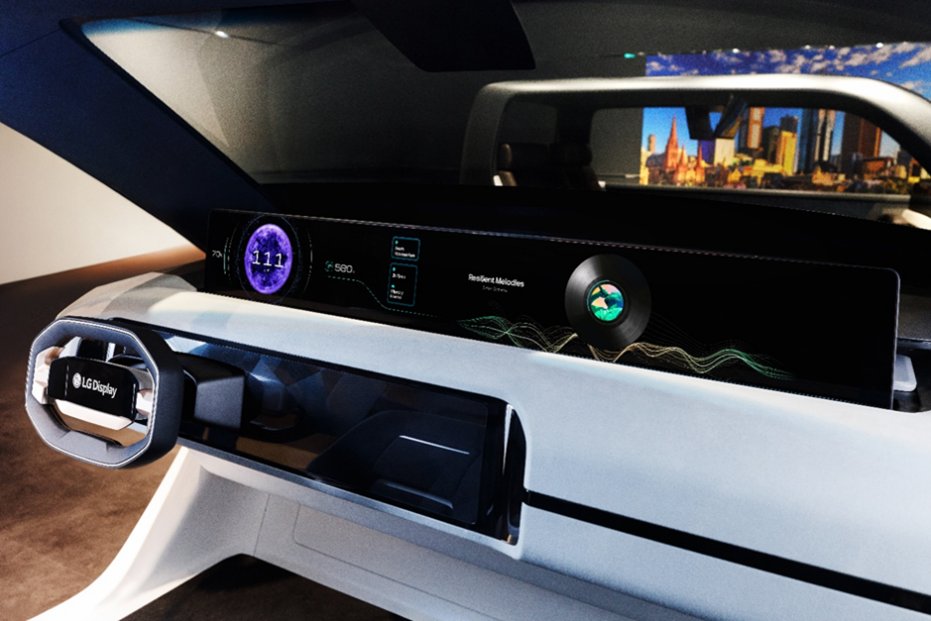
LG Display's Dual View technology allowing different content for driver and passenger, symbolizing the shift to cockpit platforms.

CES 2026: The Evolution of Automotive Displays, Beyond Screens to Platforms

On January 6, CES 2026 officially opened in Las Vegas, the United States. At this year’s exhibition, automotive displays clearly demonstrated their evolution beyond simple information panels into core interfaces that integrate and intelligently orchestrate the in-vehicle experience. Alongside advances in OLED, Micro LED, and Mini LED technologies, innovations in form factors, transparency, and AI-driven interaction converged to define the future direction of the smart cockpit.

Korean companies highlighted their technological competitiveness by focusing on ultra-large displays, form flexibility, and differentiated user experiences. LG Display redefined the vehicle interior as a continuous digital space by showcasing its pillar-to-pillar (P2P) OLED display extending from the driver’s side to the passenger side. The single-panel P2P OLED, reaching up to 51 inches, delivers high resolution and excellent touch sensitivity while addressing concerns over image quality degradation in large-format displays. LG Display also unveiled a sliding OLED concept that can retract into the dashboard, presenting a cockpit vision in which screen size and function adapt dynamically to driving conditions. In addition, automotive OLEDs incorporating under-display camera (UDC) technology and Dual View functionality emphasized a direction in which a single screen can provide different information simultaneously to the driver and the passenger.

LG Display's 12-inch UDC IR OLED Cluster and Dual View Display showing different content to driver and co-driver

LG Display’s Dual View technology providing different information to driver and co-driver, featured with UDC cluster. (Source: LGD)

LG Electronics showcased applications of transparent OLED based on LG Display’s panel technology, presenting the potential of “invisible interfaces” in automotive displays. Transparent OLED technology enables both open visibility and information display, demonstrating its potential expansion into future applications such as HUDs, panoramic displays, and in-vehicle and vehicle-to-outside communication.

LG Electronics' Transparent OLED Windscreen and Side-Window display concept for vehicles

LG Electronics’ Transparent OLED Windscreen and Side-Window solutions displaying info while maintaining openness. (Source: LGE)

Samsung Display also emphasized spatial efficiency and installation flexibility through layout-adaptive automotive OLED solutions. Its 18.1-inch “Flexible L” center information display can be bent into an L-shape to conform to dashboard structures, while the 13.8-inch passenger information display (PID) can be hidden beneath the dashboard when the seat is unoccupied, enhancing space utilization. Samsung Display further highlighted the integration of a robust OLED panel with a 500R curvature on a glass substrate, achieving both visual sophistication and ease of installation.

Chinese companies placed strong emphasis on ultra-large integrated displays and advanced HUD technologies, showcasing their system-level integration capabilities alongside aggressive performance specifications. BOE introduced its HERO 2.0 smart cockpit, emphasizing scenario-based in-vehicle experiences centered on displays. The Micro LED PHUD panoramic head-up display, delivering up to 50,000 nits of brightness, ensures high visibility even under strong ambient light and integrates AI-based voice and gesture recognition to further enhance cockpit intelligence. HERO 2.0, which also includes a 15.6-inch UB Cell central display, an AI audio system, and an integrated digital broadcasting function, clearly illustrates BOE’s strategy of transforming vehicles from transportation tools into living spaces. At the same time, BOE highlighted low-power IGZO oxide displays and carbon-reduction achievements, reinforcing its commitment to environmentally sustainable manufacturing.

Demo of BOE's HERO 2.0 Smart Cockpit featuring Micro LED Panoramic HUD

BOE demonstrating the HERO 2.0 Smart Cockpit with a 50,000-nit Micro LED Panoramic HUD. (Source: BOE)

TCL CSOT made a strong impression with its 28-inch inkjet-printed OLED applied to a sliding center console and curved armrest, demonstrating notable innovation in form factor design. At its booth, TCL CSOT also conducted live demonstrations of a projection-based HUD (P-HUD). The HVA Ultra P-HUD projects information onto the vehicle’s front windshield using a multi-LCD projection structure, positioning itself as either a replacement for or a complement to conventional dashboard displays. This demonstrated TCL’s strategy of pursuing cockpit integration not only through large OLED panels but also through HUD solutions.

HVA Ultra P-HUD (Panoramic HUD) projection demo displayed at TCL CSOT booth

TCL CSOT’s Panoramic HUD solution projecting info on the windshield to replace dashboards. (Source: TCL CSOT)

Tianma presented a next-generation cockpit centered on a 49.6-inch C-shaped panoramic display positioned as an information hub, integrating the instrument cluster, center display, passenger display, and side-mirror areas into a single visual architecture. By leveraging more than 210,000 independent dimming units to achieve a 100,000:1 contrast ratio and suppressing reflectance to below 0.55 percent, Tianma emphasized both readability and safety in ultra-large displays. The company’s multi-screen ecosystem, including a 43.7-inch IRIS PHUD panoramic display, a flexible pull-out display, and a small OLED integrated into the steering wheel, highlighted its strengthening capabilities in system-level cockpit design. Visionox also showcased a dynamic bending display using dual flexible AMOLED panels, presenting an approach that simultaneously improves the stowability and visibility of large screens.

Tianma's 43.7-inch IRIS Panoramic HUD and integrated cockpit display revealed at CES 2026

Tianma’s next-gen cockpit and Panoramic HUD system integrating instrument cluster and center display. (Source: Tianma)

Taiwanese companies pursued differentiation through transparent displays and system integration. AUO, through its subsidiary AUO Mobility Solutions, showcased transparent Micro LED displays, INVISY stealth displays, and an AI-based cockpit domain control platform, defining displays as core nodes connected to vehicle computing systems. The integration with a glass-substrate satellite antenna suggested a future in which automotive displays are directly linked to external networks. Innolux emphasized integrated cockpit solutions combining visual and audio technologies through collaboration with CARUX and Pioneer, and unveiled an ultra-high-brightness Micro LED HUD delivering 50,000 nits of direct brightness and 10,000 nits in reflected image brightness, highlighting stable HUD performance even under extreme conditions.

AUO's automotive Transparent Micro LED display showcased at CES 2026

AUO’s Transparent Micro LED display presented as a key node connecting vehicles with external networks. (Source: AUO)

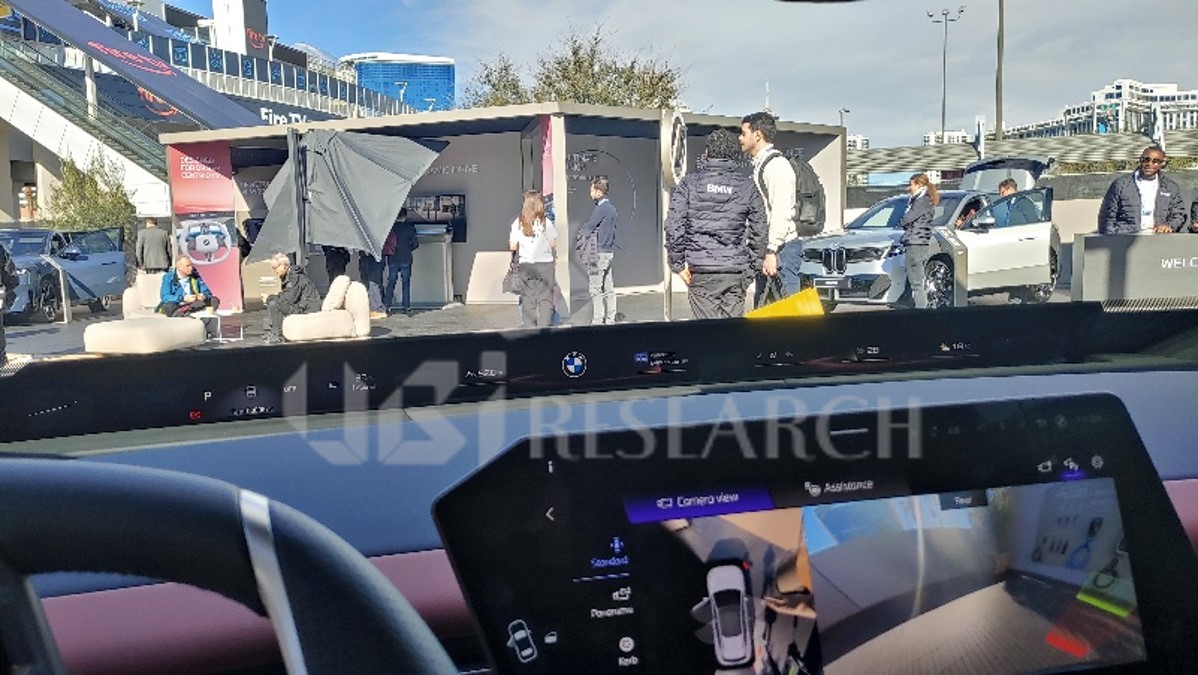
From the automaker perspective, the direction of change was equally clear. BMW presented a panoramic HUD concept for its next-generation iX3, proposing a future HUD architecture that utilizes the entire windshield as an information interface and emphasizing tighter integration between display technology and vehicle design.

BMW iDrive Surround View System and Panoramic HUD concept demonstrated at the booth

BMW’s futuristic Panoramic HUD and iDrive system utilizing the entire windshield as an information interface. (Source: BMW)

Commenting on the automotive display trends observed at CES 2026, Changwook Han, Executive Vice President at UBI Research, stated, “Automotive displays have entered a phase of cockpit platform competition, where form factors, systems, AI, and content converge, rather than remaining a field of individual component competition.” He added, “The advancement toward ultra-large displays, transparency, and sophisticated HUDs will ultimately serve as key indicators of how deeply display makers can engage in shaping the user experience of automakers.”

Changwook Han, Executive Vice President/Analyst at UBI Research (cwhan@ubiresearch.com)

▶2025 Automotive Display Technology and Industry Trends Analysis Report

※ This article is produced by UBIResearchNet.
Unauthorized reproduction or citation without source attribution is prohibited.
When quoting, please clearly indicate the source (UBIResearchNet) and provide a link.

Bar chart illustrating the rapid growth of Mini-LED and OLED in the automotive display market through 2030.

Automotive Display Premiumization Accelerates… Mini-LED and OLED Revenue Share Expected to Exceed 10% in 2026, Expanding Further by 2030

As the adoption of electric vehicles and the transition to software-defined vehicles (SDVs) gain momentum, automotive displays are rapidly being elevated from simple information panels to core components that shape user experience (UX) and enable brand differentiation. Amid this shift, the adoption of Mini-LED—capable of delivering both premium image quality and high readability—is expanding, with clear growth trends emerging across shipment volume and key market indicators.

According to UBI Research’s “2025–2026 Automotive Display Technology and Industry Trend Analysis Update Report,” shipments of automotive Mini-LED displays totaled approximately 4.5 million units in 2024 and are expected to increase to around 6.75 million units in 2025. The key drivers behind this demand are rising requirements for high brightness, enhanced readability, and high contrast, as applications expand to larger center information displays (CIDs), center displays, panoramic displays, and integrated screen configurations.

From a technology perspective, Mini-LED is considered an attractive option for automakers because it maintains an LCD-based structure while enabling premium image quality through local dimming, making it easier to secure both performance and supply stability. As a result, its influence within the market is expected to grow. The revenue share of Mini-LED displays is projected to increase from around 3.0% in 2024 to surpass 10% for the first time in 2026, and to exceed 20% from 2030 onward.

Forecast graph of automotive display shipments by technology (Mini-LED, OLED) from 2023 to 2030 (Source: UBI Research)

Graph showing the growth of the premium automotive display market, with Mini-LED projected to reach 6.75 million and OLED 4.5 million units in 2025. (Source: UBI Research)

In addition to Mini-LED, OLED is also showing strong growth momentum. Automotive OLED display shipments are projected to reach approximately 4.5 million units in 2025, and in the mid- to long-term are expected to form an annual market of around 13 million units by 2030. As a self-emissive technology, OLED delivers deep blacks and high contrast, making it advantageous for enhancing premium UI readability and overall visual quality. In terms of design, adoption is expanding primarily in high-end vehicles. OLED’s revenue share is forecast to exceed 10% in 2026 and expand to approximately 17% by 2030.

Changwook Han, Executive Vice President at UBI Research, stated, “Recently, automakers have been redefining the vehicle interior as a ‘brand experience space,’ and as competition intensifies in premiumization, display specification upgrades are becoming the most direct means of differentiation.” He added, “As demand grows for premium image-quality elements such as high brightness, high contrast, and wide color reproduction, both Mini-LED and OLED are benefiting from expanding adoption. Mini-LED is increasingly adopted for readability and stable mass-production applicability in large-area screens, while OLED is expanding primarily for premium emotional appeal and design differentiation.”

Changwook Han, Executive Vice President/Analyst at UBI Research (cwhan@ubiresearch.com)

▶2025 Automotive Display Technology and Industry Trends Analysis Report

※ This article is produced by UBIResearchNet.
Unauthorized reproduction or citation without source attribution is prohibited.
When quoting, please clearly indicate the source (UBIResearchNet) and provide a link.
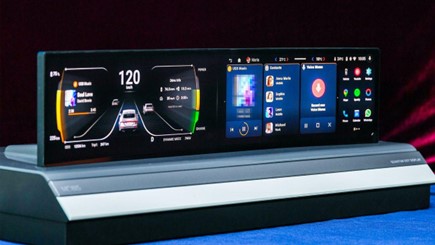
HKC RGB Mini LED automotive dashboard display representing the company's market expansion.

HKC Expands RGB Mini LED to TVs, Monitors, and Automotive Displays

In the Chinese display industry, HKC has long been known as a leading panel manufacturer, fueled by its large-scale LCD-based mass production capabilities. However, its recent move to focus on RGB Mini LED is seen as a strategic shift that transcends its traditional identity. While existing Mini LEDs improved image quality through a combination of blue LED backlights and quantum dot film, HKC has adopted a structure that directly uses red, green, and blue (RGB) LEDs as the backlight source, demonstrating a technological advancement in color reproducibility, contrast control, and operating precision. RGB Mini LED is attracting attention as a next-generation display technology due to its ability to separate and control colors from the backlight stage, resulting in higher color purity and reduced light loss. Its scalability to large-area, high-brightness environments is also remarkable. This technological advancement has first become visible in the ultra-large-screen TV market. HKC has proven its large-area display capabilities by supplying 100-inch and larger RGB Mini LED TV panels to the global TV brand Hisense. In particular, the RGB Mini LED panel used in Hisense’s 116-inch UX series reportedly achieves a peak brightness of approximately 8,000nits, features 3,584 local dimming zones, and achieves color reproduction performance that meets over 95% of the BT.2020 color gamut. Simultaneously achieving high brightness and color uniformity on ultra-large screens is a technically challenging task. HKC is satisfying these requirements with RGB Mini LED, establishing a unique technological edge in the ultra-large TV market.

In the monitor market, the precision control capabilities of RGB Mini LED are expected to be further highlighted. HKC plans to officially announce its next-generation premium monitor lineup based on RGB Mini LED at CES 2026, expanding its large-area TV picture quality technology to high-resolution, high-refresh-rate desktop environments. The 31.4-inch 4K RGB Mini LED monitor, the “M10 Ultra,” is expected to be unveiled at CES 2026. It features a total of 1,596 physical local dimming zones and employs cluster-based operation, individually controlling RGB elements within each zone. This RGB cluster-based control is a key factor in effectively suppressing the halo effect, a problem faced by existing Mini LED monitors. Its performance targets the premium market, with a peak brightness of approximately 1,600nits, a native refresh rate of 165Hz, and up to 330Hz in FHD mode. Color reproduction is also expected to reach 98% to 100% of the BT.2020 standard, making it ideal for gaming environments as well as video editing and professional monitors where color accuracy is crucial.

The automotive display sector is also a key area where HKC is strategically expanding its RGB Mini LED offerings. With the spread of electrification and autonomous driving technologies, in-vehicle displays are becoming larger and more multiplexed. Stable visibility even under direct sunlight and reliability over long periods of use are emerging as key requirements. HKC’s automotive display solution, utilizing RGB Mini LEDs, has reportedly achieved a power consumption reduction of approximately 20% compared to conventional methods while maintaining high brightness of over 1,000nits. In particular, in large-scale integrated display structures that integrate the cluster and CID into a single screen, RGB Mini LEDs are recognized as a technology suitable for next-generation dashboard design due to their ability to easily maintain brightness and color uniformity.

HKC's 12.3-inch RGB Mini LED automotive display prototype

HKC’s 12.3-inch RGB Mini LED display optimized for automotive use with over 1,000 nits brightness and low power consumption. (Source: HKC)

A key enabler of this comprehensive product expansion is large-scale investment in Mini LED and M-LED production infrastructure. HKC is pursuing a dedicated Mini LED production base project worth approximately 9 billion yuan in Liuyang, China, with an annual production capacity of over 500 million Mini LED backlight modules. This production base integrates LED chips, backlight modules, and panel assembly into a single value chain, serving as a strategic base for simultaneously securing cost and supply stability, key challenges for RGB Mini LEDs. Furthermore, through the operation of its direct-view LED factory in Mianyang, HKC is accumulating experience in ultra-fine LED processes and laying the foundation for expansion into next-generation LED-based displays. According to Changwook Han, Executive Vice President of UBI Research, “HKC’s RGB Mini LED strategy is a strong mid- to long-term technology roadmap encompassing TVs, monitors, and automotive displays. Key to this is that it has simultaneously secured the core elements of high brightness, high color reproduction, and precision control, and is expanding these to large-area displays and high-reliability environments. With this, coupled with large-scale investments in Mini LED and M-LED production infrastructure, HKC is establishing a unique position in the next-generation LED-based display ecosystem.”

Changwook Han, Executive Vice President/Analyst at UBI Research (cwhan@ubiresearch.com)

▶2025 Automotive Display Technology and Industry Trends Analysis Report

※ This article is produced by UBIResearchNet.
Unauthorized reproduction or citation without source attribution is prohibited.
When quoting, please clearly indicate the source (UBIResearchNet) and provide a link.
LG Display's advanced automotive OLED technology representing the smart cockpit trends at CES 2026.

Smart Cockpit Competition Accelerates… Automotive Displays to be Showcased at CES 2026

At CES 2026, it became clear that automotive display technology has emerged as a core competitive factor amid the broader transition of vehicles from mere means of transportation to intelligent living spaces. As the shift toward autonomous driving and Software Defined Vehicles (SDVs) accelerates, the amount of information and content required inside vehicles continues to increase. Accordingly, displays are no longer simple screens but have evolved into central technologies that define interior architecture and user experience. At this year’s exhibition, LG Display, Hyundai Mobis, AUO, and Corning each presented distinct technological approaches that together outlined the future direction of the smart cockpit.

LG Display showcased its “Automotive Dual View OLED” and “Automotive UDC (Under Display Camera)-IR OLED” at CES 2026, earning a CES Innovation Award in the In-Vehicle Entertainment category. Dual View OLED enables different content to be viewed simultaneously by the driver and the front passenger on a single panel, providing driving-related information exclusively to the driver while delivering entertainment content to the passenger. This technology is seen as an effective solution to information interference in increasingly large automotive displays, while significantly enhancing cockpit design flexibility. The UDC-IR OLED integrates an infrared camera beneath the display to support driver monitoring systems (DMS) without compromising screen continuity or image quality. Together, OLED’s inherent advantages in contrast and color reproduction, combined with advanced sensor integration, demonstrate a clear direction toward strengthening both in-vehicle entertainment and safety functions.

LG Display's CES 2026 Innovation Award-winning automotive Dual View OLED and UDC-IR OLED technology (Source: LG Display)

LG Display’s CES 2026 Innovation Award-winning automotive Dual View OLED and UDC-IR OLED technology (Source: LG Display)

Hyundai Mobis took center stage at CES 2026 after winning a CES Innovation Award for its holographic windshield display (HWD), integrated into its cockpit integration solution “M.BiCS 7.0.” Developed in collaboration with German optics company ZEISS, the HWD is the world’s first technology to apply a holographic film to the entire windshield, enabling the front glass to function as a large-scale transparent display. While conventional HUD systems face limitations in size, thermal management, and design due to their reflective optical architectures, holographic displays leverage diffractive optics to precisely control light paths, allowing the system to be realized with a compact optical engine of approximately 1.2 liters. In addition, the holographic film maintains a high transparency of over 95%, minimizing visual obstruction while driving, and supports customized eyebox designs that enable different information to be presented independently to the driver and front passenger. This technology is regarded as an effective solution for managing the rapidly increasing information density of the autonomous driving era, while simultaneously maximizing cockpit integration and design coherence.

Demonstration of Hyundai Mobis's CES 2026 Innovation Award-winning Holographic Windshield Display (HWD) (Source: Hyundai Mobis)

Demonstration of Hyundai Mobis’s CES 2026 Innovation Award-winning Holographic Windshield Display (HWD) (Source: Hyundai Mobis)

At CES 2026, AUO officially launched its new subsidiary, AUO Mobility Solutions Corporation (AMSC), declaring its transition beyond displays toward becoming a system-integrated smart cockpit solution provider. AMSC was established through the integration of AUO’s mobility solutions business with the climate control systems and HMI design expertise of Germany-based BHTC GmbH. At the exhibition, AMSC unveiled next-generation smart cockpit solutions that integrate immersive display experiences, intelligent sensing, and scalable computing platforms. By delivering visual elements, computing, and connectivity within a unified architecture, the company aims to realize cockpit environments optimized for software-defined vehicles, a strategy widely interpreted as an effort to strengthen both rapid development cycles and mass-production readiness demanded by OEMs.

In the materials segment, Corning drew attention with its advanced anti-reflective surface treatment technology for automotive displays. As large-format in-vehicle displays continue to expand toward pillar-to-pillar configurations, sunlight-induced reflections have emerged as a major challenge affecting visibility. Corning’s solution dramatically reduces surface reflections while enabling deep black performance, simultaneously enhancing image quality and driving safety. The technology offers high compatibility with a wide range of panel types, including OLED and Mini-LED, and is therefore regarded as a key enabler supporting the broader adoption of next-generation large automotive displays.

The technologies unveiled at CES 2026 collectively demonstrate that automotive displays are evolving beyond individual components into core platforms that integrate space, user experience, and safety. From OLED-driven image quality advancements and holographic displays that redefine interior space, to system-integrated smart cockpit strategies and the material innovations that underpin them, each company is pursuing a distinct approach. Yet all are converging toward a shared objective: delivering new user experiences tailored to the era of intelligent mobility.

Changwook Han, Executive Vice President/Analyst at UBI Research (cwhan@ubiresearch.com)

▶2025 Automotive Display Technology and Industry Trends Analysis Report

※ This article is produced by UBIResearchNet.
Unauthorized reproduction or citation without source attribution is prohibited.
When quoting, please clearly indicate the source (UBIResearchNet) and provide a link.
Ford 1.1m integrated screen showcasing the future of automotive cockpit design with unified cluster and CID.

Ford Unveils 1.1m Integrated Screen… Cluster-CID Integrated Display to Become Popular in Global Vehicles

Minimalism in automotive displays has gained even more traction amidst the shift from traditional physical button-centric control systems to a “digital-based single interface.” According to UBI Research’s “2025 Automotive Display Technology and Industry Trend Analysis Report,” OEMs are actively adopting a structure that integrates the cluster and CID (Center Infotainment Display) under a single cover glass. This reduces visual density within the vehicle interior, avoids complex segmentation of the driver’s field of vision, and allows for flexible UI reconfiguration in response to software updates. This integrated screen not only simplifies the interior horizontally, but also allows key vehicle information to be managed in a single visual layer, making it an interface optimized for electrification and software-defined vehicle (SDV) environments.

The Ford Evos and Mondeo exemplify this trend with a 1.1m-wide integrated screen. This configuration integrates a 12.3-inch digital cluster and a 27-inch 4K CID under a single, ultra-wide cover glass, functioning as a single display. This panel, constructed with a super-flat, wide structure rather than a curved one, enhances the continuity of information transmission and minimizes visual disruption, maximizing the benefits of a software-centric UX. Furthermore, its simplified internal structure significantly improves space efficiency and design stability.

Ford’s 1.1m integrated cluster and CID display (Source: Ford)

Ford’s 1.1m integrated cluster and CID display (Source: Ford)

In the European premium market, the BMW i4 is a prime example of an integrated screen. BMW’s curved display, which has been widely adopted by the i4, iX, 3 Series LCI, and i7, integrates a 12.3-inch digital cluster and a 14.9-inch central display (CID) under a single piece of curved glass. While the internal panels are two-piece, they appear as a single, continuous digital interface from the user’s perspective, and the curvature achieves a driver-centric UI layout. This configuration minimizes physical buttons while ensuring operability and visibility, and is considered a prime example of BMW’s digital UX direction.

BMW Curved Display with integrated cluster and CID (Source: BMW)

BMW Curved Display with integrated cluster and CID (Source: BMW)

Among Korean brands, the Genesis GV80 facelift has adopted a full-fledged integrated screen strategy. The GV80 integrates the instrument cluster and CID under a single 27-inch OLED cover glass, completely breaking away from the traditional standalone instrument panel and central display structure. The OLED panel’s unique contrast ratio and color reproducibility maximize UI readability, and combined with the horizontal, minimalist interior design, it sets a new standard for premium SUV UX.

Genesis GV80 27-inch OLED integrated display (Source: Genesis)

Genesis GV80 27-inch OLED integrated display (Source: Genesis)

While few models currently feature an integrated screen (a structure combining the cluster and CID under a single sheet of cover glass) on the market, its adoption is rapidly accelerating, with major global brands, including Ford, BMW, and Genesis, strategically adopting it. The integrated screen is not simply a design innovation; it serves as a core platform for integrating vehicle functions into a single digital layer and integrating them with a software-centric operating system. As the boundaries between the instrument panel and infotainment system blur and the scope of OTA-based UI reconfiguration expands, the integration of clusters and CIDs is likely to expand beyond luxury vehicles to mid-size electric vehicle lineups.

UBI Research Executive Vice President Changwook Han emphasized, “The integrated screen is a key piece of hardware for realizing the digital UX of the electrification and SDV era. By integrating the cluster and CID into a single visual layer, the entire vehicle interface can be redefined based on software. Its application will gradually expand to the mid-size and mass-market segments.” Ultimately, the integrated screen is positioned as a guiding light for a transformation of the entire vehicle interface architecture, transcending technology and design.

Changwook Han, Executive Vice President/Analyst at UBI Research (cwhan@ubiresearch.com)

▶2025 Automotive Display Technology and Industry Trends Analysis Report

※ This article is produced by UBIResearchNet.
Unauthorized reproduction or citation without source attribution is prohibited.
When quoting, please clearly indicate the source (UBIResearchNet) and provide a link.

Illustration of the Peugeot Polygon Concept Car featuring Micro-LED HUD, front lighting, rear & C-pillar displays (Source: UBI Research)

Peugeot Polygon Concept Car: Micro LED Unlocks the Next-Generation UX Experience

Peugeot has unveiled its new “Polygon” concept car, a model that embodies the brand’s future design direction and signals a major leap forward in next-generation automotive displays. Positioned as a representative model of Peugeot’s post-2027 identity, the Polygon concept blends futuristic design language with production-ready engineering, drawing industry attention as a prototype that goes beyond the typical inspirational show car.

Inside the vehicle, the Polygon concept redefines the traditional in-car interface. The conventional instrument cluster has been removed, and key driving information is projected directly onto the windshield through a Micro LED module positioned behind the Hypersquare® steering controller. The projected display area measures approximately 24 × 74 cm, equivalent to about 31 inches, allowing drivers to view critical information without shifting their gaze-an evolution of AR-based HUD technology.

Micro LED technology is also extensively incorporated into the exterior lighting system. At the front, Peugeot’s signature Three-Claw Lighting design is arranged horizontally and powered by Micro LED to achieve high brightness and high-density illumination. Both the headlights and taillights utilize Micro LED screens capable of rendering dynamic graphics, creating a cohesive visual identity across the vehicle while enabling advanced personalization.

A dedicated Micro LED display is mounted on the rear C-pillar near the charging connector, allowing users to check the vehicle’s charging status without entering the cabin. Despite its small size, the display delivers outstanding visibility and energy efficiency-core strengths of Micro LED-offering both functional value and refined design aesthetics.

Peugeot Polygon Concept Car 31-inch Micro-LED HUD (Source: Peugeot)

31-inch Micro-LED HUD of the Polygon Concept Car (Source: Peugeot)

Peugeot Polygon Concept Car Micro-LED Front Lighting System (Source: Peugeot)

Micro-LED front lighting on the Polygon Concept Car (Source: Peugeot)

Peugeot Polygon Concept Car Micro-LED Rear & C-Pillar Displays (Source: Peugeot)

Rear & C-Pillar Micro-LED displays in the Polygon Concept Car (Source: Peugeot)

Micro LED stands at the center of this transformation. With its high brightness, long-term durability, and programmable graphic capability, the technology is emerging as a key enabler of next-generation automotive lighting and HMI. In particular, transparent PHUDs benefit from Micro LED’s high transparency and ultra-high luminance, ensuring excellent outdoor visibility and robust performance in harsh environments.

Automotive Micro-LED market revenue forecast graph (Source: UBI Research)

Automotive Micro-LED market revenue forecast (Source: UBI Research)

Major panel manufacturers are accelerating their Micro LED strategies in line with this trend. Companies such as AUO, BOE, Tianma, and TCL CSOT are actively showcasing transparent display and PHUD-oriented Micro LED solutions, signaling rapid expansion into the automotive Micro LED market.

According to UBI Research Executive Vice President Changwook Han, “Micro LED is a next-generation display technology optimized for automotive environments through its application to transparent displays and PHUD.” He further noted that “widespread adoption is expected to begin around 2028.” Based on UBI Research’s 2025 Micro-LED Display Industry and Technology Trends Report, the automotive Micro LED display market is forecast to exceed USD 110 million by 2030.

The Polygon concept symbolizes this broader industry shift, demonstrating how Micro LED technology can redefine the future of in-vehicle UX, lighting, and information visualization-positioning Peugeot at the forefront of next-generation automotive display innovation.

Changwook Han, Executive Vice President/Analyst at UBI Research (cwhan@ubiresearch.com)

▶2025 Automotive Display Technology and Industry Trends Analysis Report

▶2025 Micro-LED Display Industry and Technology Trends Report

Chart showing automotive OLED shipments and market shares with Porsche adopting curved OLED displays for premium EV models

Cumulative Automotive OLED Shipments Reach 2.7 Million Units in Q3 – Porsche Adopts Curved OLED in Its Premium EV

The presence of OLED technology in the global automotive display market is expanding rapidly. According to UBI Research’s “Q4 Display Market Tracker,” shipments of automotive OLED displays reached approximately 2.5 million units in 2024, and the cumulative shipments as of Q3 2025 have already totaled around 2.7 million units.

By panel maker, Samsung Display maintained a dominant lead with 1.71 million units (64%), followed by BOE with 570,000 units (21%). LG Display and Ever Display accounted for 220,000 (8%) and 180,000 units (7%), respectively, continuing their expansion in the premium vehicle segment.

Quarterly shipment trends of automotive OLED displays comparing Samsung Display, BOE, LG Display, and EverDisplay (Source: UBI Research)

Quarterly Automotive OLED Display Shipments (Source: UBI Research)

Q1–Q3 2025 Automotive OLED shipment and market share by vendor — Samsung Display 64%, BOE 21%, LG Display 8%, EverDisplay 7% (Source: UBI Research)

Automotive OLED Shipments and Market Share, Q1–Q3 2025 (Source: UBI Research)

The growth of automotive OLED adoption has been driven by premium electric vehicle (EV) manufacturers. A notable example is Porsche’s upcoming Cayenne Electric, scheduled for launch at the end of this year, which will feature a large 42-inch curved OLED display. The display system consists of a 14.25-inch driver cluster, a 12.25-inch center information display (CID), and a 14.9-inch co-driver display (CDD).

The 12.25-inch curved center OLED is expected to be supplied by either LG Display or Samsung Display. Both companies have previously supplied P-OLED (Plastic OLED) curved displays for premium European brands such as Audi and Mercedes-Benz, demonstrating their technological reliability and strong capabilities in curved-panel manufacturing.

In contrast, the cluster and CDD OLED panels are likely to be provided by BOE. The Chinese panel maker began mass-producing OLED instrument clusters in 2024 and has been supplying them to Volkswagen Group, Porsche’s parent company, thereby accelerating its penetration into the global premium OEM supply chain.

OLED technology is increasingly replacing conventional LCD panels, establishing itself as a core enabler for design differentiation and enhanced user experience in premium vehicles. Its self-emissive nature allows for superior contrast ratios, deep blacks, and flexible curved form factors-features particularly valued in electric and luxury cars. Furthermore, OLED displays align well with next-generation Human-Machine Interface (HMI) trends, supporting multi-display layouts, curved user interfaces, and integrated digital cluster designs that enhance both aesthetics and functionality inside vehicles.

Changwook Han, Executive Vice President/Analyst at UBI Research (cwhan@ubiresearch.com)

▶2025 Automotive Display Technology and Industry Trends Analysis Report

▶ Quarterly Small OLED Display Market Tracker Sample

▶Quarterly Medium & Large OLED Display Market Tracker Sample

Hyundai Mobis rollable OLED display technology for Genesis GV90

The GV90’s Vehicle HMI Evolves with Rollable OLED

The luxury car market is emerging as a new stage for display innovation. Rollable OLED displays are gaining attention as a key technology for achieving both minimalism and cutting-edge sensibilities in vehicle interiors, and major manufacturers such as Hyundai Mobis and Forvia are competing to apply this technology to luxury vehicles.

In China, this technology has already become a reality. Hongqi’s ultra-luxury sedan, the Guoya (aka Hongqi L1), features a 14.2-inch rollable OLED display developed by Visionox. This display is designed to be stored within the dashboard and unfolds upward when needed. When off, it is completely hidden, maximizing the sense of integration within the interior. While driving, it displays limited information, but when stationary, it expands to display navigation and entertainment functions full-screen. The Hongqi Guoya is an ultra-luxury sedan priced at approximately 1.4 million to 1.86 million yuan (approximately 250 million won), serving as a Chinese flagship model competing with the Mercedes-Maybach and Bentley Flying Spur. The inclusion of a rollable OLED display in this vehicle goes beyond a simple luxury strategy and is interpreted as an attempt by the Chinese automaker to secure technological leadership in the premium market through advanced display technology.

Similar trends are being detected in Korea. Hyundai Mobis filed a patent (US12422892B2) in 2021 for a “rollable display for vehicles,” which features a structure that allows the OLED panel to be rolled up or unfolded around a rotating roller within the housing. According to the patent, horizontal and vertical supports are arranged on the back of the display panel to prevent panel deformation due to vibration or touch pressure while driving. It also includes a wing-shaped support structure that ensures the entire panel remains flat when unfolded. In other words, it’s not simply a “rollable” technology that simply rolls up, but a structural design that ensures stable visibility and rigidity even in driving conditions.

Rollable OLED display structure for vehicles based on US12422892B2 patent

Rollable OLED Display Architecture (US12422892B2) (Source: Hyundai Mobis)

Hyundai Mobis unveiled an actual rollable OLED prototype based on this patented technology at CES 2024. The product can be expanded up to 30 inches and the screen can be adjusted to 1/3, 2/3, and full modes. When the ignition is turned off, it completely retracts and disappears into the dashboard, and its structure shows the screen only when needed, suggesting the concept of “the most luxurious display when it is invisible.” The installation space is only about 12 cm, allowing for a high degree of freedom in interior design, and it has achieved automotive QHD (2560×1440) picture quality. Hyundai Mobis is preparing for mass production, and Samsung Display and LG Display are known to be competing to supply the panels.

Hyundai Mobis rollable OLED display prototype for vehicles

Hyundai Mobis rollable OLED display prototype for vehicles (Source: Hyundai Mobis)

The Genesis GV90 is being considered as a potential application for this technology. Hyundai Motor Group’s flagship electric SUV, the GV90, is attracting industry attention as a model likely to feature a rollable OLED display. Genesis’s reasons for considering a rollable display are clear. First, it aims to create a minimalist and luxurious interior by displaying digitalized driving information only when needed. Second, it has a functional purpose: the large screen can adjust its viewing area to avoid obstructing the driver’s view while driving. Third, it serves as a technological differentiation strategy to compete with global luxury brands. Being the world’s first “luxury SUV equipped with rollable OLED” could help Genesis narrow the gap with premium electrified models like the Mercedes-Benz EQS SUV and BMW iX.

Industry experts don’t view this trend as a simple design change. UBI Research Executive Vice President Changwook Han analyzed, “The application of rollable OLED to vehicles is not just a simple display innovation, but a technological evolution that will reorganize the paradigm of space design and user interface (UI).” He added, “The transition from large fixed screens to variable displays will emerge as an important option for premium vehicle interiors in the future.”

Changwook Han, Executive Vice President/Analyst at UBI Research (cwhan@ubiresearch.com)

▶2025 Automotive Display Technology and Industry Trends Analysis Report

Automotive OLED display shipment forecast from 2023 to 2030, highlighting Mini LED, OLED, and Micro-LED trends (Source: UBI Research)

Automotive OLED displays to ship 3.8 million units this year, with growth expected to accelerate after 2030.

The automotive OLED display market is expected to ship approximately 3.8 million units this year, with a projected compound annual growth rate (CAGR) of 24% through 2030. However, true growth is likely to begin after that point. While OLED has proven its technological prowess in the smartphone and TV markets, it is only just beginning to gain traction in automotive displays.

Automotive display shipment forecast 2023–2030, comparing Mini LED, OLED, and Micro-LED (Source: UBI Research)

Forecast of automotive display shipments by technology (2023–2030): Mini LED, OLED, Micro-LED (Source: UBI Research)

The strengths of automotive OLEDs are clear. Superior visual quality is cited as the most significant advantage. Deep black expression, low reflectivity, and superior color reproducibility improve visibility during driving. Furthermore, the recently highlighted tandem OLED structure significantly extends lifespan and ensures stable reliability even in high-temperature environments, making it ideal for automotive displays that require long-term use. Furthermore, flexible designs such as curved, foldable, slideable, and rollable panels allow for differentiated automotive interiors. This allows premium brands to strengthen their identity through OLED adoption. With major companies such as Samsung Display (SDC), BOE, Visionox, and TCL CSOT investing in 8th-generation OLED lines, production base expansion is also expected.

Current status of automotive OLED display adoption by major carmakers and models (Source: UBI Research)

Current adoption of automotive OLED displays – by carmaker and model (Source: UBI Research)

However, there are many challenges to overcome. Pricing is the biggest barrier. Currently, OLEDs are several times more expensive than LCDs, hindering mass adoption. The supply chain is also limited. Relying on a small number of companies, including LG Display, Samsung Display, and BOE makes securing a stable supply difficult. Furthermore, OLEDs only fully entered the automotive market around 2020, and sufficient long-term usage data has yet to be collected. Automotive displays must operate reliably for 10 to 15 years in harsh environments, making durability verification essential.

Due to these limitations, automakers are strategically gradually expanding OLED adoption. They are primarily being used in premium electric vehicles and flagship models, with widespread adoption likely after 2030. While limited growth is expected until 2030, a full-scale leap forward is expected thereafter, driven by cost reductions, the establishment of mass production systems, and the accumulation of reliability data. If OLED can deliver differentiated value in the automotive display market, growth rates beyond 2030 are likely to exceed current projections.

Changwook Han, Executive Vice President/Analyst at UBI Research (cwhan@ubiresearch.com)

▶2025 Automotive Display Technology and Industry Trends Analysis Report

Samsung Display unveils new automotive OLED brand DRIVE™ with digital cockpit at IAA Mobility 2025

Samsung Display Unveils New Automotive OLED Brand, ‘DRIVE™’ at IAA Mobility 2025

Samsung Display’s OLED digital cockpit concept showcased at IAA Mobility 2025 (Source: Samsung Display)

Samsung Display unveils digital cockpit for future vehicles at IAA Mobility 2025 (Source: Samsung Display)

Samsung Display unveiled its next-generation automotive OLED technology and its new automotive OLED brand, “DRIVE™,” at IAA Mobility 2025, the world’s largest mobility exhibition held in Munich, Germany. As the only global panel manufacturer to participate, Samsung Display used this exhibition to accelerate its strategy to expand into the automotive display market, highlighting the design flexibility and differentiated image quality of its automotive OLED displays. Samsung Display unveiled a digital cockpit that incorporates OLED across all touchpoints for both driver and passengers. The driver’s seat features a 10.25-inch moving OLED cluster, an innovative design that functions as a dashboard during driving and hides beneath the dashboard when parked. A large 34-inch OLED display is positioned in front of the passenger seat. 14.5-inch and 13.8-inch OLED panels can be combined using multi-lamination technology to form a single large screen or two independent displays. Samsung Display’s “Flex Magic Pixel” technology blocks passenger content from the driver’s seat, enhancing driving safety. A 14.4-inch L-shaped flexible OLED panel is featured in the center fascia, allowing intuitive control of vehicle settings and the air conditioning system. A 9.4-inch circular OLED for rear-seat passengers and a 30-inch rooftop display were also unveiled, demonstrating OLED solutions that encompass the entire interior of the vehicle.

Samsung Display unveiled its first rigid OLED-based Off-The-Shelf (OTS) solution at this exhibition. With a total of seven standardized product lines ranging from 7 inches to 17 inches, the company aims to enable customers to quickly implement desired sizes, reducing development costs and time while also securing price competitiveness. Samsung Display also demonstrated its ability to meet the demand for large-screen displays in automobiles by demonstrating multi-lamination technology, which combines multiple OLED panels to create a single, large screen. Under the theme of “Upgrade to OLED,” Samsung Display highlighted the advantages of OLED over mini LED. The company showcased a rectangular mini LED cluster, a curved OLED cluster that can be molded into a curve, and a curved OLED cluster that maximizes immersion, highlighting design freedom. Visitors were also able to experience firsthand the display’s image quality advantages, such as true black, high contrast, and excellent outdoor visibility, essential for safe driving.

Samsung Display also unveiled a concept design for a future vehicle, created in collaboration with French designer Alban Lehaye. Using rollable, foldable, and stretchable OLEDs, the company proposed a V-shaped outfolding roof display, an extendable CID, and a flexible L-shaped panel, emphasizing the infinite expandability of OLED. A highlight of the exhibition was the debut of its new automotive OLED brand, “DRIVE™,” which embodies Samsung Display’s five core values: design differentiation, robust reliability, intelligent safety, visual excellence, and expandability. Lee Ju-hyung, Executive Vice President and Head of the Small and Medium Business Division at Samsung Display, stated, “OLED is a display optimized for the digital platform of the Software Defined Vehicle (SDV) era. Together with global customers, we will promote the differentiated value of automotive OLEDs through the DRIVE™ brand and strengthen our market leadership.”

Samsung Display recently signed a contract with Mercedes-Benz to exclusively supply automotive AMOLEDs for the 2028 Maybach S-Class. Negotiations are also reportedly underway with global electric vehicle manufacturers such as Tesla and BYD. Samsung Display’s automotive OLED shipments are projected to reach approximately 1.17 million units in the first half of 2025, and the IAA Mobility 2025 exhibition is expected to accelerate its global market share expansion.

Changwook Han, Executive Vice President/Analyst at UBI Research (cwhan@ubiresearch.com)

▶2025 Automotive Display Technology and Industry Trends Analysis Report

Sony Honda Mobility to integrate Micro LED media bar into Afeela EV in 2026

Sony Honda Mobility to Implement Micro-LED Media Bar in Afeela by 2026… New Revenue Strategy Combining Subscription Models

Sony Honda Mobility (SHM) will be incorporating a micro-LED-based Media Bar into its Afeela electric vehicle, slated for release in 2026. The Media Bar, a display mounted on the front of the vehicle, can display a variety of information, including charging status, weather, welcome messages, and driving modes. It also offers customized communication features through animations and themes. It is considered a new experiment in the automotive industry, as it goes beyond a simple instrument panel or infotainment screen to visually express the vehicle’s “emotions and personality.”

Micro-LED media bar on the front of Sony Honda Mobility’s Afeela EV (Source: Sony Honda Mobility)

Afeela EV front view with Micro-LED media bar (Source: Sony Honda Mobility)

The problem lies in manufacturing costs. Currently, the production cost of micro-LEDs is nearly ten times higher than the automotive industry’s expectations. Even smartwatches and ultra-small displays are still prohibitively expensive to commercialize, and modules in the tens of inches required for vehicle fronts are even more expensive. Nevertheless, SHM’s decision to adopt micro-LEDs for the Afleea stems from strategic considerations. First, micro-LEDs are superior to conventional OLEDs and LCDs in terms of high brightness, durability, transparency, and design flexibility. They can deliver clear information even in outdoor driving conditions, and their long lifespan makes them ideal for exterior vehicle displays. The technological symbolism is also significant. By combining Sony’s display technology with Honda’s automotive brand image, the company aims to position the Afleea as a differentiated premium electric vehicle.

A more fundamental reason lies in its connection to the software subscription business. The automotive industry has recently evolved into a software-defined vehicle (SDV), offering driver assistance systems, infotainment, navigation, and connectivity features on a subscription basis. BMW, GM, Ford, and Tesla are already building new revenue models by converting some features to monthly subscriptions, and the global market is experiencing double-digit annual growth. SHM also plans to offer Afleea’s infotainment and driver assistance software as a subscription service, and by linking it with Media Bar, it aims to offer a differentiated subscription experience.

For example, Media Bar themes and animations can be expanded beyond basic functionality through a premium subscription model. Seasonal themes, brand-affiliated content, personalized designs, and social network integrations offer ongoing value for users. As the vehicle’s exterior itself becomes a means of communication, a new revenue model of “vehicle software subscription + Media Bar content subscription” becomes possible. This structure can offset the initial burden of implementing expensive micro-LEDs in the long term. In other words, it goes beyond hardware investment and enables ongoing service revenue generation based on this technology.

While the automotive industry has historically generated most of its revenue at the time of vehicle sales, the convergence of hardware, software, and services will become key in generating long-term revenue. SHM’s bold adoption of a micro-LED media bar in the Afleea is not simply a show of technology, but rather a strategic move to secure a new business model combined with software subscriptions. It reflects their confidence that, despite the high hardware investment and risk involved, they can secure profitability in the long term by combining it with subscription services.

When the Afleea hits the market in 2026, consumers will not simply be presented with an electric vehicle, but a new mobility platform offering a personalized, subscription-based display experience. This is likely to serve as a key benchmark for other automakers. It remains to be seen whether SHM’s decision will catalyze the expansion of subscription models in the automotive industry, despite the high cost structure.

Changwook Han, Executive Vice President/Analyst at UBI Research (cwhan@ubiresearch.com)

▶2025 Automotive Display Technology and Industry Trends Analysis Report

ams OSRAM unveils ALIYOS prototype interior display at Detroit exhibition

ams OSRAM unveils ALIYOS™ prototype at Detroit trade show, highlighting new potential applications for automotive interior displays

ams OSRAM, a global leader in automotive lighting and optical semiconductors, has recently expanded its scope beyond simple light source supply to include automotive interior displays and smart surface solutions. The company unveiled its next-generation interior display concept, ALIYOS™ technology, and showcased a prototype at the Vehicle Display Interface exhibition and conference held in Detroit, USA, on September 9th and 10th.

ms OSRAM’s ALIYOS™ demonstrator with multiple foil designs and integration methods (Source: ams OSRAM)

ams OSRAM ALIYOS™ interior display prototype (Source: ams OSRAM)

ALIYOS™ is an ultra-thin LED-on-foil technology that integrates Mini LEDs onto a transparent, flexible foil. This new display solution enables the display of hidden icons and symbols behind a variety of automotive interior materials. In this demonstration, a 256-segment matrix was placed behind a wood panel to display information, such as communication icons. The bright, clear symbols, while still retaining the wood grain and texture, blended seamlessly with the wood interior. When applied behind fabric, the light diffusion was more uniform than that of wood, allowing the icons to be displayed evenly. With a luminance of approximately 250 cd/m², the system demonstrated sufficient visibility even in a vehicle environment. Furthermore, function icons, such as the start button and warning signs, were hidden behind the same wood, demonstrating the potential for a premium interface that only appears when needed.

One of ALIYOS™’s most notable features is its display expansion capability, which seamlessly connects high-resolution LCD content with a low-resolution LED matrix by placing the foil matrix next to a conventional LCD screen. This method simultaneously achieves a black panel effect and brightness efficiency through seamless, borderless transitions. Furthermore, it allows for overlapping different symbols in the same location, or even multi-color and animation effects, providing an interface that responds instantly to changing situations. When applied to transparent areas, it creates a floating visual effect, and it can also be manufactured as a thin, standalone HMI module, maximizing freedom in vehicle interior design.

ams OSRAM’s display of this prototype goes beyond simply demonstrating the technology. It’s a strategic move to demonstrate to automakers and tier 1 suppliers the practical feasibility of its technology and demonstrate its ability to address design trends such as black panels, hidden-until-lit interfaces, and integration with natural materials—all of which are difficult to achieve with existing display technologies. Through this initiative, ams OSRAM demonstrates its commitment to becoming a key partner in automotive interior displays, extending beyond its role as an optical semiconductor company.

Changwook Han, Executive Vice President/Analyst at UBI Research (cwhan@ubiresearch.com)

▶2025 Automotive Display Technology and Industry Trends Analysis Report

Automotive Mini LED display adoption expanding with OLED competition

Expanding the application area of Mini LED for vehicle displays

The automotive display market has been rapidly changing in recent years, and Mini LED technology is at the center of this transformation. While some premium brands are embracing OLED for its design freedom and black expression, the overall trend is leaning toward Mini LED, which boasts price competitiveness, durability, and high brightness. Automotive environments require visibility even under direct sunlight and stability under extended use and high temperatures. Mini LED’s long lifespan and high reliability make it ideal for manufacturers to incorporate into mass-produced models.

Automotive display shipment forecast by technology – Mini LED vs OLED (Source: UBI Research)

Automotive display shipment forecast by technology (Source: UBI Research)

According to the “Automotive Display Technology and Industry Trend Analysis Report” published by UBI Research this year, shipments of Mini LED displays for vehicles are expected to increase significantly, from approximately 1.5 million units in 2023 to over 16 million units in 2030. During the same period, OLED is expected to maintain stable growth and provide differentiated value, particularly for premium brands. This suggests that OLED will establish itself as a premium, brand differentiation, and high-end image, while Mini LED, armed with stability and cost-effectiveness, will expand to mass-market models in the mid- to high-end segment.

List of automotive display models applying Mini LED technology (Source: UBI Research)

Automotive models with Mini LED display applications (Source: UBI Research)

For example, Cadillac will equip its 2022 electric SUV Lyriq with a 33-inch Mini LED display, and Lincoln will apply a 48-inch panoramic structure (23.6-inch dual 4K UHD Mini LED) to its new Navigator in 2023. The 2024 Xiaomi SU7 will introduce a 16.1-inch Mini LED CID, and the Sony-Honda joint venture Afeela, scheduled for release in 2026, will feature a 45-inch panoramic display and a 55-inch auxiliary display, suggesting the direction of next-generation electric vehicle interiors.

UBI Research Executive Vice President Changwook Han predicted, “In the automotive display market, Mini LED and OLED will continue to compete in some areas, but at the same time, Mini LED will expand its application to the general public, while OLED will maintain differentiated value in the premium segment.”

Changwook Han, Executive Vice President/Analyst at UBI Research (cwhan@ubiresearch.com)

▶2025 Automotive Display Technology and Industry Trends Analysis Report

The Evolution of Automotive Displays: OLED Leading the Premium Market

As digitalization accelerates in the automotive industry, the sophistication of in-vehicle displays is accelerating. OLED displays, in particular, are rapidly being adopted, particularly in premium vehicles, due to their superior image quality and flexible design possibilities.

The first automotive application of OLED displays was the instrument clusters of the 2016 Audi TT RS and Q7. These vehicles featured OLED panels supplied by Samsung Display, leading to the early commercialization of digital clusters. Following this, the 2017 Cadillac Escala concept car featured LG Display’s curved OLED display in its instrument cluster, demonstrating the potential of OLED in luxury vehicles.

OLEDs were first commercialized in the central information display (CID) with the 2021 Mercedes-Benz S-Class. This vehicle features a 12.8-inch vertical OLED touchscreen, which integrates with haptic feedback and Mercedes-Benz’s next-generation infotainment system, MBUX 2nd Generation, significantly enhancing the passenger experience. The 2022 EQS and EQS SUV will then see the introduction of the ‘MBUX Hyperscreen’, which integrates a 17.7-inch central OLED and a 12.3-inch passenger OLED under a curved glass panel.

Mercedes-Benz S-Class (12.8-inch OLED CID)

Mercedes-Benz S-Class (12.8-inch OLED CID)

MBUX Hyperscreen (17.7-inch OLED CID, 12.3-inch OLED CDD)

MBUX Hyperscreen (17.7-inch OLED CID, 12.3-inch OLED CDD)

Amidst this trend, LG Display was the first company to establish a mass production system for automotive OLEDs, steadily supplying OLED panels to various brands, including Mercedes-Benz. Notably, LGD has established itself as a key partner for Mercedes-Benz, leading the premium display market for its electric vehicle lineup, including the EQS and EQE.

Meanwhile, Samsung Display is actively expanding its supply of next-generation automotive OLED panels. Specifically, it plans to supply a 48-inch “pillar-to-pillar” OLED display for the 2028 Mercedes-Maybach S-Class, as well as future CLA, SL, and electric vehicle lineups. This display, with its integrated structure spanning the entire front of the vehicle, is attracting attention for its ability to deliver both immersive and design perfection.

Despite the high cost and limited supplier base compared to LCD, OLED is becoming a key element in providing differentiated user experiences and strengthening brand identity for luxury brands such as Mercedes-Benz, BMW, Genesis, Lucid, and BYD. “Automotive OLED panel shipments are expected to reach approximately 3 million units in 2025, and by 2030, they are expected to exceed 6 million units, accounting for 14.4% of the total automotive display market in terms of value,” said Changwook Han, Executive Vice President of UBI Research. “This demonstrates that in-car displays are evolving beyond a simple means of conveying information to become the center of UX that provides emotion and immersion.”

Changwook HAN, Executive Vice President/Analyst at UBI Research (cwhan@ubiresearch.com)

▶2025 Automotive Display Technology and Industry Trends Analysis Report

The Future of Panoramic HUDs, Led by Micro-LED

As in-vehicle display technologies continue to evolve rapidly, the head-up display (HUD), which projects various types of information into the driver’s forward field of view, is becoming an essential interface in modern vehicles. Recently, Panoramic HUDs (PHUDs) capable of displaying not only speed and navigation data but also augmented reality (AR) content have emerged, showcasing significant technological advancement. At the core of this evolution is Micro-LED technology, which is gaining traction as the key enabler of PHUDs.

PHUDs project information across the entire or a substantial portion of the windshield, requiring a wide field of view, high resolution, and high brightness. Currently, the most commercially viable implementation is the black strip reflection method. This approach utilizes the lower black band area of the windshield as a reflective surface, allowing for a simpler optical system and lower production costs—making it an attractive option for many automakers. However, to avoid obstructing the driver’s view, the image projection height is limited, typically restricted to a narrow vertical range of approximately 3 to 6 cm.

BMW Panoramic Vision

BMW Panoramic Vision

For a more immersive and premium experience, some high-end vehicles adopt a transparent reflection method. This involves embedding multilayer optical films or applying special structures within the windshield, allowing images to be reflected even in transparent areas without the need for a black band. While this method offers advantages in immersion and design, it poses significant challenges in optical complexity, higher costs, and low reflectivity—necessitating the use of ultra-bright displays.

Micro-LED provides a compelling solution to these structural and technological challenges. Thanks to its self-emissive pixel structure, Micro-LED can achieve brightness levels exceeding 1,000 nits, with ultra-high brightness capabilities reaching 30,000 to 50,000 nits—all while maintaining excellent power efficiency.

At SID 2025, major display companies such as AUO, BOE, and CSOT unveiled a range of Micro-LED-based PHUD prototypes. BOE showcased a 6.2-inch Micro-LED HUD with sub-0.2mm pixel pitch and 30,000 nits peak brightness (15,000 nits perceived brightness). CSOT presented a large 14.3-inch PHUD featuring 45,000 nits peak brightness (12,000 nits perceived brightness) and a wide viewing angle, while AUO demonstrated a 13-inch high-brightness PHUD with 12,000 nits of perceived brightness.

AUO 13” PHUD (12,000nits)

AUO 13” PHUD (12,000nits)

BOE 6.2” PHUD (15,000nits)

BOE 6.2” PHUD (15,000nits)

TCL CSOT 14.3” PHUD (12,000nits)

TCL CSOT 14.3” PHUD (12,000nits)

Micro-LED is not merely enhancing display performance—it is fundamentally transforming the structure and implementation of Panoramic HUDs. It overcomes the limitations of restricted reflection areas, enables the projection of high-brightness, high-resolution images onto various curved windshields, and meets the demands for transparency and design flexibility. As the commercialization of PHUDs becomes a reality, Micro-LED stands at the center of this transformation. The future of automotive vision and interface will unfold on Micro-LED.

Changwook HAN, Executive Vice President/Analyst at UBI Research (cwhan@ubiresearch.com)

▶2025 Automotive Display Technology and Industry Trends Analysis Report

Moving forward with ultra-large vehicle displays

Not only are vehicle displays increasing in size and number, but pillar-to-pillar displays, which integrate multiple displays on the dashboard into a single screen, have recently been applied to automobiles. Pillar-to-pillar displays have the advantage of enhancing the competitiveness of premium automobile brands through simple and stylish interiors, and allowing users to enjoy movies and games in the car through large screens. The Geely Galaxy E8 EV, launched last year, is equipped with a 45-inch pillar-to-pillar display. The display is a panel with amorphous silicon TFTs and Mini-LEDs and was supplied by BOE.

Sony Honda Mobility’s upcoming 2026 electric vehicle, AFEELA, will feature a 40-inch pillar-to-pillar display. The 40-inch pillar-to-pillar display panel with LTPS TFT and Mini-LEDs is provided by LG Display.

(Source: LG Display)

(Source: LG Display)

TPS TFTs have the advantage of faster mobility than amorphous silicon TFTs, making it easier to create high-resolution, high-brightness panels and reducing the black border, known as the bezel. And Mini-LEDs that utilize localized dimming are more expensive as the number of chips increases, but they offer OLED-like image quality with higher contrast and reduced thickness, which is important for external viewability.

“The share of LTPS TFTs in automotive displays was 34.7% in 2024 by revenue and will grow to 52.3% by 2030,” said Chang Wook Han, principal analyst at UBI Research. “The share of Mini-LEDs in automotive displays was 6.4% in 2024 and will increase to 29.1% by 2030,” said Han.

Chang Wook HAN, UBI Research Analyst(cwhan@ubiresearch.com)

▶2025 Automotive Display Technology and Industry Trends Analysis Report Sample

OLED panel for automotive display to be applied from 2018/The core issue is for its life-time extension.

OLED panels are expected to be used in automotive displays joining to mobile devices and TVs.

It clearly revealed that the flexible OLEDs are becoming the flagship product for automotive display in CES2017 through the Chrysler’s conference as pre-event. (website: http://www.olednet.com/en/ces2017-media-day-chrysler-potal/)

According to the “Automotive Display Report – Application & Market Trend Analysis and the Market Forecast” published by Ubi Research, OLED panels are expected to be applied to automotive cluster and CID in earnest from 2018. It will be applied to premium cars first under flexibility and superiority of image quality.

Car manufacturers are attempting to differentiate themselves with the concepts of environmentally friendly, connected, smart, and autonomous driving, and thus the interface inside the vehicle is also changing. There might be a limit to the existing analogue methods since various information must be transmitted and processed especially, as developed connected, smart car, and autonomous vehicle.

Therefore, the role of display in automobiles is becoming increasingly important and the area of display is gradually widening. Especially, since the cluster and CID have many curved surfaces, it is difficult to apply a square display to a large area and accordingly, the importance of a flexible display is emphasized.

The automobile manufacturers show great interest to the AMOLED panel since it can provide high visibility to the drivers and it is flexible and applicable to any part of the automobile based on its fast response speed, wide viewing angle, high color reproduction rate and contrast range. It is under joint development with major panel makers.

However, there is a problem that the lifetime of the AMOLED panel is still insufficient for application to automobiles. According to the analyzing report, the lifetime of the AMOLED panel has met about 50% as compared to the requirements for the car display. The most important issue is securing lifetime for the AMOLED panel usage.

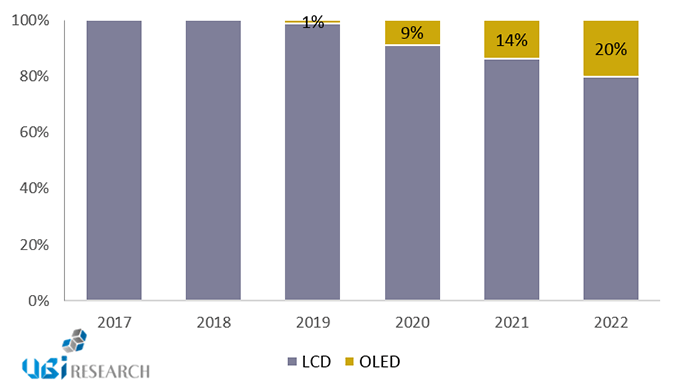
According to the report also, the automotive display market will grow at an annual average of about 17%, reaching US $ 25,000 million by 2022, and it forecasted that the AMOLED panel market will account for about 20%.

<Automotive display market share forecasting in 2017-2022>

Visualization of display for mirror-less automobiles, Green light to OLED display

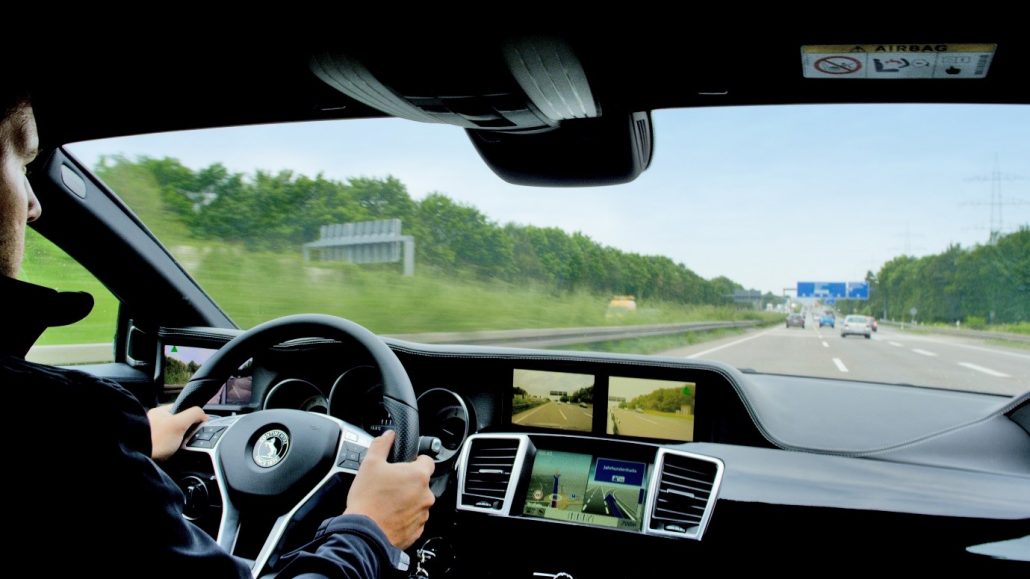
After Ministry of Land, Infrastructure and Transport did pre-announcement of legislation about partial revised plan of ‘Regulations on the performance and standards of automobiles and auto parts’ on the 7th, interests in ‘mirror-less automobiles’ having not side mirror (rearview mirror) are getting hot. This is a method of securing eyesight through display screen in the car after installing subminiature camera to car front and rear and also front doors of both sides, and solving blind zone problem which was the defect of existing side mirror and improving fuel efficiency and designs are expected, even though there are problems on functional errors and design development.

Thus, display for mirror-less automobiles is getting attentions as a drive of new market in display market for automobiles. Display fields for automobiles belongs to the industry to which creating high added value is expected because further customization is required compared to mobile and TV. So LGD or SDC panel enterprises are developing products for market penetration, and two companies are known as setting up policy of progressing differentiating strategies differently from Taiwan, Japanese companies by focusing on Flexible OLED especially.

Flexible OLED has thin, light characteristics and a nature to be able to bend, so it is favorable to mirror-less automobiles requiring new designs from free installing aspects. Also, mirror-less is being evaluated to be suitable to the display for automobiles because it can implement high visibility with very fast speed, contrast range, and wide viewing angle. On July 1st last year, Continental Corporation, auto parts supplier, revealed the possibility of better eyesight provision even in dark situations or the rain while introducing several merits of mirror-less automobiles to which 2 OLEDs were applied through its homepage. In addition, Alfred Eckert, Director of the Advanced Engineering department in Continental’s Chassis & Safety Division mentioned “The effects of unwanted optical phenomena such as glare and weak light can also be compensated”

<Mirror-less concept car to which 2 OLEDs were applied> (Source: www.continental-corporation.com)

Samsung Electronics is recently propelling automobile electric apparatus business in earnest by taking over Harman, US automobile electric company, and the industry foresees that competency of Samsung Electronics’ OLED and semiconductor would make great synergy effect to electric apparatus business. Furthermore, they lighted up goals such like securing world 30% market share in display for automobiles based on OLED display in 2018, and achieving 2 trillion won in sales.

In this way, OLED display is expected to play core roles in expanding business to electric field industry from electronic/display industry, and it is anticipated that OLED could be a new dynamic to growth of display industry.

Absolute Requirements for the Automotive OLED Display’s Success

On October 15, in IMID Exhibition Business Forum held in Korea International Exhibition Center (October 14-16), KATECH (Korea Automotive Technology Institute)’s head of Intelligent Control System R&D Center Dr. Inbeom Yang presented ‘Future of Automotive Technology and the Role of Smart Display’ and forecast the future of automotive display.


Dr. Yang revealed that “if existing vehicles focused on technological factors, future vehicles will evolve entirely centering on the driver, and the automotive display also will develop following this trend”. He also added that the driver’s safety and convenience have to be the priority.


Dr. Yang gave 4 examples of future automotive display. Firstly, he discussed ADAS and their flaws. ADAS (Advanced Driver Assistance Systems) help the driver to operate the vehicle safely. If ADAS can be actualized through displays such as HUD (head-up display), the driver’s safety can be maintained with ease.


The second item mentioned was a function that notifies the driver status reports linked with time and location. Dr. Yang reported that a device needs to be developed that can function in specific situations with sensors and sounds as well as on display.


Dr. Yang forecast that if display, touch technology, and haptic technology are combined and applied to vehicles, operation and feedback will be simpler for the driver. He announced that multi-functional & configuration display will also be introduced which will allow driver to recognize and control.


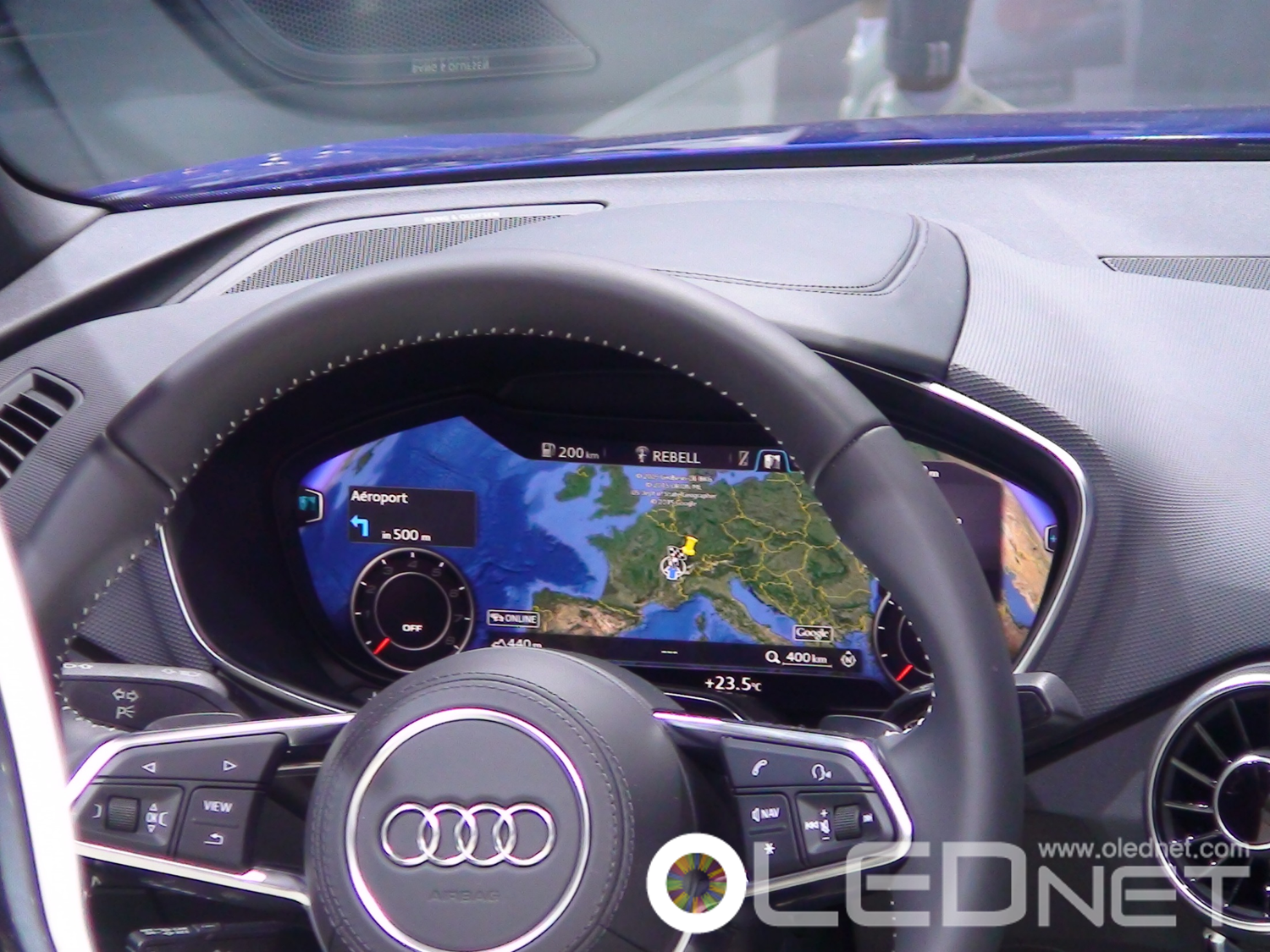
Audi’s concept vehicle that was presented in IAA 2015 Audi e-tron quattro has full OLED interface and all functions required for the vehicle operation can be controlled via touch display without physical buttons.


As futuristic displays such as these are developed that increases driver’s convenience, the proportion of display within a vehicle is expected to increase, and developed focusing on the driver centered UI (user interface). OLED Display can maximize the driver’s accuracy with fast response rate and high contrast ratio. Along with safety, and design freedom that comes with flexibility, it is suitable for automotive display. However, the linkage with the UI system optimized for the driver is essential rather than performance of the display panel itself; collaboration between display panel companies, and automotive system and peripheral companies is expected to be a major point in early market occupancy between automotive display panel companies.

Audi Q7 3.0 TDI quattro ,Geneva International Motor Show