Posts

Photolithography-based OLED processes: Challenges and opportunities for next-generation display innovation

MAX OLED™ from Applied Materials

Patterning process with MAX OLED™ from Applied Materials

OLED technology has become the centerpiece of smartphone displays due to its superior image quality and flexibility. The fine metal mask (FMM) process is currently the dominant technology for patterning RGB subpixels in small and medium-sized OLED displays, such as smartphones.

However, conventional FMM methods suffer from limited aperture (around 30%), uneven brightness due to increased electrical resistance, and high production costs. Due to the sensitivity of OLED materials, photolithographic patterning, which was considered as an alternative to FMM, has also been difficult to commercialize due to concerns about OLED damage during the process.

Applied Materials presented its MAX OLED™ process technology at the SID 2025 conference. MAX OLED™ utilizes a proprietary pixel architecture and a novel process to capitalize on the advantages of conventional photolithography while compensating for the sensitivity of OLED materials. In particular, the sensitive organic layer is protected by thin film encapsulation (TFE) immediately after OLED deposition, which enables multiple complex photolithography and etching processes.

The MAX OLED™ process doubles the aperture ratio compared to FMM, significantly improving pixel brightness, resolution, and display lifetime. In addition, the localized cathode contact structure solves the problem of increased electrical resistance and reduces power consumption by 33% for notebook PC displays and 47% for monitor displays. High resolutions of up to 2,000 ppi are possible, and individual optimization of each RGB color OLED stack is also possible.

From an economic perspective, MAX OLED™ also makes a positive difference. It shortens new product development cycles by significantly reducing photomask lead times and lowering costs compared to FMM. It also increases glass utilization through multi-product in a mother glass (MMG), which is widely applied in LCD processes, and contributes to material cost reduction by approximately doubling OLED material utilization with short source-to-substrate distances.

Visionox recently announced that it is investigating a maskless process (ViP, Visionox intelligent Pixelization) using its MAX OLED™ process to produce 8th generation OLEDs. While Visionox’s announcement is a positive sign for the commercial viability of photolithography-based OLED processes, the company is cautious about investing in mass production as it has not yet achieved sufficient yields. This shows that the complex photolithography process and yield stabilization of MAX OLED™ technology still needs to be validated. The TFE process after OLED deposition for each RGB color, followed by repeated photolithography and etching, requires high precision and process control, which is the main factor contributing to the difficulty in securing yields. The fact that Samsung Display is also conducting pilot evaluations of the MAX OLED™ process demonstrates that the technology is gaining traction with major industry players.

In conclusion, MAX OLED™ is a promising technology that will overcome the limitations of the existing FMM process and revolutionize the performance of next-generation OLED displays. Although the challenge of achieving yields due to the complexity of the process remains, the attention of leading companies in the display industry strongly suggests that MAX OLED™ has the potential to emerge as a key technology to drive the future display market. This will open up the possibility of new applications such as VR displays, transparent OLEDs, and under-panel camera (UPC) integration.

Changho Noh, Analyst at UBI Research  (chnoh@ubiresearch.com)

▶2025 Small OLED Display Annual Report Sample
▶2025 Mid-to-Large OLED Display Annual Report Sample

UBI Research, ‘2018 OLED KOREA Conference’ will be held on 7th to 8th of March

OLED Korea Conference, the global OLED conference, will be held on 7th(Wed) to 8th(Thu) of March.

The 4th OLED Korea Conference will be held on the theme of ‘OLED with opportunity & adding value to your business’ at the Novotel Ambassador Hotel in Seoul, Korea for two days. It is expected to provide a platform for various information and exchange of opinions regarding presentation of each theme.

OLED industry, which is continuing to grow at a high rate is expected to surpass the LCD market share in the small and mid-sized market of this year.

According to UBI Research, the OLED research organization, small and medium-sized OLED panel shipments for mobile devices are expected to grow up to 6.3 billion won in this year, which is 53.2% growth compared to last year. On the other side, OLED panel shipments for TV is expected to grow up to about 2.4 million won which is 47.2% growth compared to last year.

In this conference, there will be presentations on the topic; ▲ View from Panel Makers about OLED Market ▲ Solution Process Technology, yet to come ▲ New Performance Development from Major SCMs ▲ New Technology Discussions for Next Generation Display or Better Process from global companies such as Microsoft, Boeing, Sony and leading companies such as 3M, Applied Materials, Corning, Cynora and OLED panel company, set company, material/device company, university/research institute as well as domestic and foreign experts of OLED display.

Also, UBI Research, Japan Mizuho Security and French market research institute ‘Yole development’ planned a lecture about the title of “Opinion from Business and Industry Analysts.”

Especially, Yoshihiro Ono, TV business manager from Sony will present about OLED TV launch for the first time in Sony, which was one of the biggest issues in OLED industry of 2017. The title is ‘Designs for BRAVIA OLED TV and Expectations for large screen OLED devices’ and contents are about adoption background, BRAVIA OLED TV development history and different points of OLED TV from other companies.

In the 4th OLED KOREA Conference which will show trends and developments of OLED industry, it is expected that more than 200 major domestic and foreign experts and industry workers will participate. This conference has received much attention as it is planned to provide opportunities for networking and continuous exchanges of relevant information and know-how. For more information, please visit www.oledkoreaconference.com.

Is there possibility of High resolution(UHD) OLED Smart-phone generation?

Recently VR contents experience through smart-phone device has been increased, therefore high resolution of smart phone is becoming necessary. However, OLED smart-phone resolution still remains at QHD level for 3 years since QHD OLED is applied to Galaxy Note 4 for the first time in 2014.

The core point that decides resolution of OLED smart-phone is evaporation process for emission layer. Bottom-up type evaporation method, which is applied to the recent devices is that substrate and FMM (fine metal mask) are horizontally arranged on the upper side of evaporator and vaporize the organic material from the lower linear source in order to form RGB layer.

Thin FMM measures less than 15um thick is necessary for making high resolution OLED like UHD level, however, as FMM gets thinner, it would be difficult to make mass production because technical problems will be occurred such as patterning, sealing and welding.

In order to solve these problems, various metal mask patterning technologies are being developed such as vertical type evaporation and plane source evaporation.

Vertical type evaporator that arranges board and FMM vertical is developed by Hitachi of Japan for the first time. And Canon Tokki exhibited Gen6 vertical type evaporator at Finetech Japan 2013, however it is not being used for mass production at the moment.

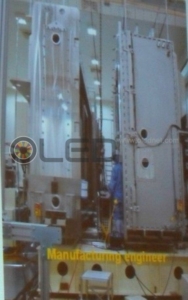
<Canon Tokki’s Gen6 vertical type evaporator which is exhibited at Finetech Japan 2013>

According to the recent ETNEWS, Applied Materials developed Gen6 flexible OLED vertical type evaporator and it is being tested in Japan Display.

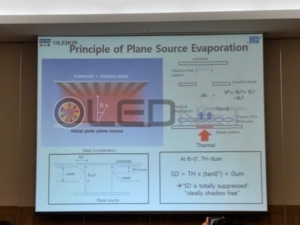
Plane source evaporator is being tested but also the linear source type. Plane source evaporator method is that an organic material is first evaporated on the metal surface to produce plane source, then re-evaporated in order to form an organic thin film on the substrate.

In the past iMiD 2017, representative of OLEDON, Chang Hoon Hwang mentioned that 2250 ppi resolution OLED can be implemented through plane source evaporator.

For metal mask patterning technology, electro forming and laser patterning technology is highlighted. Electro forming method is developed by Wave Electronics, TGO Technology, Athene and so on. Laser patterning technology is being developed by AP Systems.

As such, development for high resolution OLED is receiving great attention whether it can solve the current problems and contribute to UHD resolution implementation for OLED smart-phone.

<Principle of plane source evaporation developed by OLEDON>