Posts

A bar chart illustrating the forecast growth of XR devices equipped with OLEDoS displays between 2025 and 2031, highlighting AR dominance.

XR Headset Shipments Set to Top 10 Million in 2025… AR Expansion Drives OLEDoS Growth

Forecast chart of XR device shipments with OLEDoS from 2025 to 2031 (Source: UBI Research)

UBI Research forecast trend for XR device (MR/VR and AR) shipments equipped with OLEDoS from 2025 to 2031 (Source: UBI Research)

The rapid expansion of the AI and XR device market has intensified competition in next-generation microdisplay technologies. According to a new report published by UBI Research titled ” XR Industry Trends and OLEDoS Display Technology & Industry Analysis” XR headset shipments are expected to exceed 10 million units by 2025. Notably, AR smart glasses alone saw over a 50% year-on-year increase in the first half of this year, clearly shifting the market’s center of gravity.

The AR market is diversifying, expanding its application range from AI glasses focused on information display to business-use AR glasses and content-viewing devices. In the consumer AI glasses market, primarily focused on information display, monochrome displays with resolutions around 640 x 480 (VGA) and microdisplays under 0.3 inches are commonly used, with LCoS and micro LED competing for position. Workplace AR glasses require resolutions of 1280×720 (HD) or higher, while content-viewing AR demands resolutions of 1920×1080 (FHD) or higher.  As industry’s expansion focus shifts from VR to AR, the demand for simultaneously meeting ultra-high resolution, high brightness, and lightweight requirements has grown significantly. Consequently, OLEDoS is evaluated as the fastest-growing display technology within the XR ecosystem.

Global manufacturers are also accelerating OLEDoS development and supply chain expansion. Samsung Display joined the OLEDoS market, previously led by Sony, BOE, and Seeya, by supplying OLEDoS panels for Samsung Electronics’ Galaxy XR, released in October 2025, following Sony. In China, companies like BOE, Seeya, and SIDTEK have commenced mass production of 12-inch OLEDoS panels, marking the most notable shift in the supply chain. Chinese firms are strengthening their in-house capabilities in core processes such as high-resolution patterning, Si-backplane design, and tandem OLED structures, suggesting their global supply share will rapidly expand in the future.

UBI Research analyst Changho Noh predicted, “The OLEDoS market is projected to grow from approximately $285 million in 2025 to $840 million by 2031, driven by supply chain expansion and diverse demand bases.”

He further analyzed, “Shipments of OLEDoS-equipped XR devices are expected to increase from 1.2 million units in 2025 to 8.86 million units by 2031, with AR devices anticipated to account for approximately 90% of total OLEDoS shipments by 2031.”

Changho Noh,  Senior Analyst at UBI Research (chnoh@ubiresearch.com)

▶XR Industry Trends and OLEDoS Display Technology & Industry Analysis Report

※ This article is produced by UBIResearchNet.
Unauthorized reproduction or citation without source attribution is prohibited.
When quoting, please clearly indicate the source (UBIResearchNet) and provide a link.

Goeroptics booth at CIOE 2025 representing Goertek’s AR/XR smart glasses optical technology and new subsidiary expansion (Source: Goeroptics)

Goertek advances as a powerhouse in the AR/XR glasses industry through the establishment of a new subsidiary

In 2025, the smart wearable device market is undergoing a new transformation, with AR/XR smart glasses advancing toward commercialization. Goertek, an audio, optical, and microelectronics manufacturer, has established several new companies and acquired businesses this year targeting its AR/VR operations.

In early November, Qingdao Goertek Xingqi Intelligent Technology Co., Ltd. was established in Qingdao City. This company is a wholly-owned subsidiary of Goertek, with a registered capital of 200 million yuan. Its primary business areas include manufacturing virtual reality (VR) equipment and wearable smart devices. This signifies the company’s accelerated push into the AR/XR ecosystem through technological advancement, organizational restructuring, and ecosystem collaboration. By dedicating this new entity to AR/XR smart glasses, Goertek has revealed its strategic ambition to position smart glasses as its next-generation growth engine.

Goretek has consistently strengthened its core hardware capabilities in acoustic modules, optical modules, and precision structural components over the long term. The company announced its expansion from traditional contract component manufacturing to the role of a ‘finished product and solution provider’. Regarding its collaborative ecosystem, Gore is actively pursuing deep cooperation with brand manufacturers and optical module companies. Industry reports indicate the company has signed supply contracts for AR modules with well-known brands and is establishing joint ventures with domestic and international optical module companies to enhance its optical waveguide manufacturing capabilities.

Goeroptics booth showcasing AR/XR optical solutions at CIOE 2025 (Source: Goeroptics)

Goeroptics booth at CIOE 2025 for AR/XR optical solutions (Source: Goeroptics)

The global AR/XR smart glasses market is projected to experience rapid growth between 2026 and 2030. According to public disclosures and external reports, the company’s internal goal is to secure a leading position as a ‘module + finished product’ solution provider and achieve a 10-20% global market share in the medium term. If Goretek successfully builds an industrial supply chain from components to finished products, it is projected to become a new growth driver for the company’s overall performance.

Despite aggressive market entry, this company and industry players face major challenges. First, core display components (e.g., micro-LEDs, light guide modules) have not yet fully entered mass production. Second, for smart glasses to become part of daily wear, key issues like weight reduction, battery life, and wearing comfort must be resolved. Furthermore, the consumer smart glasses ecosystem is still in its early stages, and content and usage scenarios require further development. Companies that overcome these challenges will emerge victorious in the AR/XR glasses market competition.

Namdeog Kim, Senior Analyst at UBI Research(ndkim@ubiresearch.com)

▶UBI Research’s Micro Display Report

Google and Magic Leap prototype AR glasses demonstrating Micro-LED and waveguide integration under Android XR ecosystem

Google’s Smart Glasses Development Trends and Announcement of Collaboration with Magic Leap

Starting in 2024, Google has intensified its strategic push into smart AR glasses. Notably, with the announcement of its collaboration with U.S. AR company Magic Leap on October 29 this year, Google is strategically shifting beyond simply building a software platform to aiming for an integrated solution encompassing optics, displays, and manufacturing.

  • Platform· and software-driven strategy

Building on its success with existing mobile OS, Google formalized the Android XR platform starting late 2024. This serves as an integrated operating system and ecosystem framework for XR devices, representing an expansion strategy that includes glasses-type AR devices. Through this, Google transforms smart glasses from simple camera/display devices into wearable computing platforms integrated with AI capabilities. Translation, object recognition, and voice/gesture interaction are part of this strategy.

  • Enhancing hardware and display capabilities

On the hardware front, the company has adopted a strategy of expanding its partner model based on platforms and ecosystems rather than launching numerous finished products itself. Notably, it acquired Raxium, a company possessing Micro-LED technology, to secure high-brightness, low-power displays. Furthermore, just a few days ago on October 29th, at the FII (Future Investment Initiative) event in Riyadh, Saudi Arabia, Magic Leap and Google unveiled a joint AR glasses prototype and announced a three-year extension of their collaboration period. The key points of this collaboration are as follows.

  • Magic Leap’s optical and waveguide technology + Google’s Raxium micro-LED light engine combination → Aiming for enhanced image quality, brightness, and comfort.
  • Development of AR glasses is being conducted in the form of a reference design, establishing a framework to provide foundational solutions to multiple manufacturers within the Android XR ecosystem.
Prototype Android XR smart AR glasses jointly developed by Google and Magic Leap (Source: Magic Leap)

Google & Magic Leap Prototype Android XR Smart Glasses (Source: Magic Leap)

This collaboration carries multiple strategic implications beyond a simple technological partnership between two companies. It signals Google’s shift toward an ecosystem-centric “platform + partners” strategy over self-production. Amidst competition in smart glasses/headsets from Meta, Apple, Samsung, and others, the Google-Magic Leap alliance appears to be a move to establish a differentiated foundation within the Android XR ecosystem.  However, challenges remain. Specifications for the consumer-ready final product (resolution, price, battery life, etc.) have not been disclosed, and the launch is expected after 2026. Technologies like Micro-LED and waveguides have progressed to some extent in research/prototype stages, but they still face challenges in terms of mass production and manufacturing costs.

This announcement of Google and Magic Leap’s collaboration can be seen as a pivotal turning point that redefines the landscape of the smart glasses market. Samsung has just unveiled the Galaxy XR, and it remains to be seen whether the situation could rapidly escalate into a competitive race if Google and its partners make proper moves.

Namdeog Kim, Senior Analyst at UBI Research(ndkim@ubiresearch.com)

▶UBI Research’s Micro Display Report

Meta unveils Ray-Ban Display LCoS smart glasses and presents PIC-based LCoS research at SID 2025

Meta unveils ‘Ray-Ban Display’ smart glasses with LCoS, following up with a photonic integrated circuit (PIC)-based LCoS at SID 2025

At Meta Connect 2025 on Sept. 18 (local 17), Meta announced its first display-bringing consumer smart glasses, the Meta Ray-Ban Display. The product is an intermediate step between the existing Ray-Ban AI glasses and the Orion AR glasses unveiled last year and will be available in the U.S. market later this month.

The new glasses feature a monocular display at the bottom of the right lens, which the company says was designed with practical factors such as price and battery life in mind. The display features OmniVision’s single-panel full-color LCoS, with a 600×600 resolution, 42 PPD, 20° monocular field of view, and up to 5,000 nits of brightness. Combined with Lumus’ Waveguide, it delivers a crisp visual experience even outdoors. These specifications fulfill the requirements of an informational AR device (20-35° FoV, high brightness, low power) and provide excellent visibility, especially in outdoor environments. Meta’s choice of LCoS over green LEDoS was a strategic decision based on technology maturity, power efficiency, and the ability to implement full color.

At SID 2025, Meta Reality Labs also announced its work on a photonic integrated circuit (PIC)-based ultra-compact laser microdisplay. The technology offered the possibility of shrinking AR light engines to less than 1㎤, demonstrating a 50-degree viewing angle and high color uniformity. Despite the advantages of mature technology and competitive pricing, LCoS has been limited by the need for bulky optical modules. PICs replace traditional polarizing beamsplitters (PBSs), focusing lenses, and dichroic mirrors by implementing core optical functions such as light gathering, color separation, and polarization control on a chip. PIC-based laser lighting has great potential to scale as a platform for next-generation display technologies. It remains to be seen if the Meta Ray-Ban Display utilizes PICs.

LEDoS is not expected to be fully competitive until 2028 or later, and until then, full-color LCoS is likely to be the key solution for the AR glasses market. OmniVision, as well as Himax Display, Avegant, and Raontec, are working on the next generation of high-brightness, high-contrast LCoS engines, which will make them even more competitive in the near term.

The significance of this announcement is that Meta simultaneously unveiled OmniVision LCoS in commercial products and PIC-based ultra-compact laser microdisplays in research achievements. This demonstrates that the next generation of AR displays is rapidly evolving around the three pillars of miniaturization, efficiency, and quality, and is expected to accelerate the growth of the AR industry ecosystem.

Comparison of conventional LCoS projector and PIC-based LCoS presented at SID 2025 (Source: SID 2025 Digest)

Comparison of conventional LCoS and PIC-based LCoS structure (Source: SID 2025 Digest)

Changho Noh,  Senior Analyst at UBI Research  (chnoh@ubiresearch.com)

▶UBI Research’s Micro Display Report

JBD and Chinese companies unveil Micro-LED AR/AI glasses and optical solutions at CIOE 2025

Accelerating the Advancement of Chinese Companies’ Technology and Supply Chain in Micro-LED Displays and Optical Solutions for AR/AI Glasses

The 26th China International Optoelectronic Expo (CIOE) was held at the Shenzhen International Convention Center on September 10, 2025. At this exhibition, new Micro-LED-based AR products from companies like JBD and Goeroptics were prominently unveiled.

JBD’s ‘Hummingbird II’ Micro-LED color light engine and AR glasses (Source: UBI Research)

JBD’s showcased ‘Hummingbird II’ color light engine and AR glasses (Source: UBI Research)

AR display image as seen through JBD’s ‘Hummingbird II’ light engine (Source: UBI Research)

AR display as viewed through the Hummingbird II light engine (Source: UBI Research)

JBD showcased its latest products, including the Micro-LED 0.1-inch micro display and the ‘Hummingbird II’ color light engine.  It achieved an ultra-compact size of 0.2cc and an ultra-lightweight of 0.5g through its X-Cube structure. Innovision exhibited a development sample with a 2.5 mm pixel size and 0.06-inch display. Micro-LED display sizes are progressively shrinking from 0.13 inches to 0.1 inches, and further to 0.06 inches. Resolve introduced a light engine equipped with a 0.13-inch PowerMatch1 full-color Micro-LED display. The engine’s volume is only 0.18cc, and its weight is just 0.5g, enabling lighter AR glasses.

Chinese companies also showcased advanced new products in AR glasses optical technology at this exhibition. Goeroptics unveiled new AR/VR optical products.  They drew significant attention with diverse products ranging from silicon carbide etched waveguides to ultra-compact optical modules for full-color AR glasses and monocular 4K VR/MR pancake solutions. Utilizing Micro-LED Full color (X-cube) and silicon carbide etched waveguide technology, they achieved a 30° field of view (FOV) and a weight of 4g (see photo below).

AR glasses with SiC waveguide exhibited by Goeroptics (Source: UBI Research)

Goeroptics’ exhibited AR glasses with SiC waveguide (Source: UBI Research)

Specifications of Goeroptics AR glasses with Micro-LED and waveguide (Source: UBI Research)

Specification sheet of Goeroptics exhibited AR glasses (Source: UBI Research)

In addition, numerous Chinese companies including Raypaitech (理湃光晶), SHOUJING Sci. & Tech (首镜 科技), and North Ocean Photonics (鲲游光电) showcased a large number of waveguide and smart glasses solution products. The Chinese industry has already established a smart glasses supply chain, encompassing not only micro-displays, waveguides, and optical engines, but also companies providing complete smart glasses solutions. This supply chain is accelerating its pace of development.

Namdeog Kim, Senior Analyst at UBI Research(ndkim@ubiresearch.com)

▶2025 Micro-LED Display Industry and Technology Trends Report

Entrance of the 26th China International Optoelectronic Expo highlighting Micro LED AR showcases

At the China CIOE Optoelectronics Exhibition, JBD, Goeroptics, and other companies unveiled new AR products using Micro-LEDs

The 26th China International Optoelectronics Exhibition (CIOE) opened at the Shenzhen International Convention Center on September 10, 2025. This expo, the world’s largest, attracted over 3,800 participating companies. The exhibition focused on “IC Design and Application,” “IC Manufacturing and Supply Chain,” and “Compound Semiconductors,” with participation from companies in key fields such as semiconductor materials, advanced processes, packaging testing, and optoelectronic chips.

Entrance of the 26th China International Optoelectronic Expo (CIOE) (Source: UBI Research)

Entrance view of the 26th China International Optoelectronic Expo (CIOE) (Source: UBI Research)

At this exhibition, new products for AR using Micro-LEDs were unveiled, including from JBD and Goeroptics.

JBD’s new 0.1-inch Micro LED light engine (Source: UBI Research)

JBD’s exhibited new product, 0.1-inch Micro-LED light engine (Source: UBI Research)

JBD showcased its latest products, including a 0.1-inch Micro-LED microdisplay and the Hummingbird II color light engine. The X-Cube structure achieved an ultra-compact size of 0.2cc and an ultra-light weight of 0.5g. Goeroptics showcased a product utilizing Micro-LED full color (X-cube) and silicon carbide etched light guide technology, achieving a 30° field of view and a weight of 4g.

Across the board, companies achieved breakthroughs in various technologies, including three-color combination, color conversion, and vertical stacking. Amidst the trend toward lightweight design, the “Micro-LED + light waveguide” solution has become a relatively mainstream technology. The exhibited products show that the size of Micro-LED light engines is gradually shrinking from 0.13 inches to 0.1 inches and even 0.06 inches, demonstrating the rapid advancement of this technology toward smaller volumes and higher brightness.

Namdeog Kim, Senior Analyst at UBI Research(ndkim@ubiresearch.com)

▶2025 Micro-LED Display Industry and Technology Trends Report

JBD, Completes Pre-B Round Financing, Plans to Fully Advance Consumer AR Ecosystem Development

JBD MicroLED-based AR glasses display structure

JBD MicroLED AR glasses display structure (Source: JBD)

Shanghai JBD Company announced on August 21 that it has successfully completed a B1 round of investment worth hundreds of millions of yuan. The funds from this round of investment will primarily be used for research and development of core technologies in MicroLED micro-displays, expanding production capacity, and deepening ecosystem collaborations. This initiative aims to address the anticipated surge in global demand for AR+AI devices in the coming years.

With the accelerated application of AI, the deep integration of AI and AR is expected to bring new experiences in human-machine interaction and emerge as a core area of competition among global technology giants. As a leader in MicroLED micro-display technology, JBD aims to collaborate with partners to drive the upgrade of the AR industry and build an open and collaborative consumer AR ecosystem. 

MicroLED micro-display technology is widely recognized as the next-generation solution for AR glasses displays. The recently completed funding will significantly strengthen JBD’s research and development capabilities and production capacity, accelerating the widespread adoption of MicroLED micro-display technology in the AR display sector. This is expected to further expand JBD’s influence in the global AR micro-display industry.

JBD, established in 2015, is a leading player in the MicroLED micro-display field, aiming to become a leading provider of AR display solutions. Over the past year, JBD has achieved significant results in various areas, including market expansion, product upgrades, and technological innovation. In terms of the market, there are currently about 50 smart glasses products using JBD’s MicroLED micro-display technology, recording rapid growth compared to the same period last year. Key products include Rokid Glasses, INMO GO2, Rayeo X3 Pro, and Alibaba Quark AI glasses, among other well-known Chinese brands. In terms of products, the ‘Hummingbird Mini II’ monochrome light engine launched last year features an ultra-compact size of 0.15 cc. Additionally, the new ‘Hummingbird I’ color optical module achieves a brightness of 6,000 nits. JBD’s upcoming ‘Hummingbird II’ color light engine is expected to become the industry’s first consumer-grade lightweight AR glasses-compatible color display solution.

Namdeog Kim, Senior Analyst at UBI Research(ndkim@ubiresearch.com)

▶2025 Micro-LED Display Industry and Technology Trends Report

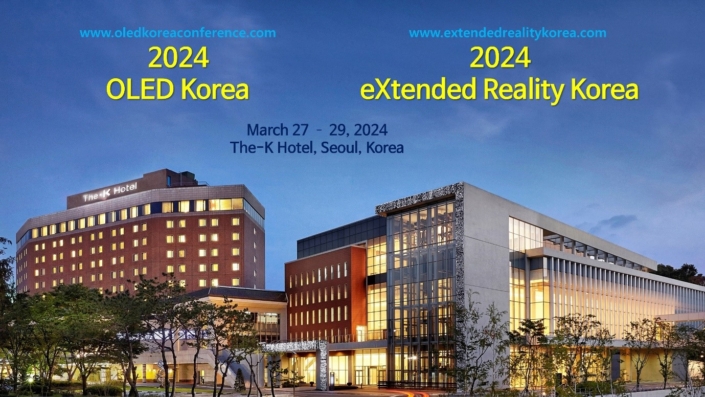
International Business Conference: 2024 OLED Korea & 2024 eXtended Reality Korea will be held in parallel!

UBI Research, a display specialist research company, will hold the international business conferences OLED Korea and eXtended Reality Korea in parallel at The-K Hotel in Yangjae, Seoul from March 27 to 29, 2024. This event is expected to be an opportunity for people from companies, academia, and research institutes related to the display industry around the world to attend, exchange the best information, and form a global network.
eXtended Reality Korea is the first XR industry-related business conference held by UBI Research and will cover trends and outlook on micro display, XR Hardware/Software, materials, equipment, etc.
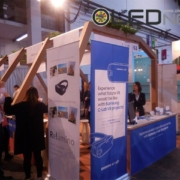
This event aims to provide attendees with the opportunity to deeply explore the display and XR areas through a comprehensive program including tutorials, keynote presentations, and panel discussions.

The tutorial on March 27th will feature presentations on the future of XR, micro LED display technology, and key technologies to realize the next generation OLED display.

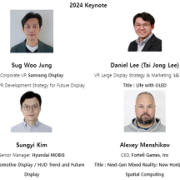
In addition, keynote presentations by ▲UBI Research, ▲Samsung Display, ▲LG Display, ▲Hyundai Mobis, and ▲Fortell Games are scheduled for the conference to be held on March 28th and 29th. Choong-Hoon Yi, CEO of UBI Research, will give a presentation on “OLED and XR industry outlook.” We will present the overall OLED industry, including OLED for IT, and the micro OLED industry that will be applied to MR equipment.

Samsung Display plans to introduce SDC’s roadmap for expanding the AR/VR market based on SDC’s plan to overcome technical obstacles in ultra-high-resolution displays under the title “AR/VR Development Strategy for Future Display.”

Under the theme of “Life with OLED,” LG Display will examine the field of OLED displays applied in daily life and present the continuous evolution and benefits of OLED technology.

Under the theme of “Automotive Display / HUD Trend and Future Display,” Hyundai Mobis presents trends and requirements for automotive displays, from Pillar To Pillar displays to Rollable displays, predicts future automotive displays, and announces development strategies.

Lastly, Fortell Games will discuss the topic of “Next-Gen Mixed Reality: New Horizons for Spatial Computing”, analyzing the latest developments in mixed reality technology and their impact on the future of the gaming industry.

In addition, it will be run by a total of 34 domestic and foreign speakers and programs, including AR/VR development and technology, automotive displays, OLED industry, backplane technology, and MicroLED display development.

Because it is a parallel event, attendees can attend both events even if they register for one event, and registration is possible at a special discount price during the early bird period until February 29th.

Detailed information can be found on the website (https://oledkoreaconference.com/, https://extendedrealitykorea.com/).

XR Industry Megatrends

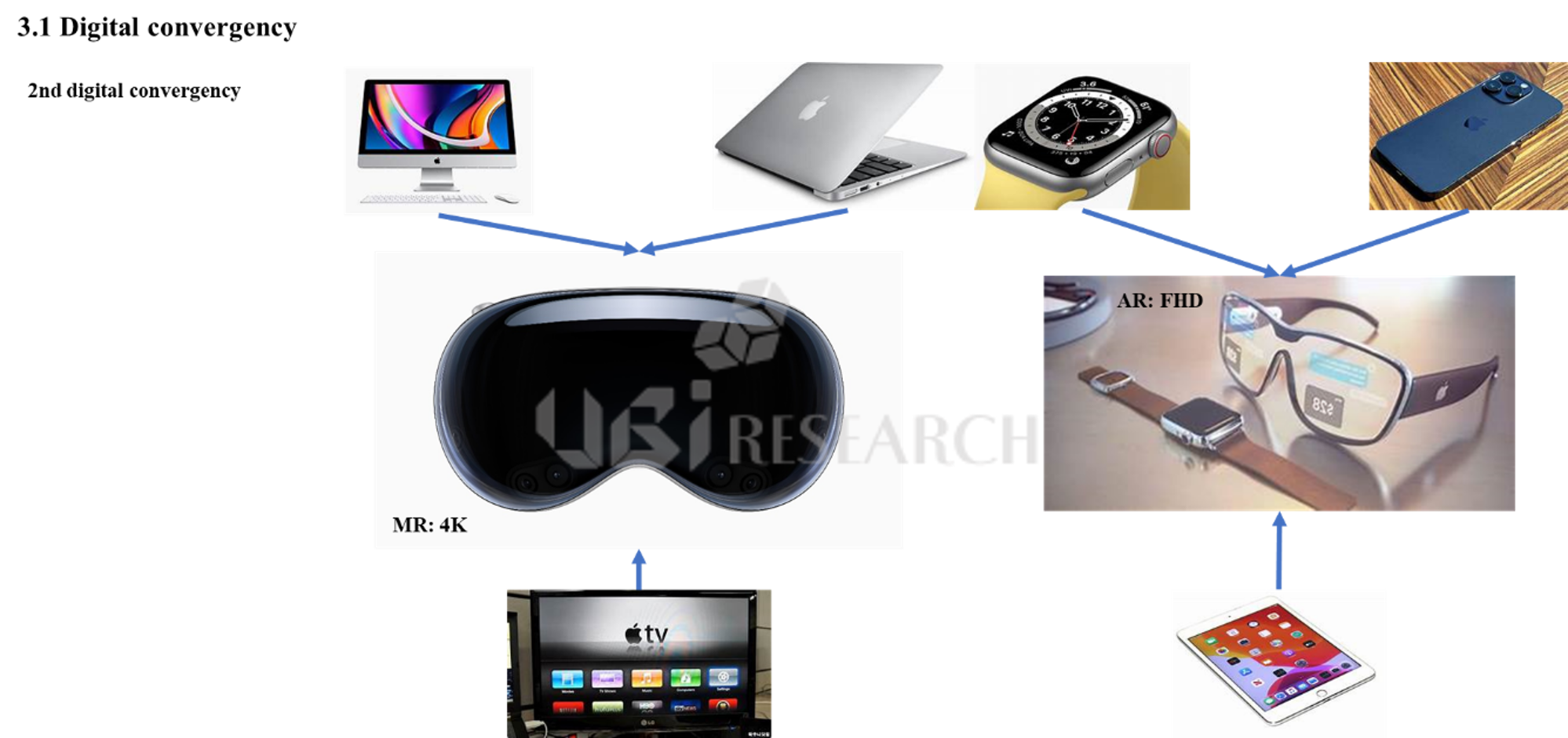
Extended reality (XR) devices, which overlay an extended reality on top of the real world, are emerging as disruptive devices that will drive a second wave of digital convergence, renewing the digital convergence brought about by smartphones. MR (mixed reality) devices will converge TVs, monitors, and laptops, while AR (augmented reality) devices will integrate smartphones, smartwatches, and tablet PCs.


UBI Research has released a new report, “XR Industry Mega Trends Analysis,” which provides a detailed analysis of the past and present of the XR industry that set manufacturers, display companies, and component/material/equipment companies need to know in order to prepare for the upcoming second wave of digital convergence.

Analyzing all the models of XR devices on the market from VR devices that started to be released in 1989 to the first half of 2023, we found that XR devices have a very complex industry structure that is different from wearables, mobile devices, and IT devices that have existed before.

MR devices are characterized by being able to work while moving, unlike conventional IT products that are used while sitting in a chair, and AR devices are products that free up both hands while actively adjusting the display to provide information in all directions of head movement.

Therefore, it was analyzed that in order to succeed in the XR device industry, which is the next generation of innovative products, all related companies, including set companies, display companies, and equipment/components/materials, must first understand the composition, operation principle, and content of XR devices and prepare business directions.

The core components of XR devices are optics, displays, and sensors for tracking, and the content used is different depending on the characteristics of these three components. While the existing IT industry has determined the content to be used based on the performance and specifications of the hardware, XR devices are expected to develop in the opposite direction, with the content determining the specifications of the XR devices.

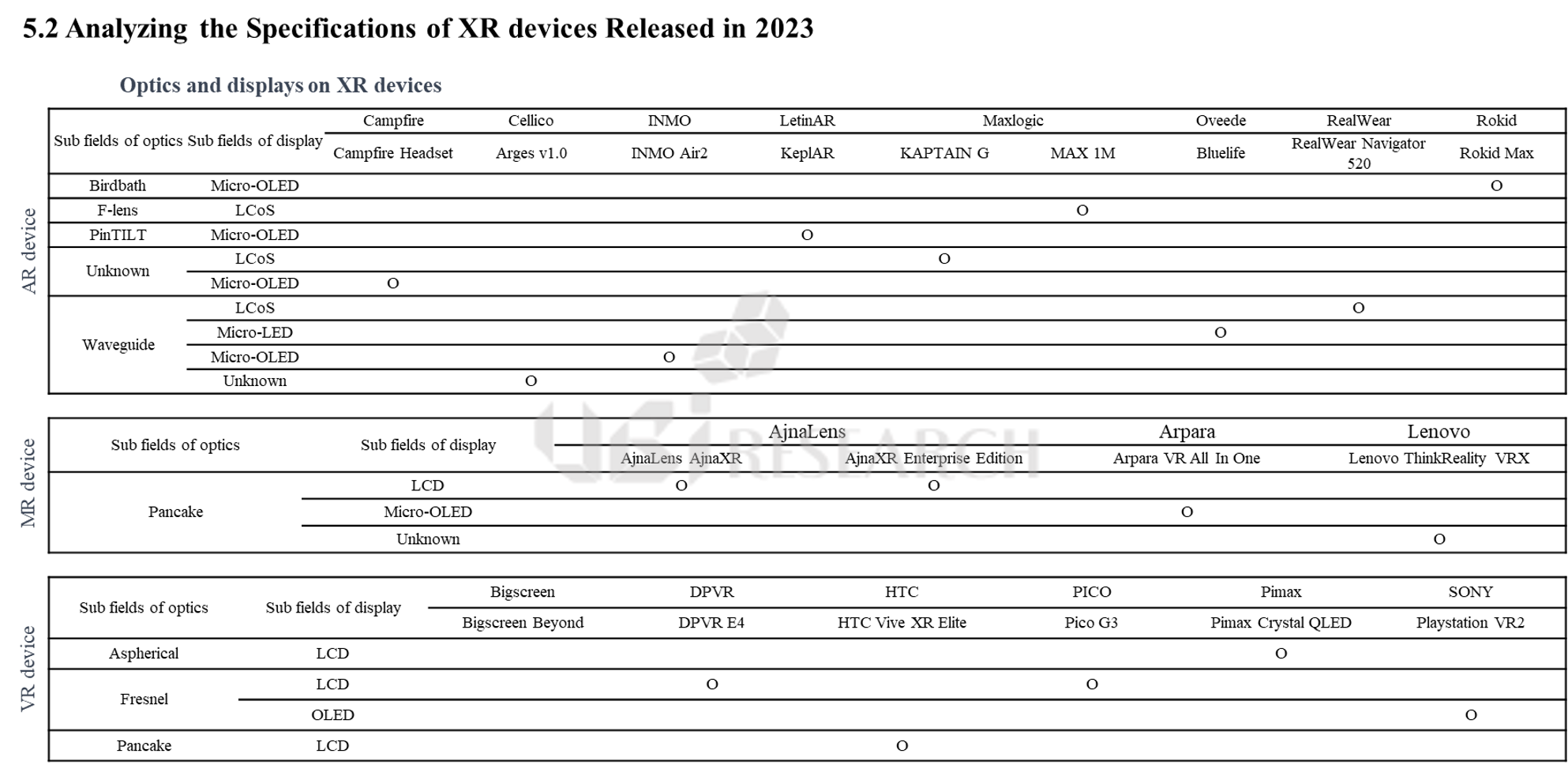
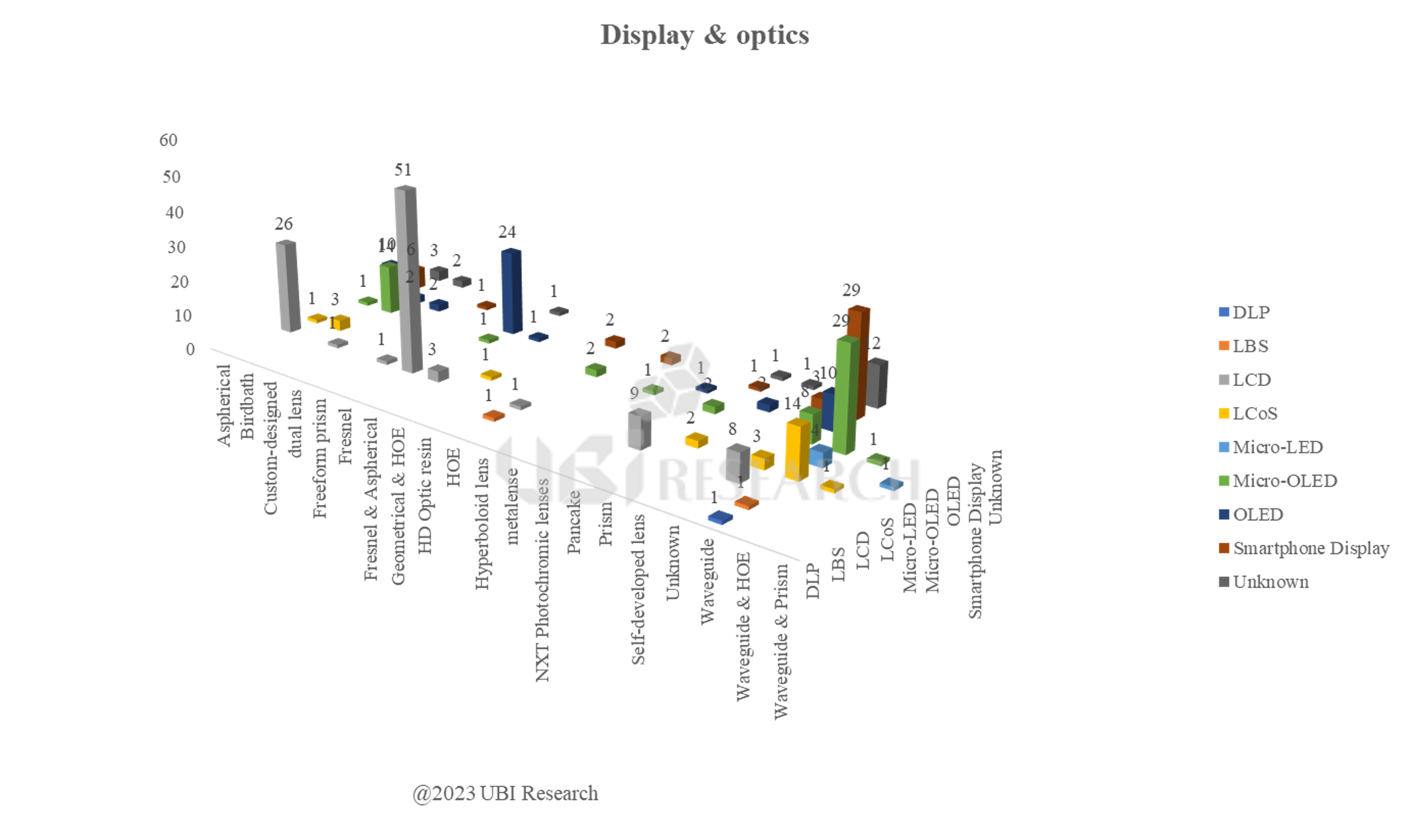
We have summarized the optics and displays of XR devices released in the first half of this year. Understanding the relationship between optics and display is an essential element of the XR device industry, as the type of content determines the specifications of the device.

We analyzed the optics, displays, and tracking methods of all XR devices released since 1989.

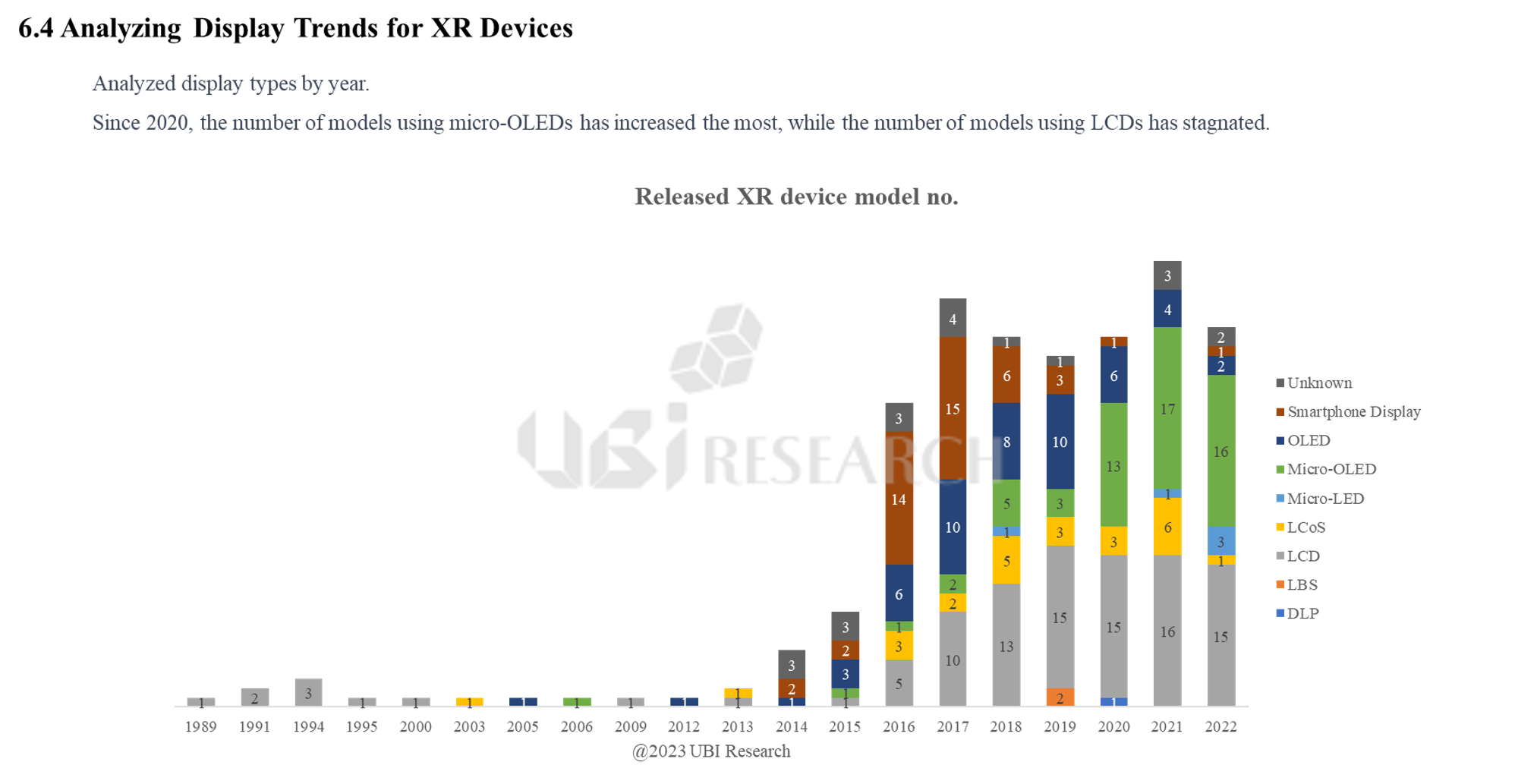
Display trends show that the number of models using LCDs is slowly decreasing, while the percentage of XR devices using micro-OLEDs is increasing.

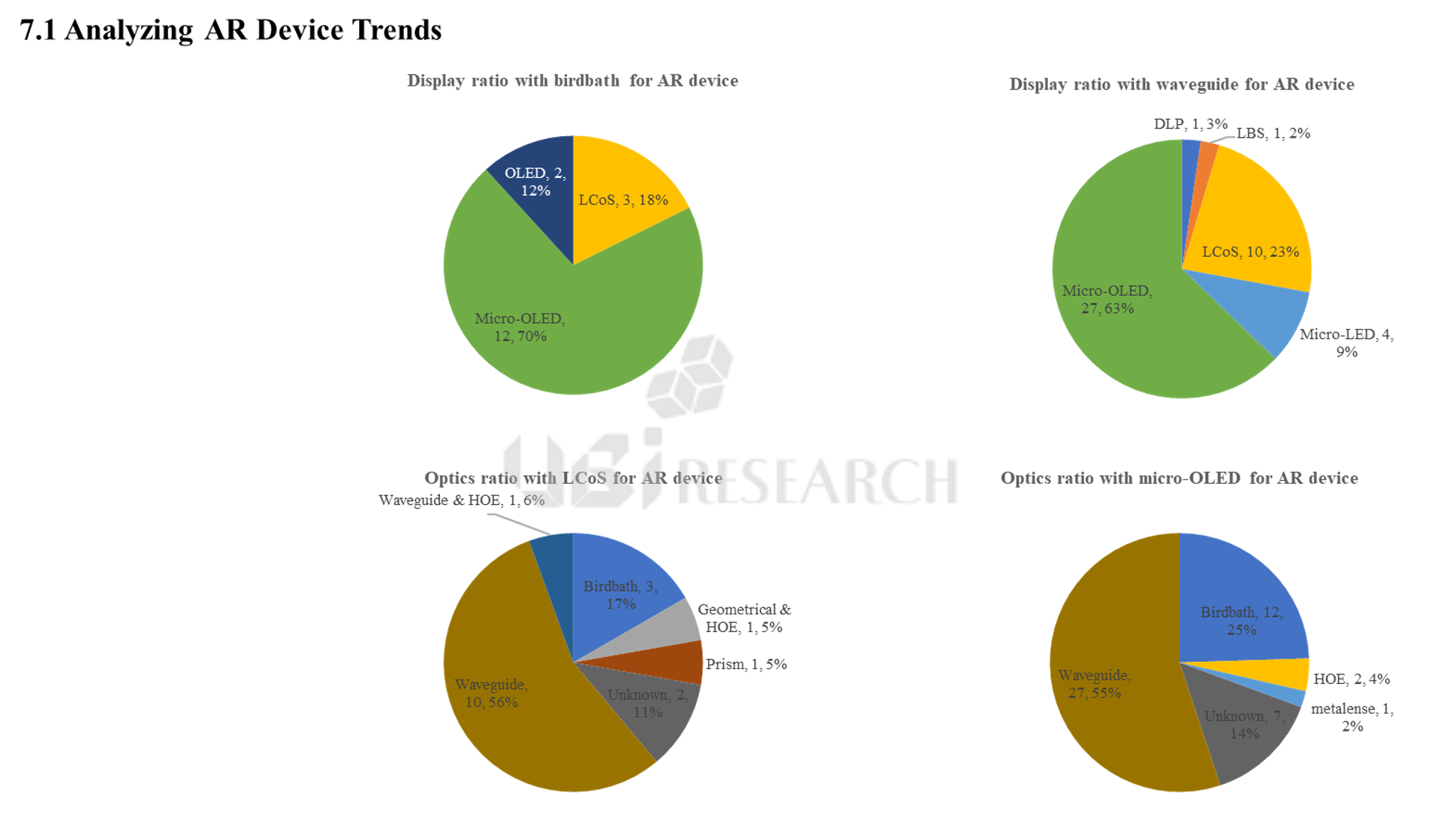
In optical see-through (OST) AR with transparent windows, micro-OLEDs are most commonly used, with waveguides and birdbaths being used as optics.

Display companies need to work together to understand which combination of optics is appropriate for the display they are developing or producing.  This is because XR devices are often used for specific purposes rather than general purpose. The field of view (FoV) of the optics can determine the display of choice.

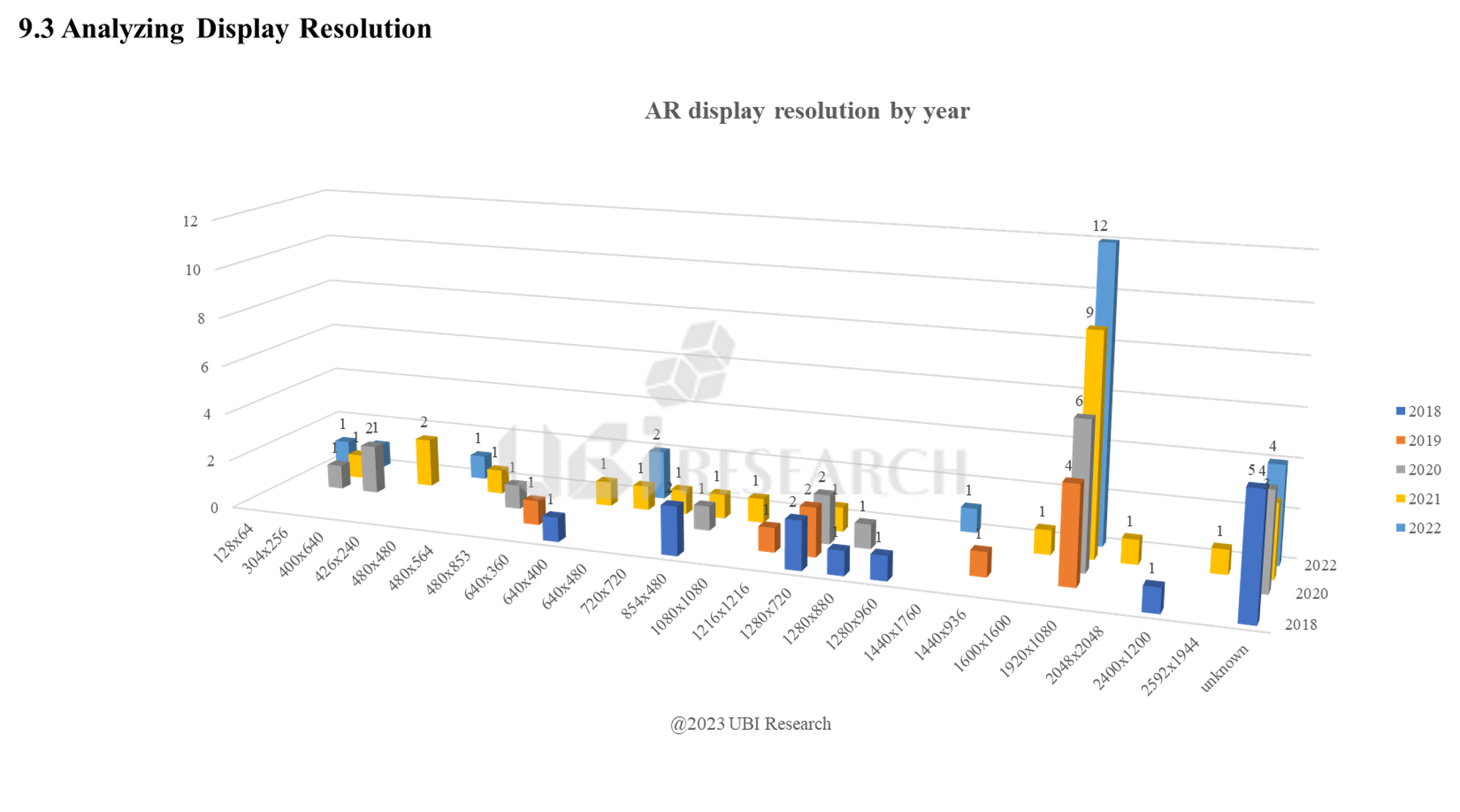
We analyzed the resolution trends in AR devices. FHD (1920×1080) resolution is becoming the main specification for AR devices. Micro-OLED is mostly used.

Micro-LEDs are attracting attention as the main display for AR devices due to their high brightness, but it will take at least five years before FHD products with a panel size of about 0.25 inches are available because panel and LED manufacturing technologies are not yet established.

As the features and specifications of XR devices vary depending on the purpose of use, it is necessary to closely examine the software, so we analyzed 472 products from 178 companies that have released software for XR since 2010.

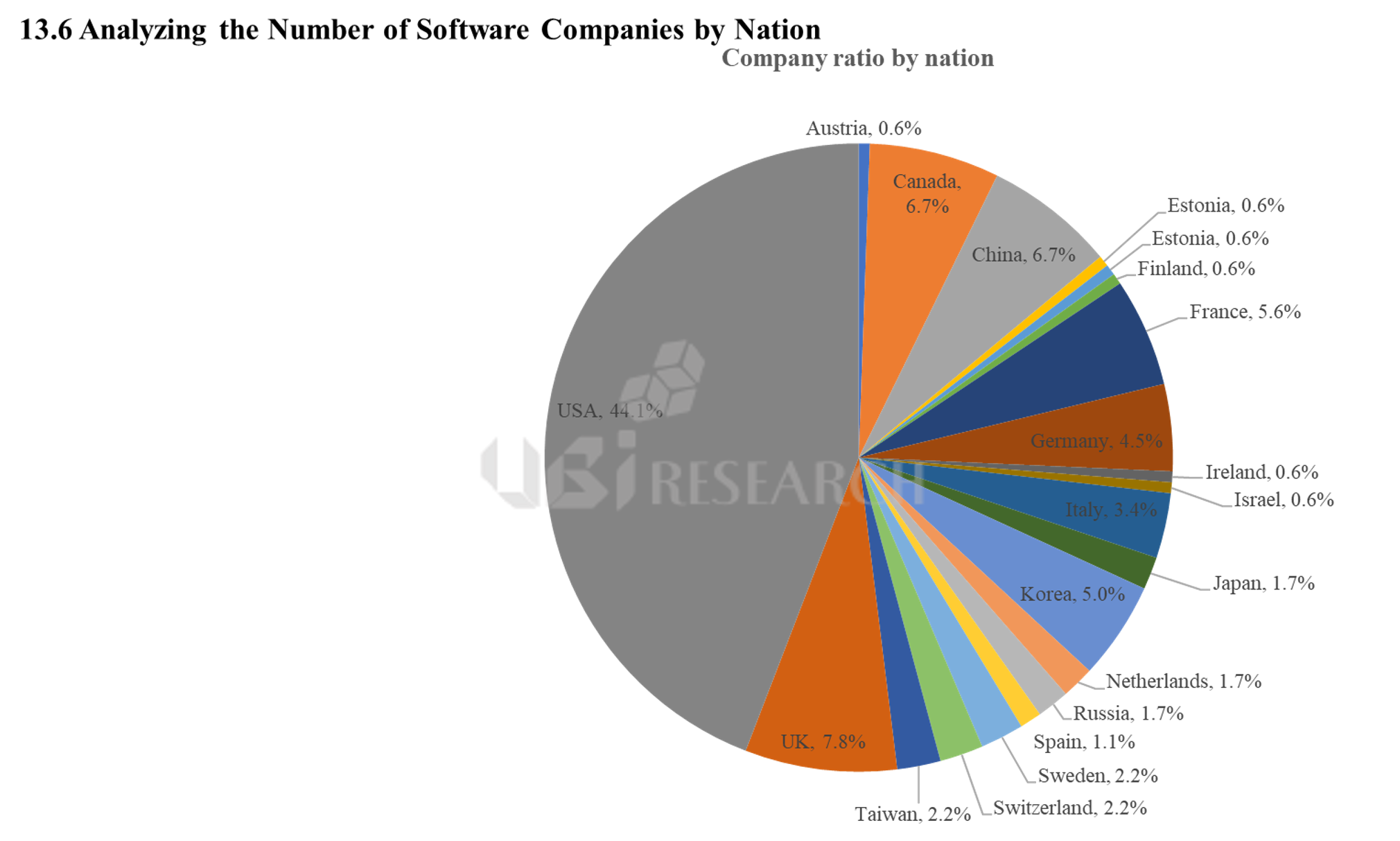
We examined the number of software companies by country, and found that the United States has 79 companies, accounting for 44.1%. It is clear that the software industry for XR is dominated by the United States.

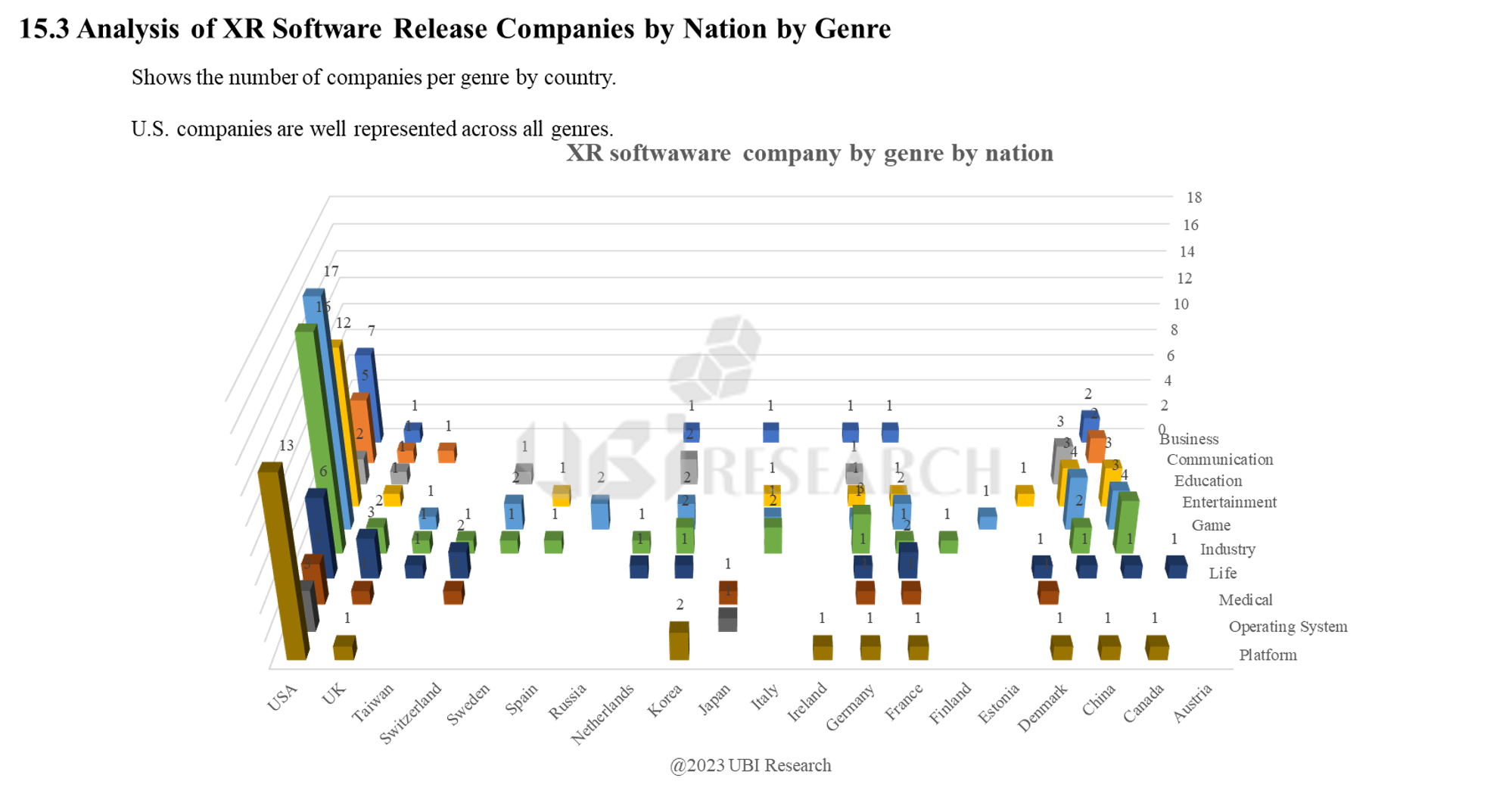
To analyze the activity of software companies, we examined the number of companies by genre that released products between 2018 and 2022. We analyzed the number of companies by genre in each country and found that the U.S. has an even distribution of companies in all genres.

This report will serve as a cornerstone for all supply chain players in the XR industry and those who wish to enter the XR industry in the future to understand the characteristics of the XR industry and find a successful business path.

▶ Megatrend Analysis of the XR industry Report Sample Download

Megatrend Analysis of the XR industry : Detailed analysis of XR devices and software industry

In order to shed light on the footsteps of the XR device industry, which is gradually increasing in scale with the goal of replacing wearable devices and IT devices, and to forecast the future market, XR device models and specifications released from 2018 to the first half of 2023 were analyzed. During this period, there were 327 models of XR devices and 127 companies that were investigated.

XR devices are classified into VR, MR, and AR. As for AR devices, only optical see-through (OST) products were classified as AR, and video see-through (VST), which allows viewing of the real world through a camera, were classified as MR. Since the labeling methods for MR and VR devices were mixed by the company, the fixing method was also closely investigated and referred to the device classification.

In order to analyze the trend of XR devices, it was analyzed by dividing into three types by period.
1) Latest trends of products released only in the first half of 2023
2) Overall XR device flow through analysis of products released from 1989 to 2022
3) 5-year trend between 2018 and 2022 for an accurate analysis of the current status, taking into account the company’s mergers and acquisitions, closure, etc.

Analyzing the number of models released between 1989 and 2022 by device, the XR device industry appears to have started to bloom in 2016. Most of the device models were for VR, but after the number of models released peaked in 2017, the number of new VR device models has been slowly declining. Especially since 2020 when Covid-19 started, the number of AR device models has outpaced the number of VR device models. One of the reasons for the decrease in the number of newly released VR device models is the increase in the number of MR device models. From this analysis, it seems that the XR device industry is shifting from VR to AR and MR industries from 2021.

The competitiveness of each country in the XR device industry was also analyzed. Recently, the device industry has been affected by the entire supply chain depending on the ecosystem of each country, so we looked at the countries and application fields that are leading the XR set industry. Between 2018 and 2022, the country with the highest number of vendors launching XR devices was China, with 25 vendors. The United States comes next with 20 companies, and Korea has the third largest number with 9 companies. As a result of investigating the number of companies by application field, Chinese companies have the largest number of companies that have released VR and MR products, but the number of AR companies is the number one in the United States. South Korea ranked third in AR and VR products respectively.

When analyzing the number of XR device product models, China ranked first, the US ranked second, and Taiwan ranked third.

We analyzed software companies for XR between 2010 and 2022, as well as their released products and applications. The number of software released during this period was 472, and the number of companies was 178. The increase in the number of software releases for XR started from 2016, and when 472 software were analyzed by XR type, the ratio was 66% with 311 cases for VR, and 81 cases and 80 cases for AR and VR, respectively. VR software still seems to dominate the XR software industry.

When XR type software was analyzed by country, China released the most products for VR with 177 cases. This result shows that China is leading the VR software industry. As a result of analysis by genre, game use accounted for 49% with 233 cases, industrial use with 62 cases with 13%, and entertainment with 41 cases with 9%.

When the number of software companies is analyzed by country, US companies have an overwhelming number of companies with 79. On the other hand, China, which has the most VR software releases, had only 12 companies.

▶ Megatrend Analysis of the XR industry Report Sample Download

PMOLED and Micro OLED Stand Out In the Wearable Device Market

At the 4th wearable expo being held from January 17th in TOKYO BIG SIGHT -Tokyo International Exhibition Center, many companies attracted the attention of participants by exhibiting OLED wearable devices and OLED panels. Particularly, at this exhibition, many wearable devices with PMOLED and micro OLED were displayed, which proved once again infinite possibilities of OLED.

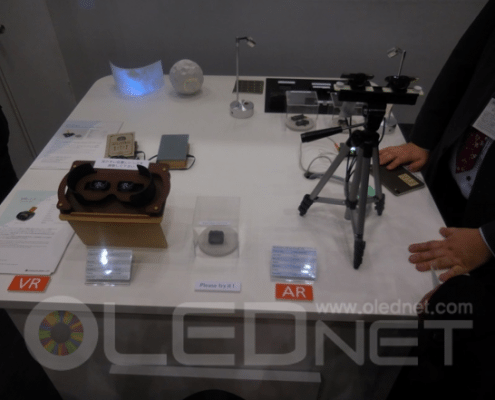
First, ColorLink Japan unveiled its VR and AR devices with micro OLED. Micro OLED is a panel that can realize high resolution in small size by reducing OLED panel to micro size. “The micro OLED applied to ColorLink Japan’s VR equipment is 0.7-inch in size with FHD resolution, and we were able to manufacture more compact and scarce VR device by applying micro OLED”, said an official from ColorLink Japan.

<ColorLink Japan’s Micro OLED VR and AR>

In addition, Fitbit and iWOWNfit exhibited smart bands with PMOLED. PMOLED refers to a passive matrix OLED that does not use TFT, which is a switching device, and is mainly applied to low resolution devices that display numbers or characters rather than high resolution-required devices. In relation to the reason for the application of PMOLED, both companies explained that they have been able to significantly reduce power consumption by applying PMOLED, and the OLED prices have fallen considerably so that they have sufficient price competitiveness.

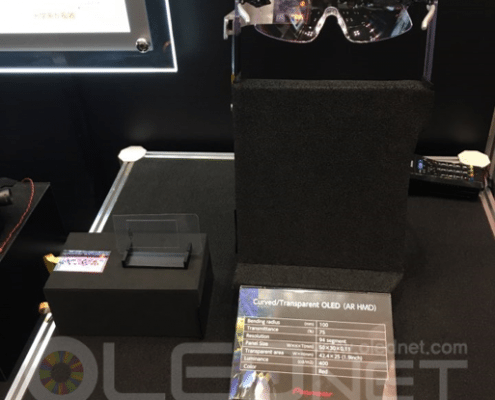
Meanwhile, OLED panel makers also exhibited a number of OLED panels for wearable devices. Pioneer, which firstly produced mono color PMOLED for FM character broadcast in 1997, attracted participants by introducing a number of PMOLEDs and devices using this. Pioneer announced its goal to diversify its business centering on PMOLED, introducing PMOLED-applied Bluetooth speakers, smart watches, and AR devices.

<Pioneer’s PMOLED Panel and AR>

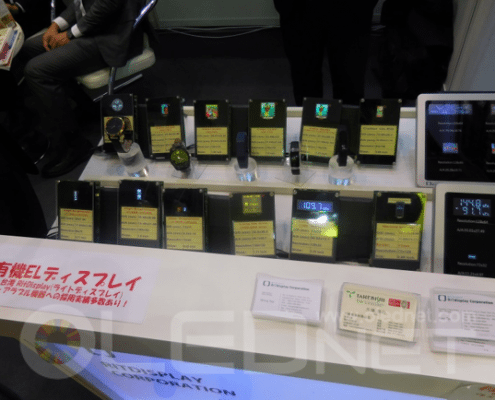
RiTdisplay also attracted attention by exhibiting a number of wearable appliances and panels with many PMOLEDs. RiTdisplay said, “Since the AMOLED market is already occupied by Korea, it is inevitably lagging behind its productivity and price competitiveness”. “Instead, PMOLED enables easy customization with less production cost than AMOLED so it is competitive in the wearable device market.” Also, they announced that since smart bands will be more aggressive in this market due to lower ppi than smart watches and mobile devices, they will actively target the market.

<RiTdisplay’s PMOLED Panels & Applications>

In addition to AMOLED which is leading the mobile device and TV market, various methods of OLEDs such as PMOLED and micro OLED are being actively applied to wearable devices, thereby expanding its influence. The future of OLED, which is being increasingly utilized, is expected.

Fraunhofer FEP will show bidirectional AR / VR head mounted display devices based on OLED microdisplay.

Fraunhofer FEP announced that they would show bidirectional AR / VR head mounted display devices based on OLED microdisplay at AWE Europe 2017 from October 19-20. According to Fraunhofer FEP, OLED microdisplay supports SVGA (800 x 600) resolution and can display augmented reality and virtual reality of 2D and 3D content via USB interface and HDMI connection. In addition, it is known that it is possible to use an eye tracking system that uses a photodiode to detect a user’s gaze.

<New HMD device of Fraunhofer FEP, Source: Fraunhofer FEP>

Judith Baumgarten, developer of Fraunhofer FEP, commented, “This exhibition will showcase the quality and versatility of OLED microdisplay,” he said. “It will be a great opportunity to demonstrate Fraunhofer FEP know-how in electronic design.”

In the meantime, AR/VR devices have been developed mainly in the fields of entertainment and games. Fraunhofer FEP, however, is expected to support designers, engineers, surgeons, etc. and enable them to be used as educational media in almost every field.

On the other hand, augmented reality and virtual reality technology are attracting great attention as one of the main technologies of the 4th industrial revolution that has recently attracted attention, and products such as Oculus Rift and Gear VR are continuously being released. According to UBi Research, the AR/VR market will expand full scale in 2019, when 5G is introduced, which can mass-produce UHD contents and transfer large volumes of content fast and the total revenues of virtual reality and augmented reality products will reach $ 58.7 billion by 2021.

iMiD 2017 Industrial Forum, a networking event to predict the next generation OLED market

■ “Finding a new OLED market” – Discussing OLED replacement in view of OLED application development

■ Discussing new technologies of future display (LCD, QD-LCD, OLED)

The potential of future OLED development is inexhaustible as OLED can be applicable to all industries including VR / AR, automotive, aerospace, and lighting not content with smart phone and TVs. There has been growing public interest in OLED in many different industries. To meet the market demand, Ubi Research, a market research company co-hosts ‘iMiD2017 Industrial Forum’ with Korea Display Society (KIDS) in BEXCO, Busan on 30th of August.

The forum will proceed with a panel discussion among key specialists and presentation, which will enable people from many different industries to exchange information not only on the display market but also current OLED market status, technology and explore a new market potential generated in the future.
In the first session ‘look for a new OLED market’, OLED replacement will be presented in view of OLED application development. The key players include Dr. Teruo Tohma, WooSeok Jeong, principal research fellow at the Electronics and Telecommunications Research Institute (ETRI), Julian K chang, Managing director of Boeing Corporation, Professor TAKUYA KOMODA at Yamagata University, senior researcher, Michi Hisaishi, ALPINE Michihisa Onishi.

The second session, ‘Discussion of New Technologies in Future Display’ will provide insight into the latest products and technology trend of TV manufacturers competing with one another to dominate the next generation display market. Nam-Suk Oh, CEO of Samsung Electronics will present an updated LCD TV using Quantum dots technology under the title of “Quantum Dot and Advance of LCD-TV”.

In the OLED TV camp, under the title of “OLED, Now and Future”, Joon-Young Yang at LG Display will review the current status of OLED TV led by the current market trends, and also address OLED future implemented in a wide range of ‘flexible and rollable’ designs.

Weir Cao, senior researcher at TCL, will present both the technology status of the Colloidal Quantum Dots and TCL products applied to LCD in the market, under the topic of “TCL Display Technology with QDs”. The premium TV strategies are expectedly revealed. Lee Choong-hoon, CEO of Ubi research co-host of this forum, offered a time to summarize the premium TV market on the topic of ‘OLED TV market outlook by premium TV market expansion’ by analyzing the presentations of the companies that presented earlier.

For more information on the 17th iMiD2017 Industrial Forum, please visit iMiD2017 official website (http://imid.or.kr/2017/indi_forum.asp).


AR and VR Market, Active Expansion in 2019 – What Propels the Growth?

  • Forecast of US$ 58,700 million of total revenue of AR and VR in 2021
  • Active expansion expected in 2019 with UHD contents mass production and fast transfer of large size content for VR through introduction of 5G


With recent ICT (Information and Communication Technologies) progress, fourth industrial revolution is receiving attention as the new growth engine. Along with the increased interest in augmented reality (AR) and virtual reality (VR), products such as Oculus Rift and Gear VR continue to be released.

Released AR products include glass types such as Microsoft’s HoloLens and Google’s Google Glass. HMD (Head Mounted Display) based VR type products include Oculus VR’s Oculus Rift, HTC’s Valve, and Sony’s PlayStation VR, and smartphone based VR types include Samsung Electronics’ Gear VR.

According to AR and VR Display Market Report published by UBI Research on 7th, AR and VR product shipment is expected to record 17 million units in 2017 with US$ 3,900 million revenue. UHD contents mass production and introduction of 5G for fast processing large size VR content are expected from 2019. Accordingly, total shipment of AR and VR products is estimated to increase at approximately 54% CAGR, and show 96.4 million units of shipment and US$ 58,700 million revenue.

The report divided the market by product and display for AR and VR market analysis, which is further categorized into AR and VR product total market, market by VR product, AR and VR use display total market, AR and VR use OLED, and market by other display type.

For immersive virtual reality experience without dizziness, display conditions such as latency, FOV, refresh rate, and high resolution were selected as key issues and were analyzed. AR and VR products released between 2014 and 2016 were arranged by types, categorized by display type and key companies and analyzed.

Furthermore, business status of key IT companies, including Apple and Facebook, is included handling AR and VR product release status, related patent, and related company takeover. With the information on key panel companies’ AR and VR product exhibition status, the report is expected to be conducive to understanding key trends of related companies.

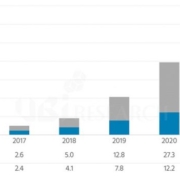
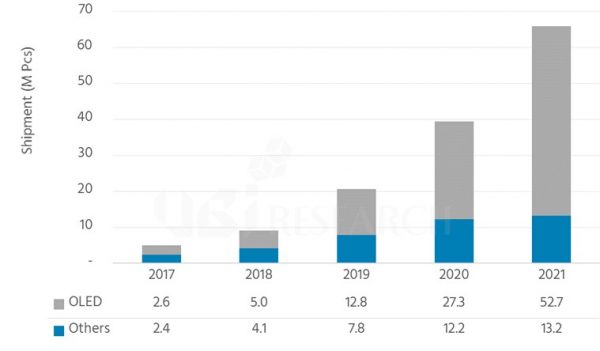
UBI Research estimates AR and VR use OLED shipment to be 2.6 million units in 2017, with 2.4 million units of other displays. OLED is expected to show 52% of market share with 48% of other display. In 2021, AR and VR use OLED is expected to show shipment of 52 million units and occupy 80% of the market.

<Shipment Forecast by AR and VR use Display Type>

[MWC 2017] Samsung Elec. lead AR/VR market with the variety of contents

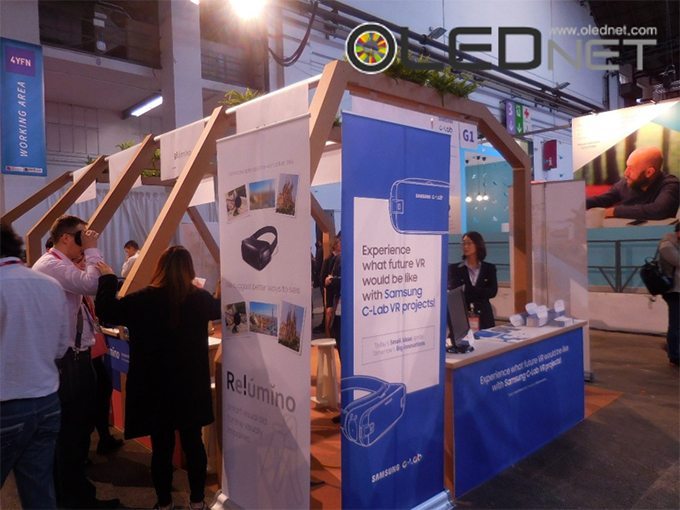
Samsung Elec. is expected to lead forward the market expansion of AR/VR, showing various AR/VR contents under developing at MWC 2017 which is being held in Barcelona, Spain from 27, Feb.

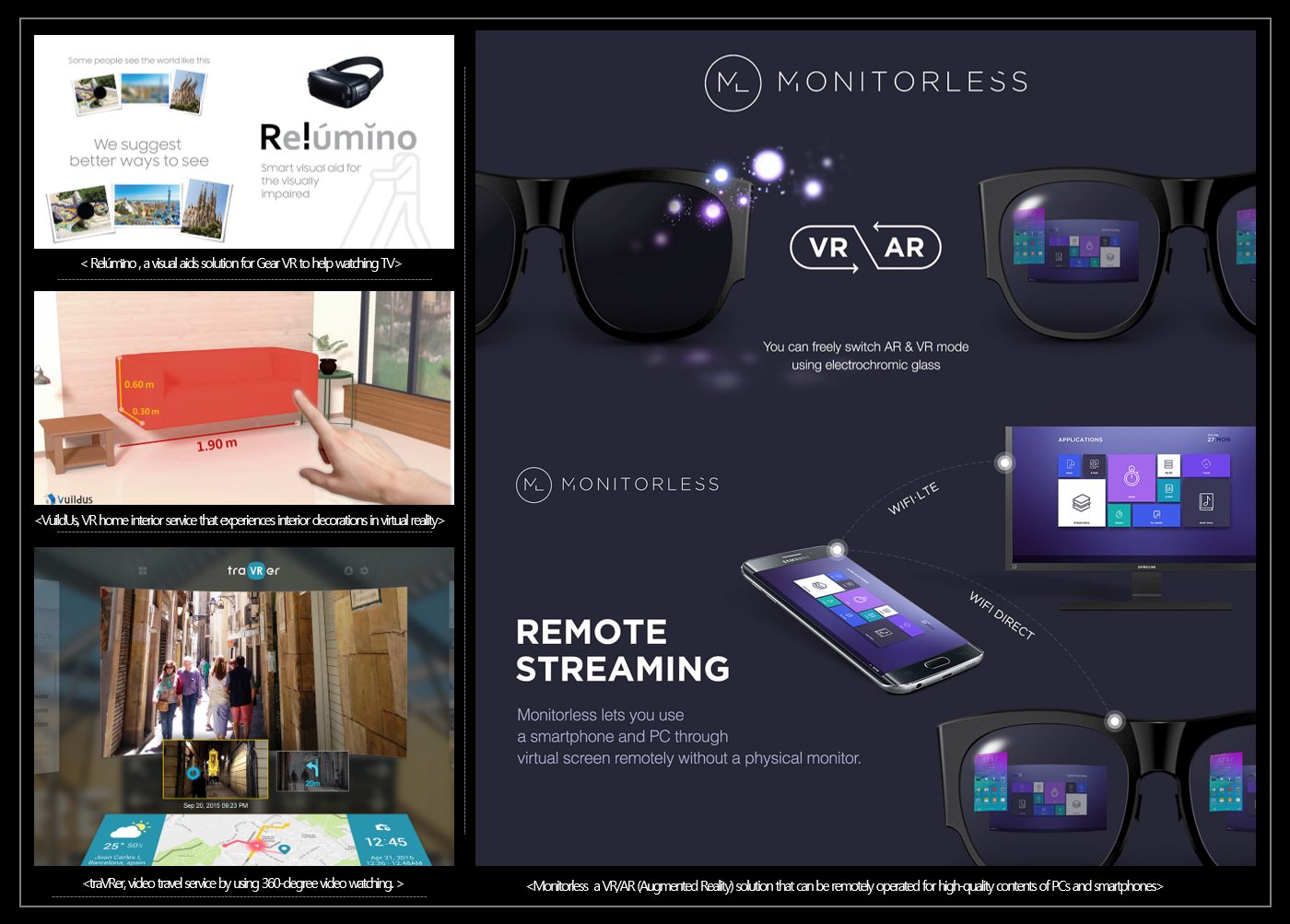
Samsung Elec. prepared the C lab exhibition hall at 4YFN in Fira Barcelona, and showed 4 types of contents for visitors such as: Relúmĭno which is a visual aids solution for Gear VR to help watching TV and reading books for persons who have low vision and blind, Monitor-less which is a VR/AR (Augmented Reality) solution that can be remotely operated for high-quality contents of PCs and smartphones, VuildUs which is a VR home interior service that experiences interior decorations in virtual reality, traVRer which is for the video travel service that helps experiencing of virtual trips by using 360-degree video watching.

Samsung Elec. is just developing for VR use now, but they revealed that Relúmĭno is being reviewed for applying to AR as a VR content effecting to the vision correction by VR algorithm that developed symptoms itself regarding to the disorder of refraction, cataracts and so on.

The principle for monitor-less is that reflects the screen of smartphones through micro OLED of the HD resolution located around the frame of glasses to its optical lens, and it is operated without a monitor of a smartphone and a PC as AR during ordinary. In addition, its merit is easy to use the VR contents by opaquely tailoring the glasses through an adaption of electro-discoloring glasses when users want.

VuildUs helps to make users arrange various furniture or do interior decorations into a virtual space through 360-degree video, and they are jointly developing contents regarding to be capable of purchasing desired items immediately in that system with architects and furniture manufacturers for commercialization.

traVRer is a content that can be freely exploring desired paths, time, positions and so on by building database based on 360-degree video which is taken from various angles, and traveling wherever you want to go into a virtual space.

These VR and AR contents revealed by Samsung Elec., are not commercialized yet, but they are catching public interests in aspects of various developments for providing convenient to users by VR and AR devices, and industries pay attention as expecting that Samsung Elec. will lead the market for contents not only for the devices of AR and VR.

<Samsung Elec.’ C lab exhibition space, MWC 2017>

<Samsung Elec.’ VR/AR contents, Source : Samsung Elec. blog>

Kopin, entering OLED microdisplay market for mobile VR and AR with new technology and business model

Kopin, mobile VR and AR wearable technology development company, announced on December 21(local time) that they will enter OLED microdisplay market for mobile VR and AR application. This company’s very first OLED microdisplay is expected to be tested during CES 2017 held next month.

Kopin mentioned they developed a new silicon backplane structure which can implement OLED-on-silicon microdisplay without restrictions of size, weight, and power of the direct view products. The characteristic of this microdisplay is the ultra-high resolution, low power, and small form factor which provides excellent user experience in mobile and wearable system.

Kopin mentioned OLED-on-silicon microdisplay consists of two main factors, silicon backplane and OLED release layer. What is special of Kopin’s business model is that, where the expert knowledge is in Kopin, both of the two manufacturing operations are the very first full fab-less OLED microdisplay business model which is outsourced in private foundry. The main reason that Kopin got involved in this fab-less is that they expect the demand of OLED microdisplay will largely increase along with VR and AR, MR market, and also they think utilizing investments from other companies seems to be the best way to be prepared in the market because there is burden in capital investments in OLED foundry.

Kopin’s CEO, as well as the founder, Dr. John C.C. Fan said “Kopin is one of the biggest and successful suppliers of microdisplay system where more than 30 million of AMLCD and LCOS products are shipped”, and “by adding OLED microdisplay and module in product portfolio, Kopin provide various display technology and optics technology where customers evaluate various designs, and based on that, we were able to manufacture the product where the application is optimized.”

Lastly, Dr. Fan said “Kopin’s OLED microdisplay is specially manufactured so that the improved technology can be utilized well that are being improved in virtual and reinforcement, mixed reality applications field”, and mentioned “Kopin’s target is to occupy a portion where they can grow in the OLED microdisplay market”. Along with competing companies such as eMagin and Sony, what new type of OLED microdisplay panel will Kopin introduce is expected attract attention in CES 2017.

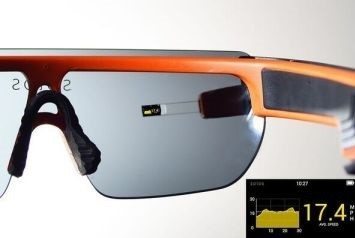
<Kopin’s world’s smallest smart glass display publicized in January 2016, businesswire.com>

BY HYUNJUN JANG, HANA OH

[KVRF2016] Even KVRF 2016, OLED leads VR industry

Korea VR festival 2016 (below “KVRF2016”) which can confirm present and future of virtual reality (VR) and augmented reality (AR) industry was opened from October 6 to October 9 at Nuridream Square of Sangam DMC.
In this event, 79 companies including global enterprises such as Samsung Electronics, Sangwha Planning, Oculus, Sony Co., etc. participated in, and new technology of each company was able to be checked on because approximately 157 booths were prepared in common production center, outdoor center, and business center.

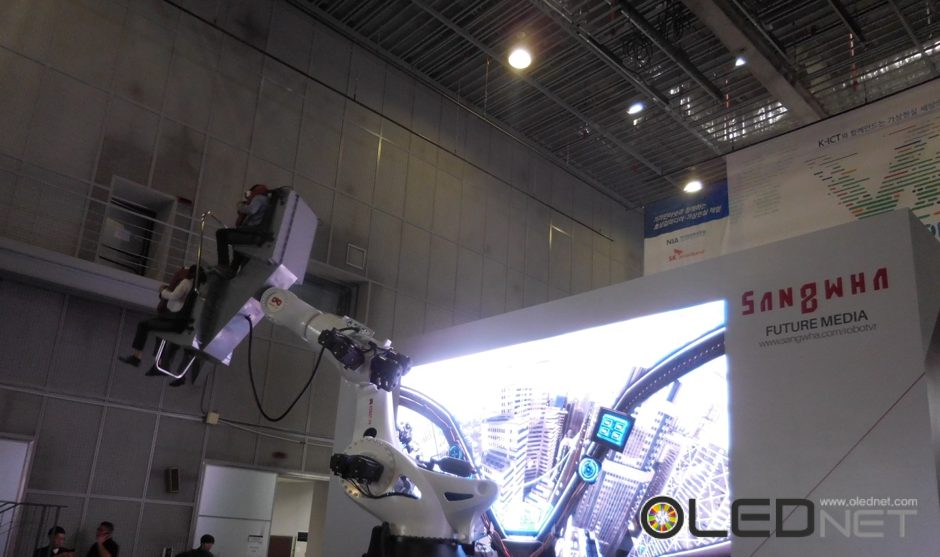
<VR Simulator using a huge robot arm of Sangwha Planning>

While interests in VR and AR are enlarged due to recent Poke’mon GO, many spectators visited this place with keen attention, each company shows off various interactive-typed contents such as roller coaster, paragliding, Sokkuram experiencing etc as well as game contents including FPS, sky jump etc accordingly. .Besides, this event did not simply limited to games such like Eye-tracking linked with cognitive concentration training system was displayed by BIOTECH, and VR goggles for military simulation by P&C Solution, and also demonstrated a fact that VR industry could be multiply applied to whole fields such as education, health, army etc.

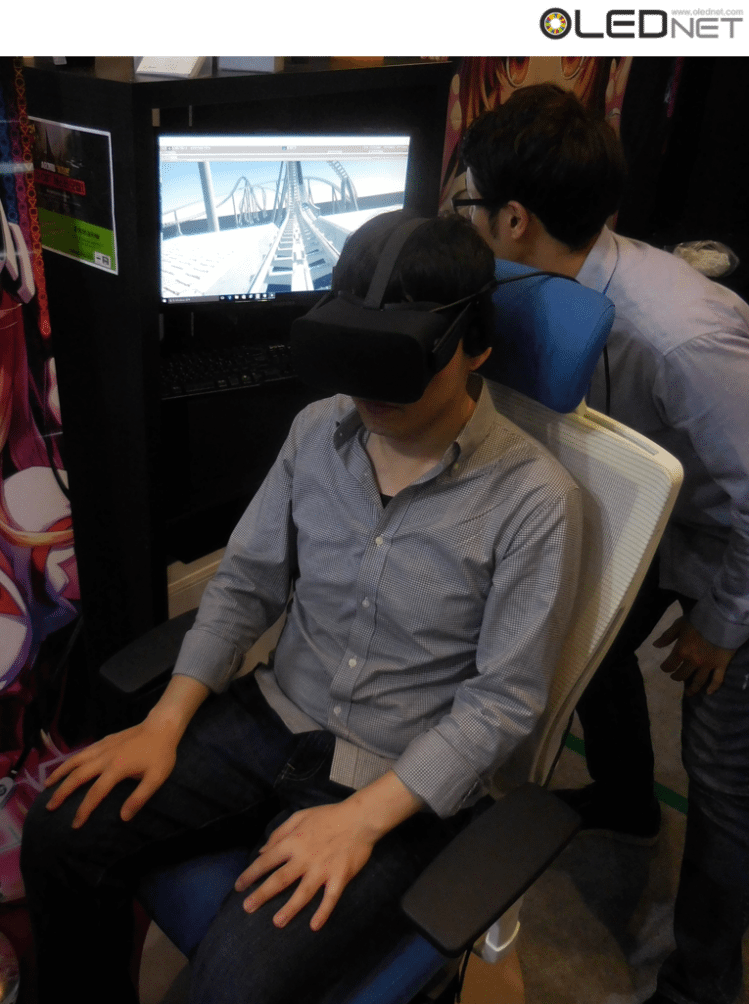
<VR 4D Simulator for Roller Coaster experiencing by MGAME Corp.>

One of interesting thing during observation was that AMOLED panel was used to majority expensive HMD (Head Mounted Display) devices. From Sony Playstation VR whose release is scheduled on 13th to Samsung Gear VR and Nibiru, a Chinese enterprise among Chinese companies, applied Samsung AMOLED. According to common opinions of company officials, they clarified AMOLED application due to issues relevant to response speed called Latency, even though there were BLU (Back Light Unit) and contrast problems which belonged to fundamental matters of LCD.. Latency indicates delaying time owing to inter-computer connections in on-line games frequently, but the reason is derived from limitations of implementing occurred delaying speed with LCD whenever moving user’s eyes, even though visual reality should quickly invoke new images too according to movement of user’s head in VR. No matter how the product has excellent computing power, AMOLED application is essential to make the delaying time shown in the screen to ‘0.’

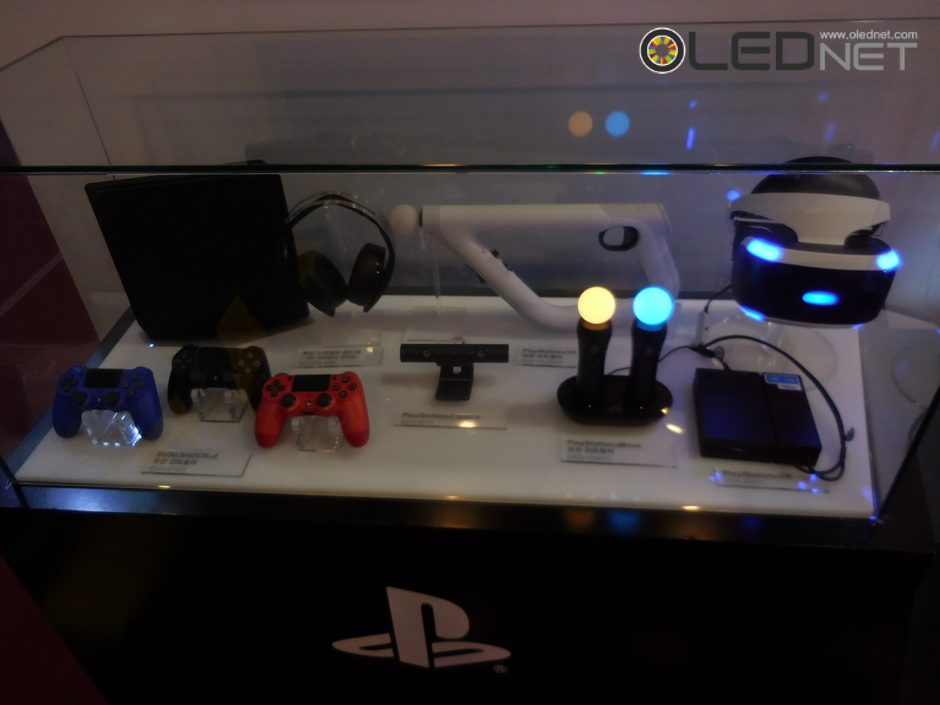
<VR product series of Playstation whose release are planned soon>

Interests in VR have been heightened such like a lot of enterprises and business start-ups in the exhibition hall were boasting their VR technology and VR café was opened in Gangnam, Korea first etc., but there was a realistic saying that even profit model could not be set up properly because related regulations on VR were vague yet and standardization in domestic was not clear as well. Business models and VR industry participation by enterprises become to be different according to legal regulations, so government should provide suitable assistance and methods to make systematic profit platform so that VR industry could strengthen global competitiveness.