[ICDT 2026] BOE Highlights Low Reflectance as the Key for Ultra-Large OLEDs… Proposes COE Technology as a Solution
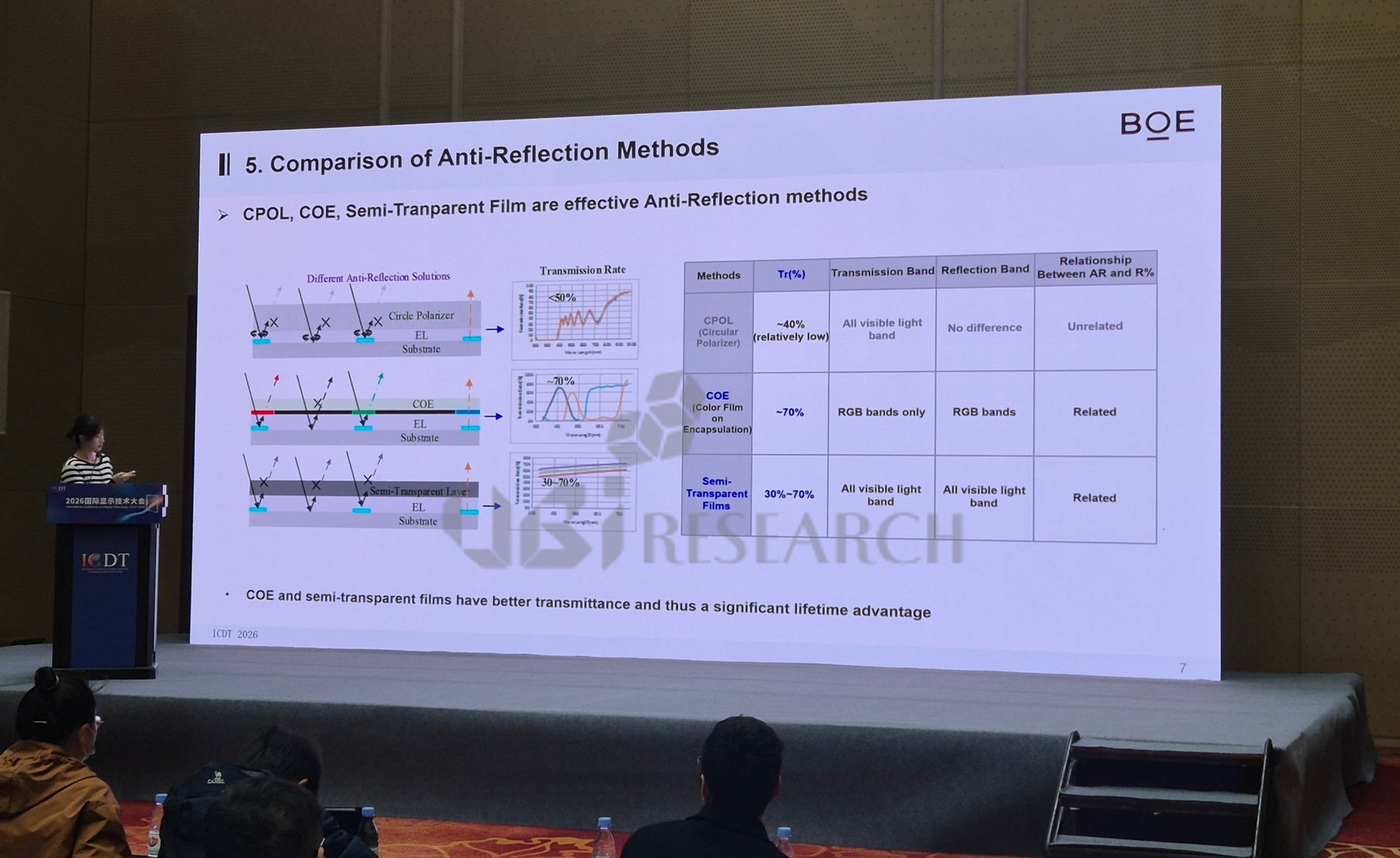
At ICDT 2026, BOE presented a polarizer-free structure using COE and Semi-Transparent Films as a solution for reducing reflection in large-size OLEDs, replacing the traditional CPOL structure. (Source: UBI Research)
At ICDT 2026, BOE presented “Application of ACR Optimization Technology for Wide Viewing Angle in Large-Size OLED Displays,” emphasizing low reflectance and improved ACR (Ambient Contrast Ratio) as key competitive factors for ultra-large OLED displays.
As the ultra-large display market expands into ultra-large TVs, commercial signage, and video walls, visibility in various environments is becoming more important than simple brightness competition. In environments with indoor lighting or external light sources, reflected light can significantly degrade image quality, making effective reflection control a critical technology.
To address this issue, BOE focused on the structural differences in reflectance characteristics in ultra-large OLEDs. In conventional OLEDs, surface reflection and internal reflection appear together, but in ultra-large OLEDs, diffuse reflection becomes the dominant reflection component due to the AG (Anti-Glare) layer and diffusion layer. BOE therefore emphasized that reducing internal reflection itself, rather than simply lowering surface reflection, is the key to improving ACR.
BOE also announced that it has developed an 81-inch P0.9 ultra-large OLED display with a reflectance of 6.9% and an ACR of over 200:1 under 100 lux conditions. The company stated that the display also achieved brightness above 500 nits and a lifetime exceeding 50,000 hours, making it suitable for commercial display environments.
In addition, seamless tiling is important for ultra-large displays. To achieve this, bezel reduction and a lower aperture ratio are both required. However, as the aperture ratio decreases, transmittance can also decline and affect lifetime, meaning that balancing reflectance, transmittance, and lifetime is essential.
In this context, BOE pointed out the limitations of conventional panel structures using CPOL (circular polarizer). While CPOL is effective in suppressing reflection, its relatively low transmittance makes it difficult to satisfy the lifetime and brightness requirements simultaneously in ultra-large displays.
As an alternative to CPOL, BOE proposed a non-polarizer structure using COE (Color Filter on Encapsulation) and semi-transparent film. According to BOE, this structure is more suitable for ultra-large OLEDs because it can secure lifetime and brightness through higher transmittance while also effectively controlling reflectance.
The non-polarizer approach proposed by BOE can address reflectance, transmittance, lifetime, and seamless tiling requirements simultaneously in ultra-large OLEDs. A structure using COE and semi-transparent film could be considered a more suitable solution for ultra-large OLEDs than conventional CPOL, and may become an important factor in the development of ultra-large commercial OLED displays.
Junho Kim, Analyst at UBI Research (alertriot@ubiresearch.com)
 2026 Medium & Large Size OLED Display Annual Report
2026 Small OLED Display Annual Report
※ This article is produced by UBIResearchNet.
Unauthorized reproduction or citation without source attribution is prohibited.
When quoting, please clearly indicate the source (UBIResearchNet) and provide a link.


 China Trends Report Inquiry