Posts

[DIC EXPO 2025] EDO Showcases OLED Capabilities, Sets Sights on Global Market Expansion

At DIC EXPO 2025 in Shanghai, China, EverDisplay Optronics (EDO), a leading Chinese AMOLED specialist, set up a large booth and showcased its extensive OLED product portfolio. While EDO is a relatively rare participant in major international display exhibitions, it highlighted its latest products and technologies at this year’s DIC EXPO, demonstrating a strong commitment to market expansion.

Founded in 2012, EDO is one of the leaders in successfully mass producing AMOLEDs in China at a relatively early stage. Currently producing both rigid and flexible OLEDs, EDO has recently expanded into high-value-added markets such as foldable OLEDs and automotive OLEDs. In particular, it holds the number one position in China in the mid- to large-sized AMOLED (tablets, laptops, etc.) market, demonstrating a dominant presence in the tablet and laptop display markets. In 2024, EDO’s OLED panel shipments reached 42.6 million units and revenue reached $462.3 million, ranking it fifth among Chinese OLED panel manufacturers. Key to this success are strategic partnerships, including supplying tablet panels to major clients such as HONOR and Huawei, and providing 14-inch 2.8K and 1.9K OLED panels to global PC brand Acer.

EDO operates both G4.5 and G6 production lines in Shanghai. The G4.5 line primarily produces panels for wearables and smartphones, while the G6 line produces large-scale panels for tablets, laptops, automobiles, monitors, and aircraft. Its monthly production capacity reaches 30,000 substrates. In the aviation industry, EDO supplies 15.6-inch, 21.6-inch, and 27-inch AMOLED panels to global airlines through Panasonic. For automotive OLEDs, EDO supplies 13-inch and 15.1-inch Tandem OLED panels to companies such as Geely.

EDO’s 11.3-inch LTPO OLED tablet display showcased at DIC EXPO 2025

11.3-inch LTPO OLED, Source: EDO

EDO’s 14.2-inch hybrid, tandem OLED tablet display showcased at DIC EXPO 2025

14.2-inch Hybrid, Tandem OLED, Source: EDO

At this exhibition, tablets utilizing Hybrid OLED and Tandem OLED technologies attracted the attention of visitors. EDO became the first company in China to mass-produce tablets utilizing Hybrid OLED and Tandem OLED in 2024, and has also successfully mass-produced a 27-inch 4K AMOLED monitor panel. LTPO TFT technology, designed for low power consumption, is also being widely applied to watches and tablets, improving energy efficiency.

EDO’s 21.6-inch and 27-inch OLED monitor panels displayed at DIC EXPO 2025

21.6-inch, 27-inch OLED Monitors, Source: EDO

Changwook Han, Executive Vice President/Analyst at UBI Research (cwhan@ubiresearch.com)

▶2025 Small OLED Display Annual Report Sample

▶2025 Mid-to-Large OLED Display Annual Report Sample

Everdisplay Accelerates Tandem OLED Production and Investment Amid Push for Profitability and Hong Kong IPO

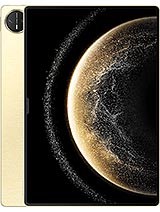
Huawei ‘MatePad Pro’

Huawei ‘MatePad Pro’

EDO

EDO


Chinese OLED specialist Everdisplay Optronics (EDO) is ramping up efforts to improve profitability and prepare for a potential listing on the Hong Kong Stock Exchange. The company is currently upgrading its production lines using vacuum deposition equipment from Japan’s Ulvac to enable manufacturing of tandem-structure OLED panels.

Tandem OLED technology stacks two or more light-emitting layers to achieve superior power efficiency and longer lifespan, making it increasingly favored in high-end OLED applications. EDO has already supplied tandem OLED panels for Huawei’s tablets—a production line that is reportedly operating profitably.

However, EDO’s broader OLED business remains in the red. To address this, the company is investing in new equipment as part of a long-term strategy to enhance profitability and expand production capabilities. The latest investment focuses on scaling up tandem OLED mass production, with a particular emphasis on the growing mid-to-large-sized OLED segment.

As of 2024, EDO’s shipments of mid-to-large-sized OLED panels are estimated at around 1.9 million units. Approximately 6–7% of these panels are used in automotive displays, while the majority are for tablet PCs. With increasing demand for OLED in the automotive sector, industry watchers expect EDO’s share in that segment to steadily grow in the coming years.

Junho Kim, UBI Research analyst(alertriot@ubiresearch.com)

▶ China Trend Report Inquiry

AMOLED panel for smart phones, just around the corner of 100million-unit shipment in a quarter

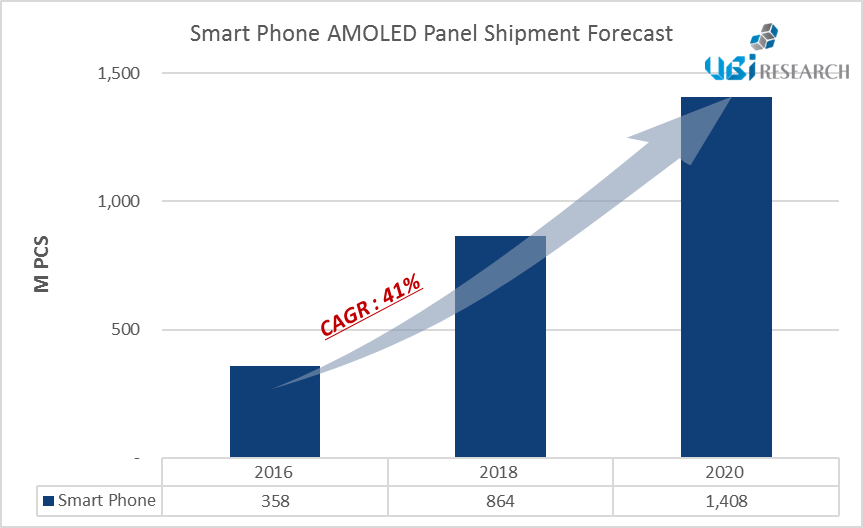
According to UBI Research, the shipment amount of AMOLED panel for smart phones in the 3rd quarter of 2016 was announced to be counted as 96million units.

It is the figure increased for 103% compared with the last quarter, and increased for 148% compared with the same period of last year, and it renewed the quarterly highest shipment amount once again, after the last quarter.

The person in charge of UBI Research mentioned that “The output of flexible AMOLED panels for Galaxy Note 7 was reduced compared to the plan due to the discontinuation of the production of Galaxy Note 7, however, the increase in shipments of AMOLED panels for China and Galaxy s7 series is seemed to play a important role in the increase of shipments in the third quarter.”

Currently, Samsung Display occupies more than 91% of the AMOLED panel market for smart phones, and Chinese panel makers such as BOE, EDO, Tianma, and Visionox are conducting mass production with small quantities.

In addition, Apple is expected to apply the flexible AMOLED panel to some models of the iPhone to be launched in 2017, therefore, future AMOLED panel market for smart phones will be increased continuously.

UBI Research expects that the annual shipment amount of AMOLED panel will form the market volume as about 1.4billion units by 2020 with the average annual growth rate of 41%, and flexible AMOLED panel among them will account for about 61%.

Smart Phone AMOLED Panel Shipment Forecast, Source : UBI research

BY HYUNJUN JANG, HANA OH

BOE’s Decision to Invest 46.5 Billion Yuan in Flexible OLED Line

According to a radio and TV source of Mianyang in Sìchuan Province, BOE has decided to invest 46.5 billion yuan(about 7.8 trillion KRW) in Gen6 flexible AMOLED production line.

BOE plans to begin construction in December 2016 and produce the items from 2019, and its capacity is 48K per month. It is expected to be used for producing high-end smartphones. BOE is carrying out 45K investment in Gen6 flexible AMOLED in Chengdu, and as part of this extension it is scheduled to put additional investment.

The investment in OLED has accelerated recently. Chinese panel companies including Visonox and EDO as well as BOE have decided to put investment in the production line of Gen6 flexible AMOLED panel and establish more lines.

BOE’s Gen6 flexible AMOLED panel production line where the investment has been decided or is still ongoing accounts for 75% of 120k that is total capacity of A3 Line, Gen6 flexible AMOLED production line of Samsung Display. If other Chinese panel companies’ investment that has been already decided or is ongoing is combined together, the investment exceeds Korea’s flexible AMOLED panel production capacity, even allowing for Samsung Display and LG Display’s additional investment.

With China’s active investment in flexible AMOLED panel production line, Chinese AMOLED panel market is expected to grow rapidly.

[CES Asis 2016] EDO, Accelerates Its Wearable Market…Reveals AMOLED Equipped VR

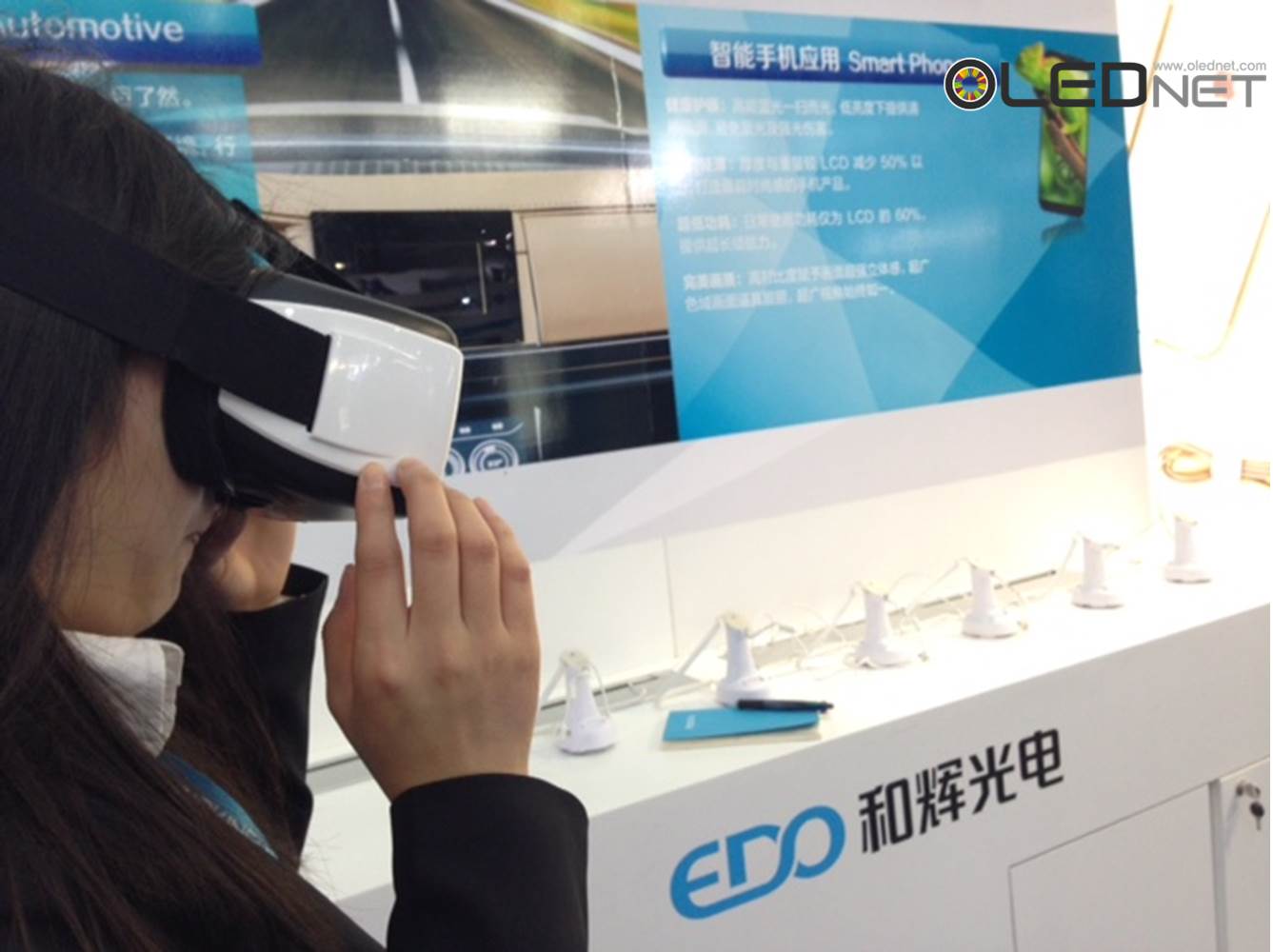
EDO`s VR Device

EverDisplay `s VR Device

Shanghai=Hyunjoo Kang / jjoo@olednet.com

EverDisplay (EDO), whose main force is mobile AMOLED, is accelerating its wearable market target.

In CES Asia 2016 (11-13 May) held in Shanghai, China, EDO presented VR (virtual reality) device equipped with their own AMOLED and revealed their roadmap in this market. The company displayed the VR device at the exhibition booth allowing the visitors to experience it. EDO explained that the device is a beta version, and although it has not been released, the picture quality is superior compared to LCD or LED equipped VR.

According to EDO, the company is planning to produce 3.2 inch 1K 400 ppi AMOLED for VR this year, and 3.5 inch 1.5K 600 ppi panel in 2017. Following this, the panel is to be improved to 2K 750 ppi in 2018, and EDO is planning produce flexible based 800 ppi panel in 2019.

EDO also revealed new AMOLED product in smartphone sector. In this exhibition, EDO showed 5.5 inch FHD panel that is already being mass produced, and flexible 6 inch panel to be mass produced in future.

Furthermore, the company exhibited new AMOLED panel in 3 types, 1.2 inch, 1.4 inch, and 1.41 inch, for smartwatch that will be consecutively launched from July. Of these, the 1.2 inch panel is expected to be used for Huawei’s smartwatch for women to be released in September.

CES Asia 2016’s participants greatly increased compared to last year, and 375 companies from 23 countries are taking part. Major companies such as Intel, Twitter, and BMW discuss wearable, VR, driverless cars, future of TV, etc. though conference.


[CES Asis 2016] Huawei to Release 1.2“ AMOLED Smartwatch for Women… EDO Panel Applied

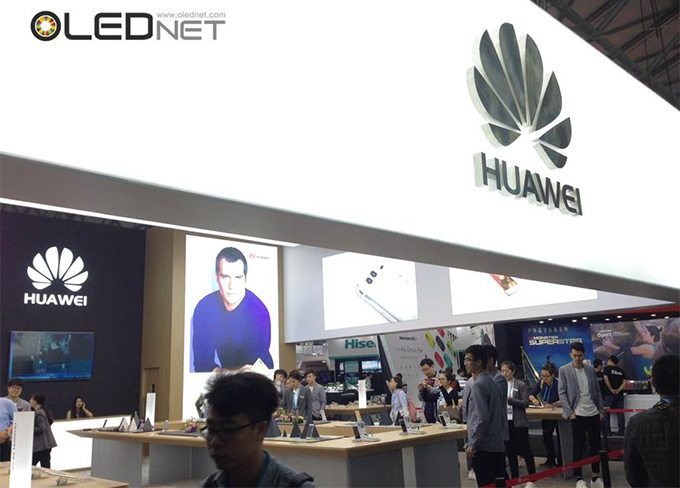
Huawei booth

Shanghai = Hyunjoo Kang / jjoo@olednet.com

Huawei is expected to release 1.2 inch AMOLED panel equipped smartwatch for women in September if early.

In CES Asia 2016 (11-13 May) held in Shanghai, China, Everdisplay (EDO) revealed that the 1.2 inch AMOLED panel product will be released in July, and Huawei will launch smartwatch for women equipped with this panel in September.

Previously Huawei released smartwatch for men equipped with EDO’s 1.4 inch AMOLED.

EDO, whose main focus is on AMOLED panel for mobile device, showed new AMOLED panels through this exhibition. EDO explained that of AMOLED panels for smartphone, 1.2 inch, 1.41 inch, and 1.4 inch panels are not yet released, and that 1.2 inch panel will be launched in July and 1.4 inch in 2017.

During this event, EDO also revealed 6 inch AMOLED panel to be mass produced in future and beta version of VR device equipped with their own AMOLED.

CES Asia 2016’s participants greatly increased compared to last year, and 375 companies from 23 countries are taking part. Major companies such as Intel, Twitter, and BMW discuss wearable, VR, driverless cars, future of TV, etc. though conference.