Posts

Stacked bar chart illustrating the $2.27 billion global OLED emitting material market in 2025, broken down by purchasing panel makers like Samsung, LG, and BOE.

The global OLED emitting Materials market reaches USD 2.27 billion… Chinese suppliers begin a full-scale rise in market share
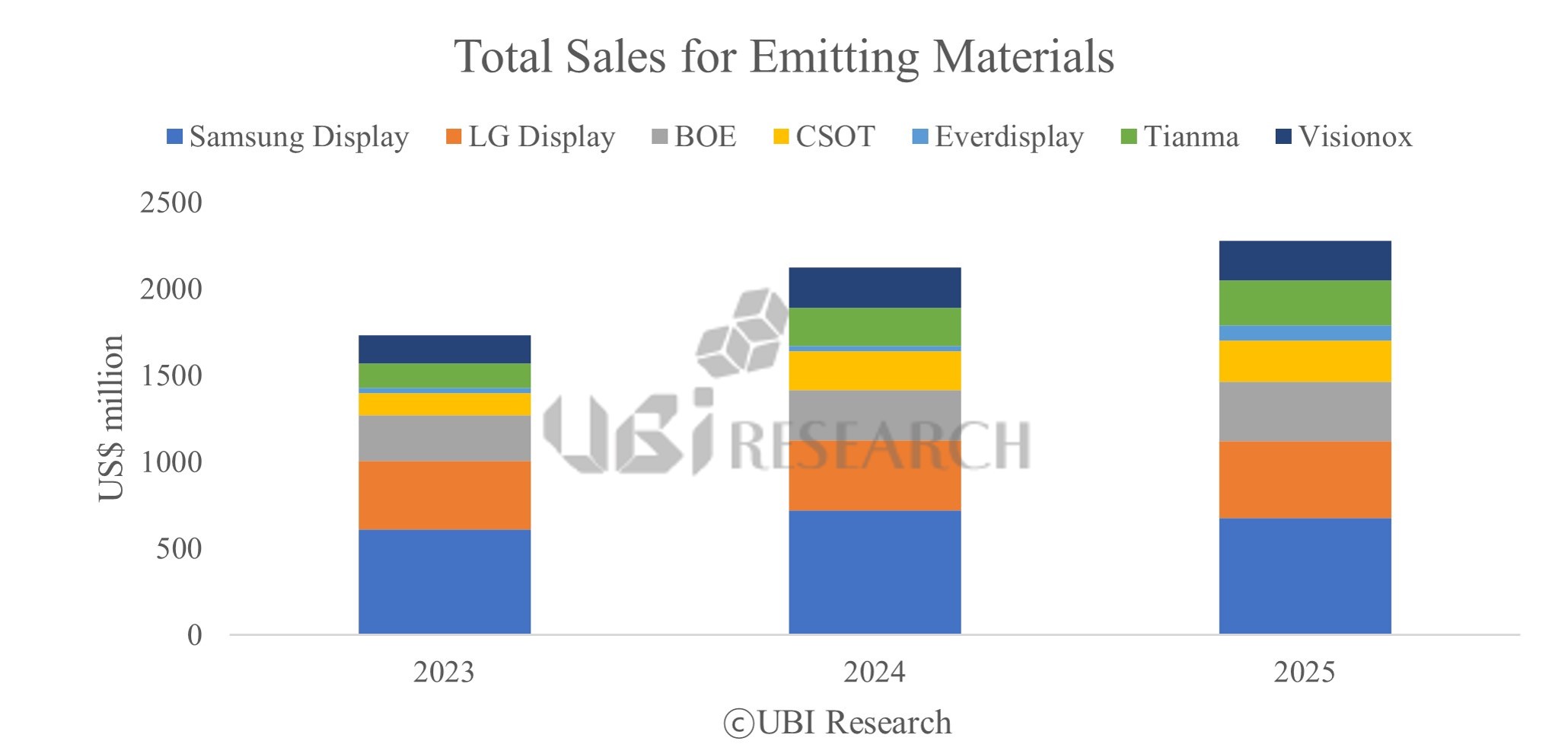
Stacked bar chart showing the trend of OLED emitting material sales by major panel makers including Samsung Display, LG Display, and BOE from 2023 to 2025

Trend of emitting material purchases by major OLED panel makers from 2023 to 2025. The total market reached $2.27 billion in 2025, with Chinese panel makers’ purchase volume surpassing Korea’s for the first time. (Source: UBI Research)

According to UBI Research’s recently published OLED Emitting Material Market Tracker, global revenues of OLED emitting Material suppliers totaled USD 2.27 billion in 2025, up 7.2% year-on-year.

From the third quarter—when mass production of OLED panels for Apple’s new products accelerated—Korean panel makers increased their purchases of emitting Materials. Purchases by Chinese panel makers also remained at a level similar to the previous quarter. As a result, the overall OLED emitting Materials market was larger in the second half than in the first half of the year.

By country, the share of emitting-material purchases by Korean OLED panel makers in 2025 was estimated at about 49.1%, and purchase spending by Chinese OLED panel makers surpassed that of Korean panel makers for the first time.

On the supplier side, revenue growth is becoming increasingly visible not only among Korean, U.S., and Japanese material companies, but also among Chinese OLED emitting Material vendors. UBI Research’s OLED Emitting Materials Market Tracker indicates that while established global suppliers such as UDC, LG Chem, and Samsung SDI continue to maintain high revenue levels, Chinese suppliers—including Beijing Summer Sprout, LTOM, Hyperions, and Jilin OLED—are rapidly expanding deliveries to new OLED panel makers, driving steep revenue increases.

In the mid to long term, the OLED emitting Materials market is expected to expand further. UBI Research forecasts continued growth of the global emitting Materials market, and expects revenue growth among Chinese suppliers—beyond the existing major global players—to accelerate even more.

However, it is expected to take additional time before new Chinese emitting-material suppliers begin supplying materials to Korean panel makers in earnest. In the near term, Chinese suppliers are likely to raise market share rapidly primarily through sales to Chinese panel makers.

Changho Noh, an analyst at UBI Research, commented: “The growth momentum of Chinese OLED emitting Material suppliers is clearly emerging as a threat to established global suppliers. However, for new suppliers to enter the supply chains of Korean panel makers, commercialization procedures such as quality validation, long-term reliability assessments, and customer qualification are essential. Therefore, a full-scale shift in a short period of time is likely to be limited.” He added, “For the time being, market share and revenues are highly likely to expand quickly, centered on supplies to domestic Chinese panel makers, and existing suppliers need to closely monitor the pace at which Chinese suppliers are spreading.”

Changho Noh,  Senior Analyst at UBI Research  (chnoh@ubiresearch.com)

▶Pre-register for Display Korea 2026

▶OLED Emitting Material Market Tracker Sample

※ This article is produced by UBIResearchNet.

Unauthorized reproduction or citation without source attribution is prohibited.

When quoting, please clearly indicate the source (UBIResearchNet) and provide a link.

Featured graphic highlighting 6.2% QoQ rise in OLED emitter purchases to $521M in Q3 2025, driven by iPhone 17 and iPad Pro (Source: UBI Research)

3Q25 OLED Emitting Material Purchases Rise 6.2%… Driven by iPhone 17 and iPad Pro Demand

Q3 2025 OLED emitter total sales chart (Source: UBI Research)

Q3 2025 OLED emitter total sales by UBI Research

According to UBI Research’s recently published OLED Emitting Material Market Tracker, global OLED panel makers recorded USD 521 million in emitting material purchases in the third quarter of 2025, marking a 6.2% increase QoQ. Purchases increased across most applications—including smartphones, notebooks, tablet PCs, and monitors—and all major panel makers except CSOT posted higher spending during the quarter.

The ramp-up of iPhone 17 series OLED panel shipments in Q3 significantly boosted small-sized OLED production by Korean panel makers, while most Chinese panel makers also saw rising shipment volumes. Tablet PC OLED shipments, which had been weak in Q2, began to recover as supply of new iPad Pro OLED panels increased.

The emitting material market is expected to expand further over the mid- to long-term. UBI Research forecasts global emitting material purchases to grow from USD 2.93 billion in 2025 to USD 3.47 billion in 2029. Growth in the mid-to-large-sized OLED segment is projected to outpace that of small-sized OLEDs, driven largely by Apple’s adoption of tandem OLED structures across major IT products such as the iPad Pro and MacBook. This shift is accelerating structural demand for higher-performance OLED materials.

OLED adoption in the automotive display market is also emerging as a key structural growth driver. As vehicles increasingly demand high brightness and durability, the adoption of 2-stack tandem OLED structures is expected to expand, leading to steady increases in emitting material consumption for automotive applications.

Structural changes are also evident in the demand outlook by OLED architecture. The share of RGB single-stack OLED, currently the dominant structure, is expected to decline by around 10% by 2029. In contrast, emitting material purchases for RGB 2-stack tandem OLEDs are projected to grow at the fastest pace. This trend aligns with the rapid expansion of IT and automotive OLED markets, where high-reliability and high-brightness performance requirements favor tandem structures.

Investment strategies among panel makers are further contributing to the expansion of the emitting material market. Major Korean and Chinese panel makers are actively investing in 8.6-generation IT-oriented OLED production lines, accelerating a long-term shift from a small-sized OLED–centric market toward a structure in which IT and automotive OLEDs account for a larger share. Beginning in 2026, Samsung Display, BOE, and Visionox are expected to begin full-scale mass production on their 8.6G 2-stack tandem OLED lines, which will drive a rapid increase in related emitting material consumption.

UBI Research analyst Noh Chang-ho stated, “Once full-scale mass production begins after 2026, emitting material consumption for RGB 2-stack tandem OLEDs will grow rapidly.” However, he also cautioned that “as Chinese emitting material suppliers begin providing low-cost materials to domestic panel makers, the growth rate of emitting material purchase value may not fully match the increase in consumption volume,” highlighting rising concerns over intensifying price competition.

Changho Noh,  Senior Analyst at UBI Research  (chnoh@ubiresearch.com)

▶OLED Emitting Material Market Tracker Sample

Featured image of Xiaomi 17 Pro Max highlighting TCL CSOT OLED panel supply

Xiaomi unveils flagship 17 Pro Max… TCL CSOT supplies Real RGB OLED panels and changes Red Host supplier

Xiaomi 17 Pro Max unveiled with TCL CSOT Real RGB OLED panel

Xiaomi 17 Pro Max unveiled with TCL CSOT Real RGB OLED panel (Source: Xiaomi)

On September 25th, Xiaomi unveiled three new smartphones, the Xiaomi 17 Series (Regular, Pro, and Pro Max). TCL CSOT has announced that it will exclusively supply all displays (front + back) of the Xiaomi 17 Pro and 17 Pro Max. The Pro Max’s main display is a 6.9-inch 1200×2608 high-resolution LTPO AMOLED panel with a 120Hz refresh rate and 3,500 nits of brightness. The rear is also a 2.9-inch LTPO AMOLED with a resolution of 596×976.

TCL CSOT has been working on developing a Real RGB structure using inkjet printing technology for a long time, so some speculated that the Xiaomi 17 Pro Max would also feature this technology. However, the Real RGB structure is actually realized through a Fine Metal Mask (FMM) process. This means that each pixel is composed of independent red, green, and blue subpixels, resulting in excellent clarity and accurate colors without any loss of resolution.

The diamond pixel structure, which Samsung Display primarily uses, has the advantages of higher luminous efficiency, more resistance to burn-in, and higher perceived resolution while reducing the number of physical pixels, which is advantageous for cost-effective high-resolution implementation. It also has strong patent protection, which has acted as a barrier to entry for other companies. However, it has been pointed out that the diamond pixel structure does not have the same number of R, G, and B subpixels, which can cause slight readability degradation or color bleeding, especially in small text or complex graphics.

TCL CSOT’s Real RGB structure appears to be a strategic move to improve visual quality, including color accuracy and text readability, and to avoid Samsung patents. TCL CSOT’s continued investment in inkjet printing Real RGB technology, while supplying FMM-based Real RGB for major products like the Xiaomi 17 Pro Max, suggests that TCL CSOT is actively exploring both technological paths. While inkjet printing has potential for large OLEDs and cost-effectiveness in the long term, there are still challenges to overcome, including technical difficulties, mass production, and reliability, before it can be applied to small, high-resolution products.

TCL CSOT’s new panel features a C10 set, the latest emissive layer stack structure, to improve luminescence efficiency and stability. A particularly noteworthy point is that among the core light-emitting materials, Lumilan’s material was applied instead of the DuPont product previously used for the Red Host. Founded in 2017, Lumilan is a Chinese company specializing in OLED materials, backed by China’s Jizhi Technology and Xiaomi Changjiang Industrial Fund. With a factory in Ningbo, Zhejiang Province, the company has been focusing on the R&D, production and sales of OLED emitting materials, and has strengthened its strategic partnership with Xiaomi, including the establishment of a joint research center in 2022. The Xiaomi 17 Pro Max application is the fruit of that cooperation. The replacement of one of the main core luminescent materials with a Chinese company’s product heralds a new change in the supply chain of the global display industry.

Changho Noh,  Senior Analyst at UBI Research  (chnoh@ubiresearch.com)

▶2025 OLED Emitting Materials Report Sample

▶OLED Emitting Material Market Tracker Sample

OLED emitting material market share by nation, Korea leading overall while China rises in smartphones

OLED Emitting Material Market Landscape Shifts… Korea Maintains Overall Lead While China Advances in Smartphones

OLED emitting material market share by nation, comparison of Korea and China (Source: UBI Research)

OLED emitting material market share trends by nation (Source: UBI Research)

According to the Q3 Emitting Material Market Tracker recently published by UBI Research, Korean panel makers maintained their lead over Chinese competitors in total OLED emitting material purchases in the first half of 2025. Korean panel makers purchased approximately 36.7 tons, accounting for 59.9% of the total, while Chinese panel makers purchased 24.6 tons, representing 40.1%. By quarter, Korea recorded 18.6 tons versus China’s 12.8 tons in Q1 2025, and 18.1 tons versus 11.8 tons in Q2, continuing a stable lead.

While Korea continues to dominate the overall OLED emitting material market, the smartphone segment shows a different trend. Since 2025, Chinese panel makers have consistently exceeded 50% market share on a quarterly basis, surpassing Korea in the first-half total as well. This indicates that although Korea remains ahead in the overall OLED emitting material market, China’s share is steadily expanding in smartphones, a core application segment. Backed by its strong domestic demand, China has rapidly increased shipments, suggesting that the balance between the two countries is gradually shifting in the medium to long term.

By company, Samsung Display accounted for about 40% of the total OLED emitting material purchases, maintaining the largest share, followed by LG Display, BOE, and Tianma. In contrast, in the smartphone OLED emitting material market, BOE closely followed Samsung Display, with Tianma, TCL CSOT, and LG Display trailing behind. Thus, while Korean panel makers still demonstrate clear strength in the overall market, Chinese panel makers are making notable strides in the smartphone sector.

UBI Research analyst Noh Chang-ho stated, “Although Korea has been overtaken by China in the smartphone OLED emitting material market, Samsung Display and LG Display remain ahead in the overall OLED market, supplying IT panels, QD-OLED, and WOLED,” adding, “However, as Chinese panel makers expand shipments of smartphones and foldables, along with increasing IT OLED production, the gap between Korea and China in the emitting material market is narrowing rapidly.”

Changho Noh,  Senior Analyst at UBI Research  (chnoh@ubiresearch.com)

▶OLED Emitting Material Market Tracker Sample

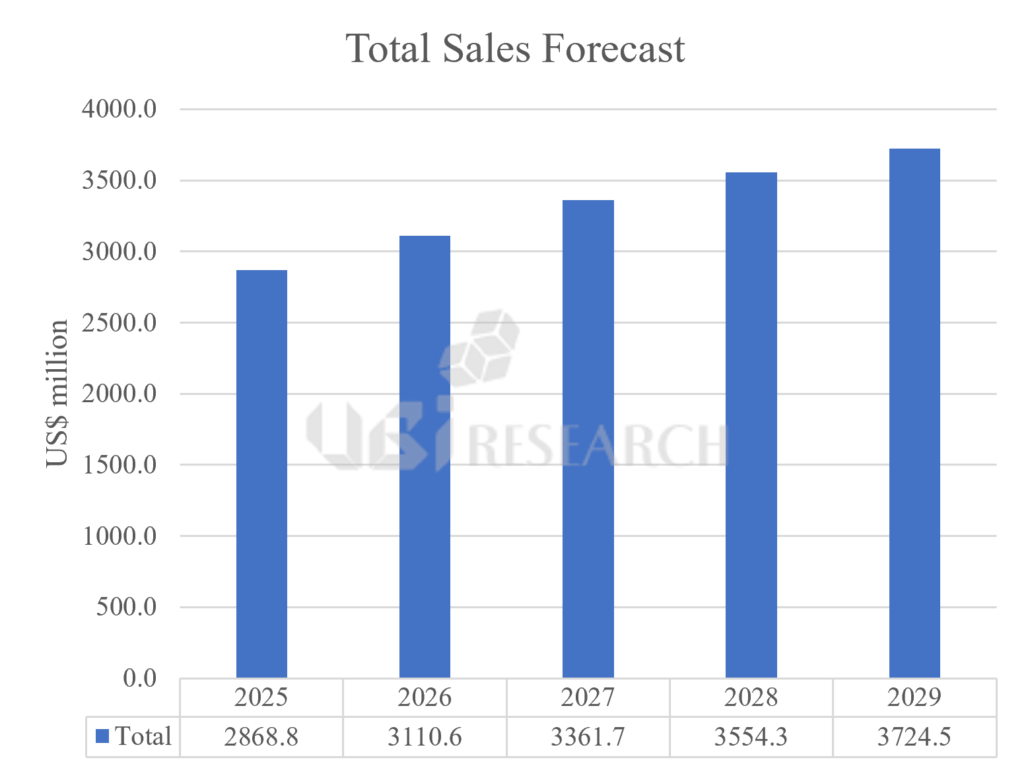
OLED Emitting Material Market Projected to Grow from $2.86 Billion in 2025 to $3.72 Billion by 2029

2Q25-Quaterly-OLED-Emitting-Material-Market-Tracker

‘2Q25_Quaterly OLED Emitting Material Market Tracker’

According to UBI Research’s “2Q25_Quarterly OLED Emitting Material Market Tracker”, the OLED emitting material market reached $490 million in the first quarter of 2025 and is expected to achieve a total of $2.86 billion for the full year. The market is projected to grow at a compound annual growth rate (CAGR) of 6.7%, reaching $3.72 billion by 2029.

By nation, due to the production cycle characteristics of Korean panel makers—whose shipments are concentrated in the second half of the year—Chinese OLED panel makers surpassed Korean makers in terms of emitting material revenue for the first time in Q1 2025. However, with the mass production of Apple’s iPhone 17 and iPad Pro panels beginning in Q2, Korean panel makers are expected to regain the lead in the second half of the year.

In terms of company-specific material usage in 2025, Samsung Display is projected to hold a 39.8% share, followed by LG Display with 19.9%, and BOE with 13.1%. Korean panel makers are expected to maintain a combined market share of 55% through 2029.

UBI Research analyst Changho Noh stated, “Although Chinese panel makers temporarily overtook their Korean counterparts in emitting material revenue in Q1 2025, Korean companies are expected to recover soon,” and added, “While Korean panel makers may fall behind Chinese makers in shipment volume from 2025, they will continue to dominate in terms of emitting material revenue for the time being.”

Chang Ho NOH, Analyst at UBI Research  (chnoh@ubiresearch.com)

▶OLED Emitting Material Market Tracker Sample

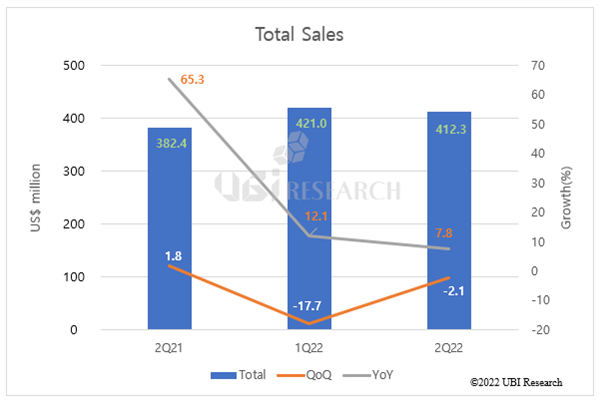
2Q22 OLED Light-Emitting Material Market $4.12 billion, up 7.8% from the Same Quarter Last Year

According to the “3Q22 OLED Emitting Material Market Track” published quarterly by UBI Research, purchases of OLED light-emitting materials in the second quarter of 2022 amounted to $4.12 billion.

In the second quarter of 2022, the OLED light-emitting material market decreased by 2.1% compared to the previous quarter and increased by 7.8% compared to the same quarter last year. Overall, there was a decrease in panel shipments of Samsung Display and LG Display due to the off-season, but sales did not decrease significantly from the previous quarter due to rising exchange rates and the supply of new materials.

In the small OLED panel market, Samsung Display’s second-quarter purchase of light-emitting materials fell 2.2 % from the previous quarter to $1.52 billion, BOE fell 11.7% to $53.1 million, and LG Display fell 12.6% from the previous quarter to $39.7 million.

For OLED TVs, LG Display’s second-quarter purchase of light-emitting materials was $77.3 million, similar to the previous quarter, while Samsung Display’s purchase of materials for TVs was $28.3 million, up slightly from the previous quarter.

2Q 2022 OLED Emitting Materials Market

2Q 2022 OLED Emitting Materials Market

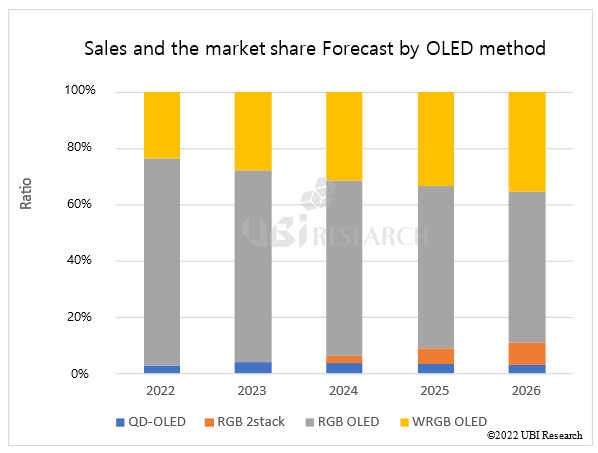
Sales of OLED light-emitting materials for each quarter were classified by layer, and the expected sales until 2026 were expressed as a 100% cumulative graph.

Sales and the market share Forecast by OLED method

Sales and the market share Forecast by OLED method

The OLED light-emitting material market is predicted to be $1.81 billion in 2022 and $2.5 billion in 2026. As shipments of WRGB OLEDs are expected to exceed 20 million units in 2026, purchases of light-emitting materials for WRGB OLEDs are expected to reach $900 million in 2026 from $4.3 billion in 2022. As the RGB 2stack market for IT grows, it is expected to reach $53.4 million in 2024 and $190 million in 2026.

Sales of luminescent layer and common layer were investigated to identify the overall market of light-emitting materials, and performance was analyzed by dividing them into countries, panel companies, applied products, layers, and OLED methods (RGB, WRGB, and QD-OLED). In addition, OLED market information up to 2026 was predicted by predicting the usage and sales of light-emitting materials by each company over the next five years. The Market Track Quarterly Report provides necessary information to industry workers who lead OLED industries.

▶ 3Q22 OLED Emitting Material Market Track Sample Download

Is green emitting material a key material in the high refresh rate trend?

green emitting material capacitance

OLED material

Recently released smartphones support a fast refresh rate of 120 Hz. Such a fast refresh rate allows smooth screen transitions and can express dynamic movements, especially in games, but consumes a lot of power.

Major set makers such as Samsung Electronics and Apple started to use OLEDs with LTPO TFTs, which consume relatively low power while realizing a refresh rate of 120 Hz and OLED smartphones to which LTPO TFT is applied are positioned in each set maker’s ultra-premium lineup.

In this high refresh rate trend, the capacitance of the green emitting material is becoming an issue.

If the capacitance of the green emitting material is high, dragging may occur when switching the screen in the high refresh rate mode. Since the human eye responds the most to green, the green appears prominently, which may cause problems in color expression.

For this reason, it is understood that some material makers have recently received requests from set or panel makers to lower the capacitance characteristics of green emitting materials.

Daejeong Yoon, an analyst at UBI Research, said, “The biggest issue for material companies in the past and still is lifetime and efficiency, but recently, even the capacitance of materials has become an issue due to the trend of high refresh rate.” And “Green material with deuterium substitution technology will be applied to some mass production from the second half of this year, and material makers are immediately forced to develop green materials with low capacitance.”

As smartphones supporting a high refresh rate of 120 Hz are expected to become mainstream in the future, the use of green emitting materials with low capacitance is also expected to increase.

▶ 2022 OLED Emitting Material Report Sample Download

1Q of 2022 OLED Emitting Material Market $420 million, up 9% Compared to the Same Quarter of the Previous Year

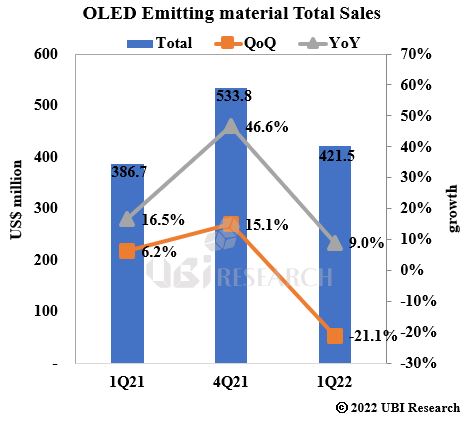
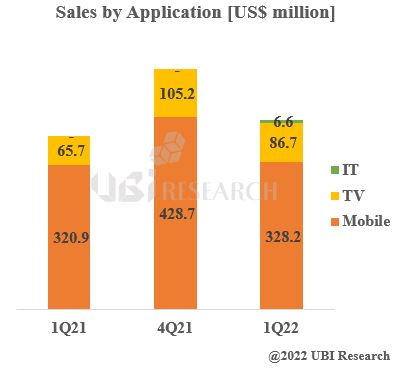
According to “2Q22 OLED Emitting Material Market Track”, a quarterly report published by UBI Research, the sales of emitting materials in the first quarter were $421 million, down 21.1% (QoQ) from $533 million in the previous quarter but was an increase by 9% (YoY)when compared to $386 million in the first quarter of 2021.
Although sales of emitting materials for TV and mobile devices decreased compared to the previous quarter, IT sales recorded a meaningful figure of $6.6 million. Although sales fluctuate depending on seasonal demand for applied products, if the sales of emitting materials are analyzed by application product, TV use is gradually increasing.

The top 3 companies in 1Q sales were UDC($86.6 million), DuPont($41.3 million), and Duksan($37.5 million). Duksan became the number one company in sales as a Korean company. The overall sales of luminescent materials in the first quarter decreased compared to the previous quarter but only UDC’s sales increased. Sales decreased to $421.5 million in 1Q22 from $533.8 million in 4Q21. However, UDC’s 1Q22 sales increased to $86.6 million from 4Q21’s sales of $85.5 million. It is estimated that this is due to the rise in the price of rare earth metals, a key material for manufacturing dopant.
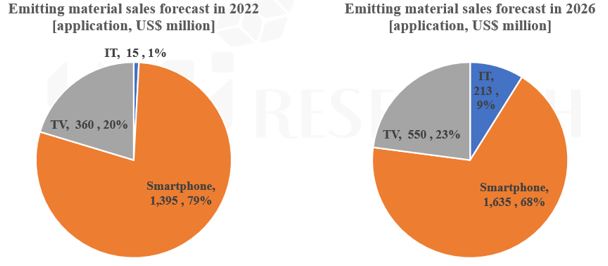
Estimated sales of emitting materials in 2022 are $1.77 billion and are expected to grow to $2.4 billion in 2026.
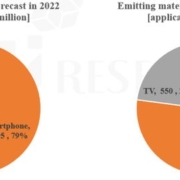
By application product, the projected sales of emitting materials for smartphones this year are $1.4 billion, accounting for 79% of the total.
Of the projected sales in 2026, emitting materials for TV are expected to reach $550 million, which is expected to increase by 23%. In addition, emitting materials for IT are expected to account for 9% of $210 million.

“OLED Emitting Material Market Track” surveys and analyzes the market for quarterly OLED emitting materials. The total market of light emitting materials was identified by examining sales by light emitting layer and common layer. Performance analysis was categorized by country, panel maker, application product, layer, and OLED method (RGB, WRGB, QD-OLED). In addition, OLED market information for the next five years (up to 2026) was forecasted by predicting the amount of emitting material usage and sales by company. The quarterly market track provides necessary information to industry professionals who lead the OLED industry.

UDC’s 2015 OLED Emitting Materials Revenue $ 113 million, a 11% Decrease…Still Leading Market

Source : UDC

Hyunjoo Kang / Reporter / jjoo@olednet.com

UDC (Universal Display) that is dominating the global OLED emitting materials market, recorded 11% reduced OLED emitting materials revenue in 2015 compared to 2014. Despite the decreased revenue, it maintained its top place in the market.

According to 2016 OLED Emitting Material Annual Report, published by UBI Research, UDC recorded approximately $ 113 million in 2015 OLED emitting materials revenue. In 2014, this company’s OLED emitting materials revenue recorded $ 127 million and led the global market, and maintained its position in 2015.

In particular, this company is a dominating presence in dopant materials sector. In 2015, UDC occupied 82% of the dopant materials sector, and the rest of the companies share the remaining 18%. Based on the phosphorescent patents, it is supplying phosphorescent red and green dopant to Samsung Display and LG Display.

Following UDC’s top place in 2015 global OLED emitting materials market in terms of revenue, Idemitsu Kosan ranked 2nd, and this was followed by Novaled, Dow Chem., and Samsung SDI. In 2013, Dow Chem. was at the top of the market, but since 2014 UDC overtook the leadership. In 2016, LG Display’s OLED TV mass production line operation rate, materials structure of Galaxy Note series to be mass produced in H2, and other factors are expected to affect the OLED emitting materials market.

UDC is scheduled to announce 2016 Q1 performance on 5 May (local time).