Posts

Featured graphic of 2024–2025 OLED shipment share by application highlighting smartphone dominance and China’s rising supply share (Source: UBI Research)

Dual Axes of the 2025 OLED Market: Korea’s Premium Focus and China’s Expansion in Shipments

The OLED market in 2024 and 2025 witnessed marked changes in both the demand structure by application and the supply structure by panel manufacturer. The smartphone-centric demand base became more robust, while major Korean and Chinese panel manufacturers, leveraging their distinct strengths, expanded their market contributions, leading to continued diversification in the OLED industry.

By application, smartphones dominated the OLED market in 2024, accounting for 82% of total shipments, reaching 833.8 million units. Watches accounted for 119.7 million units (12%), while other product groups, including tablets, laptops, monitors, and TVs, remained small markets. This structure continued in 2025, with smartphone shipments increasing to 920.7 million units, representing 84% of the total. Watches remained relatively stable at 113.4 million units, and the share of other product groups remained largely unchanged.

Pie charts of OLED shipments by application for 2024 and 2025 showing larger smartphone share (Source: UBI Research)

OLED shipment share by application, 2024 (left) and 2025 (right) (Source: UBI Research)

In 2024, the roles of Korea and China in OLED panel supply were clearly divided. Samsung Display maintained its position as the largest supplier with 410 million units (41%), while LG Display recorded 100 million units (11%). In the same year, Chinese panel makers continued their quantitative expansion, accounting for 48% of the total, with a combined shipment of 490 million units: BOE with 138 million units, Visionox with 114 million units, Tianma with 102 million units, CSOT with 83 million units, and EverDisplay with 43 million units.

This structure was further strengthened in 2025. Chinese panel makers, including BOE, Tianma, Visionox, CSOT, and EverDisplay, combined to ship 555 million units annually, accounting for over 51% of the global supply, emerging as a key player in the global supply chain. In the same year, Samsung Display maintained its technology-focused responsiveness, with shipments reaching 411 million units (37%), while LG Display reached 128 million units (12%).

The differences in sales strategies between the two countries were also clear. In 2024, Samsung Display solidified its premium-focused structure with $25.6 billion (57%), while LG Display also achieved $7 billion. Conversely, Chinese companies such as BOE, Visionox, and Tianma demonstrated a trend of expanding sales based on mass production. In 2025, LG Display grew significantly to $11.6 billion, and BOE’s shipments also expanded to $7.1 billion, further separating the two countries’ technology and production strategies.

In summary, the OLED market in 2025 saw a strengthened smartphone-centric demand structure, while Chinese companies accounted for over half of panel shipments, demonstrating a clear shift in regional composition. Korean companies maintained a sales structure centered on high-value-added products, while Chinese companies continued to expand their market presence based on increased shipments. UBI Research Executive Vice President Changwook Han said, “The 2025 OLED market is a period in which the supply structure by region and company is expanding simultaneously, with each company broadening its market response based on its product portfolio and technological capabilities.”

Changwook Han, Executive Vice President/Analyst at UBI Research (cwhan@ubiresearch.com)

▶ Quarterly Small OLED Display Market Tracker Sample

▶Quarterly Medium & Large OLED Display Market Tracker Sample

※ This article is produced by UBIResearchNet.
Unauthorized reproduction or citation without source attribution is prohibited.
When quoting, please clearly indicate the source (UBIResearchNet) and provide a link.

Featured image illustrating global IT OLED shipment growth forecast through 2029 (Source: UBI Research)

“Beyond Mobile” Era Begins… IT OLED to More Than Double by 2029

IT OLED shipment forecast chart for 2025–2029 (Source: UBI Research)

IT OLED shipment forecast (Source: UBI Research)

According to UBI Research’s recently published report, “Beyond Mobile: IT OLED Technology and Industry Analysis,” global shipments of IT OLEDs are expected to more than double from 24 million units in 2025 to 53 million units in 2029. The report states that OLED adoption in tablets, notebooks, and monitors is entering a structural growth phase over the next four years.

Company-level shipment projections also show clear shifts. Samsung Display, currently the largest producer of OLED panels for notebooks, tablets, and monitors, is expected to maintain a stable market share of more than 60%. LG Display, Everdisplay, BOE, and Visionox are projected to follow, shaping a competitive global landscape in the IT OLED market.

Because most IT OLED products use medium-to-large panel sizes, large-substrate production lines that maximize glass utilization rates are essential. As global device makers—especially Apple—accelerate their adoption of OLED across IT product categories, panel manufacturers are positioning 8.6-generation (8.6G) OLED line investments as a core strategic priority.

The investment landscape reflects this trend. After Samsung Display announced the industry’s first 8.6G OLED line investment worth approximately KRW 4 trillion in April 2023, BOE, Visionox, and TCL CSOT soon followed. More recently, Tianma has also begun reviewing 8.6G OLED investment, drawing attention across the industry. This shift signals that the OLED market is moving beyond a smartphone-centered structure and into a phase of expanding demand driven by notebooks, tablets, and monitors.

As the market grows, technology requirements for IT OLEDs are also becoming more stringent. The report highlights that IT products have longer replacement cycles and a higher percentage of white-background usage for document work, making them more vulnerable to burn-in than smartphones. As a result, 2-stack tandem OLED, known for long lifetime, high brightness, and high efficiency, is evaluated as essential. Samsung Display, BOE, and Visionox are therefore investing in production lines capable of mass-producing 2-stack tandem OLED.

Customer acquisition competition is another critical factor. Samsung Display has secured Apple as a key customer and is building its strategy around mass production for the OLED “MacBook Pro.” In contrast, Chinese panel makers are prioritizing markets for OLED panels used in notebooks, tablets, and smartphones among Chinese and global brands, rather than targeting Apple’s supply chain as their first objective.

UBI Research Vice President Changwook Han stated, “As Chinese OLED panel makers rush into 8.6G OLED investments in an effort to catch up with Samsung Display, the industry is closely watching how effectively Samsung Display can leverage its technology leadership to secure additional IT customers beyond Apple.”

Changwook Han, Executive Vice President/Analyst at UBI Research (cwhan@ubiresearch.com)

Graph showing forecasted growth of OLED notebook shipments from 2025 to 2029 based on UBI Research data

OLED Notebook Market Stagnant in 2025, Poised for Strong Growth from 2026

Forecast graph showing OLED notebook panel shipments from 2025 to 2029 (Source: UBI Research)

OLED Shipment for Notebook Forecast (Source: UBI Research)

The global shipment of OLED notebooks in 2025 is expected to reach about 10 million units, remaining at a similar level to the previous year.

According to UBI Research’s “Mid-to-Large OLED Display Market Tracker”, cumulative shipments through the third quarter of 2025 are estimated at about 6.7 million units, and the total annual shipment is projected to be similar to that of 2024.

The OLED notebook market will remain in an adjustment phase through 2025, but it is evaluated as a period to strengthen the foundation for mid- to long-term growth. The market is currently led by Samsung Display, while LG Display and EverDisplay are also gradually expanding their shipments.

As OLED panel prices continue to fall, Chinese panel makers are expanding the supply of 2-Stack Tandem OLEDs and low-cost Single OLEDs, and steady market growth is expected to follow. Major Chinese companies such as BOE, Visionox, TCL CSOT, and EverDisplay are establishing mass-production lineups for global set makers such as Lenovo, Dell, HP, and Huawei, thereby enhancing their competitiveness.

In 2026, the market structure is expected to change significantly. Industry attention is focused on whether Apple will adopt OLED displays for the MacBook Pro. Apple introduced OLED for the first time in the iPad Pro in 2024 but experienced limited demand due to higher prices. Accordingly, the company is taking a cautious approach to applying OLED to the MacBook series, reportedly reviewing cost structure, demand elasticity, and supply-chain stability.

Changwook Han, Executive Vice President of UBI Research, said, “If Apple launches an OLED MacBook in 2026, the notebook OLED market is expected to grow by more than 30% year on year and to more than double by 2029 compared to 2025.” He added, “Not only Apple but also major global brands such as Acer, Dell, and HP are expanding OLED adoption in their high-end lineups, and OLED notebooks will gradually replace LCDs to become the mainstream premium display.”

Changwook Han, Executive Vice President/Analyst at UBI Research (cwhan@ubiresearch.com)

▶ Quarterly Small OLED Display Market Tracker Sample

▶Quarterly Medium & Large OLED Display Market Tracker Sample

Chart showing automotive OLED shipments and market shares with Porsche adopting curved OLED displays for premium EV models

Cumulative Automotive OLED Shipments Reach 2.7 Million Units in Q3 – Porsche Adopts Curved OLED in Its Premium EV

The presence of OLED technology in the global automotive display market is expanding rapidly. According to UBI Research’s “Q4 Display Market Tracker,” shipments of automotive OLED displays reached approximately 2.5 million units in 2024, and the cumulative shipments as of Q3 2025 have already totaled around 2.7 million units.

By panel maker, Samsung Display maintained a dominant lead with 1.71 million units (64%), followed by BOE with 570,000 units (21%). LG Display and Ever Display accounted for 220,000 (8%) and 180,000 units (7%), respectively, continuing their expansion in the premium vehicle segment.

Quarterly shipment trends of automotive OLED displays comparing Samsung Display, BOE, LG Display, and EverDisplay (Source: UBI Research)

Quarterly Automotive OLED Display Shipments (Source: UBI Research)

Q1–Q3 2025 Automotive OLED shipment and market share by vendor — Samsung Display 64%, BOE 21%, LG Display 8%, EverDisplay 7% (Source: UBI Research)

Automotive OLED Shipments and Market Share, Q1–Q3 2025 (Source: UBI Research)

The growth of automotive OLED adoption has been driven by premium electric vehicle (EV) manufacturers. A notable example is Porsche’s upcoming Cayenne Electric, scheduled for launch at the end of this year, which will feature a large 42-inch curved OLED display. The display system consists of a 14.25-inch driver cluster, a 12.25-inch center information display (CID), and a 14.9-inch co-driver display (CDD).

The 12.25-inch curved center OLED is expected to be supplied by either LG Display or Samsung Display. Both companies have previously supplied P-OLED (Plastic OLED) curved displays for premium European brands such as Audi and Mercedes-Benz, demonstrating their technological reliability and strong capabilities in curved-panel manufacturing.

In contrast, the cluster and CDD OLED panels are likely to be provided by BOE. The Chinese panel maker began mass-producing OLED instrument clusters in 2024 and has been supplying them to Volkswagen Group, Porsche’s parent company, thereby accelerating its penetration into the global premium OEM supply chain.

OLED technology is increasingly replacing conventional LCD panels, establishing itself as a core enabler for design differentiation and enhanced user experience in premium vehicles. Its self-emissive nature allows for superior contrast ratios, deep blacks, and flexible curved form factors-features particularly valued in electric and luxury cars. Furthermore, OLED displays align well with next-generation Human-Machine Interface (HMI) trends, supporting multi-display layouts, curved user interfaces, and integrated digital cluster designs that enhance both aesthetics and functionality inside vehicles.

Changwook Han, Executive Vice President/Analyst at UBI Research (cwhan@ubiresearch.com)

▶2025 Automotive Display Technology and Industry Trends Analysis Report

▶ Quarterly Small OLED Display Market Tracker Sample

▶Quarterly Medium & Large OLED Display Market Tracker Sample

Chart showing quarterly tablet OLED shipments by UBI Research with QoQ and YoY growth trends in 2024–2025

Tablet OLED Demand Rebounds… Mid- to Large-Size OLED Shipments Up 11% in Q3 2025

Quarterly OLED shipment trend for tablet PCs from 2024 to 2025, showing QoQ and YoY growth (Source: UBI Research)

Quarterly OLED Shipments for Tablet PCs (Source: UBI Research)

According to UBI Research’s Q4 Mid- to Large-Size OLED Display Market Tracker, the mid- to large-size OLED market in Q3 2025 rose 11% QoQ in shipments and 7.2% QoQ in revenue. This indicates that demand for mid- to large-size OLED panels is gradually recovering, exiting the slump that persisted since the second half of last year.

Within this segment, tablet PC OLED panels posted particularly strong growth. Q3 tablet OLED shipments increased 56% QoQ and 25.9% YoY, largely driven by the full-scale ramp of panel supply for Apple’s new iPad Pro. After a lull since Q3 last year, tablet OLED demand is rebounding quickly alongside the resumption of iPad Pro shipments.

By panel maker, Samsung Display supplied approximately 1.5 million OLED panels for tablets in the third quarter, while LG Display shipped about 1.3 million units. Among Samsung Display’s shipments, around 700,000 units were for the iPad Pro, whereas all of LG Display’s shipments were used exclusively in the iPad Pro. Both companies count Apple as a key client. In addition, Samsung Display solely supplies OLED panels for Samsung Electronics’ own Galaxy Tab S series.

Chinese panel makers are also increasing shipments of tablet OLEDs. Everdisplay (EDO) has been rapidly expanding its market share, recording 600,000–800,000 units per quarter since Q4 2024. BOE and Visionox are likewise supplying tablet OLED panels—albeit in smaller volumes—to Chinese device makers, steadily raising their output.

UBI Research’s Executive Vice President Chang-wook Han commented, “Today’s tablet OLED market is dominated by Apple, which supports the strong position of Korean panel makers. However, as OLED adoption expands beyond the iPad Pro to more affordable lineups such as iPad Air and iPad mini, Korean vendors could see their share pressured. At the same time, higher adoption among Chinese brands is expected to gradually lift the market share of Chinese panel makers.”

He added, “Amid these shifts, it remains to be seen whether Samsung Display and LG Display can maintain their technology lead and defend their market shares.

Changwook Han, Executive Vice President/Analyst at UBI Research (cwhan@ubiresearch.com)

▶ Quarterly Small OLED Display Market Tracker Sample

▶Quarterly Medium & Large OLED Display Market Tracker Sample

Small OLED display shipments in 2024 are expected to increase by 200 million units compared to 2023 and exceed 1 billion units in 2025

‘1Q25 Small OLED Display Market Track’

‘1Q25 Small OLED Display Market Track’

According to UBI Research’s ‘1Q25 Small OLED Display Market Track’, which includes application performance and outlook for smartphones, foldable phones, smartwatches, etc., small OLED shipments in 2024 are expected to reach 980 million units, an increase of approximately 200 million units from 773 million units in 2023. The small OLED market is expected to exceed 1 billion units in 2025.

Looking at the 2024 performance, most panel manufacturers in Korea and China saw an increase in shipments of 40 to 50 million units, and in particular, Chinese panel manufacturers TCL CSOT, Tianma, Visionox, and Everdisplay saw shipments increase by more than 50% compared to 2023. BOE, China’s largest panel manufacturer, saw its panel shipments increase by only about 8% due to temporary production suspensions caused by disruptions in iPhone supplies throughout the year.

Not only Chinese panel makers, but also Korean panel makers have seen a significant increase in shipments. As rigid OLED panels began to be applied to Samsung Electronics’ Galaxy A series, Samsung Display’s shipments are expected to surge from 320 million units in 2023 to 380 million units in 2024. LG Display’s smartphone OLED shipments also increased from 52 million units in 2023 to 68 million units in 2024 as its supply of panels for iPhones expanded.

With Chinese panel makers’ shipments steadily increasing, and Samsung Display’s rigid OLED shipments and LG Display’s iPhone panel shipments also increasing, small OLED shipments in 2025 are expected to easily exceed 1 billion units.

“OLEDs are being widely applied to lower-end models of Samsung Electronics’ Galaxy A series and low-cost models from Chinese set manufacturers, and BOE and Visionox’s new 8.6G lines are also designed to produce panels for smartphones, so small-sized OLED shipments are expected to continue to rise for the time being,” said Han Chang-wook, Vice President of UBI Research.

Chang Wook HAN, VP/Analyst, UBI Research(cwhan@ubiresearch.com)

▶Small OLED Display Quarterly Market Track Sample

Small OLED shipments in the third quarter increased by 7.8% compared to the previous quarter, and LG Display’s shipments surged

‘4Q24 Small OLED Display Market Track’

‘4Q24 Small OLED Display Market Track’

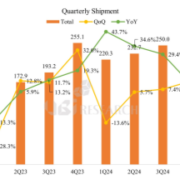
The small OLED market in the third quarter rose 7.8% compared to the previous quarter. Most panel companies recorded panel shipments at a similar level to the second quarter, but overall shipments increased as shipments from LG Display and China’s Everdisplay surged.

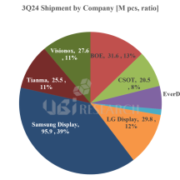
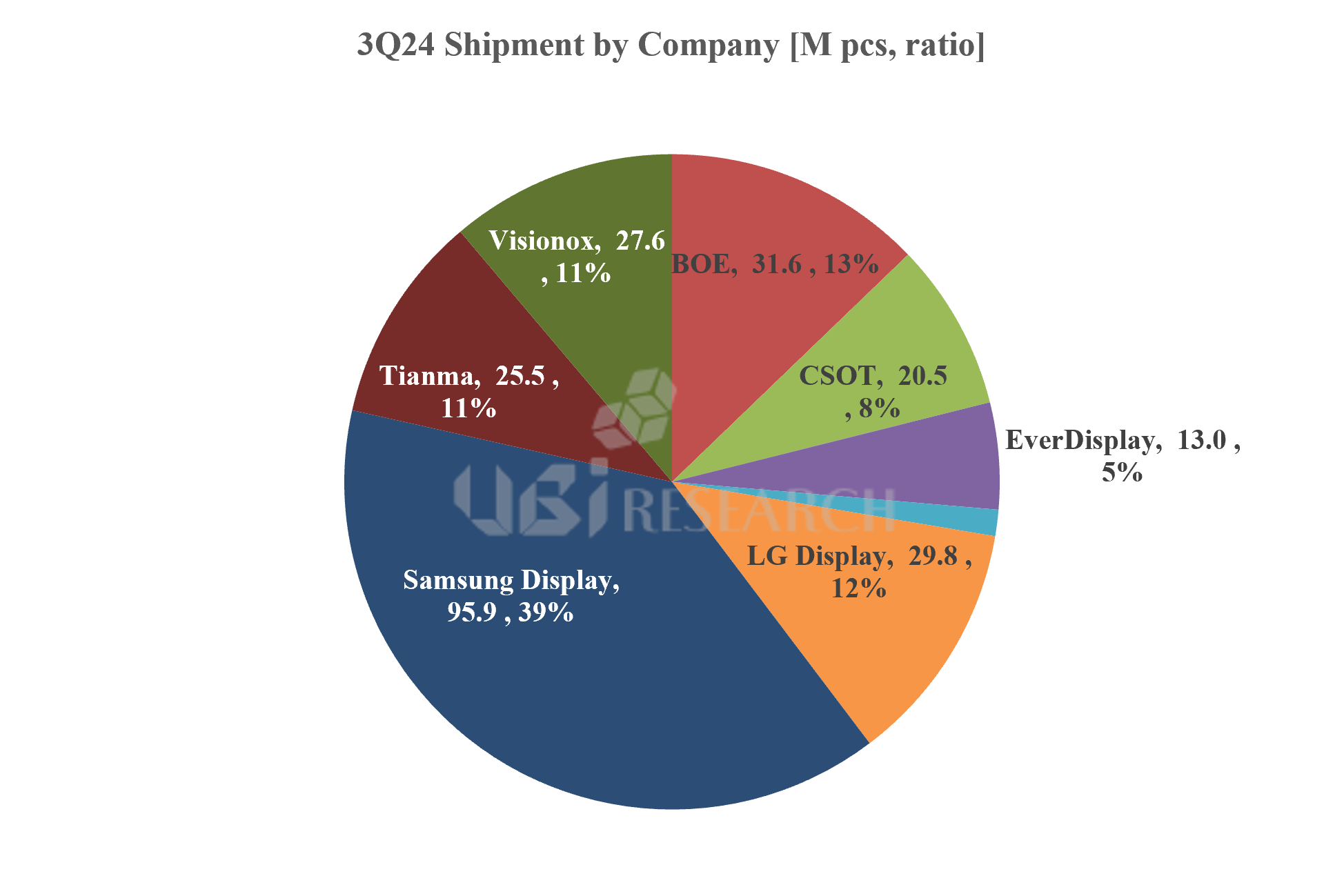
According to the ‘4Q24 Small OLED Display Market Track’ recently published by UBI Research, small OLED shipments in the third quarter of 2024 were 247 million units, up 7.8% compared to the previous quarter and 32.6% compared to the same quarter of the previous year. The shipments of Chinese panel companies, including Samsung Display and BOE, were similar to or slightly lower than the previous quarter, but as the shipments of LG Display and China’s Everdisplay surged, overall shipments increased.

Based on the iPhone 16 series, which began full-scale production, LG Display shipped 17.6 million iPhone panels, a 64% increase from the previous quarter, and smartwatch shipments increased 147% to 12.2 million units. Due to the impact of increased shipments, LG Display’s sales increased by 74% compared to the previous quarter and by 115% compared to the same quarter of the previous year.

LG Display’s shipments are expected to continue to increase next year following the fourth quarter. As LTPO TFT begins to be applied to the iPhone 17 series scheduled to be released in 2025, there are predictions that BOE’s initial panel supply will actually be difficult, and as BOE is unable to supply panels, the supply may be transferred to LG Display. However, since LG Display is currently producing panels close to full capacity, line expansion is necessary to produce more panels. There is an analysis that it is realistic to expand 6G lines because it is realistically difficult to quickly start investing in 8.6G.

Among Chinese panel companies, shipments of Everdisplay and Tianma increased. Tianma’s shipments increased, but only slightly, and Everdisplay’s shipments more than doubled to 13 million units compared to the previous quarter.

Samsung Display’s shipments decreased somewhat, but sales were similar to the second quarter, and BOE’s shipments were similar to the second quarter, but sales increased by 15%. In the fourth quarter, shipments from not only LG Display but also Samsung Display and BOE are expected to increase, and considering the characteristics of the OLED market with the highest shipment volume in the fourth quarter, global OLED shipments for smartphones are expected to exceed 800 million units in 2024.

Junho Kim, UBI Research analyst(alertriot@ubiresearch.com)

▶Small OLED Display Quarterly Market Track Sample

[CES Asis 2016] EDO, Accelerates Its Wearable Market…Reveals AMOLED Equipped VR

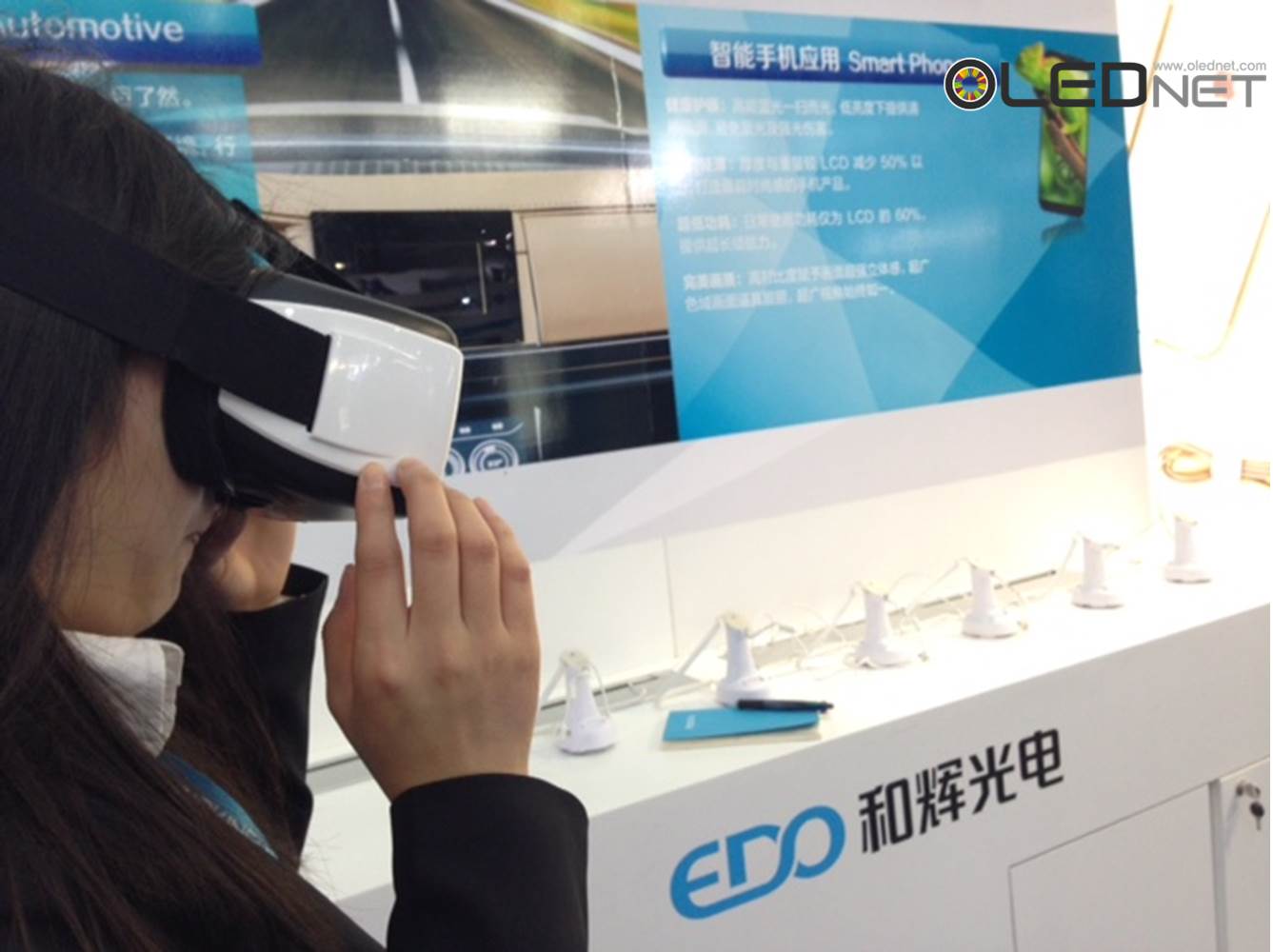
EDO`s VR Device

EverDisplay `s VR Device

Shanghai=Hyunjoo Kang / jjoo@olednet.com

EverDisplay (EDO), whose main force is mobile AMOLED, is accelerating its wearable market target.

In CES Asia 2016 (11-13 May) held in Shanghai, China, EDO presented VR (virtual reality) device equipped with their own AMOLED and revealed their roadmap in this market. The company displayed the VR device at the exhibition booth allowing the visitors to experience it. EDO explained that the device is a beta version, and although it has not been released, the picture quality is superior compared to LCD or LED equipped VR.

According to EDO, the company is planning to produce 3.2 inch 1K 400 ppi AMOLED for VR this year, and 3.5 inch 1.5K 600 ppi panel in 2017. Following this, the panel is to be improved to 2K 750 ppi in 2018, and EDO is planning produce flexible based 800 ppi panel in 2019.

EDO also revealed new AMOLED product in smartphone sector. In this exhibition, EDO showed 5.5 inch FHD panel that is already being mass produced, and flexible 6 inch panel to be mass produced in future.

Furthermore, the company exhibited new AMOLED panel in 3 types, 1.2 inch, 1.4 inch, and 1.41 inch, for smartwatch that will be consecutively launched from July. Of these, the 1.2 inch panel is expected to be used for Huawei’s smartwatch for women to be released in September.

CES Asia 2016’s participants greatly increased compared to last year, and 375 companies from 23 countries are taking part. Major companies such as Intel, Twitter, and BMW discuss wearable, VR, driverless cars, future of TV, etc. though conference.


Looking Ahead to 2016 OLED Industry through Keywords

  1. Flexible AMOLED Investment

In 2016, flexible AMOLED mass production line investment is expected to be actively carried out by Samsung Display, LG Display, BOE, and Japan Display. For Samsung Display to apply flexible AMOLED panel to the new Galaxy model, the mass production line investment is necessary. If they supply flexible AMOLED panel to Apple, volume of the flexible AMOLED mass production to be invested in 2016 is estimated to be grow significantly. LG Display also is expected to actively carry out flexible AMOLED line manufacturing equipment order for Gumi’s P6 line, as well as additional flexible AMOLED mass production line investment following Apple’s demand. BOE is estimated to seriously begin orders for Chengdu’s Gen6 45K flexible AMOLED mass production line.


  1. P10

With the announcement of new factory establishment and 1.84 billion KRW investment for part of facilities in Q4 2015, as the first step of the investment, LG Display began site construction for P10 line factory that can produce large area panel. However, the investment direction has not yet been decided. P10 could be directed to only producing large area LCD panel, large area OLED panel, small-to-medium size OLED panel, or large area and small-to-medium size OLED panel simultaneously. China’s Gen8 LCD facilities investment is quite advanced and BOE’s Gen10.5 LCD line investment has also been confirmed. As such how much LG Display’s large area LCD can bring profit has to be carefully considered. Additionally, with the increase of OLED TV consumption and the supply of OLED panel to Apple practically confirmed, OLED investment is essential. P10, Gen11 line, is the world’s largest factory site, and depending on the investment direction in 2016, it is estimated to affect OLED market’s opening time.


  1. Chinese OLED

Everdisplay is supplying AMOLED panel to some several Chinese set companies, and Visionox is also expected to actively supply AMOLED panel from 2016. As such, most of Chinese OLED panel companies’ OLED mass production preparation is anticipated to conclude in 2016. Accordingly, second investment by companies including Everdisplay, Visionox, and Tianma is analyzed to be possible and serious movement by China’s OLED industry could occur.


  1. Evaporation Equipment

Flexible AMOLED mass production line investment by Samsung Display, LG Display, Japan Display, and BOE, and other Chinese OLED panel companies’ additional installation are expected to be actively carried out from 2016. Amidst this, order of evaporation equipment, OLED production’s essential component, is expected to be an issue.


Evaporation equipment currently being used in mass production is mostly Japanese Canon Tokki’s. As this evaporation equipment has been verified in mass production, it is estimated that most companies, including Samsung Display, LG Display, BOE, and JDI, will want to order Canon Tokki’s evaporation equipment. However, as the production capa. of Canon Tokki’s evaporation equipment is limited, the issue is expected to be which panel company will be able to order early. At the same time, this could be a new opportunity for Korean evaporation equipment companies.


  1. Samsung OLED TV

At present, the TV industry trend is moving to OLED from LCD. Accordingly, Samsung Display is continuing research to resume their large area OLED for TV panel business. It is analyzed that Samsung Display possesses RGB OLED technology that uses SMS evaporation method, white OLED, and solution process OLED technology. However, as each technology has its drawbacks, they are carefully considering future directions. First, RGB OLED technology is estimated to lack Gen8 mother glass substrate evaporation equipment at present. Solution process OLED method has low material performance. For white OLED, as the key patents are owned by LG Display, technology that avoids these has to be first developed. Therefore, much attention is focused on which technology Samsung Display will use and invest in production line to enter the TV market.

Visionox Reveals 604PPI High Resolution AMOLED

On November 12, Visionox announced that they recently developed 604ppi (approximately 4.85inch) high resolution full color OLED panel through FMM (fine metal mask) using evaporation technology.


Visionox Z-Type(Source : OLED-info)

Visionox Z-Type(Source : OLED-info)


In 2014, Visionox developed 570ppi RGB AMOLED panel with newly developed pixel structure, Z-Type. This Z-Type arrangement had larger blue sub-pixel with green and red sub-pixels beside it. The new panel has resolution of 604ppi which is a 35ppi increase from the 2014 panel. With this new reveal, Visionox displayed their high resolution OLED technology improvement.


The 604ppi panel combined the self-developed pixel layout under proprietary intellectual property rights and co-developed Chinese FMM. The resolution is 2,560 × 1,440, manufactured using real RGB method and not pentile.


Chinese companies are developing their high resolution AMOLED panel technology at a fast pace. In August, EverDisplay presented 734ppi 6inch panel, and the technology difference with Korean panel companies is rapidly decreasing.


Visionox revealed that this OLED panel shows Visionox’s research development for high resolution OLED is continuing and aptly demonstrated the current results.


604 PPI High Resolution Display Panel (real RGB) (Source: Visionox)

604 PPI High Resolution Display Panel (real RGB) (Source: Visionox)

General Class AMOLED Panel Estimated to be Extensively Supplied. How Will it Affect OLED Industry?

Only 2 models of smartphone with the general class AMOLED panel were released in the first 2 quarters of 2015. However, as 5 more models were revealed until August in the third quarter, it is expected that demand for general class AMOLED panel will gradually increase.


Currently 7 companies, including Samsung Display, are mass producing or aiming to mass produce small to medium-sized AMOLED panel of rigid type. China’s EDO or Taiwan’s AUO are believed to be producing in small quantity for samples. Other Chinese companies are also aiming to mass produce AMOLED panel but satisfying the current demand is analyzed to be difficult. At present, Samsung Display is the only panel company that can meet the demand for general class AMOLED panel by set companies. There is much interest in whether AMOLED industry can rebound with the Samsung Display’s movement in the second half.


It is expected that Samsung Display will increase operation rate of A1 and A2 rigid lines in the second half in order to meet the demand for general class AMOLED panel. Following this, emitting material companies’ sales increase is also anticipated and positively affect management of AMOLED industry’s ecosystem.


If the demand for general class AMOLED panel is higher than expected, there are some who believe that additional investment for A3 line could be for hybrid structure that can switch between rigid and flexible rather than flexible exclusive line.


There is much focus on how Samsung Display’s mass production and supply plans for general class AMOLED panel will affect the AMOLED industry growth.


General Class AMOLED Panel Applied Smartphone Released Until August 2015