
[Display Korea 2026] Limitations of FMM in OLED Processes Become Clear, Samsung Display Presents ‘FMM-less’ Solution
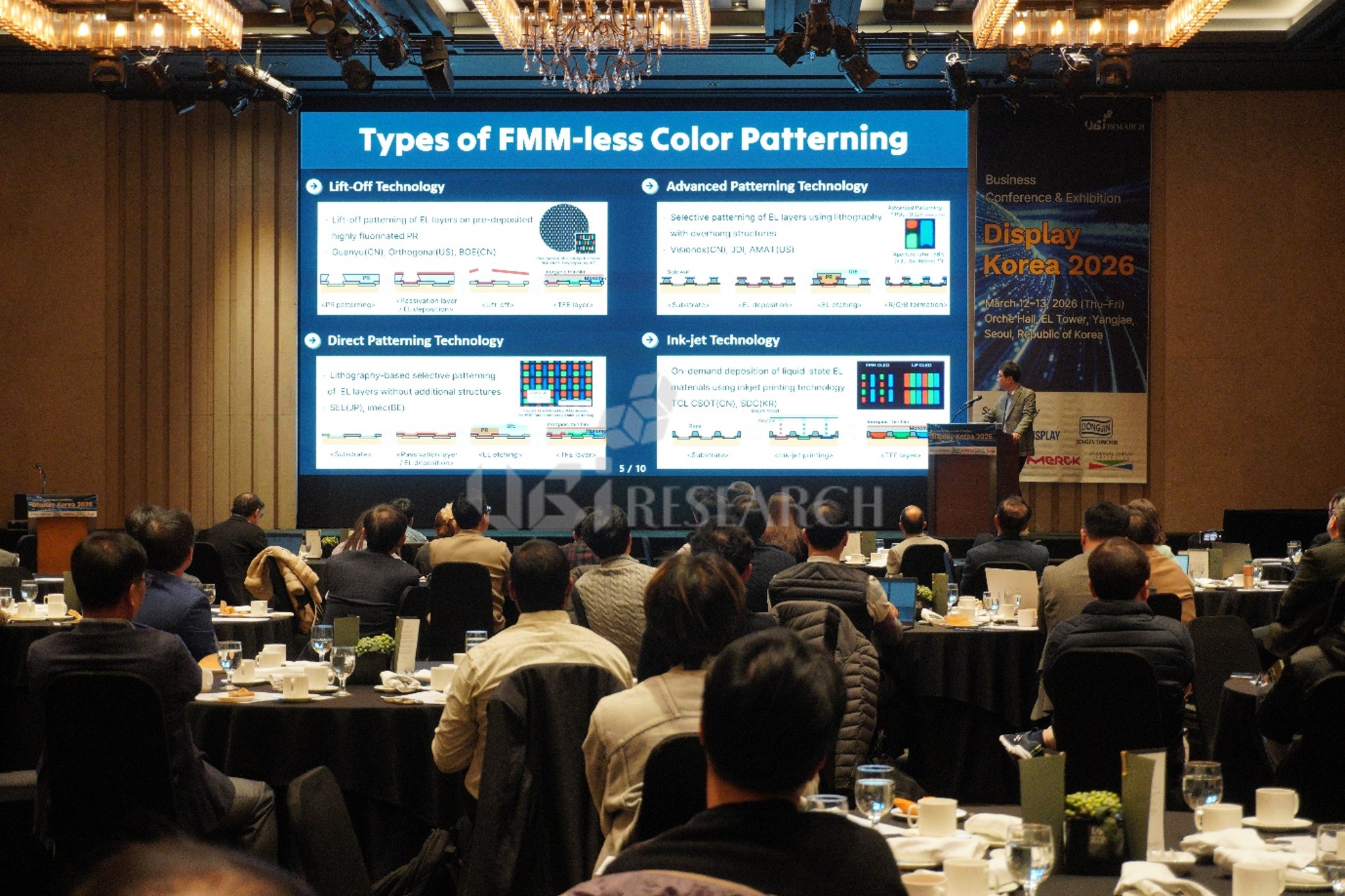
Samsung Display Vice President So Byung-soo presenting the types and directions of FMM-less patterning technology for next-generation OLED manufacturing at ‘Display Korea 2026’ hosted by UBI Research. (Source: UBI Research)
Samsung Display has outlined the necessity and direction of FMM-less patterning as a next-generation OLED manufacturing technology. At Display Korea 2026, hosted by UBI Research, Executive Vice President Byungsoo So of Samsung Display highlighted the technological evolution of the OLED industry, pointing out the limitations of conventional FMM (Fine Metal Mask)-based processes and emphasizing the importance of next-generation patterning technologies to replace them.
OLED displays are rapidly evolving toward ultra-high resolution, large-area IT applications, higher luminance and improved power efficiency, as well as free-form form factors. In line with these trends, high brightness and power efficiency have become key competitive factors, while curved and free-form designs are emerging as important trends in automotive displays.
These technological demands are exposing structural limitations in conventional FMM-based deposition processes. FMM processes face constraints in achieving high aperture ratios and encounter difficulties in reducing the PDL (Pixel Define Layer) gap. In addition, physical issues such as mask sagging, shadow effects, tensile deformation, and frame deformation limit both high-resolution implementation and large-area scalability. Furthermore, complex mask handling and high operational costs remain ongoing challenges.
Against this backdrop, Samsung Display expects FMM-less patterning technologies to become a core enabler of next-generation OLED manufacturing. FMM-less approaches enable more flexible pixel design, reduce PDL gaps, and achieve higher aperture ratios. They are also advantageous for large-area OLED production, making them critical for the expansion of IT and TV markets.
So also presented three key directions for future OLED technology development: “Value Up,” “New Generation,” and “ECO+.” “Value Up” refers to high resolution, high brightness, and long lifetime. “New Generation” indicates expansion into large-area 8.x generation substrates, large panels, and free-form displays. “ECO+” focuses on reducing IR drop and improving power efficiency to enable low-power operation.
He further illustrated the limitations of FMM by analyzing the relationship between resolution and PDL gap. As resolution increases, reducing the PDL gap becomes essential; however, FMM processes face limitations in scaling below a certain threshold, restricting high-resolution implementation. These limitations are particularly pronounced in ultra-high-resolution applications such as VR/AR, making the transition to FMM-less technologies inevitable.
In conclusion, Samsung Display defined the transition from FMM to FMM-less as a critical evolution in the OLED industry. To simultaneously meet the performance and productivity requirements of next-generation displays, the adoption of new patterning technologies that overcome the limitations of conventional processes is essential, with FMM-less technologies expected to play a central role.
Junho Kim, Analyst at UBI Research (alertriot@ubiresearch.com)
 2026 Small OLED Display Annual Report
101 inch Micro-LED Set BOM Cost Analysis For TVs
※ This article is produced by UBIResearchNet.
Unauthorized reproduction or citation without source attribution is prohibited.
When quoting, please clearly indicate the source (UBIResearchNet) and provide a link.