Posts

Bar chart showing the quarterly growth of OLED smartphone panel shipments in 2025, highlighting Q4 peak.

OLED Smartphone Panel Shipments to Reach 900 Million Units in 2025…Q4 Production Drives Annual Growth

Quarterly OLED Shipments Forecast for Smartphones by Manufacturer in 2025 (Source: UBI Research)

UBI Research forecast trend for quarterly OLED smartphone panel shipments and manufacturer share in 2025 (Source: UBI Research)

According to UBI Research’s quarterly publication, the OLED Display Market Tracker, OLED panel shipments for smartphones and foldable phones are expected to reach approximately 900 million units in 2025. By shipment share, Chinese panel makers are projected to account for about 48.8% of the annual total, nearly matching the level of Korean manufacturers. While shipment volumes between the two countries are similar, Korean companies maintain a revenue advantage due to their higher proportion of premium-tier orders for flagship models such as Apple’s iPhone and Samsung’s Galaxy.

In particular, Korean panel makers saw a significant surge in smartphone and foldable panel shipments in the fourth quarter, marking their strongest performance of the year. Panel supply expanded sharply from the third quarter with the launch of new Apple products, and shipments peaked as Samsung Electronics began full-scale production of Galaxy S26 series panels.

Samsung Display continued its solid growth into the fourth quarter, driven by increasing demand for panels for the iPhone 17 series and Samsung’s Galaxy S25 FE. With mass production for both the iPhone lineup and Galaxy S26 series in full swing, Samsung Display is expected to post its highest annual shipment volume to date. LG Display also achieved a strong rebound in the third quarter with shipments of roughly 20 million units, representing a sharp quarter-over-quarter increase, and its Q4 shipments are forecast to rise by an additional 20%.

Chinese panel makers showed quarterly fluctuations depending on demand conditions but maintained stable supply across major smartphone brands. BOE expanded its customer base by diversifying its supply portfolio from entry-level to upper-mid-range smartphone models. TCL CSOT and Visionox continued to grow shipments to both the domestic Chinese market and global brands, while Tianma focused on enhancing technological competitiveness by increasing the share of high value-added products such as LTPO.

In terms of set makers, Apple secured the largest volume of OLED panels, followed by Samsung Electronics, Xiaomi, Vivo, and Huawei. Executive Vice President Changwook Han of UBI Research commented, “As the industry enters the second-half peak season, Korean display manufacturers are showing clear improvements in both shipments and revenue. In particular, Samsung Display is expected to ship around 150 million panels in the fourth quarter driven by increased demand for iPhone panels.” He added, “Chinese panel makers are also maintaining stable momentum by adjusting their supply strategies in line with shifting market demand.”

Changwook Han, Executive Vice President/Analyst at UBI Research (cwhan@ubiresearch.com)

▶ Quarterly Small OLED Display Market Tracker Sample

▶Quarterly Medium & Large OLED Display Market Tracker Sample

※ This article is produced by UBIResearchNet.
Unauthorized reproduction or citation without source attribution is prohibited.
When quoting, please clearly indicate the source (UBIResearchNet) and provide a link.

Graph illustrating 2025 foldable OLED shipment decline and anticipated 2026 market recovery driven by Apple’s foldable iPhone (Source: UBI Research)

Slow Growth in Foldable Phones Due to High Prices and Weak Demand… The 2026 Foldable iPhone Expected to Be a Turning Point

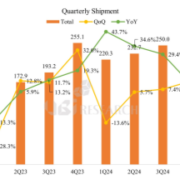
OLED shipment trend for foldable smartphones in 2025 by quarter showing QoQ and YoY changes (Source: UBI Research)

OLED Shipment Trend for Foldable Phones (Source: UBI Research)

According to UBI Research’s recently published Small OLED Display Market Tracker, global shipments of OLEDs for foldable phones continued to show weak year-on-year performance for three consecutive quarters.

Cumulative shipments for January–September 2025 totaled 16.7 million units, down about 20 percent from 21 million units during the same period last year. On an annual basis, foldable OLED shipments in 2025 are expected to reach 21.3 million units, a 14.4 percent decrease from the previous year.

The foldable-phone market, now in its fifth year since launch, has entered a mature stage but faces limitations in expanding its consumer base. Although leading brands such as Samsung Electronics and Huawei continue to release new products, new demand beyond replacement purchases has slowed.

The biggest constraint is price. While high-end bar-type smartphones remain in the 1.3 to 1.7 million-won range, Samsung’s Galaxy Z Fold series sells for over 2 million won, and Huawei’s tri-fold model exceeds 3 million won. The foldable iPhone, expected to launch next year, is also likely to be priced above 2.5 million won, making it less accessible to consumers.

As a result, even within the premium market, the perception that “technological innovation does not bring enough practical benefit” is spreading, deepening consumers’ hesitation to buy.

The foldable OLED market is expected to stagnate through 2025, but structural change is likely to begin in 2026. Samsung Display is reportedly set to be the sole supplier of OLED panels for Apple’s foldable iPhone, and once full-scale mass production begins, Samsung’s foldable OLED shipments are expected to rise sharply.

Meanwhile, Chinese panel makers are responding mainly through domestic brands. BOE, CSOT, and Visionox are working to increase market share by improving next-generation hinge structures, enhancing UTG (ultra-thin glass) durability, and expanding low-cost foldable lineups. In particular, Huawei, Oppo, and Vivo are pursuing both “vertical integration” and “domestic-market-focused strategies” to secure price competitiveness.

UBI Research Executive Vice President Changwook Han said, “Foldable phone shipments are stagnant in both Korea and China, but 2026, when Apple enters the market, will be a turning point. Samsung Display is expected to strengthen its influence in the market by maintaining technological superiority and exclusively supplying foldable OLEDs to Apple.”

He added, “Chinese companies are expanding their market share through strong domestic bases, but in terms of panel performance and reliability, they still have not fully closed the technological gap with Samsung.”

The industry expects that although growth in foldable phones will remain stagnant through 2025, it will recover double-digit growth from 2026 after Apple’s market entry.

Changwook Han, Executive Vice President/Analyst at UBI Research (cwhan@ubiresearch.com)

▶ Quarterly Small OLED Display Market Tracker Sample

▶Quarterly Medium & Large OLED Display Market Tracker Sample

Small OLED display shipments in 2024 are expected to increase by 200 million units compared to 2023 and exceed 1 billion units in 2025

‘1Q25 Small OLED Display Market Track’

‘1Q25 Small OLED Display Market Track’

According to UBI Research’s ‘1Q25 Small OLED Display Market Track’, which includes application performance and outlook for smartphones, foldable phones, smartwatches, etc., small OLED shipments in 2024 are expected to reach 980 million units, an increase of approximately 200 million units from 773 million units in 2023. The small OLED market is expected to exceed 1 billion units in 2025.

Looking at the 2024 performance, most panel manufacturers in Korea and China saw an increase in shipments of 40 to 50 million units, and in particular, Chinese panel manufacturers TCL CSOT, Tianma, Visionox, and Everdisplay saw shipments increase by more than 50% compared to 2023. BOE, China’s largest panel manufacturer, saw its panel shipments increase by only about 8% due to temporary production suspensions caused by disruptions in iPhone supplies throughout the year.

Not only Chinese panel makers, but also Korean panel makers have seen a significant increase in shipments. As rigid OLED panels began to be applied to Samsung Electronics’ Galaxy A series, Samsung Display’s shipments are expected to surge from 320 million units in 2023 to 380 million units in 2024. LG Display’s smartphone OLED shipments also increased from 52 million units in 2023 to 68 million units in 2024 as its supply of panels for iPhones expanded.

With Chinese panel makers’ shipments steadily increasing, and Samsung Display’s rigid OLED shipments and LG Display’s iPhone panel shipments also increasing, small OLED shipments in 2025 are expected to easily exceed 1 billion units.

“OLEDs are being widely applied to lower-end models of Samsung Electronics’ Galaxy A series and low-cost models from Chinese set manufacturers, and BOE and Visionox’s new 8.6G lines are also designed to produce panels for smartphones, so small-sized OLED shipments are expected to continue to rise for the time being,” said Han Chang-wook, Vice President of UBI Research.

Chang Wook HAN, VP/Analyst, UBI Research(cwhan@ubiresearch.com)

▶Small OLED Display Quarterly Market Track Sample

China Aims for the Foldable Phone Market with Multiple Foldable Phone Launches

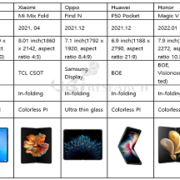
Samsung Electronics widely successful release of its foldable phones, Galaxy Z Fold 3 and Flip 3 last year has risen expectations for establishing foldable phones into the mainstream. Chinese companies such as Huawei, Xiaomi, Oppo are also releasing multiple foldable phones.

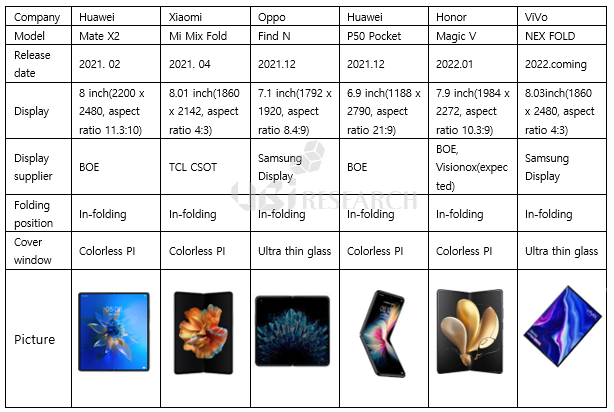
As the first foldable phone in China, Huawei has been releasing the Mate X series every year since its launch in 2019. The Mate X and the Mate Xs released in 2020 are 8 inches in size and folds outward. The external display is 6.6 inches with a resolution of 1148×2480 and an aspect ratio of 19.5:9.

Mate X2 was introduced in February 2021 with 8 inches for the internal display and the external display is 6.45 inches OLED with a resolution of 1160 x 2700 and an aspect ratio of 21:9. Colorless PI was applied to the cover window. Mate X2 folds inward instead of Mate X’s outward folding display.

P50 Pocket released in December 2021 is a clamshell phone similar to the Samsung Flip 3. The internal display is 6.9 inches with 120Hz refresh rate and an aspect ratio of 21:9. The cover window is 1.1 inches circular type.

Honor released a foldable phone, Magic V on January 10th 2022.

The internal display is 8 inches with 90Hz refresh rate and the external display is 6.5 inches with 120Hz refresh rate. The cover window is colorless PI. Both internal and external panels are made in BOE B11(Mianyang) line. The initial production is estimated to be 50,000 and the estimated total production volume is 100,000 to 200,000.

According to the sales result, the Visionox panel might be applied to the product.

Vivo is about to release a new foldable, the NEX FOLD. Vivo filed patents for NEX FOLD, NEX ROLL, and NEX SLIDE.

NEX fold’s internal display is 8.03 inches with QHD 120Hz and the external display is 6.53 inches with FHD 120Hz. Both internal and external display has the same refresh rate. The display panel is Samsung Display’s LTPO, and the cover window is planned to be 30 um thickness UTG.

It is planned to be released in March 2022, but no official announcement has been made.

Samsung Display is using UTG(Ultra Thin Glass) for the cover window and most Chinese panel companies are using Colorless PI. Many Chinese companies are introducing foldable phones, but durability issues are reported on many social network media posts. Chinese panel makers still have much to go in terms of quality in technology and production cost when compared to Samsung Display.

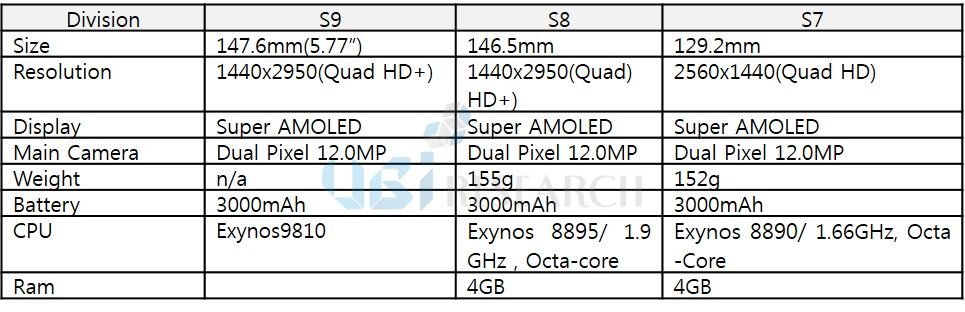
Galaxy S9 – Curious about Samsung’s strategy to launch Foldable Phone

Interests in Galaxy S9 and Note 9, which will be released soon, are growing. There are a lot of people who want to figure out in advance the features of Foldable Phone, which Samsung announced to be launched within this year, through Galaxy S9 and Note9. However, it is impossible to predict the specifications of the Foldable Phone with the contents that have been opened so far.

In general, Galaxy S9 does not seem to be much different, compared to the previous S8. The front fingerprint sensor, which has been anticipated since last year, may not apply, and it seems to adopt iris recognition and fingerprint sensor at the back side. Unlike the S8, which was noticed in the name of Infinity Display, it will not expect much different concept in the design part. The CPU will be equipped with Samsung’s Exynos 9810 chip, except for the US model.

So what is the strategy of the Galaxy series this year? Some say that iPhoneX’s sales volume is a failure, but if you consider adding iPhoneX to the 3-model lineup in the new 2-model lineup, Apple’s overall performance is a success. In the meantime, there seems to require a new strategy for the Galaxy flagship model, which was dominated by superior image quality with adopting OLED display.  The Galaxy S9 appears to have little change, except for a slight improvement in performance. Therefore, it is curious whether it might be Samsung’s planned intention to concentrate on launching the Foldable Phone.

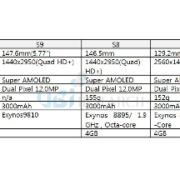
<Spec Comparison for Galaxy flagship models>