Expanding into new markets through an integrated solution combining Micro-LED and CPO technology
Generative AI has ignited a global race for computing power, with high-speed transmission bottlenecks in data centers emerging as a key obstacle constraining AI infrastructure upgrades. While chip-internal computation speeds have accelerated dramatically, the copper wiring connecting chips cannot keep pace with data transmission speeds due to resistance and heat generation issues. Next-generation ultra-high-speed, ultra-low-power optical interconnect solutions are establishing themselves as the core alternative to traditional copper cable interconnects, offering a new solution to the transmission challenges facing AI computing centers and data centers. Micro-LEDs are gaining attention as the optimal light source to solve this problem and could become a key technology for overcoming the ‘energy barrier’ in AI infrastructure.
In early March, Chinese micro-LED-related stocks saw significant gains. The surge in buying pressure, driven by capital inflows, stems from the rise of micro-LED CPO (Co-Packaged Optics) technology. Recently, micro-LED companies, including those in Taiwan and China, are accelerating development not only in display products but also in the ‘non-display sector’—specifically the optical communication and optical sensor markets.
PlayNitride is strengthening its R&D efforts to develop communication-specific Micro-LED chips capable of high-speed modulation and to convert ultra-high-resolution LEDos technology into arrays for optical interconnects. In January this year, it announced a partnership with Brillink to jointly develop micro-LED-based optical interconnect solutions. AUO is preparing to enter the CPO market for next-generation AI servers by leveraging its display supply chain. It is attempting to establish a vertical integration by combining the micro-LED resources of its subsidiary, LED chip manufacturer Ennostar, with the receiver technology of Tyntek. China’s largest display manufacturer, BOE, has established an 8-inch GaN-on-Si-based Micro-LED mass production system in collaboration with its subsidiary HC-Semitek. Aligned with the Chinese government’s ‘semiconductor self-reliance’ strategy, it is building a low-cost light source supply chain for optical interconnects between AI chipsets.
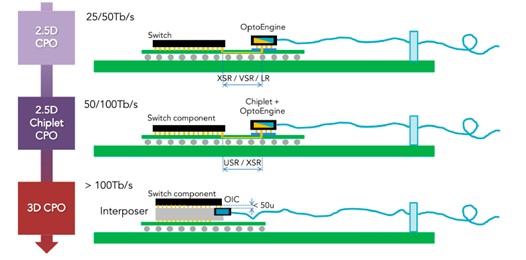
Co-Packaged Optics (CPO) packaging technology roadmap designed to resolve high-speed transmission bottlenecks in data centers. (Source: Micromachines 2025, 16, 1037)
Micro-LEDs are gaining attention as an optimal light source for the following reasons.
- Ultra-high-speed modulation principle: Smaller micro-LEDs reduce RC delay and allow higher current density, enabling ultra-high-speed modulation bandwidths exceeding several GHz. This facilitates data transmission of several Gbps per pixel.
- Energy Efficiency: Unlike laser light sources (VCSELs: Vertical Cavity Surface Emitting Lasers), they do not require a resonator structure, resulting in extremely low drive power. Efficiency levels around ~1 pJ/bit could be the only viable alternative to dramatically reduce power consumption in AI data centers.
- High-density packaging: Thousands of light sources can be directly integrated (monolithic/hybrid integration) onto HBM (High Bandwidth Memory) or GPU dies with pitches in the micrometer range, maximizing data transmission density per unit area.
While existing micro-LEDs for displays focused on color reproduction and brightness, the key for optical interconnect solutions lies in compatibility with semiconductor processes. Moving beyond the traditional 4-inch and 6-inch sapphire wafer methods, the introduction of 8-inch and 12-inch GaN-on-Si (Gallium Nitride on Silicon) processes enables the direct use of existing semiconductor fab equipment. This not only lowers manufacturing costs but also enables ‘Monolithic Integration’—packaging the CMOS driver IC and micro-LED together in a single package—accelerating the commercialization of optical interconnect solutions.
Experts anticipate a future where micro-LEDs transcend being mere ‘screens’ and are recognized as key components determining the performance of AI semiconductors. If the micro-LED industry achieves breakthroughs in two core areas—reducing mass production costs and validating the technical feasibility of optical interconnection application scenarios—micro-LEDs will gradually open new markets beyond consumer electronics displays like smartwatches and AR smart glasses, with significant potential for substantial market expansion.
Namdeog Kim, Senior Analyst at UBI Research (ndkim@ubiresearch.com)
 Pre-register for Display Korea 2026
101 inch Micro-LED Set BOM Cost Analysis For TVs
Industry Trends and Technology of Micro-LED Displays for XR Report
※ This article is produced by UBIResearchNet.
Unauthorized reproduction or citation without source attribution is prohibited.
When quoting, please clearly indicate the source (UBIResearchNet) and provide a link.