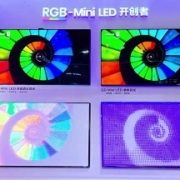


At CES 2026, while Samsung Electronics and Hisense positioned RGB Mini LED as the top tier of their existing QLED lineup, TCL presented a diametrically opposed strategy, placing Super Quantum Dot (SQD)—an evolution of QD technology—at the core of its flagship offerings. This signals a shift in the competition within the LCD-based ultra-large premium TV market, which is expected to expand around RGB backlighting. It also marks a stage where the role and status of QD are being redefined.

Comparison of TCL’s SQD-Mini LED flagship strategy against RGB approaches from Samsung and Hisense at CES 2026. (Source: UBI Research)
TCL’s decision to showcase SQD-Mini LED as its flagship at CES 2026 reveals an intent to redefine the very concept of QD. Whereas QD was primarily perceived as a “material that expands color gamut,” TCL has repositioned Super Quantum Dot (SQD) as the core technology responsible for ‘color purity and control stability’ as QD evolves toward high brightness and ultra-high zone-count local dimming.
As Mini LED TVs evolve with ultra-high zone-count local dimming and ultra-high brightness, phenomena like color blooming/color crosstalk at high-brightness boundaries become more sensitive, not just simple brightness bleed (halo). TCL has prioritized addressing this issue in its flagship models, proposing a solution combining SQD (High-Purity QD) + filter + color purity algorithms.
TCL positioned SQD-Mini LED not as a new technology, but as an extension of the Halo Control System introduced at CES 2025. At CES 2025, TCL defined Halo not as a single backlight issue, but as a systemic challenge requiring a holistic solution encompassing optical distance (OD), drive timing, backlight control precision, local dimming algorithms, and panel characteristics. The key change at CES 2026 is that while maintaining this framework, the flagship’s problem definition has been expanded to a dual challenge of “brightness blooming + color blooming.”

TCL’s Halo Control System addresses picture quality issues by integrating backlight control with advanced optical structures. (Source: TCL)
What’s interesting is that TCL didn’t deny the RGB trend itself. TCL positioned RGB Mini LED as a high-end lineup beneath its flagship SQD-Mini LED. This approach directly impacts consumer experience. High-end TV buyers care not only about the impact of ‘peak moments’ but are more dissatisfied when quality falters during specific content (subtitles, night scenes, high-contrast edges, fast-moving sports/gaming scenes). TCL’s decision to anchor SQD in its flagship models is interpreted as a strategic choice to align with premium buyers’ psychology—prioritizing “minimum dissatisfaction” over “peak perceived quality.”
At CES 2026, LG Display emphasized that OLED TVs offer more stable control over light and color compared to LCD-based premium TVs. This highlights the awareness that as competition intensifies in high brightness and ultra-high zone-count local dimming, ‘consistency of control’ could emerge as the core premium value, surpassing ‘highest specs’.
The premium TV market is expected to evolve into a multi-front competition for some time, with RGB-based (LCD) models offering perceived impact, QD/SQD models emphasizing color purity and control stability, and OLED maintaining its self-emissive control advantage. Ultimately, the decisive factor will not be competition over single metrics (brightness, number of dimming zones), but rather how stably light and color are maintained across diverse content environments as experienced by consumers, thereby minimizing dissatisfaction risks.
Changho Noh, Senior Analyst at UBI Research (chnoh@ubiresearch.com)
 2025-2026 Beyond Mobile: IT OLED Technology and Industry Analysis Report
※ This article is produced by UBIResearchNet.
Unauthorized reproduction or citation without source attribution is prohibited.
When quoting, please clearly indicate the source (UBIResearchNet) and provide a link.

At CES 2026, RGB Mini LED emerged not as a single technology trend, but as a symbolic technology demonstrating the maturation of the premium TV market and the different approaches being adopted by each manufacturer. Amidst the existing competitive landscape centered on QD Mini LED and OLED, RGB Mini LED emerged as an attempt to go beyond the competition of “brightness and number of zones” and redesign the color production method and control structure itself. However, the significance of RGB Mini LED revealed at CES 2026 differed significantly across companies.
Samsung Electronics: Micro RGB Reshaping Neo QLED’s Flagship Position
Samsung Electronics redefined the pinnacle of its LCD premium strategy at CES 2026, highlighting its 130-inch Micro RGB TV. Micro RGB utilizes micrometer-sized RGB LEDs as backlights and employs a structure that independently controls R, G, and B. This approach differs from blue LED-based QD Mini LED (Neo QLED) in its color production method. Samsung’s Micro RGB is positioned not as a technology intended to directly replace OLED, but rather as a strategic technology to reclaim the ultra-large premium segment, where Neo QLED struggled to expand. Specifically, in the ultra-large market (100 inches and above), the company aims to redefine LCD’s strengths, such as high brightness potential and durability (avoiding burn-in concerns), as “ultra-premium,” while prioritizing color reproduction and control precision to reset the standard for the upper end of the premium market. Samsung has announced plans to focus on 130-inch displays, but expand to 55-, 65-, 75-, 85-, 100-, and 115-inch lineups by 2026, demonstrating its strategy to gradually expand Micro RGB beyond its flagship lineup.

Samsung’s 130-inch Micro RGB TV, redefining the ultra-large premium market and positioning itself at the top of the Neo QLED lineup. (Source: Samsung Electronics)
LG Electronics: OLED for Flagship, Micro RGB evo for Ultra-Premium LCD
LG Electronics unveiled its RGB Mini LED under the name Micro RGB evo at CES 2026, revealing its strategy to further layer its premium TV portfolio. LG’s key strategy is to maintain the status of OLED. In other words, OLED remains the absolute flagship in terms of picture quality and brand symbolism, and the company defines Micro RGB evo not as a replacement technology for OLED, but as an “ultra-premium LCD” positioned between OLED and QNED (QD Mini LED-based premium LCD).
Micro RGB evo features LG’s α AI processor integrated into an RGB backlight-based LCD structure, enhancing color accuracy and tone reproduction. LG has emphasized “Triple 100% Color Coverage,” which 100% covers BT.2020, DCI-P3, and Adobe RGB. Unlike QD Mini LED, which has primarily competed on the basis of “brightness, local dimming, and price-to-performance ratio,” Micro RGB evo is seen as an attempt to redefine the premium upper echelon by emphasizing “color accuracy and control precision.” At CES 2026, LG unveiled 100-, 86-, and 75-inch product lines. This strategy aims to capture ultra-large and premium demand from LCD while maintaining OLED’s top-tier position. This strategy reorganizes its premium lineup into a three-tier structure: OLED (top-tier), Micro RGB evo (ultra-premium LCD), and QNED (QD Mini LED).

LG’s 100-inch Micro RGB evo TV, positioned as a ‘Super Premium LCD’ between OLED and QNED lines. (Source: LG Electronics)
Hisense: RGB Mini LED Built on QD Mini LED
Hisense further evolved its RGB Mini LED strategy at CES 2026. While CES 2025 showcased its technological direction with the debut of its RGB Mini LED TV, CES 2026 emphasized its position as a premium product with its improved second-generation RGB Mini LED. At this exhibition, Hisense showcased its 116-inch RGB Mini LED flagship (116UXS), once again highlighting “RGB backlight-based color control” as a key differentiating factor in its ultra-large premium lineup. Of particular note is the 4-subpixel (RGB+Cyan) backlight structure, which adds cyan to RGB. Hisense has adopted this approach to not only expand the color gamut but also further enhance color resolution and color control precision. This is interpreted as an evolved design that mitigates color boundary and fringing issues that can arise with existing RGB structures and maintains color purity even in ultra-high brightness ranges. Strategically, for Hisense, RGB Mini LED is not a replacement for QD Mini LED. QD Mini LED (U8/U9 series) remains the core technology responsible for sales volume and price competitiveness, while RGB Mini LED (including RGB+Cyan) serves as a symbolic flagship, targeting ultra-large, ultra-premium models.

Hisense’s 116-inch flagship RGB Mini LED TV featuring RGB+Cyan structure for enhanced color control precision. (Source: Hisense)
TCL: RGB Mini LED as an “Optional High-End”, SQD Mini LED as the Top-of-the-Line
TCL showcased RGB Mini LED TVs at CES 2026, but did not promote it as its core flagship technology. TCL has adopted a strategy of maintaining SQD Mini LED as its top technology, while positioning RGB Mini LED as an optional complement to its high-end lineup. This approach appears to reflect an intention to moderate the adoption rate of RGB backlighting while acknowledging its potential, taking into account structural complexity, cost, and tuning difficulty.
In terms of RGB Mini LED products, TCL presented its lineup with the RM9L, a product line focused on ultra-large screens extending to 85, 98, and 115 inches. Furthermore, TCL emphasized high brightness (up to 9,000 nits) and high-zone (local dimming) configurations through RGB Mini LED, demonstrating its commitment to securing a presence in the ultra-large premium LCD market. However, RGB Mini LED is not the sole top-tier technology within TCL’s overall portfolio; rather, it serves as a complement to TCL’s flagship strategy, which focuses on SQD Mini LED.

TCL’s RGB Mini LED TV lineup offered as a high-end option, supporting up to 9,000 nits brightness. (Source: TCL)
Shenzhen MIC: Entering the Premium Market with a 65-inch True RGB Mini LED
SMIC officially announced its entry into the premium TV market at CES 2026, unveiling a 65-inch RGB Mini LED TV. This product features a True RGB backlight, where the R, G, and B elements directly emit light, emphasizing its exceptional color purity, 100% satisfying the BT.2020 color gamut without a filter. Specifically, the company boasted that it simultaneously achieves a brightness of over 4,000 nits and OLED-level black expression through precise control via thousands of local dimming zones. Furthermore, the company emphasized durability, eliminating burn-in concerns due to the absence of organic materials. Furthermore, SMIC explained that its proprietary RGB-dedicated AI chipset optimizes image quality. SMIC plans to launch this model in the second half of 2026, fully targeting the premium TV market.

SMIC’s 65-inch True RGB Mini LED comparison demo, achieving 100% BT.2020 without filters, signaling entry into the premium market. (Source: SMIC)
UBI Research Executive Vice President Changwook Han explained, “RGB Mini LED at CES 2026 is closer to an indicator of how far the premium TV market has come rather than a ‘next-generation TV technology.’ Mini LED has reached its limit of numerical expansion, and OLED is also having difficulty covering all segments. RGB Mini LED is the clearest example of how each company is redefining its portfolio in the meantime. Ultimately, RGB Mini LED at CES 2026 is most appropriately interpreted as a technological signal confirming that the premium TV market has entered a multi-strategy phase rather than a single evolutionary path, rather than declaring a new standard.”
Changwook Han, Executive Vice President/Analyst at UBI Research (cwhan@ubiresearch.com)
2025-2026 Beyond Mobile: IT OLED Technology and Industry Analysis Report
※ This article is produced by UBIResearchNet.
Unauthorized reproduction or citation without source attribution is prohibited.
When quoting, please clearly indicate the source (UBIResearchNet) and provide a link.

CES 2026 (January 6–9, Las Vegas) is an event where AI takes center stage, but it’s also likely to be a turning point where the premium picture quality competition in TVs, monitors, and electronics shifts to RGB Mini-LED. With image quality demos expected to be first showcased during Media Day (January 4–5) followed by comparative experiences at the main exhibition, this year’s RGB Mini-LED market is likely to be influenced by “how much of a difference can be felt on-site,” rather than by the specifications presented in the presentation.

CES 2026 official logo (Source: CES)
RGB Mini-LED is attracting attention not because it’s simply an extension of increasing the number of dimming zones, but because it separates the R/G/B light sources at the backlight stage to create color and expand control freedom. While existing premium Mini-LEDs optimized “blue/white light source + QD (or color filter) + local dimming,” RGB Mini-LED reorders priorities across evaluation criteria, including color accuracy, color volume, low-level stability, and power/heat management, by altering the light source structure itself. Even when using the same LCD panel, a different combination of light source and algorithm results in a different product. At this point, RGB Mini-LED is not simply a “brighter LCD,” but rather an attempt to shift the definition of premium picture quality from “panel” to “light source + algorithm.” Exhibition trends support this, with TV brands clearly positioning their RGB offerings as a “live experience.” LG is showcasing its “Micro RGB evo” at the forefront of its 75/86/100-inch models, demonstrating a strategy that directly links its RGB strategy to “large living room” displays. Samsung is expanding its 2026 Micro RGB lineup to 55-115 inches, demonstrating a strong approach to RGB across all sizes, rather than focusing solely on ultra-large demos. Hisense is also emphasizing RGB MiniLED for core living room sizes (e.g., 55-100 inches), reinforcing its premium appeal by integrating viewing convenience and efficiency beyond simple image quality. Ultimately, the RGB competition at CES 2026 is likely to unfold not simply as a product launch, but as a battle over how each company defines its “standard of premium” within a given size range and convinces audiences with its compelling experience. Furthermore, the messages from Sony and TCL are also attracting market attention. Sony has consistently been hinting at the possibility of presenting its perspective on the “standard of color reproduction” at CES, with terms like “True RGB” related to RGB backlighting being discussed in the industry. TCL has been pushing the advancement of Mini-LED technology, particularly through TCL CSOT, so it will be interesting to see how the company will articulate its premium LCD strategy at CES 2026. In other words, whether RGB Mini-LED remains the exclusive domain of a select few leading brands or expands into a standard competitive premium LCD market will depend on whether these players can communicate their message at CES with a “market message” (lineup/price/channel) rather than a “technology demo.”
The impact of RGB Mini-LED may not be limited to TVs. In the monitor market, RGB backlighting is also emerging as a strategy to capture premium demand by integrating messages like high-brightness HDR, color expression, and burn-in risk avoidance. From a market perspective, the key question is whether RGB Mini-LED will remain a “flagship-only technology” or become a standardized platform where components, modules, drives, and algorithms all work together. If manufacturers at CES begin to talk about RGB not as a single model but as a portfolio, linking it to regional distribution (North America/Europe/Asia) and price positioning, it will signal that RGB has transitioned from a “demo” to a “market.”
Ubi Research Executive Vice President Changwook Han summarizes this perspective in a single sentence: “The most important signal at CES is not the flashiness of the demo, but the concreteness of the lineup and launch plan.” He emphasized, “For RGB Mini-LED to truly reshape the market, the key will be how quickly it can lower the barriers to price, yield, and supply stability beyond ultra-large showcases to core living room sizes (75–100 inches).” He continued, “The key to real-world experience is not flashy demo videos, but the naturalness and consistency of real-world content, such as low-gray tones, nighttime HDR, subtitles, and skin tones.” He added, “If RGB Mini-LED can gain traction in this segment, it will be able to fully compete with OLED in the premium market and shift the competitive axis of the premium TV and monitor market from ‘panel specs’ to a system competition combining ‘light sources, algorithms, and supply chains’ after 2026.”
Ultimately, RGB Mini-LED at CES 2026 is entering a phase where it must simultaneously demonstrate both marketability and perceived quality, rather than simply presenting a ‘well-made demonstration.’ Looking solely at size strategies, companies are taking different approaches: focusing on the ‘large living room’ segment, like LG (75/86/100 inches), expanding to ‘cover all segments’, like Samsung (55-115 inches), and reinforcing their message based on the ‘living room volume size (55-100 inches)’, like Hisense. Add to this the language in which Sony and TCL CSOT redefine the standard for premium LCDs, and the landscape of the premium TV and monitor markets after 2026 could be rearranged more quickly than expected.
Changwook Han, Executive Vice President/Analyst at UBI Research (cwhan@ubiresearch.com)
2025-2026 Beyond Mobile: IT OLED Technology and Industry Analysis Report
※ This article is produced by UBIResearchNet.
Unauthorized reproduction or citation without source attribution is prohibited.
When quoting, please clearly indicate the source (UBIResearchNet) and provide a link.
Reporter : Daejeong Yoon
The CES, held in early January of each year, is the most important event to understand all of the consumer electronics trends of the year. This year, TV makers from all over the world exhibited a variety of products to attract spectators to the event.
When OLED TV occupied more than 50% of the premium TV market with more than $ 2,000, the LCD TV industry sought to prevent the OLED TV market from expanding by exhibiting 8K LCD TVs to CES. However, the attention and admiration of the spectators were poured into OLED TV R.
The 8K TV market began to open slightly from last year, in preparation for the 8K broadcast starting from the Tokyo Olympics in 2020. LCD TV companies displayed 8K LCD TVs of various sizes to preoccupy the market with the keyword of 8K. LCD TV, however, has not been recognized by viewers as a new TV product since Sharp has already exhibited steadily.
Another reason is OLED TV R displayed by LG Electronics. In the main body with built-in speaker, OLED TV rises up and goes down again. A lot of people came to see OLED TV R to shoot.
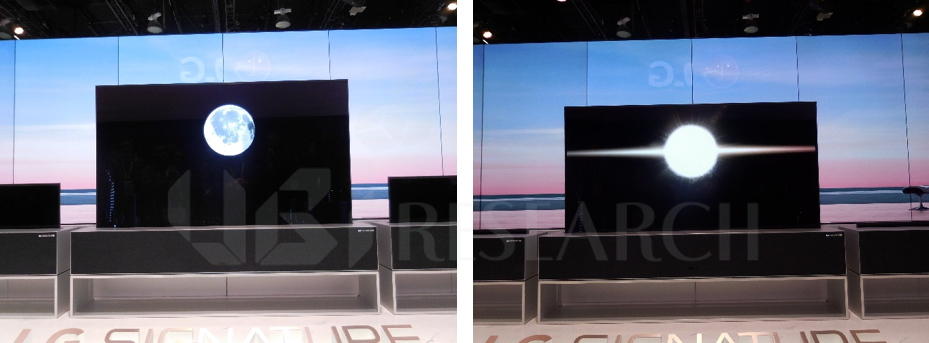
<LG Electronics, OLED TV R>
Last year, micro LED TVs became more prominent. In addition to Samsung Electronics, Sony, TCL and Hisense exhibited micro LED TVs this year. It seems that the gap of micro LED TV technology between Korean companies and Chinese companies is only about one year. In the micro LED TV market based on assembly technology that does not require special manufacturing technology, China, which is the world’s best LED industry and infrastructure, is expected to dominate the market soon.
However, as LG Display has a unique OLED TV manufacturing technology, which has a very complicated panel structure and manufacturing process, the technological gap between Korea and China is expected to be more than five years difference. In this situation, OLED TV R, released by LG Electronics, once again realizes that Korea’s OLED technology is the best in the world.
On the other hand, TV companies’ display of OLED TVs, except for LG Electronics, has stagnated. These companies are not yet receiving 8K OLED panels and rollable OLED panels from LG Display. Even Sony does not have any special features, only OLED TVs that are well known so far.
As a result, the CES TV show was notable only for LG Electronics.
It is judged that LCD TV using mini LED that TCL has released can compete with OLED TV in this exhibition. The contrast ratio is displayed as 1,000,000: 1 similar to OLED TV. Black is a very good product that has a vibrant color and contrast ratio similar to OLED TV. However, a holo-effect was found around the bright screen displayed on the black desktop. It is a phenomenon that the surroundings appear to spread brightly. As it is invisible to non-specialists, it is competitive in price and is a product that can compete well with OLED TVs.
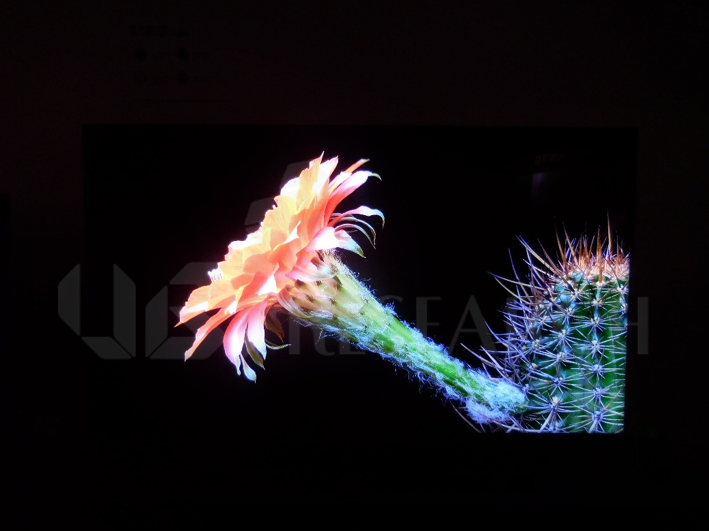
< TCL, 8K QLED TV with mini LED>

CITE 2017(China Information Technology Expo) was held in Shenzhen, China from April 9 to 11. As the Asia’s largest electronic and information exhibition hosted by the ministry of industry and information technology of the people’s republic of China and the local government of Shenzhen, the 5th CITE 2017 is the international IT event in which 1,600 companies participate annually, with 160,000 visitors.
At this expo, LG Display, BOE, CSOT, and Tianma exhibited OLED panel on one hand, and Changhong, Hisense, Konka, and Skyworth unveiled OLED-applied products on the other hand. Besides, many companies including Jilin OLED operated a shared exhibition hall under the name of China OLED Industry Alliance(COIA).
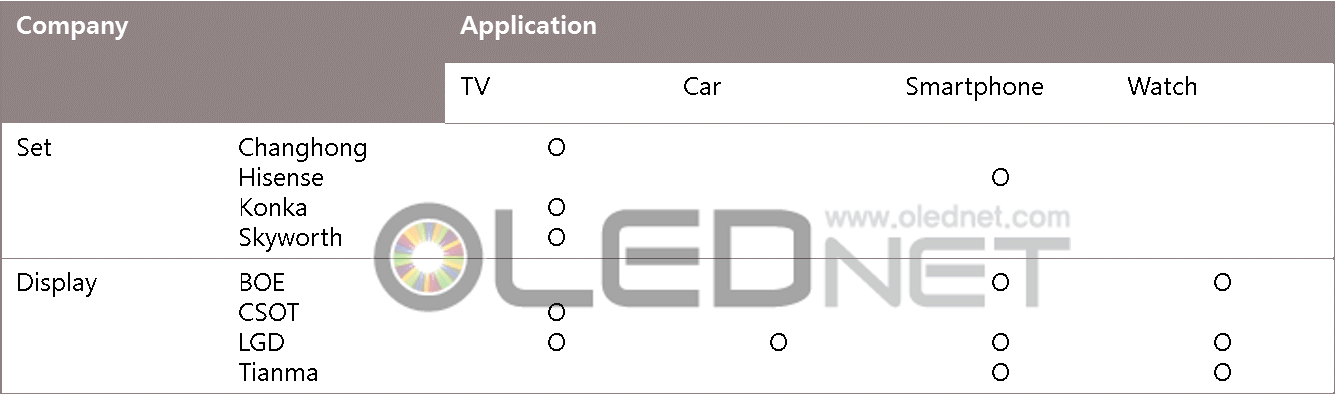
<Different Companies’ OLED Products at CITE 2017>
LG Display, the only large-area OLED panel manufacture unveiled its flagship 65-inch UHD Wall Paper OLED with an ultrathin and ultralight design of 3mm thickness and 7Kg weight, and Crystal Sound OLED displaying itself as a speaker. LG has received CES 2017 Innovation Award for its technology of Wallpaper TV OLED panel.
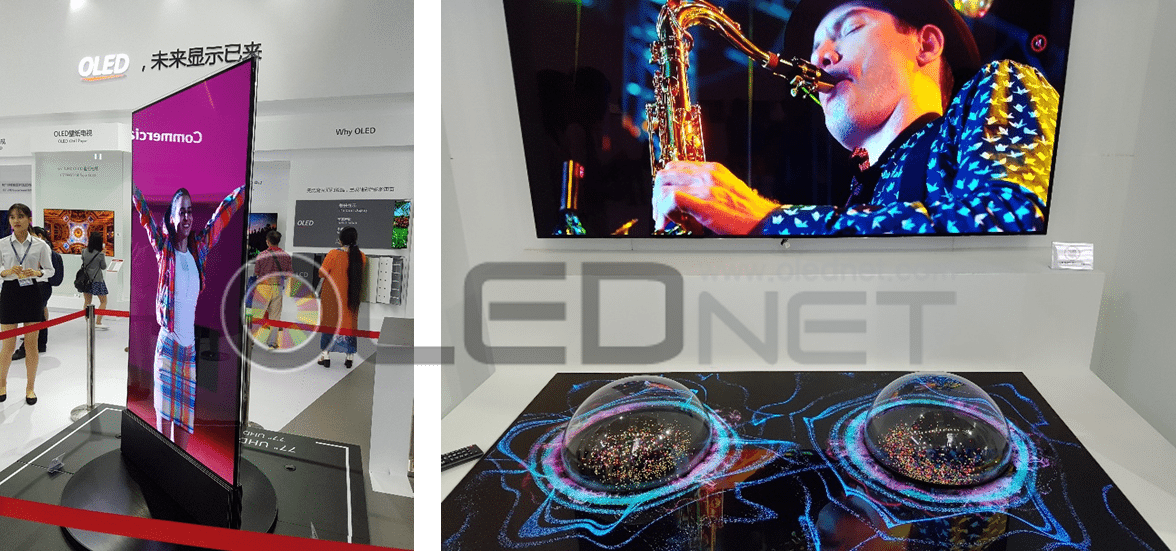
<LG Display’s Wall paper OLED(Left) & Crystal Sound OLED(Right)>
Besides, LG Display showcased various products applying OLED including OLED Pillar with six 77-inch UHD OLED panels and Dual-view flat with two 77-inich UHD OLED panels, while unveiling a 12.3-inch curved OLED for automobiles, two kinds of smartphones, and two kinds of plastic OLEDs for watches.
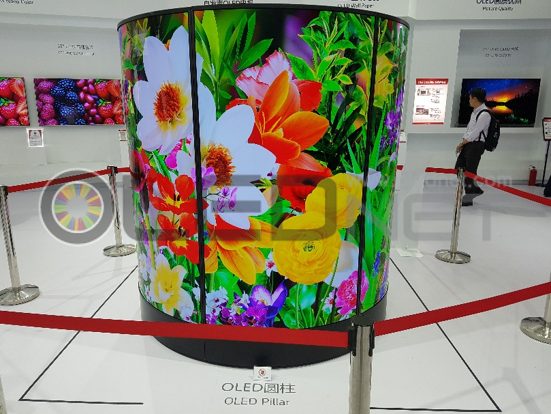
<LG Display’s OLED Pillar>
A Chinese OLED panel company, BOE boasted of its technology, demonstrating a 7.9-inch foldable OLED, a 5.5-inch edge bended OLED, and a 1.39-inch rounded OLED.
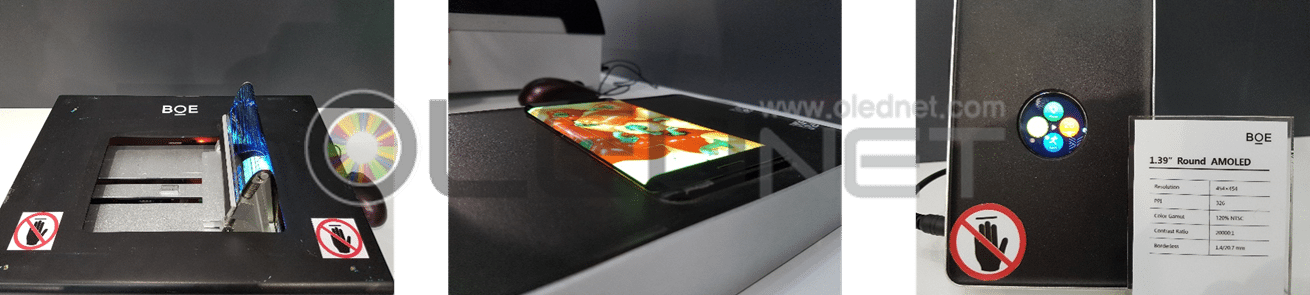
<BOE’s Foldable OLED(Left), Edge Bended OLED(Middle), Round OLED(Right)>
The other OLED TV set companies are all Chinese companies such as Changhong, Hisense, and Skyworth. They exhibited its flagship 65-inch OLED TV, a key size of premium TVs. Hisense exhibited the smartphone with OLED panel and e-ink panel on its both sides as well as OLED TV.
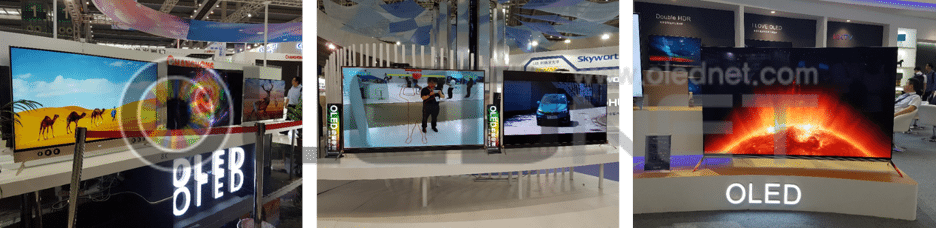
<Changhong(Left), Hisense(Middle), Skyworth’s OLED TV(Right)>