Posts

Shoei GT-Air 3 Smart featuring an OLEDoS HUD that projects navigation and speed in the rider’s field of view

Smart Helmet Evolved with OLEDoS Technology: Shoei GT-Air 3 Smart Unveiled

Japanese premium helmet manufacturer Shoei has set a new standard in the smart helmet market by announcing the GT-Air 3 Smart, the world’s first fully integrated augmented reality head-up display (HUD) helmet, developed in collaboration with French augmented reality specialist Airight. The core feature of this new product is its HUD, which utilizes Sony’s OLEDoS microdisplay.

Shoei GT-Air 3 Smart helmet with HUD info projected inside the visor

GT-Air 3 Smart projecting riding data in the rider’s view (Source: SHOEI)

Conventional LCD or projection systems face limitations in size, weight, power consumption, and brightness. Within the confined space of a helmet, delivering clear information without obstructing the rider’s vision required a solution that was ultra-compact, high-resolution, and energy efficient. OLEDoS, built on a silicon substrate with OLED pixels, achieves full-color FHD resolution and 3,000nits’ brightness even in a miniature form factor. This ensures perfect visibility under direct sunlight and allows riders to intuitively access speed, navigation, and alerts without taking their eyes off the road.

HUD information is projected approximately 3 meters ahead, reducing eye focus adjustment and shortening reaction time by 32%. Battery efficiency is improved, enabling over 10 hours of mixed use, while low heat generation enhances the reliability of internal electronics. Above all, OLEDoS miniaturization enables full integration of HUD, audio, and communication modules without significantly increasing helmet weight.

Shoei has combined its AIM (Advanced Integrated Matrix) shell structure, ventilation system, and face shield with EyeLights’ communication technology, including unlimited distance and user intercom, active noise-canceling microphone, and Siri/Google Assistant support.

According to UBI Research’s analysis, this announcement is closely linked to the relevant patents held by Shoei (including US Patent 12,342,893 and EP3888482). These patents protect rights to the optical structure integrating a HUD into the helmet and the screen device. The structure describes forming virtual images within the rider’s field of view using light sources and reflective optical systems. It is designed to allow for various implementations, including OLED and MicroLED, without restricting the display elements to specific technologies. In practice, OLEDoS was chosen as the optimal solution to meet the structural requirements defined in the patents, delivering ultra-compact, high-brightness, and low-power performance.

The GT-Air 3 Smart was unveiled at EICMA 2025 and will be released in summer 2026 at a price of approximately $1,199 in the US. Shoei aims to achieve sales of 3 billion yen and operating profits of several hundred million yen within three years.

The GT-Air 3 Smart is the first commercial helmet to fully integrate HUD, communication, audio, and AI functions. With OLEDoS technology, it revolutionizes rider visibility and reaction speed, marking a milestone in innovation and leading the future of the smart helmet industry.

EyeLights HUD module with Sony OLED microdisplay

EyeLights HUD implementation using a Sony OLED microdisplay (Source: EyeLights)

Changho Noh,  Senior Analyst at UBI Research (chnoh@ubiresearch.com)

▶UBI Research’s Micro Display Report

※ This article is produced by UBIResearchNet.
Unauthorized reproduction or citation without source attribution is prohibited.
When quoting, please clearly indicate the source (UBIResearchNet) and provide a link.

Tianma Unveils Future Display Roadmap at TIC 2025

On November 18th, the 2025 Tianma Microelectronics Global Innovation Conference (TIC 2025) was held in Wuhan, under the theme of “Innovation, New Horizons.” UBI Research summarized the key findings and technological trends presented at the event. This year’s TIC was attended by approximately 1,000 participants, including government and academic officials, global industry chain partners, investment institutions, and the media, who discussed the future direction of next-generation display technology. The conference served as a meaningful platform to showcase Tianma’s technological innovation achievements and simultaneously announce its ecological cooperation, technological standards, and sustainable development strategies.

The event featured specialized sessions on five key technology areas strategically strengthened by Tianma: the intelligent cockpit ecosystem, OLED technology, IT display technology, Micro LED, and intelligent sensing. A panoramic exhibition space encompassing smartphones, vehicles, IT, wearables, and professional displays was also unveiled. The “Tiangong Screen” experience zone showcased premium OLED technology, featuring eye protection, high resolution, and high refresh rates. The “Tianxuan Screen” exhibition area showcased advanced vehicle display experiences, showcased in real vehicles, including the Yangwang U9 and U7, ZEEKR 009 Glory Edition and 9X, NIO ES6, and Xpeng X9.

OLED technology for smartphones garnered significant attention at the presentation. Tianma unveiled the world’s first “Full Ambient Light Sensing Display,” which integrates fingerprint recognition, ambient light detection, and panel life monitoring into a single panel. This significantly enhances the user experience by reducing sensor thickness by 99% and improving light detection performance by 40x. Furthermore, the company unveiled “Super Narrow Bezel” technology, which utilizes circuit optimization based on LTPO 3.0 Pro to reduce the bezel by 20% for enhanced immersion, and the “Premium Health Display” solution, which improves blue and green light emission efficiency to reduce power consumption. In the automotive display sector, a number of technologies that best portray the future of cockpits have emerged. The 49.6-inch ultra-wide-angle panoramic screen integrates the instrument panel, side mirrors, rearview mirror, and center console into a single large screen. Its ACRUS-based pixel-level dimming technology delivers a contrast ratio of 100,000:1 and low reflectivity. Furthermore, the “IRIS HUD Panoramic Screen,” with its 12,000nit brightness, projects driving information clearly onto the windshield, garnering attention as a HUD solution that simultaneously addresses power and thickness issues. Adding to this a 13-inch central display with an L-shaped curved panel and a dynamic roll-up screen that can expand or hide a 17-inch screen in just six seconds, the possibilities for in-vehicle UX have been significantly expanded.

Tianma IRIS HUD Panoramic Automotive Display System (Source: Tianma)

Tianma IRIS HUD Panoramic Automotive Display System (Source: Tianma)

Tianma 49.6-inch Curved ACRUS Panoramic Screen for Automotive (Source: Tianma)

Tianma 49.6-inch Curved ACRUS Panoramic Screen for Automotive (Source: Tianma)

IT display technology targets next-generation PCs and esports demand. “LEAF 2.0” technology, which significantly reduces logic power consumption even at 1Hz through oxide-based ultra-low frequency operation, addresses the power efficiency demands of the AIPC era. The world’s first esports panel with a 610Hz refresh rate aims to optimize the screen for professional gaming environments with ultra-fast response and minimal afterimages.

Finally, in the Micro LED field, Tianma unveiled its flagship products, symbolizing the company’s technological prowess. The first exhibit to catch the eye was the 19-inch IRIS HUD Micro-LED, a HUD solution that delivers over 2,000 nits of brightness to the driver’s field of vision through precision tiling and a high-brightness design. Featuring a compact structure and non-reflective design, it suggests the potential for lighter and smaller HUDs for luxury vehicles.

Furthermore, the 19-inch transparent Micro-LED tiling panel demonstrates next-generation HMI technology, combining 60% transparency with 5,000nits of brightness to display information while maintaining a clear view from inside the vehicle. The 7.05-inch ultra-slim bezel transparent Micro-LED, displayed alongside the display, boasts a bezel of less than 0.1mm, emphasizing the design perfection of the transparent display.

At the center of the exhibition was a 108-inch 4K Seamless Tiling Micro-LED. This all-laser transmission-based display features 1,500nits peak brightness, a 0mm bezel, and a sophisticated LTPS-based structure. The seamless implementation ensured that the module boundaries were virtually invisible during actual playback.

This exhibition demonstrated the rapid expansion of Micro-LED technology and its potential for implementation in diverse applications, including automotive, IT, and large commercial screens. Tianma showcased its extensive portfolio, encompassing HUDs, transparent panels, and large tiling screens, clearly demonstrating its Micro-LED R&D strategy and signaling its potential to shape a new competitive landscape in the premium display market.

Changwook Han, Executive Vice President/Analyst at UBI Research (cwhan@ubiresearch.com)

▶2025 Automotive Display Technology and Industry Trends Analysis Report

▶2025 Micro-LED Display Industry and Technology Trends Report

The Future of Panoramic HUDs, Led by Micro-LED

As in-vehicle display technologies continue to evolve rapidly, the head-up display (HUD), which projects various types of information into the driver’s forward field of view, is becoming an essential interface in modern vehicles. Recently, Panoramic HUDs (PHUDs) capable of displaying not only speed and navigation data but also augmented reality (AR) content have emerged, showcasing significant technological advancement. At the core of this evolution is Micro-LED technology, which is gaining traction as the key enabler of PHUDs.

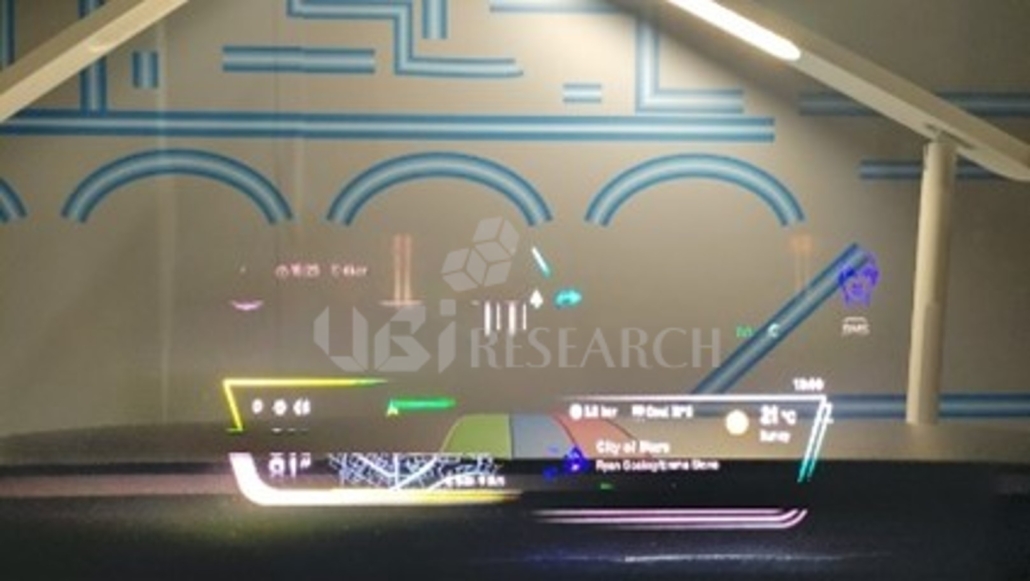
PHUDs project information across the entire or a substantial portion of the windshield, requiring a wide field of view, high resolution, and high brightness. Currently, the most commercially viable implementation is the black strip reflection method. This approach utilizes the lower black band area of the windshield as a reflective surface, allowing for a simpler optical system and lower production costs—making it an attractive option for many automakers. However, to avoid obstructing the driver’s view, the image projection height is limited, typically restricted to a narrow vertical range of approximately 3 to 6 cm.

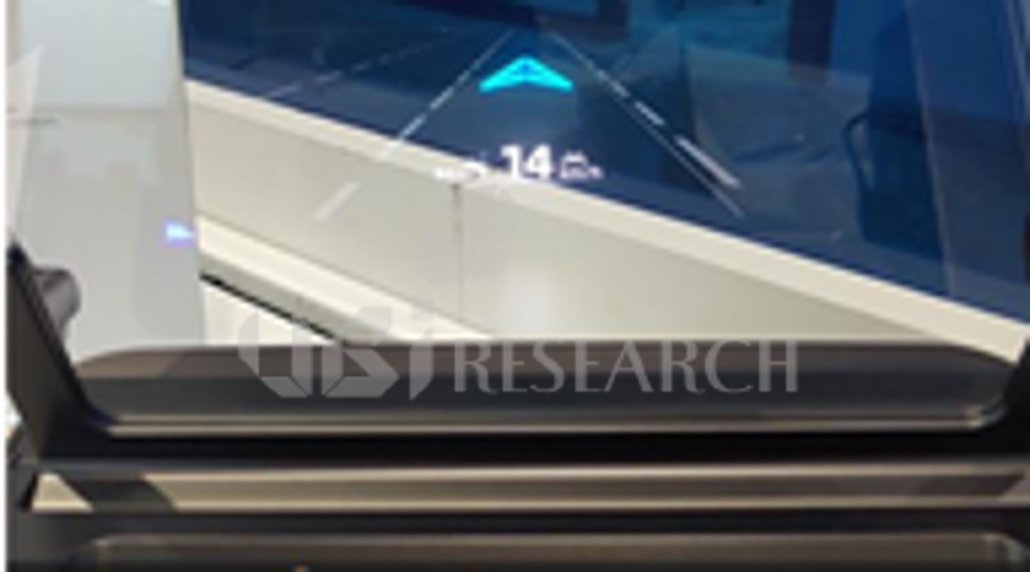
BMW Panoramic Vision

BMW Panoramic Vision

For a more immersive and premium experience, some high-end vehicles adopt a transparent reflection method. This involves embedding multilayer optical films or applying special structures within the windshield, allowing images to be reflected even in transparent areas without the need for a black band. While this method offers advantages in immersion and design, it poses significant challenges in optical complexity, higher costs, and low reflectivity—necessitating the use of ultra-bright displays.

Micro-LED provides a compelling solution to these structural and technological challenges. Thanks to its self-emissive pixel structure, Micro-LED can achieve brightness levels exceeding 1,000 nits, with ultra-high brightness capabilities reaching 30,000 to 50,000 nits—all while maintaining excellent power efficiency.

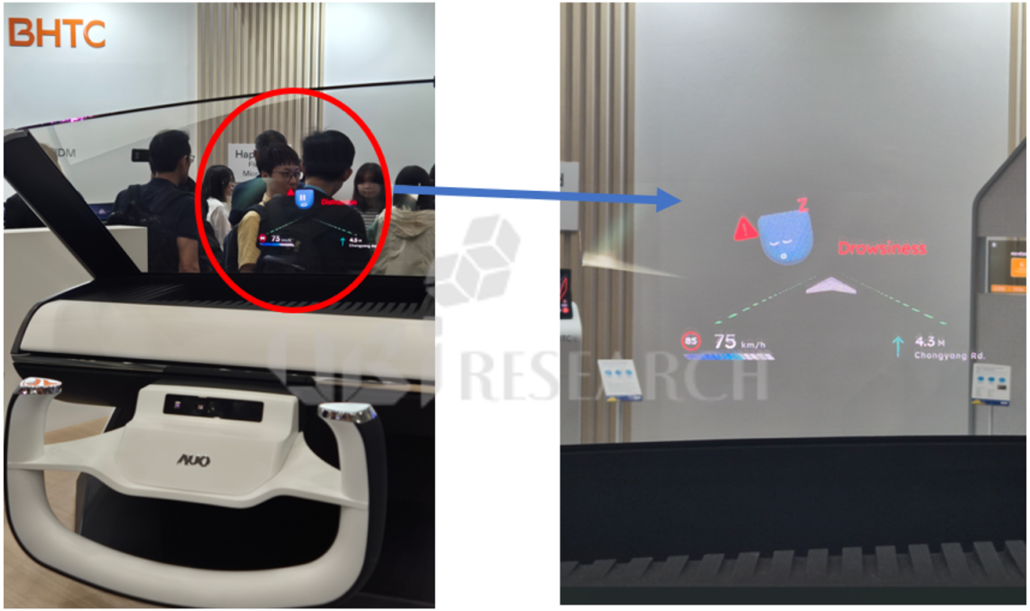
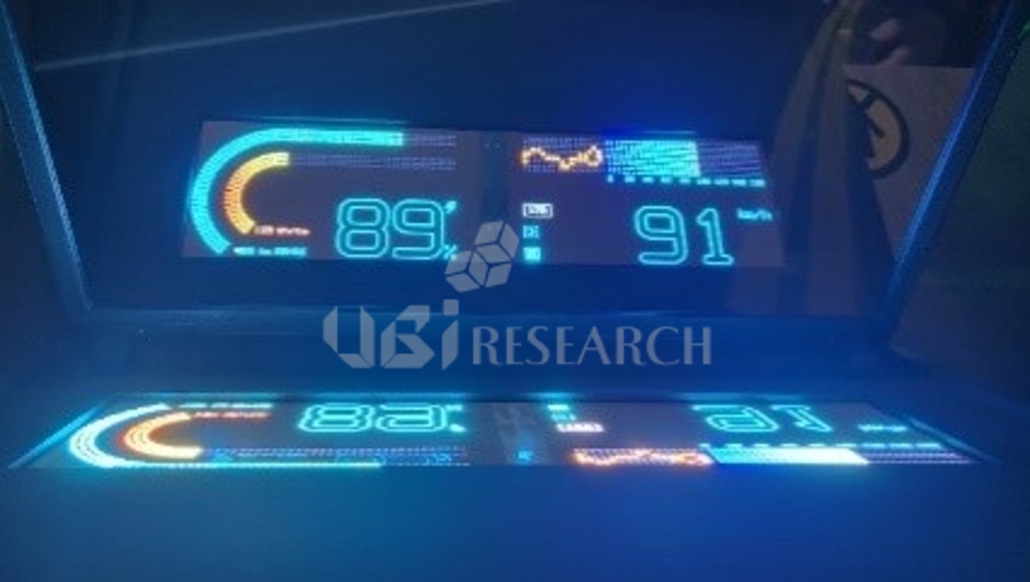
At SID 2025, major display companies such as AUO, BOE, and CSOT unveiled a range of Micro-LED-based PHUD prototypes. BOE showcased a 6.2-inch Micro-LED HUD with sub-0.2mm pixel pitch and 30,000 nits peak brightness (15,000 nits perceived brightness). CSOT presented a large 14.3-inch PHUD featuring 45,000 nits peak brightness (12,000 nits perceived brightness) and a wide viewing angle, while AUO demonstrated a 13-inch high-brightness PHUD with 12,000 nits of perceived brightness.

AUO 13” PHUD (12,000nits)

AUO 13” PHUD (12,000nits)

BOE 6.2” PHUD (15,000nits)

BOE 6.2” PHUD (15,000nits)

TCL CSOT 14.3” PHUD (12,000nits)

TCL CSOT 14.3” PHUD (12,000nits)

Micro-LED is not merely enhancing display performance—it is fundamentally transforming the structure and implementation of Panoramic HUDs. It overcomes the limitations of restricted reflection areas, enables the projection of high-brightness, high-resolution images onto various curved windshields, and meets the demands for transparency and design flexibility. As the commercialization of PHUDs becomes a reality, Micro-LED stands at the center of this transformation. The future of automotive vision and interface will unfold on Micro-LED.

Changwook HAN, Executive Vice President/Analyst at UBI Research (cwhan@ubiresearch.com)

▶2025 Automotive Display Technology and Industry Trends Analysis Report

Accelerating competition in the development of next-generation HUD display products with Micro-LED technology

This year, companies are engaged in intense competition to develop Micro-LED HUD products for automotive use at display exhibitions such as CES, Touch Taiwan, and SID. Major panel manufacturers such as AUO and Innolux in Taiwan, and BOE, TCL CSOT, and Tianma in China have unveiled a host of new products. These companies are the main suppliers of LCD HUD products.

AUO exhibited a 13-inch micro LED AR HUD, while Innolux’s CarUX implemented a HUD on the windshield using a 9.6-inch Micro-LED reflective display solution with 9.6-inch Micro- LED.

AUO-13”-AR-HUD

AUO 13” AR HUD

BOE showcased two HUD display solutions at SID. One is a 6.2-inch (624×360) RGB Micro-LED HUD, and the other is a monochrome Micro-LED HUD achieving up to 300,000 nits. TCL CSOT unveiled a 14.3-inch (1700 x 650) Micro-LED PHUD, while Tianma showcased an 8-inch (1204×608) HUD.

BOE-6.2”-HUD

BOE 6.2” HUD

TCL-14.3”-HUD

TCL 14.3” HUD

Tianma-8”-HUD

Tianma 8” HUD

These products achieve high resolution and high contrast ratios based on the advantages of Micro-LEDs, offering differentiation and the potential to replace existing LCOS products. As a result, panel manufacturers are engaging in intense competition to secure a technological lead in the market.

According to UBI Research’s “2025 Automotive Display Technology and Industry Trend Analysis Report,” this year’s vehicle display shipments are expected to exceed 240 million units, with Mini-LED and OLED panels gradually increasing. As competing technologies, companies are actively developing differentiated technologies applied to Micro-LED HUD products.

In summary, automotive displays are one of the key areas of the future display market. As the importance of displays has grown as a key differentiating factor in smart cars, the automotive display market will become an essential competitive arena for panel manufacturers. In other words, with the smart evolution of vehicles, HUDs will become mainstream, and companies will need to respond and compete accordingly.

Namdeog Kim, Senior Analyst at UBI Research(ndkim@ubiresearch.com)

▶2025 Automotive Display Technology and Industry Trends Analysis Report

Absolute Requirements for the Automotive OLED Display’s Success

On October 15, in IMID Exhibition Business Forum held in Korea International Exhibition Center (October 14-16), KATECH (Korea Automotive Technology Institute)’s head of Intelligent Control System R&D Center Dr. Inbeom Yang presented ‘Future of Automotive Technology and the Role of Smart Display’ and forecast the future of automotive display.


Dr. Yang revealed that “if existing vehicles focused on technological factors, future vehicles will evolve entirely centering on the driver, and the automotive display also will develop following this trend”. He also added that the driver’s safety and convenience have to be the priority.


Dr. Yang gave 4 examples of future automotive display. Firstly, he discussed ADAS and their flaws. ADAS (Advanced Driver Assistance Systems) help the driver to operate the vehicle safely. If ADAS can be actualized through displays such as HUD (head-up display), the driver’s safety can be maintained with ease.


The second item mentioned was a function that notifies the driver status reports linked with time and location. Dr. Yang reported that a device needs to be developed that can function in specific situations with sensors and sounds as well as on display.


Dr. Yang forecast that if display, touch technology, and haptic technology are combined and applied to vehicles, operation and feedback will be simpler for the driver. He announced that multi-functional & configuration display will also be introduced which will allow driver to recognize and control.


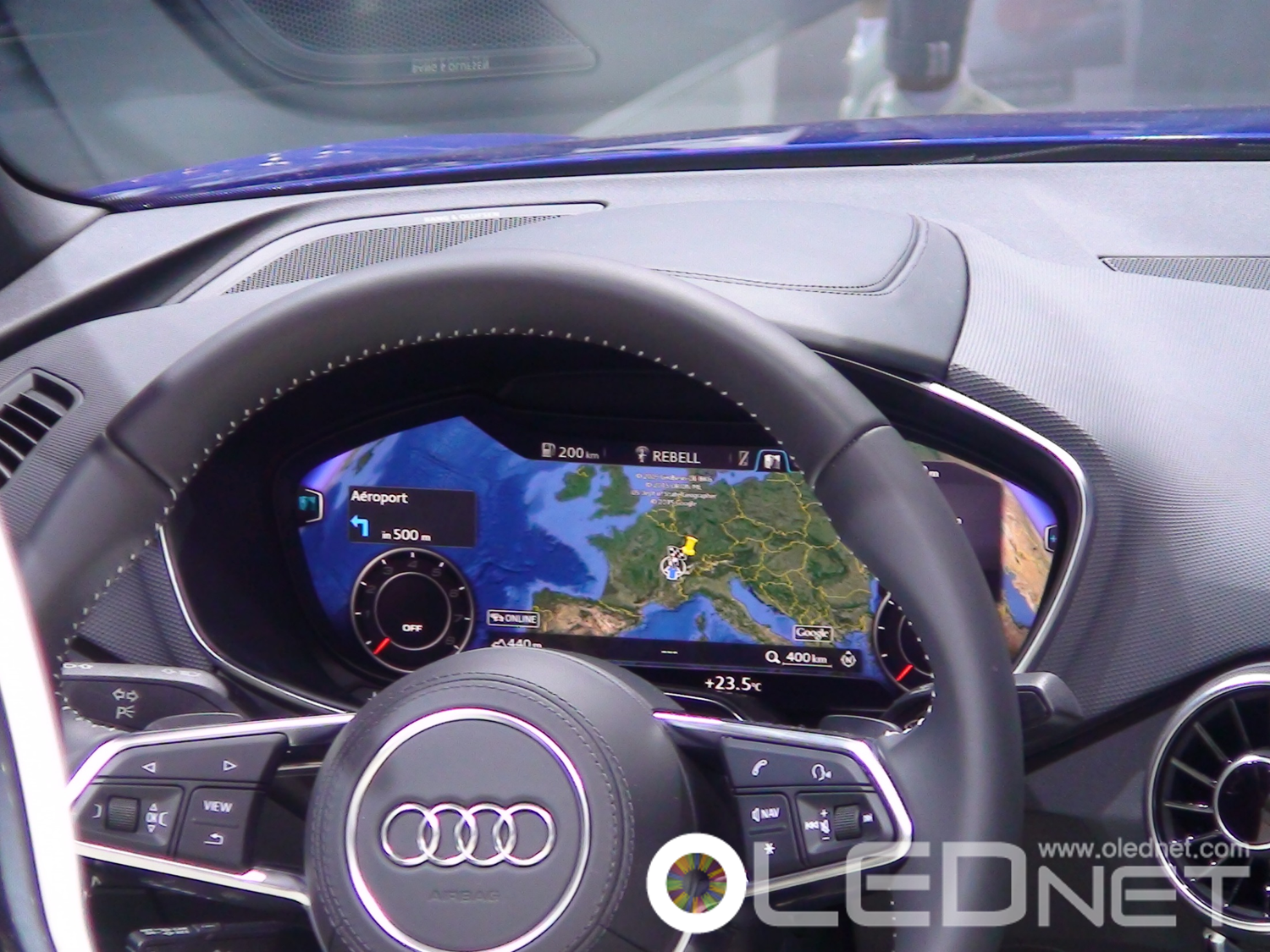
Audi’s concept vehicle that was presented in IAA 2015 Audi e-tron quattro has full OLED interface and all functions required for the vehicle operation can be controlled via touch display without physical buttons.


As futuristic displays such as these are developed that increases driver’s convenience, the proportion of display within a vehicle is expected to increase, and developed focusing on the driver centered UI (user interface). OLED Display can maximize the driver’s accuracy with fast response rate and high contrast ratio. Along with safety, and design freedom that comes with flexibility, it is suitable for automotive display. However, the linkage with the UI system optimized for the driver is essential rather than performance of the display panel itself; collaboration between display panel companies, and automotive system and peripheral companies is expected to be a major point in early market occupancy between automotive display panel companies.

Audi Q7 3.0 TDI quattro ,Geneva International Motor Show