The Key Growth Path for the OLED Market After Smartphones: “IT OLED”… Industry Strategy to Be Presented at Display Korea 2026
Display Korea 2026 (https://display-korea.com/), which will be held from March 12 to 13 at EL Tower in Seoul, is a global business event where industry professionals gather to exchange insights on next-generation display technologies such as OLED, Micro-LED, XR, and automotive displays. Organized by UBI Research, the event will feature both technical presentations and exhibitions. A total of 24 presentations are scheduled, including 15 from Korea, 3 from the United States, 5 from China and Taiwan, and 1 from Europe. With 10 presentations each dedicated to OLED and Micro-LED, the event is expected to serve as a comprehensive forum for discussing key technological trends shaping the next-generation display industry. In particular, major companies and organizations from Korea, the United States, and Greater China—including Samsung Display, LG Display, the Korea Display Industry Association, Juhua (a TCL affiliate), UDC, Vistar, and PlayNitride—will participate in both presentations and exhibitions. The event is expected to provide a valuable networking platform where global display industry stakeholders can share technology strategies and explore business collaboration opportunities.
At the event, Changwook Han, Executive Vice President of UBI Research, will deliver a presentation titled “Latest OLED Market and Industry Trends.” His presentation will focus on how the OLED industry, which has grown primarily on the back of the smartphone market, may expand into new application areas and what conditions are required for the next phase of OLED market growth.
Over the past decade, the OLED industry has experienced rapid expansion driven largely by smartphones. Even today, smartphones account for the majority of global OLED panel shipments and remain the primary application sustaining industry growth. However, further expansion of the OLED market will require extending beyond smartphones into the IT device segment. Apple’s plans to gradually adopt OLED displays in tablets and notebook computers, along with panel makers’ investments in Gen 8.6 IT OLED production lines, are regarded as positive signals for this transition.
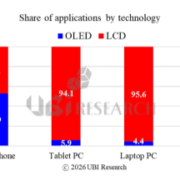
Nevertheless, the adoption rate of OLED in IT devices remains relatively low. OLED penetration is currently estimated at about 5.9% for tablet PCs, 4.4% for laptop PCs, and 2.0% for monitors. In the case of laptops in particular, OLED adoption is largely limited to high-end and certain premium models, indicating that the technology is still at an early stage from a broader market perspective. This is primarily because, despite its technological advantages, OLED panels still carry a significant price premium compared with LCD.
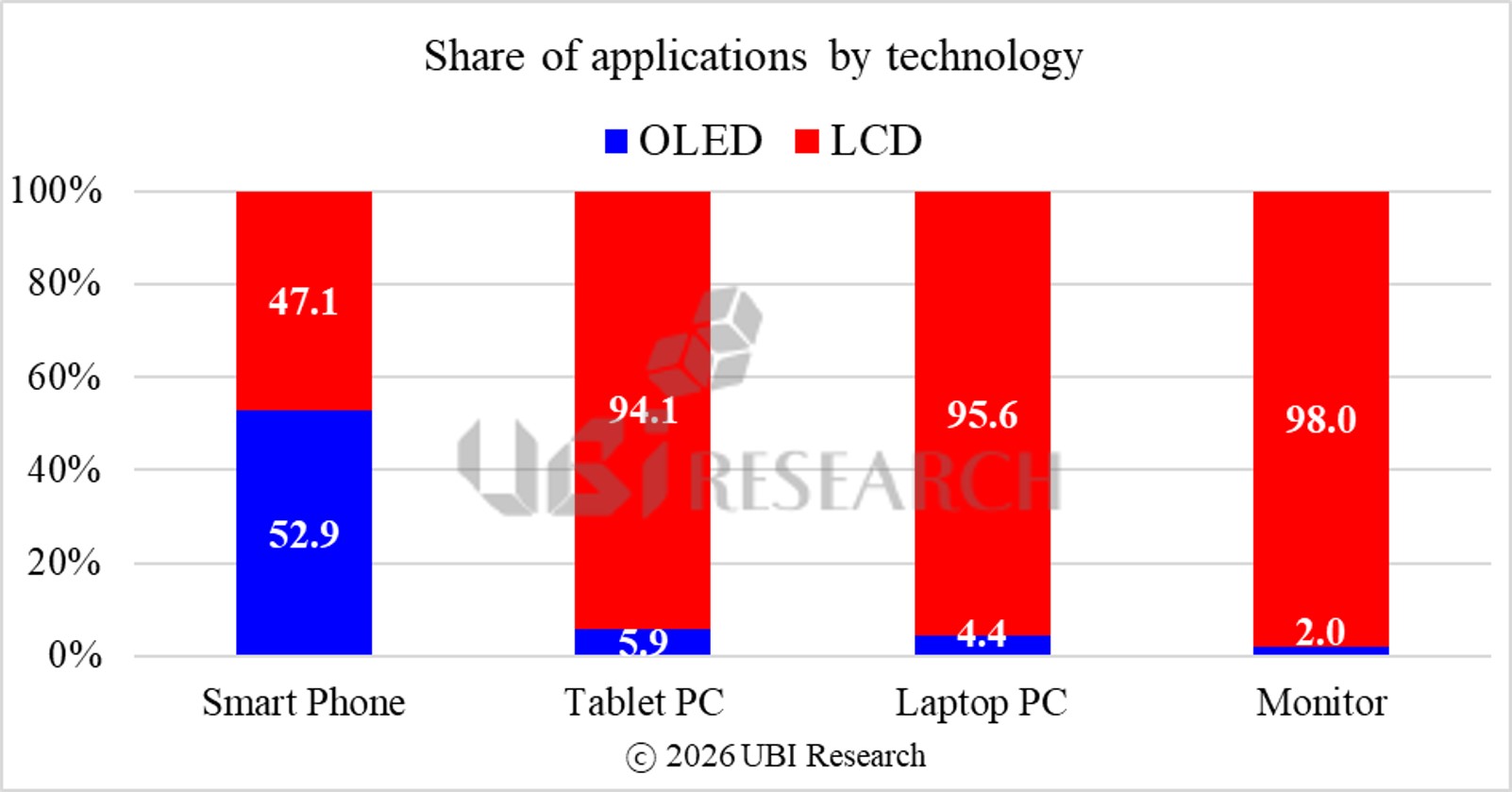
While OLED accounts for 52.9% of the smartphone market, its adoption in IT devices like Tablet PCs (5.9%) and Laptop PCs (4.4%) remains in the early stages. (Source: UBI Research)
For OLED adoption to expand meaningfully in the laptop market, reducing the price premium over LCD panels is a critical challenge. Structural cost reduction will be necessary for OLED to expand beyond the premium segment and penetrate the mainstream market. In the notebook segment, OLED panels can command a price premium of approximately 1.8–2.5 times that of LCD in high-end models and about 1.5–2.0 times in premium models. However, to expand into the mainstream segment, which represents the largest portion of the market, the price gap will need to be reduced to roughly 1.2–1.5 times that of LCD.
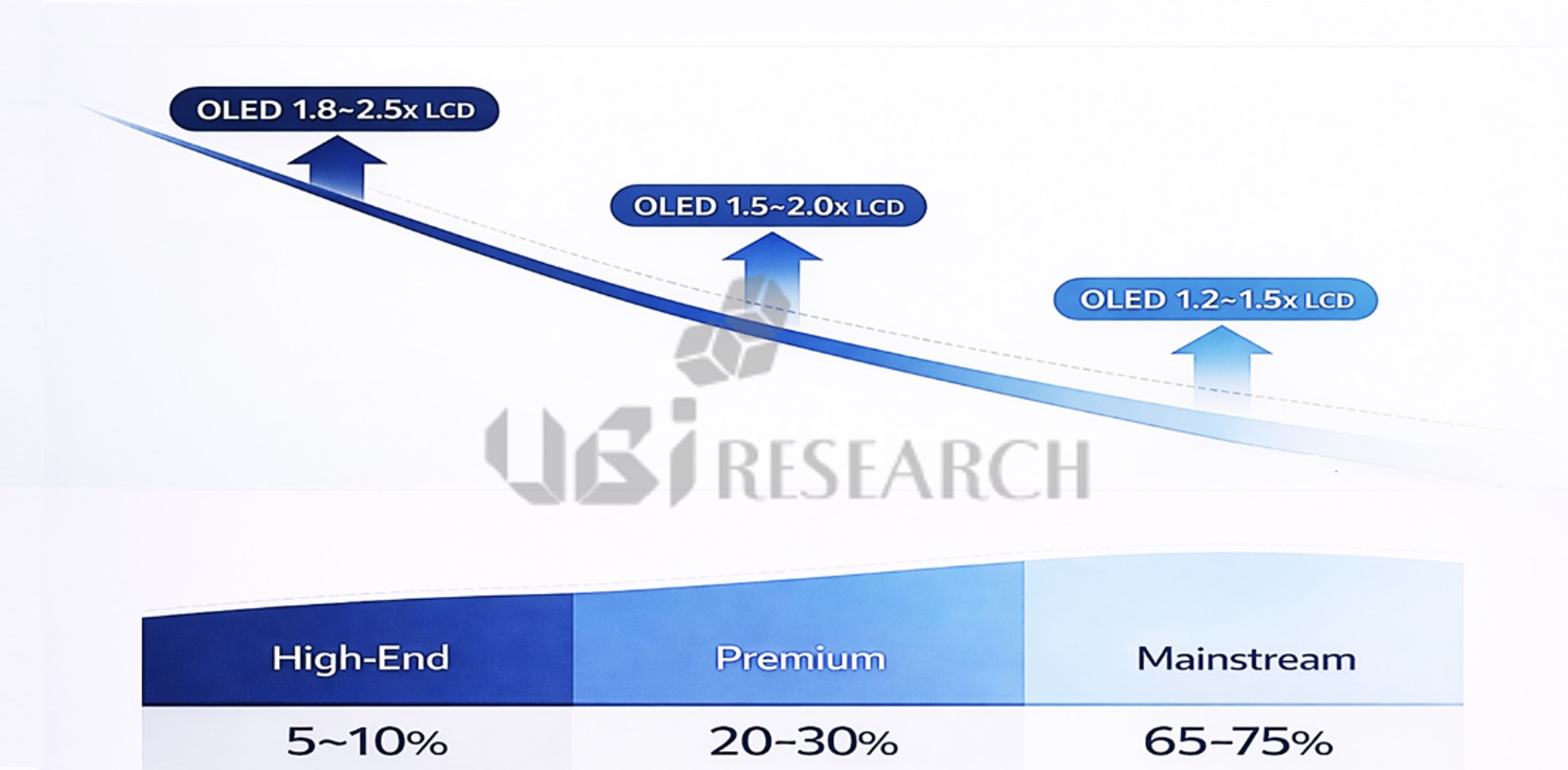
For OLED to expand beyond the High-End and Premium segments into the Mainstream laptop market (65-75% share), the price gap with LCD must be reduced to 1.2~1.5x. (Source: UBI Research)
The first cost-reduction lever is the transition to Gen 8.6 substrates. Moving from Gen 6 to Gen 8.6 increases the number of 14.5-inch notebook panels produced from a single mother glass by approximately 2.17 times. This improves substrate utilization and spreads fixed costs more efficiently. Even when accounting for depreciation, yield factors, and material scaling, the overall panel manufacturing cost can be reduced by roughly 32%. This step is considered the most fundamental approach to narrowing the price gap between OLED and LCD.
The second strategy is the transition from tandem OLED structures to single-stack OLED. However, this shift is only feasible if emitter material performance improves significantly. In tandem structures, two emissive stacks share the burden of brightness and lifetime, whereas in a single-stack structure this burden is concentrated in one layer. Therefore, applying a single-stack structure to notebook OLED panels requires substantial improvements in the lifetime of red and green emitters, while blue must transition from fluorescent systems to high-efficiency phosphorescent blue in order to meet both efficiency and lifetime requirements. If these material conditions are achieved, reducing the number of stacks will lower material consumption and process complexity, resulting in additional cost reductions.
The third strategy involves removing the polarizer and adopting a COE (Color filter on Encapsulation) structure. By integrating the color filter directly onto the encapsulation layer, the optical stack becomes simpler and recurring material costs can be reduced. At the same time, optical efficiency improves, reducing the current required to achieve the same display brightness. This improvement in light extraction efficiency not only lowers module costs but also supports the implementation of single-stack OLED structures. Higher optical efficiency enables the same luminance to be achieved at lower current density, reducing lifetime stress on the emissive layer and improving the feasibility of single-stack structures. Although COE requires upfront investment, its cost advantages become more apparent as depreciation progresses and patterning yields stabilize.
In summary, the combination of Gen 8.6 substrate scaling, single-stack OLED transition, and polarizer removal with COE adoption represents a practical pathway for improving the cost competitiveness of IT OLED panels. Once these structural cost reductions are realized, OLED technology is expected to expand beyond premium notebook models into the mainstream segment. This transition could mark a major turning point for the OLED industry, shifting its growth driver from smartphones toward IT displays.
The presentation at Display Korea 2026 is expected to provide comprehensive insights into these structural changes in the OLED industry and outline strategies for future market expansion, offering valuable perspectives for global display companies and industry stakeholders.
Changwook Han, Executive Vice President/Analyst at UBI Research (cwhan@ubiresearch.com)
 Pre-register for Display Korea 2026
Quarterly Small OLED Display Market Tracker Sample
Quarterly Medium & Large OLED Display Market Tracker Sample
※ This article is produced by UBIResearchNet.
Unauthorized reproduction or citation without source attribution is prohibited.
When quoting, please clearly indicate the source (UBIResearchNet) and provide a link.


 China Trends Report Inquiry