

“Beyond Mobile” Era Begins… IT OLED to More Than Double by 2029

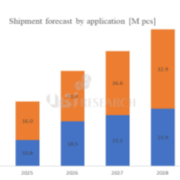
IT OLED shipment forecast (Source: UBI Research)
According to UBI Research’s recently published report, “Beyond Mobile: IT OLED Technology and Industry Analysis,” global shipments of IT OLEDs are expected to more than double from 24 million units in 2025 to 53 million units in 2029. The report states that OLED adoption in tablets, notebooks, and monitors is entering a structural growth phase over the next four years.
Company-level shipment projections also show clear shifts. Samsung Display, currently the largest producer of OLED panels for notebooks, tablets, and monitors, is expected to maintain a stable market share of more than 60%. LG Display, Everdisplay, BOE, and Visionox are projected to follow, shaping a competitive global landscape in the IT OLED market.
Because most IT OLED products use medium-to-large panel sizes, large-substrate production lines that maximize glass utilization rates are essential. As global device makers—especially Apple—accelerate their adoption of OLED across IT product categories, panel manufacturers are positioning 8.6-generation (8.6G) OLED line investments as a core strategic priority.
The investment landscape reflects this trend. After Samsung Display announced the industry’s first 8.6G OLED line investment worth approximately KRW 4 trillion in April 2023, BOE, Visionox, and TCL CSOT soon followed. More recently, Tianma has also begun reviewing 8.6G OLED investment, drawing attention across the industry. This shift signals that the OLED market is moving beyond a smartphone-centered structure and into a phase of expanding demand driven by notebooks, tablets, and monitors.
As the market grows, technology requirements for IT OLEDs are also becoming more stringent. The report highlights that IT products have longer replacement cycles and a higher percentage of white-background usage for document work, making them more vulnerable to burn-in than smartphones. As a result, 2-stack tandem OLED, known for long lifetime, high brightness, and high efficiency, is evaluated as essential. Samsung Display, BOE, and Visionox are therefore investing in production lines capable of mass-producing 2-stack tandem OLED.
Customer acquisition competition is another critical factor. Samsung Display has secured Apple as a key customer and is building its strategy around mass production for the OLED “MacBook Pro.” In contrast, Chinese panel makers are prioritizing markets for OLED panels used in notebooks, tablets, and smartphones among Chinese and global brands, rather than targeting Apple’s supply chain as their first objective.
UBI Research Vice President Changwook Han stated, “As Chinese OLED panel makers rush into 8.6G OLED investments in an effort to catch up with Samsung Display, the industry is closely watching how effectively Samsung Display can leverage its technology leadership to secure additional IT customers beyond Apple.”
Changwook Han, Executive Vice President/Analyst at UBI Research (cwhan@ubiresearch.com)

 2025 Mid-to-Large OLED Display Annual Report Sample