Posts

Composite image of Garmin Fenix 8 Pro Micro-LED smartwatch showing front face and side view for outdoor visibility (Source: Garmin)

When will the commercialization competition of Micro-LED smartwatch products become feasible?

The development of Micro-LED-based smartwatches has continued since 2020 through prototype exhibitions, and their high brightness characteristics led to high expectations for commercialization. Previously, companies like KONKA, AUO, Innolux, and Apple had attempted development or commercialization. However, when Apple halted its own development in early 2024, the difficulties of the Micro-LED manufacturing process and high cost issues came to the fore, suggesting that commercialization of Micro-LED smartwatches would require more time.

Assorted Micro-LED smartwatch prototypes from multiple vendors

Assorted Micro-LED smartwatch prototypes from multiple vendors

However, sports smart wearable brand Garmin launched the world’s first Micro-LED smartwatch, the ‘Fenix 8 Pro’, in September this year. It is currently retailing for approximately 13,000 yuan on Chinese online shopping platforms. Garmin’s September launch sent a significant signal to the market, demonstrating that Micro-LED technology has secured commercial viability in the smartwatch sector.  Of course, there are still many areas requiring improvement. Nevertheless, beyond AUO, which is already in mass production, companies like PlayNitride, Innolux, Samsung Display, TCL CSOT, and Tianma are actively entering the market and accelerating efforts to commercialize Micro-LED smartwatches. By late 2023, AUO had already achieved mass production of Micro-LED watch panels. In its subsequent production plans, AUO’s 4.5-generation Micro-LED production line is scheduled to enter mass production this year, with products covering smartwatches and large TVs. At CES 2025, Samsung Display showcased a watch prototype (2.1 inches, 418×540 resolution, 326 ppi) developed over years of Micro-LED technology advancement. Chinese home appliance company KONKA also unveiled its Micro-LED watch, the APHAEA Watch, in 2020. The Chongqing KONKA Optoelectronics Technology Research Institute is enhancing core technologies to reduce manufacturing costs. PlayNitride has positioned smartwatches as a key growth driver this year, exhibiting a 1.39-inch smartwatch panel at Touch Taiwan 2025. This product applies high-efficiency, low-power ‘Tantium’ chip technology to achieve high resolution and 5,000 nits peak brightness, presenting a new solution that simultaneously delivers low power consumption and high image quality for wearable devices. Innolux has also developed 1.1-inch and 1.39-inch Micro-LED displays with integrated touch sensors. Tianma has established a dedicated Micro-LED research institute and is exploring new application areas like smartwatches, in addition to automotive applications.

Garmin Fenix 8 Pro Micro-LED smartwatch (Source: Garmin)

Garmin Fenix 8 Pro Micro-LED smartwatch (Source: Garmin)

Garmin has pioneered Micro-LED in smartwatches, but who will be the next contender for Micro-LED smartwatches? When will commercialization competition become feasible? Significant hurdles remain. Developed watch panels (326~338 PPI) achieve high brightness levels of 4,000~6,000 nits. However, to compete with existing OLED products, Micro-LED chip and manufacturing costs must be reduced, and power consumption characteristics must be improved. Recent announcements from Micro-LED technology companies clearly outline and are actively pursuing solutions to overcome these cost challenges. The mid-to-long-term strategy for Micro-LED smartwatches is to build integrated technological capabilities combining Micro-LED technology with health monitoring sensors. Long-term, as chip miniaturization technology matures and the advantages of sensor integration are fully realized, Micro-LED is expected to break free from its niche market limitations and expand into the broader wearable product market. UBI Research analyzed that the Micro-LED smartwatch market will fully open starting in 2028.

Namdeog Kim, Senior Analyst at UBI Research(ndkim@ubiresearch.com)

▶2025 Micro-LED Display Industry and Technology Trends Report

※ This article is produced by UBIResearchNet.
Unauthorized reproduction or citation without source attribution is prohibited.
When quoting, please clearly indicate the source (UBIResearchNet) and provide a link.
[CES 2018] OLED TV exhibition from major set manufacturers

On 8 January 2018, the largest electronic show is held at Enclave Convention Center in Las Vegas, United States.

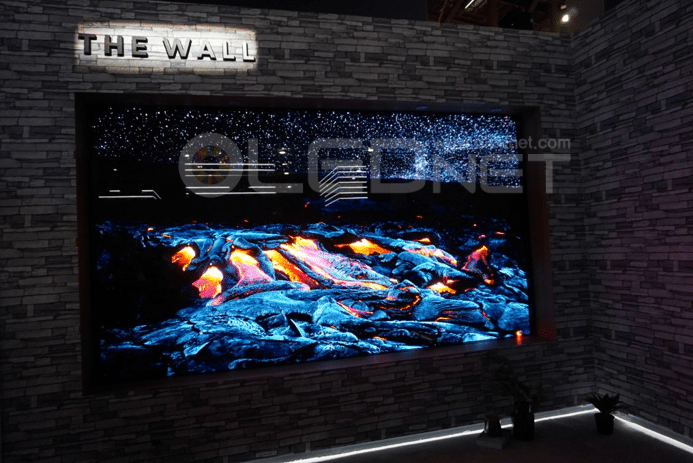
Major electronic companies such as LG Electronics, Sony, Vestel, Changhong, Skyworth presented OLED TV as main exhibition. In particular, Samsung Electronics’ “Micro LED” exhibition received a great deal of attention.  Samsung Electronics unveiled the world’s first “micro LED” technology-applied 146-inch modular TV, “The Wall.” People came to see the product and it was heated up in a hot issue. Samsung Electronics emphasized that this product is a future screen that is unlimited in image quality, size and form. Through the implementation of the local dimming 3000, “The Wall”, which was unveiled at the exhibition show is developed by brightness, contrast ratio, color reproduction and black display compared to the existing display.

<‘Micro LED TV ‘The Wall’ of Samsung Electronics’>

Especially, the existing “Mini LED” products were exhibited along with “The Wall” for comparison of exhibition. And the excellence of “Micro LED” was outstanding. “Mini LED” products was little far from the large display as pixels and the lines of each module were shown on the screen.

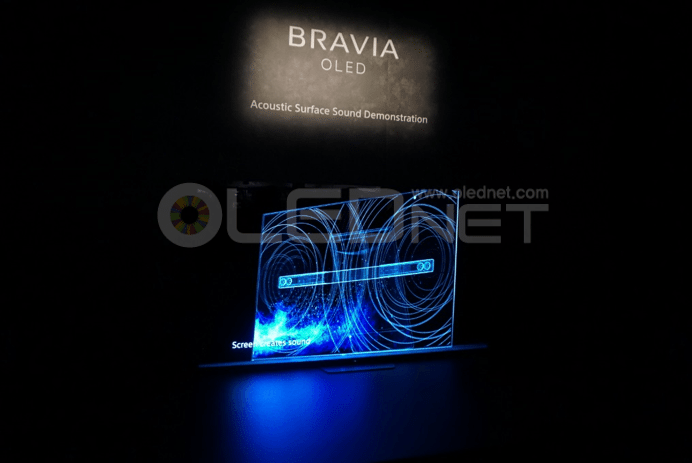
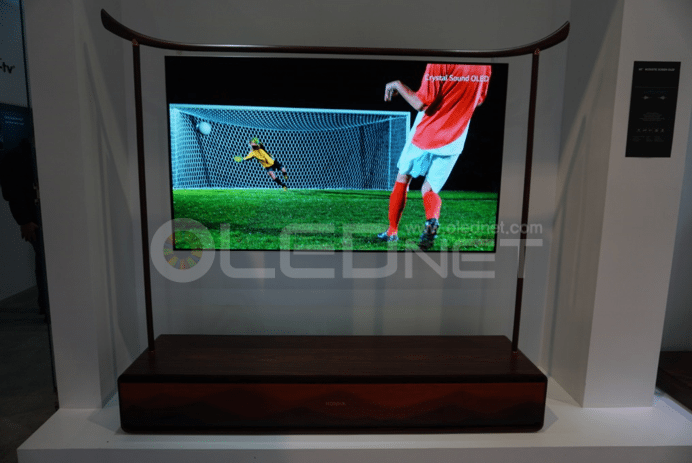
LG Electronics, Sony, Changhong and other companies presented 65-inch and 77-inch OLED TV display products including Sound Acoustic OLED TV products. In particular, Konka reflected the trend that TV is a part of furniture, not just electronic products and it consists of a set design that took advantages of Chinese traditional atmosphere.

In addition, many set manufacturers have demonstrated the advantages of OLED TV, which is the lightest and thinnest through “Wall Paper TV” and “Slim” concepts.

<A8F Bravia OLED TV of Sony>

<OLED TV of Kongka>

‘TCL’, which occupies a side of QLED TV showed more advanced QLED TV in image quality and color reproduction range. According to the person in charge of TCL, QD dominated the portion of the current market therefore, many manufacturers are producing Quantum dot LCD, and also considering OLED TV launches. The person in charge emphasized that they are building factories in China that produce only OLED.

LG Electronics is a leading OLED TV company and showed OLED which is being developed continuously through making tunnels of OLED TV. They revealed that LG Electronics is the world’s first OLED TV set manufacturer. People look forward to seeing OLED growth in the future through CES the first electronic exhibition show in 2018.

LG DISPLAY, Will lead global TV market with OLED

LG Display invited about 200 people of Chinese set makers, distributors and related experts and had ‘OLED Partner’s Day’ to share the status of premium TV market and OLED TV business development at Renaissance Capital Hotel in Beijing, China on September 12.

<Source : LG Display>

In the expert forum on the day, key executives from distribution and set makers such as LG Electronics, Sony, Philips, Skyworth, Suning and related organizations such as electronic committee and awards association participated and agreed that OLED will lead the TV market in the future. Forum participants, Liu Tangz(刘棠枝), CEO of Skyworth, said “The Chinese TV industry is currently in a state of saturation, but OLED TV, which can offer new value, will be a breakthrough in the display industry,” and commented “OLED TV will help increase brand awareness and market share.”

Yeo Sang-Deog, LG Display CMO, said, “OLED TV has already become the market trend” and emphasized “We will lead the market with OLED TV, a true future display that can deliver value beyond TV.”

Since LG Display began mass production of OLED TV panels in 2013, it has expanded its customer base to 13 major companies in Europe, Japan and China, starting with LG Electronics. World TV set makers such as LG Electronics, Skyworth, Concha, Philips and Panasonic have set OLED TV products on the front at the IFA (International Consumer Electronics Show) 2017 in Berlin in early September.

OLED TV’s market competitiveness is getting higher as major set makers in the world recognized the value of OLED TV, which has various advantages such as image quality, thickness, design, viewing angle and power consumption and aggressively launch products.

Yeo Sang-Deog CMO emphasized the confidence in quality, he added, “In addition to securing stable yields, we will increase the output to 1.7 ~ 1.8 million units in 2017 and 2.5 million units in 2018.” and explained that they finished all the preparations that OLED TV can influence in terms of production.

<Source : LG Display>

OLED TV has been rated as one of the best products by the world’s leading professional rating agencies such as ‘Consumer Report’, a nonprofit consumer organization in the US.

OLED TV can be used for interior decoration that displays pictures and photos even when not watching TV, and easy to apply on various AI platforms so that there is no limit to the range of applications. LG Display expects OLED TVs with infinite scalability to change the lifestyle of consumers.

“OLED is a true future display that can deliver new value to the TV market,” said Yeo Sang-Deog CMO and “LG Display plans to carry out a variety of promotional activities to enable more consumers to know and experience the value of OLED.”

LG Display plans to build an OLED landmark in Guangzhou Tower while operating an OLED experience center in the core city of China.

Meanwhile, Vincent Teoh, editor-in-chief and image quality expert at HDTV Test, explained that the TV picture quality test conducted recently proved the overwhelming superiority of OLED TV in all aspects such as contrast and color accuracy, famous Chinese photographer Tungmeong (童梦) shared the experience of use from the user perspective that OLED is the best display to realize the natural color.

On the he other side of the event hall, there prepared the experience zone that can compare structure and image quality of OLED, gallery that can be observed high-end products such as CSO and wallpapers TV and products released by customers allowing attendees to directly experience the benefits of OLED TV.

OLED Display Embellished CITE 2017

CITE 2017(China Information Technology Expo) was held in Shenzhen, China from April 9 to 11. As the Asia’s largest electronic and information exhibition hosted by the ministry of industry and information technology of the people’s republic of China and the local government of Shenzhen, the 5th CITE 2017 is the international IT event in which 1,600 companies participate annually, with 160,000 visitors.

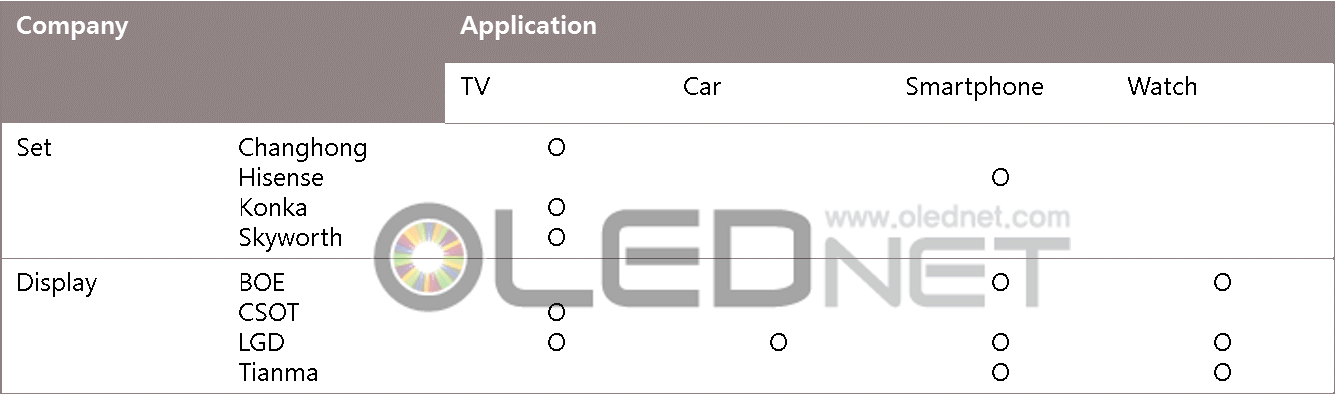
At this expo, LG Display, BOE, CSOT, and Tianma exhibited OLED panel on one hand, and Changhong, Hisense, Konka, and Skyworth unveiled OLED-applied products on the other hand. Besides, many companies including Jilin OLED operated a shared exhibition hall under the name of China OLED Industry Alliance(COIA).

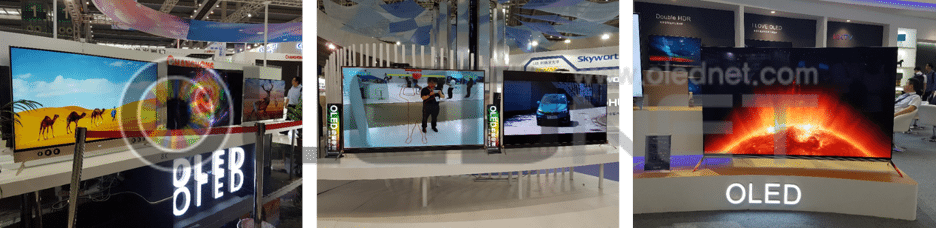
<Different Companies’ OLED Products at CITE 2017>

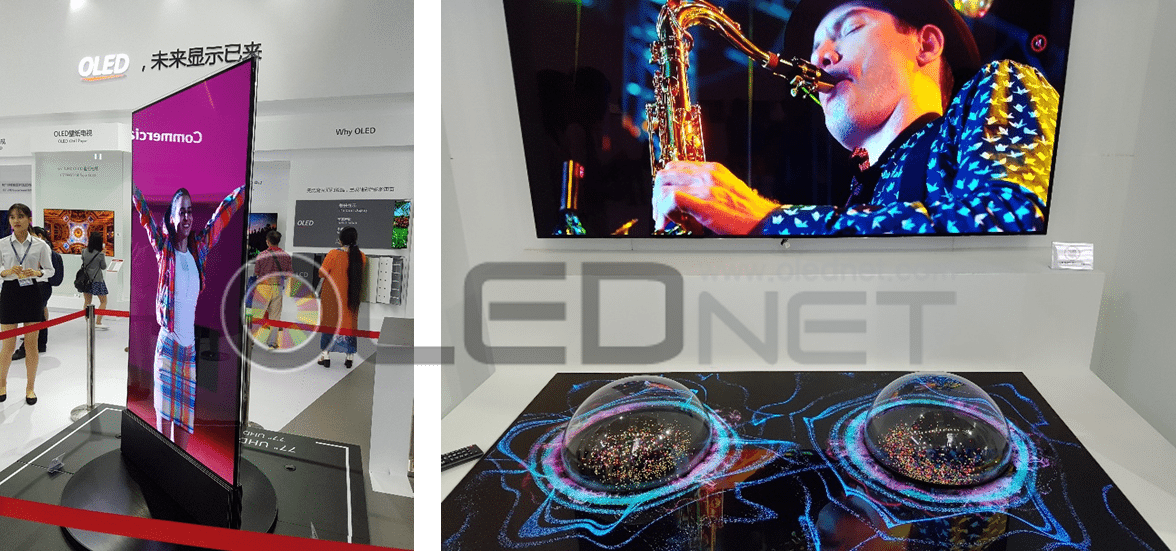
LG Display, the only large-area OLED panel manufacture unveiled its flagship 65-inch UHD Wall Paper OLED with an ultrathin and ultralight design of 3mm thickness and 7Kg weight, and Crystal Sound OLED displaying itself as a speaker. LG has received CES 2017 Innovation Award for its technology of Wallpaper TV OLED panel.

<LG Display’s Wall paper OLED(Left) & Crystal Sound OLED(Right)>

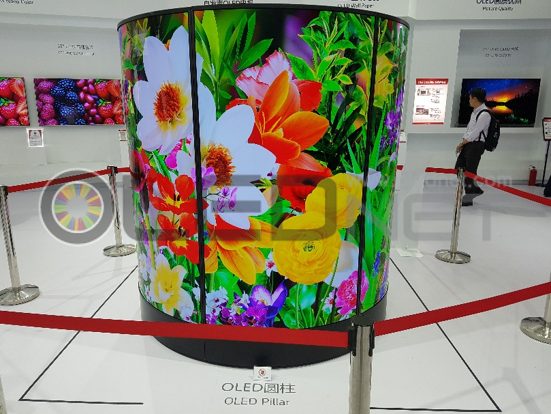
Besides, LG Display showcased various products applying OLED including OLED Pillar with six 77-inch UHD OLED panels and Dual-view flat with two 77-inich UHD OLED panels, while unveiling a 12.3-inch curved OLED for automobiles, two kinds of smartphones, and two kinds of plastic OLEDs for watches.

<LG Display’s OLED Pillar>

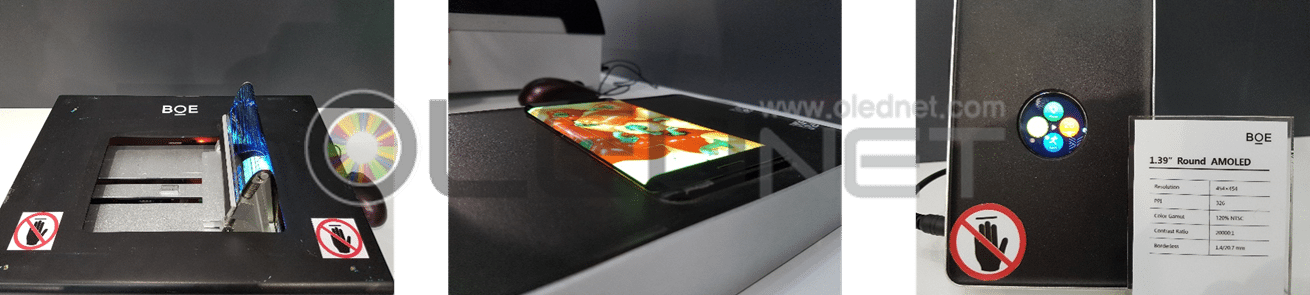
A Chinese OLED panel company, BOE boasted of its technology, demonstrating a 7.9-inch foldable OLED, a 5.5-inch edge bended OLED, and a 1.39-inch rounded OLED.

<BOE’s Foldable OLED(Left), Edge Bended OLED(Middle), Round OLED(Right)>

The other OLED TV set companies are all Chinese companies such as Changhong, Hisense, and Skyworth. They exhibited its flagship 65-inch OLED TV, a key size of premium TVs. Hisense exhibited the smartphone with OLED panel and e-ink panel on its both sides as well as OLED TV.

<Changhong(Left), Hisense(Middle), Skyworth’s OLED TV(Right)>