Posts

BOE Unveils Next-Generation LTPO OLED Roadmap at DIC 2025…Evolving into LTPO 2.x in 2025

BOE LTPO OLED roadmap unveiled at DIC 2025, showing evolution from LTPO 1.0 to LTPO 2.x

BOE’s LTPO Roadmap Exhibited at DIC 2025

From August 7 to 9, at the DIC EXPO 2025 (Display Innovation China), BOE unveiled its LTPO OLED technology development roadmap. The presentation provided a clear view of the company’s technological evolution, starting with the commercialization of LTPO 1.0 in 2021 and leading up to the upcoming launch of the next-generation LTPO 2.x in 2025.

From LTPO 1.0 to 2.0 – Enhanced Power Efficiency and Color Reproduction

In 2021, BOE began mass production of LTPO 1.0, commercializing technology that supports a variable refresh rate (1–120 Hz) and delivers up to 15% power savings. In the same year, the company developed LTPO 1.0+COE (Color on Encapsulation), improving color gamut performance from 83% to 92% (BT2020 standard) and ushering in the era of high color gamut displays.

In 2023, BOE commenced mass production of LTPO 2.0, which minimizes visual fatigue by reducing flicker. This product features 960 Hz PWM driving, supports high brightness of 500 nits, and achieves up to 71% power savings in low-brightness environments.

Tandem Structure Adoption – High Brightness and Low Carbon

Launched in 2024, LTPO 2.0+Tandem improves both transmittance and power efficiency. By adopting a tandem stacked structure, it delivers 24% power savings while simultaneously achieving high brightness and eco-friendliness.

LTPO 2.x in 2025 – Expanding Beyond Mobile to Laptops and Tablets

BOE plans to introduce its next-generation LTPO 2.x in 2025. This technology will further enhance resolution and transmittance, while adopting a thinner and lighter structure. It is expected to be applied not only to smartphones but also to various devices such as laptops (MB), notebooks (NB), and tablets (TPC).

Accelerating Next-Generation Mobile Display Competition

Industry experts believe BOE’s LTPO 2.x will serve as a critical weapon in next-generation OLED competition with Samsung Display and LG Display. With its emphasis on both energy efficiency and eco-friendly technology, BOE is expected to strengthen its position in the global premium smart device market.

Junho Kim, Analyst at UBI Research (alertriot@ubiresearch.com)

▶ China Market Trend Report Inquiry

LG Display Expected to Supply only LTPO Panels for iPhone 15 to be Released in 2023

iPhone 15 expected lineup

iPhone 15 expected lineup

It is forecasted that LG Display will supply only two panels of the LTPO model among the iPhone 15 series to be released in 2023. It is unlikely that panels will be supplied to 6.1 inch LTPS models that have previously supplied panels. LG Display first started supplying OLED panels for the iPhone11 Pro max released in 2019 and supplied LTPO TFT-applied panels for the first time for the iPhone14 Pro max released this year.

According to the prospect that LG Display will supply LTPO panels for iPhone 15 to be released next year, Samsung Display and LG Display will jointly supply LTPO models. Samsung Display is expected to supply panels for all 4 types of iPhone15, LG Display for 2 pro models, and BOE for 6.1-inch LTPS models. It is still unknown whether BOE will supply panels for the 6.7-inch LTPS model.

It was in 2017 that Apple began to apply OLED to iPhone. LTPO TFT was applied from the iPhone13 pro series released last year and LTPO TFT applied panel was supplied to Apple for the first time by Samsung Display.

▶ 2022 Small OLED Display Semi-Annual Report Sample Download
Foldable Phones Predicted to Exceed 100 Million Units by 2026

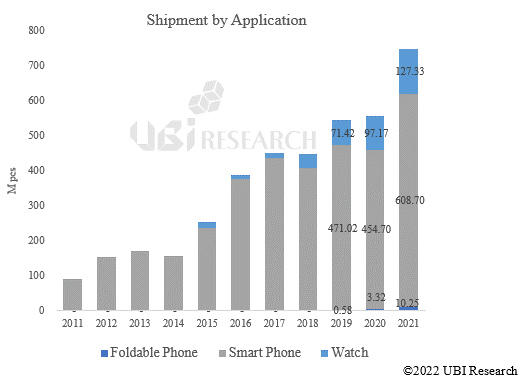
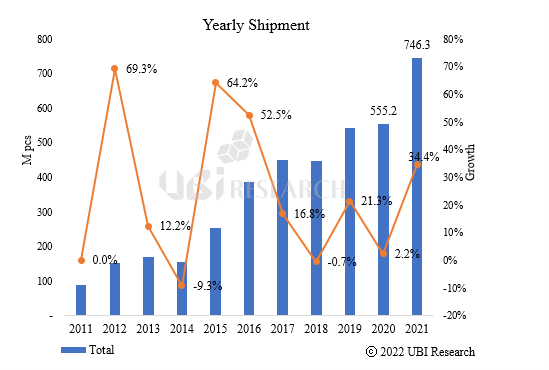
According to UBI Research’s “1Q22 Small OLED Display Market Track” Small OLED Display (10-inches or smaller watch, smartphone, foldable phone, etc.) shipment in 2021 was 746 million, a 34.4% increase from the previous year’s 555 million. The reason for the increase in shipments compared to 2020 can be attributed to the increased sales of iPhone 12, iPhone13, and the unexpectedly strong sales of Galaxy Z’s Fold 3 and Flip 3.

Compared to the previous year, Small OLED sales in 2021 was up from $26.5 billion to $38.1 billion, a 43.9% increase.

Graphs are categorized by application product; Watch, Smartphone, Foldable Phone.

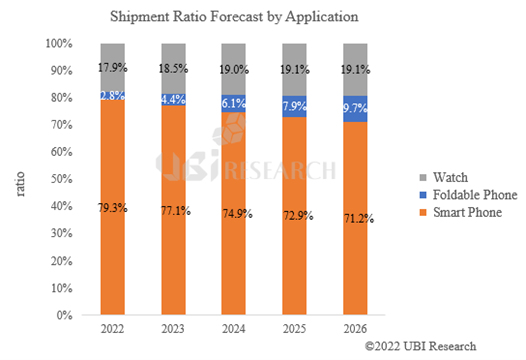
Since 2019, foldable phones have been on an upward trend. The market for foldable phones in 2021 exceeded 10 million units, accounting for 1.4% of all small displays. It is predicted that foldable phones’ yearly upward trend will result in exceeding 100 million units by 2026, accounting for 9.7% of all small displays.

“1Q 2022, Small OLED Display Market Track” analyzes the production capacity for 10-inches or smaller OLED Displays. Quarterly sales market and shipment market were investigated by these categories; major panel makers, country, generation, substrate, TFT technology (LTPO and LTPS), and by application products (watch, smartphone, foldable phone).

An analysis of ASP and OLED supply/demand by application is also provided. Small OLED Display market forecast data is predicted until 2026 on Excel.

Small OLED performance in the second quarter of 2021

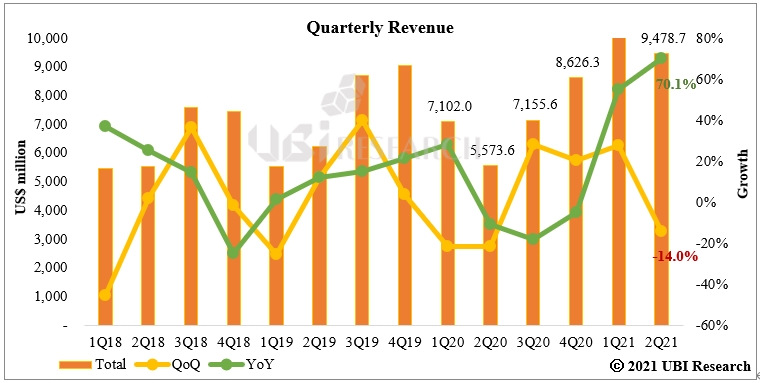
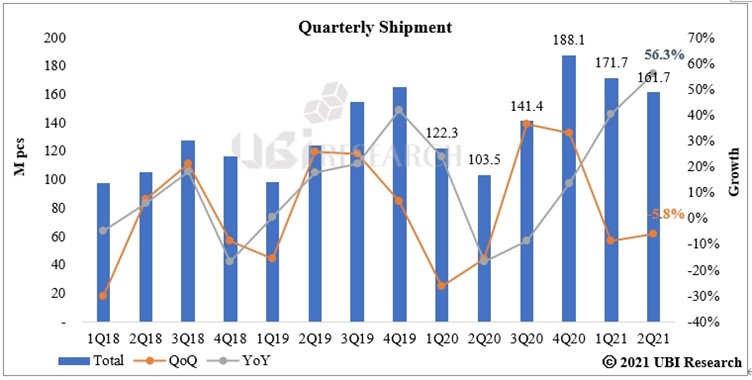
According to the market track on small OLED market performance of less than 10 inches published by UBI Research, Revenue and shipments in the second quarter were about $9.5 billion and 161.7 million units, respectively. QoQ(Quarter over Quarter) revenue and shipments decreased by -14.0% and -5.8%, respectively. Compared to the year over year (YoY), Revenue and shipments increased by 70.1% and 56.3%, respectively.

In 3Q, Samsung Display’s 6G LTPO TFT line capacity is expected to be increased to 60K units. LG Display decided to invest $15,000 in the LTPO TFT line for P6 ph3. The expected equipment installation time is the second quarter of 2022. BOE’s B15, which reviewed the investment in the 6G flexible OLED line, was changed to the 8.5G line for IT manufacturing. Revenue and shipments are expected to increase in the second half of 2021 with the mass production of Apple’s iPhone 13.

Medium & Large OLED performance in the second quarter of 2021

UBI Research has published a market track on the market performance of 10-inch and larger OLEDs. Applications include TVs, monitors, laptops, and tablet PCs.

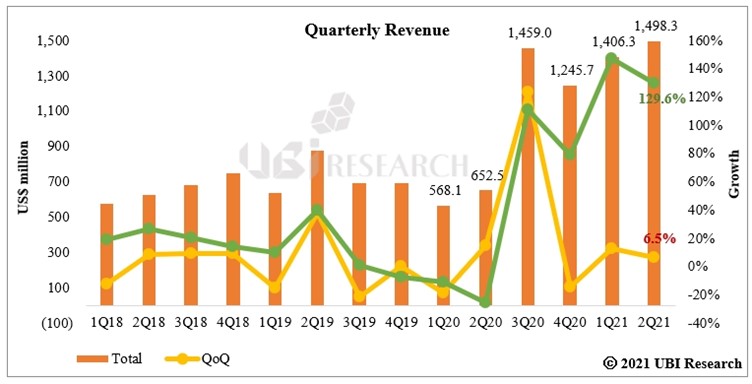
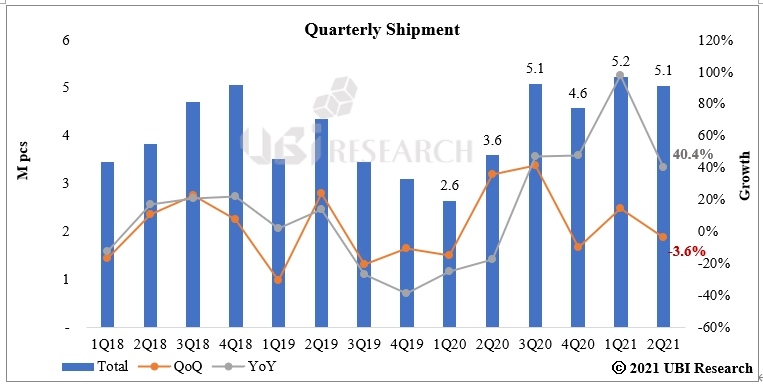
According to UBI Research’s Medium & Large OLED market track, the total revenue in the second quarter were about $1.5 billion, which is a 6.5% (QoQ) increase from the previous quarter and 129.6% in the same quarter of the previous year (YoY). In the second quarter, shipments totaled 5.1 million units, an increase of -3.6% (QoQ) and 40.4% (YoY). Samsung Display’s notebook OLED shipments in the second quarter were about 900K units. LG Display shipped 1.8 million TV panels in the second quarter of 2021.

Although there were concerns about a decrease in the utilization rate of the rigid OLED line due to the decrease in OLED for smartphones sold to Samsung Electronics, the A2 line is gradually being converted to production of OLED for laptops due to the increase in rigid OLED demand. In the first half of the year, two 12K lines were put into OLED production for notebooks, and in the second half, it is planned to increase to three or four lines.

Apple’s iPad, which will be mass-produced by Samsung Display from the end of the year, will use LTPO TFT and hybrid OLED (rigid substrate + TFE).

Apple adopts LTPO TFT to extend battery life time to Apple Watch Series 4

Reporter & Analyst : Daejeong Yoon

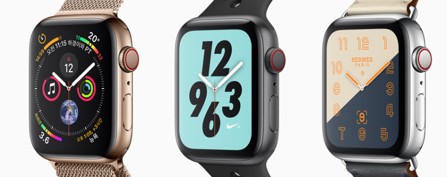
Apple released its Apple Watch Series 4 with enhanced healthcare features on a larger screen than before, in the Steve Jobs Theater at Apple Park in California, USA on September 12.

<Apple Watch Series 4, Source: Apple.com>

In this announcement, Apple brought Apple watch series 4 with a new technology called LTPO to improve power efficiency.

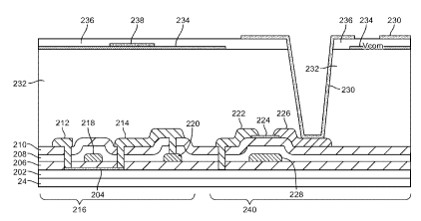
LTPO stands for low temperature polycrystalline oxide. It is a kind of TFT using only the advantages of poly-Si with good charge mobility and IGZO with low power driving. LTPO TFTs have low leakage current and good on / off characteristics, which lowers power consumption and increases battery life.

<Apple’s LTPO TFT patent>

In addition, Apple increased the size of its Apple Watch 4 to 40mm and 44mm. The edge-to-edge screen is 35% and 32% larger than previous models by narrowing the bezel compared to previous models. The screen resolution was 368×448 pixels for the 44mm model and 324×394 pixels for the 40mm model. The display of Apple Watch4 is a plastic OLED made by LG Display with a maximum brightness of 1,000 nit. The Apple Watch Series 4 starts at US$399 for GPS model, while the cellular model starts at US$499. The Apple Watch Series 4 is available for pre-order from Septmber14 in the U.S. with the availability beginning September 21.