Posts

Display Korea 2026 banner showing event dates (March 12-13), location (EL Tower), and sponsor logos.

UBI Research to Host ‘Display Korea 2026’ in March… Reorganized as a Global Hub for Next-Generation Displays

Official banner for the Display Korea 2026 Business Conference & Exhibition

Display Korea 2026, held at EL Tower, Seoul from March 12-13. (Source: UBI Research)

Display market research firm UBI Research announced that it will host the international display event ‘Display Korea 2026’ at El Tower in Seoul from March 12 to 13, 2026.

‘Display Korea 2026’ is a newly reorganized and expanded global event from the previous OLED & XR Korea. It is an international business conference and exhibition encompassing all areas of next-generation displays, including OLED, Micro-LED, Mini-LED, and XR.

Under the theme ‘Connecting Display Innovation — OLED, Micro-LED, XR,’ this event will be attended by global panel makers, materials and equipment companies, optical and component companies, research institutes, and academic experts to share the latest technology trends and industry strategies.

UBI Research has been operating Display Korea as the largest international conference specializing in OLED and Micro Displays in Korea. Through this rebranding, it has expanded its scope to include medium-to-large OLEDs, Micro-LEDs, microdisplays (XR), and related materials, equipment, and software fields.

The event program consists of △IT/TV/OLED displays, △Micro Display (AR/VR/XR) technologies, △QD and OLED components and materials, △Micro-LED processes and inspections, and △Micro-LED industry trends. Keynote speeches by global speakers, professional sessions, and networking programs will be provided.

An exhibition section will also be operated concurrently. Participating companies will exhibit their products and solutions and receive various benefits, including logo exposure on the official website and promotional materials, opportunities to participate in conference presentations, and free registration for two people.

UBI Research stated, “As the display industry expands beyond OLED to Micro-LED and diversifies into the Micro Display and Automotive sectors, Display Korea 2026 will serve as a core platform for global industry stakeholders to discuss technological innovation and market strategies.”

The pre-registration period for this event is until March 10. Program and speaker information, as well as event registration, are available through the official website.

▶Pre-register for Display Korea 2026

Visualization of TCL CSOT’s 0.28-inch 5,131 PPI Micro LED and 2.56-inch 1,500 PPI OLED microdisplay technologies

0.28-inch 5,131 PPI Micro LED and 1,500 PPI OLED… TCL CSOT Takes the Micro-display Market to the Next Level

TCL CSOT is further solidifying its presence in the next-generation near-field display market and driving changes in the AR and VR ecosystem. Unveiled at the 2025 Global Display Ecology Conference, the two latest micro-displays – a silicon-based Micro LED that delivers ultra-high resolution and a glass-based Real RGB OLED that achieves high PPI – target key requirements for the development of AR and VR devices, respectively. This announcement is particularly noteworthy because TCL CSOT has achieved breakthroughs in both silicon-based and glass-based technologies, creating a significant shift in the technological landscape of the micro-display market.

The most noteworthy product is a 0.28-inch full-color silicon-based Micro LED micro-display. This product delivers full color with high color accuracy on a single chip, and with an ultra-high pixel density of 1280 x 720 and 5,131 PPI, it achieves a “retina-level clarity.” The high-density structure, which makes pixel particles completely imperceptible on small screens, offers significant advantages, particularly in devices with extremely close eye-to-screen distances, such as AR glasses. Furthermore, the silicon-based self-luminous structure facilitates high brightness and a high contrast ratio, enabling a clear image even in small displays prone to brightness loss. Combining Micro LED’s high-efficiency light-emitting characteristics with ultra-high brightness, its ability to maintain clarity even outdoors or in high-light environments is considered a clear competitive advantage over existing OLED-based micro displays.

TCL CSOT 0.28-inch 5,131 PPI silicon-based Micro-LED display (Source: TCL CSOT)

TCL CSOT 0.28-inch 5,131 PPI Micro-LED display (Source: TCL CSOT)

TCL CSOT’s proprietary quantum dot-based color conversion material is also significant. Combining a single blue Micro LED with a quantum dot color conversion layer, rather than individual RGB chips, for full-color implementation offers significant technological value in terms of simplified manufacturing processes, stable yields, and improved color reproducibility. In particular, managing luminous efficiency and color uniformity is crucial for AR displays, which are undergoing extreme miniaturization. TCL CSOT’s material technology is believed to have significantly addressed these limitations. This high-efficiency material-based approach demonstrates the potential for improved cost structure in future mass production and is a key step toward resolving the color process challenges that have hindered the commercialization of Micro LED AR devices.

On another front, the 2.56-inch glass-based Real RGB OLED is noteworthy. VR and MR displays have relied on silicon-based OLEDs to achieve high PPI, but their high manufacturing costs have limited their adoption in mainstream products. TCL CSOT’s achievement of over 1,500 PPI on a glass substrate goes beyond simple high-resolution performance and signals a potential shift in the VR and MR market structure itself. Adopting a Real RGB pixel structure ensures color accuracy and color coordinate stability, while specifications like a refresh rate of over 120Hz and a contrast ratio of 1,000,000:1 fully meet the demands of high-end VR and MR devices.

TCL CSOT 2.56-inch glass-based Real RGB OLED display (Source: TCL CSOT)

TCL CSOT 2.56-inch glass-based Real RGB OLED display (Source: TCL CSOT)

Global big tech companies, in particular, are embracing this same technological trend. Apple, following the launch of its “Vision Pro” in 2024, which uses silicon-based OLEDoS, is reportedly preparing a glass-based MR display for its next entry-level model to reduce costs. This demonstrates a growing shift in the high-resolution VR and MR market, moving away from a silicon-based, single-resolution strategy and toward diversifying substrate structures based on application and price range. The attention given to TCL CSOT’s glass-based, high-PPI OLED is aligned with this industry shift. Glass substrates, with their high cost competitiveness, play a crucial role in popularizing VR and MR. Their ability to lower price barriers while maintaining high resolution is likely to impact the entire global supply chain.

TCL CSOT’s technological advancements in both silicon-based Micro LED and glass-based OLED demonstrate the growing emphasis on high-density, low-power, and high-brightness requirements for future AR and VR devices. Micro LEDs, with their high brightness, peak performance, low power consumption, and long lifespan, are particularly suited for ultra-compact and lightweight devices centered around AR glasses. OLEDs, with their wide color gamut and high-quality image quality, enhance the immersive experience of VR and MR headsets. As the complementary nature of these two technologies becomes more evident, the micro-display market, which had stagnated in recent years, is rapidly expanding again.

UBI Research Executive Vice President Changwook Han commented on this technology announcement, saying, “Micro LED and high-resolution OLED are key technologies that determine the completeness and user experience of AR and MR devices.” He added, “Micro LED, in particular, is at a critical turning point that will accelerate the commercialization of AR glasses in terms of brightness, power, and lifespan. The proliferation of glass-based, high-PPI OLEDs will lower the cost barriers in the VR and MR markets, rapidly accelerating the expansion of mass-market models.” He summarized the future direction of the micro-display ecosystem as “lightweight, low power, and high definition,” predicting that companies that comprehensively optimize not only technology but also optics, materials, and actuator quality will secure future competitiveness.

Changwook Han, Executive Vice President/Analyst at UBI Research (cwhan@ubiresearch.com)

▶2025 Micro-LED Display Industry and Technology Trends Report

Samsung Display Develops High-Resolution OLEDoS Microdisplay for Next-Generation XR

Samsung Display researchers revealed it in a recent paper published in J. Soc. Info. Display, the official journal of the Society for Information Display (SID), that they have developed a next-generation OLED-on-Silicon (OLEDoS) microdisplay with 4032 PPI (pixels per inch). This technology is optimized for the next generation of XR devices, including virtual reality (VR), mixed reality (MR), and augmented reality (AR), with panels that dramatically reduce system power consumption and crosstalk while maintaining high resolution and image quality.

This 1.3-inch panel has an ultra-high resolution of 4032PPI, delivering images so precise that pixels are indistinguishable to the naked eye. This minimizes the screen door effect in VR and AR glasses, enabling an immersive content experience. The display of the Apple Vision Pro, released in 2024, features a high-resolution display with a size of 1.42 inches and 3,391 PPI.

In this paper, a pixel compensation circuit structure with 7T1C (7 transistors and 1 capacitor) structure was introduced for high-resolution implementation, which complemented the shortcomings of the previous generation, 6T2C structure, and realized a design that was strong against voltage deviation.

Existing 6T2C pixel structures have caused problems with threshold voltage (Vth) deviations and image distortion between small transistors when implemented in high resolution. Accordingly, Samsung Display’s newly devised 7T1C structure provides the following major advantages.

  • Improved Vth compensation accuracy: Suppresses luminance imbalance caused by threshold voltage deviation to ±2.75% (previously ±10.6%)
  • Reduced horizontal crosstalk: 1.3% (previously 2.0%)
  • Area efficiency optimized with a single capacitor
  • Improved SRU (short range uniformity): 97.3% (previously 90.4%)

In addition, improvements have been made in the way data is driven. The existing 6T2C circuit consumes a lot of power because it has to charge and discharge a data line every frame, but the 7T1C greatly reduced power consumption by a single charging method. For example, in the same full gray pattern, the power consumption of the source IC decreased from 120 mW to 0.1 mW.

In addition, while lowering the operating voltage through the 8V CMOS-based design, it secured more than 50% of the power efficiency compared to the previous one.

Samsung Display officially announced its dual-track strategy to develop RGB OLEDoS and white-based OLEDoS simultaneously last year, and this 4032PPI panel is considered the result of that technological achievement. Although the mass production date for this newly developed product has not been announced, this technology is expected to serve as an important step in accelerating the development of the next-generation XR device market.


About the paper: J Soc Inf Display, 1–9(2025). 

                               SID 2025 Digest 1424 (P-8)

4032-PPI 1.3-inch OLEDoS Reference Image

4032-PPI 1.3-inch OLEDoS Reference Image

4032-PPI 1.3-inch OLEDoS Reference Image and Specifications

4032-PPI 1.3-inch OLEDoS Reference Image and Specifications

Changho Noh, Analyst at UBI Research  (chnoh@ubiresearch.com)

▶UBI Research’s Micro Display Report

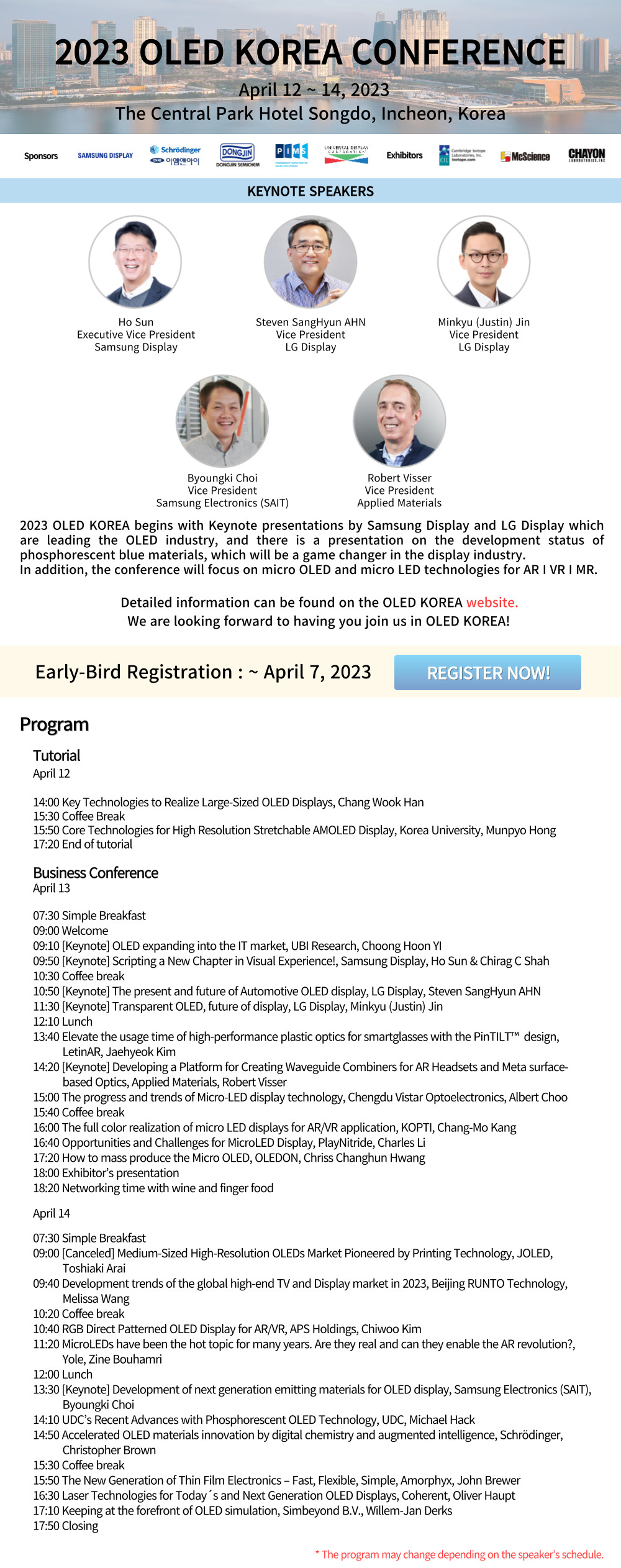
2023 OLED KOREA Conference “OLED, a premium electronic product lineup and micro display, a promising future industry”

OLED KOREA, hosted by UBI Research, a market research company, will be held at the Central Park Hotel in Songdo, Incheon from April 12 to 14. OLED KOREA, which marks its 7th anniversary, is a business conference where top authorities in display from Korea, Japan, Asia, the United States, and Europe gather.

This conference will deal with the topics of OLED, which has become a premium electronic product, and micro-display for AR and VR, which are rapidly emerging as future industries.

In order for OLED to replace LCD, the emergence of phosphorescent blue materials is the most important. At this conference, Samsung Advanced Institute of Technology and UDC will introduce the direction of phosphorescent material development. Commercialization of phosphorescent blue materials will be an inflection point that can overturn the display industry.

There are two types of micro displays: micro OLED and micro LED. While micro OLED is leading the way for VR, micro LED is gradually taking its place in AR. In OLED KOREA, programs are composed of AR companies, micro display manufacturers, and related technology companies. It will be an important place to guess who will be the winner of the future micro display.

The pre-registration period for this conference is until April 7, 2023, and you can check program and speaker information and register for the event through the website (https://oledkoreaconference.com/).


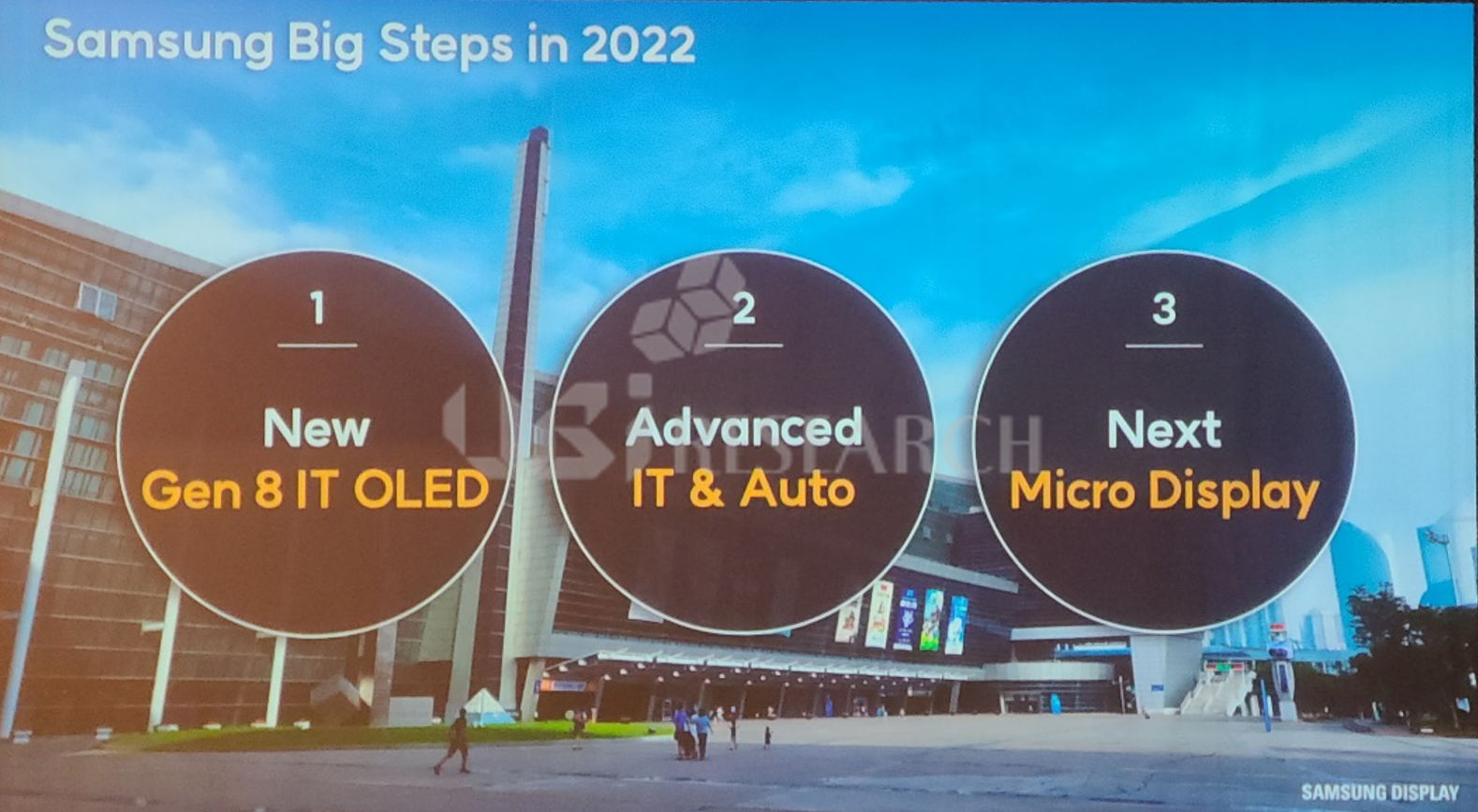
[IMID 2022 Keynote] Samsung Display Announces OLED Big Step in 2022

At IMID 2022 held in BEXCO, Busan, from August 23rd to the 26th, Samsung Display CEO Joo-seon Choi gave a keynote speech, ‘Changing Display Industry with Disruptive Innovation’. He announced plans to expand the display business for automobiles and invest in micro-displays for AR/VR.

Samsung Display's mid- to long-term plans

Samsung Display’s mid- to long-term plans

First, President Choi mentioned the investment in 8.5G IT OLED and said, “When 8G ledger is used, glass efficiency is improved by more than 20% compared to the existing 6G half cut. This will accelerate the penetration of OLED in the IT market. Through this, we are also targeting the automotive display market in the future.”

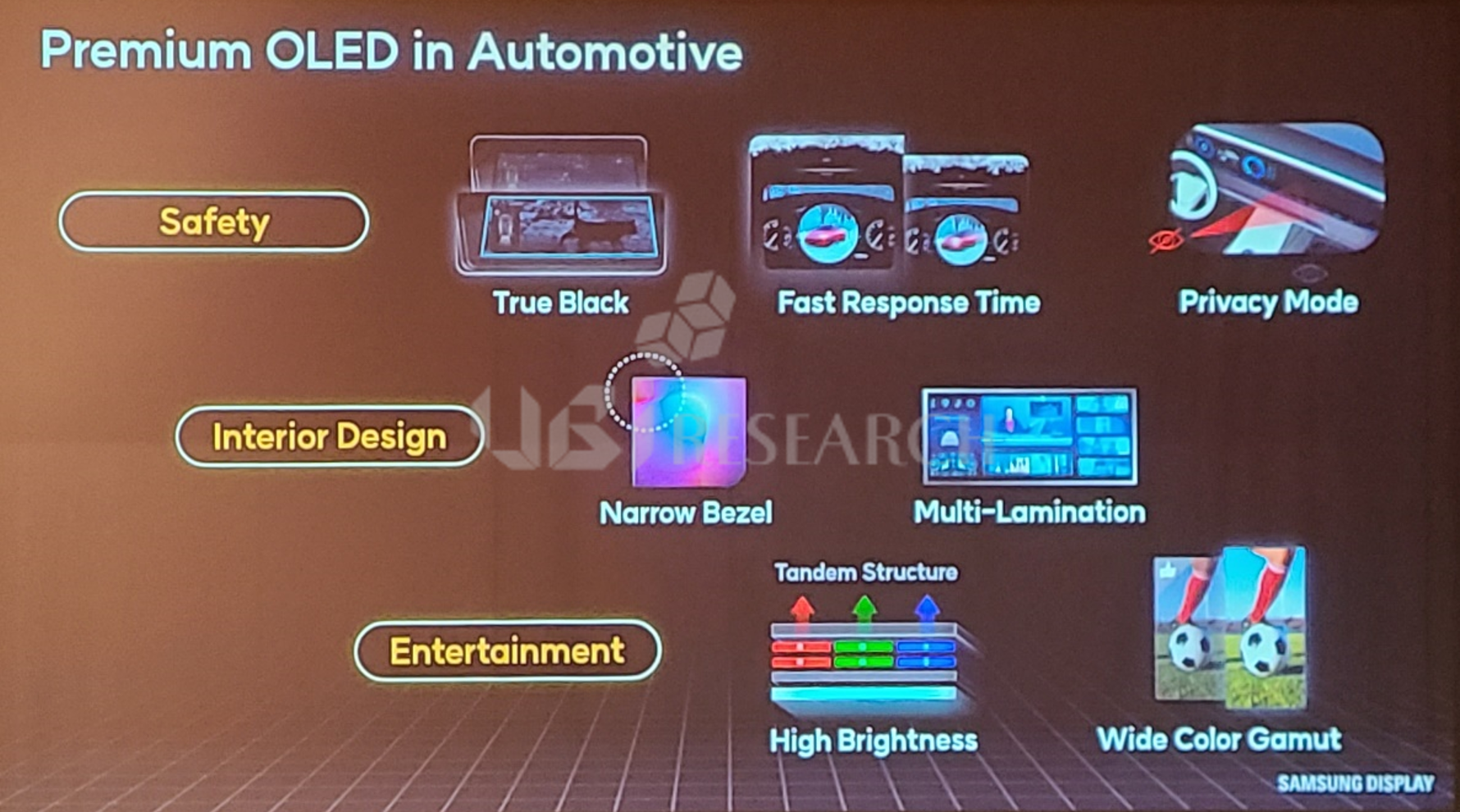
Characteristics of premium OLED for automobiles

Characteristics of premium OLED for automobiles

Next, President Choi showed key features in Premium OLED in Automotive

 ‘Safety’ – accurate information with the characteristics of premium OLED for automobiles.

‘Interior Design’ – such as narrow bezel and multi-lamination.

‘Entertainment’ – high brightness through tandem structure and wide color gamut of OLED emphasized.

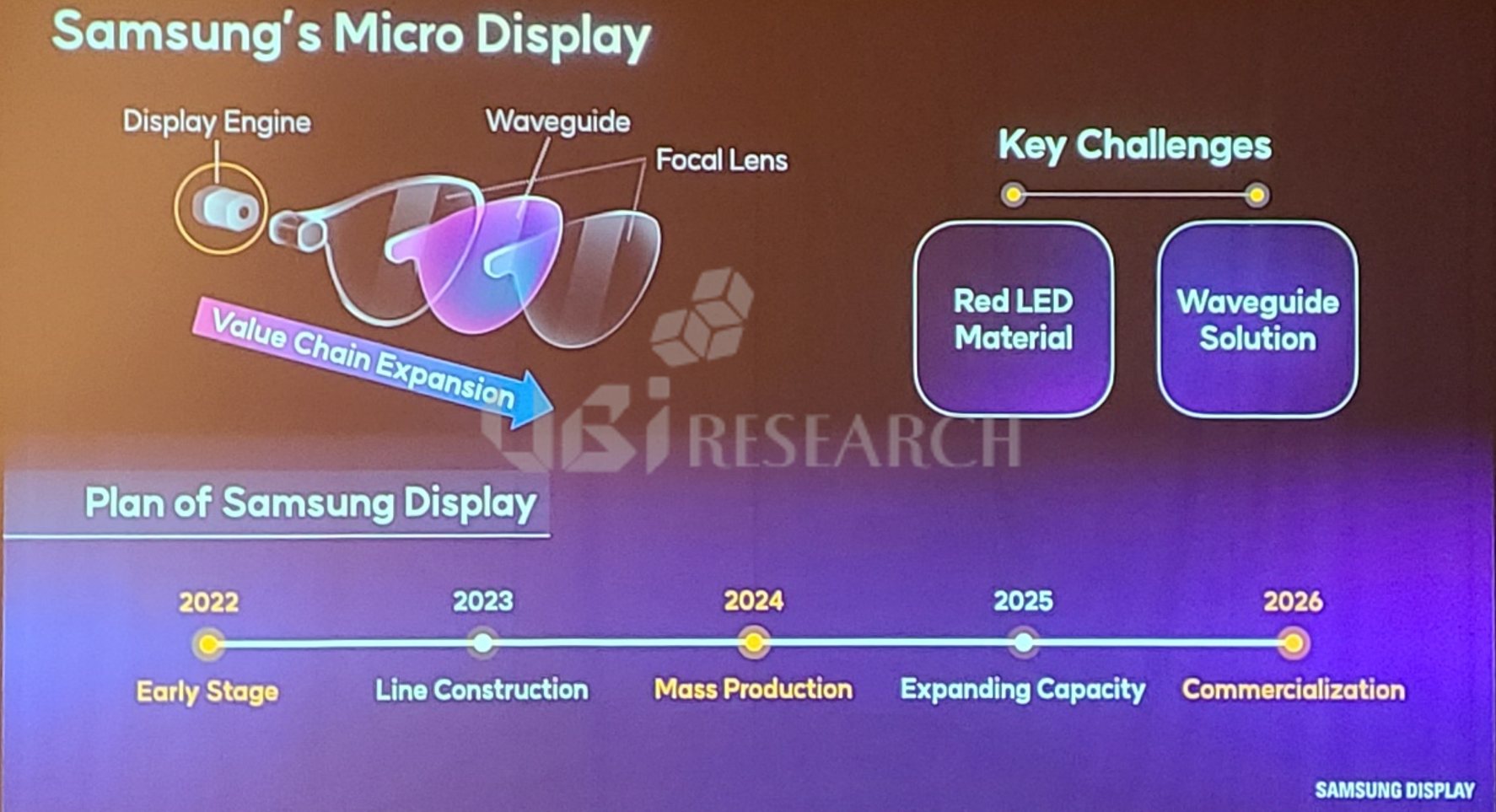
Samsung Display's AR/VR micro display

Samsung Display’s AR/VR micro display

Finally, “The AR/VR industry is a great opportunity to expand the display market. Samsung Display plans to develop micro-displays for AR/VR, such as micro-OLED and micro LED, to keep pace with the market needs. For the AR/VR industry to develop, cooperation across the ecosystem is important.”

According to the announcement, Samsung Display is aiming for commercialization in 2026 by mass-producing prototypes in 2024 and expanding the capacity in 2025. This is the first time that Samsung Display has revealed a specific time for AR/VR business.

In the announcement, CEO Joo-sun Choi predicted that the self-luminous display market would reach $100 billion in 2030 and that displays would penetrate all industries.

▶ OLED Display Report Sample Download

Sony, announced the commercialization of 0.5-inch micro OLED with UXGA resolution

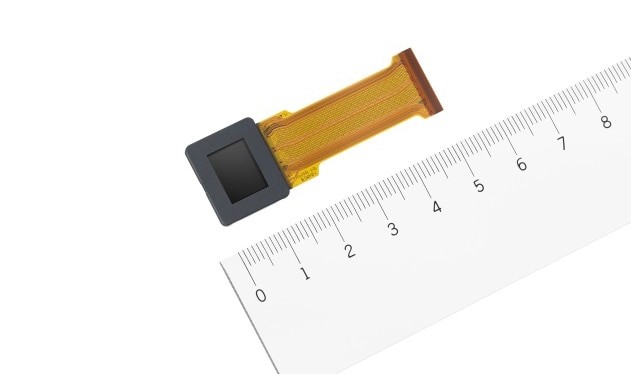
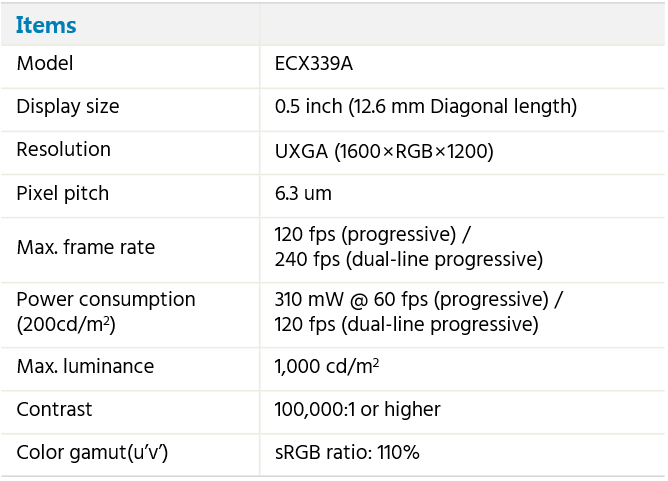
Sony announced the upcoming release of the ‘ECX339A’, a 0.5-inch OLED micro-display with UXGA resolution. According to Sony, it has achieved the world’s smallest pixel pitch of 6.3 μm, enabling a resolution 1.6 times higher than its predecessor, “ECX337A “(0.5-inch QVGA (1280 × 960)).

<Sony’s 0.5 inch micro OLED ‘ECX339A’, Source: sony.co.jp>

By employing newly-designed peripheral circuits that operate on half the voltage of previous model, it supports a high frame rate of up to 240 fps, with dual line progressive driving technique and low power operation.

<Comparison of OLED resolution between new product(left) and previous product(right), Source: sony.co.jp>

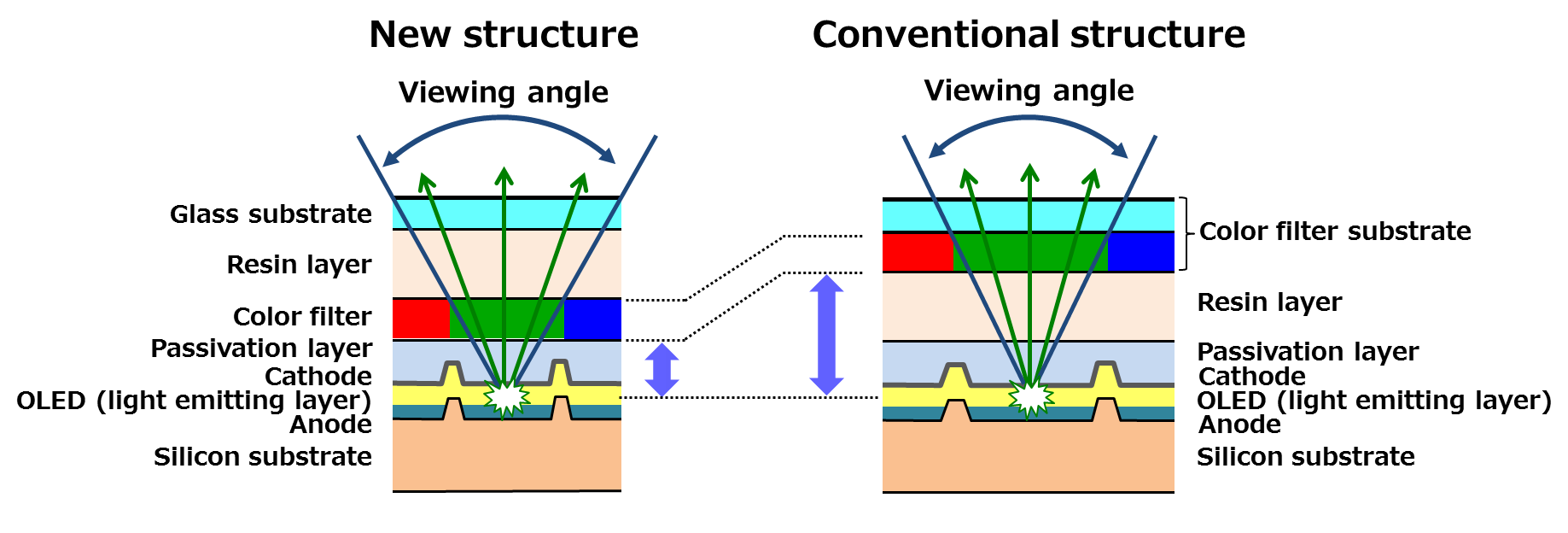
According to Sony, the high resolution of the existing micro display had problems such as deterioration in picture quality and deterioration in viewing angle due to pixel pitch reduction; however, they have been improved by Sony’s transistor layout, process optimization, and compensation circuit. In addition, the color filter is deposited directly on the silicon substrate, reducing its distance from the light emitting layer, and the filter’s color array has been modified to secure the viewing angle properties while achieving high resolution.

<Structure and viewing angle image, new product (left) and previous product (right), Source: sony.co.jp>

The mass production schedule for the ECX339A is November 2018, and the sample price is set at JPY 50,000 (Tax not included). Sony expects this product to be applied to high-end cameras and head-mounted displays for virtual reality, which require the highest picture quality.

<ECX339A, key specifications, Source: sony.co.jp>