Posts

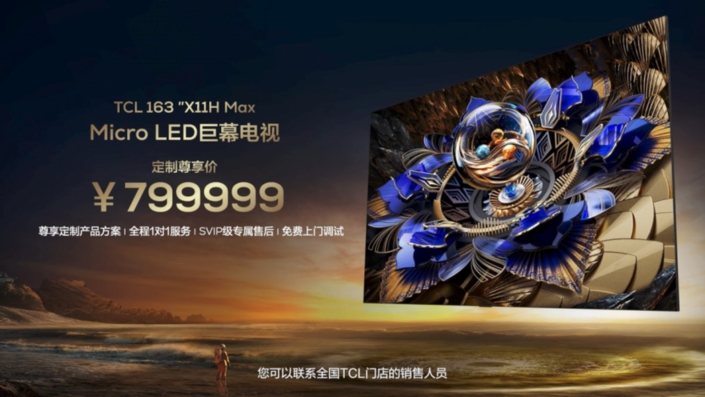
TCL CSOT's 163-inch X11H Max Micro-LED TV representing the company's push for mass adoption.

Breaking the KRW 100 Million Barrier?” TCL CSOT’s Bold Bet on Micro-LED Mass Adoption

Micro-LED, the pinnacle of “self-emissive” display technology where each pixel generates its own light, is finally shedding its laboratory skin and attempting to enter the living room. At the forefront is TCL CSOT, which has thrown down a bold technical roadmap in a market once considered the exclusive domain of Samsung Electronics. We analyze their three-stage evolution—from CES 2025 through the recent DTC 2025 to the upcoming CES 2026—through the lens of display engineering.


1. [CES 2025] The 10,000-Nit Shock: Pushing the Limits of Inorganic Elements

At CES 2025, TCL CSOT’s 163-inch Micro-LED TV, the ‘X11H Max’, injected significant technical tension into the industry. It wasn’t just about the size; the device achieved a staggering peak brightness of 10,000 nits by individually controlling approximately 24.88 million inorganic RGB chips at the pixel level. This was a landmark event that redefined the standards of “super-gap” picture quality, using the durability of inorganic materials to directly overcome the brightness degradation and burn-in issues inherent in organic-based OLEDs.

TCL CSOT's 163-inch X11H Max Micro-LED TV and pricing unveiled at CES 2025 (Source: TCL CSOT)

TCL’s 163-inch Micro-LED TV ‘X11H Max’ achieving 10,000 nits brightness, surpassing the limits of inorganic devices. (Source: TCL CSOT)

2. [DTC 2025] Technical Maturity in Driving Algorithms and Grayscale Expression

The key takeaway from DTC 2025 (TCL Global Display Tech Ecosystem Conference) was the “evolution of internal substance.” TCL addressed the chronic challenge of Micro-LEDs—color distortion in low-light areas—through its proprietary ‘Hybrid PWM+PAM Driving Architecture.’ This method, which sophisticatedly combines Pulse Amplitude Modulation (PAM) and Pulse Width Modulation (PWM), achieved a 24-bit color depth. It demonstrated technical maturity by perfectly resolving the shapes of objects even in pitch-black darkness through 16.77 million steps of grayscale.

TCL CSOT's 219-inch 36:9 ultra-wide Micro-LED display showcased at the exhibition (Source: TCL CSOT)

A 219-inch ultra-large Micro-LED display supporting 98% DCI-P3 color gamut and 120Hz refresh rate. (Source: TCL CSOT)

3. [CES 2026 Outlook] Crushing the “100 Million Won” Wall via Mass Transfer Innovation

At the upcoming CES 2026, TCL is expected to move beyond technical posturing and place a practical bet on “price destruction.” Experts predict that TCL will drastically lower the production cost of 100-inch+ models by significantly increasing the yield of the Mass Transfer process—the method of moving millions of microscopic chips onto a substrate. In particular, process efficiency linked with Inkjet Printing (IJP) technology is projected to be the detonator that pulls down Micro-LED TV prices, once exceeding hundreds of thousands of dollars, to the tens of thousands range (approx. 50–80 million KRW).

While past Micro-LEDs were merely “expensive display pieces densely packed with small LEDs,” today’s TCL CSOT is attempting to democratize “nanosecond-level response speeds” and “infinite contrast ratios” by perfectly grafting semiconductor micro-processes onto displays. CES 2026 will serve as the “technological singularity” where Micro-LED moves beyond being a luxury for the ultra-wealthy to become the new standard for premium home appliances.

Joohan Kim, Senior Analyst at UBI Research (joohanus@ubiresearch.com)

▶2025 Micro-LED Display Industry and Technology Trends Report

※ This article is produced by UBIResearchNet.
Unauthorized reproduction or citation without source attribution is prohibited.
When quoting, please clearly indicate the source (UBIResearchNet) and provide a link.

Samsung Electronics 114-inch Micro LED TV representing ultra-premium display market leadership

Diversifying Micro-LED Strategies – Samsung with Ultra-Premium, LG Electronics, Vistar with Market Diversification

The global display industry is taking different strategic directions in the race to commercialize Micro-LED, the next generation of technology, and the evolution of Micro-LED is being realized not through “falling prices” but through “market diversification. While Samsung Electronics is strengthening its symbolic technology leadership in the ultra-premium TV market, LG Electronics and Vistar are simultaneously driving the technological advancement and application expansion of the Micro-LED industry by exploring new growth paths in the ProAV and industrial markets.

Samsung Electronics has positioned its Micro-LED TV lineup as a flagship lineup of ultra-high-priced products and maintains its technological superiority, focusing on ultra-large models such as 110-inch and 114-inch models that are fully self-luminous through the precision transfer process and RGB chip integrated structure. However, the company has not been able to achieve this technological feat. However, despite this technological perfection, prices remain in the hundreds of millions due to limitations in production unit cost and process yield.

Currently, Micro-LED TVs have a strong “technology showcase premium product” character in the consumer market and need time to become popular. Market experts diagnose that it will take at least three to five years for the demand for Micro-LED TVs to grow, and that the market will not be able to fully expand unless improvements in price accessibility and production efficiency are made in tandem.

In contrast, LG Electronics has a strategy to expand Micro-LED technology into the commercial and professional imaging market (ProAV). The recently announced MAGNIT ProAV series, with a diverse lineup including 0.78mm, 0.94mm, and 1.25mm pixel pitch, is aimed at high-luminance, high-precision video environments such as conference rooms, broadcast studios, and exhibition halls.

This is regarded as an attempt to get ahead of the B2B market, which has lower technical barriers to entry than consumer TVs and a shorter investment payback period. The fact that the pixel pitch has been reduced to less than 1mm is a signal that LG’s Micro-LED transfer and calibration technology has entered the stabilization stage, and the foundation is now in place for the full-scale commercialization of Micro-LED as a large-sized display for commercial indoor use. The foundation for the full-scale commercialization of Micro-LEDs as large-sized commercial indoor displays is now in place.

Meanwhile, China’s Vistar (a Visionox subsidiary) has strengthened its presence in the large-area market by announcing a prototype of a Seamless Wall up to 135 inches in size through a tile-type Micro-LED display based on a TFT backplane. matrix (TFT) drive to minimize brightness, color uniformity, and tile-to-tile boundaries. This is an example of Visionox extending the TFT process technology it has accumulated in OLED production to Micro-LED, setting a new growth axis for the high-precision B2B display area, including large control rooms, exhibition halls, and industrial control systems.

UBI Research noted that “Micro-LED is no longer just a technology for premium TVs, but has entered a stage where it can lead to actual sales in B2B environments such as professional video, exhibition, and industrial control,” and analyzed that “LG Electronics and Vistar’s moves signal that the range of applications for Micro-LED is expanding. The moves by LG Electronics and Vistar are a signal that the range of Micro-LED applications is expanding.” 

Samsung 114-inch Micro LED TV — flagship product targeting the ultra-premium market (Source: Samsung Electronics)

Samsung 114-inch Micro LED TV (Source: Samsung Electronics)

LG MAGNIT ProAV Series — Micro LED display designed for commercial and professional AV markets (Source: LG Electronics)

LG MAGNIT ProAV Series (Source: LG Electronics)

Vistar 135-inch TFT-based Micro LED Seamless Display — prototype developed by Visionox subsidiary (Source: Vistar)

Vistar 135-inch TFT-based Micro LED Seamless Display (Source: Vistar)

Joohan Kim, Senior Analyst at UBI Research (joohanus@ubiresearch.com)

▶2025 Micro-LED Display Industry and Technology Trends Report

RGB Mini LED TV market trend showing Samsung, Hisense, and Sony’s premium large-screen competition

Will RGB Mini LED Be a Game Changer in the Premium TV Market?

A new competitive landscape is forming in the premium TV market. Samsung Electronics, Hisense, and Sony are competing to launch RGB Mini LED TVs, challenging the OLED-dominated market. While existing QD-Mini LEDs employ an indirect color conversion method using blue and white LEDs, RGB Mini LEDs directly emit red, green, and blue (RGB) LEDs. This allows them to achieve over 90% of the BT.2020 color gamut, deliver ultra-high brightness of 4,000-8,000 nits, and minimize blooming. They are particularly noteworthy for their ability to maintain stable color depth and brightness even on ultra-large screens.

Trends by Major Manufacturers

Samsung Electronics 115-inch RGB Micro LED TV, premium large display

Samsung Electronics 115-inch RGB Micro LED TV (Source: Samsung Electronics)

  • Samsung Electronics launched a 115-inch RGB Micro LED TV in August 2025, marking its full-scale foray into the ultra-large-screen market. By utilizing 90μm micro RGB LEDs and CSOT’s LCD panel, the company achieved both large-screen size and mass production, while also achieving 100% BT.2020 color gamut and high brightness. The company also announced the expansion of its 75-inch, 85-inch, and 98-inch lineups.
Hisense 116-inch RGB Mini LED TV, ultra-bright premium TV

Hisense 116-inch RGB Mini LED TV (Source: Hisense)

  • Hisense unveiled a 116-inch RGB Mini LED TV at CES 2025. It features 15,680-point precision control using the H7 AI chip and proprietary algorithms, and uses RGB LED chips from Qianzhao Optoelectronics to improve efficiency and lifespan. Hisense then entered the ultra-large market in March with the mass production of its flagship UX series.
  • Sony unveiled a 75-inch RGB Mini LED prototype at CES 2025. It boasts 32,000 RGB bubbles and 4,000 dimming zones, achieving twice the precision of conventional displays. It also boasts 66-bit backlight control and 30-bit signal processing, delivering picture quality approaching OLED. The Bravia 10 will be officially unveiled at IFA 2025.

Impact on OLED TVs

OLED TVs still possess strengths in black expression, design flexibility, and gaming-optimized performance thanks to self-illuminating pixels. However, brightness limitations and the inability to scale to larger sizes are pointed out as drawbacks. RGB Mini LED TVs can maintain color accuracy and high brightness even on ultra-large screens, threatening OLED’s dominance in the 100-inch and larger market.

Over the next five years, OLED is likely to remain competitive in the mid- to large-sized market, ranging from 55 to 77 inches. However, if RGB Mini LED achieves cost competitiveness in the 75 to 85-inch range, OLED will significantly impact its market share.

Future Strategic Challenges for OLED

For OLED to expand its presence in the premium market (75 inches and below), cost reduction is paramount. At the same time, OLED’s unique strengths –

  • exceptional black characteristics,
  • excellent color gamut at low grayscale levels,
  • natural color gradation

– must be emphasized as marketing points. By reducing costs and establishing a distinct value proposition over RGB Mini LED through differentiated image quality, OLED will remain a key player in the premium TV market.

Changwook Han, Executive Vice President/Analyst at UBI Research (cwhan@ubiresearch.com)

▶2025 Micro-LED Display Industry and Technology Trends Report

Micro-LED Market Expected to Grow to $1.3 Billion in 2030

UBI Research forecasts the Micro-LED market to reach $1.342 billion by 2030, with annual TV production capacity expanding from 50,000 to 6 million units

UBI Research projects the Micro-LED market to grow to around $1.342 billion by 2030, reshaping the premium TV market landscape. Source: UBI Research

– Annual TV production capacity of 50,000 → 6 million units will accelerate game changing in the premium TV market

According to the “2025 Micro-LED Display Industry and Technology Trend Report” recently published by Ubi Research, Micro-LED, which is touted as a “game changer” in the next generation display market, is on a full-scale growth trajectory. Global Micro-LED TV production capacity is expected to expand from the 50,000 units per year level in 2023 to approximately 6 million units in 2030, and the Micro-LED market size is expected to reach approximately US$1.3 billion (US$1.342 billion).

 Micro-LED is a self-luminous flat panel display technology with higher brightness, longer life, and better durability than OLED, and has emerged as a next-generation candidate in the premium TV and next-generation wearable device markets. Especially it has a wide range of applications from large displays to ultra-compact AR-VR devices due to its superior color reproducibility and visibility with no burn-in concerns.

 UBI Research analyzes that full-scale commercialization will begin after 2027, coupled with improved production efficiency and reduced manufacturing costs, and that the market will continue to grow at a high average annual rate of more than 50% from 2028 onward.

 The main factors driving market expansion are as follows

  •  Increased demand for premium TVs: Growing consumer preference for ultra‑large, high-resolution products.
  • Expansion of production infrastructure: Large-scale investment in mass production lines and process improvements by major manufacturers.
  •  Diversification of application fields: In addition to TVs, enter new markets such as transparent displays, smart glasses, and wearable devices.
  •  Enhanced price competitiveness: Expansion of consumer accessibility through mass production stabilization and cost reduction.

 Joohan Kim, an analyst at UBi Research, pointed out that “the key to Micro-LED proliferation is a stable supply of epi wafers. He added, “Large-scale MOCVD orders are expected to continue after 2026, and wafer production volume is expected to expand to 10 times the current level by 2030,” and “Such stabilization of material supply will support the mass production system of Micro-LED, strengthen price competitiveness, and accelerate market expansion. He added.

 Analyst Kim, Joohan added, “By 2030, the Micro-LED TV market will not only change the competitive landscape of the premium TV market but also affect the profit structure of the forward industry in general,” and “in particular, it will create new growth opportunities in the overall value chain.”

 More specific market outlooks and industry-specific ripple effects will be presented at the “Display Strategy Seminar for 2026 Readiness” to be held on September 5.

Joohan Kim, Senior Analys at UBI Research (joohanus@ubiresearch.com)

▶2025 Micro-LED Display Industry and Technology Trends Report

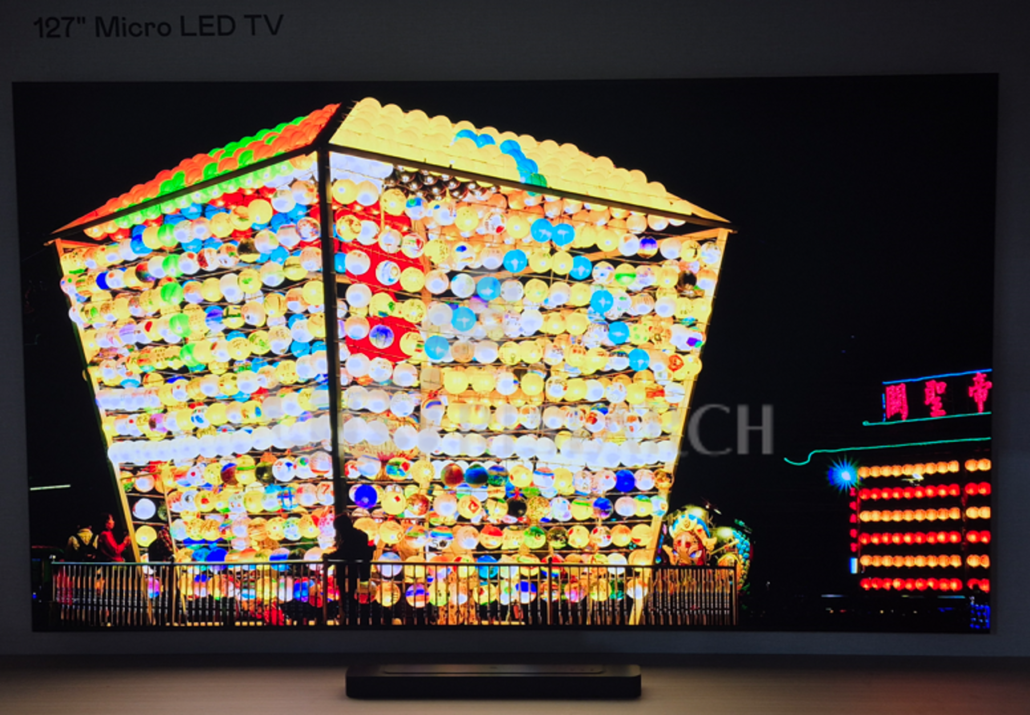
AUO Unveils 127-Inch Micro-LED TV at Touch Taiwan 2025 – Signaling Ambitions in the Premium Display Market

AUO, a Taiwanese global display specialist, captured the attention of the industry by showcasing a 127-inch Micro-LED TV with its latest technology at Touch Taiwan 2025 in April. More than just a technology demonstration, AUO’s exhibit is seen as a strategic move with the company’s full-scale commercialization in the ultra-large premium TV market in mind.

The 127-inch Micro-LED TV on display was based on AUO’s proprietary bonding technology and pixel structure design, and realized 4K resolution and high brightness of over 1,000 nits on average. It demonstrated excellent picture quality performance, including color reproduction (DCI-P3 100%), which is an advantage of Micro-LED TVs.

AUO’s 127-inch Micro-LED TV on display is aimed at commercial digital signage, as well as high-end home cinema and special purpose markets. Considering the commercialization potential of Micro-LED technology and the spread of demand, AUO will continue to expand its product lineup with various sizes and specifications.

Micro-LED is a next-generation spontaneous light display technology that miniaturizes LED devices into individual pixels, offering longer lifetimes, higher brightness, freedom from burn-in, and superior response speeds compared to OLEDs. However, the technology is still technically complex and expensive, so AUO’s prototype display can be considered a symbolic milestone. It will be interesting to see how AUO’s Micro-LED technology will make an impact in the global premium TV market and whether it will be commercialized and achieved high production yields in the future.

127-inch Micro-LED TV (Resolution: 3840×2160, Pixel Pitch: 0.732mm)

127-inch Micro-LED TV (Resolution: 3840×2160, Pixel Pitch: 0.732mm)

Here are some of the key implications of the 127” Micro-LED TV development

  • World’s largest single 42” Micro-LED module in the world
  • Improved competitiveness by simplifying the entire product design/manufacturing process
  • Reduces the color difference between tiled modules
  • 5th generation Mass-Transfer technology reduces process costs and accelerates product commercialization

More details and technical analysis will be presented in a forthcoming Micro-LED report from UBI Research.

Nam Deog Kim, UBI Research Analyst(ndkim@ubiresearch.com)

▶Micro-LED Display Technologies for XR Applications Report Sample

RGB Mini-LED TVs are forming a confrontation composition with OLED TVs, and future trends will be closely watched.

While Micro-LED TVs are expected to enter the consumer market in 2025, RGB Mini-LED TVs with lower OLED performance are expected to enter the market and compete with OLED TVs. Chinese panel producers, which lag far behind Korea in OLED production volume, are strategically focusing on RGB Mini-LED technology development, while Samsung Electronics and SONY are also entering this field.

Hisense introduced a 116″ 4K TriChroma RGB Mini-LED TV at CES2025, featuring 97% BT.2020 color reproduction, 10,000 nits peak brightness, and a 10K-class local dimming zone. TCL also plans to launch an RGB Mini- LED TVs in 2026.

Samsung Electronics plans to launch RGB Mini-LED TVs, including Mini-LED and Micro-LED under the brand name RGB Micro-LED TV, in various sizes during 2025, and quietly unveiled a 98-inch 8K product at CES 2025.

Sony has also revealed that it is developing a general RGB LED Backlight technology, which is expected to be introduced into the Bravia XR Mini-LED TV and released as the Bravia XR RGB Mini-LED TV.

The price of the RGB Mini-LED Backlight is expected to be similar to the price of the traditional Mini-LED Backlight, and it will be interesting to see how it will fare against OLED TVs in the future.

Hisense 116UX 4K TV with TriChroma RGB mini LED backlight system (CES2025).

Hisense 116UX 4K TV with TriChroma RGB mini LED backlight system (CES2025).

Samsung 98-inch 8K Neo QLED prototype with RGB micro-LED backlighting (CES2025)

Samsung 98-inch 8K Neo QLED prototype with RGB micro-LED backlighting (CES2025)

Joohan Kim, UBI Research Analyst(joohanus@ubiresearch.com)

Micro LED TV, is the price competitive compared to OLED TV?

“It needs to consider how to resolve the price competitiveness compared to other displays, such as OLED, before Micro LED is to be applied to the big screen TVs of 60 inches and 70 inches in future.”

Moon Dae-Gyu, professor of Soonchunhyang University, mentioned as above while explaining the micro LED technology at the ‘latest OLED technology trends seminar’ organized by UBI Research in Seoul COEX on April 26th, 2018.

“Micro LED is attracting attention as a technology capable of realizing a high resolution display of 1,000 ppi or more. Since micro LEDs are individually obtained from a LED wafer by the photo process, they are not affected by the size and shape of a substrate, and have the merits that the advantages of existing LED such as luminance, lifetime and low power consumption, can be applied as they are.” professor Moon added.

In addition, it is expected to be a good environment to show the advantages of micro LED in the field where power consumption is very important, such as wearable appliances. He also predicted that it is possible to implement display in no tile form in very large display area such as public display and digital wall, which might be easy segments for micro LED to enter.

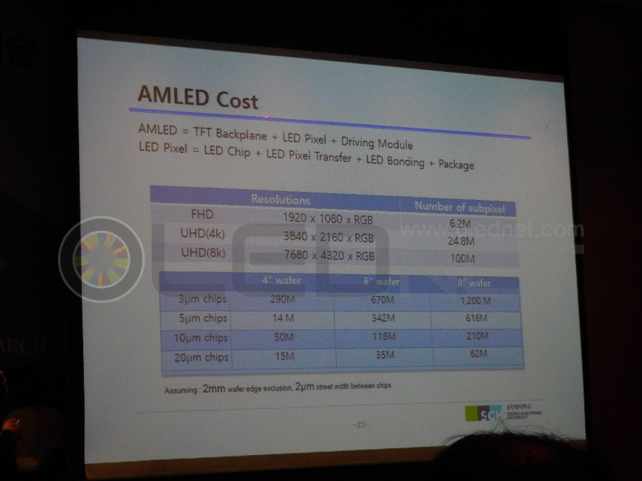
However, regarding the mass production of micro LED TV, which is becoming a recent issue, Moon said, “In order to implement 4K, 24.8 million LED chips (with a size of 10 μm/chip) are required. At the 4 inch wafer, which is currently being commercialized, 4K panels can be produced twice only. Thus, it is doubtful whether micro LED is competitive compared to LCD and OLED in terms of mass production.”

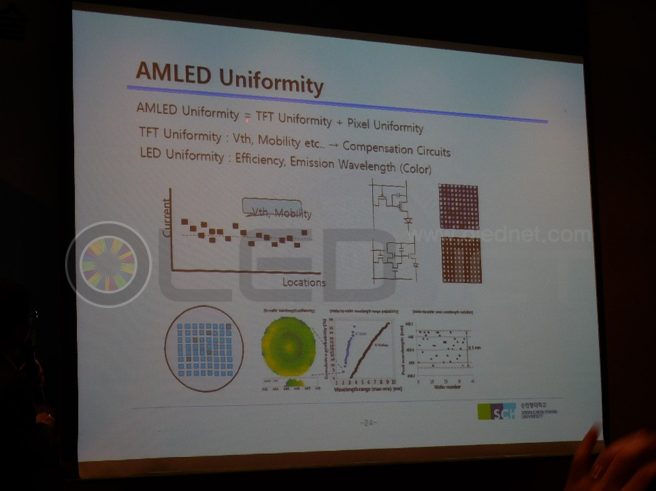
Commenting about TFT uniformity and pixel uniformity of the micro LED, he mentioned “TFT uniformity can be sufficiently compensated by the compensation circuit that is currently applied to OLED, but it should be considered how to solve the color imbalance problem.”

Micro LED TV, which was introduced by Samsung Electronics in CES 2018, and received a lot of attentions at the time, but it was disagreed about commercialization. In particular, Kang In-Byung, CTO of LG Display, pointed out, “About 25 million LEDs are needed to realize 4K micro LED TV. Even if 1 LED is 1 Korean Won, the cost might be 25 million. And when the circuits and boards are added, it would be a huge price.”