Medium & Large Size OLED Market to Reach $20 Billion… Monitor and Automotive Lead Growth, IT Faces Price Constraints
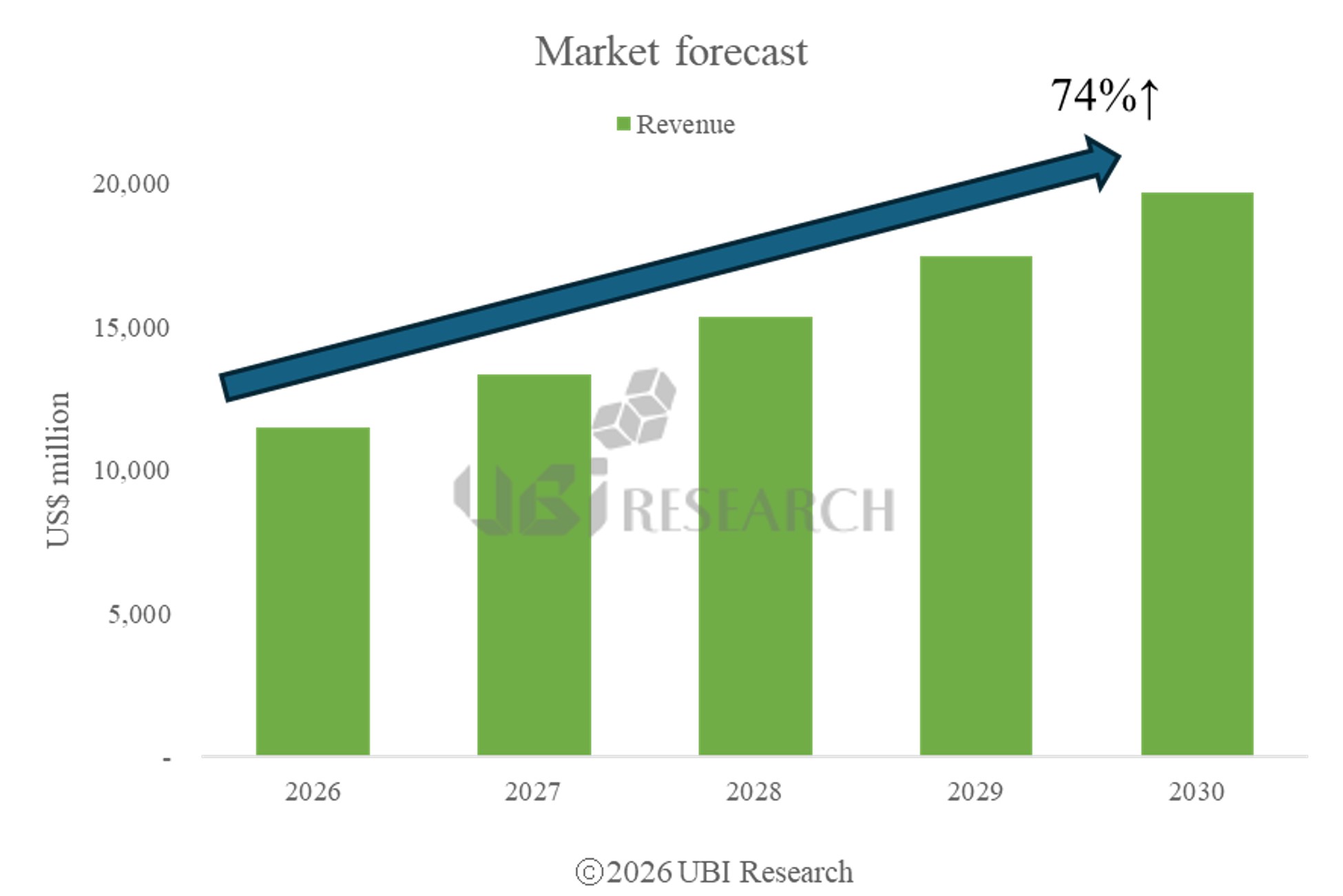
Medium-large OLED market revenue forecast. It is expected to grow by 74%, from approximately $11.5 billion in 2026 to $20 billion in 2030. (Source: UBI Research)
According to UBI Research’s “2026 Medium & Large Size OLED Display Annual Report,” the medium and large size OLED market is projected to grow from approximately $11.5 billion in 2026 to around $20 billion by 2030. This represents about 74% growth, with a compound annual growth rate (CAGR) of 14.8%.
While LCD still dominates the medium and large size display market, OLED adoption is rapidly increasing as demand rises for premium performance such as high resolution, high refresh rates, and superior contrast. However, the future growth trajectory is expected to diverge significantly by application. The key distinction lies in the structural differences in consumption between Monitor and Automotive versus Notebook and Tablet PC segments.
Monitors are a representative product category where OLED’s advantages directly translate into purchasing decisions, particularly in gaming and content consumption environments. Features such as high refresh rates, fast response times, and high contrast are clearly perceptible to consumers, making OLED a compelling choice. As a result, OLED for monitors is expected to account for approximately 26% of the total medium and large size OLED market by 2030, emerging as a core growth driver.
The automotive segment also has a favorable structure for OLED adoption. Since display costs account for a relatively small portion of the total vehicle price, the impact of increased panel costs on the final vehicle price is limited. In addition, trends toward larger, curved, and multi-display configurations—especially in premium vehicles—are driving demand for differentiated design and higher-end display solutions. Consequently, automotive displays are considered a market where the transition to OLED can proceed relatively smoothly despite higher panel costs.
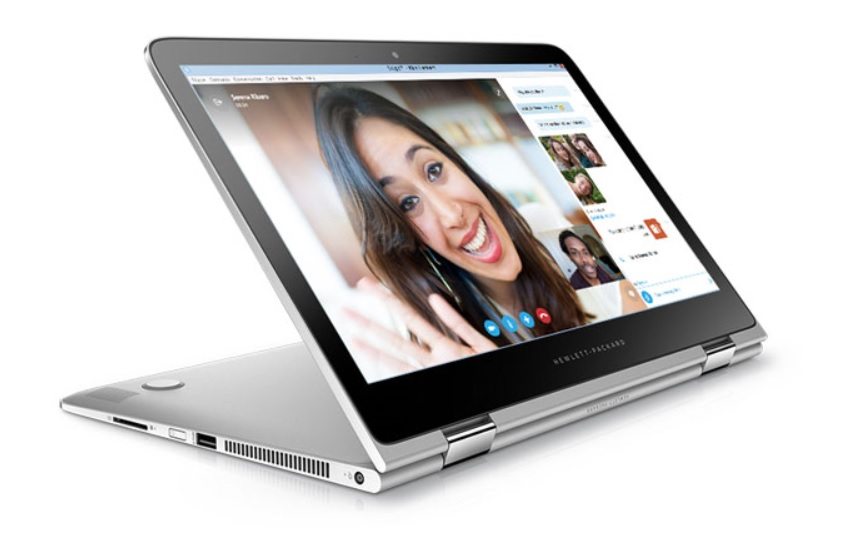
In contrast, Notebook and Tablet PC markets are expected to experience relatively limited OLED expansion. This is because performance and price competitiveness in these segments are primarily determined by key components such as CPUs, memory, and storage. As a result, cost management at the overall BOM level is critical. When the cost of major components such as memory increases, manufacturers often adjust display specifications to maintain overall product pricing.
Moreover, even though OLED offers clear improvements in image quality, contrast, thickness, and design, the added value perceived by consumers may not fully offset the increase in retail price. In other words, the key factor for market expansion is whether the performance benefits of OLED can justify the price premium.
This structural limitation has also been observed in recent cases. Apple attempted to accelerate OLED adoption in the tablet market by introducing OLED in the iPad Pro; however, sales performance fell short of expectations due to higher set prices. This serves as a representative example showing that technological competitiveness alone does not necessarily translate into increased demand when price factors are involved.
Changwook Han, Executive Vice President of UBI Research, stated, “The medium and large size OLED market will continue to show strong overall growth through 2030, but the pace of growth will clearly differ by application. Monitor and Automotive will lead the transition to OLED, while Notebook and Tablet PC are expected to show relatively moderate growth due to pricing structures and the influence of key component costs.”
Changwook Han, Executive Vice President/Analyst at UBI Research (cwhan@ubiresearch.com)
 2026 Medium & Large Size OLED Display Annual Report
2026 Small OLED Display Annual Report
※ This article is produced by UBIResearchNet.
Unauthorized reproduction or citation without source attribution is prohibited.
When quoting, please clearly indicate the source (UBIResearchNet) and provide a link.