Posts

The Future of Panoramic HUDs, Led by Micro-LED

As in-vehicle display technologies continue to evolve rapidly, the head-up display (HUD), which projects various types of information into the driver’s forward field of view, is becoming an essential interface in modern vehicles. Recently, Panoramic HUDs (PHUDs) capable of displaying not only speed and navigation data but also augmented reality (AR) content have emerged, showcasing significant technological advancement. At the core of this evolution is Micro-LED technology, which is gaining traction as the key enabler of PHUDs.

PHUDs project information across the entire or a substantial portion of the windshield, requiring a wide field of view, high resolution, and high brightness. Currently, the most commercially viable implementation is the black strip reflection method. This approach utilizes the lower black band area of the windshield as a reflective surface, allowing for a simpler optical system and lower production costs—making it an attractive option for many automakers. However, to avoid obstructing the driver’s view, the image projection height is limited, typically restricted to a narrow vertical range of approximately 3 to 6 cm.

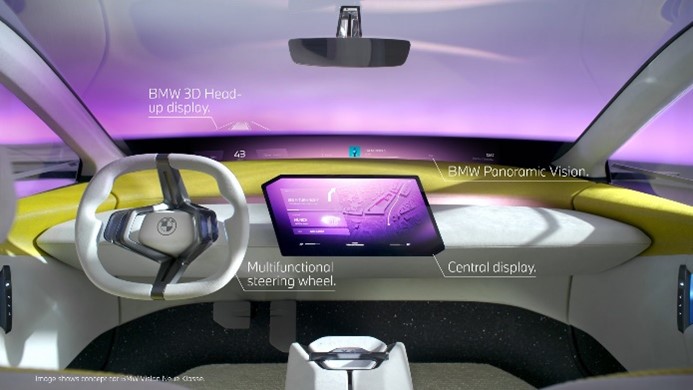
BMW Panoramic Vision

BMW Panoramic Vision

For a more immersive and premium experience, some high-end vehicles adopt a transparent reflection method. This involves embedding multilayer optical films or applying special structures within the windshield, allowing images to be reflected even in transparent areas without the need for a black band. While this method offers advantages in immersion and design, it poses significant challenges in optical complexity, higher costs, and low reflectivity—necessitating the use of ultra-bright displays.

Micro-LED provides a compelling solution to these structural and technological challenges. Thanks to its self-emissive pixel structure, Micro-LED can achieve brightness levels exceeding 1,000 nits, with ultra-high brightness capabilities reaching 30,000 to 50,000 nits—all while maintaining excellent power efficiency.

At SID 2025, major display companies such as AUO, BOE, and CSOT unveiled a range of Micro-LED-based PHUD prototypes. BOE showcased a 6.2-inch Micro-LED HUD with sub-0.2mm pixel pitch and 30,000 nits peak brightness (15,000 nits perceived brightness). CSOT presented a large 14.3-inch PHUD featuring 45,000 nits peak brightness (12,000 nits perceived brightness) and a wide viewing angle, while AUO demonstrated a 13-inch high-brightness PHUD with 12,000 nits of perceived brightness.

AUO 13” PHUD (12,000nits)

AUO 13” PHUD (12,000nits)

BOE 6.2” PHUD (15,000nits)

BOE 6.2” PHUD (15,000nits)

TCL CSOT 14.3” PHUD (12,000nits)

TCL CSOT 14.3” PHUD (12,000nits)

Micro-LED is not merely enhancing display performance—it is fundamentally transforming the structure and implementation of Panoramic HUDs. It overcomes the limitations of restricted reflection areas, enables the projection of high-brightness, high-resolution images onto various curved windshields, and meets the demands for transparency and design flexibility. As the commercialization of PHUDs becomes a reality, Micro-LED stands at the center of this transformation. The future of automotive vision and interface will unfold on Micro-LED.

Changwook HAN, Executive Vice President/Analyst at UBI Research (cwhan@ubiresearch.com)

▶2025 Automotive Display Technology and Industry Trends Analysis Report
CES 2025 becomes a competition hall for panoramic HUDs

We will introduce the contents of the “2025 Automotive Display Technology and Industry Trends Analysis Report” published by UBI Research in February 2025 as a series. As the first series, we will introduce Panoramic-HUD, which is included in the report.

Generally, automotive head up displays are projected on the windshield, the windshield of a car, and the driver can see a virtual image generated several meters away. Unlike general HUDs, Panoramic HUDs directly reflect the image projected from the display onto a black film coated on the lower surface of the windshield, but they are classified as HUDs because they allow the driver to maintain a head-up view while driving.

Panoramic HUDs are implemented using a direct image method, so their design is simple and the system cost is low. This reduces manufacturing costs while enabling the digital experience of premium vehicles. In addition, P-HUDs have the advantage of being able to use polarized sunglasses that prevent glare because they reflect p-polarization. Therefore, it is expected that panoramic HUDs will enter the market before AR-HUDs become widespread. At this year’s CES, several companies announced Panoramic HUDs, reminiscent of the P-HUD competition arena. BMW calls its panoramic HUD “Panoramic Vision” and announced that it will be installed in the Neue Klass model to be released from 2025. It uses TFT-LCD and has a brightness of about 5,000nits, but higher brightness is needed to improve outdoor visibility, and for this purpose, it is working closely with e-LEAD, a Taiwanese company that manufactures black films.

(Source: BMW)

(Source: BMW)

BOE introduced a P-HUD with a brightness of 5,000nits (normal) / 7,000nits (10% peak) by applying a 44.8-inch oxide TFT-LCD panel and 2,850 zone local dimming, and polarized sunglasses can be used because the P-polarization reflectance is 25%.

TCL-CSOT introduced a P-HUD with a brightness of 11,000 nit by applying three 11.98-inch TFT-LCD panels and 384 zone local dimming.

CarUX, a subsidiary established by Innolux in 2019, introduced a 48-inch P-HUD and boasted a high brightness of 14,000 nit by using a micro-LED panel.

Hyundai Mobis introduced a transparent P-HUD with a transmittance of 95% by introducing holographic technology from Zeiss in Germany, and plans to mass produce it in 2027. Continental also introduced the “Scenic View HUD,” a panoramic HUD with three TFT-LCD panels and local dimming, in 2023, and plans to release it in 2026.

Since the P-HUD is located in the vent, heating, ventilation, and air conditioning hardware must be rearranged, and heat dissipation issues must be resolved, so there are many issues to be resolved in addition to the display, so it took a long time, but 2025 is expected to be the first year of the P-HUD release.

This report covers the overall trends of vehicle display technology, including HUD, as well as the status of display development and vehicle application by finished vehicles, electrical equipment manufacturers, and panel manufacturers. If you are involved in the automobile and display industries, now is an important time to analyze market trends and prepare future strategies. We hope that you will gain insight one step ahead through this report so that you can understand the future trends of the vehicle display market in advance and proactively respond to industry changes.

UBI Research Chang Wook HAN Analyst(cwhan@ubiresearch.com)

▶2025 Automotive Display Technology and Industry Trends Analysis Report Sample