
Posts

Charts demonstrating the structural hybrid process and efficiency improvements of solution-processed PSF OLED devices presented at ICDT 2026.

Demonstrating the suitability of PSF materials for hybrid processes

A joint research team from Beijing Summer Sprout Technology and Guangdong Juhua Printed Display Technology announced at ICDT2026 that they had achieved efficiency, color purity, and lifetime on par with vacuum thermal evaporation (VTE) devices by spin-coating phosphorescent-sensitized MR-TADF (hereinafter PSF) materials. This research is drawing attention as it aligns with the technological initiatives of TCL CSOT, which is currently pursuing the mass production of large-area RGB OLEDs based on inkjet printing.

PSF has already been validated as a technology capable of simultaneously achieving high efficiency, high color purity, and low roll-off in vacuum-deposited devices, and Visionox has begun applying PSF materials to AMOLED panels for smartphones.

The device structure adopted in this study is a hybrid method in which the emissive layer (EML) is formed by spin coating, while the electron transport layer (ETL), electron injection layer (EIL), cathode, and capping layer (CPL) are stacked via vacuum deposition. The research team used a process sequence in which the three hole-side layers were formed via spin coating, followed by substrate pretreatment with UV ozone treatment and baking at 230°C. After applying the EML via spin coating, the remaining layers were completed via vacuum deposition. This is a practical approach that focuses on the EML’s luminous efficiency and color purity while enhancing mass-production feasibility.
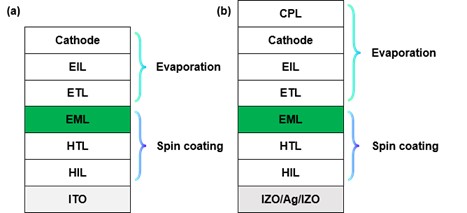
Structure diagram of a solution-processed OLED utilizing a hybrid process

Structure diagram of a solution-processed OLED utilizing a hybrid process

The PSF device developed by the research team achieved a current efficiency of over 200 cd/A at 1,000 nits. This performance is on par with both existing polymer-based solution-processed devices and vacuum thermal evaporation (VTE) devices. The roll-off characteristics were also found to be virtually identical to those of VTE devices. Depending on the composition, the color gamut satisfied 100% DCI-P3 and 95% or more of BT.2020. The device demonstrated a lifespan up to 170% longer than that of a standalone phosphorescent device.
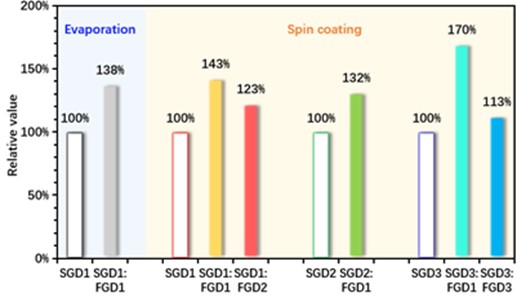
Operational lifetime (LT95) comparison graph demonstrating the enhanced lifespan of the PSF solution-processed device

Operational lifetime (LT95) comparison graph demonstrating the enhanced lifespan of the PSF solution-processed device compared to phosphorescent OLED devices.

After more than 10 years of research, TCL CSOT began small-scale mass production of inkjet-printed OLED panels at its 5.5-generation line in Wuhan in November 2024 and aims to begin shipping 27-inch 4K 120Hz inkjet OLED panels for monitors in July 2026. Construction began in October 2025 on the Guangzhou T8 8.6-generation fab, where approximately $4.15 billion is being invested to build a dedicated inkjet OLED line with a monthly capacity of 22,500 panels, with mass production targeted for 2027. The key reason TCL CSOT chose the inkjet process is to enhance product competitiveness by directly applying light-emitting materials to RGB pixels without an FMM (Fine Metal Mask), thereby increasing material utilization to over 90% and reducing equipment investment costs by approximately 30% compared to VTE.

Spin coating and inkjet printing both fall within the category of solution-based processes; however, inkjet printing entails a higher level of process complexity than spin coating due to its pixel-level selective deposition. While the intrinsic challenges of the inkjet process—such as deposition uniformity, drying control, and jetting stability—must be addressed independently, a material-level basis has been established demonstrating that PSF molecular materials can maintain high efficiency, high color purity, and low roll-off in solution.

The results of the hybrid process hold value as data directly transferable to a fab environment. It remains to be seen whether the mass production of PSF-based, low-cost inkjet OLED panels will become a cost-driven innovation originating from China that disrupts the FMM-process-based OLED supply structure.

Changho Noh, Senior Analyst at UBI Research (chnoh@ubiresearch.com)

▶2026 Medium & Large Size OLED Display Annual Report

▶2025 OLED Emitting Materials Report Sample

※ This article is produced by UBIResearchNet.

Unauthorized reproduction or citation without source attribution is prohibited.

When quoting, please clearly indicate the source (UBIResearchNet) and provide a link.

Tianma SLOD device showing 96% BT.2020 coverage at CES 2026.

Chinese panel companies increasingly adopting tandem structure/PSF-based OLED technology for smartphones

The focus of smartphone OLED technology development is shifting from resolution and driving technology to attempts to simultaneously apply new light-emitting materials and tandem stack (layered) architectures. Recently, Chinese panel companies like Tianma, BOE, and Visionox have successively unveiled next-generation OLED technologies combining PSF (Phosphor-Sensitized Fluorescence) series emitting materials—a fourth-generation OLED technology—with tandem structures at major exhibition stages such as CES 2026 and Display Week 2025. These technologies collectively aim to achieve ultra-wide color gamut, high brightness, and improved power efficiency.

At CES 2026, Tianma demonstrated its NFT (New Fluorescence Technology) and SLOD (Stacked Layer OLED Device) concepts applying PSF principles. NFT enhances energy transfer efficiency while maintaining the color purity of fluorescence-based emitting materials. Combined with the SLOD structure, it emphasizes optimizing low-voltage CGL (Charge Generation Layer) and emitting unit designs. According to Tianma’s explanation, SLOD technology is closer to a direction of boosting efficiency by co-designing the light-emitting material–CGL–stack structure, rather than simply expanding the stacking of layers in a Tandem structure.

Tianma's SLOD and 96% BT.2020 Coverage Device displayed at CES 2026

Tianma showcases its SLOD (Stacked Layer OLED Device) achieving 96% BT.2020 color coverage at CES 2026. (Source: Tianma)

BOE exhibited a smartphone OLED solution at Display Week 2025 that combines a Tandem (2-stack) structure with COE (Color filter on Encapsulation) on PSF-based light-emitting materials. BOE demonstrated a direction to achieve a color gamut approaching BT.2020 through spectrum width reduction (FWHM reduction) and peak coordinate shift, while simultaneously improving efficiency and lifespan by lowering current density at the same luminance through the Tandem structure. This is evaluated as an example proposing the light-emitting material, structure, and optical elements as a single integrated package. Meanwhile, Huawei officially announced the Mate 80 RS, featuring BOE’s PSF-based light-emitting material combined with a Tandem (2-stack) structure, in late November 2025, with sequential launches beginning in late November. The industry notes that this timing marks the beginning of ‘Tandem OLED + BT.2020’ specifications being applied to actual flagship products. This is interpreted as a case where the commercialization of technology combining high-color-purity new light-emitting materials (PSF/TADF/pTSF series) with Tandem architecture is spreading in earnest.

Visionox also officially declared the mass production success of pTSF (Phosphor-assisted Thermally Activated Delayed Fluorescence Sensitized Fluorescence), its fourth-generation OLED light-emitting technology, at a technology forum jointly held with Tsinghua University in December 2025.

According to UBI Research’s analysis, applying next-generation high-color-purity emitting materials and tandem structures in smartphones is evaluated as a powerful means to mitigate OLED’s physical limitations. However, expanding layered structures and introducing new materials may lead to increased costs, yield management challenges, and greater difficulty in driving and calibration. There is also the possibility that ultra-wide color gamut and ultra-high brightness could become excessive specifications relative to the average user’s perceived experience. The industry views the recent trend not as a complete shift, but rather as a phase where certain technologies are entering mass production and being selectively adopted.

Changho Noh,  Senior Analyst at UBI Research (chnoh@ubiresearch.com)

▶2025-2026 Beyond Mobile: IT OLED Technology and Industry Analysis Report

※ This article is produced by UBIResearchNet.
Unauthorized reproduction or citation without source attribution is prohibited.
When quoting, please clearly indicate the source (UBIResearchNet) and provide a link.