Posts

‘Unrivaled Color Expression’ QD-OLED, Superior Viewing Angles

Exceptional viewing angles proven by UL ‘QuantumView’ validation… Luminance maintenance over 60% even at 60-degree angle

□ UL Solutions completes viewing angle evaluation for the entire ‘QD-OLED’ lineup

□ Luminance stays above 60% with almost no change in color coordinates at 60-degree side view

□ QD-OLED becomes essential for dual/pro-reference monitors to avoid luminance drop and color distortion

□ Samsung Display: “Quantum Dots exhibit a ‘Lambertian-like’ emission pattern, scattering light widely for superior viewing angles”

□ Expansion of self-emissive monitor market from gaming-focused B2C to high-precision B2B sectors

Samsung Display’s QD-OLED, known for having the best color expression among existing displays, has once again been recognized for its exceptional picture quality by proving superior viewing angles.

The company announced on the 22nd that its QD-OLED for TVs and monitors has recently completed the ‘QuantumView™’ validation by UL Solutions, a global safety science leader. The ‘QuantumView™’ evaluation measures changes in luminance and color coordinates based on the viewing position (moving in 10-degree increments from the front up to a 60-degree point). The evaluation results for the entire QD-OLED lineup showed that at a 60-degree side view, the luminance maintenance rate remained above 60% compared to the front, and the color coordinate change was almost negligible at 0.012 or less. For typical LCDs, the luminance maintenance rate at a 60-degree angle drops below 20%, and the color coordinate change can reach up to 0.025—about twice the variance seen in QD-OLED.

“Viewing angles have always been a key factor in selecting a TV, considering environments where multiple people watch together in a living room,” said a Samsung Display representative. “Recently, as usage patterns change—such as the increased use of dual or triple monitors and professional reference monitors for collaborative work—the demand for wide-viewing-angle QD-OLED monitors is also rising.”

The company attributes QD-OLED’s superior viewing angle characteristics to its unique top-emission structure and the ‘Lambertian’ emission property of Quantum Dot materials. Light typically has directionality, causing brightness or color to change depending on the viewing angle. However, ‘Lambertian emission’ refers to an optical property where light is emitted uniformly in all directions, providing consistent brightness regardless of the angle.

“In a QD-OLED, Quantum Dots absorb blue OLED light and re-emit it into red and green wavelengths. These nanometer-sized particles don’t just convert color; they exhibit a Lambertian emission pattern where light spreads widely in a spherical shape,” the company explained. “Unlike other large OLED technologies, QD pixels directly create vivid, high-purity colors at the front, simultaneously improving color accuracy and light efficiency.”

Based on these superior wide-viewing-angle and color reproduction characteristics, Samsung Display is expanding its OLED monitor market beyond the gaming-centered B2C market into B2B areas with high demand for high-precision displays, such as video/graphic professionals, content creators, and financial traders. Recently, ASUS and Dell Technologies launched their professional monitor lines—ProArt and UltraSharp, respectively—featuring QD-OLED, receiving positive market responses. Other manufacturers like Acer, Lenovo, and MSI are also expected to introduce professional monitor lineups.

“The ‘QuantumView™’ validation objectively proves that QD-OLED is a technology that provides consistent picture quality across diverse viewing environments,” said Jung Yong-wook, Vice President and Head of the Strategic Marketing Team at Samsung Display. “By collaborating with global brands using QD-OLED, which combines outstanding color expression with wide viewing angles, we will provide consumers with the best possible viewing experience large displays can offer.”
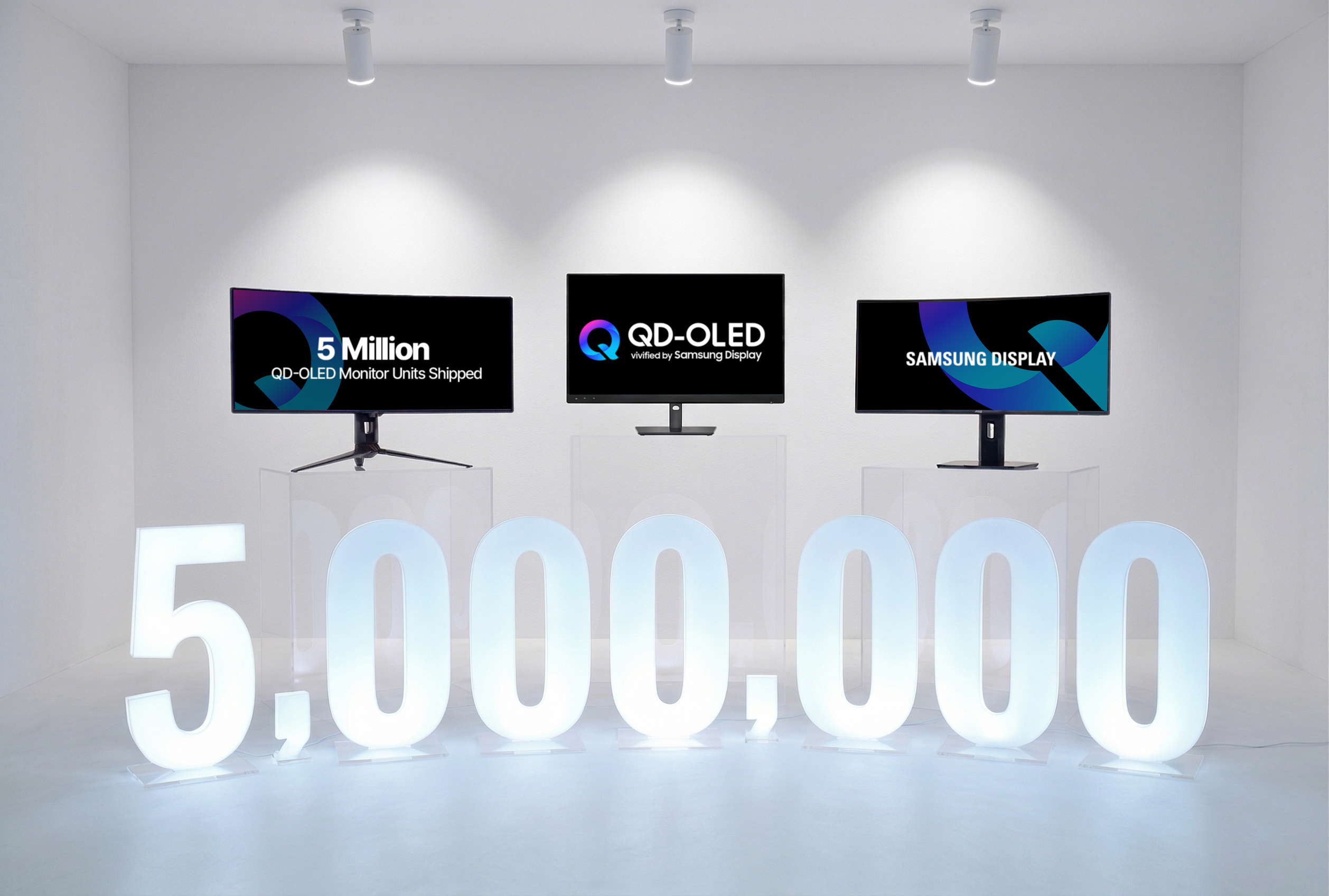
“LCD Fades as the QD-OLED Monitor Era Arrives”: Samsung Display Surpasses 5 Million Units in Cumulative QD-OLED Monitor Shipments

□ Reaching 5 million units in roughly 4 years since mass production launch… Average annual growth rate of over 320%

□ Innovating ultra-high resolution with ‘Quantum Dot,’ shifting the paradigm of the premium monitor market

□ Partnering with 16 global brands… Focused on expanding the reach of self-emissive monitors

□ Son Dong-il, Head of Business Unit: “Accelerating the technological transition of the monitor market based on QD-OLED’s unrivaled picture quality, quality, and stable production capacity”

QD-OLED for monitors surpassed a cumulative shipment of 5 million units this March, establishing itself as the ‘new normal’ in the premium monitor market.

Samsung Display announced that its QD-OLED for monitors exceeded the 5-million-unit mark in March, approximately four years after the start of mass production. Since successfully mass-producing QD-OLED for the first time in the world in late 2021 and entering the premium monitor market, Samsung Display has led the popularization and technological transition of the self-emissive monitor market, recording an average annual growth rate of over 320% through 2025. Notably, this 5-million-unit milestone was achieved in less than two years since reaching 1 million cumulative units in May 2024, proving once again the rapidly increasing global demand.

QD-OLED is a technology that internalizes ‘Quantum Dots (QD)’—nanometer-sized semiconductor particles that absorb light energy and convert it into specific wavelengths—into the display. Unlike conventional large OLEDs that implement color through a separate color filter, QD-OLED converts light from a blue OLED into red and green light within the QD-emitting layer. The unique optical characteristics of Quantum Dots allow for exceptionally high-purity color expression, resulting in superior color accuracy, color volume, and color luminance. Additionally, thanks to the wide light-scattering properties of Quantum Dots, it offers wide viewing angles and excellent response times, allowing users to enjoy clearer picture quality without motion blur even at the same refresh rate compared to LCDs.

According to global market research firm Omdia, the share of products equipped with self-emissive panels in the premium monitor market priced over $500 (based on revenue) is projected to expand from 22% in 2024 to 41% by 2026. Samsung Display is driving this market growth by collaborating with 20 global customers, including Acer, AOC/Philips, ASUS, Dell, GIGABYTE, HP, Lenovo, MSI, and Samsung Electronics, and has released over 150 types of QD-OLED monitors to expand the market’s reach.

Recently, the company launched a 34-inch 360Hz QD-OLED with a ‘V (Vertical)-Stripe’ pixel structure that enhances text readability and is currently supplying it to global monitor manufacturers. Furthermore, it has developed ‘QuantumBlack™’, a low-reflection and high-strength film that reduces light reflection on monitor screens by 20% compared to previous in-house films while increasing panel hardness to 3H, and applied it to all new QD-OLED monitor products launched this year. ‘Quantum Black’ reduces external light reflection to express more perfect blacks; this black expression adds depth and three-dimensionality to game content by clarifying the boundaries between objects and backgrounds, thereby doubling immersion.

According to Omdia, Samsung Display recorded a 75% market share (based on shipments) in the self-emissive monitor display sector last year. Son Dong-il, Executive Vice President and Head of the Large Display Business at Samsung Display, stated, “The rapid growth and overwhelming market share of QD-OLED stem from its unrivaled picture quality, quality competitiveness, and stable production capacity. We will continue to introduce differentiated technologies and products closely aligned with customers and the market to change the landscape and trends of the monitor market and lead the technological transition.”

Samsung Display Develops ‘Quantum Black’, a Low-Reflection and High-Strength Film for QD-OLED Monitors

Light reflectance reduced by 20%, panel hardness strengthened to 3H… Full application to 2026 new models

□ Secured ‘Deep Black’ expression in any environment… Doubling gaming immersion

□ Surface hardness increased from 2H to 3H, enhancing panel durability

□ ASUS, Gigabyte, MSI, and others to launch QD-OLED monitors featuring ‘Quantum Black’… Actively promoting low-reflection features

□ Samsung Display: “Quantum Black is a premium technology that further strengthens QD-OLED’s inherent black expression while offering high durability… It will present a new user experience”

Samsung Display is developing and applying a low-reflection, high-strength film that further reduces light reflectance on monitors while enhancing display durability for its new products.

Samsung Display announced on the 26th that it has developed ‘QuantumBlack™’, a low-reflection and high-strength film that reduces light reflection on monitor screens by 20% compared to its previous films while increasing panel hardness to 3H. The technology will be applied to all new QD-OLED monitor products launching this year. To promote the differentiated value of this technology, Samsung Display named it ‘Quantum Black’ and recently completed trademark registration.

QD-OLED, a self-emissive display, can achieve ‘True Black’ by completely cutting off pixel power. However, in actual usage environments, ambient bright light reflecting off the screen can make it difficult to experience perfect black. To solve this, Samsung Display has developed and applied low-reflection films since the early stages of its QD-OLED monitor business. This year, the company developed ‘Quantum Black’, which reduces reflectance by an additional 20% compared to previous in-house films, and plans to expand its application, centered on new products.

Black expression is a particularly crucial specification for gaming monitors. In game content, perfect black clarifies the boundary between objects and backgrounds, adding depth and a sense of three-dimensionality to the space, thereby doubling immersion. Especially in FPS (First-Person Shooter) or survival games, it can influence win rates by clearly showing the silhouettes of enemies or the location of items.

Applying Quantum Black also strengthens panel durability. Internal evaluations showed that with Quantum Black, the hardness of QD-OLED improved from the existing 2H to a 3H level. Low display hardness can lead to scratches during moving or cleaning; 3H represents excellent strength that leaves no scratches even when scraped with a fingernail.

In line with Samsung Display’s development of ‘Quantum Black’ film, global clients are announcing the launch of monitors featuring the new technology. Notably, ASUS has launched ‘Black Shield’, Gigabyte ‘Obsidian Shield’, and MSI ‘Dark Armor’—successive technical brands emphasizing enhanced low-reflection features to actively promote their new products.

According to market research firm Omdia, the global self-emissive monitor display market is projected to grow more than twofold, from 3.4 million units in 2025 to 7.6 million units in 2030. Industry experts expect that differentiated technologies carefully reflecting consumer needs, such as Quantum Black, Penta Tandem, and V-Stripe, will lead market growth. Samsung Display is leading the market with a 75% share in the self-emissive monitor display sector as of 2025.

Meanwhile, Jung Yong-wook, Vice President and Head of the Strategic Marketing Team for the Large Display Business, stated, “Quantum Black is a premium technology that provides a differentiated sense of immersion by further strengthening the deep and perfect black expression—the essential advantage of QD-OLED—while also increasing panel durability. We will continue to create new user experiences in both gaming and content environments through innovative technologies.”

Samsung Display Launches Premium Tech Brand ‘QD-OLED Penta Tandem’

Organic material layers increased from 4 to 5… Leading high-picture quality technology with 1.3x higher luminous efficiency

□ Energy dispersion via 5-layer stack structure… Significantly improves efficiency, lifespan, and brightness

□ Core technology for realizing high-definition products such as ‘Industry’s only 27-inch 160PPI’

□ 31.5-inch UHD monitor with Penta Tandem is the only one of its size to receive ‘True Black 500’ certification

□ Expanded application to all flagship models this year… “Best technology to prove QD premium”

Samsung Display announced on the 12th that it has released ‘QD-OLED Penta Tandem™’, a trademarked brand for its unique 5-layer stacking structure of QD-OLED. Samsung Display is applying an organic material light-emitting structure consisting of 5 layers to QD-OLED panels mounted on premium monitors and TVs, and has launched a new technology brand and completed trademark registration to publicize the unrivaled value of this technology. ‘Penta’ means the number ‘5’ in Greek.

QD-OLED expresses colors using Quantum Dots that react to light, utilizing blue OLED, which has the strongest energy among visible lights, as the light source. Since last year, Samsung Display has innovated the stacking structure of this blue OLED from the existing 4 layers to 5 layers and applied the latest organic materials to complete high-definition, high-efficiency, and high-brightness QD-OLEDs.

In particular, organic material stacking technology is attracting attention as a key factor determining the fierce high-definition competition in the recent monitor market. To implement higher resolution within the same panel size, increasing pixel density causes the light-emitting area of individual pixels to become smaller. To stably achieve high brightness even under these technical constraints, technology that effectively disperses energy applied to organic materials is essential. The pixel density of the 27-inch UHD (3840×2160) monitor product launched by Samsung Display last year reaches 160 PPI (Pixels Per Inch), the highest among self-emissive gaming monitors, and Penta Tandem technology served as the core foundation for this product development. Currently, Samsung Display is the only company mass-producing self-emissive displays with 27-inch UHD and 160PPI specifications.

Furthermore, increasing the number of stacked organic material layers improves luminous efficiency, allowing for higher brightness with the same power or the same brightness with less power. It is similar to five people sharing a load that four people used to carry, allowing them to carry it longer or lift a heavier load. Penta Tandem has 1.3 times higher luminous efficiency and 2 times longer lifespan compared to the previous year’s QD-OLED developed with a 4-layer structure. As a result, the maximum screen brightness of products applied with Penta Tandem technology reaches the industry’s highest level of 4,500 nits for TVs and 1,300 nits for monitors, based on 3% OPR (On Pixel Ratio, the ratio of operating pixels among total pixels constituting the screen).

Panels applied with Penta Tandem technology support clients in obtaining VESA’s ‘DisplayHDR™ True Black 500’ certification. True Black certification is an indicator evaluating the HDR performance of displays capable of expressing deep blacks; to obtain the True Black 500 grade certification, a display must express black at 0.0005 nits or less while simultaneously achieving a peak brightness of 500 nits (based on 10% OPR). Among the currently released 31.5-inch UHD monitors, the only product that has received True Black 500 certification is equipped with Samsung Display’s Penta Tandem panel.

This year, Samsung Display plans to expand Penta Tandem to product lines of all sizes and supply them to flagship products of major clients. Following the 27-inch UHD last year and the 31.5-inch UHD and 34-inch WQHD products early this year, it is scheduled to be expanded to 49-inch Dual QHD (5120×1440) products in the second half of the year. For TVs, it has been mounted on the top-tier products of major clients’ OLED lineups since last year.

Jung Yong-wook, Vice President and Head of the Strategic Marketing Team for Large Display Business, stated, “Organic material stacking technology is not simply about increasing the number of layers, but is completed only when know-how on which materials to stack, at what thickness, and in what combination is integrated.” He added, “Penta Tandem technology, which integrates about 5 years of QD-OLED mass production experience since ’21, will be the best choice for customers who want to prove the premium value of QD-OLED.”

Bar chart showing the rapid increase in OLED monitor shipments from 2026 to 2030.

OLED Monitor Market Sees Rapid Growth… Shipments Up 64% in 2025

Global OLED monitor panel shipment forecast graph from 2026 to 2030

OLED monitor market trends with over 50% growth expected in 2026, following a 64% surge in 2025. (Source: UBI Research)

Global OLED monitor shipments in 2025 are estimated at approximately 3.2 million units, marking a sharp year-on-year increase. According to UBI Research’s Medium & Large OLED Display Market Tracker, OLED monitor shipments in 2025 rose by about 64% from 1.95 million units in 2024. Growth of more than 50% is also expected in 2026, positioning OLED monitors as the fastest-growing application segment within the mid- to large-sized OLED industry.

This strong growth is closely linked to strategic shifts by panel makers. Samsung Display is focusing on expanding shipments of OLED panels for monitors—centered on its QD-OLED mass production lines—where unit prices and profitability are relatively higher than for TV panels. As adoption of QD-OLED expands across premium gaming monitors and creator-focused products, monitors are taking up an increasing share of Samsung Display’s mid- to large-sized OLED strategy.

LG Display is also maintaining its supply of WOLED TV panels while intensifying efforts to expand OLED monitor shipments. After beginning OLED monitor panel supply at around 100,000 units in 2023, LG Display increased shipments to roughly 200,000 units in 2024 and is estimated to have reached about 400,000 units in 2025. In 2026, shipments are expected to continue rising through new customer acquisitions and improved line utilization.

Behind the panel makers’ growing focus on OLED monitors rather than TVs are production efficiency and profitability considerations. On 8.5-generation glass substrates, TV panels typically achieve a utilization rate of around 60–70%, and even with MMG (Multi Model Glass) technology applied, utilization often remains near 80%. In contrast, monitor panels—based on IT-standard sizes such as 27-inch and 34-inch—can be laid out to achieve utilization rates exceeding 90%. Moreover, on a price-per-area basis, OLED monitor panels offer relatively higher profitability than TV panels, making them an attractive option in terms of both line efficiency and margins.

This trend is not limited to Korean manufacturers. Chinese panel makers are also accelerating their entry into the IT OLED market. BOE is gradually increasing shipments of IT OLED panels, while TCL CSOT is planning shipments of OLED monitor panels based on its in-house inkjet-printed OLED technology. Over the mid to long term, the entry of Chinese players is likely to enhance both price competitiveness and product diversity in the OLED monitor market.

Changwook Han, Vice President of UBI Research, commented, “In the mid- to large-sized OLED market, panel makers’ strategic focus is gradually shifting from TVs to monitors.” He added, “OLED monitors offer both high glass utilization and a relatively stable profit structure.” He further noted, “Not only Korean companies but also Chinese panel makers are actively entering the OLED monitor market with their own technologies, and the OLED monitor segment is expected to continue growing as applications expand across gaming, creator, and premium IT devices.”

Changwook Han, Executive Vice President/Analyst at UBI Research (cwhan@ubiresearch.com)

▶ Quarterly Small OLED Display Market Tracker Sample

▶Quarterly Medium & Large OLED Display Market Tracker Sample

※ This article is produced by UBIResearchNet.
Unauthorized reproduction or citation without source attribution is prohibited.
When quoting, please clearly indicate the source (UBIResearchNet) and provide a link.

Samsung Display Begins Full-Scale Supply of World’s First 360Hz ‘V-Stripe’ QD-OLED

To be equipped in new 2026 monitor models from 7 clients including ASUS and MSI

□ ‘High Performance’ QD-OLED monitor anticipated for ’26 debut featuring new pixel structure, 21:9 ultra-wide aspect ratio, 360Hz high refresh rate, and 1,300 nits peak brightness

□ ‘V-Stripe’ pixel application significantly strengthens text readability… Provides optimal gaming experience with wide screen, smooth transitions, and fast response speed

□ QD-OLED solidifies #1 spot with 75% market share in the self-emissive monitor market in ’25

□ “Will continue technical innovation with QD-OLED in the ‘high-end monitor’ market, a battleground for the latest displays”

Samsung Display announced on the 1st that it is launching the world’s first 34-inch 360Hz QD-OLED featuring a ‘V (Vertical)-Stripe’ pixel structure. Samsung Display began mass production of the new product last December and is now fully supplying it to a total of seven global monitor manufacturers, including ASUS, MSI, and Gigabyte.

While conventional QD-OLEDs utilized a triangular arrangement for the Red (R), Green (G), and Blue (B) sub-pixels, the ‘V-Stripe’ arranges the R, G, and B sub-pixels in a vertical stripe pattern. Although commonly referred to in the industry as a stripe structure or RGB stripe structure, Samsung Display developed a stripe pixel structure optimized for Quantum Dot elements in-house and named it ‘V-Stripe’. Applying this pixel structure expresses text edges more clearly, offering an optimal monitor solution for users sensitive to text readability in tasks such as document work, coding, and content creation.

In addition, this new product combines the ▲‘V-Stripe’ structure with a ▲21:9 ultra-wide aspect ratio, a ▲360Hz high refresh rate enabling smooth transitions and fast response speeds, and ▲high brightness characteristics with a peak of 1,300 nits. It is gathering high expectations among consumers who enjoy speedy and immersive games such as sports and racing.

Generally, a 21:9 aspect ratio significantly increases the number of horizontal pixels and data processing volume compared to 16:9, increasing the burden on driving components such as power consumption and heat generation even at the same refresh rate. Also, it is known that implementing high refresh rates is difficult because it is hard to uniformly match the signal timing between left and right pixels.

A Samsung Display representative stated, “The biggest technical hurdles in mass-producing high-refresh-rate products with a new pixel structure are reduced organic material lifespan, heat generation, and brightness degradation.” The representative added, “Since QD-OLED adopts a top-emission method, it is advantageous in terms of brightness. Through efficiency improvement of organic materials and design optimization, we were able to mass-produce a ‘high performance’ monitor display equipped with all four specs: ▲‘V-Stripe’ pixel structure, ▲ultra-wide aspect ratio, ▲high refresh rate, and ▲high brightness.”

The ‘V-Stripe’ QD-OLED monitor, considered a highly anticipated product in the new year’s monitor market, can be seen at ‘CES 2026’ opening in Las Vegas, USA on the 6th (local time). This is because ASUS and MSI will unveil new monitor products equipped with the ‘V-Stripe’ structure QD-OLED for the first time at CES. Samsung Display also plans to reveal the panel at a private booth operated at the Encore at Wynn hotel during the CES period.

According to market research firm Omdia, the transition from LCD to OLED continues, with the proportion of products equipped with self-emissive panels in the premium monitor market of $500 or more expected to rise from 14% in ’24 to 23% in ’25 and 27% in ’26. Amidst this, Samsung Display’s QD-OLED shipments in the monitor OLED panel market for ’25 are estimated at approximately 2.5 million units, expecting to maintain an overwhelming number one position in the market with a share exceeding 75%.

Jung Yong-wook, Vice President and Head of the Strategic Marketing Team for Large Display Business at Samsung Display, stated, “The high-end monitor market, including gaming, can be called a battleground for the latest display technologies as consumers’ sensitivity and expectations for display image quality are high.” He added, “As QD-OLED is receiving overwhelming support from consumers in this market, we will continue to maintain market leadership by showcasing even more innovative technologies in the future.”

Samsung Display Wins “Korea Technology Award” for QD-OLED Innovation

Recognized with Minister’s Commendation for developing high-resolution monitor and high-brightness TV QD-OLED panels

□ Leading innovation in large-scale panels with the world’s first 160PPI QD-OLED for monitors and 4,000-nit QD-OLED for TVs.

□ Winning products showcased at the “2025 Korea Tech Festival” at COEX (Dec. 3–5).

□ Choi Yeol, Executive Vice President, receives Presidential Commendation for contributions to industrial technology promotion.

Samsung Display announced that it has received the Minister’s Commendation at the “Korea Technology Award” for its development of the world’s first 160PPI (Pixels Per Inch) QD-OLED for high-resolution monitors and 4,000-nit QD-OLED for high-brightness TVs.

The company is currently showcasing its award-winning QD-OLED products, along with its foldable display lineup, at the “2025 Korea Tech Festival” held at COEX in Seoul from December 3rd to 5th. Established in 1992, the “Korea Technology Award” is considered the country’s most prestigious technology honor. It is awarded by the Ministry of Trade, Industry and Energy (MOTIE) and the Korea Institute for Industrial Technology Planning and Evaluation (KIET) after evaluating leading domestic companies on technological value, development capabilities, and commercialization potential.

Earlier this year, Samsung Display launched its 160PPI QD-OLED for monitors and 4,000-nit QD-OLED for TVs, spearheading technological innovation in the large-sized display sector. The 160PPI monitor panel features an ultra-high-density pixel arrangement, packing 160 pixels into every inch. Higher PPI allows for a greater amount of data to be displayed within the same resolution, resulting in significantly sharper and more detailed imagery.

The 4,000-nit TV panel boasts extreme brightness and clarity that were previously difficult to achieve, delivering an exceptional viewing experience even in very bright environments. Optimized for High Dynamic Range (HDR) content, this product offers delicate expression in dark scenes while providing powerful contrast in bright scenes for lifelike picture quality.

Meanwhile, Choi Yeol, Executive Vice President and Head of Small & Medium Display Development at Samsung Display, was selected as a person of merit for the promotion of industrial technology at the festival, receiving the Presidential Commendation. EVP Choi was recognized for his pivotal role in the development of foldable displays.

[K-Display 2025] Samsung Display, QD-OLED 49″ DQHD Monitor

[SID 2025] Samsung Display, QD-OLED 27-inch QHD 500Hz Monitor

Samsung Display’s QD-OLED: Key Highlights at CES 2025

Samsung Display unveiled the winning keywords to strengthen its QD-OLED business at CES 2025: ‘Brightness, Highest, Fastest.

“Brightness” represents the industry’s first TV OLED to achieve 4,000 nits.”

In 2025, QD-OLED achieved an industry-first high brightness of 4,000 nits by altering its OLED structure. It is reported that the structure was changed from 4-stack to 5-stack. The 5-stack QD-OLED includes an additional green (G) layer to enhance efficiency, resulting in a composition of Blue-Blue-Green-Blue-Green.

‘Highest’ refers to a 27-inch OLED monitor manufactured using deposition technology, achieving a resolution of 160 PPI. Although JOLED (now part of JDI) previously achieved 204 PPI with inkjet printing, this is the world’s first high-resolution product using deposition technology. Samsung Display aims to achieve 220 PPI for 27-inch displays in the future.

Another innovation in monitors is ‘Fastest.’ To target the growing gaming audience, Samsung Display has developed an OLED monitor with a 500Hz refresh rate. This monitor features no motion blur and an extremely fast response time, allowing gamers to keep up with the rapid pace of gameplay seamlessly.

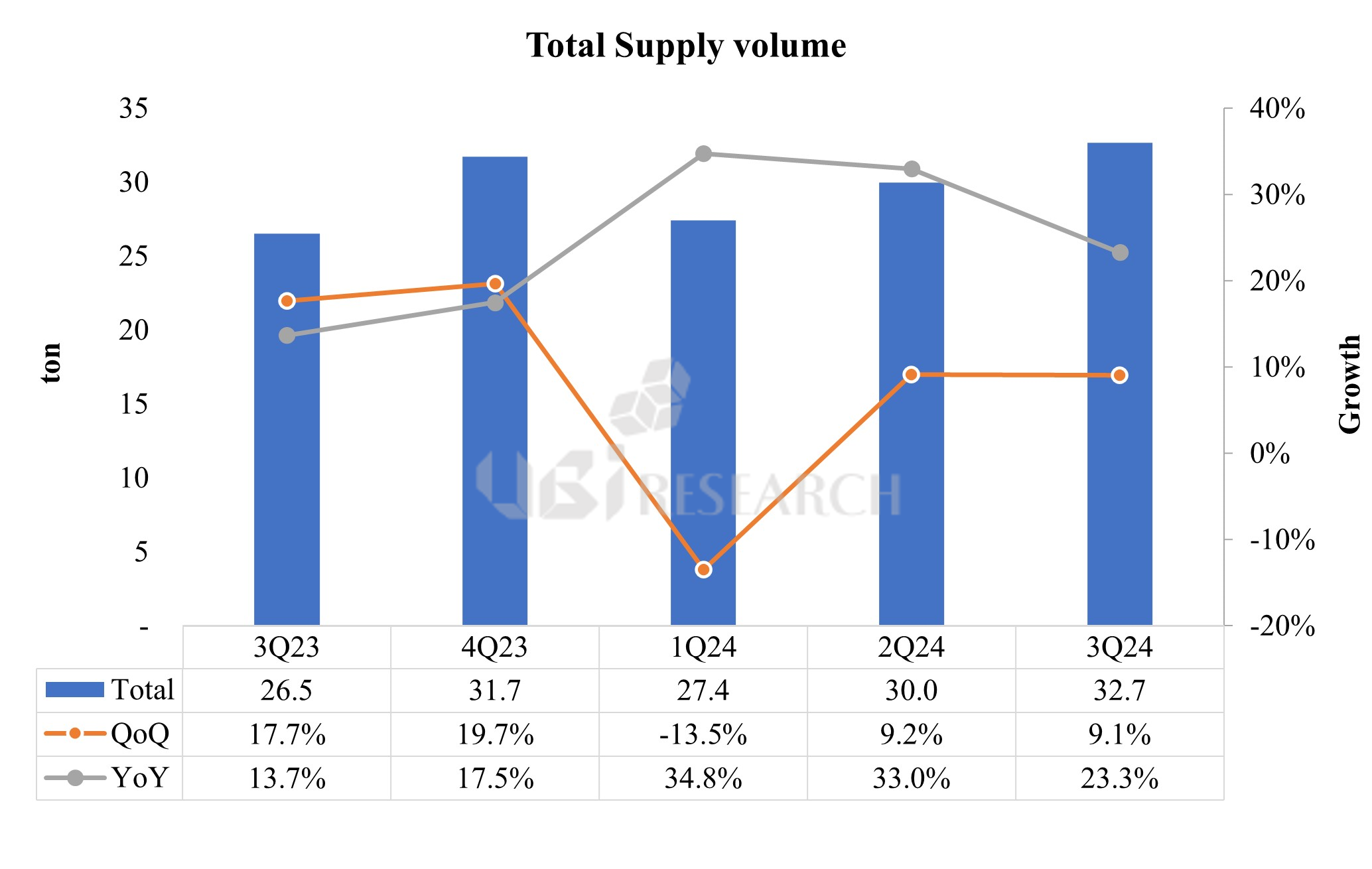
The purchase volume of OLED emitting materials in the third quarter of 2024 is expected to reach 32.7 tons, the highest ever purchase volume of emitting materials in 2024

According to UBI Research’s ‘4Q24_Quarterly OLED Emitting Material Market Tracker’, the purchase volume of emitting materials in the third quarter of 2024 was calculated to be 32.7 tons. Previously, material purchases were highest in 2021, when the market expanded due to COVID-19, but the all-time high was renewed in the third quarter of 2024. Considering the characteristics of OLED emitting materials, which show the highest usage in the fourth quarter of every year, it is expected that 2024 will see the highest usage ever.

Looking at each company, Samsung Display consistently holds the highest market share. Samsung Display had a 41.4% share in the entire OLED emitting material market based on purchase volume, followed by LG Display with 20.5%, BOE with 11.6%, and Visionox with 8.3%.

By substrate, RGB OLED still maintains the 80% level with a market share of 83.7% based on purchase volume, and as 8.6G lines begin to operate in earnest, RGB OLED’s market share is expected to gradually decline. WRGB-OLED’s market share was 11.3%, similar to the second quarter, and QD-OLED’s market share was 2.8%.

The market share of RGB 2 stack tandem OLED once rose to 6.4% in the second quarter due to a surge in iPad Pro OLED shipments but fell to the 2.2% range in the third quarter due to low demand. Compared to panel shipments, IT devices that use 2-stack tandem OLED for smartphone OLED, which uses single stack OLED, have large panel areas and have two light-emitting layers, so material purchase volume accounted for a higher share than shipment volume.

However, as BOE’s 8.6G line was confirmed to supply OLED for smartphones first, the growth of the 2 stack tandem OLED market was in the hands of Samsung Display. Starting in 2026, when OLED is expected to be applied to MacBook Pro, the purchase amount of light emitting materials applied to 2 stack tandem OLED is expected to more than double compared to 2024. The 2-stack tandem OLED panel supplied to MacBook Pro is expected to be supplied first by Samsung Display.

Junho Kim, UBI Research analyst(alertriot@ubiresearch.com)

▶OLED Emitting Material Market Track Sample

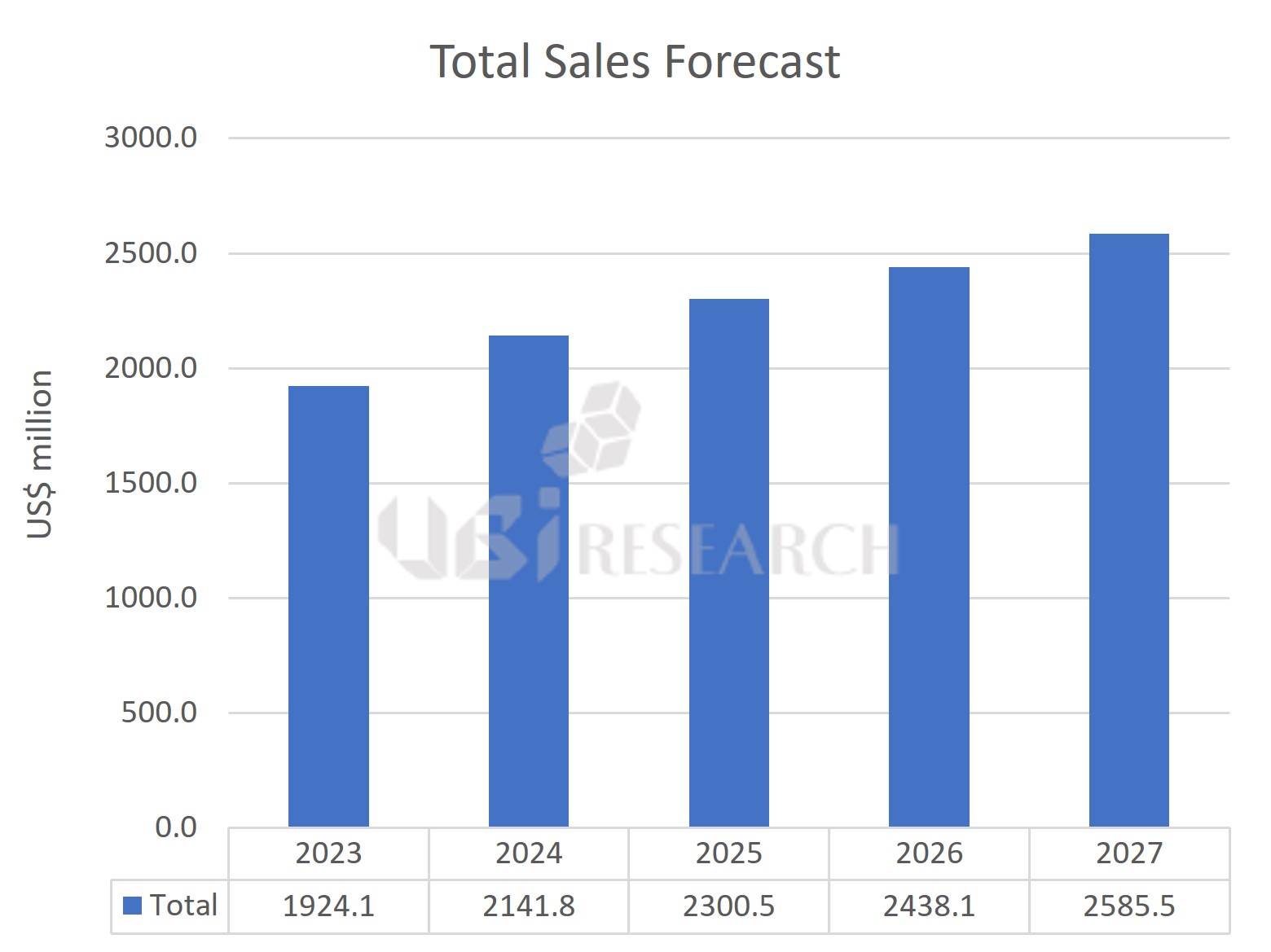
OLED emitting materials market in 2027 expected to reach US$ 2.59 billion with an average annual growth rate of 7.7%

According to the ‘2023 OLED Emitting Material Report’ recently published by UBI Research, the total emitting material market is expected to reach US$ 2.59 billion in 2027 with an average annual growth rate of 7.7% from US$ 1.92 billion in 2023.

total emitting material market

total emitting material market

Analyst Yoon Daejeong of UBI Research said, “The small OLED material market is expected to grow at an average annual growth rate of 2.5% from 2023 to US$ 1.61 billion in 2027. And in 2027, Samsung Display’s purchase of small OLED materials is expected to be US$ 560 million, BOE US$ 430 million, and LG Display US$ 200 million.” and “the small OLED material market will change depending on how much the foldable OLED market replaces the sharp decline in rigid OLED shipments for smartphones.

Analyst Yoon continued, “As the shipments of LG Display’s WOLED and Samsung Display’s QD-OLED are expected to be 12 million units and 3 million units, respectively, in the large OLED material market in 2027, the purchase amount of emitting materials is also expected to be US$ 430 million and US$ 140 million, respectively”

Meanwhile, the report predicted that by OLED method in 2027, RGB OLED would occupy the largest share at 66.6%, followed by WOLED at 16.5%, RGB 2stack OLED at 11.4%, and QD-OLED at 5.5%.

▶ 2023 OLED Emitting Material Report Sample Download

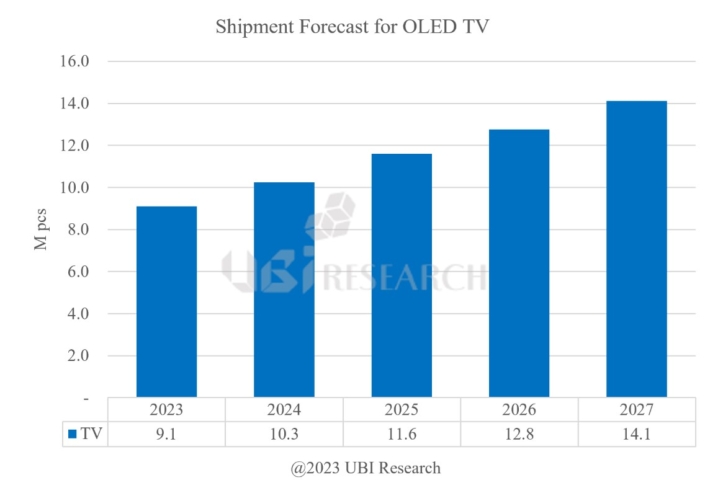
OLED panel shipments for TVs are expected to reach 14.1 million units in 2027 with an average annual growth rate of 11.6% from 9.1 million units in 2023

According to the ‘2023 Medium and Large OLED Annual Report’ recently published by UBI Research, OLED panel shipments for TVs are expected to grow from 9.1 million units in 2023 to 14.1 million units in 2027 with an average annual growth rate of 11.6%.

Shipment Forecast for OLED TV

Shipment Forecast for OLED TV

In 2022, it is analyzed that TV demand will decline due to the global economic deterioration, and global TV shipments will also stop at the early 200 million units. In the case of LG Display, it set a goal to ship more than 10 million WOLEDs in early 2022, including those for monitors, but released a total of 6.96 million units, recording a decrease of 880,000 units from 7.84 million units in 2021. Samsung Display’s QD-OLED shipments for TVs are also analyzed to have recorded 950,000 units.

As the economic situation is expected to gradually recover in 2023, LG Display’s TV WOLED shipments are expected to be 7.6 million units and Samsung Display’s QD-OLED shipments to be 1.5 million units.

Meanwhile, UBI Research predicted that LG Display’s micro lens array (MLA) applied ‘OLED.EX’ panel would be partially mass-produced from 2023, and Samsung Display’s QD-OLED monthly capacity of 36K is expected to be 41K per month by the second half of 2023 and 45K per month by the first half of 2024.

▶ 2023 Medium and Large OLED Display Annual Report Sample Download

New emitting structure QM2 for QD-OLED will be applied to Samsung Electronics’ 2023 OLED TVs

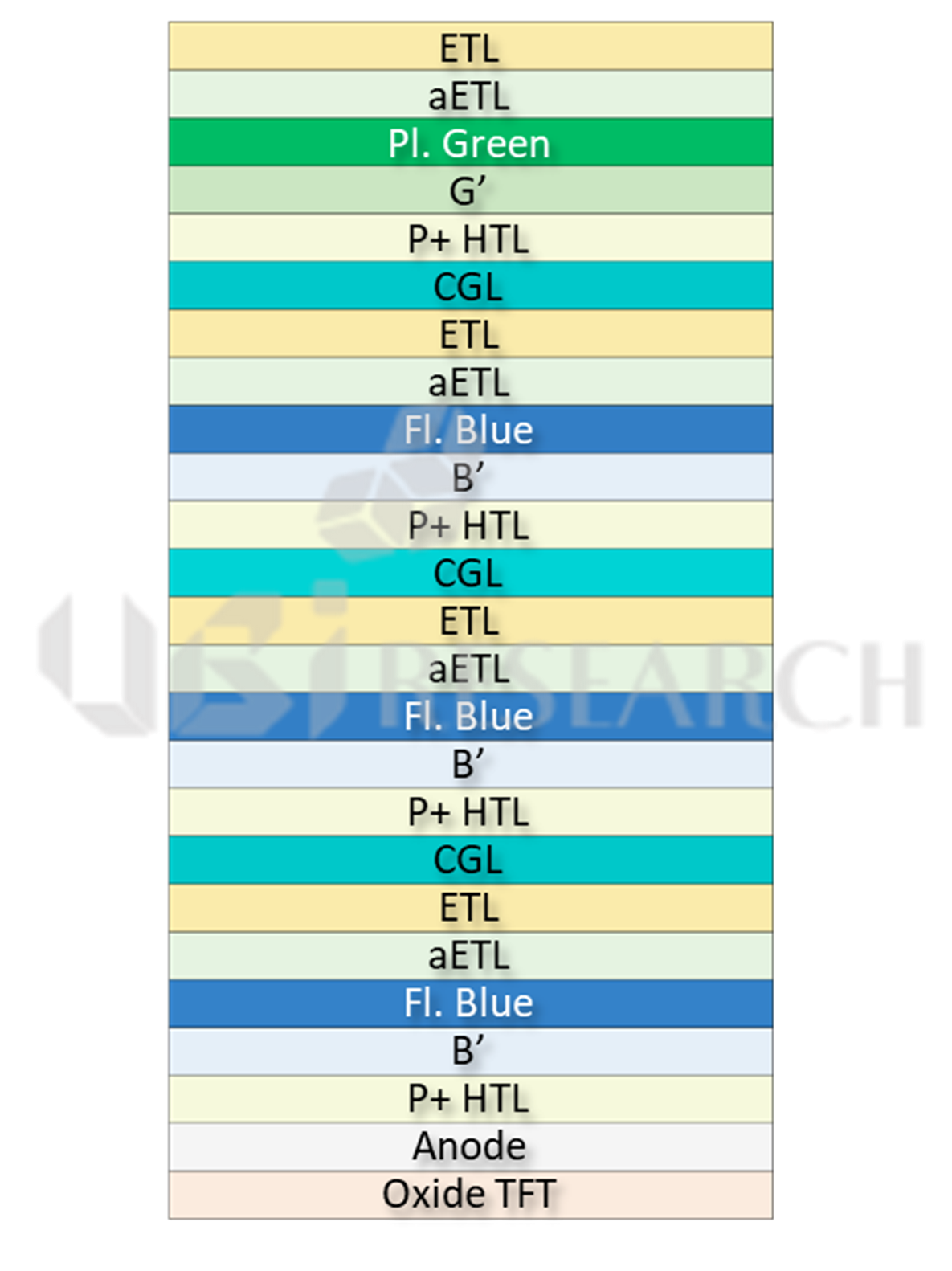
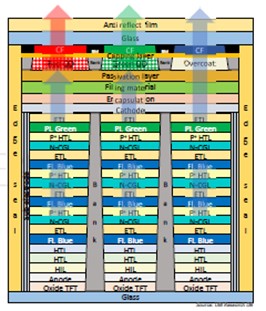
According to ‘AMOLED Manufacturing Process Report Ver.5’ recently published by UBI Research, QM2, a new emitting structure of QD-OLED, has been applied from the end of 2022, and is expected to be applied to Samsung Electronics’ 2023 OLED TVs.

QD-OLED QM2 structure, Source: AMOLED Manufacturing Process Report Ver.5

QD-OLED QM2 structure, Source: AMOLED Manufacturing Process Report Ver.5

QD-OLED, which is being mass-produced by Samsung Display, consists of three blue emitting layers and one green emitting layer, and is a structure in which the three primary colors of RGB are expressed through quantum dots and color filters.

In the QM1 structure mass-produced by the end of 2022, there was no aETL and G’ in the green emitting layer, but it was confirmed that all of them were applied from the QM2 structure. In addition, the change cycle of the emitting structure is expected to be extended from one year to two years due to recycling of materials.

Meanwhile, Samsung Display is expected to expand its existing 30K monthly QD-OLED Capa. to 45K monthly by 2024. In addition, from 2023, it plans to further expand its lineup by mass-producing 49-inch and 77-inch panels in addition to 55-inch and 65-inch panels.

▶ AMOLED Manufacturing Process Report Ver.5 Sample Download

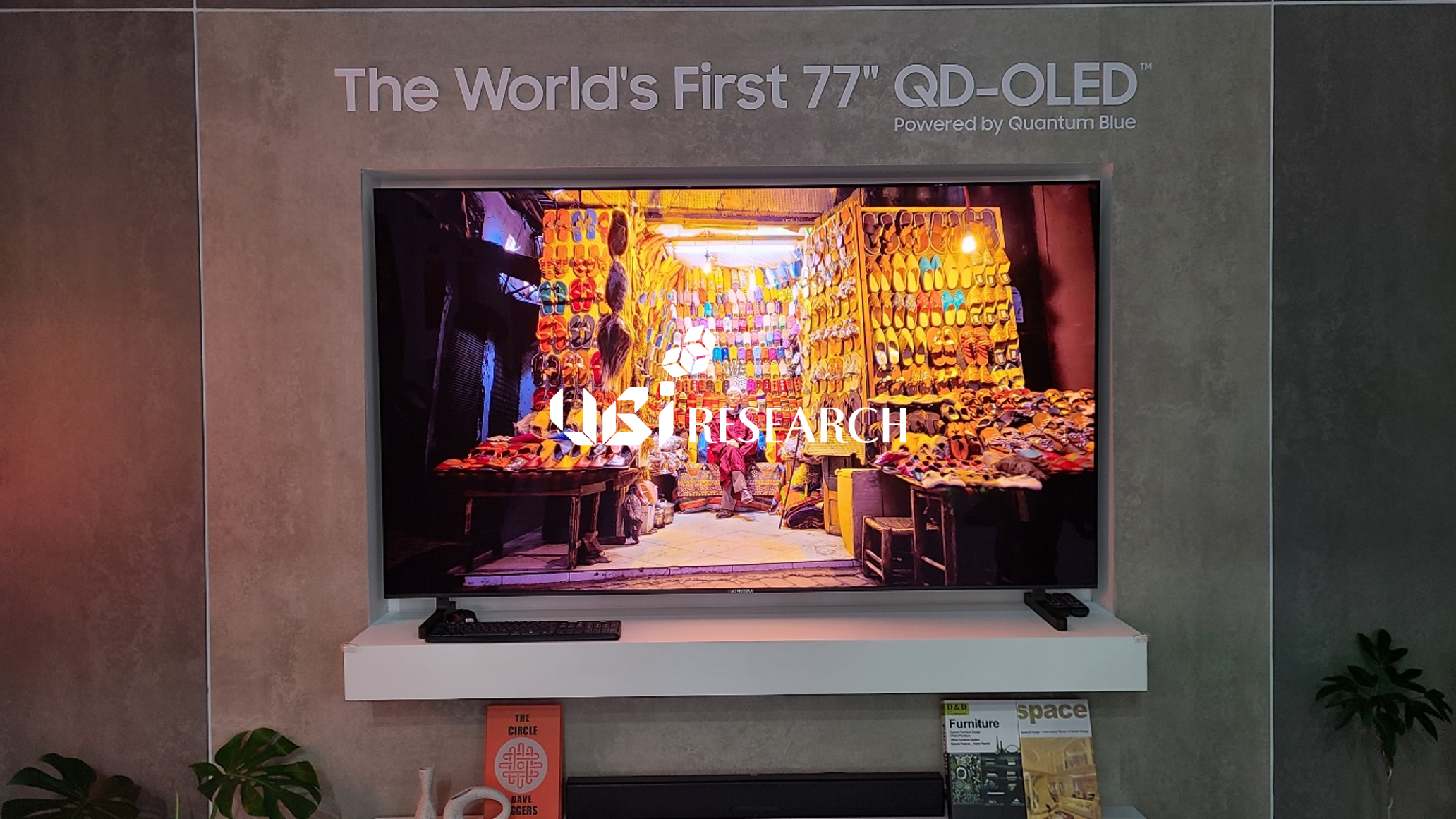
Samsung Electronics to enter the domestic market with QD-OLED TV within the first half of the year

77-inch QD-OLED TV exhibited by Samsung Display at CES 2023

77-inch QD-OLED TV exhibited by Samsung Display at CES 2023

According to the industry, Samsung Electronics recently obtained radio wave certification for its 55-inch OLED TV (KQ55C95A). Since products are usually released within three months after obtaining certification, it is expected to be introduced in the domestic market within the first half of the year. Samsung Electronics is expected to obtain radio wave certification for 65-inch products following 55-inch products, and then release them to the domestic market at the same time as 55-inch products.

Samsung Electronics launched 55-inch and 65-inch QD-OLED TVs in North America and Europe in March last year. At the time, it was not released in Korea due to problems such as low yield and profitability of QD-OLED panels. Samsung Electronics’ 55-inch and 65-inch QD-OLED TVs were released at 2,200 dollars and 3,000 dollars, respectively, but due to QD-OLED panel yield improvement, the prices went down to 1,450 dollars and 1,800 dollars, respectively.

In addition to 55-inch and 65-inch TVs, Samsung Electronics is also reviewing the release of a 77-inch QD-OLED TV first unveiled at CES 2023. Samsung Display also plans to diversify its QD-OLED lineup by producing 49-inch and 77-inch QD-OLED panels following 55-inch and 65-inch QD-OLED panels in line with set makers. If the MMG (Multi model glass) process is applied to the 8.5th generation (2200x2500mm) motherglass used by Samsung Display, it is possible to produce a total of four panels, two 77-inch panels and two 49-inch panels.

▶ 4Q22 Medium & Large OLED Display Market Track Sample Download

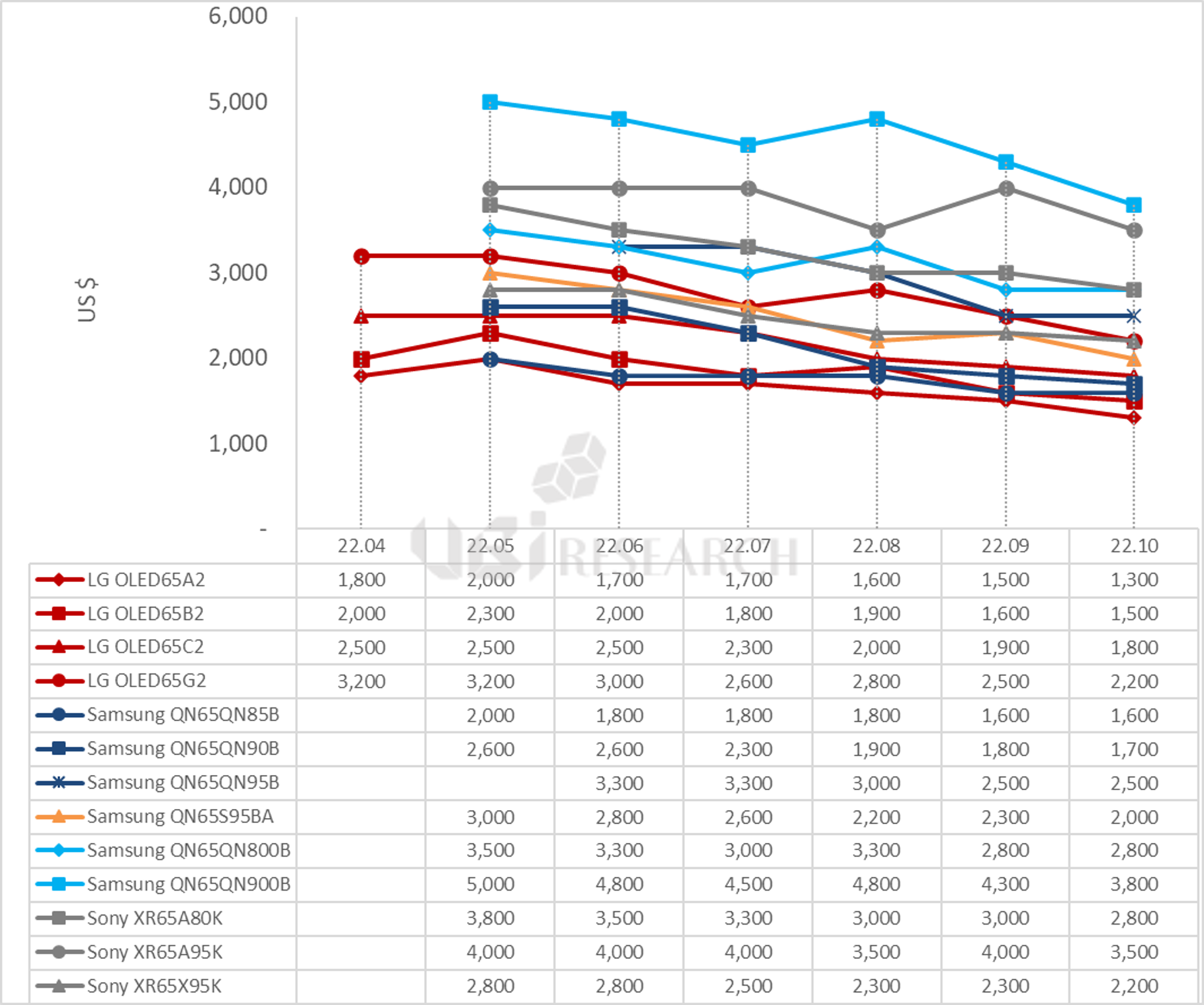
65-inch Premium TV $800 Price Drop On Average. Prices Are Expected to Continue to Fall.

The price of 65-inch premium TV models released from April 2022 was analyzed to have dropped by an average of $800 by October. The price drop is expected to continue for a while because of the Qatar World Cup starting on the 21st of next month and Black Friday on the 25th of November.

Average prices for 65-inch premium TVs

Average prices for 65-inch premium TVs

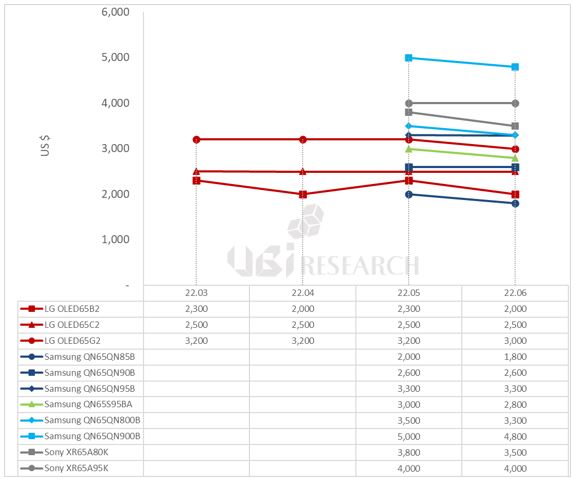
The prices of Samsung Electronics’ QLED TV and QD-OLED TV, LG Electronics and Sony’s WOLED TV, and Sony’s QD-OLED TV and Mini LED TV were analyzed on a 65-inch basis until October 2022. The selling price of Bestbuy.com was used as the standard, and Sony’s TV was based on the selling price of the official website.

LG Electronics’ WOLED TVs A2, B2, C2, and G2, released in March, were priced at $2,000, $2,300, $2,500, and $3,200, respectively. Samsung Electronics’ 4K QLED TVs 85B, 90B, and 95B cost $2,000, $2,600 and $3,300. 8K QLED TVs 800B and 900B were $3,500 and $5,000. QD-OLED TV, S95B was priced at $3,000. Sony’s WOLED TV, A80K, was priced at $3,800 and QD-OLED TV, A95K, at $4,000. Mini LED TV, X95K was priced at $2,800.

In October, the price of LG Electronics’ G2 model fell by $300, forming an average price difference of $300 per series. Samsung Electronics’ QD-OLED TV, the S95B model, continues to maintain a price difference of $200 lower than LG Electronics’ high-end model, the G2. Sony lowered the price of the WOLED TV A80K by $1,000, the QD-OLED TV A95K by $500, and the mini LED TV X95K by $600.

The higher price of TV, the larger the price drop and among premium TVs, Samsung’s QLED TV, QN90B, had the highest rate of decline at 34.6%. Among OLED TVs, Samsung Electronics’ QD-OLED TV, S95B, had the highest rate at 33.3%.

In terms of price competition, Samsung Electronics’ S95B and LG Electronics’ high-end OLED TV, G2, are competing. Sony’s QD-OLED TV, which had maintained its price range, is also entering the price competition by lowering its price. The prices of Samsung Electronics’ 4K Neo QLED TV series and LG Electronics’ 4K OLED TV series are forming similarly. In Samsung Electronics’ entire TV series, QD-OLED TV is located between 90B and 95B, which are 4K Neo QLED.

Samsung Electronics’ 8K QLED TV, QN800B, has the same price as Sony’s 4K WOLED TV, A80K, and QN900B has a $300 difference from Sony’s QD-OLED TV A95K, leading to consumption of 8K TVs instead of 4K TVs.

With the Qatar World Cup starting on the 21st of next month and Black Friday on the 25th, premium TV prices are expected to continue to decline. Price-competitive marketing by company according to market conditions is expected to be a major variable.

▶ UBI Research website
https://ubiresearch.com/en/

[IFA 2022] Samsung (QD-OLED, Odyssey Gaming Monitors, The Serif, The Frame, The Sero)

#ifa2022 #samsung #qdoled

▶ UBI Research official website
https://ubiresearch.com/en/

▶If you are curious about the latest news related to OLED?
https://en.olednet.com/

▶Business, display report inquiry
marketing@ubiresearch.com
+82-2-577-4391

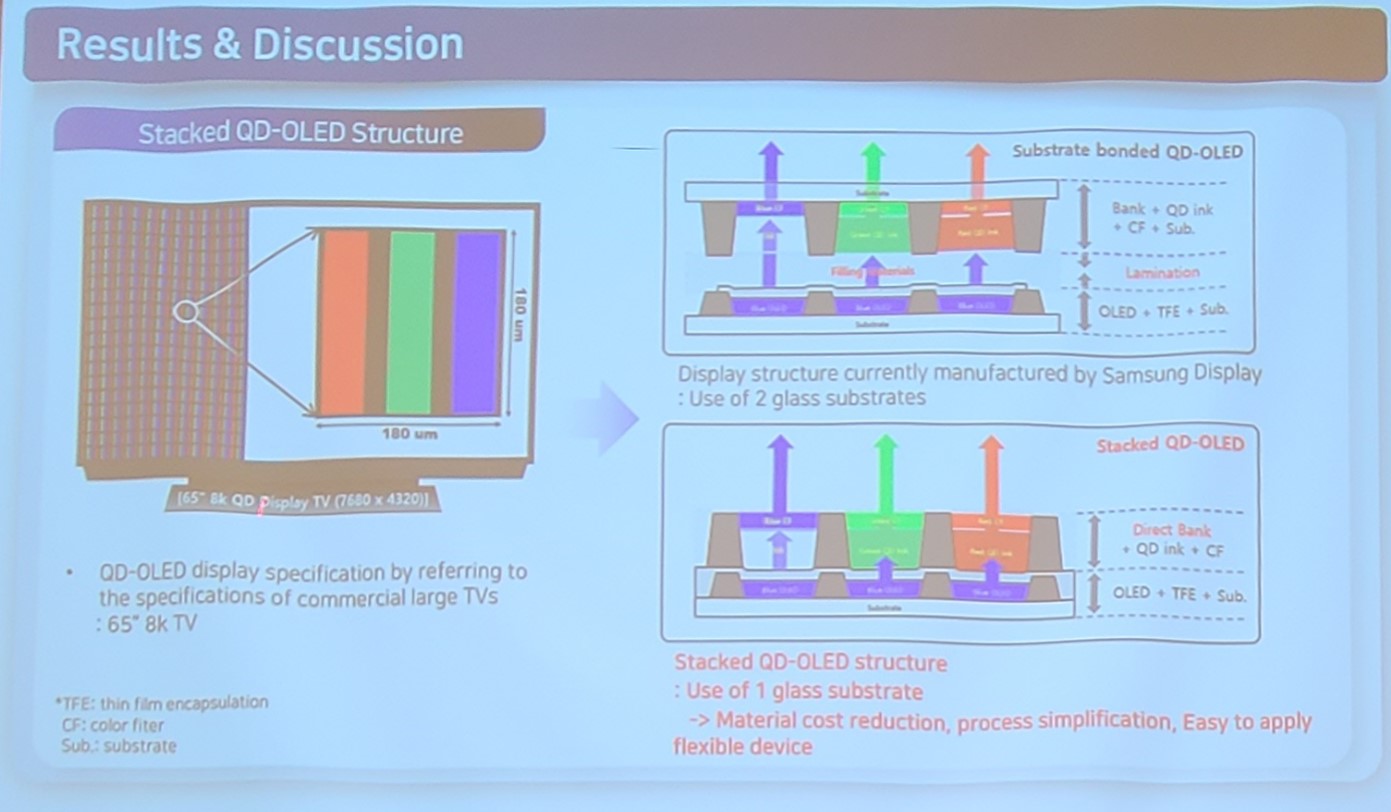
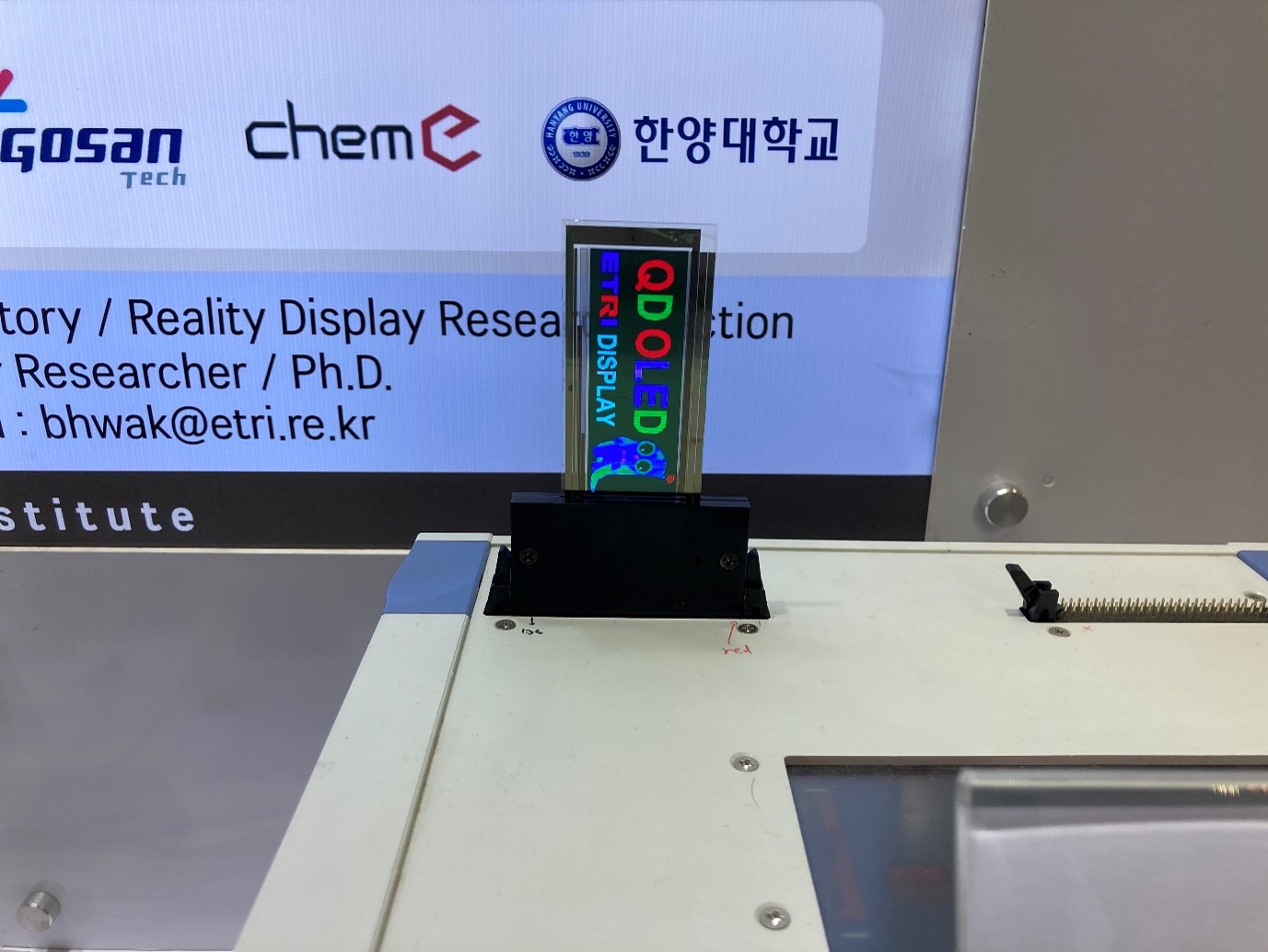
[IMID 2022] ETRI to Show ‘Stacked QD-OLED’ With Top Glass Removed

At IMID 2022 held in BEXCO, Busan, from August 23rd to the 26th, ETRI held an exhibition and presentation, ‘Development of QD-OLED Technology with Fine Quantum Dot Pixel Array using Inkjet Printing Process’.

Stacked QD-OLED structure/ ETRI

Stacked QD-OLED structure/ ETRI

Two glass substrates are used in the QD-OLED produced by Samsung Display, but the ‘Stacked QD-OLED’ developed by ETRI has a structure in which the glass with the QD color conversion layer is removed. In the stacked OLED, TFE and BM are formed on the light emitting layer, and the QD color conversion layer is formed by the inkjet printing process instead of the lamination process. The ‘Stacked QD-OLED’ structure has advantages such as material cost reduction and process simplification compared to the existing method.

ETRI explained that there are advantages of material cost reduction and process simplification compared to the existing process through this, and the thickness of the QD color conversion layer can be made thicker than before, resulting in a higher color conversion rate and less blue light leakage.

Meanwhile, ETRI collaborated with Kosan Tech for inkjet module head, Duksan Neolux for black bank material, and Chem e for QD material to develop ‘Stacked QD-OLED’.

‘Stacked QD-OLED’ Developed by ETRI

‘Stacked QD-OLED’ Developed by ETRI

▶ OLED Display Report Sample Download

[IMID 2022] Samsung Display to Start Mass Production of 49-inch and 77-inch QD-OLED Panels Early Next Year

At ‘IMID 2022’, which was held in BEXCO, Busan, from August 23rd to 26th, 2022, Samsung Display exhibited 77-inch QD-OLED and foldable OLED such as ‘Flex S’, ‘Flex G’, ‘Flex Note,’ ‘Flex Gaming’, and ‘Diamond Pixel’.

77-inch QD-OLED TV/ Samsung Display

77-inch QD-OLED TV/ Samsung Display

The 77-inch QD-OLED exhibited by Samsung Display was very similar to the previously released 65-inch QD-OLED TV with a resolution of 4K, a contrast ratio of 1,000,000:1, and a refresh rate of 120 Hz, but Samsung Display revealed that there was a slight improvement in luminance.

Following the existing 55-inch and 65-inch QD-OLEDs, Samsung Display plans to start mass production of 49-inch and 77-inch QD OLEDs from early next year. If the MMG (Multi model glass) process is used in the 8.5 generation (2200x2500mm) ledger used by Samsung Display, it is possible to produce two 77-inch panels and two 49-inch panels, a total of four panels.

Samsung Display concluded with, “Depending on the situation of the set makers, a new size QD-OLED TV is expected to be released as early as the second quarter of next year.”

▶ OLED Display Report Sample Download

[K-Display 2022 Business Forum] Samsung Display, ‘QD-OLED, The New Display Industry Standard‘

Samsung Display's Vice President Seon Ho

Samsung Display’s Vice President Seon Ho

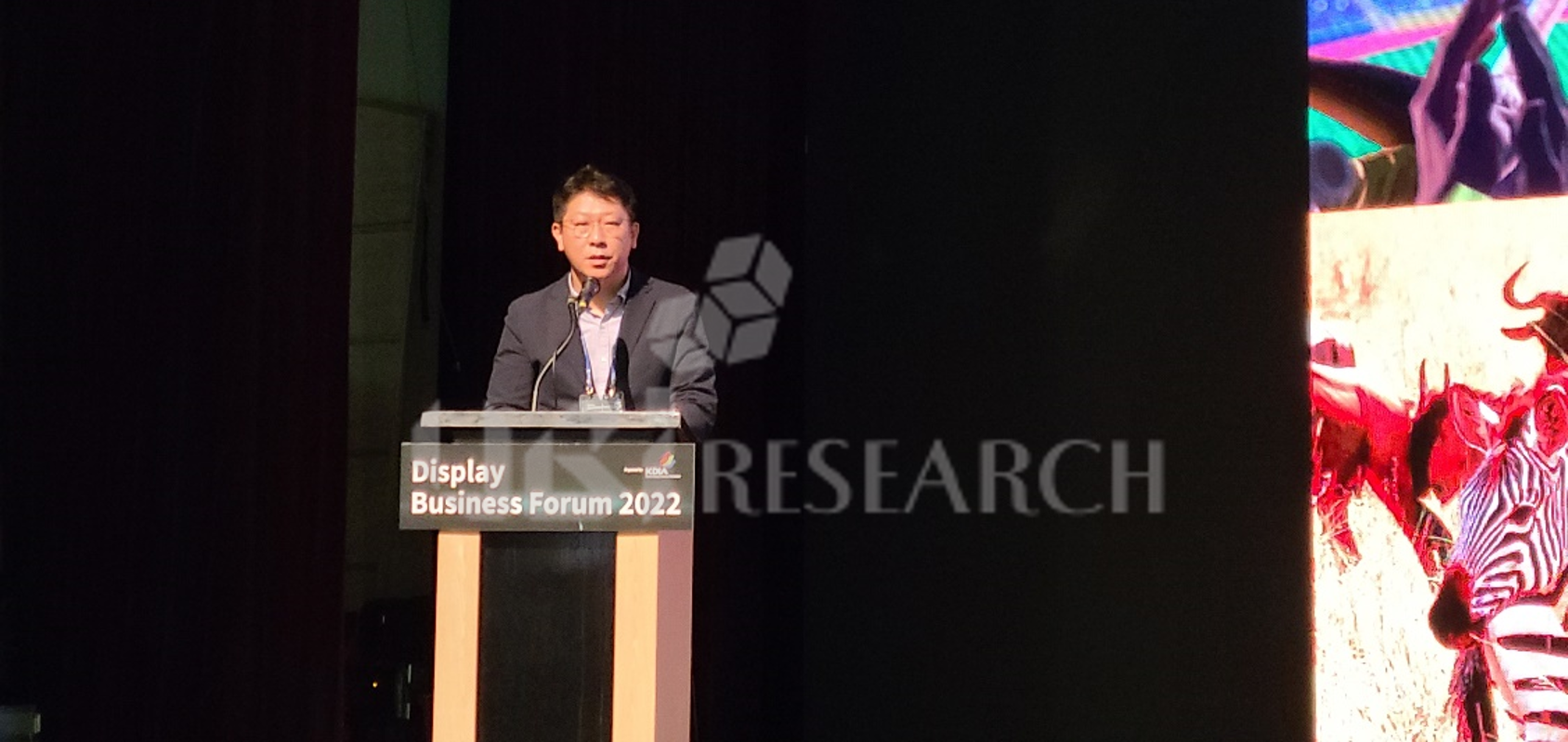
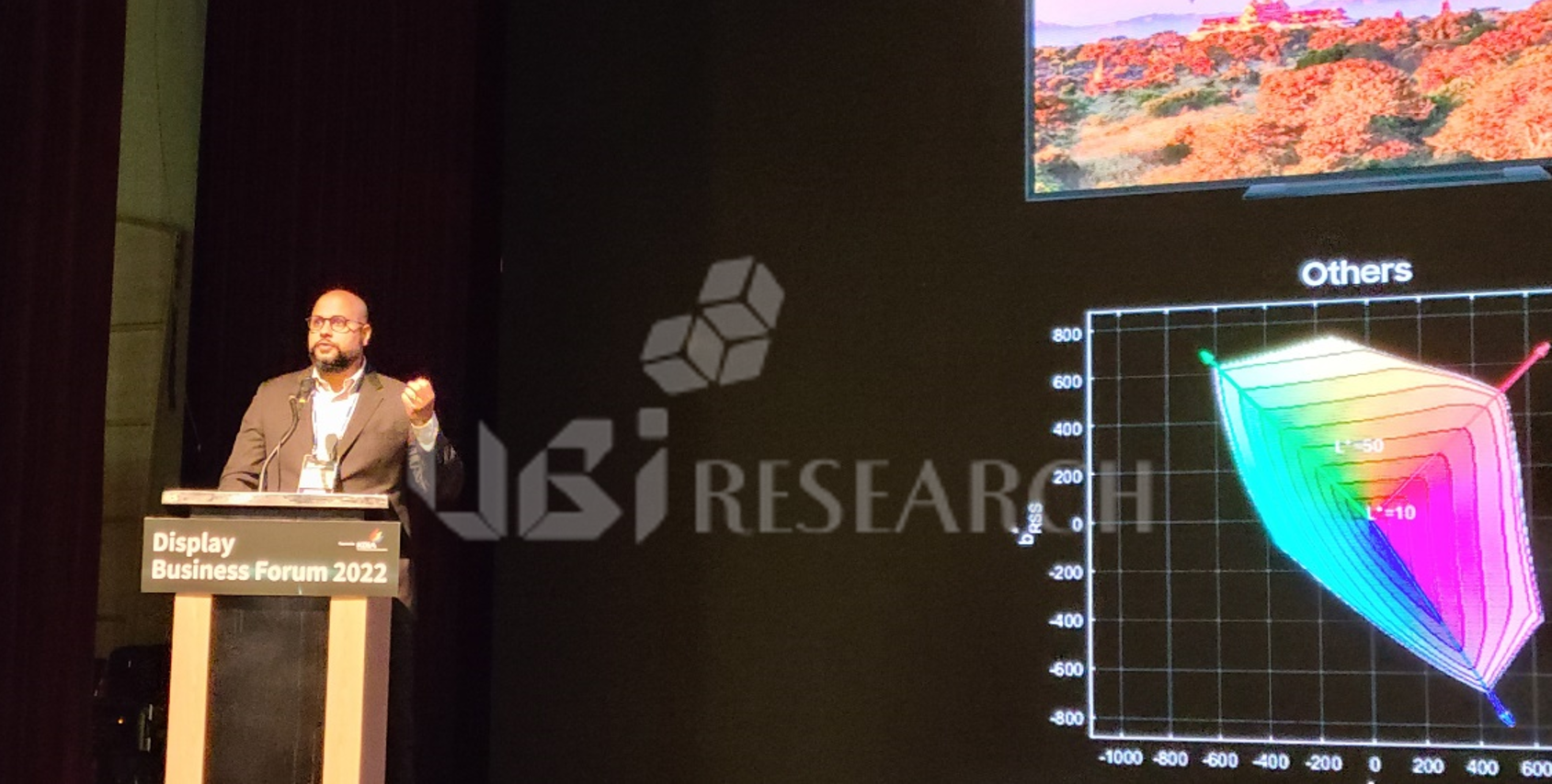
At the ‘K-display 2022 Business Forum’ held at COEX in Samseong-dong from Aug 11 to 12, Samsung Display’s Vice President Seon Ho and Marketing Team Manager Shah Chirag gave a keynote speech, ‘QD-OLED: Redefining Your Visual Experience’.

Vice President Seon Ho said, “As the COVID-19 situation has passed, online communication has become more active, and the era has come when daily life is done through displays.” He continued, “If the focus has been on increasing the size of the display so far, the display in the future will pursue better picture quality. Samsung Display is aiming for a display that has excellent color volume and purity, expands HDR, and does not change color depending on the viewing angle. QD-OLED will be the new standard for displays in pursuit of better picture quality.”

Marketing Team Manager Shah Chirag

Marketing Team Manager Shah Chirag

Shah Chirag presented, “QD-OLED is currently the display that can display the color closest to nature.” Samsung Display’s QD-OLED supports more than 125% of DCI-P3 and more than 90% of BT2020 color gamut due to the characteristics of quantum dots.

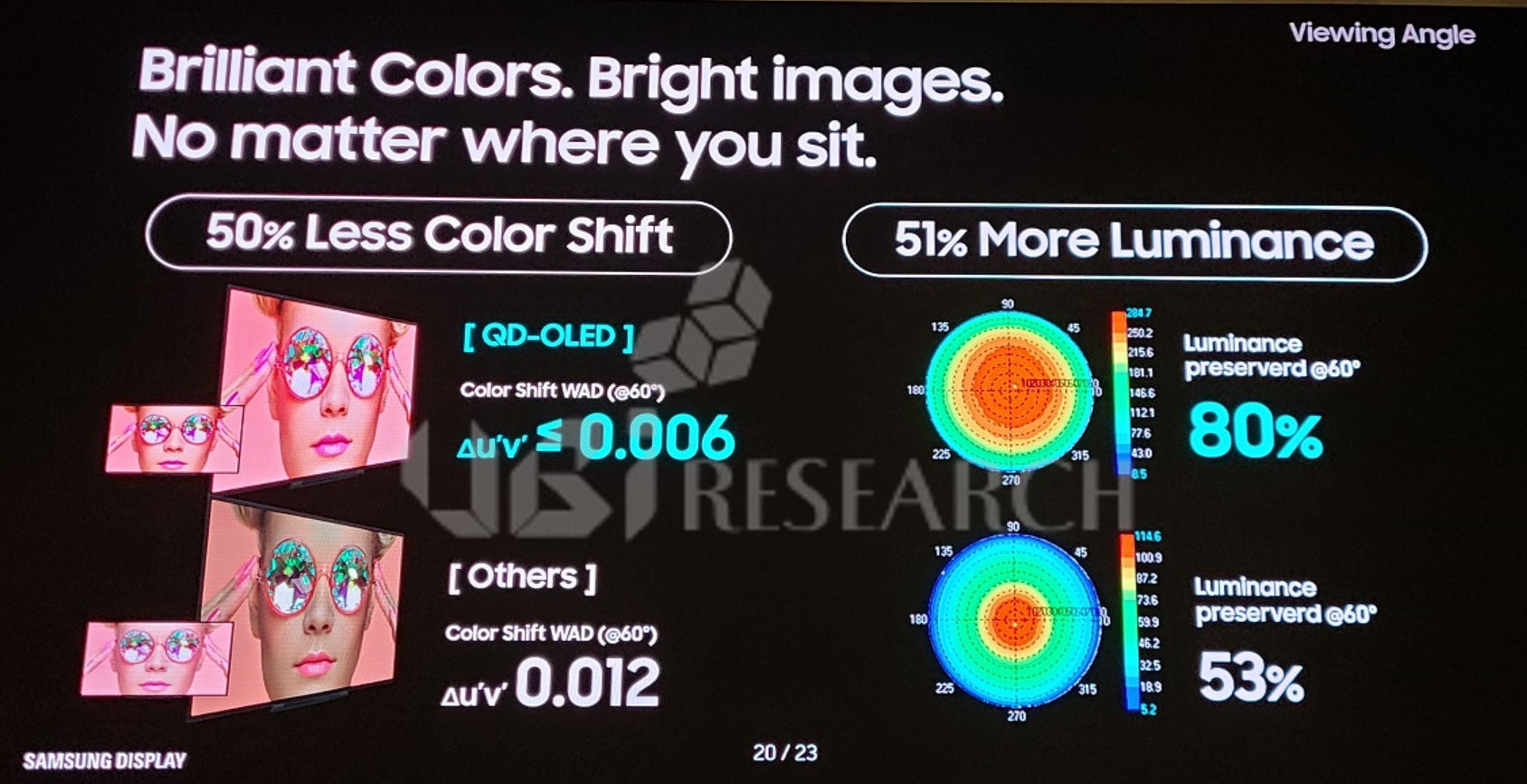
Shah Chirag also mentioned the excellent viewing angle characteristics of QD-OLED. He further explained, “Unlike general displays that have different colors or brightness depending on the viewing position, QD-OLED shows 50% improved luminance and color characteristics compared to conventional displays at a viewing angle of 60 degrees.”

excellent viewing angle characteristics of QD-OLED

excellent viewing angle characteristics of QD-OLED

Lastly, Vice President Seon Ho concluded with, “It has been half a year since QD-OLED TV came out as a set, and Samsung Electronics and Sony are selling them. Next year, we will continue to strive to create brighter and clearer displays so that more products can be launched in Korea. I hope the display industry develops in a better direction.”

Samsung Display mainly exhibited QD-OLED TVs at K-display 2022. Samsung Display has mass-produced QD-OLED panels since the end of last year. The production capacity is 30,000 sheets per month and the products produced are 55- and 65-inch TV panels and 34-inch monitor panels.

▶ OLED Display Report Sample Download

삼성디스플레이 QD-OLED

[K-Display 2022] Samsung Display’s QD-OLED

Samsung Display unveiled QD-OLED for the first time in Korea.
It is unfortunate that the camera cannot capture the advantages of QD-OLED, but I hope you enjoy it.

▶ UBI Research official website
https://ubiresearch.com/en/

▶Business, display report inquiry
marketing@ubiresearch.com
+82-2-577-4391

▶If you are curious about the latest news related to OLED?
https://en.olednet.com/

Fierce Price Competition Amongst WOLED TVs, QD-OLED TVs, and Neo QLED TVs

We experienced fierce price competition in the first half of 2022 among premium TVs with a launch price of $2,000 or more. It will be interesting to see how the Amazon Prime Day event scheduled for July will affect TV prices.
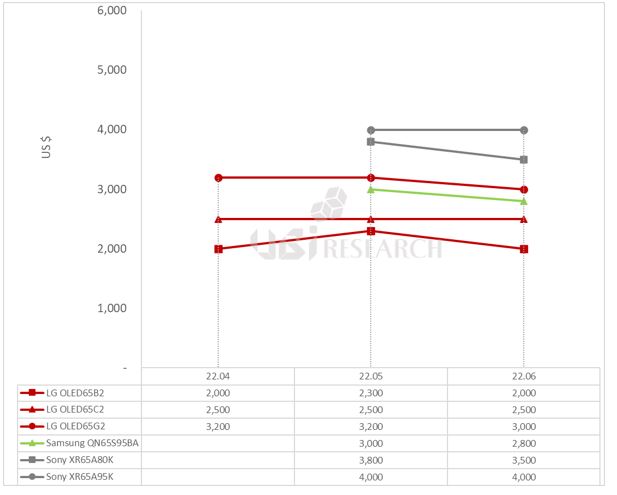
2022 OLED TV prices until June 2022 was analyzed based on 65 inch TVs. The standard was the selling price on Bestbuy.com and Sony’s QD-OLED TV selling price on their official website.
LG Electronics’ WOLED TVs B2, C2, and G2 released in March were $2,300, $2,500, and $3,200, respectively. Samsung Electronics’ QD-OLED TV S95B was $3,000. Sony’s WOLED TV A80K was priced at $3,800 and QD-OLED TV A95K was priced at $4,000.

In June, the price of LG Electronics’ G2 model fell by $200, forming a price difference of $500 for each series. Samsung Electronics’ S95B model continues to maintain a price difference of $200 lower than LG Electronics’ high-end model G2. Sony lowered the price of the WOLED TV A80K by $300, while maintaining the price of QD-OLED TV A95K.
Samsung Electronics’ S95B and LG Electronics’ high-end OLED TV G2 are in heavy price competition. Sony is setting the price of QD-OLED TV higher than WOLED TV.
The price competition is also fierce between OLED TVs from each set makers and Neo QLED TVs with Samsung Electronics’ mini-LED technology.
As of June, the prices of Samsung Electronics’ 4K Neo QLED TVs, QN85B, QN90B, and QN95B, are $1,800, $2,600, and $3,300, respectively. The 8K Neo QLED TVs QN800B and QN900B are $3,300 and $4,800.

The prices of Samsung Electronics’ 4K Neo QLED TV series and LG Electronics’ 4K OLED TV series are similar. Within Samsung Electronics’ entire TV series, QD-OLED TV is located between 4K Neo QLED and 8K Neo QLED. Sony’s OLED TV series, which is highly evaluated in terms of picture quality, is competing in price with Samsung Electronics’ 8K Neo QLED TV series.
Although this price trend is expected to continue this year, aggressive marketing following the Amazon Prime event in the second half of the year and the Qatar World Cup is expected to be strong variables. Attention should be paid to how LG Electronics’ OLED TV with micro lens array technology, which is expected to be released next year, will affect the premium TV market in the future.

What is the future change of WRGB OLED to respond to QD-OLED?


2As Samsung Display’s QD-OLED begins to be applied to TVs and monitors in earnest in 2022, technological changes are being detected for LG Display’s WRGB OLED, which has been leading the large OLED market.

LG Display’s WRGB OLED has produced a WBC structure consisting of two blue layers and one red+yellow green layer in Paju by the end of 2021, and a WBE structure consisting of two blue layers and one red+green+yellow green layer in Guangzhou. Deuterium substitution technology was applied to the blue of the WBE structure.

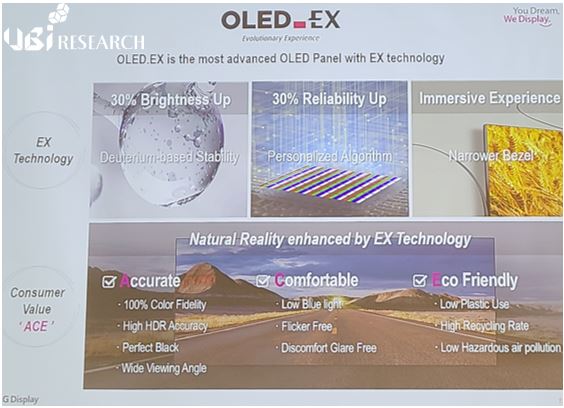
Since 2022, LG Display has stopped producing WBC panels from its Paju line and has been producing ‘OLED.EX’ panels with deuterium substitution technology applied additionally to green of WBE produced in Guangzhou.

<Photo of OLED.EX presented by LG Display at the 2022 OLED Korea Conference>

At SID 2022, LG Display also exhibited a large OLED panel with micro lens array technology. Micro lens array technology was applied to Samsung Electronics’ ‘Galaxy S Ultra’ series, and it is the first technology applied to large OLEDs. LG Display is known to expect a 20% improvement in luminance compared to the previous one by applying micro lens array technology. Panels which micro lens array technology is applied are expected to be produced in Paju from the second half of this year.

Lastly, it is known that LG Display is developing a structure in which yellow green is removed from WRGB OLED. By eliminating yellow green, material and processing costs can be saved, and color gamut is expected to be improved.

Attention is paid to how LG Display’s WRGB OLED will evolve to compete against QD-OLED.
<OLED panel with micro lens array technology exhibited by LG Display at SID 2022>

[SID2022] Samsung Display Tour 2 Display Week 2022

[SID 2022] Samsung Display Booth Display Week 2022

LG Display Achieves Record Sales in 2021, Swinging a Profit after Three Years

As LG Display posted the highest sales ever, at the same time it also made a sharp pivot into a profit for the first time in three years. On the 26th, LG Display announced that it had achieved annual sales of 29.878 trillion won and operating profit of 2.23 trillion won in 2021. “This is the result of the large-sized OLED panels in the premium market, the strengthening of the small and medium-sized OLED business base, and the innovation of LCD structures centered on IT products,” LG Display goes on the explain. While the overall TV market experienced negative growth last year, LG Display led the large-sized OLED business. OLED TV panel shipments grew by more than 70% compared to the previous year, which turned to profit in the second half of the year. This helped reach a break-even point.

Following the previous year’s earnings announcement, LG Display stated, “This year, we plan to expand profitability in stages based on shipment growth of more than 20% compared to the previous year and strengthened business capabilities,” and “From the second quarter, ‘OLED.EX’ will be applied to all OLED TV panel series to accelerate the trend toward OLED in the premium TV market.” OLED.EX is a TV panel that increases screen brightness (luminance) by 30% and reduces bezel by 30% by applying ‘deuterium technology’ and ‘personalization algorithm’ to organic light emitting devices. These are the core elements of OLED picture quality. In the case of small and medium-sized OLEDs, the mobile sector plans to improve profitability by expanding new models and high-end products in the second half of the year and expand to the overall mobility industry. The LCD division will continue its strategy of selection and concentration focusing on IT products.

LG Display also expressed confidence in Samsung Display, which has emerged as a new competitor in the OLED market. When asked about LG Display’s competitiveness compared to Samsung Display’s QD-OLED, Large-Scale Marketing Manager Lee Tae-Jong remarked, “Our competitor’s products have not been released yet, so an accurate comparison will be possible only after the actual launch.” He continued, ”LG Display, which has been in business for more than 10 years is far superior in our overall competitiveness in our products and cost, economies of scale, and customers. We will continue to widen the gap in the future.”

Samsung Display’s QD-OLED Applied to Sony’s TV and DELL’s Monitor

QD-OLED panels, which are being mass-produced from the second half of 2021 at Samsung Display, will be applied to new products for Sony and DELL.

First, Sony announced A95K, the first TV with QD-OLED in its 2022 TV lineup. A95K is available in 55-inch and 65-inch models, featuring 4K resolution and a refresh rate of 120 Hz.

    <Sony’s QD-OLED TV ‘A95K’, Source: electronics.cony.com>

Meanwhile, Samsung Display’s QD-OLED is also applied to DELL’s 34-inch gaming monitor. DELL’s ‘Alienware AW3423DW’ monitor has a 34-inch size, 3440 x 1440 resolution, a refresh rate of 175 Hz, and a response speed of 0.1 ms. In addition, the monitor supports ‘DisplayHDR 400 True Black’. DELL said it will start selling around March 2022.

As Samsung Display’s QD-OLED enters the TV and IT markets, it is expected to compete fiercely with LG Display’s WRGB OLED and JOLED’s RGB inkjet printing technology in the existing mid-to-large market. Many have a huge interest as to which company’s technology will become the main technology in the mid- to large-sized market in the future.

Samsung Display begins mass production of QD-OLED in the fourth quarter of 2021

Samsung Display begins mass production of QD-OLED in the fourth quarter of 2021, a new growth opportunity in the large OLED market

Samsung Display is planning to start mass production of QD-OLED in earnest from the fourth quarter of 2021. The mass production scale is 8.5G 30K/month, and it is expected to be mass-produced mainly for 65-inch 4K resolution panels. Since three 65-inch panels can be produced in the 8.5th generation, about 1 million panels are expected to be mass-produced annually.

At the closing seminar held in the second half of 2020, UBI Research predicted that Samsung Display’s QD-OLED will produce 200,000 units in 2021, 600,000 units in 2022, and 800,000 units in 2025. However, as Samsung Display announced in its second quarter conference call that it will also introduce a monitor product with a smaller QD display than a TV, production is expected to vary depending on the proportion of products..

If mass production begins in the fourth quarter, QD-OLED TV will be unveiled for the first time at the CES 2022 exhibition held in Las Vegas in 2022, and the product is expected to be officially released in the first half of the year.

Joo-seon Choi, president of Samsung Display, emphasized in a recently published sustainability report that “If QD displays are commercialized, new growth opportunities will be created in the large display industry, which has been stagnant for a long time.”

Attention is paid to how much influence Samsung Display’s QD-OLED mass production will have in the large OLED market led by LG Display.

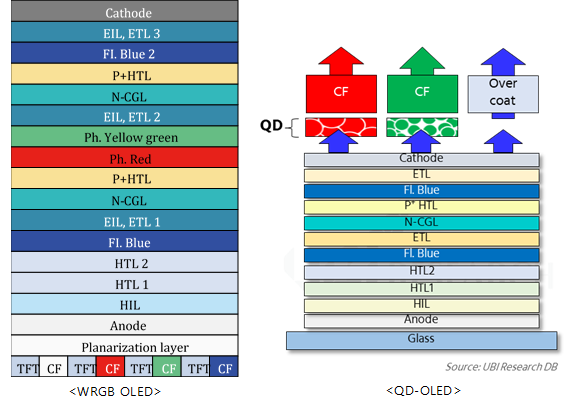
<Expected structure of QD-OLED, Source: UBI Research>

Middle and Large OLED sales growth of 40.2% in 2020

Although Samsung Display’s rigid OLED line is expected to decrease due to a decrease in Huawei’s volume due to the US production, demand for rigid OLEDs is expected to increase as demand for laptops, monitors and tablet PCs is increasing. To respond to this, investment in rigid OLED lines in A4 is also being reviewed. This year’s notebook OLED panel is expected to come out with more than 10 different model product lines, and Apple’s OLED production for iPad is scheduled to start from 2022, so demand for middle and large-sized OLED panels is expected to increase.

In addition, LG Display, a leader in P-OLED supplying in the automotive field, is planning to supply plastic OLEDs for automobiles to German car makers by producing premium OLED panels, and Samsung Display is also supplying OLED panels for vehicles.

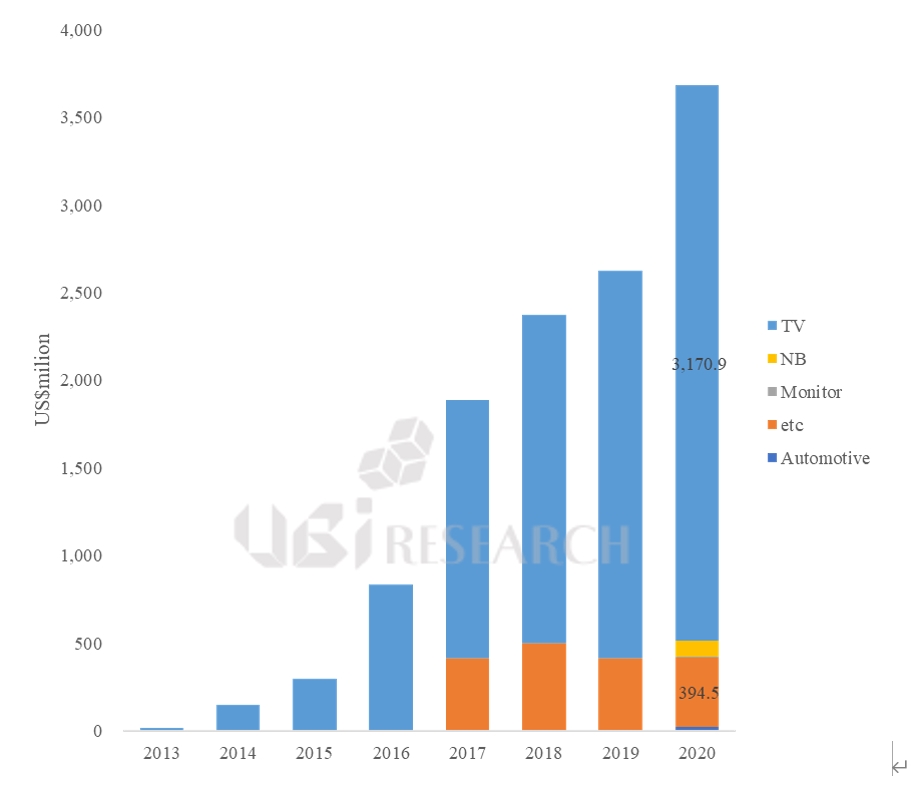
According to the 2021 middle and large OLED annual report published by UBI Research, the total sales of middle and large-sized OLEDs in 2020 was $3.882.7 million, and last year was $2.63 billion, an increase of 40.2% from the previous year. By application, the notebook and automobile markets have increased remarkably, and the notebook, monitor, and automotive product markets are expected to grow in 2021.

Samsung Display’s QD-OLED mass production is expected to be around December 2021, and 65-inch panels are highly likely to be used by Sony. Samsung Electronics is expected to receive only 32-inch QD-OLEDs for monitors, not purchasing 65 inches.

LG Display’s 2020 TV OLED panel shipments were counted to 4.4 million units, and if the Guangzhou plant operates at 90K from the third quarter, the production capacity will reach 8.5 million units in 2021.


Samsung’s QNED, will make a sensation in the TV and display markets?

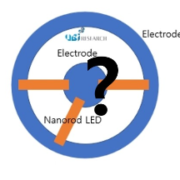
QNED (Quantum dot nanorod LED), which is known to be under development by Samsung, is becoming a hot issue in the display industry in 2020.

With the emergence of micro LEDs, followed by CRTs, PDPs, LCDs, and OLEDs as TV displays, the industry is interested in whether QNED could be another new technology.

Samsung Display is known to stop the LCD business and invest 13.1 trillion won as an alternative to do the QD-OLED business. In this situation, attention is being focused because the development of QNED can act as another variable in the future of Samsung Display’s large display business.

QNED uses oxide TFT and QD (quantum dot) -CF (color filter) technologies used in QD-OLED manufacturing. On the other hand, the pixel material that emits light is characterized by being changed to a nano-sized bar-type LED (nanorod LED), unlike OLED emitting materials. The pixel manufacturing technology, which is the core technology of QNED manufacturing, is a method of spraying nanorod LEDs dispersed in a solution into a pixel area by an ink jet method and arranging them in a self-align method by an electric signal.

UBI Research published a report that analyzed the structure and manufacturing technology of QNED based on the patented technology filed by Samsung Display. This report is structured to quantitatively analyze QNED-related patents filed by Samsung Display, so that QNED’s technology completeness and mass productivity can be known.

Samsung Display QD-OLED Investment Timing Forecast to Oppo?

Samsung’s LCD business, which began in 1991, will be suspended in 2021. Samsung’s LCD business is completely closed after a 30-year lifespan. Samsung foresaw the limitations of the LCD business 10 years ago and stopped investing in the 10G. Instead, Samsung Electronics has separated the LCD business to create a Samsung Display combined with Samsung SDI’s OLED and has been preparing for a new display era.

Samsung’s loss of LCD business can be estimated for two reasons. The first is the deterioration of profitability from China’s LCD over-investment, and the second is the transition to a new business with high added value.

Since the display is an essential product in the modern information society, demand is gradually increasing worldwide as the usage is increased. In addition, as the amount of information increases, the data to be expressed increases, so the display size must also increase. By these two factors, the display industry has the power to continue to develop. However, China’s LCD investments have continued to invest in large quantities over many years. In the wake of this, only two LCD companies in Japan, Sharp and JDI, remained, and the Korean LCD business also reached a point where it was necessary to organize the business due to deficits.

Samsung Display and LG Display have expanded the OLED business to respond to the low-priced panel of Chinese LCD companies, and have focused on producing OLEDs with the best image quality preferred by set makers with high brand power. Samsung Display already secured a market of $ 25.3 billion in the smartphone display business in 2019, and LG Display secured $ 2.2 billion in sales in the OLED market for TV last year.

Samsung Display has enjoyed tremendous sales and operating profit in the OLED business, but the LCD business has been in the red for several years. Samsung Display sells LCDs for monitors, mainly for LCDs for TVs, but has secured the optimal solution to replace them all as QD-OLEDs.

QD-OLED production, which Samsung Display started investing from this year, uses 8.5G equipment. This is because Samsung Display’s factory in Tangjeong is an 8.5G LCD line, which can reduce the cost of building an OLED production line. Samsung Display will produce 8K 65-inch QD-OLED panels at this plant starting next year. It also produces QD-OLEDs for 32-inch 4K monitors. Maintaining the TV and monitor panel business previously held by Samsung Display, profitability can be secured by selling expensive products.

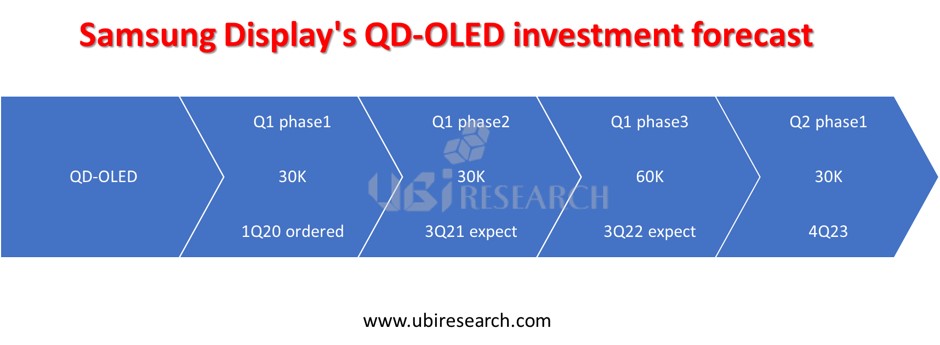
Samsung Display started investing in QD-OLED 30K in the existing 8.5G LCD factory, but the total investment is 120K. The remaining investment is 90K. Samsung Display’s additional investment is expected to change in size and timing depending on the QD-OLED production situation starting next year. If a yield of over 60% is secured from the beginning of production, the remaining 90K can be invested in next year. This is the most desirable timing. It can be used without leaving the LCD engineer. To prepare for this situation, all LCD lines must be removed by the first half of 2021. The next scenario is when the QD-OLED yield is less than 60%. In general, when the yield is low, the plant cannot be fully operated, so it does not require much manpower. Since additional investment is appropriate after securing the yield, it is a method of separating the investment, investing 30 ~ 60K, and then investing the remaining size later.

Nobody know what will happen next year, but Samsung Display is steadily taking a step forward to secure the future business.

The OLED emitting material market will grow to $ 1.9 billion by 2020

UBI Research(www.ubiresearch.com), a company specializing in OLED market research, predicted that the market for OLED emitting materials for 2020 will rapidly grow to $ 1.9 billion.

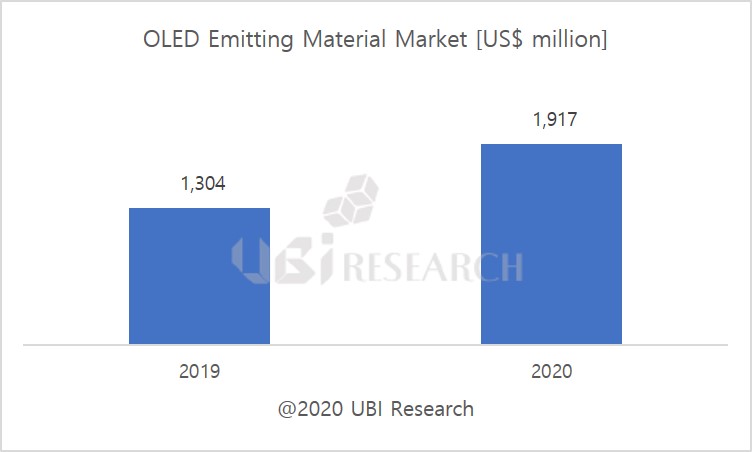
According to the OLED emitting material market track published by UBI Research every quarter, the emitting material market in 2019 was $ 1.304 billion, up 39.2% from 2018’s $ 0.937 billion market.

The reason for the growth of the emitting market in 2019 is proportional to the growth of the OLED panel market for smartphones. This is because OLED shipments for smartphones in 2018 were 407 million units, but growth was 16% in 2019 at 474 million units. (Source: UBI Research 2020 OLED Display Market Track).

The reason why the emitting material market growth is greater than that of the panel market is that 6G flexible OLED factories of Chinese panel makers have started operation. The production amount is still small, but the yield is low, so the input of the substrate is twice the amount of production, so the consumption of emitting materials is very high. In addition, it is one of the reasons that the market for emitting materials has grown due to the small purchase volume compared to Samsung Display.

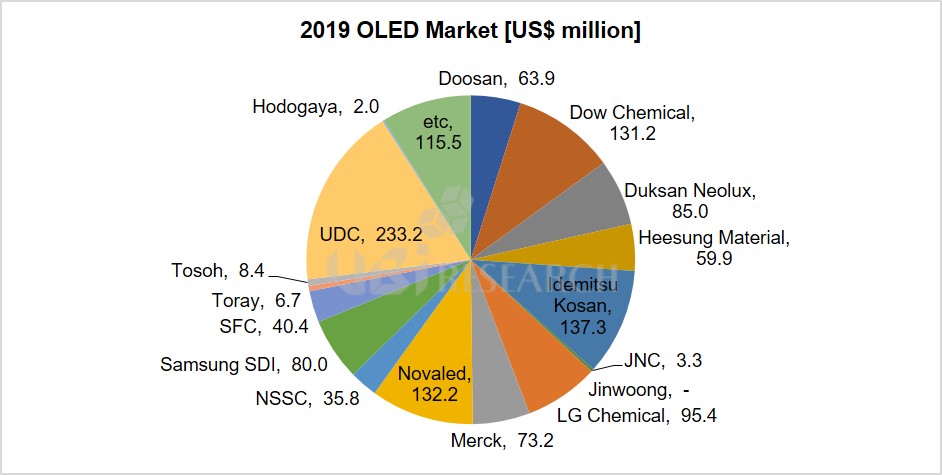
As a result of counting sales by emitting materials companies in 2019, UDC accounted for $ 233 million, accounting for 17.9% of total sales, and Samsung SDI accounted for $ 212 million (including Novaled sales), accounting for 16.2%.

In 2020, both panel makers’ capacity and utilization rate are expected to increase, and consumption of emitting materials is also expected to increase.

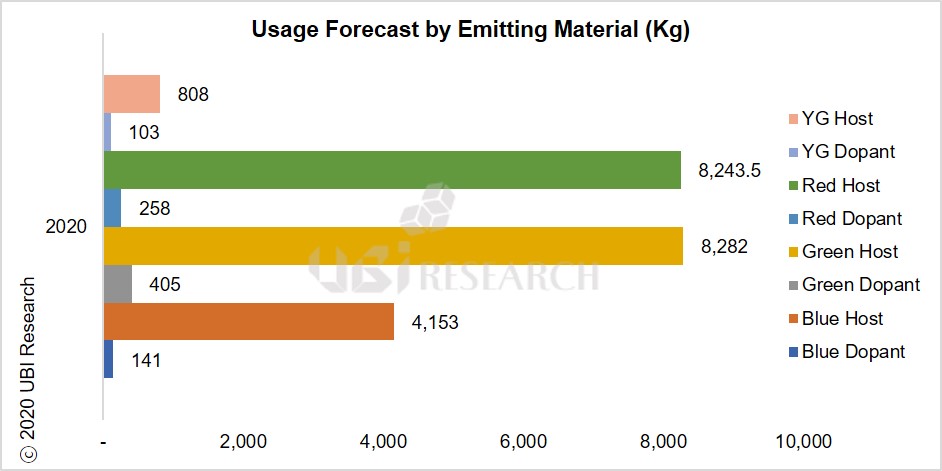
The total consumption of emitting materials in 2019 was 73 tons, but it is expected to increase to 102 tons in 2020.

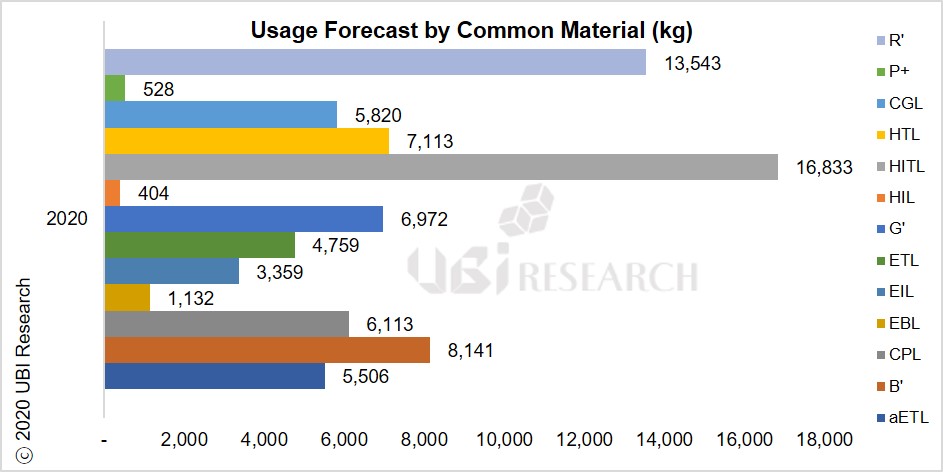
Expected consumption for each material is 16.9 tons for HITL materials and 4.15 tons for blue host materials. Blue host and dopant materials are expected to increase rapidly from 2021 when Samsung Display starts mass production of QD-OLED.

How much will be the investment cost for 8Generation QD-OLED TV?

In the “2018 OLED Equipment Report” recently published by UBI Research, the required investment cost was analyzed for the QD-OLED that Samsung Display started to develop.

QD-OLED, which is being developed by Samsung Display, is a method of displaying three colors of RGB by separating green and red from the light emitted from blue OLED through QD (quantum dot) material. The light passing through the QD material once again passes through the color filter and displays a richer color.

QD-OLED is similar to the manufacturing method of WDRGB OLED produced by LG Display. First, both companies use oxide TFTs. At WRGB OLED, blue is applied twice and red and green are deposited between them. In contrast, QD-OLED is fabricated by depositing only blue material twice. Both methods use the open mask with an empty center.

For both QD-OLED and WRGB OLED, the color filter manufacturing cost is assumed to be same; however, QD-OLED should be equipped with additional equipment to coat QD materials.

According to the report, it is expected that the investment cost is to be equal because the similar equipment can be used for module, cell, encapsulation and evaporator. Since WRGB OLED is bottom emission type, it is formed together when backplane is formed including TFT. However, QD-OLED adopts top emission method. A color filter is separately formed on the top glass substrate and the QD layer is patterned thereon. Therefore, QD-OLED requires higher investment cost than WRGB OLED.

The report describes that based on 8Generation 26K, the investment cost for QD-OLED is estimated to be US$ 1.1 billion, which is 1.03 times higher than WRGB OLED (US$ 1.07 billion). In contrast, the required investment cost to manufacture OLED by inkjet method, which JOLED is promoting commercialization, is projected as US$ 0.88 billion, which is to be about 80% of QD-OLED.

QD-OLED TV, is it to be the next generation premium TV?

Samsung Electronics is currently occupying the premium TV market with QD-LCD TVs, which use ‘PL-QD (photoluminescence quantum dot) technology’. This technology has a mechanism in which the material stimulated by external light re-emits light.

The operating profit of the consumer electronics division (CE), which controls QD-LCD TVs, fell more than Korean won 1 trillion in last year and the operating profit ratio was only 3.6%.

On the other hand, LG Electronics’ HE business division achieved a record operating profit of Korean won 1,566.7 billion and an operating margin of 8.1% through OLED TV. Sony also turned its operating profit into a surplus by quickly taking over the premium TV market with OLED TV.

OLED TV has had a positive effect in driving corporate sales growth.

Samsung Electronics has been developing EL-QLED, with EL-QD (electroluminescence quantum dot) technology, to increase its market share in the premium TV market. However, efficacy, lifetime and mass production technology of quantum dot, which is the material of QLED, is not yet secured.

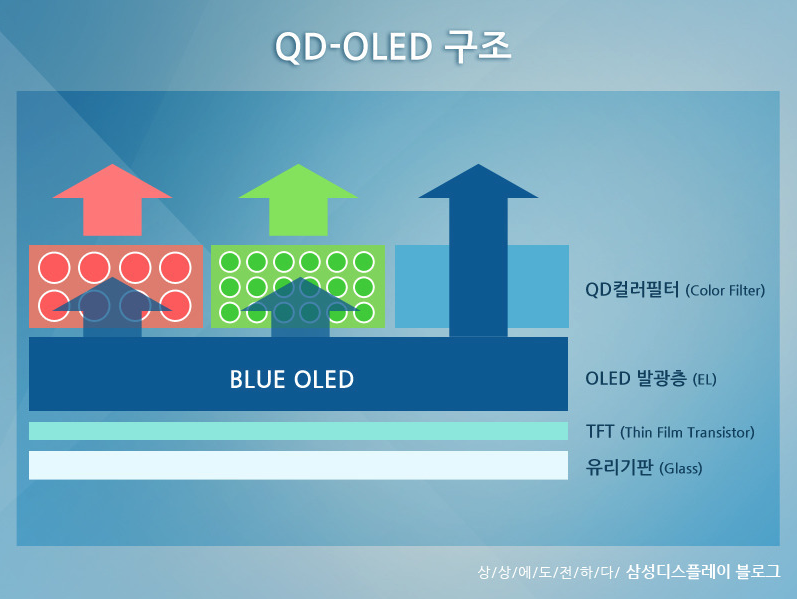
Recently, QD-OLED TV technology, which uses blue OLED as a light source and that implements red and green colors through a quantum dot color filter (QDCF), is attracting attention.

<Expected structure for QD-OLED, Source: Samsung Display Blog>

By using QDCF, it is possible to easily make desired colors by adjusting the size of the QD material and improve the color reproduction rate. This is because the color gamut is enlarged to BT2020, so it is close to natural color and it is possible to deliver vivid picture quality more clearly. In addition, QD-OLED TV has a top emission structure, which makes it easy to secure the aperture ratio, thereby improving resolution and screen uniformity.

However, in QD-OLED TV, there are various problems to be solved such as lifetime and efficiency of blue OLED, and technology of ink-jet printing process. Given that the industry is still in the early stages of reviewing the business possibility, QD-OLED TVs are expected to go into mass production after 2020.

Attention is focused on the QD-OLED TV’s entry into the premium TV market and its impact.