Posts

Sony Honda Mobility presentation slide showing Afeela's interior features like Rich Cluster and Dynamic Wallpapers.

Sony Honda Mobility’s vision unveiled at CES 2026 Media Day: The future of mobility as envisioned by Afeela

At CES 2026 Media Day press conference in Las Vegas on January 5th, Sony Honda Mobility reiterated its long-term vision of transforming mobility from a simple means of transportation into a “Creative Entertainment Space.” Sony Honda Mobility, a joint venture between Sony Group and Honda, shared updates on the development of its first mass-produced model, the “AFEELA 1,” and its future roadmap.The company announced that the vehicle is currently in the pre-production phase, with customer deliveries scheduled to begin in California in 2026, followed by expansion to Arizona and other regions in 2027.  They also unveiled the “AFEELA Prototype 2026” as a world premiere, showcasing the design and technological direction for a potential mass-produced model in the US around 2028.  Sony Honda Mobility reaffirmed its plan to adopt a next-generation automotive architecture based on Qualcomm’s Snapdragon Digital Chassis and introduced the “AFEELA Co-Creation Program,” which opens development documentation to external creators to expand the in-car entertainment content ecosystem. They also mentioned plans for an on-chain mobility service platform utilizing token-based incentives, suggesting the possibility of a new service economy model centered around automobiles. At the CES exhibition, various color options of the AFEELA 1 pre-production vehicle and concept models were displayed, emphasizing Sony Honda Mobility’s identity with key keywords such as autonomous driving, augmentation, and human-centered design (Affinity).

Presentation of Afeela's digital cockpit and key features at the CES 2026 Media Day press conference

Sony Honda Mobility presents the Afeela infotainment system and digital cockpit vision at CES 2026 Media Day. (Source: SHM)

A particularly noteworthy aspect of this announcement was the in-car display and infotainment system, presented as a key differentiating factor of the Afeela platform. While the official CES 2026 press release did not disclose specific display specifications in detail, the Afeela interior is designed with multiple digital displays tailored to the location and purpose of each driver and passenger, providing an environment where various applications and video content can be freely utilized. According to industry and media reports, the Afeela vehicle aims for an interior “swimming in displays,” focusing on personalized UI and diverse entertainment experiences. In particular, LG Display has officially stated that the mass-produced Afeela vehicle will feature an approximately 40-inch pillar-to-pillar (P2P) display spanning the entire dashboard, symbolically demonstrating the evolution of in-car displays from simple information displays to immersive interfaces. This large, integrated display integrates the driver’s instrument panel, navigation, and passenger entertainment area into a single continuous screen, representing an attempt to redefine the car interior as a single digital space. Furthermore, Afeela directly incorporates Sony’s strengths by supporting PlayStation Remote Play, allowing users to stream PS4 and PS5 games within the vehicle. This is a clear example of Sony Honda Mobility’s strategy to expand the vehicle into a mobile entertainment platform.

In summary, the message conveyed by Sony Honda Mobility and the Afeela project at CES 2026 clearly demonstrates that the automotive industry is moving away from hardware-centric competition and towards a “software-defined mobility” era where software, displays, and content are integrated. According to Changwook Han, Executive Vice President of UBI Research, “The Afeela electric vehicle is the result of an attempt to redesign the user experience, going beyond driving performance and traditional vehicle specifications, focusing instead on large displays and an entertainment ecosystem. This is a symbolic example of the combination of Sony’s content and digital capabilities with Honda’s automotive manufacturing expertise.” He continued, “Afeela is less of a single electric vehicle and more of a platform that transforms the vehicle’s interior into a digital experience space.” He predicted that this direction would shift the axis of differentiation in the premium electric vehicle market from driving performance to the digital cockpit experience, and that it would also likely bring about a certain level of impact and change to the overall automotive display industry in the medium to long term.

Changwook Han, Executive Vice President/Analyst at UBI Research (cwhan@ubiresearch.com)

▶2025 Automotive Display Technology and Industry Trends Analysis Report

※ This article is produced by UBIResearchNet.
Unauthorized reproduction or citation without source attribution is prohibited.
When quoting, please clearly indicate the source (UBIResearchNet) and provide a link.

Sony Honda Mobility to integrate Micro LED media bar into Afeela EV in 2026

Sony Honda Mobility to Implement Micro-LED Media Bar in Afeela by 2026… New Revenue Strategy Combining Subscription Models

Sony Honda Mobility (SHM) will be incorporating a micro-LED-based Media Bar into its Afeela electric vehicle, slated for release in 2026. The Media Bar, a display mounted on the front of the vehicle, can display a variety of information, including charging status, weather, welcome messages, and driving modes. It also offers customized communication features through animations and themes. It is considered a new experiment in the automotive industry, as it goes beyond a simple instrument panel or infotainment screen to visually express the vehicle’s “emotions and personality.”

Micro-LED media bar on the front of Sony Honda Mobility’s Afeela EV (Source: Sony Honda Mobility)

Afeela EV front view with Micro-LED media bar (Source: Sony Honda Mobility)

The problem lies in manufacturing costs. Currently, the production cost of micro-LEDs is nearly ten times higher than the automotive industry’s expectations. Even smartwatches and ultra-small displays are still prohibitively expensive to commercialize, and modules in the tens of inches required for vehicle fronts are even more expensive. Nevertheless, SHM’s decision to adopt micro-LEDs for the Afleea stems from strategic considerations. First, micro-LEDs are superior to conventional OLEDs and LCDs in terms of high brightness, durability, transparency, and design flexibility. They can deliver clear information even in outdoor driving conditions, and their long lifespan makes them ideal for exterior vehicle displays. The technological symbolism is also significant. By combining Sony’s display technology with Honda’s automotive brand image, the company aims to position the Afleea as a differentiated premium electric vehicle.

A more fundamental reason lies in its connection to the software subscription business. The automotive industry has recently evolved into a software-defined vehicle (SDV), offering driver assistance systems, infotainment, navigation, and connectivity features on a subscription basis. BMW, GM, Ford, and Tesla are already building new revenue models by converting some features to monthly subscriptions, and the global market is experiencing double-digit annual growth. SHM also plans to offer Afleea’s infotainment and driver assistance software as a subscription service, and by linking it with Media Bar, it aims to offer a differentiated subscription experience.

For example, Media Bar themes and animations can be expanded beyond basic functionality through a premium subscription model. Seasonal themes, brand-affiliated content, personalized designs, and social network integrations offer ongoing value for users. As the vehicle’s exterior itself becomes a means of communication, a new revenue model of “vehicle software subscription + Media Bar content subscription” becomes possible. This structure can offset the initial burden of implementing expensive micro-LEDs in the long term. In other words, it goes beyond hardware investment and enables ongoing service revenue generation based on this technology.

While the automotive industry has historically generated most of its revenue at the time of vehicle sales, the convergence of hardware, software, and services will become key in generating long-term revenue. SHM’s bold adoption of a micro-LED media bar in the Afleea is not simply a show of technology, but rather a strategic move to secure a new business model combined with software subscriptions. It reflects their confidence that, despite the high hardware investment and risk involved, they can secure profitability in the long term by combining it with subscription services.

When the Afleea hits the market in 2026, consumers will not simply be presented with an electric vehicle, but a new mobility platform offering a personalized, subscription-based display experience. This is likely to serve as a key benchmark for other automakers. It remains to be seen whether SHM’s decision will catalyze the expansion of subscription models in the automotive industry, despite the high cost structure.

Changwook Han, Executive Vice President/Analyst at UBI Research (cwhan@ubiresearch.com)

▶2025 Automotive Display Technology and Industry Trends Analysis Report

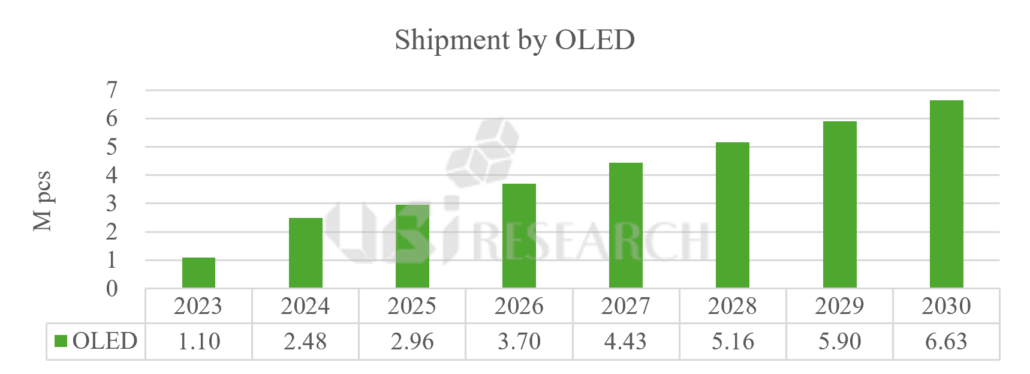
OLED Automotive Display Shipments to Hit 2.48 Million Units in 2024: Up 126% YoY

In the ‘2025 Automotive Display Technology and Industry Trends Analysis Report’ by UBI Research, various technologies, companies, and market trends of automotive displays were introduced. In 2024, global shipments of automotive display panels reached 236 million units, an 8.3% increase from the previous year. It is expected to reach 241.8 million units in 2025. In 2024, OLED panel shipments reached approximately 2.48 million units, an increase of 126% from the previous year.

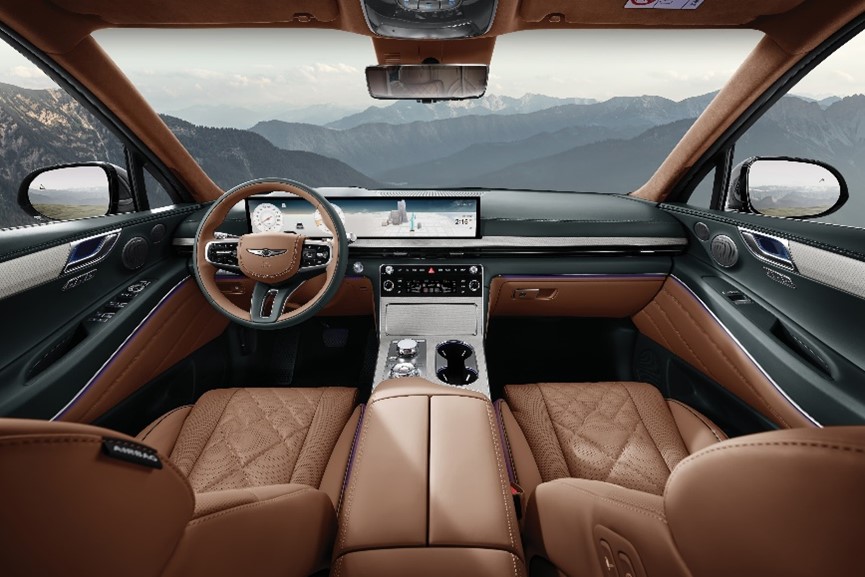
This is because OLED displays can contribute to the sophistication and efficiency of vehicle interior design, so OLEDs are actively adopted, especially in premium cars. Hyundai Motor Company’s Genesis GV80 vehicle, released last year, applied a 27-inch OLED display produced by LG Display. In addition, Nio, a Chinese EV car manufacturer, will adopt a 15.6-inch OLED and a 14.5-inch OLED display for passengers in its 2025 ET9 model.

27-inch OLED mounted on Genesis GV80 (source: Hyundai Motor Company)

27-inch OLED mounted on Genesis GV80 (source: Hyundai Motor Company)

As the entertainment use of vehicle displays increases, LCD displays are increasingly adopting Mini-LED with local dimming to provide a contrast ratio similar to OLED. In 2024, Mini-LED panel shipments was more than double to 3.4 million units compared to the previous year. Sony Honda Mobility’s electric vehicle, AFEELA, to be released in 2026, will use a 40-inch Pillar-to-Pillar Mini-LED display provided by LG Display.

“Software-defined vehicles (SDVs) require high resolution, low power, AR, and multi-display performance, and they require real-time data provision and optimized user experience. Accordingly, the adoption of OLED displays suitable for this will continue to expand, and vehicle OLED panel shipments will reach approximately 3 million units in 2025,” said Chang Wook Han, Executive Vice President of UBI Research.

Chang Wook HAN, VP/Analyst, UBI Research(cwhan@ubiresearch.com)

▶2025 Automotive Display Technology and Industry Trends Analysis Report