Posts

View of the topped-out factory structure of Anhui Hongxi (Metaways) for OLEDoS production.

Sunic System to Supply Mass-Production Deposition Equipment for China’s Accelerating 12-Inch OLEDoS Investment, Signing Supply Agreement with Anhui Hongxi Weixian Technology

Metaways' Wholly-Owned Subsidiary (12-inch OLEDoS) Officially Topped Out" ceremony, where Sunic System's equipment will be installed

Metaways’ Wholly-Owned Subsidiary (12-inch OLEDoS) Officially Topped Out! Sunic System’s equipment is set to be installed here. (Source: Metaways)

Sunic System, a Korean OLED deposition equipment company, has signed a contract to supply deposition equipment for mass production of Micro OLED (OLED on Si, OLEDoS) displays with Chinese microdisplay manufacturer Anhui Hongxi Weixian Technology Co., Ltd. (安徽宏禧微显科技有限公司). This is interpreted as evidence that the ultra-high resolution microdisplay market for XR/AR is moving beyond technology validation into the stage of building commercial mass production infrastructure.

According to Sunic Systems’ disclosure, the contract was signed on February 4, 2026, with a contract value of KRW 20.5758 billion (USD 14.2M). The contract period runs from February 4, 2026, to September 15, 2026, with delivery dates subject to mutual agreement between the parties. Payment terms stipulate 50% within 30 days after contract signing, 40% prior to shipment, and 10% via T/T after installation and inspection completion.

OLEDoS is a technology that deposits organic materials onto a silicon wafer-based backplane to achieve ultra-high resolution, high brightness, and low power consumption. It is gaining attention as a core display for next-generation devices such as XR/AR headsets and smart glasses. Particularly in OLEDoS manufacturing, the deposition process determines critical quality indicators (CTQs) like yield, uniformity, and stack stability. Therefore, the order for ‘mass-production deposition equipment’ is seen as a signal reflecting the customer’s commitment to transitioning their production system.

The background to this contract includes the investment by Anhui Hongxi, a subsidiary of the Metaways (Zhejiang Hongxi Technology) Group, and the local Chinese government in establishing a 12-inch OLEDoS production base. Metaways, as the group’s parent company, has been advancing OLEDoS technology and business, while Anhui Hongxi Micro-Display/Weixian is interpreted as the structure materializing through agreements with the local government in Anhui Province and project promotion entities. According to the publicly announced Chinese announcement, the company signed a 12-inch OLEDoS project investment agreement with the Chuzhou City government in Anhui Province, China, in August 2024. The first-phase investment amount was stated as 2 billion yuan. The agreement’s target goals include an annual production capacity of 72,000 12-inch wafers (72K) and an annual production value of 3 billion yuan, clearly indicating this is a CAPEX investment for mass production, not merely a pilot project. Chuzhou is a city in Anhui Province, and the project is reportedly being pursued within a local high-tech industrial park.

According to UBI Research’s analysis, the flow of actual equipment orders following the establishment of this ‘government-agreement-based CAPEX framework’ demonstrates that the Chinese OLEDoS ecosystem is rapidly transitioning and expanding to 12-inch-based OLEDoS, alongside the swift introduction of core process (deposition) equipment.

From Sunic System’ perspective, this contract secures an additional reference for mass-production equipment for OLEDoS used in XR/AR. OLEDoS is an area with high panel manufacturing difficulty, where process stability, yield, and material/stack optimization act as entry barriers. Consequently, securing mass-production equipment orders not only contributes to short-term sales but can also serve as leverage for future additional CAPEX (line expansion/process scaling) and securing new customers.

This case is seen as a signal that China’s OLEDoS ecosystem is materializing through large-scale line construction based on government agreements and the introduction of core process equipment. Simultaneously, it demonstrates that Korean equipment suppliers are securing meaningful supply references within this trend.

Changho Noh,  Senior Analyst at UBI Research (chnoh@ubiresearch.com)

▶Pre-register for Display Korea 2026

▶XR Industry Trends and OLEDoS Display Technology & Industry Analysis Report

※ This article is produced by UBIResearchNet.
Unauthorized reproduction or citation without source attribution is prohibited.
When quoting, please clearly indicate the source (UBIResearchNet) and provide a link.
Sunic System’s Successful Demonstration of 1.1um Shadow Distance, High resolution up to 1500 ppi

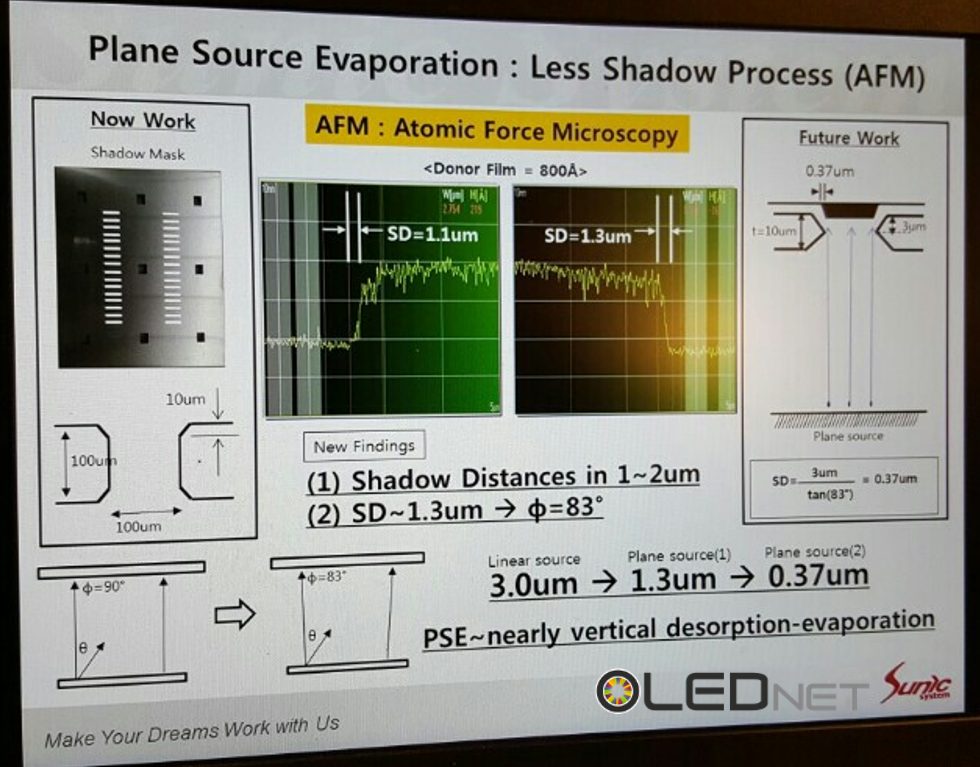
Sunic System announced at 2016 IMID Business Forum that it succeeded in implementing 1.1um shadow distance by using plane source evaporation and 100um shadow mask. 1.1um shadow distance is able to manufacture 1000ppi~1500ppi high resolution.

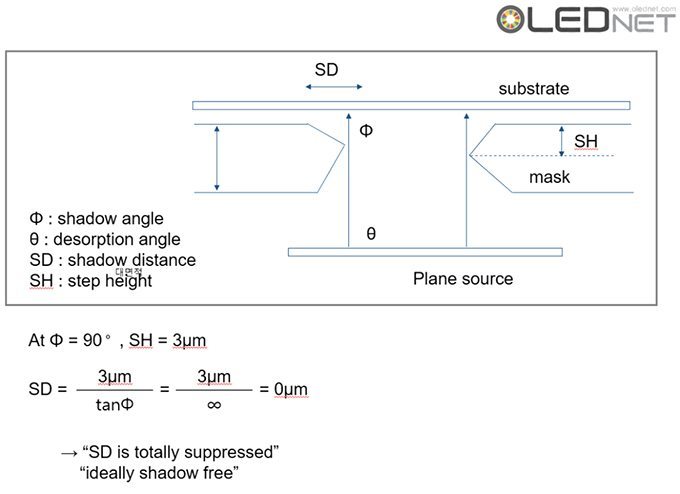
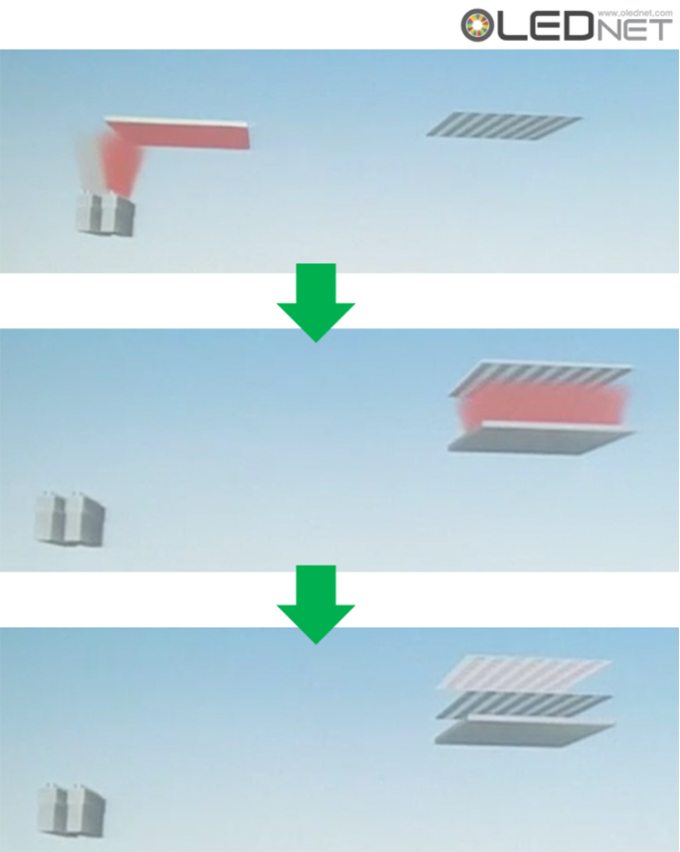
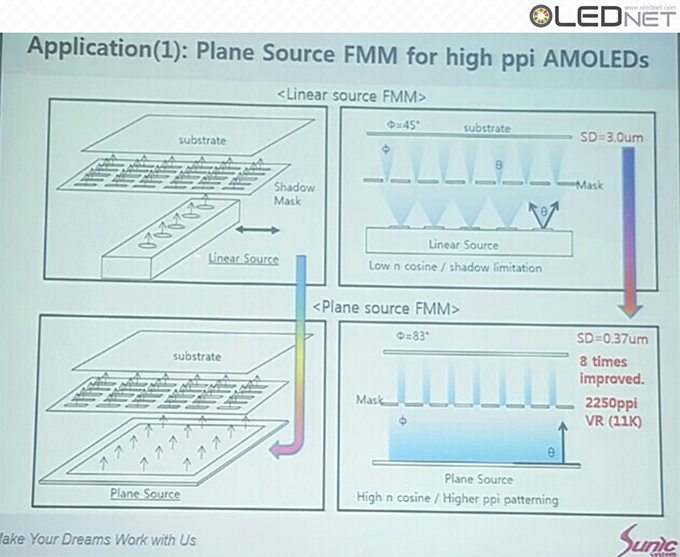
Plane source evaporation is a technology to evaporate OLED light-emitting material on metal plate, invert it, apply heat to the metal plate, and vertically evaporate OLED light-emitting material. When the shadow angle(Ф) of OLED light-emitting material evaporation is 90 degrees, the value of SD(Shadow distance, step height / tanФ) is zero (0) theoretically. So, it is possible to design thick and high resolution FMM, which means high-resolution AMOLED panel can be manufactured. This principle was announced for the first time at IMID 2016 Business Forum, attracting big attention.

Sunic System Dr. Hwang Chang-hoon said “If we lower step height up to 3um by reducing the thickness of shadow mask based on this result, 0.37um shadow distance would be possible, which means we can manufacture maximum 2250ppi(11K) high resolution AMOLED panel. Accordingly, we will put spurs to development of 0.37 shadow distance”.

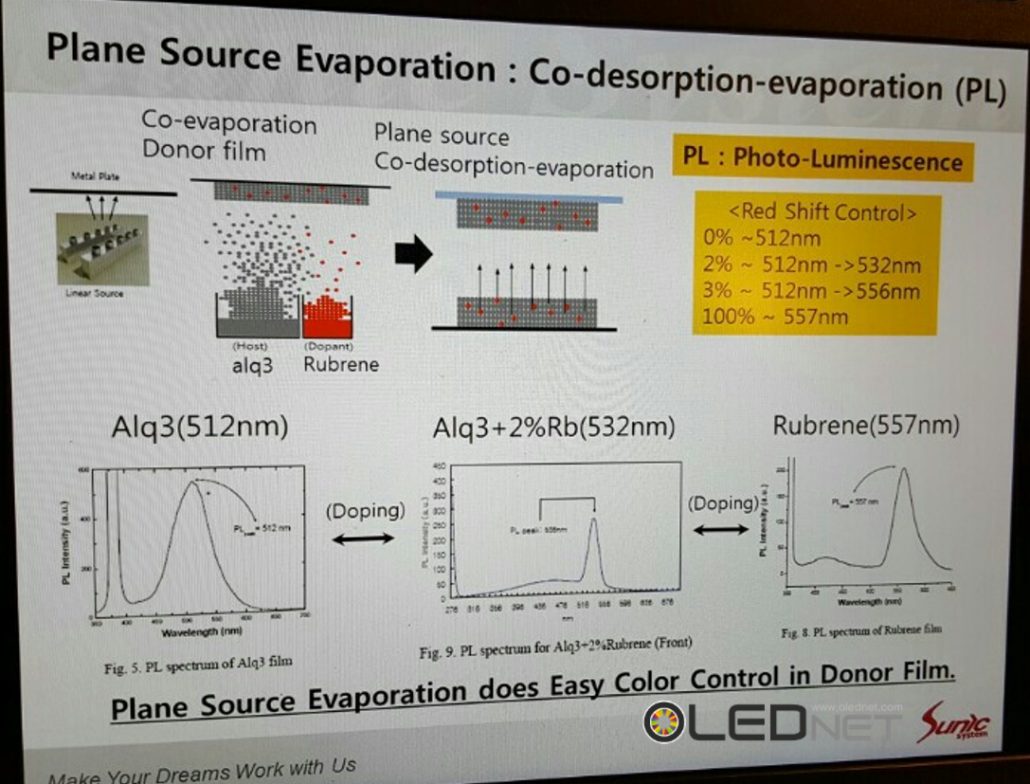
Also, he announced that co-evaporation of host and dopant that had been thought to be impossible in plane source has been resolved using flashing evaporation. He also proved that if donor film goes through flashing evaporation after co-evaporation of host and dopant, host and dopant can co-evaporate, and color control becomes easier by controlling dopant ratio to manufacture donor film.

<Result of Color Control after applying Flashing Evaporation>

<Result of 1.1um Shadow Distance>

Sunic System Suggests High Resolution 11K AMOLED Panel Solution through Plane Source

Sunic System’s solution for 11K (2,250 ppi) AMOLED production revealed in IMID 2016 held in Jeju ICC, South Korea is receiving much attention.

In the 2nd OLED Korea Conference held earlier this year, Samsung Display’s principal engineer Insun Hwang told the attendees that high resolution is the key in VR, and approximately 2,000 ppi is required for suitable realism. He explained that the resolution of VR falls as the distance between the user and display is short and this is an issue that needs to be solved.

The highest resolution of the current AMOLED panel for mobile device is 806 ppi, revealed by Samsung Display in SID 2016. The technology being applied to AMOLED panel mass production is evaporating OLED emitting materials through heat from linear source, and depositing the OLED emitting materials onto substrate through fine metal mask (FMM).

However, during the deposition stage of the OLED emitting materials, due to the distance between the evaporation source and FMM, thickness of FMM, and distance between FMM and substrate, incidence angle (θ) is produced. Due to the incidence angle, shadow distance (SD) is generated. Because of the SD issues, mask thickness and step height that minimize SD have to be decided, and these are the main reasons for the FMM production difficulty.

Plane Source Process, Sunic System IMID 2016

Plane Source Process, Sunic System IMID 2016

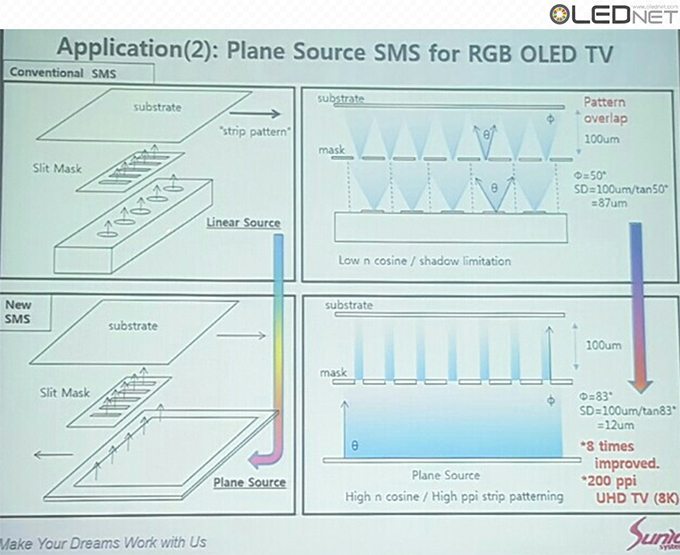
To solve these issues, Sunic System suggested plane source, instead of linear source, and reported that this will become a key technology for high resolution AMOLED panel. Plane source technology deposits OLED emitting materials on metal plate and vertically evaporates the materials through heat after reversing that metal plate. If OLED emitting material shadow angle (Ф) becomes 90, the SD (shadow distance, step height / tanФ) theoretically becomes 0. This means FMM can be designed to be thin and high resolution, allowing for high resolution AMOLED panel production.

Sunic System’s Dr. Chang Hun Hwang explained that plane source can reduce SD figure up to approximately 8 times compared to existing technology, and 11K (2250 ppi) AMOLED panel for VR use becomes possible. Through this 8K (200 ppi) RGB OLED TV panel production becomes possible in large area SMS evaporation technology.

Particularly, if plane source using SMS evaporation technology can be applied to large area, it is also expected to have significant impact on large area OLED panel production technology.

So far, inkjet printing technology applied solution process method has been mainly developed for RGB large area OLED panel production, but soluble OLED emitting materials’ performance fall short of existing evaporation OLED emitting materials. However, if plane source technology is successfully developed and applied, evaporation OLED emitting materials can be used. Accordingly, this could become large size OLED panel production technology that replaces solution process OLED.

Sunic System supplied Gen6 evaporator to LG Display, a first for a Korean manufacturing equipment company, and active mass production is expected to be possible from 2018.