Posts

Table comparing TCL's SQD-Mini LED technology with RGB Mini LED displays from Samsung and Hisense.

TCL defines SQD(Super Quantum Dot )-Mini LED as its flagship at CES 2026

At CES 2026, while Samsung Electronics and Hisense positioned RGB Mini LED as the top tier of their existing QLED lineup, TCL presented a diametrically opposed strategy, placing Super Quantum Dot (SQD)—an evolution of QD technology—at the core of its flagship offerings. This signals a shift in the competition within the LCD-based ultra-large premium TV market, which is expected to expand around RGB backlighting. It also marks a stage where the role and status of QD are being redefined.

Specification comparison table of TCL SQD-Mini LED (X11L), Hisense RGB Mini LED (116UX), and Samsung Micro RGB TV (130")

Comparison of TCL’s SQD-Mini LED flagship strategy against RGB approaches from Samsung and Hisense at CES 2026. (Source: UBI Research)

TCL’s decision to showcase SQD-Mini LED as its flagship at CES 2026 reveals an intent to redefine the very concept of QD. Whereas QD was primarily perceived as a “material that expands color gamut,” TCL has repositioned Super Quantum Dot (SQD) as the core technology responsible for ‘color purity and control stability’ as QD evolves toward high brightness and ultra-high zone-count local dimming.

As Mini LED TVs evolve with ultra-high zone-count local dimming and ultra-high brightness, phenomena like color blooming/color crosstalk at high-brightness boundaries become more sensitive, not just simple brightness bleed (halo). TCL has prioritized addressing this issue in its flagship models, proposing a solution combining SQD (High-Purity QD) + filter + color purity algorithms.

TCL positioned SQD-Mini LED not as a new technology, but as an extension of the Halo Control System introduced at CES 2025. At CES 2025, TCL defined Halo not as a single backlight issue, but as a systemic challenge requiring a holistic solution encompassing optical distance (OD), drive timing, backlight control precision, local dimming algorithms, and panel characteristics. The key change at CES 2026 is that while maintaining this framework, the flagship’s problem definition has been expanded to a dual challenge of “brightness blooming + color blooming.”

Diagram of TCL's Halo Control System technology designed to manage light bleeding and color blooming

TCL’s Halo Control System addresses picture quality issues by integrating backlight control with advanced optical structures. (Source: TCL)

What’s interesting is that TCL didn’t deny the RGB trend itself. TCL positioned RGB Mini LED as a high-end lineup beneath its flagship SQD-Mini LED. This approach directly impacts consumer experience. High-end TV buyers care not only about the impact of ‘peak moments’ but are more dissatisfied when quality falters during specific content (subtitles, night scenes, high-contrast edges, fast-moving sports/gaming scenes). TCL’s decision to anchor SQD in its flagship models is interpreted as a strategic choice to align with premium buyers’ psychology—prioritizing “minimum dissatisfaction” over “peak perceived quality.”

At CES 2026, LG Display emphasized that OLED TVs offer more stable control over light and color compared to LCD-based premium TVs. This highlights the awareness that as competition intensifies in high brightness and ultra-high zone-count local dimming, ‘consistency of control’ could emerge as the core premium value, surpassing ‘highest specs’.

The premium TV market is expected to evolve into a multi-front competition for some time, with RGB-based (LCD) models offering perceived impact, QD/SQD models emphasizing color purity and control stability, and OLED maintaining its self-emissive control advantage. Ultimately, the decisive factor will not be competition over single metrics (brightness, number of dimming zones), but rather how stably light and color are maintained across diverse content environments as experienced by consumers, thereby minimizing dissatisfaction risks.

Changho Noh,  Senior Analyst at UBI Research (chnoh@ubiresearch.com)

▶2025-2026 Beyond Mobile: IT OLED Technology and Industry Analysis Report

※ This article is produced by UBIResearchNet.
Unauthorized reproduction or citation without source attribution is prohibited.
When quoting, please clearly indicate the source (UBIResearchNet) and provide a link.

CES 2026: The Evolution of RGB Mini LEDs and Manufacturer Strategies

At CES 2026, RGB Mini LED emerged not as a single technology trend, but as a symbolic technology demonstrating the maturation of the premium TV market and the different approaches being adopted by each manufacturer. Amidst the existing competitive landscape centered on QD Mini LED and OLED, RGB Mini LED emerged as an attempt to go beyond the competition of “brightness and number of zones” and redesign the color production method and control structure itself. However, the significance of RGB Mini LED revealed at CES 2026 differed significantly across companies.


Samsung Electronics: Micro RGB Reshaping Neo QLED’s Flagship Position

Samsung Electronics redefined the pinnacle of its LCD premium strategy at CES 2026, highlighting its 130-inch Micro RGB TV. Micro RGB utilizes micrometer-sized RGB LEDs as backlights and employs a structure that independently controls R, G, and B. This approach differs from blue LED-based QD Mini LED (Neo QLED) in its color production method. Samsung’s Micro RGB is positioned not as a technology intended to directly replace OLED, but rather as a strategic technology to reclaim the ultra-large premium segment, where Neo QLED struggled to expand. Specifically, in the ultra-large market (100 inches and above), the company aims to redefine LCD’s strengths, such as high brightness potential and durability (avoiding burn-in concerns), as “ultra-premium,” while prioritizing color reproduction and control precision to reset the standard for the upper end of the premium market. Samsung has announced plans to focus on 130-inch displays, but expand to 55-, 65-, 75-, 85-, 100-, and 115-inch lineups by 2026, demonstrating its strategy to gradually expand Micro RGB beyond its flagship lineup.

Samsung Electronics' 130-inch Micro RGB TV unveiled at CES 2026

Samsung’s 130-inch Micro RGB TV, redefining the ultra-large premium market and positioning itself at the top of the Neo QLED lineup. (Source: Samsung Electronics)

LG Electronics: OLED for Flagship, Micro RGB evo for Ultra-Premium LCD

LG Electronics unveiled its RGB Mini LED under the name Micro RGB evo at CES 2026, revealing its strategy to further layer its premium TV portfolio. LG’s key strategy is to maintain the status of OLED. In other words, OLED remains the absolute flagship in terms of picture quality and brand symbolism, and the company defines Micro RGB evo not as a replacement technology for OLED, but as an “ultra-premium LCD” positioned between OLED and QNED (QD Mini LED-based premium LCD).

Micro RGB evo features LG’s α AI processor integrated into an RGB backlight-based LCD structure, enhancing color accuracy and tone reproduction. LG has emphasized “Triple 100% Color Coverage,” which 100% covers BT.2020, DCI-P3, and Adobe RGB. Unlike QD Mini LED, which has primarily competed on the basis of “brightness, local dimming, and price-to-performance ratio,” Micro RGB evo is seen as an attempt to redefine the premium upper echelon by emphasizing “color accuracy and control precision.” At CES 2026, LG unveiled 100-, 86-, and 75-inch product lines. This strategy aims to capture ultra-large and premium demand from LCD while maintaining OLED’s top-tier position. This strategy reorganizes its premium lineup into a three-tier structure: OLED (top-tier), Micro RGB evo (ultra-premium LCD), and QNED (QD Mini LED).

LG Electronics' 100-inch Micro RGB evo TV displayed at CES 2026

LG’s 100-inch Micro RGB evo TV, positioned as a ‘Super Premium LCD’ between OLED and QNED lines. (Source: LG Electronics)

Hisense: RGB Mini LED Built on QD Mini LED

Hisense further evolved its RGB Mini LED strategy at CES 2026. While CES 2025 showcased its technological direction with the debut of its RGB Mini LED TV, CES 2026 emphasized its position as a premium product with its improved second-generation RGB Mini LED. At this exhibition, Hisense showcased its 116-inch RGB Mini LED flagship (116UXS), once again highlighting “RGB backlight-based color control” as a key differentiating factor in its ultra-large premium lineup. Of particular note is the 4-subpixel (RGB+Cyan) backlight structure, which adds cyan to RGB. Hisense has adopted this approach to not only expand the color gamut but also further enhance color resolution and color control precision. This is interpreted as an evolved design that mitigates color boundary and fringing issues that can arise with existing RGB structures and maintains color purity even in ultra-high brightness ranges. Strategically, for Hisense, RGB Mini LED is not a replacement for QD Mini LED. QD Mini LED (U8/U9 series) remains the core technology responsible for sales volume and price competitiveness, while RGB Mini LED (including RGB+Cyan) serves as a symbolic flagship, targeting ultra-large, ultra-premium models.

Hisense's 116-inch 4-subpixel RGB Mini LED TV revealed at CES 2026

Hisense’s 116-inch flagship RGB Mini LED TV featuring RGB+Cyan structure for enhanced color control precision. (Source: Hisense)

TCL: RGB Mini LED as an “Optional High-End”, SQD Mini LED as the Top-of-the-Line

TCL showcased RGB Mini LED TVs at CES 2026, but did not promote it as its core flagship technology. TCL has adopted a strategy of maintaining SQD Mini LED as its top technology, while positioning RGB Mini LED as an optional complement to its high-end lineup. This approach appears to reflect an intention to moderate the adoption rate of RGB backlighting while acknowledging its potential, taking into account structural complexity, cost, and tuning difficulty.

In terms of RGB Mini LED products, TCL presented its lineup with the RM9L, a product line focused on ultra-large screens extending to 85, 98, and 115 inches. Furthermore, TCL emphasized high brightness (up to 9,000 nits) and high-zone (local dimming) configurations through RGB Mini LED, demonstrating its commitment to securing a presence in the ultra-large premium LCD market. However, RGB Mini LED is not the sole top-tier technology within TCL’s overall portfolio; rather, it serves as a complement to TCL’s flagship strategy, which focuses on SQD Mini LED.

TCL's lineup of 115, 98, and 85-inch RGB Mini LED TVs showcased at CES 2026

TCL’s RGB Mini LED TV lineup offered as a high-end option, supporting up to 9,000 nits brightness. (Source: TCL)

Shenzhen MIC: Entering the Premium Market with a 65-inch True RGB Mini LED

SMIC officially announced its entry into the premium TV market at CES 2026, unveiling a 65-inch RGB Mini LED TV. This product features a True RGB backlight, where the R, G, and B elements directly emit light, emphasizing its exceptional color purity, 100% satisfying the BT.2020 color gamut without a filter. Specifically, the company boasted that it simultaneously achieves a brightness of over 4,000 nits and OLED-level black expression through precise control via thousands of local dimming zones. Furthermore, the company emphasized durability, eliminating burn-in concerns due to the absence of organic materials. Furthermore, SMIC explained that its proprietary RGB-dedicated AI chipset optimizes image quality. SMIC plans to launch this model in the second half of 2026, fully targeting the premium TV market.

Comparison demo of 65-inch standard Mini LED (left) vs. True RGB Mini LED (right) at SMIC booth

SMIC’s 65-inch True RGB Mini LED comparison demo, achieving 100% BT.2020 without filters, signaling entry into the premium market. (Source: SMIC)

UBI Research Executive Vice President Changwook Han explained, “RGB Mini LED at CES 2026 is closer to an indicator of how far the premium TV market has come rather than a ‘next-generation TV technology.’ Mini LED has reached its limit of numerical expansion, and OLED is also having difficulty covering all segments. RGB Mini LED is the clearest example of how each company is redefining its portfolio in the meantime. Ultimately, RGB Mini LED at CES 2026 is most appropriately interpreted as a technological signal confirming that the premium TV market has entered a multi-strategy phase rather than a single evolutionary path, rather than declaring a new standard.”

Changwook Han, Executive Vice President/Analyst at UBI Research (cwhan@ubiresearch.com)

▶2025-2026 Beyond Mobile: IT OLED Technology and Industry Analysis Report

※ This article is produced by UBIResearchNet.
Unauthorized reproduction or citation without source attribution is prohibited.
When quoting, please clearly indicate the source (UBIResearchNet) and provide a link.

RGB Mini-LED, Beyond Demos and into the Marketplace: A Key Inflection Point at CES 2026

CES 2026 (January 6–9, Las Vegas) is an event where AI takes center stage, but it’s also likely to be a turning point where the premium picture quality competition in TVs, monitors, and electronics shifts to RGB Mini-LED. With image quality demos expected to be first showcased during Media Day (January 4–5) followed by comparative experiences at the main exhibition, this year’s RGB Mini-LED market is likely to be influenced by “how much of a difference can be felt on-site,” rather than by the specifications presented in the presentation.

CES 2026 official logo (Source: CES)

CES 2026 official logo (Source: CES)

RGB Mini-LED is attracting attention not because it’s simply an extension of increasing the number of dimming zones, but because it separates the R/G/B light sources at the backlight stage to create color and expand control freedom. While existing premium Mini-LEDs optimized “blue/white light source + QD (or color filter) + local dimming,” RGB Mini-LED reorders priorities across evaluation criteria, including color accuracy, color volume, low-level stability, and power/heat management, by altering the light source structure itself. Even when using the same LCD panel, a different combination of light source and algorithm results in a different product. At this point, RGB Mini-LED is not simply a “brighter LCD,” but rather an attempt to shift the definition of premium picture quality from “panel” to “light source + algorithm.” Exhibition trends support this, with TV brands clearly positioning their RGB offerings as a “live experience.” LG is showcasing its “Micro RGB evo” at the forefront of its 75/86/100-inch models, demonstrating a strategy that directly links its RGB strategy to “large living room” displays. Samsung is expanding its 2026 Micro RGB lineup to 55-115 inches, demonstrating a strong approach to RGB across all sizes, rather than focusing solely on ultra-large demos. Hisense is also emphasizing RGB MiniLED for core living room sizes (e.g., 55-100 inches), reinforcing its premium appeal by integrating viewing convenience and efficiency beyond simple image quality. Ultimately, the RGB competition at CES 2026 is likely to unfold not simply as a product launch, but as a battle over how each company defines its “standard of premium” within a given size range and convinces audiences with its compelling experience. Furthermore, the messages from Sony and TCL are also attracting market attention. Sony has consistently been hinting at the possibility of presenting its perspective on the “standard of color reproduction” at CES, with terms like “True RGB” related to RGB backlighting being discussed in the industry. TCL has been pushing the advancement of Mini-LED technology, particularly through TCL CSOT, so it will be interesting to see how the company will articulate its premium LCD strategy at CES 2026. In other words, whether RGB Mini-LED remains the exclusive domain of a select few leading brands or expands into a standard competitive premium LCD market will depend on whether these players can communicate their message at CES with a “market message” (lineup/price/channel) rather than a “technology demo.”

The impact of RGB Mini-LED may not be limited to TVs. In the monitor market, RGB backlighting is also emerging as a strategy to capture premium demand by integrating messages like high-brightness HDR, color expression, and burn-in risk avoidance. From a market perspective, the key question is whether RGB Mini-LED will remain a “flagship-only technology” or become a standardized platform where components, modules, drives, and algorithms all work together. If manufacturers at CES begin to talk about RGB not as a single model but as a portfolio, linking it to regional distribution (North America/Europe/Asia) and price positioning, it will signal that RGB has transitioned from a “demo” to a “market.”

Ubi Research Executive Vice President Changwook Han summarizes this perspective in a single sentence: “The most important signal at CES is not the flashiness of the demo, but the concreteness of the lineup and launch plan.” He emphasized, “For RGB Mini-LED to truly reshape the market, the key will be how quickly it can lower the barriers to price, yield, and supply stability beyond ultra-large showcases to core living room sizes (75–100 inches).” He continued, “The key to real-world experience is not flashy demo videos, but the naturalness and consistency of real-world content, such as low-gray tones, nighttime HDR, subtitles, and skin tones.” He added, “If RGB Mini-LED can gain traction in this segment, it will be able to fully compete with OLED in the premium market and shift the competitive axis of the premium TV and monitor market from ‘panel specs’ to a system competition combining ‘light sources, algorithms, and supply chains’ after 2026.”

Ultimately, RGB Mini-LED at CES 2026 is entering a phase where it must simultaneously demonstrate both marketability and perceived quality, rather than simply presenting a ‘well-made demonstration.’ Looking solely at size strategies, companies are taking different approaches: focusing on the ‘large living room’ segment, like LG (75/86/100 inches), expanding to ‘cover all segments’, like Samsung (55-115 inches), and reinforcing their message based on the ‘living room volume size (55-100 inches)’, like Hisense. Add to this the language in which Sony and TCL CSOT redefine the standard for premium LCDs, and the landscape of the premium TV and monitor markets after 2026 could be rearranged more quickly than expected.

Changwook Han, Executive Vice President/Analyst at UBI Research (cwhan@ubiresearch.com)

▶2025-2026 Beyond Mobile: IT OLED Technology and Industry Analysis Report

※ This article is produced by UBIResearchNet.
Unauthorized reproduction or citation without source attribution is prohibited.
When quoting, please clearly indicate the source (UBIResearchNet) and provide a link.

SID 2025, TCL exhibits inkjet OLEDs from 6.5 inches to 65 inches… Will mass production shake up the display market?

At the SID 2025 Display Week, TCL showcased various sizes of inkjet OLED products. The inkjet method is considered to be a technology that is advantageous in reducing material costs compared to the vacuum deposition method due to its high utilization efficiency of luminescent materials. TCL officially announced the mass production of a 21.6-inch 4K inkjet OLED professional display in November 2024, and is currently considering investment for mass production.

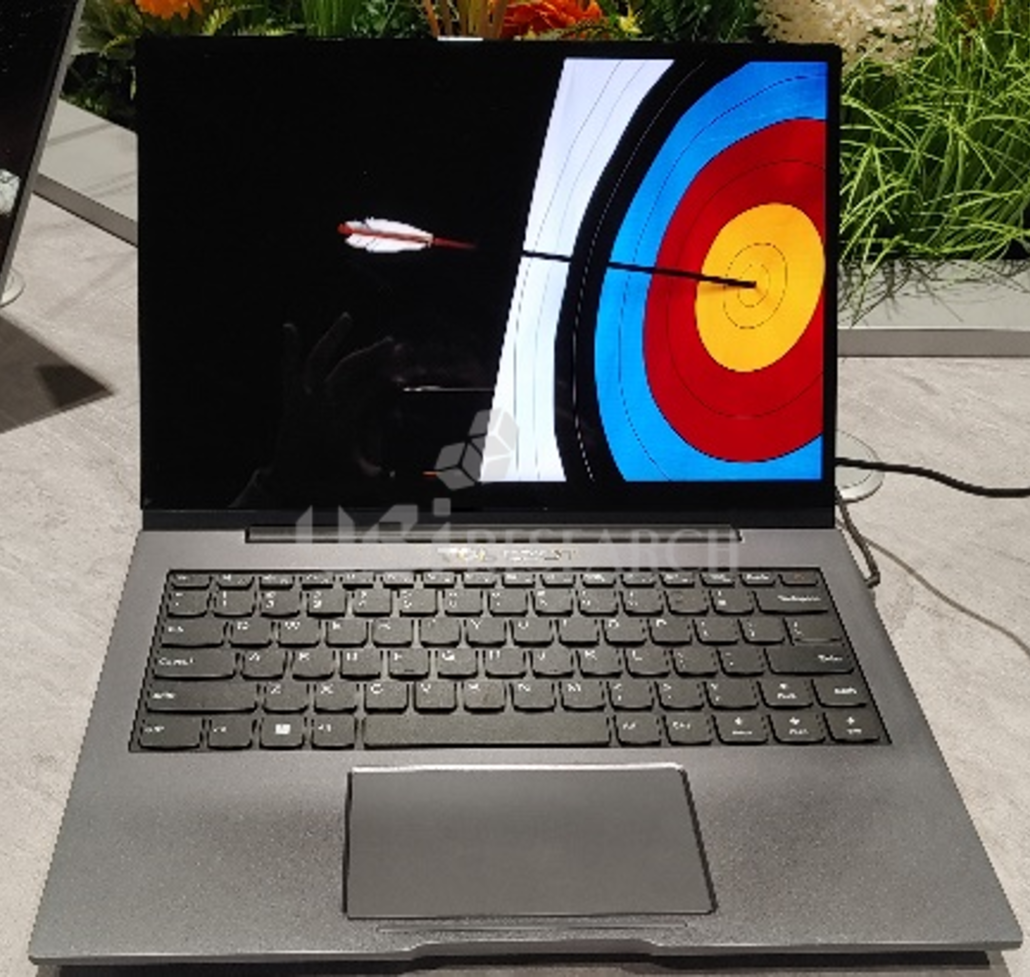
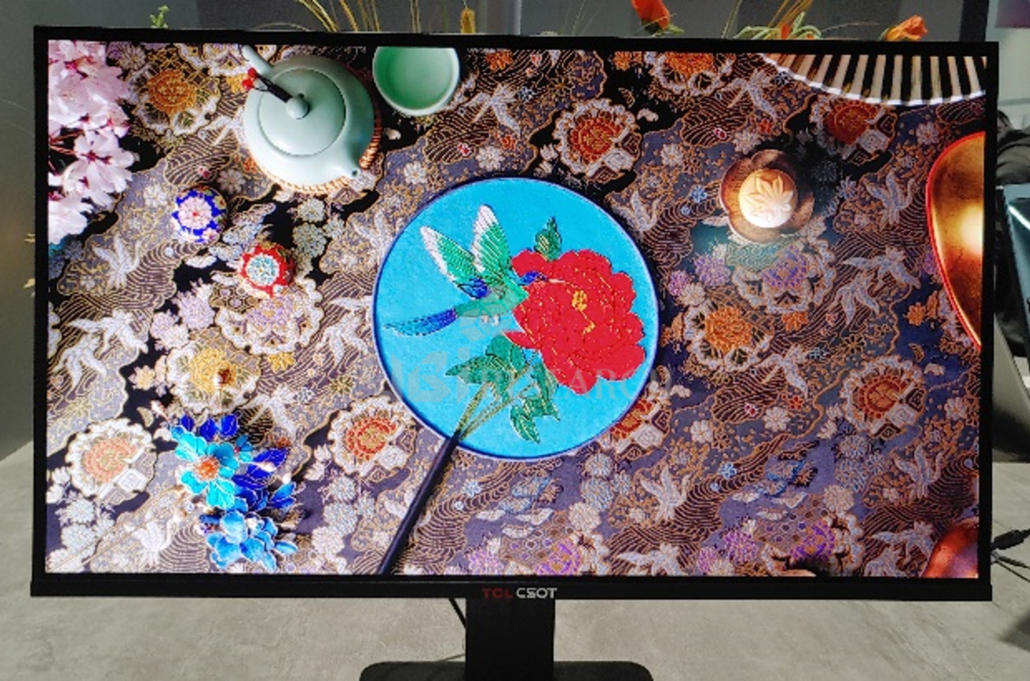
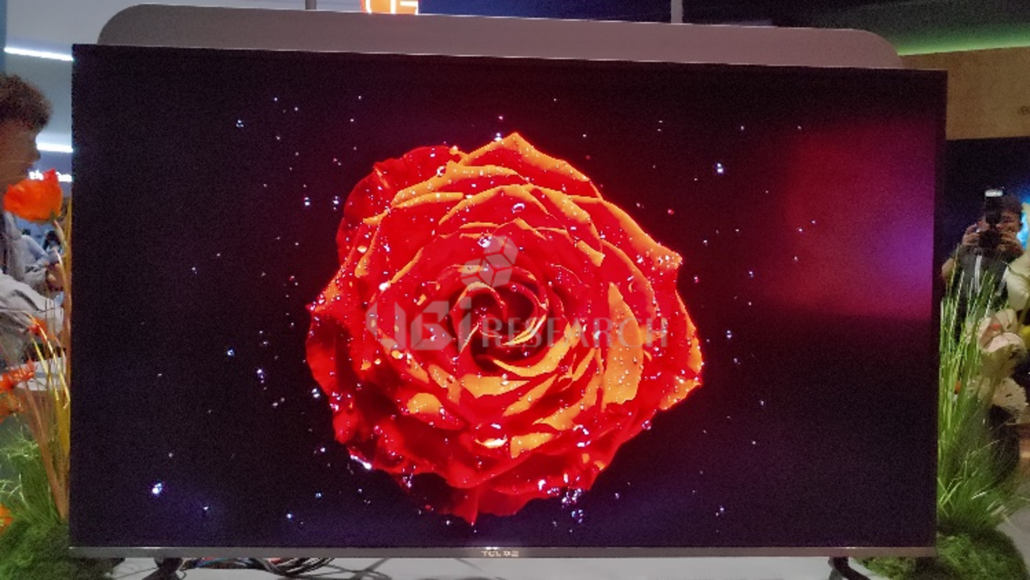
At this exhibition, TCL showcased a 6.5-inch inkjet OLED display for smartphones, which provides a high resolution of 360ppi based on real stripe, which is equivalent to approximately 460ppi based on pentile. In addition, a variety of product lines were exhibited, including a 14-inch oxide TFT-based OLED notebook panel with a 2.8K resolution (243ppi), a 27-inch OLED monitor with 4K 120Hz specifications, and a 65-inch OLED TV display with 33 million pixels and 8K 120Hz.

TCL, 6.5” Smartphone

TCL, 6.5” Smartphone

TCL, 14” Notebook PC

TCL, 14” Notebook PC

TCL, 27” Monitor

TCL, 27” Monitor

The 65-inch product maintains 99% of the DCI-P3 color gamut even in low-gradation, and has applied technology that doubles the utilization of light-emitting materials and reduces blue light by 50%. This is evaluated as a significant technological breakthrough in the large-scale and commercialization of inkjet OLED.

TCL 65” 8K TV

TCL 65” 8K TV

With a full lineup from 6.5 inches to 65 inches, TCL has shown confidence that inkjet OLED technology can be applied to all product lines from mobile to TV. Up to now, Chinese OLED panel manufacturers have focused on production based on technologies first verified by advanced companies, but inkjet OLED is the first technology that China has led in mass production. The success of this technology can be an opportunity for Chinese panel manufacturers to leap forward in both technology and production.

However, OLED using vacuum deposition method is continuously improving brightness and lifespan through tandem IT OLED structure or multi-stack TV OLED structure, and inkjet OLED still has the task of not only securing productivity but also reducing this performance gap.

Chang Wook HAN, Executive Vice President/Analyst at UBI Research (cwhan@ubiresearch.com)

▶2025 Small OLED Display Annual Report Sample

▶2025 Mid-to-Large OLED Display Annual Report Sample

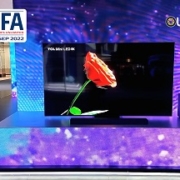
[IFA 2022] TCL CSOT (Mini LED TV, QLED TV, Smart home appliances)

#ifa2022 #tcl #tcltv

▶ UBI Research official website
https://ubiresearch.com/en/

▶If you are curious about the latest news related to OLED?
https://en.olednet.com/

▶Business, display report inquiry
marketing@ubiresearch.com
+82-2-577-4391

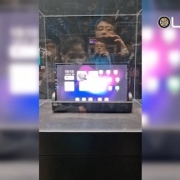
[SID 2022] TCL CSOT 14” Riseable Inkjet Printing OLED Display Week 2022

Resolution : 1920(H) * RGB * 1080 (V)

Frame Rate : 60Hz

Active Area(mm) : 309.12(H) X 173.88(V)

Color Gamut : DCI-P3 → 99%

Color Temperature : 6500K

Brightness : 200nits

Contrast Ratio : 1,000,000 : 1

Crimp Radius : R20mm

Crimp Life : 100,000 times


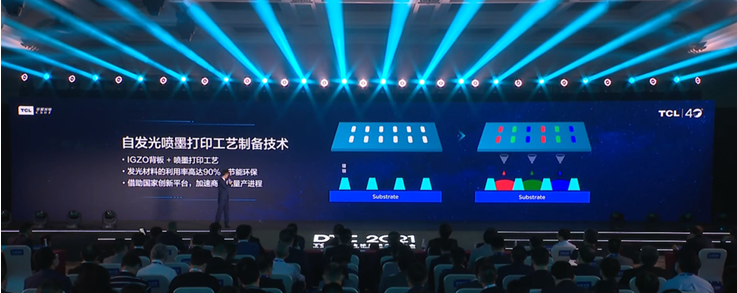
[China Trend Report] TCL CSOT’s T8 Project to Invest in Generation 8.5 Inkjet Printing Technology


According to the ‘China Trend Report’ published by UBI Research, TCL CSOT plans to apply the generation 8.5 inkjet printing OLED technology to the T8 line. It is expected that some layers will be formed by vapor deposition in the inkjet printing method rather than the complete inkjet printing method. The location is likely to be Guangzhou.

TCL CSOT’s T8 line was scheduled to start construction in March 2022 using the inkjet method, but there were rumors that the schedule continued to be delayed due to investment scale and yield issues. There are also talks about the project being canceled altogether. However, it seems that TCL CSOT has continuously improved its technology by continuously collaborating with JOLED. They also announced related contents at DTC 2021 held in November 2021.

It is is expected that mainly OLEDs for IT and automobiles will be mass-produced at the T8 line. The investment schedule and details of the TCL CSOT T8 project can be found in the ‘March China Trend Report’.

[MWC 2019] The new form factor, foldable phone wars heat up

Reporter : Daejeong Yoon

Smartphone makers are promoting the new form factor, foldable phones at MWC 2019 started on February 27 and it runs until 29 in Barcelona Spain.

The show is buzzing with products from big-name tech companies, including Samsung Electronics and Huawei,TCL, LG Electronics being unveiled. That includes a variety of phones with foldable screens.

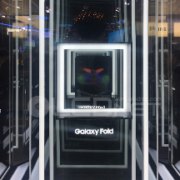
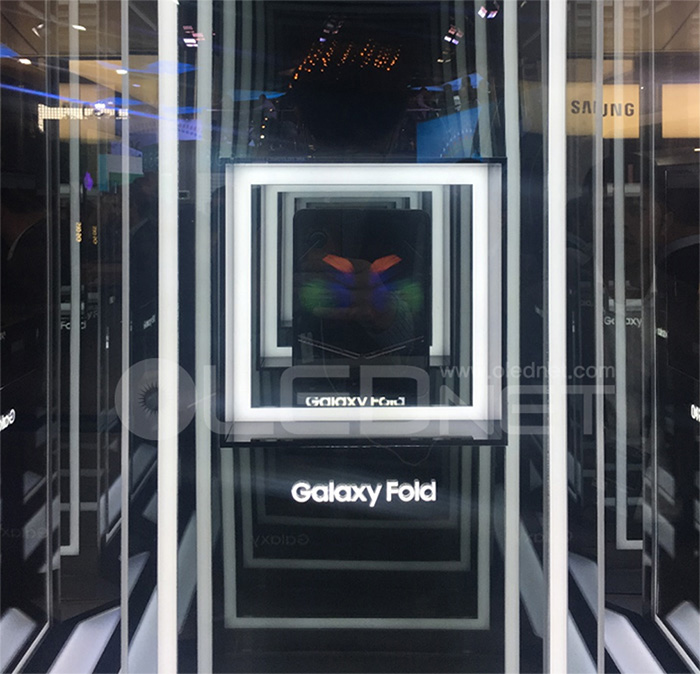
Samsung unveiled foldable phone ‘Galaxy Fold’ to customer, highly touted at the Samsung Galaxy unpacked event.

In folding ‘Galaxy Fold’ features a 7.3-inch QXGA + resolution OLED screen and it was built to be compact size with 4.6-inch HD + resolution OLED when folded.

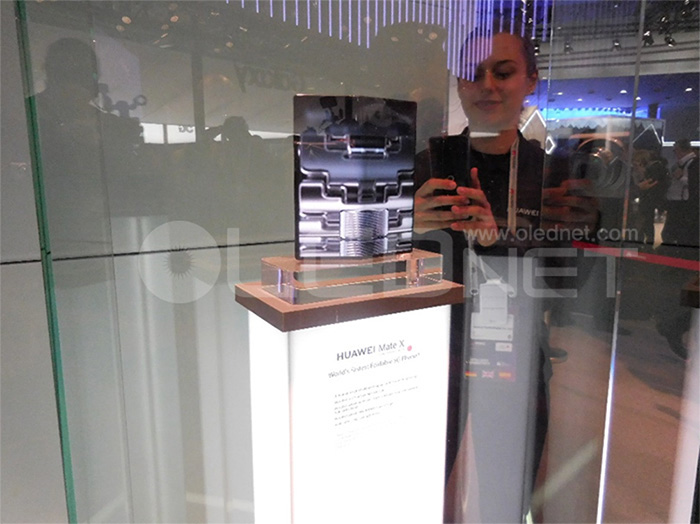
And Huawei announced its own foldable phone “Mate X” uses roll out foldable technology, it is surrounded by a 6.6-inch main OLED on the front and a 6.38-inch on the back. It is 8.7 inches when it is opened, 1.4 inches bigger than Samsung Electronics’ Galaxy Fold.

Mate X’s front display has 2480 × 1148 resolution with a 19.5: 9 aspect ratio. The back OLED has a 2480 × 892 resolution with a 25: 9 aspect ratio. When you flip it open, the resolution is 2480 × 2200 with an aspect ratio of 8: 7.1. .

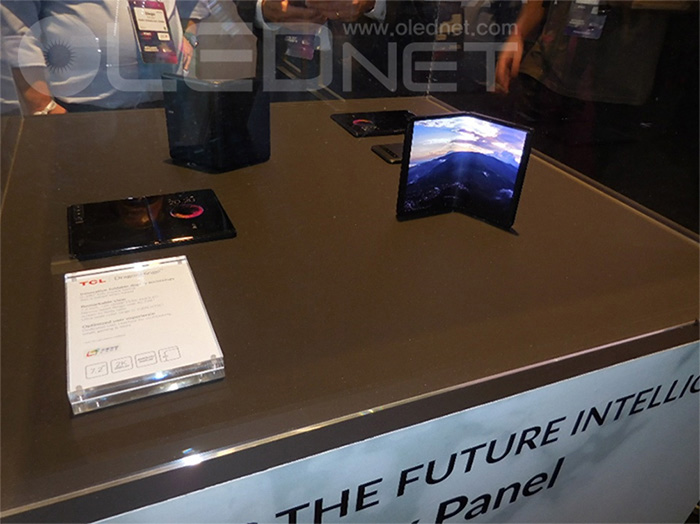
Also, TCL announced the prototype device uses the company’s proprietary “DragonHinge” mechanism to fold and unfold the screen, it has 7.2-inch screen.

According to TCL, this device will build a production version that is slated for release by 2021.

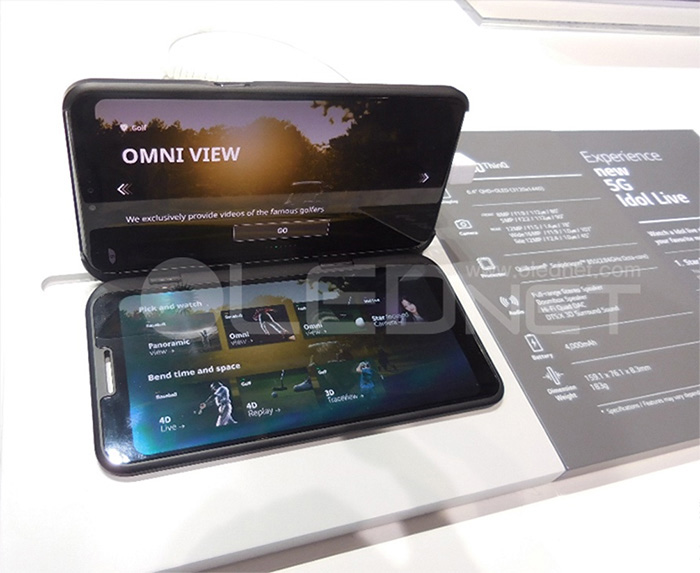
Lastly, LG showed off V50 which is similar to a folding phone, it does have an optional case with a whole second screen on it. With two near-identical phone displays next to each other, the functional split-screen allows multitasking and gaming easily.

CES2019, the Biggest Issue of TV is LG Electronics OLED TV R

Reporter : Daejeong Yoon

The CES, held in early January of each year, is the most important event to understand all of the consumer electronics trends of the year. This year, TV makers from all over the world exhibited a variety of products to attract spectators to the event.

When OLED TV occupied more than 50% of the premium TV market with more than $ 2,000, the LCD TV industry sought to prevent the OLED TV market from expanding by exhibiting 8K LCD TVs to CES. However, the attention and admiration of the spectators were poured into OLED TV R.

The 8K TV market began to open slightly from last year, in preparation for the 8K broadcast starting from the Tokyo Olympics in 2020. LCD TV companies displayed 8K LCD TVs of various sizes to preoccupy the market with the keyword of 8K. LCD TV, however, has not been recognized by viewers as a new TV product since Sharp has already exhibited steadily.

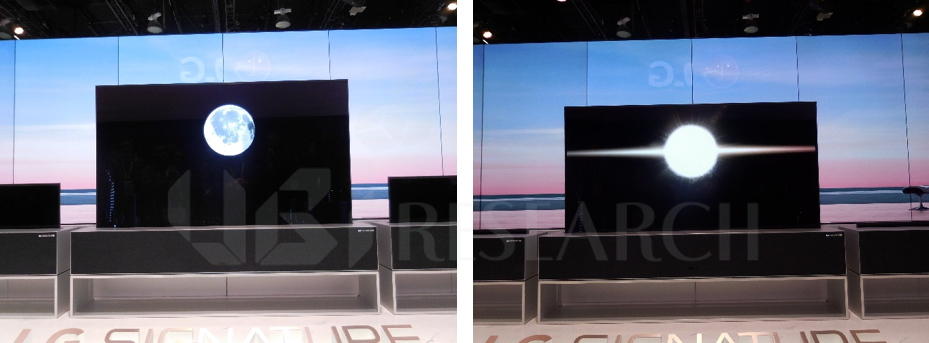
Another reason is OLED TV R displayed by LG Electronics. In the main body with built-in speaker, OLED TV rises up and goes down again. A lot of people came to see OLED TV R to shoot.

 <LG Electronics, OLED TV R>

Last year, micro LED TVs became more prominent. In addition to Samsung Electronics, Sony, TCL and Hisense exhibited micro LED TVs this year. It seems that the gap of micro LED TV technology between Korean companies and Chinese companies is only about one year. In the micro LED TV market based on assembly technology that does not require special manufacturing technology, China, which is the world’s best LED industry and infrastructure, is expected to dominate the market soon.

However, as LG Display has a unique OLED TV manufacturing technology, which has a very complicated panel structure and manufacturing process, the technological gap between Korea and China is expected to be more than five years difference. In this situation, OLED TV R, released by LG Electronics, once again realizes that Korea’s OLED technology is the best in the world.

On the other hand, TV companies’ display of OLED TVs, except for LG Electronics, has stagnated. These companies are not yet receiving 8K OLED panels and rollable OLED panels from LG Display. Even Sony does not have any special features, only OLED TVs that are well known so far.

As a result, the CES TV show was notable only for LG Electronics.

It is judged that LCD TV using mini LED that TCL has released can compete with OLED TV in this exhibition. The contrast ratio is displayed as 1,000,000: 1 similar to OLED TV. Black is a very good product that has a vibrant color and contrast ratio similar to OLED TV. However, a holo-effect was found around the bright screen displayed on the black desktop. It is a phenomenon that the surroundings appear to spread brightly. As it is invisible to non-specialists, it is competitive in price and is a product that can compete well with OLED TVs.

< TCL, 8K QLED TV with mini LED>

TCL announced “Establishing large-area OLED panel production plant”, is solution processed RGB OLED mass production accelerated?

China TCL will invest RMB 42.8 billion (US$ 6.71 billion) in Shenzhen to establish a factory for large-area OLED panel production. According to South China Morning Post, TCL recently announced that it will produce 90,000 units on the basis of 70-inch panel in the new production line of Gen 11 (3370 mm x 2940 mm) with the goal of mass production in March 2021 in the data submitted to the Shenzhen Stock Exchange. The main products are to be known as 65-inch and 75-inch OLED panels, and 65-inch, 70-inch and 75-inch display panels with 8K resolution.

TCL will form a partnership with the China Development Fund for the necessary financing and will set up a new production line at TCL’s semiconductor subsidiary with RMB 20.3 billion.

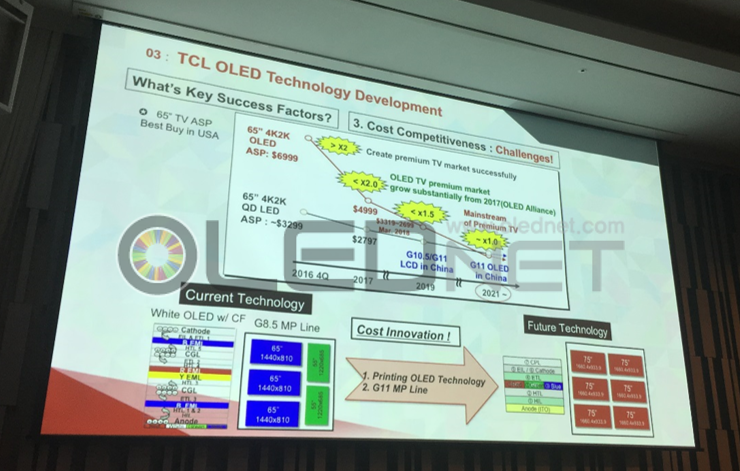
Large-area OLED to be produced by TCL is expected to adopt solution process RGB. At the ‘4th OLED Korea conference’ hosted by UBI Research in March, James Lee, deputy chief engineer of TCL mentioned about the development of next-generation premium TV with the screen size of 70-inch or more and 8K resolution, based on the solution process.

Lee said, “The price difference between OLED TV and premium LCD TV is estimated to be reduced to 1.4 times when the price of large-area OLED panel is lowered by the operation of LG Display’s Gen 10.5 plant in 2020. We are developing solution process technology for large area OLED and it will be applicable to Gen11 factory. ”

Gen 11 production line is capable of producing six sheets of 75-inch OLED panels, being able to achieve a yield three times higher than Gen 8.5 production line and a cutting efficiency of over 95%. In addition, it is possible to produce large-area OLED panels with a real RGB structure instead of the WRGB structure when solution process is applied. Based on this, TCL emphasized that the construction of the Gen 11 solution process OLED mass production line is essential. Meanwhile, TCL has jointly established JUHUA Printing Display Technology with Tianma, a Chinese company, in 2016 through CSOT, which is a subsidiary of TCL, and is continuously developing the inkjet printing process by a Gen 4.5 R&D pilot plant.


[CES 2018] OLED TV exhibition from major set manufacturers

On 8 January 2018, the largest electronic show is held at Enclave Convention Center in Las Vegas, United States.

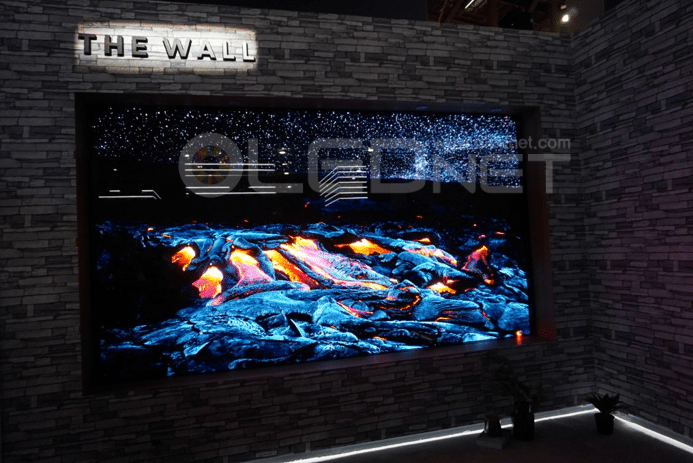
Major electronic companies such as LG Electronics, Sony, Vestel, Changhong, Skyworth presented OLED TV as main exhibition. In particular, Samsung Electronics’ “Micro LED” exhibition received a great deal of attention.  Samsung Electronics unveiled the world’s first “micro LED” technology-applied 146-inch modular TV, “The Wall.” People came to see the product and it was heated up in a hot issue. Samsung Electronics emphasized that this product is a future screen that is unlimited in image quality, size and form. Through the implementation of the local dimming 3000, “The Wall”, which was unveiled at the exhibition show is developed by brightness, contrast ratio, color reproduction and black display compared to the existing display.

<‘Micro LED TV ‘The Wall’ of Samsung Electronics’>

Especially, the existing “Mini LED” products were exhibited along with “The Wall” for comparison of exhibition. And the excellence of “Micro LED” was outstanding. “Mini LED” products was little far from the large display as pixels and the lines of each module were shown on the screen.

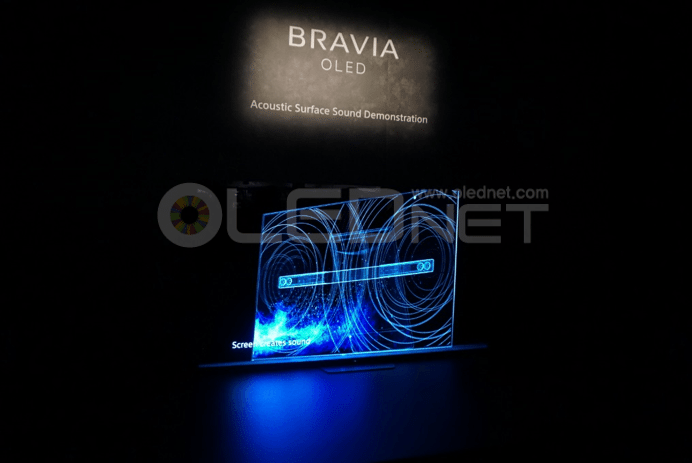
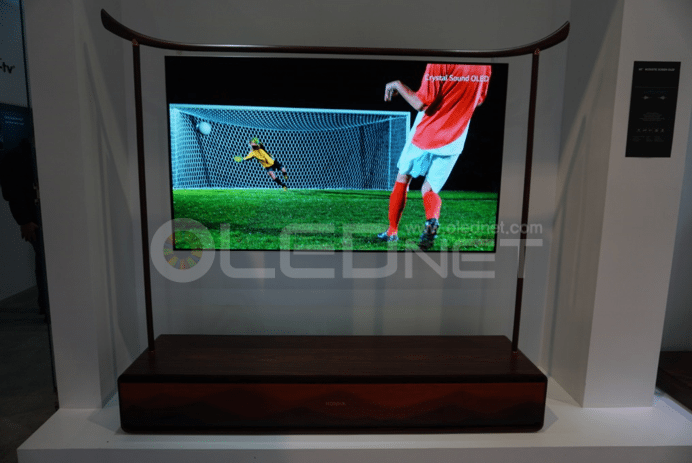
LG Electronics, Sony, Changhong and other companies presented 65-inch and 77-inch OLED TV display products including Sound Acoustic OLED TV products. In particular, Konka reflected the trend that TV is a part of furniture, not just electronic products and it consists of a set design that took advantages of Chinese traditional atmosphere.

In addition, many set manufacturers have demonstrated the advantages of OLED TV, which is the lightest and thinnest through “Wall Paper TV” and “Slim” concepts.

<A8F Bravia OLED TV of Sony>

<OLED TV of Kongka>

‘TCL’, which occupies a side of QLED TV showed more advanced QLED TV in image quality and color reproduction range. According to the person in charge of TCL, QD dominated the portion of the current market therefore, many manufacturers are producing Quantum dot LCD, and also considering OLED TV launches. The person in charge emphasized that they are building factories in China that produce only OLED.

LG Electronics is a leading OLED TV company and showed OLED which is being developed continuously through making tunnels of OLED TV. They revealed that LG Electronics is the world’s first OLED TV set manufacturer. People look forward to seeing OLED growth in the future through CES the first electronic exhibition show in 2018.

[iMiD 2017] TCL, Development focusing on Solution process OLED and QLED

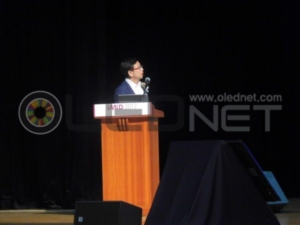
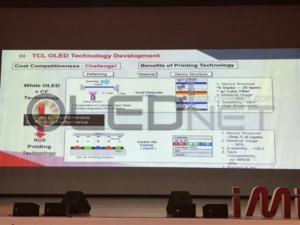
TCL’s Xiaolin Yan CTO addressed solution process OLED TV and self-emitting QLED TV as premium TV after white OLED TV at iMiD 2017 keynote address in BEXCO, Busan on 29th.

Yan CTO noted that white OLED TV, which is currently leading the premium TV market, meets all the requirements of premium TV due to its superior image quality, design differentiation, high resolution realization and nature-friendly characteristics compared to QD LCD TV.

In addition, the price that is higher than the current QD LCD TV is expected to be overcome by applying the solution process, and mass production is also expected in 2019.

Yan CTO predicted that the “solution process would be easy to produce 75-inch panels at Gen 10.5 because the process can be performed without splitting the ledger,” and “it is also possible to produce full-emission RGB OLED TVs.” However, he emphasized that the compatibility of materials and equipment and the development of ink forming process technology should be done.

Following to that, “QLED structure is very similar to OLED structure, so it is easy to apply the technology because of the low entry barriers,” he said. “The lifetime and efficiency of the blue light emitting layer compared to the current OLED is very low, and performance must be ensured without the use of cadmium.”

Lastly, He mentioned the establishment of printing technology in Guangdong JUHUA to promote the commercialization of solution process OLED TV and self-luminous QLED TV, and emphasized the cooperation of material, equipment and panel makers to develop next-generation premium TV.

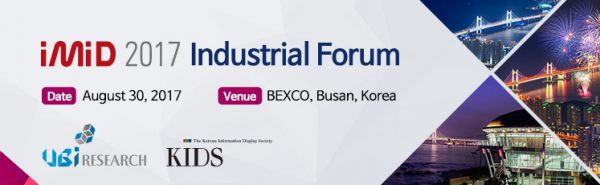
iMiD 2017 Industrial Forum, a networking event to predict the next generation OLED market

■ “Finding a new OLED market” – Discussing OLED replacement in view of OLED application development

■ Discussing new technologies of future display (LCD, QD-LCD, OLED)

The potential of future OLED development is inexhaustible as OLED can be applicable to all industries including VR / AR, automotive, aerospace, and lighting not content with smart phone and TVs. There has been growing public interest in OLED in many different industries. To meet the market demand, Ubi Research, a market research company co-hosts ‘iMiD2017 Industrial Forum’ with Korea Display Society (KIDS) in BEXCO, Busan on 30th of August.

The forum will proceed with a panel discussion among key specialists and presentation, which will enable people from many different industries to exchange information not only on the display market but also current OLED market status, technology and explore a new market potential generated in the future.
In the first session ‘look for a new OLED market’, OLED replacement will be presented in view of OLED application development. The key players include Dr. Teruo Tohma, WooSeok Jeong, principal research fellow at the Electronics and Telecommunications Research Institute (ETRI), Julian K chang, Managing director of Boeing Corporation, Professor TAKUYA KOMODA at Yamagata University, senior researcher, Michi Hisaishi, ALPINE Michihisa Onishi.

The second session, ‘Discussion of New Technologies in Future Display’ will provide insight into the latest products and technology trend of TV manufacturers competing with one another to dominate the next generation display market. Nam-Suk Oh, CEO of Samsung Electronics will present an updated LCD TV using Quantum dots technology under the title of “Quantum Dot and Advance of LCD-TV”.

In the OLED TV camp, under the title of “OLED, Now and Future”, Joon-Young Yang at LG Display will review the current status of OLED TV led by the current market trends, and also address OLED future implemented in a wide range of ‘flexible and rollable’ designs.

Weir Cao, senior researcher at TCL, will present both the technology status of the Colloidal Quantum Dots and TCL products applied to LCD in the market, under the topic of “TCL Display Technology with QDs”. The premium TV strategies are expectedly revealed. Lee Choong-hoon, CEO of Ubi research co-host of this forum, offered a time to summarize the premium TV market on the topic of ‘OLED TV market outlook by premium TV market expansion’ by analyzing the presentations of the companies that presented earlier.

For more information on the 17th iMiD2017 Industrial Forum, please visit iMiD2017 official website (http://imid.or.kr/2017/indi_forum.asp).
 

[MWC 2017] Samsung Electronics, LG Electronics, HUAWEI, and TCL Compete over OLED Smart Watches

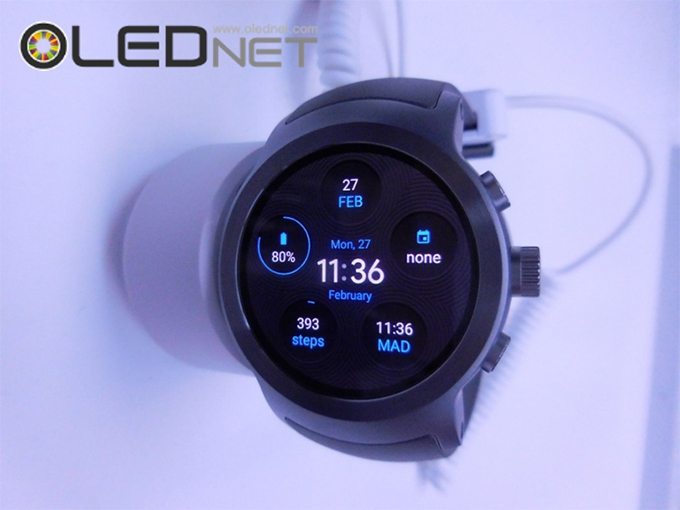
In MWC 2017, the competition over smart watches proceeded fiercely.

The unveiling of Gear S3 by Samsung Electronics in the last IFA 2016 attracted great attention from the smart watch market. The disclosures of products that can compete with Samsung Electronics’ Gear S3 at MWC 2017 are gaining great popularity among viewers.

LG Electronics displayed G-Watch 2 Sports with 1.38-inch P-OLED and G-Watch Style with 1.2-inch P-OLED, HUAWEI exhibited HUAWEI Watch 2 and HUAWEI Watch 2 Classic with 1.2-inch AMOLED panel, and TCL showed MOVETIME with 1.39-inch AMOLED panel.

The smart watches shown by LG Electronics, HUAWEI, and TCL adopted flexible AMOLED (P-OLED) and circle types to save the designs of existing watches, and LG Electronics’ G-Watch 2 and HUAWEI’s HUAWEI Watch 2 can be used as devices independent of smartphones because they have separate sims.

LG Electronics’ G-Watch 2 Sports is equipped with 1.38-inch circle type AMOLED panel, Google Android Wear 2.0, 768MB RAM, 4GB internal memory, and 430mAh battery, and it supports IP68-level waterproof and dustproof functions and wireless charging function.

On the other hand, G-Watch 2 Style is equipped with 1.3-inch circle type AMOLED panel, Google Android Wear 2.0, 4GB internal memory, and 240mAh battery, and it supports IP67-level waterproof and dustproof functions.

HUAWEI Watch 2 is equipped with a 1.2-inch circle type AMOLED panel, Qualcomm® Snapdragon ™ Wear 2100, 1.1GHz quad-core CPU, Google Android Wear 2.0, 4GB internal memory, 768MB RAM, and 420mAh battery, and it supports various types of Watch face, an equippable Sim (4G), and IP68-level waterproof and dustproof functions.

Meanwhile, LG Electronics and HUAWEI devoted considerable spaces to the smartwatch exhibition at their booths in the MWC 2017 exhibition, and it suggests that there will be big changes in the smart watch market which is dominated by Samsung and Apple.

<G-Watch 2 Sports of LG Electronics>

<HUAWEI Watch 2 of HUAWEI.>