Posts

Featured image of ASUS ROG Swift OLED PG27AQWP-W equipped with LG Display’s 4th Gen White OLED panel — 540Hz refresh rate and 1,500-nit peak brightness

ASUS ROG Leads Gaming Monitor Innovation with LG Display’s 4th-Generation White OLED

ASUS’s gaming brand, ROG, recently released its 27-inch gaming monitor, the ROG Swift OLED PG27AQWP-W, featuring LG Display’s latest 4th-generation white OLED panel. LG Display is extending its proven TV technology to the monitor market, enhancing brightness and durability to address OLED’s weaknesses. ASUS, a top-five global gaming monitor manufacturer, has adopted this new OLED panel for its ROG series, marking a significant step toward popularizing OLED technology in the premium gaming monitor market.

The ROG Swift OLED PG27AQWP-W features a 26.5-inch QHD resolution, 4th-generation white OLED panel, and supports dual modes: 540Hz in QHD and 720Hz in HD. It boasts a fast response time of 0.02ms, and the application of LG Display’s 4th-generation white OLED technology delivers high luminance efficiency and a lifespan that’s approximately 60% longer than previous models. Color expression has been improved by 25%, and maximum brightness has been increased by 15% compared to the previous model.

ASUS ROG Swift PG27AQWP-W vs XG27AQDMG gaming monitor specs comparison – 4th Gen White OLED applied (Source: ASUS)

Comparison of ASUS ROG Swift PG27AQWP-W and XG27AQDMG specs (Source: ASUS)

The structure of the 4th generation white OLED is a 4-layer configuration including 2 blue light-emitting layers and red and green layers. On the other hand, the 3rd generation white OLED was a 3-layer structure with 2 blue light-emitting layers and red, green, and yellow elements arranged in one layer, and a Micro Lens Array (MLA) was applied. The peak brightness (based on 1.5% APL) of the ‘ROG Strix OLED XG27AQDMG’ using the 3rd generation OLED was around 1,300 nits, but this new model with the 4th generation OLED applied has improved to 1,500 nits, realizing much clearer HDR picture quality.

Comparison of LG Display’s 3rd and 4th Gen White OLED structures with brightness and lifetime improvements (Source: LG Display)

Comparison between 3rd and 4th Gen White OLED structure and performance (Source: LG Display)

LG Display’s 4th-generation OLED was first applied to LG Electronics’ “UltraGear 27GX700A” gaming monitor, in addition to ASUS. This model demonstrated the performance of the new OLED technology, achieving a full white brightness of 335 nits and a peak brightness of 1,500 nits. Starting with this ASUS ROG model, LG Display plans to expand the application of the 4th-generation white OLED to various IT monitors. Building on its expertise in OLED TVs, LG Display aims to deliver a new level of picture quality competitiveness in both gaming and creative applications.

“LG Display’s 4th-generation OLED is expected to accelerate the adoption of OLED in both the gaming and IT display markets by applying proven TV technology to monitors,” said Changwook Han, Executive Vice President of UBI Research. “In particular, the improved lifespan and high brightness achieved through the 4th-generation white OLED structure will be a significant turning point in the competitive landscape of the high-end gaming monitor market.”

Changwook Han, Executive Vice President/Analyst at UBI Research (cwhan@ubiresearch.com)

▶ Quarterly Small OLED Display Market Tracker Sample
▶Quarterly Medium & Large OLED Display Market Tracker Sample
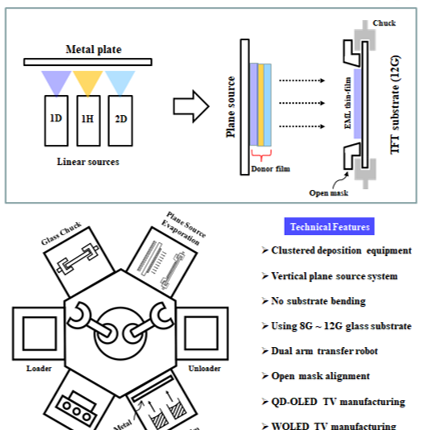
OLEDON develops vertical plane source deposition technology for large OLED TV manufacturing

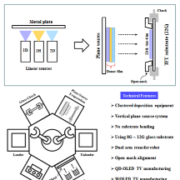
Hwang Chang-Hoon, CEO of OLEDON, which has developed plane-source deposition technology for small & medium-sized OLED and large area OLED, said that it is under development of vertical plane source deposition technology capable of manufacturing ultra-large OLED TVs of 77 inches or larger. Hwang introduced the related technology that it is possible to mass produce OLED TVs of 77 inches or more without the sagging problem of large substrate such as 12th generation (3300 x 4000 mm) substrate when using vertical plane source deposition technology.

According to Hwang, the production yield for 75 inch TVs or larger with the conventional inline type evaporator might be very low due to severe sagging of the substrate and difficult control of many linear sources. To solve this problem, Hwang said that a new 12-generation large-area cluster-type deposition technology is needed, and that vertical plane source deposition technology will be an appropriate alternative.

On the other hand, OLEDON holds the original patents for plane source deposition technology. It also filed a patent related to the curved plane source FMM deposition for high-resolution AMOLED manufacturing, and a patent related to the vertical plane source deposition technology for manufacturing large-area OLED TV.


BLUE OLED, is rapidly emerging as a competitor of WRGB OLED

In the premium TV market, the share of OLED TVs is steadily increasing, and the price gap with LCD is gradually decreasing. As a result, LCD TV (QD-LCD TV) companies using quantum dot technology are sluggish in the premium TV market.

OLED TV uses white OLED and OLED panel with color filter (hereafter referred to as WRGB OLED), which is mass-produced only by LG Display.

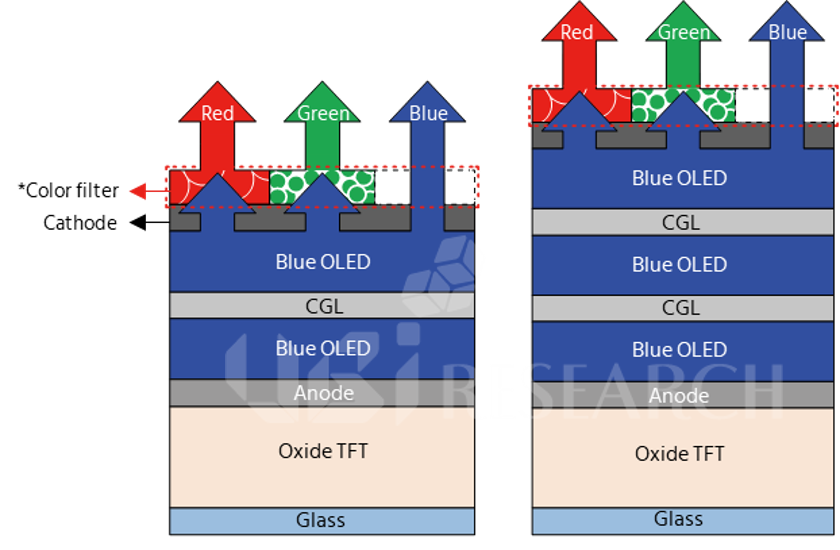
Samsung Display is known to actively develop blue OLED + QDCF (blue OLED), which is one of the technologies to compete with WRGB OLED in the premium TV market.

UBI Research predicted that Samsung Display would implement blue OLED + QDCF with top emission method and it would be more advantageous to implement 8K and BT 2020 than WRGB in its ‘2018 OLED Material Industry Report’ published on April 18.

<Expected stack structure for Blue OLED, 2stack (left), 3stack (right), 2018 AMOLED emitting materials Report, UBI Research>

8K and BT2020 are to be adopted for the premium TVs. Also, the development of blue materials is expected to be aggressively progressed according to Samsung Display’s development of blue OLED. The blue material currently used in OLED is a fluorescent material that is insufficient in the efficiency and lifetime than phosphorescent material used in red and green. Blue phosphorescent materials have been developed continuously but they have not been applied to mass production due to the scarcity of materials and technical barriers. Therefore, blue fluorescent materials are stacked two or more times to improve efficiency and lifetime for large area OLED, and blue OLED is expected to use more than 2 stack structure.


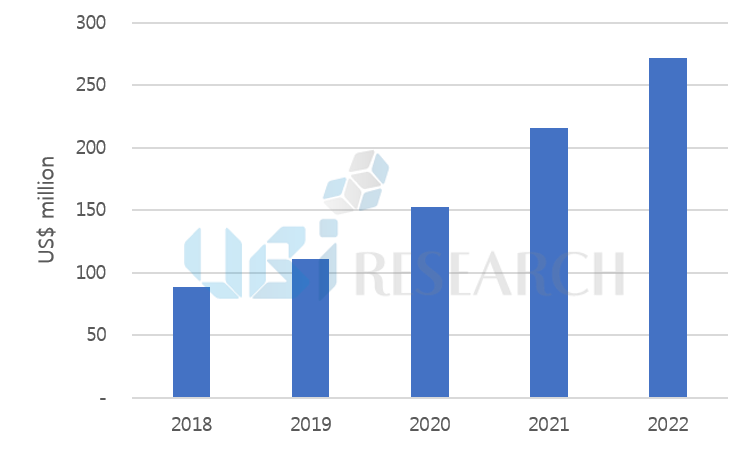
With this trend, the market for blue emitting materials is expected to continue to grow. In 2017, blue materials (host and dopant) formed market of US$ 70 million.  According to the 2018 AMOLED emitting material market track published by UBI Research, blue material is expected to grow at an average annual rate of 32% by 2022 and reach US $ 272 million sales.

<Blue material (host and dopant) market forecast, 2018 AMOLED emitting materials Market track>

[iMiD 2017] LG Display, Spur Development of 77 inch transparent flexible OLED

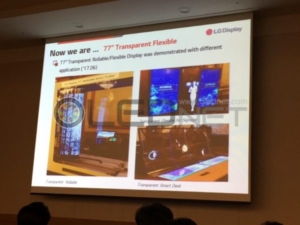
LG Display’s Kwon Se-Yeol senior researcher introduced the 77-inch transparent flexible OLED which had been introduced in June at IMID 2017 held in BEXCO, Busan on Aug. 30, and announced the applied technologies to realize this.

Kwon Se-Yeol senior researcher mentioned, “OLED is self-luminous, so it can be manufactured with a thin thickness because it does not need a back light unit. The thinner the thickness, the more flexible the OLED can be so that it is easy to implement flexible displays with OLEDs.” and forecasted. “It can be used in various fields such as signage and smart desk.”

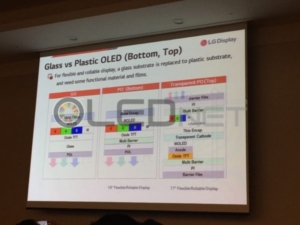
The 77-inch transparent flexible OLED which is released this time is a top emission type for improved luminance. The transparent thin film encapsulation layer is applied, different from the conventional OLED TV or large flexible OLED, and two polyimide substrates are used.

Kwon Se-Yeol senior researcher said “We applied a transparent thin-film encapsulation layer instead of the existing metal encapsulation layer for the top emission method ” and explained “A white OLED light emitting layer and a color filter layer were formed on two polyimide substrates and cemented together. A barrier film and a multi-barrier were applied to the top and bottom of the polyimide substrates to prevent moisture and oxygen penetration.”

The Kwon Se-Yeol senior researcher then states that “flexural rigidity of the panel is mainly affected by the thickness of the polarizer and the encapsulant layer, so it is necessary to reduce the thickness in order to improve the flexibility”, and emphasized “By reducing the thickness of the encapsulant layer from 100 μm to 20 μm, we can reduce the strain on the OLED module from 0.36% to 0.21%, along with improved flexibility”.

In addition, he mentioned that surface reflection due to polyimide birefringence phenomenon, laser wavelength selection according to polyimide properties in LLO (laser lift off) process, and use of flexible OLED module are all covered, and technical development is continuing.

Meanwhile, LG Display has developed the world’s first 77-inch transparent flexible OLED with UHD (3840 × 2160) resolution, transmittance of 40%, and radius of curvature of 80R as part of the national project.

JDI Announces OLED Mass Production in 2018

Japan Display (JDI) officially announced OLED mass production. The press, including the Sankei Shimbun and the Nikkei, reported that on January 22 JDI revealed their plans to begin mass production of OLED panel to be used in smartphone from 2018.


JDI continued development with the aim of LTPS TFT and WRGB OLED technology applied high resolution AMOLED panel mass production for mobile device, and revealed the results through exhibitions in recent years.


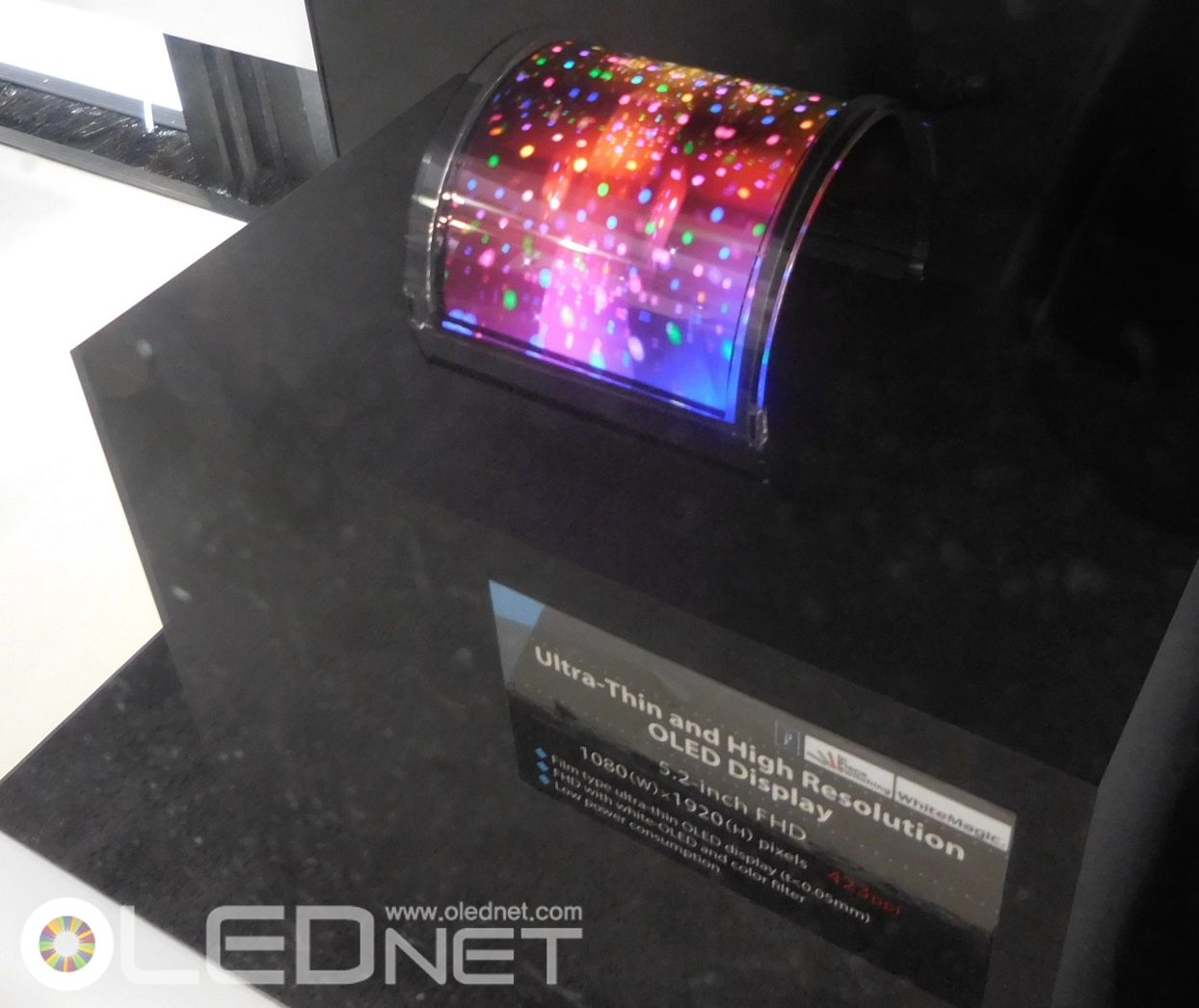
In Display Innovation 2014 (FPD International) and SID 2015, JDI have presented 5.2 inch FHD flexible AMOLED panel. Particularly, in SID 2015, JDI showed a notepad equipped with flexible OLED panel.


JDI is likely to mass produce flexible AMOLED following the current mobile device market trend. Although the mass production technology was not mentioned, due to the client demands, it is estimated that either the RGB method, which is being used by LG Display and Samsung Display, or WRGB method, which is being developed by JDI, will be selected.


At present, only Samsung Display and LG Display can mass produce flexible AMOLED panel, but Chinese companies are fast in pursuit. There is much interest in how this JDI’s mass production announcement will affect the future OLED market.


JDI