The adoption of QD-Mini LED is also expanding into automotive applications.
Automotive displays must reliably present navigation, driving information, and infotainment content even under harsh conditions such as direct sunlight, diffuse reflection, high and low temperatures, and vibration. QD is advantageous for achieving high color purity and a wide color gamut thanks to its narrow emission spectrum, while Mini-LED offers strengths in high brightness and high contrast through local dimming. By combining these two technologies, QD-Mini LED can maintain clear and vivid image quality even under strong ambient light. With added competitiveness in cost and lifetime, it is drawing attention as a premium automotive display solution.
QD-Mini LED panels have already begun to appear in mass-produced vehicles. Geely’s ZEEKR 7X, launched from 2025, features a QD-Mini LED panel, while the Tata Harrier.ev in India is equipped with a Mini-LED display incorporating Samsung’s cadmium-free QD film technology. Hyundai Mobis has also entered the automotive display market with its QL display, which combines QD with local dimming. QD-Mini LED is now moving beyond demonstration-stage technology and beginning to spread across actual production vehicle platforms.
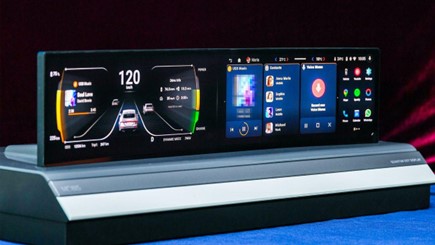
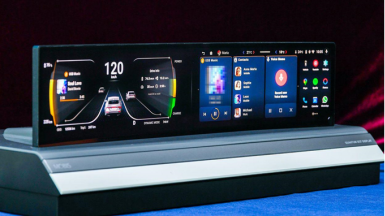
Hyundai Mobis’ QL (Quantum Dot + Local Dimming) display. Combining QD and local dimming Mini-LED technologies, it enters the competition in the premium automotive display market. (Source: Hyundai Mobis)
The supply chain is also forming rapidly. At the Tier 1 level, automotive electronics suppliers such as Harman, Hyundai Mobis, and HIWAY are providing display systems and smart cockpit solutions to automakers. At Tier 2, panel and module suppliers such as BOE Varitronix and Tianma are expanding shipments of automotive QD-Mini LED panels. At Tier 3, companies including Najing Technology, Fine Shin Technology, Jizhi Technology, and Shinwha Intertek are supplying QD films, backlights, optical solutions, and related components and materials, supporting the lower end of the value chain. Shinwha Intertek is drawing particular attention for its supply of QD films that meet automotive durability standards.
When QD film, Mini-LED backlighting, and local dimming control are combined, the structure becomes more complex than that of a conventional LCD, and the cost burden also rises. In the automotive market, the technology must also be validated for long-term operating conditions, including color shift, optical uniformity, and resistance to high and low temperatures.
Going forward, the key factors that will determine market expansion are cost and reliability. The pace of adoption will depend on how quickly QD-Mini LED can move beyond premium vehicle segments into mid-range models, and on how stably the supply chain can be established.
Changwook Han, Executive Vice President/Analyst at UBI Research (cwhan@ubiresearch.com)
 2026 Medium & Large Size OLED Display Annual Report
2025-2026 Automotive Display Technology and Industry Trends Analysis Report
※ This article is produced by UBIResearchNet.
Unauthorized reproduction or citation without source attribution is prohibited.
When quoting, please clearly indicate the source (UBIResearchNet) and provide a link.