Posts

Co-Packaged Optics (CPO) packaging technology roadmap showing the integration of Micro-LEDs for AI data centers.

Expanding into new markets through an integrated solution combining Micro-LED and CPO technology

Generative AI has ignited a global race for computing power, with high-speed transmission bottlenecks in data centers emerging as a key obstacle constraining AI infrastructure upgrades. While chip-internal computation speeds have accelerated dramatically, the copper wiring connecting chips cannot keep pace with data transmission speeds due to resistance and heat generation issues. Next-generation ultra-high-speed, ultra-low-power optical interconnect solutions are establishing themselves as the core alternative to traditional copper cable interconnects, offering a new solution to the transmission challenges facing AI computing centers and data centers. Micro-LEDs are gaining attention as the optimal light source to solve this problem and could become a key technology for overcoming the ‘energy barrier’ in AI infrastructure.

In early March, Chinese micro-LED-related stocks saw significant gains. The surge in buying pressure, driven by capital inflows, stems from the rise of micro-LED CPO (Co-Packaged Optics) technology. Recently, micro-LED companies, including those in Taiwan and China, are accelerating development not only in display products but also in the ‘non-display sector’—specifically the optical communication and optical sensor markets.

PlayNitride is strengthening its R&D efforts to develop communication-specific Micro-LED chips capable of high-speed modulation and to convert ultra-high-resolution LEDos technology into arrays for optical interconnects. In January this year, it announced a partnership with Brillink to jointly develop micro-LED-based optical interconnect solutions. AUO is preparing to enter the CPO market for next-generation AI servers by leveraging its display supply chain. It is attempting to establish a vertical integration by combining the micro-LED resources of its subsidiary, LED chip manufacturer Ennostar, with the receiver technology of Tyntek. China’s largest display manufacturer, BOE, has established an 8-inch GaN-on-Si-based Micro-LED mass production system in collaboration with its subsidiary HC-Semitek. Aligned with the Chinese government’s ‘semiconductor self-reliance’ strategy, it is building a low-cost light source supply chain for optical interconnects between AI chipsets.
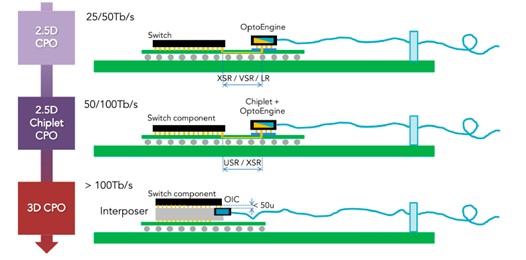
Co-Packaged Optics (CPO) packaging technology roadmap for high-speed AI data centers

Co-Packaged Optics (CPO) packaging technology roadmap designed to resolve high-speed transmission bottlenecks in data centers. (Source: Micromachines 2025, 16, 1037)

Micro-LEDs are gaining attention as an optimal light source for the following reasons.

  • Ultra-high-speed modulation principle: Smaller micro-LEDs reduce RC delay and allow higher current density, enabling ultra-high-speed modulation bandwidths exceeding several GHz. This facilitates data transmission of several Gbps per pixel.
  • Energy Efficiency: Unlike laser light sources (VCSELs: Vertical Cavity Surface Emitting Lasers), they do not require a resonator structure, resulting in extremely low drive power. Efficiency levels around ~1 pJ/bit could be the only viable alternative to dramatically reduce power consumption in AI data centers.
  • High-density packaging: Thousands of light sources can be directly integrated (monolithic/hybrid integration) onto HBM (High Bandwidth Memory) or GPU dies with pitches in the micrometer range, maximizing data transmission density per unit area.

While existing micro-LEDs for displays focused on color reproduction and brightness, the key for optical interconnect solutions lies in compatibility with semiconductor processes. Moving beyond the traditional 4-inch and 6-inch sapphire wafer methods, the introduction of 8-inch and 12-inch GaN-on-Si (Gallium Nitride on Silicon) processes enables the direct use of existing semiconductor fab equipment. This not only lowers manufacturing costs but also enables ‘Monolithic Integration’—packaging the CMOS driver IC and micro-LED together in a single package—accelerating the commercialization of optical interconnect solutions.

Experts anticipate a future where micro-LEDs transcend being mere ‘screens’ and are recognized as key components determining the performance of AI semiconductors. If the micro-LED industry achieves breakthroughs in two core areas—reducing mass production costs and validating the technical feasibility of optical interconnection application scenarios—micro-LEDs will gradually open new markets beyond consumer electronics displays like smartwatches and AR smart glasses, with significant potential for substantial market expansion.

Namdeog Kim, Senior Analyst at UBI Research (ndkim@ubiresearch.com)

▶Pre-register for Display Korea 2026

▶101 inch Micro-LED Set BOM Cost Analysis For TVs

▶Industry Trends and Technology of Micro-LED Displays for XR Report

※ This article is produced by UBIResearchNet.

Unauthorized reproduction or citation without source attribution is prohibited.

When quoting, please clearly indicate the source (UBIResearchNet) and provide a link.

AI AR smart glasses Meta Ray-Ban Display showing growth of the global AR wearable market

The Competition in AI/AR Smart Glasses and the Advancement of Chinese companies in the Supply Chain Ecosystem

Meta officially announced its new products at the Meta Connect 2025 event on the 18th of last month (the 17th in US time), and began launching the Meta Ray-Ban Display smart glasses—its first consumer glasses to bring a display—in the US at the end of September. Meta continues its strategy to dominate the AI/AR glasses market. According to a post by Meta CTO Andrew Bosworth on Threads on October 2nd, the Meta Ray-Ban Display smart glasses have nearly sold out in physical stores, and November reservations are also almost fully booked. He stated that the market response to the product has been stronger than expected, and the company is working hard to keep up.

Meta Ray-Ban Display AI AR smart glasses (Source: Meta)

Meta Ray-Ban Display Smart Glasses (Source: Meta)

Meanwhile, over a year after its launch, the Vision Pro has gradually faded into the background. According to external reports, last year’s total sales of the Vision Pro fell below one million units, significantly underperforming market expectations. Additionally, rumors have intensified that Apple has halted development of a low-cost Vision Pro model and is shifting its strategic focus entirely to smart glasses. The goal is to launch a product capable of directly competing with Meta’s Ray-Ban smart glasses, with the initial smart glasses launch target date reportedly moved up to 2026. This pivot signifies Apple’s recognition that ‘AI+AR’ devices hold promise as the next generation of mobile terminals.

Samsung is also collaborating with Google to develop the Project Moohan XR headset, and its smart glasses Haean may also be unveiled this year. China’s Alibaba company has also announced ‘Quark AI Glasses,’ reported to launch by the end of 2025. Companies like Xiaomi and Baidu are also entering the market one after another, continuously fueling market excitement. Furthermore, the rise and expanding market share of domestic Chinese AR glasses brands like XREAL, RayNeo, Rokid, and INMO are evident.

From the supply chain perspective of smart glasses, the mutual penetration of AI and AR technologies has created an industrial ecosystem. The role of Chinese companies within this ecosystem is also evolving. While gaps persist in advanced core areas, they are emerging as ecosystem participants beyond their traditional supply chain roles through vertical integration within companies and external technology collaborations. In essence, they are becoming key drivers in this new industry. For instance, in Meta’s Ray-Ban Display glasses, Chinese company Goertek handles manufacturing, and numerous Chinese component suppliers are involved in internal parts like LCoS displays, batteries, and camera modules. Indeed, at the recent CIOE 2025 optoelectronics exhibition held in Shenzhen, China, the strong showing of Chinese companies like JBD, Goeroptics, and Sunny Optical was evident in LEDoS panels and optical waveguide components applied to next-generation AR glasses products.

In summary, major tech companies like Meta, Apple, and Samsung have recently shown active movements in the AI/AR glasses sector, further strengthening the influence of AI+AR glasses as a field receiving high attention. Therefore, as the industry ecosystem enters a critical transition phase and growth period, companies across the industrial supply chain are expected to intensify competition while actively pursuing technological breakthroughs and collaborative ecosystem development. Amidst this, Chinese companies are making notable strides. Benefiting from the Chinese government’s support for strategic industries and the policy trend positioning AR/XR as a core element of the digital economy, domestic optical module, display, and component companies are actively participating in the AR/XR glasses ecosystem.

Namdeog Kim, Senior Analyst at UBI Research(ndkim@ubiresearch.com)

▶2025 Micro-LED Display Industry and Technology Trends Report

Meta Ray-Ban Display AI/AR Glasses at Connect 2025

Meta Announced New Products: Meta Ray-Ban Display AI/AR Glasses, Evolving Beyond the Original Ray-Ban AI Glasses

Meta held its Meta Connect 2025 event on the 18th (U.S. time: 17th) and officially announced several new products. Meta signaled a smart glasses boom, confirming its first consumer smart glasses with a display will launch in the U.S. later this month. Named ‘Meta Ray-Ban Display’, the glasses represent a midpoint product between the existing Ray-Ban AI glasses and Meta’s Orion AR glasses unveiled at last year’s Connect conference. They feature a ‘monocular panel’ positioned at the lower right corner of the right lens. The choice of a single monocular display appears driven by issues like cost and wearing time, and it requires pairing with a smartphone app.

Meta Ray-Ban Display AI/AR smart glasses unveiled at Connect 2025 (Source: Meta)

Meta Ray-Ban Display AI/AR smart glasses (Source: Meta)

These glasses feature a camera, multiple microphones, and speakers, enabling users to command the Meta AI voice assistant to take photos, record videos, play music, and more. The compact display provides functions such as notifications, turn-by-turn navigation, and real-time translation. The core display component utilizes an LCoS single-chip full-color microdisplay. Regarding the optical waveguide, it is known to utilize Arrayed Waveguide Grating (AWG) technology licensed from Lumus. The wristband, based on surface electromyography (sEMG) technology, is the industry’s first product targeting the consumer market. The sEMG technology collects bioelectric signals from the wrist area via multiple electrodes embedded in the bracelet. It then uses algorithms to recognize these signals and convert them into corresponding gesture commands. “It’s the first smart glasses integrating a high-resolution display and Meta’s sEMG wristband while maintaining Ray-Ban’s signature design,” the company emphasized. Meta does not sell this wristband separately; it is sold as a set with the Ray-Ban Meta Display. The price for the AR glasses and sEMG wristband set unveiled by Meta is $799.

Meta officially unveiled five key new hardware products at this event. These include Meta’s first pair of AR glasses, three pairs of AI glasses without displays, and one electromyography (EMG) wristband based on sEMG technology.

Meta Connect 2025 lineup featuring Ray-Ban Display, AI glasses, AR glasses, and sEMG wristband (Source: Meta)

New product lineup unveiled at Meta Connect 2025 (Source: Meta)

Meta remains optimistic about the AI glasses market and continues its strategy to dominate the market. The social media company continues to promote AI-based wearable devices as the next-generation core technology following smartphones, and competition among companies is expected to intensify further.

Namdeog Kim, Senior Analyst at UBI Research(ndkim@ubiresearch.com)

▶2025 Micro-LED Display Industry and Technology Trends Report

LG Display keynote at IMID 2025 on cognitive display interface with AI

[IMID 2025] LG Display Presents Future Direction of Next-Generation Displays Connecting AI and Humans

LG Display presentation at IMID 2025 on display requirements in the AI Interface Era

LG Display keynote at IMID 2025, “Display Requirements in the AI Interface Era” (Source: LG Display)

At IMID 2025, held from August 19 to 22, LG Display delivered a keynote speech on “Beyond Screen: Display as Cognitive Interface.”

Displays are rapidly evolving beyond simple tools for showing information into gateways for communication between humans and artificial intelligence (AI). In his keynote speech at IMID 2025, Choi Hyun-chul, Executive Vice President of LG Display, emphasized, “The advancement of AI is transforming displays from mere visual output devices into cognitive interfaces that understand human emotions and intentions.”

Executive Vice President Choi presented three key pillars in the AI Interface Era: User Interface, Spatial Structure, and AI Sustainability.

First, User Interface—an innovation in input methods. Displays are moving beyond button- and touchscreen-based controls toward AI-driven interfaces that recognize and interpret nonverbal signals such as gaze, gestures, and facial expressions.

Second, Spatial Structure—an innovation in form. With the advent of foldable, stretchable, and transparent displays, as well as AR/VR-based mixed reality (MR) technologies, screens are no longer confined to fixed rectangular shapes.

Third, AI Sustainability. Choi stressed that such advancements must proceed in an ethical and sustainable manner. Privacy protection, energy efficiency, eco-friendly materials, and responsible manufacturing processes are essential prerequisites for displays to be established as responsible technologies.

He concluded, “In the AI era, displays will go beyond simple screens to become new interfaces where humans and machines mutually understand and connect,” outlining the technical requirements and developmental directions that future displays should pursue.

In addition to delivering the keynote speech, LG Display also received the Display of the Year Award at IMID 2025 and showcased a wide range of OLED products at the BEXCO exhibition hall.

Junho Kim, Analyst at UBI Research (alertriot@ubiresearch.com)

▶UBI Research’s Display Reports

Samsung Display Declares ‘Era of Smarter’ at K-Display 2025… Accelerating Display Paradigm Shift with AI

Samsung Display’s ‘Era of Smarter’ concept diagram and AI-driven display paradigm shift presented at K-Display 2025

Display paradigm shift with AI, Source: Samsung Display

At the K-Display 2025 Business Forum held from August 6 to 9 last week, Seongchan Cho, Vice President of Samsung Display, delivered a presentation titled “Display Paradigm Shift with AI,” explaining that, against the backdrop of evolving usage patterns across smartphones, tablets, and smart monitors and the advancement of communications and cloud infrastructure, the trend of “carry small, view big” is spreading and displays are being redefined as the core of the next-generation human–machine interface (HMI).

He noted that OLED has achieved major advances in perceived image quality—such as contrast, response, and color reproduction—and that it is now time to leap forward into a stage of intelligent optimization that simultaneously improves power, thermal, optical, and algorithmic performance. In particular, he outlined three clear pillars for AI.

First, with AI-designed OLED materials, the company will accelerate materials discovery and property prediction to improve key metrics such as lifetime, efficiency, and color purity more rapidly. Second, in panel architecture optimization, AI-driven design and simulation will shorten multivariable trade-offs across light extraction, encapsulation, and color conversion. Third, under “AI on Display,” the company will emphasize a strategy that dynamically operates features for health, security, and power saving by recognizing usage context. Power optimization and perceived user quality were also central messages.

The company introduced an approach that reduces unnecessary power consumption through control of the off-pixel ratio (OPR) and region-specific frequency optimization, while structurally lowering optical losses such as polarization loss. At the same time, based on the concept of “perceptual image quality”—that contrast and color optimization determine readability and fatigue even at the same luminance—the company stated it will comprehensively enhance contrast, color accuracy, and uniformity to elevate perceived sharpness.

The roadmap for the XR era was also made clear. By combining high-density, high-brightness OLEDoS microdisplays compatible with lightweight optics (such as pancake lenses) with ultra-low-latency driving and improvements in viewing angle and uniformity, the company aims to reduce fatigue in long-wear scenarios, while presenting practical use cases in which multimodal inputs—such as eye gaze, hand gestures, and voice—are processed by on-device AI. This aligns with the direction of “smart displays,” which integrate and optimize power, thermal, optical, and algorithmic factors under device battery constraints.

The health, security, and power-saving focus of “AI on Display” was also presented in concrete terms. On the health front, the company pointed to organic photodiode (OPD)-based biosignal sensing and adaptive contrast/color temperature control to reduce eye strain; on security, smart privacy displays and risk detection based on gaze and presence sensing; and on power saving, dynamic operation that reflects content, environment, and user status to maximize battery efficiency.

The company also demonstrated strong commitment to environmental and safety (ESG) goals. It is pursuing a roadmap to substitute hazardous gases and chemicals used in silicon-oxide-based multilayer structures with safer substances and to phase out and replace high-performing yet environmentally burdensome materials such as PFAS. The company plans to raise environmental and safety standards in parallel throughout large-format, high-integration, and wearable expansion.

At its exhibition booth, Samsung Display showcased exhibits that concretize this vision. Through microdisplay engines/modules for XR, lightweight-optics-compatible reference designs, and interaction demos under the “AI on Display” concept—such as gaze-based focusing and variable-resolution/brightness driving—the company highlighted its capabilities in the integrated optimization of panels, optics, and algorithms.

Changho Noh, Analyst at UBI Research  (chnoh@ubiresearch.com)

▶2025 Small OLED Display Annual Report Sample

▶2025 Mid-to-Large OLED Display Annual Report Sample

“AI/AR Glasses Growth, Significant Expectations for the Development of Micro-LED Displays”

AI technology is making a soft landing and the AI era is opening up. Recently, the competition among big tech companies to become the winner of the AI war has become more intense. It is expected that the multimodal technology of AI will renew the market’s perception of AI functions through interactions such as voice, video, and photos. AI/AR glasses are expected to be more popular as they have a viewing function and are equipped with various sensors such as cameras, microphones, and speakers to access data, voice, or displays in real time to complete interactions. Accordingly, AI/AR glasses have received a lot of attention in the past year.

Ray-Ban META AI Glasses (left) and META Orion AR Glasses Prototype (right) (source: META)

Ray-Ban META AI Glasses (left) and META Orion AR Glasses Prototype (right) (source: META)

The Ray-Ban smart glasses can be seen as Meta’s present, and the Orion project as its future. In September 2024, Meta unveiled the Orion glasses prototype, showcasing the new possibilities of AR glasses with innovative display technology. Micro LED was adopted as the display solution for the Orion AR glasses. AR glasses require ultra-high brightness (5,000 nits or more, ideally 10,000 nits or more) to be visible in outdoor environments. In addition, micro-LEDs are essential for lightweight, compact display engines that are required for AR glasses to be very slim and stylish when they are worn.

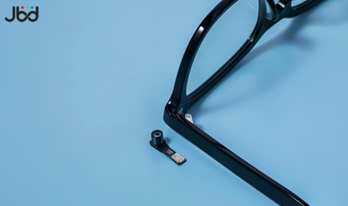
JBD “Hummingbird Mini II” mono-color engine (0.15cc, 0.3 grams) and daily-use glasses (source: JBD)

JBD “Hummingbird Mini II” mono-color engine (0.15cc, 0.3 grams) and daily-use glasses (source: JBD)

“AI” was the highlight of CES 2025, and AI smart glasses were one of the main attractions. Companies such as Vuzix, Rokid, Goertek, and RayNeo introduced new AI glasses products that use micro-LEDs.

Among the manufacturers of micro-LED displays, China’s Jade Bird Display (JBD), a company specializing in micro-LED microdisplays, has begun mass production at its facility in Hefei with a manufacturing capacity of more than 100 million 0.13-inch micro-LED panels per year. In addition to US and European companies, Chinese and Taiwanese companies such as Sitan and Raysolve are moving quickly to develop and prepare for the production of LEDoS displays. At UBI Research’s seminar held on on February 14, a presentation was given on micro-LED technologies for XR and trends in the industry. AI glasses began to blossom in 2024 with the development of AI and AR technology, and more large manufacturers are expected to enter the market in 2025. AI/AR smart glasses are expected to promote the accelerated development of the AI/AR industry, and there are high expectations for the development of micro-LED technology.

UBI Research published a report on micro-LED technology for XR in January. This report summarizes the technology related to the production of LEDoS panels required for XR glasses. It will help to improve the understanding of LEDoS’s micro-LED technology and will be an important reference for companies developing micro-LED display technologies to plan the future direction of technological development.

UBI Research Nam Deog Kim Analyst(ndkim@ubiresearch.com)

▶Micro-LED Display Technologies for XR Applications Report Sample