LG and Samsung and Expand OLED TV Competition… Premium TV Market Landscape Shifts
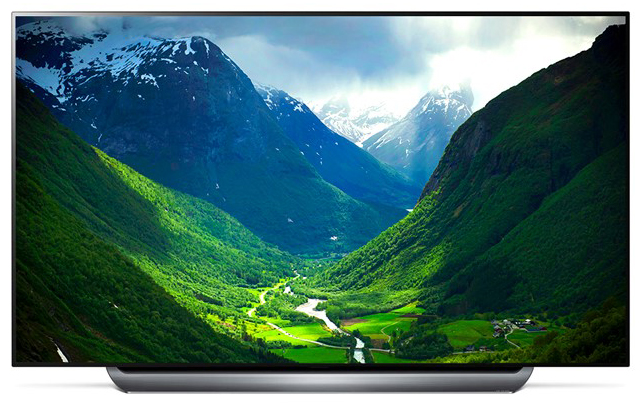
The influence of OLED TVs in the premium TV market is rapidly expanding. While the OLED TV market has historically been shaped largely by LG Electronics, the competitive landscape of the global premium TV market is gradually changing as Samsung Electronics actively expands its OLED TV strategy. In particular, Samsung has repositioned OLED TVs as core, image-quality–focused products within its premium TV lineup, signaling that the OLED TV market is entering a new phase of growth.
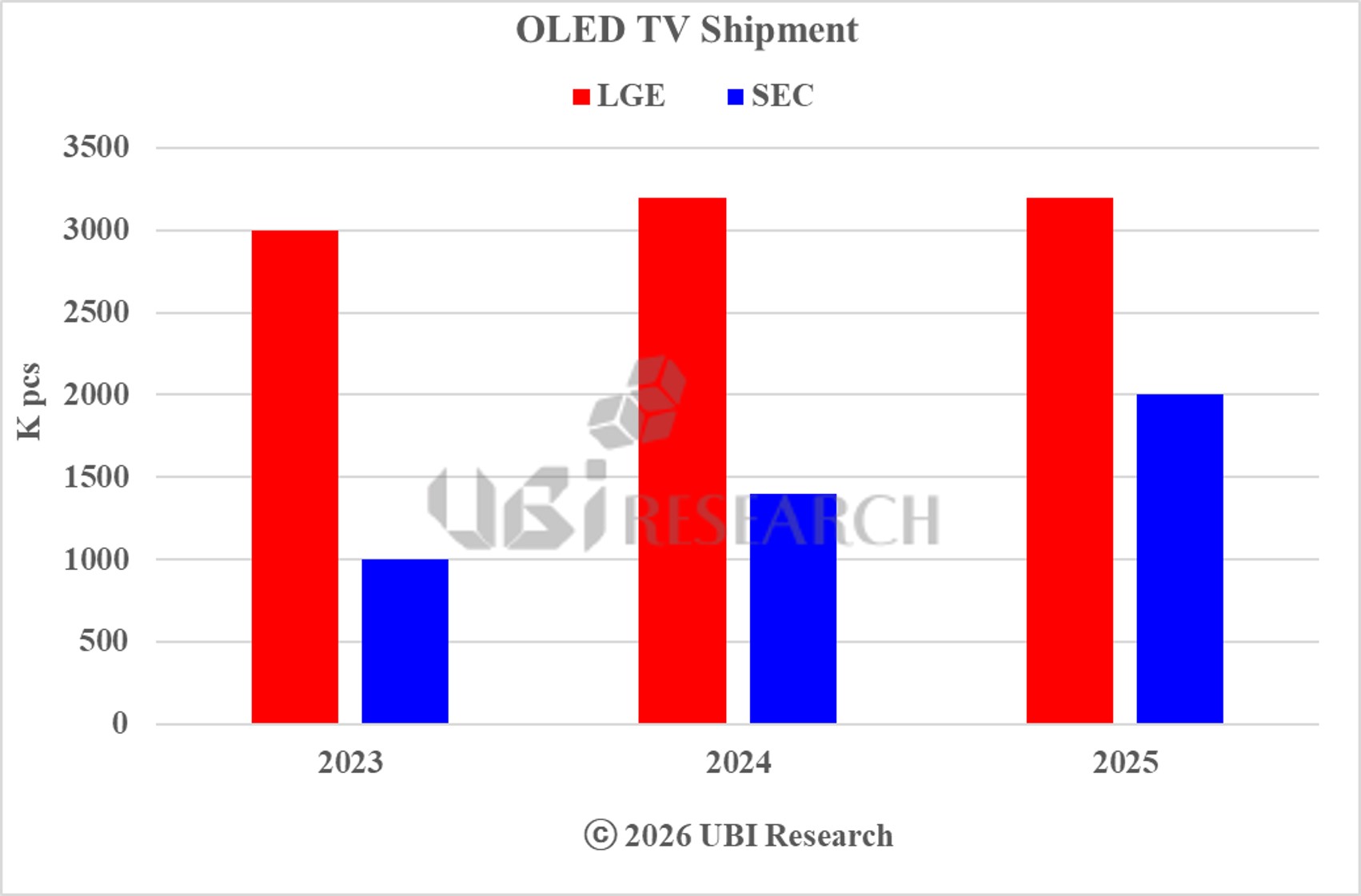
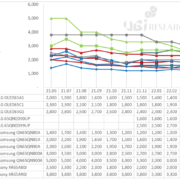
OLED TV shipments by LGE and SEC. LG maintains around 3.2 million units, while Samsung rapidly increases its volume to 2 million units in 2025. (Source: UBI Research)
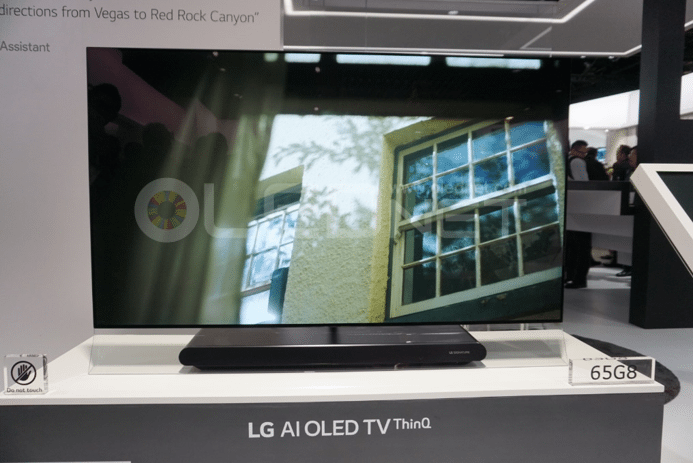
According to an analysis by UBI Research, LG Electronics’ OLED TV shipments have remained stable at around 3 million units annually in recent years. Shipments, which were about 3 million units in 2023, increased to approximately 3.2 million units in 2024 and remained at a similar level in 2025. Since the early stages of the OLED TV market, LG Electronics has fostered OLED as a central pillar of its premium TV strategy, strengthening its competitiveness through ultra-large models and a wide range of design-oriented products. This strategy demonstrates that LG continues to maintain a significant leadership position in the OLED TV market.
Meanwhile, Samsung Electronics has shown rapid growth in the OLED TV segment within a relatively short period since entering the market. Samsung’s OLED TV sales increased from about 1 million units in 2023 to approximately 1.4 million units in 2024, and reached around 2 million units in 2025. This growth reflects Samsung’s aggressive expansion of its OLED TV product lineup. In particular, starting in 2025, Samsung began actively adopting WOLED panels from LG Display, enabling the company to expand its OLED TV supply more rapidly. Previously focused mainly on Samsung Display’s QD-OLED panels, Samsung is now utilizing both QD-OLED and WOLED panels to broaden its product lineup and strengthen market responsiveness.
Samsung has also repositioned OLED TVs as image-quality–focused flagship models within its 4K premium TV lineup. While the company’s Neo QLED series—based on Mini-LED LCD technology—has traditionally been recognized for its strengths in brightness and large-screen formats, OLED TVs emphasize superior picture quality through perfect blacks, high contrast ratios, and exceptional color reproduction. As Samsung increasingly positions OLED TVs above Neo QLED models in its lineup, the status of OLED in the premium TV market is gradually rising.
The expansion of the OLED TV market is also aligned with strategic shifts among major global TV manufacturers. In addition to LG Electronics and Samsung Electronics, Sony has strengthened its OLED TV lineup, further increasing the share of OLED in the premium TV segment. As demand for high-quality video content grows and large-screen TV adoption expands, OLED technology—based on self-emissive displays capable of delivering outstanding picture quality—is gaining greater recognition in the premium TV market. These characteristics are further reinforcing the competitiveness of OLED TVs.
At the panel technology level, developments are also underway to improve the cost competitiveness of OLED TVs. At CES 2026, LG Display introduced a new OLED panel structure known as the SE model. This model reportedly reduces panel costs by approximately 20% by removing the polarizer and reducing the number of tandem layers compared with the conventional WOLED structure. Such structural improvements are expected to lower panel prices while enabling OLED TVs to expand into a broader range of price segments. If panel cost reductions materialize, OLED TVs could extend beyond ultra-premium products into a wider portion of the premium TV market.
At the same time, competition between OLED and LCD-based technologies in the premium TV segment is intensifying. Recently, premium LCD TVs using RGB Mini-LED backlights have emerged, introducing a new technological trend that competes with OLED in terms of brightness and color reproduction. These products improve color accuracy and brightness performance compared with conventional Mini-LED LCD TVs, creating a new competitive dynamic with OLED in the premium TV market. Nevertheless, OLED continues to hold advantages in contrast and picture quality derived from its self-emissive structure, maintaining its position as a key technology in the premium TV segment.
Overall, the OLED TV market is expected to continue its growth as Samsung’s aggressive market expansion strategy combines with LG’s stable market leadership and ongoing efforts to reduce panel costs through technological innovation. As Samsung rapidly increases its OLED TV sales, the gap with LG is gradually narrowing. At the same time, the expansion of OLED TV lineups among major global TV manufacturers suggests that the overall OLED TV market is likely to grow further. Even amid continued competition with premium LCD technologies, OLED TVs are expected to remain a central pillar of the premium TV market.
Changwook Han, Executive Vice President at UBI Research, stated, “Samsung Electronics has recently been aggressively expanding OLED TVs as core products in its premium TV lineup, while LG Display is advancing panel structure improvements that reduce manufacturing costs. As a result, the market competitiveness of OLED TVs is expected to strengthen further.” He added, “With LG Electronics, Samsung Electronics, and Sony leading the expansion of OLED TV shipments, the share of OLED TVs in the premium TV market is expected to steadily increase.”
Changwook Han, Executive Vice President/Analyst at UBI Research (cwhan@ubiresearch.com)
 Pre-register for Display Korea 2026
Quarterly Small OLED Display Market Tracker Sample
Quarterly Medium & Large OLED Display Market Tracker Sample
※ This article is produced by UBIResearchNet.
Unauthorized reproduction or citation without source attribution is prohibited.
When quoting, please clearly indicate the source (UBIResearchNet) and provide a link.







 2023 OLED KOREA