Posts

Automotive Mini LED display adoption expanding with OLED competition

Expanding the application area of Mini LED for vehicle displays

The automotive display market has been rapidly changing in recent years, and Mini LED technology is at the center of this transformation. While some premium brands are embracing OLED for its design freedom and black expression, the overall trend is leaning toward Mini LED, which boasts price competitiveness, durability, and high brightness. Automotive environments require visibility even under direct sunlight and stability under extended use and high temperatures. Mini LED’s long lifespan and high reliability make it ideal for manufacturers to incorporate into mass-produced models.

Automotive display shipment forecast by technology – Mini LED vs OLED (Source: UBI Research)

Automotive display shipment forecast by technology (Source: UBI Research)

According to the “Automotive Display Technology and Industry Trend Analysis Report” published by UBI Research this year, shipments of Mini LED displays for vehicles are expected to increase significantly, from approximately 1.5 million units in 2023 to over 16 million units in 2030. During the same period, OLED is expected to maintain stable growth and provide differentiated value, particularly for premium brands. This suggests that OLED will establish itself as a premium, brand differentiation, and high-end image, while Mini LED, armed with stability and cost-effectiveness, will expand to mass-market models in the mid- to high-end segment.

List of automotive display models applying Mini LED technology (Source: UBI Research)

Automotive models with Mini LED display applications (Source: UBI Research)

For example, Cadillac will equip its 2022 electric SUV Lyriq with a 33-inch Mini LED display, and Lincoln will apply a 48-inch panoramic structure (23.6-inch dual 4K UHD Mini LED) to its new Navigator in 2023. The 2024 Xiaomi SU7 will introduce a 16.1-inch Mini LED CID, and the Sony-Honda joint venture Afeela, scheduled for release in 2026, will feature a 45-inch panoramic display and a 55-inch auxiliary display, suggesting the direction of next-generation electric vehicle interiors.

UBI Research Executive Vice President Changwook Han predicted, “In the automotive display market, Mini LED and OLED will continue to compete in some areas, but at the same time, Mini LED will expand its application to the general public, while OLED will maintain differentiated value in the premium segment.”

Changwook Han, Executive Vice President/Analyst at UBI Research (cwhan@ubiresearch.com)

▶2025 Automotive Display Technology and Industry Trends Analysis Report
65-inch Premium TV $800 Price Drop On Average. Prices Are Expected to Continue to Fall.

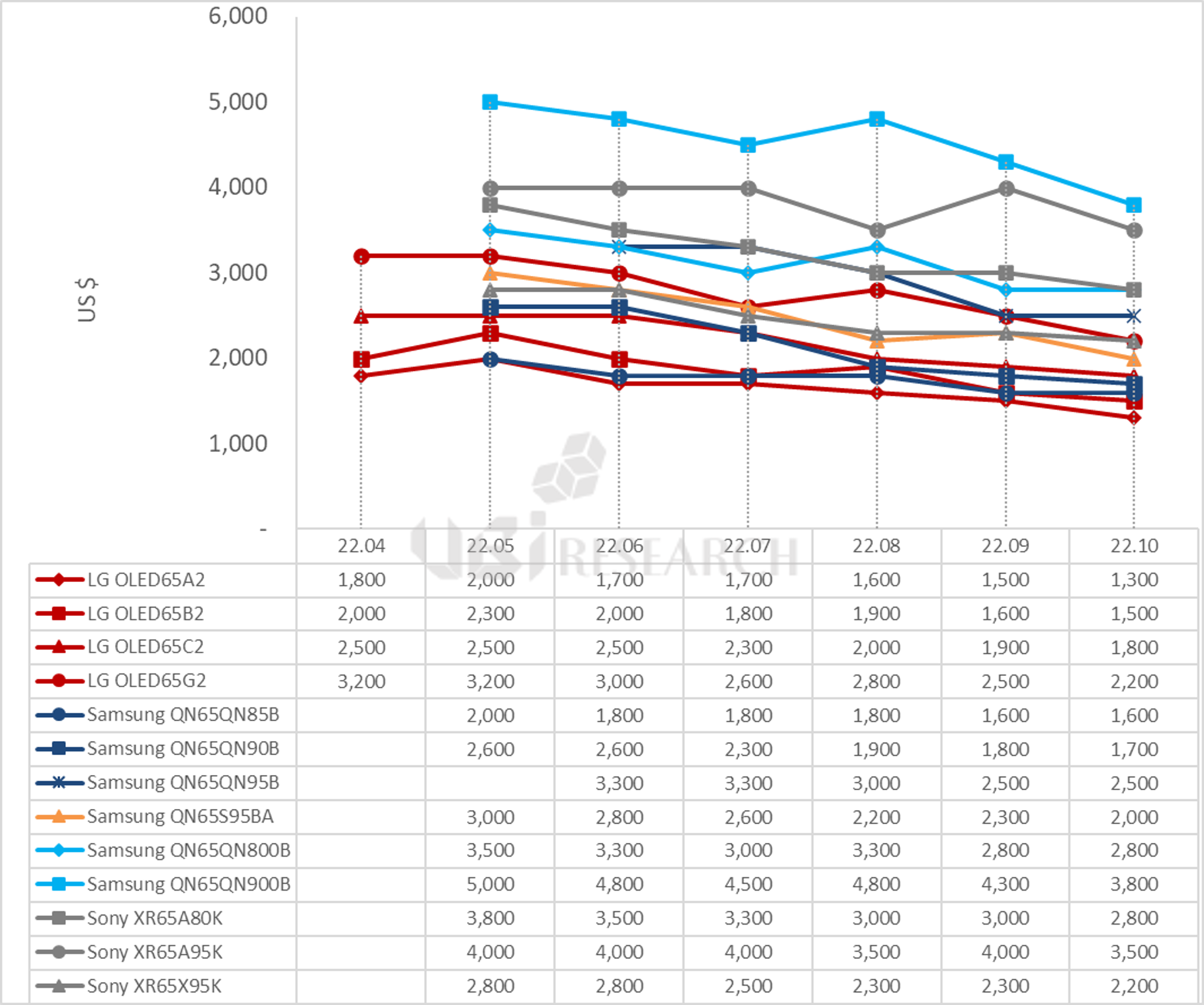
The price of 65-inch premium TV models released from April 2022 was analyzed to have dropped by an average of $800 by October. The price drop is expected to continue for a while because of the Qatar World Cup starting on the 21st of next month and Black Friday on the 25th of November.

Average prices for 65-inch premium TVs

Average prices for 65-inch premium TVs

The prices of Samsung Electronics’ QLED TV and QD-OLED TV, LG Electronics and Sony’s WOLED TV, and Sony’s QD-OLED TV and Mini LED TV were analyzed on a 65-inch basis until October 2022. The selling price of Bestbuy.com was used as the standard, and Sony’s TV was based on the selling price of the official website.

LG Electronics’ WOLED TVs A2, B2, C2, and G2, released in March, were priced at $2,000, $2,300, $2,500, and $3,200, respectively. Samsung Electronics’ 4K QLED TVs 85B, 90B, and 95B cost $2,000, $2,600 and $3,300. 8K QLED TVs 800B and 900B were $3,500 and $5,000. QD-OLED TV, S95B was priced at $3,000. Sony’s WOLED TV, A80K, was priced at $3,800 and QD-OLED TV, A95K, at $4,000. Mini LED TV, X95K was priced at $2,800.

In October, the price of LG Electronics’ G2 model fell by $300, forming an average price difference of $300 per series. Samsung Electronics’ QD-OLED TV, the S95B model, continues to maintain a price difference of $200 lower than LG Electronics’ high-end model, the G2. Sony lowered the price of the WOLED TV A80K by $1,000, the QD-OLED TV A95K by $500, and the mini LED TV X95K by $600.

The higher price of TV, the larger the price drop and among premium TVs, Samsung’s QLED TV, QN90B, had the highest rate of decline at 34.6%. Among OLED TVs, Samsung Electronics’ QD-OLED TV, S95B, had the highest rate at 33.3%.

In terms of price competition, Samsung Electronics’ S95B and LG Electronics’ high-end OLED TV, G2, are competing. Sony’s QD-OLED TV, which had maintained its price range, is also entering the price competition by lowering its price. The prices of Samsung Electronics’ 4K Neo QLED TV series and LG Electronics’ 4K OLED TV series are forming similarly. In Samsung Electronics’ entire TV series, QD-OLED TV is located between 90B and 95B, which are 4K Neo QLED.

Samsung Electronics’ 8K QLED TV, QN800B, has the same price as Sony’s 4K WOLED TV, A80K, and QN900B has a $300 difference from Sony’s QD-OLED TV A95K, leading to consumption of 8K TVs instead of 4K TVs.

With the Qatar World Cup starting on the 21st of next month and Black Friday on the 25th, premium TV prices are expected to continue to decline. Price-competitive marketing by company according to market conditions is expected to be a major variable.

▶ UBI Research website
https://ubiresearch.com/en/

The mini-LED TV market in 2025 is the trend of the premium TV market

Products with more advanced LCDs appear. It is an LCD that has greatly improved brightness, HDR, and color reproducibility by adding QD film and mini-LED to BLU. The existing top-level LCD used a full array local dimming (FALD) BLU with a local dimming zone of about 300 to 500.

When the local dimming zone is increased to more than 3,000 by using mini-LED, the contrast ratio is significantly improved, and the halo effect is reduced compared to FALD BLU LCD TVs. In order to achieve the same performance as OLED, the local dimming zone must have as many pixels as the number of pixels, but due to the limitation of LED size reduction, mini-LED TVs to be sold this year will have a local dimming zone of 1,000-3,000 products.

To make the best LCD TV, a TFT substrate capable of AM driving mini-LED BLU is needed. The competitive pointer of LCD TVs using mini-LED BLU is a technology that can make the image quality similar to OLED while minimizing the local dimming zone and the number of LEDs. In order to realize the same image quality as OLED, the local dimming zone must be more than 100,000 divisions, and hundreds of thousands of LEDs and TFT substrates are required for driving, so the manufacturing cost of panels (including modules) becomes similar to that of OLED.

If the backplane of the mini-LED BLU uses FR4 or BT and the local dimming zone is divided into 3,000, the mini-LED TV manufacturing cost can be reduced to about half of that of the OLED TV, maximizing the quality of the LCD TV while lowering the price. The TV with the best cost performance is created.

The manufacturing cost of mini-LED BLU for 65-inch TVs with a local dimming zone of 10,000 divisions or less is analyzed at 250-1,100 dollars level, and the TV price is expected to range from 1,500 to 6,000 dollars depending on the size and local dimming division level. In 2021, the mini-LED TV market is expected to form 2.5 million units.

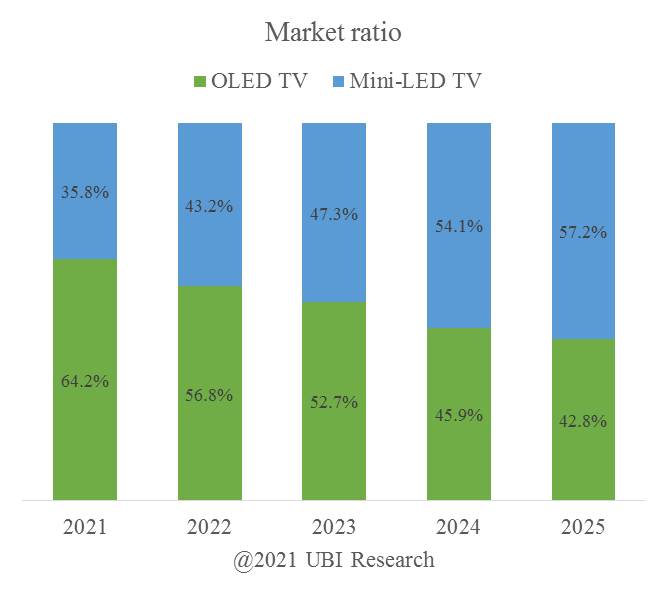
In terms of market share with OLED TVs, mini-LED TVs are expected to dominate after 2024.

TCL has led the development of Mini-LED TVs, but the market will be led by Samsung Electronics and LG Electronics.