Posts

LG Display logo (Source: LG Display)

LG Display Returns to Profit on Apple OLED Supply: Conditions for Profitability in 2027

Mobile dependence revealed in 3Q results, the 4Q supply outlook, and variables in the 20th-anniversary iPhone and monitor businesses

LG Display returned to an operating profit in 3Q 2026. On October 22, it reported consolidated revenue of KRW 6.277 trillion and operating profit of KRW 250.6 billion. Higher shipments of large and mobile OLED panels and a greater share of high-value products brought the company out of the red. However, revenue fell 10% and operating profit 42% year on year, leaving earnings below last year’s peak-season level.

The recovery centered on increased mobile OLED supply for new iPhone production. Shipments to Apple are expected to continue supporting results in 4Q.

LG Display’s Key Quarterly Results

Metric 3Q 2025 2Q 2026 3Q 2026
Revenue KRW 6.957 trillion KRW 5.6121 trillion KRW 6.277 trillion
Operating profit KRW 431 billion KRW -107.7 billion KRW 250.6 billion
Operating margin Approx. 6.2% Approx. -1.9% Approx. 4.0%
OLED share of revenue 65% 57% 67%

Higher Apple Shipments Reshape the 3Q Revenue Mix

Mobile products accounted for 42% of total revenue in 3Q, up 10 percentage points from 2Q. A simple calculation using disclosed revenue and product shares puts mobile revenue at roughly KRW 2.6 trillion, up from about KRW 1.8 trillion. The mobile increase exceeded the rise in total revenue, offsetting declines in other product groups.

Apple began selling the iPhone 18 Pro and Pro Max on September 18. LG Display’s smartphone OLED supply to Apple rose more than 50% from 2Q to 3Q, with a higher share of new Pro models.

The return to profit appears to reflect lower fixed costs per panel from higher volumes and higher average revenue from a greater share of high-specification products.

4Q Apple Supply and Profitability Outlook, and 1H 2027 Volume Outlook

LG Display guided for an approximately 10% increase in shipment area from 3Q to 4Q and a low-single-digit rise in ASP per unit area. In its 3Q Market Tracker, UBI Research forecasts that 4Q smartphone OLED supply to Apple will rise by at least 10% but less than 20% from 3Q. It also expects LG Display’s smartphone OLED supply to Apple to grow from the low-to-mid 80 million range in 2026 to the high-80 million range in 2027.


LG Display’s Key OLED Shipment Trends

Product group 2026 estimate 2027 forecast Analysis focus
Smartphones for Apple Low–mid 80 million units High-80 million units Higher supply in 1H
Tablets for Apple High-2 million units Low-3 million units More volume with existing customers
Watch OLED Low-30 million units Mid-30 million units Gradual supply expansion
TV and monitor WOLED Mid–high 7 million units High-8 million units Monitor-focused product mix

Source: UBI Research estimates and LG Display’s business direction. Figures refer to panel shipments.


Outlook for Four-Sided Bending in the 20th-Anniversary iPhone

A display with OLED edges bent on all four sides to reduce bezels is under discussion for the 20th-anniversary iPhone in 2027. According to UBI Research, four-sided bending is planned for 2027, while COE and LTPO+ adoption is expected to be delayed until 2028 or later. Although Apple has not announced official specifications, the 2027 changes may focus first on panel shape rather than adopting all new technologies at once.

If four-sided bending is adopted, ensuring optical performance at the panel edges alongside reliable encapsulation, wiring and module assembly will become important. Greater technical difficulty may create opportunities for capable suppliers, but could also add process steps and increase initial defect burdens. LG Display’s profitability will depend more directly on how quickly it stabilizes mass-production yields after customer qualification than on new technology adoption itself.


New Technology Investment and Use of Existing Facilities in 2027

Official investment plans are already underway over two periods. The KRW 1.26 trillion OLED technology investment approved in June 2025 is scheduled to end in June 2027. The KRW 1.106 trillion investment in new technology infrastructure approved in April 2026 runs through June 2028. LG Display described the former as building infrastructure for next-generation panels and modules, and the latter as strengthening OLED technology competitiveness and the foundation for growth.

Officially confirmed item Period and amount Implications for 2027
Technology investment approved in 2025 KRW 1.26 trillion
Through June 2027
Key period for adapting installed equipment to products
and preparing it for operation
Technology investment approved in 2026 Approx. KRW 1.1 trillion
Through June 2028
Continued investment for future technologies
Does not imply full spending in 2027
2026 company-wide CAPEX outlook Low KRW 2 trillion range Separate from the 2027 annual budget

Source: LG Display investment announcements and disclosures

In 2027, customer qualification and operating readiness for previously approved technology equipment will become important. Once investment is executed, equipment operation may bring depreciation charges and initial process costs. Securing customer volumes and stabilizing mass production will therefore determine the returns on investment.

FLiPP is a separate medium- to long-term initiative. LG Display has outlined plans to form RGB pixels without FMMs using its existing infrastructure for large WOLED panels. However, it did not confirm a specific investment amount or mass-production schedule at its 3Q earnings announcement.


Monitor OLED Expansion and Large OLED Profitability

In large OLEDs, monitors were identified as a more important source of incremental growth than TVs. LG Display expects large OLED shipments in the high-7 million range this year, with monitors accounting for about 20%. It plans to increase monitor shipments next year and gradually restart idle capacity as demand grows. UBI Research forecasts that combined TV and monitor WOLED supply will approach the high-8 million range in 2027.

Product expansion is also taking shape. LG Display launched a 24.5-inch 720 Hz gaming OLED in September. In October, it announced that cumulative WOLED sales had exceeded 50 million units and said it would extend applications to office and professional use. This reflects efforts to adapt a production base built around TVs to different screen sizes and uses.

Monitor expansion offers a way to broaden demand using existing large-panel production facilities. TV and monitor panels differ in area and the number cut from each motherglass sheet, so cutting layouts and production allocation by product affect revenue and utilization differently. Large OLED profitability therefore depends on changes in revenue per motherglass sheet and production costs, as well as unit growth.

Automotive OLED is affected by slower European EV demand and delays in mass production of some new vehicles. In the near term, increased monitor supply offers more visible support for results.

LG Display’s challenge in 2027 is to earn profits from more product groups while maintaining supply to Apple. Higher mobile volumes in the first half would ease seasonality, the 20th-anniversary iPhone would test its competitiveness in premium products, and monitor OLED would broaden the earnings contribution of existing large-panel assets. Together, these changes could turn the current peak-season return to profit into a stronger basis for earnings throughout the year.

Infographic comparing LG Display’s 111-inch WOLED expansion with Samsung Display’s 83-inch QD-OLED entry

LGD 111-inch, SDC 83-inch… Is an OLED TV ‘Size Race’ Getting Underway?

Chart comparing 65-, 77-, 83-, 97- and 111-inch OLED TV sizes and competition between WOLED and QD-OLED

Guangzhou Development District Holding Group (广开控股, hereinafter GDDH) announced on October 26 that it will join LG Display in injecting a combined CNY 1 billion (approx. KRW 198.6 billion) into their Guangzhou OLED joint venture (LG Display 70%, GDDH 30%) in proportion to their stakes. The funds will be used to build module lines for 77-, 83-, 97- and 111-inch OLED panels, and GDDH stated that the 111-inch line will be the world’s first dedicated module line based on WOLED (as reported by CINNO Research). LG Display’s current WOLED lineup spans 42 to 97 inches; the addition of 111 inches would raise the maximum size of OLED TVs by another step.

Samsung Display is also on the move. Its QD-OLED TV panels have so far been limited to 55, 65 and 77 inches, which is why Samsung Electronics has used LG Display’s WOLED panels in its 83-inch OLED TVs. In April this year, however, Samsung Display registered an 83-inch QD-OLED panel for UL Solutions certification for the first time, and the industry sees a possibility of mass production in 2027.

Looking back, it is LG Display that has led the size expansion of OLED TVs. WOLED, which started at 55 and 65 inches, grew through 77 and 83 inches to reach 97 inches in 2022, and sizes of 83 inches and above have effectively been supplied by LG Display alone. The Guangzhou investment is not a panel capacity expansion but a technology upgrade of the module process. Its aim is to enable ultra-large panels produced at the existing Gen 8.5 OLED fab (90,000 glass substrates per month) to be finished into complete modules on site.

The first driver of OLED TV upsizing is a shift in the competitive landscape with LCD. Chinese TV makers are rapidly expanding the market for 100 inches and above with Mini LED and RGB LED backlit LCDs. If OLED fails to enter this segment, it will have no choice but to cede premium ultra-large TV demand to LCD.

Second, upsizing raises the utilization of existing equipment. A Gen 8.5 mother glass (2200×2500 mm) yields three 65-inch panels or two 77-inch panels, but theoretically only one 111-inch panel. Because glass consumption rises sharply even at the same unit volume, fab utilization and revenue per unit can be lifted together without investing in a new fab. As both companies operate Gen 8.5 lines, upsizing serves as a means of improving profitability.

Third, the zone of differentiation is moving upward. 83 inches has long been a size monopolized by LG Display, but it will turn into a contested segment once QD-OLED enters. LG Display’s move to set up 97- and 111-inch module lines at the same time can be read as a step to secure the next zone of differentiation in advance.

Because ultra-large OLEDs yield few panels per mother glass, yield translates directly into cost. The 111-inch market is expected to take shape initially around a limited number of premium home and commercial display applications.

HKC OLED strategy covering H6 production, H7 investment delays and the proposed H8 WOLED line

HKC OLED Business Review… H7 Delays and H8 WOLED Plans Reshape Investment Direction

Written by: Junho Kim, Analyst

H6 Backplane Bottlenecks, H7 Schedule Revisions, and Changsha R&D Funding Define the Conditions for Entry into Large-Area OLED

HKC’s OLED business has entered a phase of adjusting the timing and direction of mass-production investment. The Shenzhen H6 plant is shipping small quantities of smartphone OLED panels, building experience in product development and customer qualification. Meanwhile, the schedule and process approach for the new Gen 6 OLED investment at Mianyang H7 have been revised repeatedly. The H8 project, which envisages a 50K-per-month White OLED (WOLED) line on a site adjacent to Changsha H5, has also been confirmed to be under review.

H6 is an operating low-volume production site, H7 combines relocated LCD equipment with new OLED investment, and H8 remains an internal proposal. In its September investor relations (IR) activity report, HKC stated that its OLED business remains focused on R&D and that industrialization would proceed according to technological maturity and market demand. The company appears to be reassessing the sequence of mass-production investments and its target markets while continuing low-volume production and R&D at H6.


Changsha OLED R&D Funding Plan Takes Shape

HKC operates four Gen 8.6 LCD lines at Chongqing H1, Chuzhou H2, Mianyang H4, and Changsha H5. Following its listing in June 2026, the company secured funding for OLED technology development. According to its October 13 disclosure, gross IPO proceeds totaled RMB 8.493 billion, with net proceeds of RMB 8.187 billion after issuance expenses. The disclosure also outlined a plan to lend up to RMB 2.5 billion to Changsha HKC for the ‘Changsha New OLED R&D Upgrade Project.’ Funds will be disbursed in installments according to project needs. With this funding mechanism in place, Changsha is increasingly likely to become a central base for OLED technology and process development.

Both the proposed H8 site and the disclosed OLED R&D base are located in Changsha. If H8 proceeds as currently proposed, it could benefit from process transfer, workforce deployment, and shared infrastructure.

H6: Backplane Supply Is the Key Variable for Output Expansion

H6 houses Royole’s former Gen 5.5 AMOLED equipment. At its September IR meeting, HKC stated that product development and pilot production were underway at H6 and that small-scale production and shipments had begun. The site has accumulated hands-on experience in linking OLED design, process conditions, and customer qualification to actual products.

H6 Equipment Configuration and Expansion Constraints

Category Equipment and Process Configuration Business Implications
H6 PH1
Former Royole Equipment
Backplane (BP) substrate: 1,300 × 1,500 mm, 4K/month. Deposition uses quarter-cut 650 × 750 mm glass. Hybrid structure combining a glass substrate and thin-film encapsulation. Base line providing operating experience. BP input capacity sets a benchmark for downstream expansion.
H6 PH2
Used Deposition Equipment
Uses second-hand Sharp Gen 4.5 deposition equipment. Deposition area: 730 × 920 mm. No separate matching BP equipment has been secured. Finished-panel output depends on externally sourced BPs and process compatibility.
Supporting Processes and R&D Equipment One Kateeva inkjet system and a 200 × 200 mm R&D line. Touch processing is outsourced because there is no TSP process. Integration of encapsulation, product structure, and outsourced touch processing affects module-production stability.
Relocation and Setup Considering turnkey outsourcing of dismantling, relocation, and installation.
Candidates: Siyue, Xinyihua, Wuhan Jingce.
Vendor selection and division of responsibilities will affect installation timing and restart stability.

H6 PH2 is being reviewed on the assumption that deposition equipment will be added while BPs are supplied from another site. Actual output may depend on BP supply volume, cutting dimensions, product design, and process compatibility.


H7: LCD Equipment Transfer and Delays in OLED Investment

H7 is understood to be proceeding under an existing corporate entity at a site adjacent to Mianyang H4. H7 PH1 is a proposed 60K-per-month line using relocated second-hand Gen 6 LTPS LCD equipment from JDI, while H7 PH2 represents a new Gen 6 OLED investment. DMS announced that it signed an equipment supply contract worth approximately KRW 41.3 billion with HKC on July 6, 2026, with the equipment to be installed at Mianyang H7. Orders for the H7 PH2 OLED deposition line have yet to be determined.

H7 Initial Plan and Progress as of October 2026

Category LCD and BP, H7 PH1 OLED, H7 PH2
Initial Plan JDI line dismantling in October 2025. LCD and OLED BP light-up in November 2026. OLED BP supply to H6 from November 2027. eLEAP: 32K/month (8K + 24K). Deposition tools scheduled for March 2027, mass production for June 2028.
As of October 2026 Arrival of used equipment has begun, but setup is reportedly delayed by difficulties coordinating relocation and installation. Year-end ordering remains uncertain. Prolonged project review could lead to cancellation of the Gen 6 OLED investment.

In its September IR report, HKC explained that pressure on smartphone demand from rising memory prices and other factors is also affecting the small OLED market. With limited visibility into pricing and volumes, the burden of initial yield losses could be greater for a late entrant. HKC is therefore expected to reconsider its target customers and product mix while adjusting order timing and investment plans. H7 PH2 is planned to adopt JDI’s eLeap technology, making yield attainment with the new process a major factor in the start of mass production.

H6’s BP procurement plan is linked to production readiness at H7 PH1. The original plan called for H7 PH1 to supply OLED BPs to H6. Even if the H7 PH2 OLED investment is canceled, an H6 supply route could remain if H7 PH1’s BP production and qualification plans continue. Conversely, delays in H7 PH1 setup or BP process conversion could limit the benefits of expanding H6 PH2. BP production readiness and supply qualification at H7 PH1 therefore appear likely to be key variables for increasing shipments from H6.

H8 WOLED: An Option to Leverage Existing Customers and Process Capabilities

H8 is a proposal to build a 50K-per-month WOLED line on a site adjacent to Changsha H5. The substrate generation, phased investment cost, and mass-production schedule have not yet been determined. Compared with H7’s small- and medium-size OLED investment, the plan suggests an expansion into large-area OLED, drawing on HKC’s existing LCD customer base in TVs and monitors and its large-substrate process capabilities.

WOLED uses a stacked emission structure that produces white light over a large area, with color generated through color filters. LCD manufacturers experienced in Oxide TFT and color-filter processes may be able to leverage existing expertise. However, because OLED is current-driven, TFT characteristics optimized for LCD cannot be directly applied to OLED, and bringing products into mass production will require considerable time. HKC’s 2026 interim report reported mass production of LCD products using its proprietary HMO (high-mobility oxide) technology and identified the potential to extend the technology to OLED backplanes.

H8 Existing Business Capabilities and Mass-Production Validation Tasks

Area Existing Capabilities Items to Verify Before Mass-Production Investment
Backplane Large-area LCD production and experience with Oxide and HMO technologies Device stability for OLED current driving, compensation circuits, uniformity, and long-term reliability.
Emission and Deposition Large-substrate handling and OLED process experience at H6 WOLED stack structure, deposition uniformity, material combinations, lifetime, and process throughput.
Color Filter and Encapsulation Potential use of LCD color-filter processes and infrastructure OLED-specific optical design and filter properties, low-defect encapsulation, contamination control, and scope for equipment reuse.
Customers and Supply Chain TV and monitor customers and experience operating in-house brands External customer qualification and purchase volumes, key equipment acceptance criteria, materials sourcing, and required technology licenses.

Integration with HKC’s existing finished-product business is also possible. HKC operates the HKC, ANTGAMER, and KOORUI brands, and its official product site lists the OG27QK, a 2K 240Hz OLED monitor. OLED monitor panels are currently sourced externally. In-house panels could support vertical integration from product planning through modules to finished products, while the company’s own brands could serve as initial channels for product validation.

The actual shipment potential of a 50K-per-month line depends on substrate generation, panel yield per substrate, production yield, and utilization. In-house brands could support initial product qualification and shipments, but purchase commitments from external TV and monitor customers would also likely be needed to sustain stable line utilization.

Competing products are also improving. LG Display is refining its emission structure by applying Primary RGB Tandem 2.0 to its 2026 Tandem WOLED. H8’s competitiveness will depend on how it balances the brightness, color characteristics, lifetime, and price required by customers. Qualification as an additional source for product segments where these requirements can be met could provide one route into the market.


Funding and Capital Deployment Pace for OLED and Semiconductor Businesses

HKC has secured investment funding through IPO proceeds and operating cash flow. Its 2026 interim report showed higher revenue and lower net profit, alongside improved cash flow from operating activities. Expected returns from new OLED investment and funding needs in other businesses are likely to influence future investment priorities and the pace of capital deployment.

HKC Investment Capacity and Financial Constraints

Item H1 2026 or June 30 Key Changes and Implications
Revenue / Net Profit Attributable to Owners RMB 20.516 bn / RMB 1.857 bn Year-on-year changes of +7.99% and −14.07%, respectively. Revenue growth accompanied by weaker profitability.
Operating Cash Flow RMB 5.041 bn Up 24.35% year on year. Internal investment funding from operations is maintained.
Cash and Monetary Assets / Restricted Portion RMB 46.609 bn / RMB 23.490 bn Includes time deposits, pledged assets, and guarantee deposits. Funds available for investment depend on restrictions.
Total Liabilities RMB 75.076 bn Consolidated liabilities include recognized obligations to acquire equity interests in subsidiaries.

Source: HKC 2026 interim report, consolidated basis. Income and cash flow cover January–June; cash and liabilities are balances as of June 30.

In a July disclosure, HKC announced that it would establish a wholly owned subsidiary with registered capital of RMB 4 billion for advanced packaging and testing in Shaoxing, Zhejiang Province. Capital will be contributed from internal funds over two to three years. Phase 1 targets 12-inch hybrid-chip packaging and testing, with a planned throughput of 20 million chips per month at full capacity.

According to the interim report, cumulative investment in the Chengdu project reached approximately RMB 2.6 billion at the end of June, representing 44.01% progress. Funds had been allocated to equipment and real estate. At its September IR meeting, HKC also described the Chengdu and Shaoxing businesses as advanced packaging and testing projects. Semiconductor investments already underway are likely to affect not only funding but also the allocation of equipment procurement, personnel, and management resources.

A possible plan to produce 12-inch, 20nm-class DRAM at the Gaozhen (Jinsemi) pilot plant in Chengdu was also identified. It involves adding second-hand equipment and reconfiguring the line, targeting a restart by the end of 2026.

IPO funds allocated to Changsha OLED have designated uses, while capital for Shaoxing will be contributed from internal funds in stages. HKC appears to be maintaining cash generation from LCD, continuing OLED R&D, and adjusting the sequence of major mass-production investments as it evaluates customer commitments and commercial feasibility.


Investment Stages and Equipment Order Outlook by Project

HKC’s equipment needs can be divided into H7 LCD relocation and modification, H6 process upgrades, Changsha OLED R&D, and future H8 mass-production facilities. Each involves different equipment and procurement schedules. R&D equipment may be ordered first; the timing and overall scale of orders for a 50K-per-month production line are likely to become clearer only after a specific investment plan is finalized.

Key Items to Monitor by Project

Project Key Items to Verify Business Implications
H6 Approval of external BP supply, installation of H6 PH2 deposition equipment, and repeated-production results Potential increase in actual panel shipments following deposition-capacity upgrades.
H7 LCD / BP Completion of relocation, stabilization of TFT processes, and specifications and qualification of OLED BPs for H6 LCD restart timing and potential to supply OLED BPs to H6.
H7 OLED Finalization of technology approach, deposition-tool orders, investment cost, and equipment arrival schedule Whether new OLED capital investment will materialize and its implementation schedule.
H8 Government agreements, project filing (备案) and environmental impact assessment, substrate generation, funding, and deposition-tool orders Clarification of whether mass-production investment will proceed and projected capacity. Subsequent qualification and customer orders will affect utilization.

If H8 proceeds with WOLED, new opportunities could emerge in large-area deposition, encapsulation, inspection, process automation, and emissive materials. The actual scope of new equipment orders will depend on how much of the existing TFT, color-filter, and other infrastructure can be reused. For Korean equipment and material suppliers, WOLED mass-production experience could be an advantage, while price competition with Chinese suppliers, local support, technology licenses, and customer acceptance requirements will also affect order prospects.

The impact on LG Display will depend on H8’s progress toward mass production and customer qualification. If HKC passes qualification by major customers and establishes a record of stable, good-quality supply, buyers could gain another WOLED procurement option. This may alter customers’ multisourcing strategies and price negotiation dynamics.

HKC appears to be continuing H6’s low-volume production and Changsha R&D while considering OLED mass-production investments linked to its existing TV and monitor businesses. The execution and results of Changsha R&D, BP supply readiness at H7 PH1, and further definition of the H8 investment plan will be key variables in assessing future investment scale and timing.

LG디스플레이 27인치 5K WOLED 패널의 RGB 스트라이프와 Square 픽셀 구조 비교 자료

LG Display Unveils 27-Inch 5K WOLED with 220 PPI and RGB Stripe Structure

LG Display 27-inch 5K WOLED presentation comparing text and line clarity between RGB stripe and square pixel structures (Source: UBI Research)

Whiteness comparison between RGB stripe and square pixel structures for LG Display’s 27-inch 5K WOLED. (Source: UBI Research)

LG Display unveiled its 27-inch 5K OLED monitor panel technology during an on-site seminar at K-Display 2026. The newly introduced panel is based on Tandem WOLED technology and features a resolution of 5,120 × 2,880 and a high pixel density of 220 PPI on a 27-inch screen.

LG Display presented the 27-inch 5K OLED as a solution for professional work environments that require precise image reproduction, including graphic design and video editing. At the same 27-inch size, conventional QHD products offer a resolution of 2,560 × 1,440 and 110 PPI, while the 5K panel doubles the number of pixels in both the horizontal and vertical directions, resulting in four times the total pixel count.

A key feature of the panel is its RGB stripe pixel structure. The red, green, and blue subpixels are arranged side by side in a consistent direction, reducing color fringing and color distortion around the edges of text and lines while improving the clarity of high-resolution content.

According to the whiteness evaluation results presented by LG Display at the seminar, the RGB stripe structure achieved 97.9% for line rendering and 97.1% for text rendering. By comparison, the square pixel structure recorded 93.1% for lines and 94.9% for text. LG Display explained that the RGB stripe structure reduces color fringing around the edges of text and straight lines, providing a more uniform appearance that is closer to pure white.

The 27-inch 5K panel delivers a brightness of 250 nits at 100% APL and supports DisplayHDR True Black 400 and 99% DCI-P3 color gamut coverage. The 27-inch QHD panel presented for comparison offers 300 nits at 100% APL, DisplayHDR True Black 500, and 99% DCI-P3 coverage.

Because the 5K panel has twice the pixel density of the QHD model, it presents greater technical challenges in securing aperture ratio and brightness, as well as in manufacturing yield and cost. LG Display has secured the technology required to produce a 27-inch 5K WOLED panel, but additional process stabilization and yield improvements are believed to be necessary before mass production. Full-scale mass production is expected to begin after 2028.

The 27-inch 5K panel unveiled at the event uses the four-stack emission structure currently applied to LG Display’s WOLED products. The four-stack structure consists of two blue emitting layers and one red and one green emitting layer. Separately from this four-stack structure, LG Display is also developing a next-generation five-stack WOLED technology that increases the number of blue emitting layers to three. The five-stack structure consists of three blue emitting layers and one red and one green emitting layer, and its development is reportedly at an advanced stage.

LG Display’s 27-inch 5K OLED technology demonstrates the potential to expand WOLED applications beyond TVs and gaming monitors into the professional high-resolution IT market. In particular, the combination of 220 PPI resolution and an RGB stripe structure is significant because it improves text readability and reduces color fringing, which have long been regarded as weaknesses of OLED monitors.

Junho Kim, Analyst at UBI Research (alertriot@ubiresearch.com)

▶2026 Medium & Large Size OLED Display Annual Report

▶Quarterly Medium & Large OLED Display Market Tracker Sample

※ This article is produced by UBIResearchNet.

Unauthorized reproduction or citation without source attribution is prohibited.

When quoting, please clearly indicate the source (UBIResearchNet) and provide a link.

Bar chart showing the rapid increase in OLED monitor shipments from 2026 to 2030.

OLED Monitor Market Sees Rapid Growth… Shipments Up 64% in 2025

Global OLED monitor panel shipment forecast graph from 2026 to 2030

OLED monitor market trends with over 50% growth expected in 2026, following a 64% surge in 2025. (Source: UBI Research)

Global OLED monitor shipments in 2025 are estimated at approximately 3.2 million units, marking a sharp year-on-year increase. According to UBI Research’s Medium & Large OLED Display Market Tracker, OLED monitor shipments in 2025 rose by about 64% from 1.95 million units in 2024. Growth of more than 50% is also expected in 2026, positioning OLED monitors as the fastest-growing application segment within the mid- to large-sized OLED industry.

This strong growth is closely linked to strategic shifts by panel makers. Samsung Display is focusing on expanding shipments of OLED panels for monitors—centered on its QD-OLED mass production lines—where unit prices and profitability are relatively higher than for TV panels. As adoption of QD-OLED expands across premium gaming monitors and creator-focused products, monitors are taking up an increasing share of Samsung Display’s mid- to large-sized OLED strategy.

LG Display is also maintaining its supply of WOLED TV panels while intensifying efforts to expand OLED monitor shipments. After beginning OLED monitor panel supply at around 100,000 units in 2023, LG Display increased shipments to roughly 200,000 units in 2024 and is estimated to have reached about 400,000 units in 2025. In 2026, shipments are expected to continue rising through new customer acquisitions and improved line utilization.

Behind the panel makers’ growing focus on OLED monitors rather than TVs are production efficiency and profitability considerations. On 8.5-generation glass substrates, TV panels typically achieve a utilization rate of around 60–70%, and even with MMG (Multi Model Glass) technology applied, utilization often remains near 80%. In contrast, monitor panels—based on IT-standard sizes such as 27-inch and 34-inch—can be laid out to achieve utilization rates exceeding 90%. Moreover, on a price-per-area basis, OLED monitor panels offer relatively higher profitability than TV panels, making them an attractive option in terms of both line efficiency and margins.

This trend is not limited to Korean manufacturers. Chinese panel makers are also accelerating their entry into the IT OLED market. BOE is gradually increasing shipments of IT OLED panels, while TCL CSOT is planning shipments of OLED monitor panels based on its in-house inkjet-printed OLED technology. Over the mid to long term, the entry of Chinese players is likely to enhance both price competitiveness and product diversity in the OLED monitor market.

Changwook Han, Vice President of UBI Research, commented, “In the mid- to large-sized OLED market, panel makers’ strategic focus is gradually shifting from TVs to monitors.” He added, “OLED monitors offer both high glass utilization and a relatively stable profit structure.” He further noted, “Not only Korean companies but also Chinese panel makers are actively entering the OLED monitor market with their own technologies, and the OLED monitor segment is expected to continue growing as applications expand across gaming, creator, and premium IT devices.”

Changwook Han, Executive Vice President/Analyst at UBI Research (cwhan@ubiresearch.com)

▶ Quarterly Small OLED Display Market Tracker Sample

▶Quarterly Medium & Large OLED Display Market Tracker Sample

※ This article is produced by UBIResearchNet.
Unauthorized reproduction or citation without source attribution is prohibited.
When quoting, please clearly indicate the source (UBIResearchNet) and provide a link.

OLED TV Panel Shipments Expected to Surpass 10 Million Units in 2028… Production Line Expansion Needed

OLED Display Market Tracker

OLED Display Market Tracker

According to UBI Research’s quarterly publication, OLED Display Market Tracker, the global OLED TV market is projected to approach annual shipments of 10 million units by 2028. As the OLED TV market enters a full-fledged growth trajectory, attention is turning to the production expansion strategies of key panel manufacturers.

Recently, Samsung Electronics has expanded its OLED TV lineup featuring WOLED (White OLED) panels and is actively increasing panel purchases from LG Display. Currently, all WOLED TV panels used by Samsung Electronics are supplied exclusively by LG Display.

UBI Research’s analysis indicates that considering the current mass production capacities of LG Display’s WOLED panels and Samsung Display’s QD-OLED panels—along with yield rates—the actual annual output amounts to approximately 10 million units. While existing production capabilities are sufficient to meet current market demand, a surge beyond the 10 million unit mark in 2028 and continued growth thereafter will likely necessitate additional line expansions to satisfy panel demand.

Samsung Electronics is further strengthening its OLED strategy to counter the aggressive Mini-LED push by Chinese TV makers. Following its announcement of a goal to “become No.1 in the OLED TV market,” the company has steadily increased OLED adoption within its premium TV segment.

As a result, LG Display is expected to directly benefit from rising OLED TV demand. Samsung’s aggressive OLED strategy not only improves profitability for WOLED suppliers but also serves as a driving force for long-term production expansion.

UBI Research forecasts that global OLED TV shipments will surpass 10 million units in 2028 and predicts that leading panel manufacturers are highly likely to begin full-scale expansion of dedicated OLED TV production lines.

Changwook Han, Vice President of UBI Research, stated, “OLED has proven its superior picture quality and brand value in the premium TV market. As such, major panel makers will actively consider expanding large-size OLED lines,” adding, “2028 will mark a turning point for the OLED TV market’s resurgence.”

Changwook Han, Executive Vice President/Analyst at UBI Research (cwhan@ubiresearch.com)

▶Quarterly Medium & Large OLED Display Market Tracker Sample

▶ Quarterly Small OLED Display Market Tracker Sample

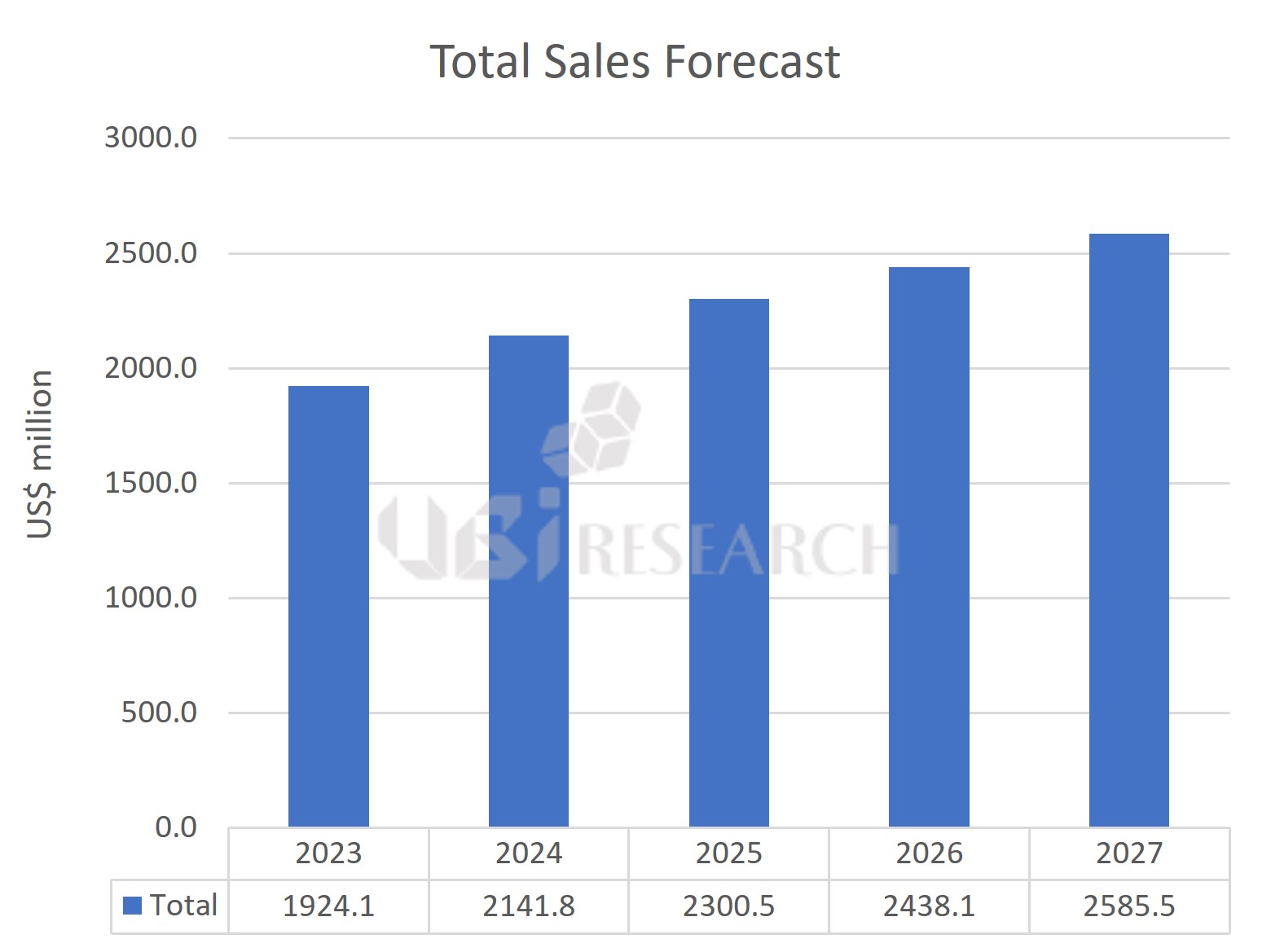
OLED emitting materials market in 2027 expected to reach US$ 2.59 billion with an average annual growth rate of 7.7%

According to the ‘2023 OLED Emitting Material Report’ recently published by UBI Research, the total emitting material market is expected to reach US$ 2.59 billion in 2027 with an average annual growth rate of 7.7% from US$ 1.92 billion in 2023.

total emitting material market

total emitting material market

Analyst Yoon Daejeong of UBI Research said, “The small OLED material market is expected to grow at an average annual growth rate of 2.5% from 2023 to US$ 1.61 billion in 2027. And in 2027, Samsung Display’s purchase of small OLED materials is expected to be US$ 560 million, BOE US$ 430 million, and LG Display US$ 200 million.” and “the small OLED material market will change depending on how much the foldable OLED market replaces the sharp decline in rigid OLED shipments for smartphones.

Analyst Yoon continued, “As the shipments of LG Display’s WOLED and Samsung Display’s QD-OLED are expected to be 12 million units and 3 million units, respectively, in the large OLED material market in 2027, the purchase amount of emitting materials is also expected to be US$ 430 million and US$ 140 million, respectively”

Meanwhile, the report predicted that by OLED method in 2027, RGB OLED would occupy the largest share at 66.6%, followed by WOLED at 16.5%, RGB 2stack OLED at 11.4%, and QD-OLED at 5.5%.

▶ 2023 OLED Emitting Material Report Sample Download

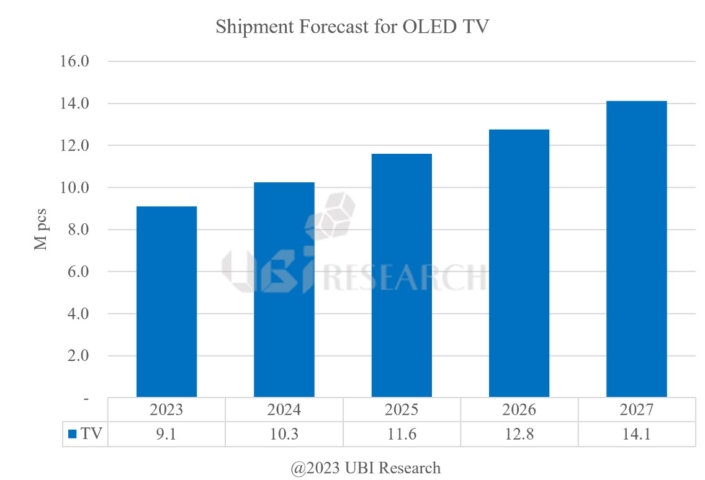
OLED panel shipments for TVs are expected to reach 14.1 million units in 2027 with an average annual growth rate of 11.6% from 9.1 million units in 2023

According to the ‘2023 Medium and Large OLED Annual Report’ recently published by UBI Research, OLED panel shipments for TVs are expected to grow from 9.1 million units in 2023 to 14.1 million units in 2027 with an average annual growth rate of 11.6%.

Shipment Forecast for OLED TV

Shipment Forecast for OLED TV

In 2022, it is analyzed that TV demand will decline due to the global economic deterioration, and global TV shipments will also stop at the early 200 million units. In the case of LG Display, it set a goal to ship more than 10 million WOLEDs in early 2022, including those for monitors, but released a total of 6.96 million units, recording a decrease of 880,000 units from 7.84 million units in 2021. Samsung Display’s QD-OLED shipments for TVs are also analyzed to have recorded 950,000 units.

As the economic situation is expected to gradually recover in 2023, LG Display’s TV WOLED shipments are expected to be 7.6 million units and Samsung Display’s QD-OLED shipments to be 1.5 million units.

Meanwhile, UBI Research predicted that LG Display’s micro lens array (MLA) applied ‘OLED.EX’ panel would be partially mass-produced from 2023, and Samsung Display’s QD-OLED monthly capacity of 36K is expected to be 41K per month by the second half of 2023 and 45K per month by the first half of 2024.

▶ 2023 Medium and Large OLED Display Annual Report Sample Download

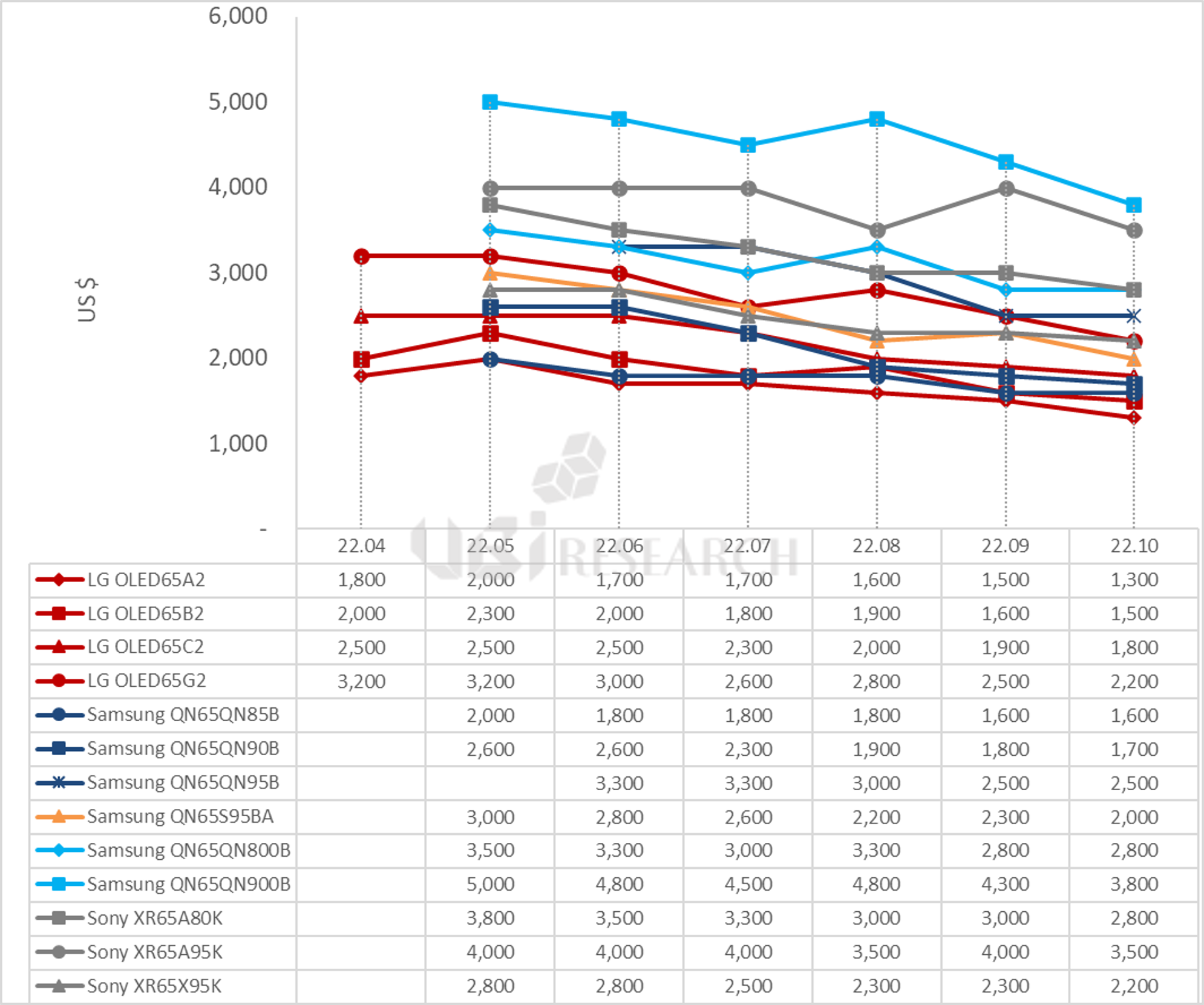
65-inch Premium TV $800 Price Drop On Average. Prices Are Expected to Continue to Fall.

The price of 65-inch premium TV models released from April 2022 was analyzed to have dropped by an average of $800 by October. The price drop is expected to continue for a while because of the Qatar World Cup starting on the 21st of next month and Black Friday on the 25th of November.

Average prices for 65-inch premium TVs

Average prices for 65-inch premium TVs

The prices of Samsung Electronics’ QLED TV and QD-OLED TV, LG Electronics and Sony’s WOLED TV, and Sony’s QD-OLED TV and Mini LED TV were analyzed on a 65-inch basis until October 2022. The selling price of Bestbuy.com was used as the standard, and Sony’s TV was based on the selling price of the official website.

LG Electronics’ WOLED TVs A2, B2, C2, and G2, released in March, were priced at $2,000, $2,300, $2,500, and $3,200, respectively. Samsung Electronics’ 4K QLED TVs 85B, 90B, and 95B cost $2,000, $2,600 and $3,300. 8K QLED TVs 800B and 900B were $3,500 and $5,000. QD-OLED TV, S95B was priced at $3,000. Sony’s WOLED TV, A80K, was priced at $3,800 and QD-OLED TV, A95K, at $4,000. Mini LED TV, X95K was priced at $2,800.

In October, the price of LG Electronics’ G2 model fell by $300, forming an average price difference of $300 per series. Samsung Electronics’ QD-OLED TV, the S95B model, continues to maintain a price difference of $200 lower than LG Electronics’ high-end model, the G2. Sony lowered the price of the WOLED TV A80K by $1,000, the QD-OLED TV A95K by $500, and the mini LED TV X95K by $600.

The higher price of TV, the larger the price drop and among premium TVs, Samsung’s QLED TV, QN90B, had the highest rate of decline at 34.6%. Among OLED TVs, Samsung Electronics’ QD-OLED TV, S95B, had the highest rate at 33.3%.

In terms of price competition, Samsung Electronics’ S95B and LG Electronics’ high-end OLED TV, G2, are competing. Sony’s QD-OLED TV, which had maintained its price range, is also entering the price competition by lowering its price. The prices of Samsung Electronics’ 4K Neo QLED TV series and LG Electronics’ 4K OLED TV series are forming similarly. In Samsung Electronics’ entire TV series, QD-OLED TV is located between 90B and 95B, which are 4K Neo QLED.

Samsung Electronics’ 8K QLED TV, QN800B, has the same price as Sony’s 4K WOLED TV, A80K, and QN900B has a $300 difference from Sony’s QD-OLED TV A95K, leading to consumption of 8K TVs instead of 4K TVs.

With the Qatar World Cup starting on the 21st of next month and Black Friday on the 25th, premium TV prices are expected to continue to decline. Price-competitive marketing by company according to market conditions is expected to be a major variable.

▶ UBI Research website
https://ubiresearch.com/en/

Fierce Price Competition Amongst WOLED TVs, QD-OLED TVs, and Neo QLED TVs

We experienced fierce price competition in the first half of 2022 among premium TVs with a launch price of $2,000 or more. It will be interesting to see how the Amazon Prime Day event scheduled for July will affect TV prices.
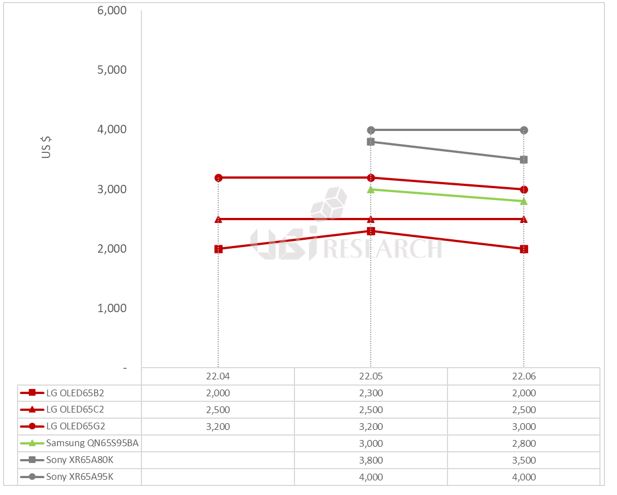
2022 OLED TV prices until June 2022 was analyzed based on 65 inch TVs. The standard was the selling price on Bestbuy.com and Sony’s QD-OLED TV selling price on their official website.
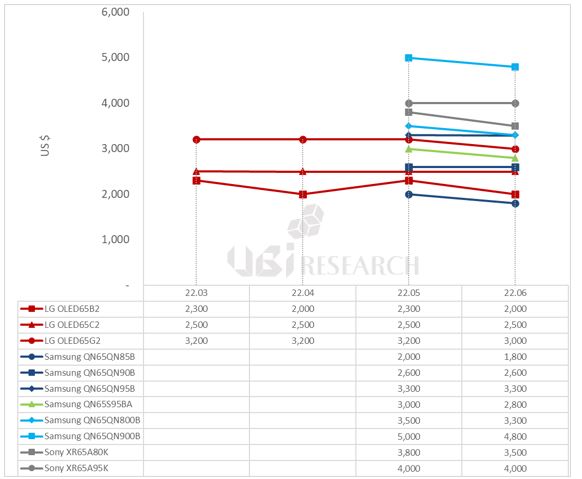
LG Electronics’ WOLED TVs B2, C2, and G2 released in March were $2,300, $2,500, and $3,200, respectively. Samsung Electronics’ QD-OLED TV S95B was $3,000. Sony’s WOLED TV A80K was priced at $3,800 and QD-OLED TV A95K was priced at $4,000.

In June, the price of LG Electronics’ G2 model fell by $200, forming a price difference of $500 for each series. Samsung Electronics’ S95B model continues to maintain a price difference of $200 lower than LG Electronics’ high-end model G2. Sony lowered the price of the WOLED TV A80K by $300, while maintaining the price of QD-OLED TV A95K.
Samsung Electronics’ S95B and LG Electronics’ high-end OLED TV G2 are in heavy price competition. Sony is setting the price of QD-OLED TV higher than WOLED TV.
The price competition is also fierce between OLED TVs from each set makers and Neo QLED TVs with Samsung Electronics’ mini-LED technology.
As of June, the prices of Samsung Electronics’ 4K Neo QLED TVs, QN85B, QN90B, and QN95B, are $1,800, $2,600, and $3,300, respectively. The 8K Neo QLED TVs QN800B and QN900B are $3,300 and $4,800.

The prices of Samsung Electronics’ 4K Neo QLED TV series and LG Electronics’ 4K OLED TV series are similar. Within Samsung Electronics’ entire TV series, QD-OLED TV is located between 4K Neo QLED and 8K Neo QLED. Sony’s OLED TV series, which is highly evaluated in terms of picture quality, is competing in price with Samsung Electronics’ 8K Neo QLED TV series.
Although this price trend is expected to continue this year, aggressive marketing following the Amazon Prime event in the second half of the year and the Qatar World Cup is expected to be strong variables. Attention should be paid to how LG Electronics’ OLED TV with micro lens array technology, which is expected to be released next year, will affect the premium TV market in the future.

LG Display, announcement on development trend for OLED TV and latest WOLED device for lighting in IDW 2016

In IDW(International Display Workshops) 2016 held in Fukuoka Japan from December 7~9, LG Display announced on the development trend for OLED TV and latest WOLED device for lighting, and mentioned that the color area of latest WOLED device for OLED TV increased from 114% to 129% compared to sRGB, and 90% to 99% compared to DCI. In the paper, 3 stack structured 55” UHD OLED TV shows 150cd/m2 in full white screen, 500cd/m2 of luminance in peak white screen, and showed that it lowered the power consumption by 20% compared with 2 stack structure.

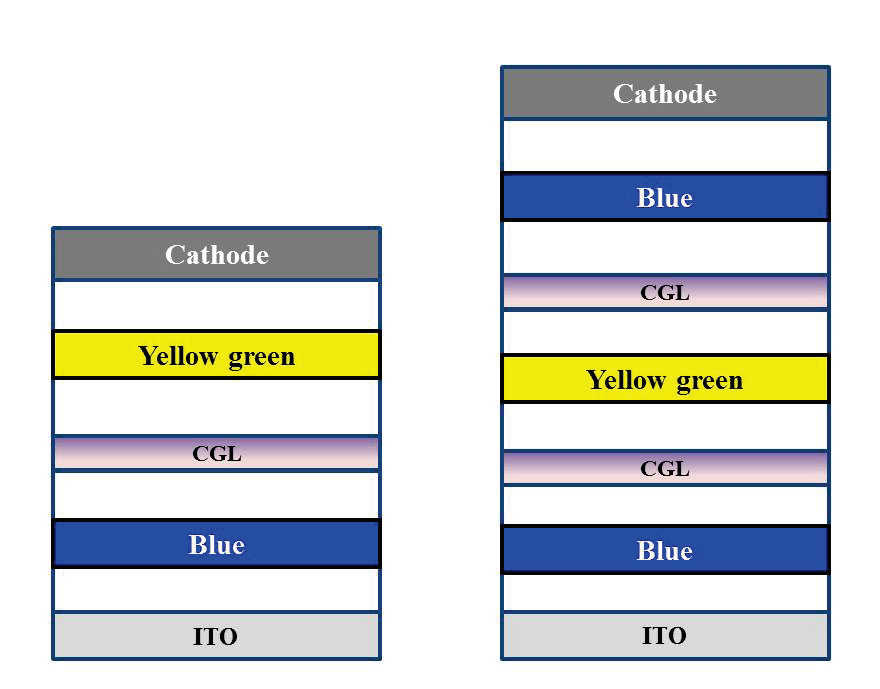
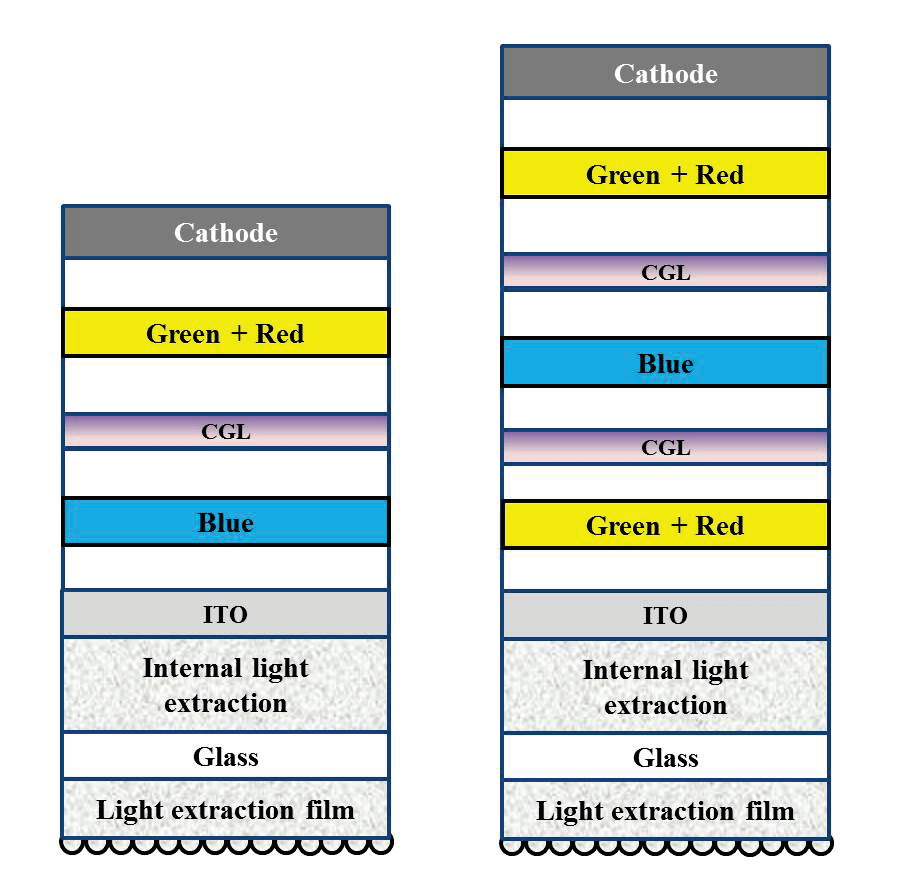
<LG Display’s 2 stack and 3 stack WOLED lighting structure, IDW 2016>

Also by introducing WOLED for lighting, LG Display mentioned that lighting WOLED has 3 stack tandem structure with green-red/blue/green-red, where WOLED for OLED TV has 3 stack tandem structure with blue/yellow-green/blue. It showed high efficiency of 90lm/w by applying Ag cathode and light extraction film which the reflectivity is high, and the color temperature is 2,850K which is in the warm white range, CRI showed characteristics of 88. This OLED light will start its production in 3rd quarter of 2017 in 5 generation line.

<LG Display’s 2 stack and 3 stack WOLED light structure which applied light extraction film, IDW 2016>

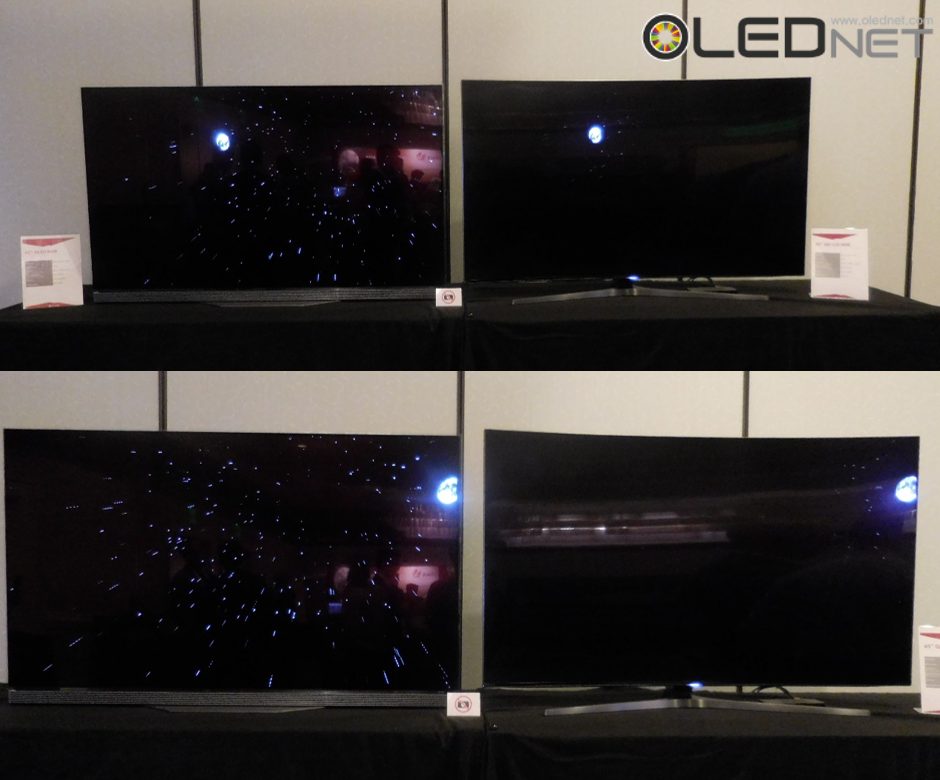
Meanwhile, LG display exhibited 800 nit 65” UHD OLED TV during OLED summit 2016 held last September in San Diego where they gained much interest compared to 65” curved QD-LCD TV quality, and it is expected that they will introduce OLED TV with improved luminance with more than 1,000 nits next year.

<Comparison of black quality between 65inch OLED TV(left) and 65inch curved QD-LCD TV(right), LG Display, OLED Summit 2016>

Aggressive investment on QLED, Shortcut of OLED commercialization

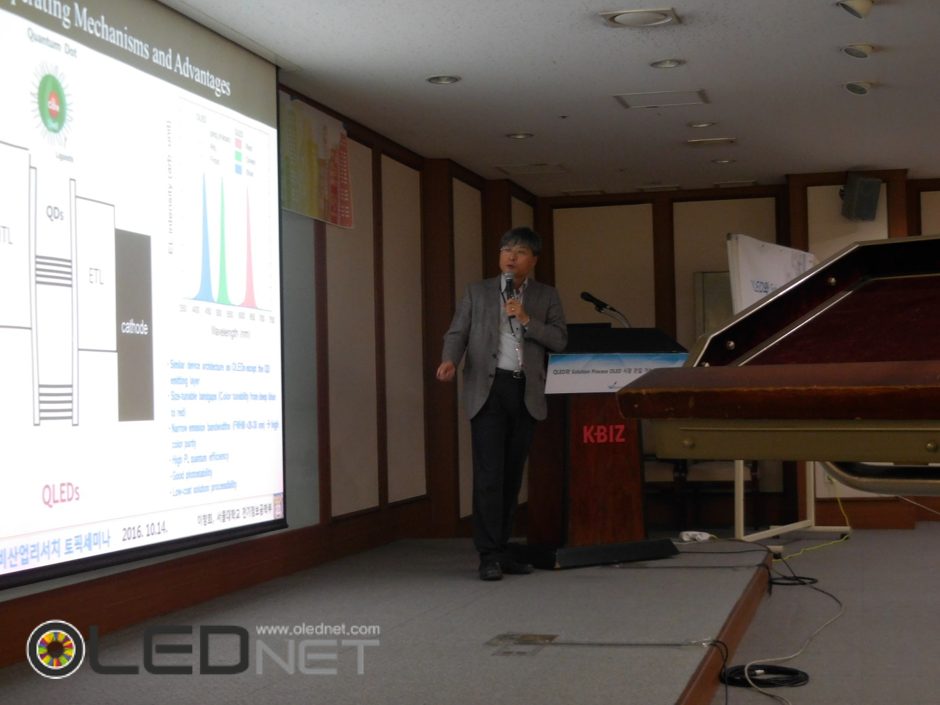
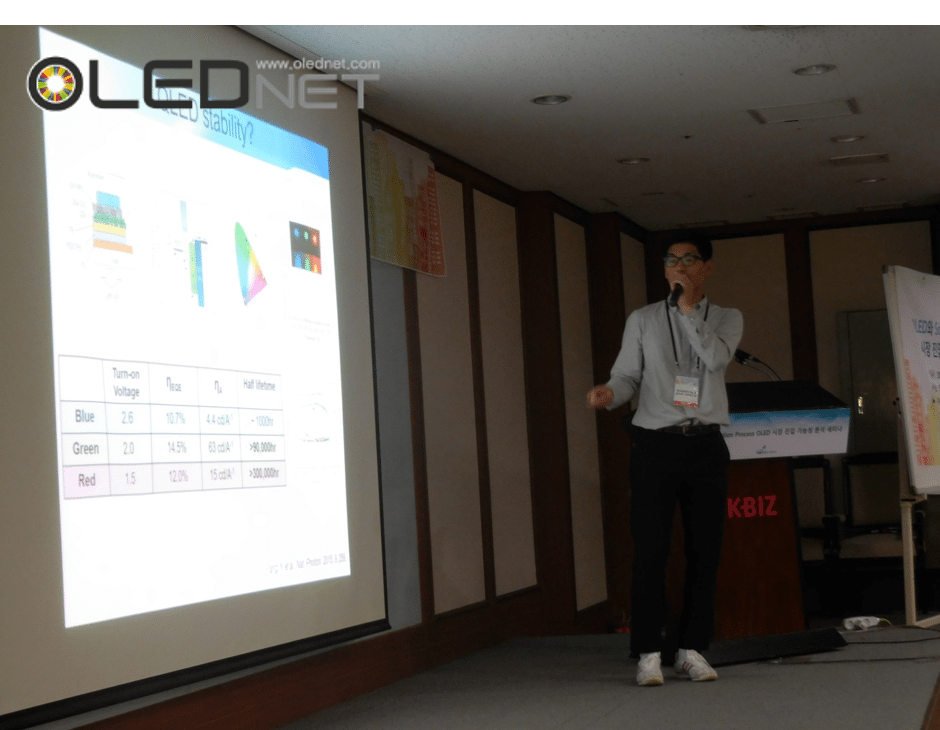
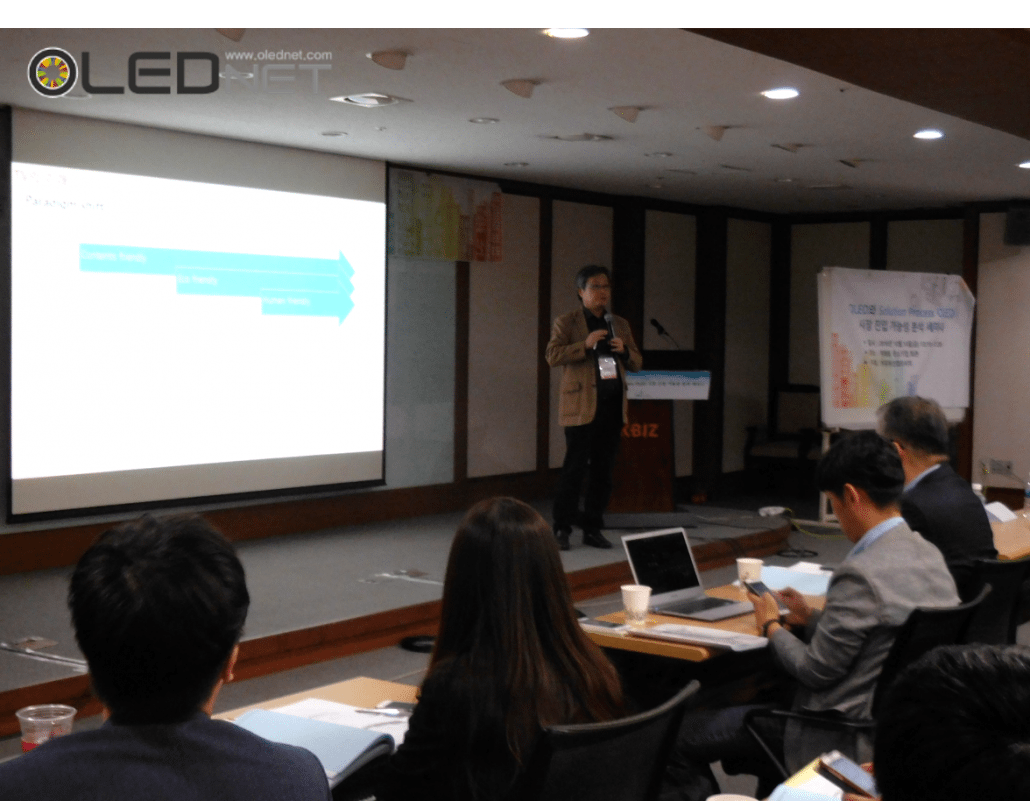
At ‘an analytical seminar on market entry potential of OLED and Solution Process OLED’ having been held in Seoul Small& Medium Business Center on last October 14th, Professor Lee Chang-hee of Seoul National University and Senior Researcher Bang Ji-won of Korea Institute of Ceramic Engineering and Technology shared opinions about current situations of QLED, development trends, and issues.

<Professor Lee Chang-hee of Seoul National University>

<Senior Researcher Bang Ji-won of Korea Institute of Ceramic Engineering and Technology>

Professor Lee Chang-hee said that QLED had excellent color purity because half-width of QLED was narrower than OLED by approximately 20~30nm, and disclosed a fact that QLED was favorable in color reproduction due to high levels of accuracy when manufacturing it, and efficiency of luminescence material reached to regular levels to the degree of catching up OLED. However, he stated technical difficulties of Cd-free QLED which did not use cadmium, a heavy metal, together with securing life stability of QD (Quantum Dot) luminescence materials, and emphasized that investment on QLED is the shortcut of commercialization by saying “The time of commercialization could be moved forward to 5 years or 3 years according to capital and manpower investing scales from the industry.”

Senior Researcher Bang Ji-won pronounced luminescence efficiency of light-emitting materials, stability, non-toxic QD, and approaches by various directions such as QD-LCD which applied QD CCL (Color Change Layer) to blue-LED BLU (Black Light Unit) by using QD, OLED which applied OD-CCL and C/F (Color Filter) to WOLED, OLED that applied QD CCL without C/F to blue-OLED were being progressed.

QLED-related academia discussed about the potential of OLED positively in this way, but CEO Lee Chung-hoon of UBi RESEARCH said “Development of WOLED will be strived too because QLED has already been developed, and if brightness is more enhanced after being evolved to top emission method from current bottom emission one, QLED entry to premium market will become difficult further, and then pronounced “When new technology can enter the market, considerations whether new technology will be good from certain aspects including performance, efficiency, cost etc. shall be made in case of comparing them with the technologies having been commercialized ”

WOLED will lead premium TV market after 2020

UBi RESEARCH held ‘An Analytical Seminar on OLED Market Entry Feasibility of QLED and Solution Process’ on the 14th at Seoul Small& Medium Business Center.

CEO Lee Chung-hoon of UBi REARCH said “OLEd TV will show 16.7% market share in 2016 at the world premium TV market, and lead premium TV market with 68.1% share in 2020.” and analyzed such like “LCD TV could not follow OLED TV performance excluding low price and high solution.”

China is threating domestic LCD market in current wide TV market while displaying material superiority to LCD industry, and cost-effective rate of the wide TV is losing ground to Chinese products too. Thus, LG Display and LG Electronics did successful market entry after having equipped with competiveness in the premium market through OLED TV, and they are expediting mass-production investment and technical development aiming at dominating and popularizing premium TV market.

The most important factor in popularizing OLED TV is price. ASP (average sales price) of UHD OLED panel based on second quarter of 2016 is USD 720, and FHD OLED panel is approximately USD 450. It was expected that UHD OLED panel could lead TV market if it secured about USD 500.

Development to adopt solution process methods has been progressed in order to lower price of wide OLED panel in the industry, and QLED technology as an alternative of OLED TV is becoming an issue nowadays.

In relation with this, CEO Lee Chung-hoon forecasted like “As much as being closed to commercialization due to development of solution process OLED or QLED technology, WOLED technology becomes to be developed one step more, so market entry of solution process OLED and QLED will not be achieved easily. Specially, there are many technical issues in QLED which is considered as next OLED by Samsung Electronics, and 10 years of research will be required further.”

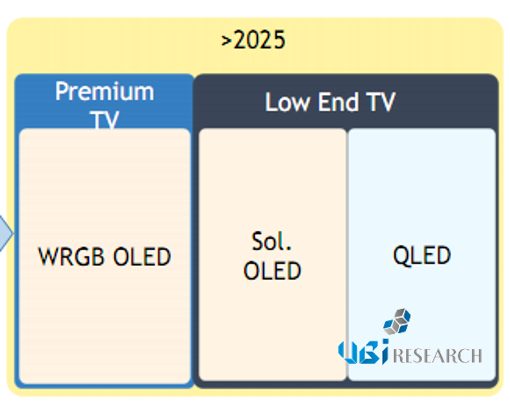
Also, he emphasized that the technology of being able to reduce cost vs. WOLED such as lessening layer numbers dramatically etc. should be developed in order to enter solution process OLED and market successfully, and the entry shall be made by targeting low-end market. In particular, he analyzed that WOLED would lead premium TV, and solution process QLED and QLED occupy the low-end market after 2020.

<TV Market Scenario after 2025 (Source: UBi RESEARCH)>