
OLED Gaming Monitor Market Set to Enter Full-Scale Growth Phase from 2026

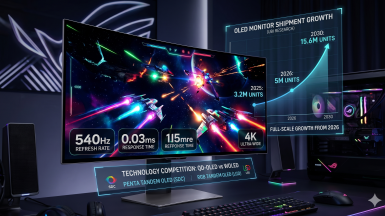
A conceptual image showing the full-scale growth of the OLED gaming monitor market and technological competition between panel makers. OLED monitor shipments are expected to reach 5 million units in 2026. (Image generated by Gemini)
The OLED monitor market is expanding rapidly, led by gaming products. Fast response time, high contrast ratio, wide color gamut, and slim design are among OLED’s key strengths. Combined with rising demand for ultra-high-refresh-rate products for e-sports and premium 4K and ultrawide monitors, OLED monitors are emerging as a key segment in high-end gaming displays. Recently, OLED gaming monitors have been segmented into 27-inch QHD ultra-high-refresh-rate models, 32-inch 4K models, and 34-inch-and-above ultrawide models.
In 2026, LG Electronics, ASUS, MSI, Dell Alienware, Sony, and other major brands are launching new products one after another, intensifying competition. 27-inch models are emphasizing dual-mode performance with QHD 540Hz and HD 720Hz, while 32-inch 4K models are targeting both gamers and creators with 240Hz refresh rates and high color reproduction.
According to UBI Research, OLED shipments for monitors are expected to increase from 3.2 million units in 2025 to 5.0 million units in 2026, and further expand to 15.6 million units by 2030. The key growth drivers are stabilizing panel supply, expanding product lineups by set makers, and rising demand for premium gaming monitors.
Technology competition among panel makers is also accelerating. Samsung Display is promoting Penta Tandem OLED, based on 5-stack QD-OLED technology. By applying a Penta Tandem structure to QD-OLED, which already offers strong color purity and color reproduction, Samsung Display has further improved brightness, efficiency, and lifetime. LG Display has introduced its 4th Gen Primary RGB Tandem OLED, strengthening its competitiveness in monitor panels based on 4-stack White OLED technology. This panel is being applied across a wide range of products, from 27-inch ultra-high-refresh-rate monitors to 39-inch and 45-inch 5K2K ultrawide monitors.
The potential entry of Chinese panel makers is also an important variable. BOE is currently producing 2K-class products at its B5 White OLED line, mainly focusing on 24.5-inch monitor panels. The company is also considering a new investment of 16K to 18K sheets per month at its B18 plant in Nanjing for White OLED monitor panels. The investment decision and detailed plan are expected to become more concrete during 2026. Changwook Han, Executive Vice President of UBI Research, said, “Although OLED monitors are more expensive than LCDs, demand in the premium gaming market is clear, driven by response time, contrast ratio, color reproduction, and design differentiation. As SDC’s 5-stack QD-OLED, LGD’s 4-stack Tandem WOLED, and BOE’s potential investment in White OLED come together, the OLED monitor market is expected to enter a full-scale growth phase from 2026.”
Changwook Han, Executive Vice President/Analyst at UBI Research (cwhan@ubiresearch.com)
 2026 Medium & Large Size OLED Display Annual Report
※ This article is produced by UBIResearchNet.
Unauthorized reproduction or citation without source attribution is prohibited.
When quoting, please clearly indicate the source (UBIResearchNet) and provide a link.