Posts

Meizu StarV Air2 Micro-LED AR glasses illustrating the trend of lightweight and AI-integrated eyewear.

Micro-LED AR glasses market is set for significant expansion… ‘Lightweight design, outdoor visibility, and AI integration’ emerge as core competitive factors

Meizu StarV Air2 Lightweight Micro-LED AR Glasses (Source: MEIZUWORLD)

Meizu StarV Air2, a mass-market AR glass featuring lightweight design and AI capabilities (Source: MEIZUWORLD)

A comprehensive review of major AR glasses released between 2023 and 2025 confirms that the global XR market is rapidly restructuring around ultra-lightweight AR glasses based on Micro-LED technology. Notably, lightweight AR glasses combining Micro-LED and waveguide technology have been successively launched, primarily in China. This trend clearly shifts the AR market’s focus from high-priced, high-performance MR headsets toward information-centric AR glasses suitable for everyday use.


Market Expansion: Rapid Commercialization Centered on Chinese OEMs

2024 marks the turning point where Micro-LED AR glasses began entering the actual consumer market. Chinese manufacturers including Orion AR from Southeast University, INMO, Dreame, and Thunderbird simultaneously launched numerous Micro-LED AR glasses around April 2024. Subsequently, in August and September, mass-market models like the Sihe G1 and Meizu StarV Air2 appeared at reasonable price points. Global brands such as Vuzix and Rokid also expanded their industrial and consumer models, joining the market expansion trend. This continuous product launch demonstrates that Micro-LED is no longer primarily a research and development technology, but has entered the market application phase as a practical technology.


Technical Direction: Monochrome Micro-LED + Waveguide Becoming Mainstream

The core technology combination in currently commercialized products is monochrome Micro-LED and waveguide. This structure offers significant advantages: high luminous efficiency, low power consumption, thin and lightweight optical structures, and excellent outdoor visibility.

Major models like the Meizu StarV Air2, INMO GO 2, and Vuzix Z100 all adopt monochrome Micro‑LED, making monochrome-based solutions the likely mainstream for consumer AR glasses in the near term.

On the other hand, prototypes like the ThunderBird X3 Pro and Meta Orion AR utilize full-color Micro‑LED. However, due to process complexity, yield issues, and cost concerns, they remain in the research and prototyping phase. While big tech companies are strategically developing this technology, indicating its high medium-to-long-term importance, short-term commercialization remains limited.


Price Structure: The US$100–500 range forms the mass-market segment.

Based on the Chinese market, the primary price range for Micro-LED AR glasses is established at US$100–500. This price range is advantageous for positioning AR glasses as an extension device for smartphones and smartwatches, indicating the potential for Micro-LED-based AR glasses to expand into a market of 10 million units.

  • Entry-level (Sihe G1, INMO GO 2)
  • Mid-range (Meizu StarV Air2)
  • Global Mid-Range Model (Vuzix Z100)


Player Landscape: A Tripartite Ecosystem of Local Chinese, Global, Niche, and Big Tech Players

Currently, the Micro-LED AR glasses ecosystem is led by three groups. The product ecosystem formed by Chinese OEMs intersects with the platform strategies of global companies, creating a multi-layered growth structure in the AR market across technology, price, and ecosystem.

1) Chinese Local OEMs (Meizu, INMO, Dreame, Sihe, Thunderbird, etc.)

→ Rapid productization, price competitiveness, platform expansion strategy based on JBD engine

→ Pioneering the mass market centered on domestic Chinese demand

2) Global Niche/Industrial Companies (Vuzix, Rokid, etc.)

Bridge role between industrial AR demand and lightweight consumer AR

→ Increasing Micro-LED adoption in B2B-centric markets

3) Big Tech Platforms (Google, Meta)

→ Building OS-SDK (Software Development Kit)-Cloud-based AR platforms

→ Technology development at the exhibition product stage to preempt next-generation interfaces based on Micro-LED


Market Outlook: Toward an ‘All-day AR’ Era with Ultra-Lightweight, Outdoor Visibility Foundations

Analyzing product specifications and launch trends, Micro-LED AR glasses are likely to evolve in the following directions:

  • Expansion from monochrome to full-color AR
  • Ultra-lightweight designs in the 40-50g range will become the de facto market baseline.
  • Accelerated standardization of engine-optics modules and design modularization
  • Intensified competition in the AR OS-AI-app ecosystem centered around Big Tech

The 44g Meizu StarV Air2, in particular, prominently features a practical price point, lightweight design, outdoor visibility, and wearable AI capabilities, positioning it as a likely benchmark model for mass-market AR glasses. The StarV Air2 has launched sales not only domestically in China but also on select global online channels, with a known price point around US$300-400. This represents a competitive price range within the existing, high-price-focused AR market and is expected to accelerate the adoption of ultra-lightweight AR devices.


UBI Research analyzed that “maximizing lightness and practicality instead of implementing full-color, high-resolution MR is the key differentiator,” adding that “this demonstrates the potential for information-assistance-focused AR glasses to enter the mass market.”

Joohan Kim, Senior Analyst at UBI Research (joohanus@ubiresearch.com)

▶2025 Micro-LED Display Industry and Technology Trends Report

※ This article is produced by UBIResearchNet.
Unauthorized reproduction or citation without source attribution is prohibited.
When quoting, please clearly indicate the source (UBIResearchNet) and provide a link.

AR Glass Market Evolves in Two Directions: China’s Content-Immersive Approach vs. Global Big Tech’s AI-Integrated Wearable Platforms

TCL’s AR brand RayNeo launched its latest AR glasses, the Air 4 Pro, in October 2025. It is pursuing a differentiated strategy in the global AR market by leveraging high-frequency PWM (Pulse Width Modulation) dimming technology and AI-based image optimization.

The RayNeo Air 4 Pro minimizes eye fatigue through 3840Hz high-frequency OptiCare™ dimming. It supports HDR10 and incorporates the Vision 4000 image quality chip, delivering an experience optimized for immersive content viewing. Notably, the Seeya 5.5-generation Micro OLED panel, featuring a tandem OLED light-emitting structure, achieves a maximum brightness of 6000 nits. It maximizes image quality with a wide color gamut (145% sRGB, 98% DCI-P3) and a 200,000:1 contrast ratio.

While competitors like XREAL and Viture focus on external light blocking via electrochromic dimming lenses, RayNeo adheres to a video quality-centric strategy using digital brightness control and an AI video engine. This allows RayNeo to maintain lightweight design (76g) without increasing lens weight, delivering products optimized for indoor-focused immersive content consumption.

This technological strategy is yielding market results. As of Q1 2025, RayNeo holds approximately 50% market share in China’s AR/AI smart glasses market, ranking first. Notably, the Air 3s Pro achieved the top sales position among XR products during the 618-shopping festival, solidifying the brand’s standing in China. Another Chinese AR specialist, XREAL, holds a lower market share than RayNeo domestically but differentiates itself with OST-based products like the XREAL One Pro. It focuses more on expanding into global markets like North America and Europe than on the Chinese domestic market.

Meta is concentrating on smartphone-complementary smart glasses that combine LCOS displays with cameras and AI assistants for functions like checking messages, taking photos, and voice commands. Apple has postponed the successor to Vision Pro, shifting its strategy to developing lightweight AI/AR glasses and accelerating the commercialization of smartphone-linked AR glasses. Google is realigning its strategy around AI-based real-time translation and search, preparing AR glasses integrated with an AI assistant. All three companies share a common direction: cultivating AR glasses as a core platform, positioning them as the next-generation interface beyond smartphones.

Comparison chart between RayNeo Air 4 Pro and Meta Ray-Ban Display — display type, optical structure, key functions, and market positioning (Source: UBI Research)

The AR glasses market is undergoing a restructuring driven by two key trends: AI-integrated wearable platforms and content-centric immersive experiences. In the medium to long term, AR glasses are expected to evolve into devices with the potential to replace smartphones as AI-integrated wearable platforms.  

llustration of a user wearing AR glasses operating an AI-powered immersive interface — symbolizing next-generation wearable platforms (Source: Created by Gemini)

Created by Gemini

Changho Noh,  Senior Analyst at UBI Research  (chnoh@ubiresearch.com)

▶UBI Research’s Micro Display Report

RayNeo Air 4 AR glasses featuring HDR10, Micro-OLED display by SEEYA, and collaboration with B&O for audio

Chinese company RayNeo released its new product, the RayNeo Air 4 glasses.

RayNeo Air 4 and Air 4 Pro AR glasses product image and pricing details (Source: RayNeo)

RayNeo Air 4 Product Image (Source: RayNeo)

On October 23, consumer AR brand RayNeo held an autumn new product launch event and officially released its fourth-generation AR glasses, the ‘RayNeo Air 4 series’. The standard edition is priced at 1,599 yuan (approximately 320,000 KRW), while the Pro edition is priced at 1,699 yuan. Sales have already commenced on e-commerce platforms.

According to the introduction, it is the world’s first AR glasses for movie viewing supporting HDR10 displays, featuring AI dynamic HDR display with a peak brightness of up to 1200 nits. Equipped with the dedicated Vision4000 image quality chip, it enables conversion from SDR to HDR and supports 10-bit color display. Combined with a Micro-OLED display (SEEYA panel), they provide a viewing experience with a 120Hz refresh rate and a virtual 135-inch ultra-large screen. They were developed in collaboration with the high-end audio brand Bang & Olufsen (B&O) for the first time. The RayNeo Air 4 is expected to significantly elevate the overall audio-visual experience and solidify its position in the consumer AR glasses market.

This product was developed through close collaboration not only with Chinese OLEDoS display manufacturers (SEEYA) but also with overseas companies (B&O, Pixelworks) in terms of the supply chain. Chinese companies are injecting new vitality into the AR industry through continuous new product launches. With the proliferation of 5G technology and the rise of metaverse technology, the potential of the AR glasses market is enormous, so competition among companies is expected to intensify further.

Namdeog Kim, Senior Analyst at UBI Research(ndkim@ubiresearch.com)

▶UBI Research’s Micro Display Report

AI AR smart glasses Meta Ray-Ban Display showing growth of the global AR wearable market

The Competition in AI/AR Smart Glasses and the Advancement of Chinese companies in the Supply Chain Ecosystem

Meta officially announced its new products at the Meta Connect 2025 event on the 18th of last month (the 17th in US time), and began launching the Meta Ray-Ban Display smart glasses—its first consumer glasses to bring a display—in the US at the end of September. Meta continues its strategy to dominate the AI/AR glasses market. According to a post by Meta CTO Andrew Bosworth on Threads on October 2nd, the Meta Ray-Ban Display smart glasses have nearly sold out in physical stores, and November reservations are also almost fully booked. He stated that the market response to the product has been stronger than expected, and the company is working hard to keep up.

Meta Ray-Ban Display AI AR smart glasses (Source: Meta)

Meta Ray-Ban Display Smart Glasses (Source: Meta)

Meanwhile, over a year after its launch, the Vision Pro has gradually faded into the background. According to external reports, last year’s total sales of the Vision Pro fell below one million units, significantly underperforming market expectations. Additionally, rumors have intensified that Apple has halted development of a low-cost Vision Pro model and is shifting its strategic focus entirely to smart glasses. The goal is to launch a product capable of directly competing with Meta’s Ray-Ban smart glasses, with the initial smart glasses launch target date reportedly moved up to 2026. This pivot signifies Apple’s recognition that ‘AI+AR’ devices hold promise as the next generation of mobile terminals.

Samsung is also collaborating with Google to develop the Project Moohan XR headset, and its smart glasses Haean may also be unveiled this year. China’s Alibaba company has also announced ‘Quark AI Glasses,’ reported to launch by the end of 2025. Companies like Xiaomi and Baidu are also entering the market one after another, continuously fueling market excitement. Furthermore, the rise and expanding market share of domestic Chinese AR glasses brands like XREAL, RayNeo, Rokid, and INMO are evident.

From the supply chain perspective of smart glasses, the mutual penetration of AI and AR technologies has created an industrial ecosystem. The role of Chinese companies within this ecosystem is also evolving. While gaps persist in advanced core areas, they are emerging as ecosystem participants beyond their traditional supply chain roles through vertical integration within companies and external technology collaborations. In essence, they are becoming key drivers in this new industry. For instance, in Meta’s Ray-Ban Display glasses, Chinese company Goertek handles manufacturing, and numerous Chinese component suppliers are involved in internal parts like LCoS displays, batteries, and camera modules. Indeed, at the recent CIOE 2025 optoelectronics exhibition held in Shenzhen, China, the strong showing of Chinese companies like JBD, Goeroptics, and Sunny Optical was evident in LEDoS panels and optical waveguide components applied to next-generation AR glasses products.

In summary, major tech companies like Meta, Apple, and Samsung have recently shown active movements in the AI/AR glasses sector, further strengthening the influence of AI+AR glasses as a field receiving high attention. Therefore, as the industry ecosystem enters a critical transition phase and growth period, companies across the industrial supply chain are expected to intensify competition while actively pursuing technological breakthroughs and collaborative ecosystem development. Amidst this, Chinese companies are making notable strides. Benefiting from the Chinese government’s support for strategic industries and the policy trend positioning AR/XR as a core element of the digital economy, domestic optical module, display, and component companies are actively participating in the AR/XR glasses ecosystem.

Namdeog Kim, Senior Analyst at UBI Research(ndkim@ubiresearch.com)

▶2025 Micro-LED Display Industry and Technology Trends Report

Meta Ray-Ban Display AI/AR Glasses at Connect 2025

Meta Announced New Products: Meta Ray-Ban Display AI/AR Glasses, Evolving Beyond the Original Ray-Ban AI Glasses

Meta held its Meta Connect 2025 event on the 18th (U.S. time: 17th) and officially announced several new products. Meta signaled a smart glasses boom, confirming its first consumer smart glasses with a display will launch in the U.S. later this month. Named ‘Meta Ray-Ban Display’, the glasses represent a midpoint product between the existing Ray-Ban AI glasses and Meta’s Orion AR glasses unveiled at last year’s Connect conference. They feature a ‘monocular panel’ positioned at the lower right corner of the right lens. The choice of a single monocular display appears driven by issues like cost and wearing time, and it requires pairing with a smartphone app.

Meta Ray-Ban Display AI/AR smart glasses unveiled at Connect 2025 (Source: Meta)

Meta Ray-Ban Display AI/AR smart glasses (Source: Meta)

These glasses feature a camera, multiple microphones, and speakers, enabling users to command the Meta AI voice assistant to take photos, record videos, play music, and more. The compact display provides functions such as notifications, turn-by-turn navigation, and real-time translation. The core display component utilizes an LCoS single-chip full-color microdisplay. Regarding the optical waveguide, it is known to utilize Arrayed Waveguide Grating (AWG) technology licensed from Lumus. The wristband, based on surface electromyography (sEMG) technology, is the industry’s first product targeting the consumer market. The sEMG technology collects bioelectric signals from the wrist area via multiple electrodes embedded in the bracelet. It then uses algorithms to recognize these signals and convert them into corresponding gesture commands. “It’s the first smart glasses integrating a high-resolution display and Meta’s sEMG wristband while maintaining Ray-Ban’s signature design,” the company emphasized. Meta does not sell this wristband separately; it is sold as a set with the Ray-Ban Meta Display. The price for the AR glasses and sEMG wristband set unveiled by Meta is $799.

Meta officially unveiled five key new hardware products at this event. These include Meta’s first pair of AR glasses, three pairs of AI glasses without displays, and one electromyography (EMG) wristband based on sEMG technology.

Meta Connect 2025 lineup featuring Ray-Ban Display, AI glasses, AR glasses, and sEMG wristband (Source: Meta)

New product lineup unveiled at Meta Connect 2025 (Source: Meta)

Meta remains optimistic about the AI glasses market and continues its strategy to dominate the market. The social media company continues to promote AI-based wearable devices as the next-generation core technology following smartphones, and competition among companies is expected to intensify further.

Namdeog Kim, Senior Analyst at UBI Research(ndkim@ubiresearch.com)

▶2025 Micro-LED Display Industry and Technology Trends Report

Who will develop LEDoS for Samsung Electronics and Samsung Display and AR glasses?

The development of LEDoS for AR glasses by Samsung Electronics’ semiconductor (DS) division has been the focus of much attention. Last year, the DS division of Samsung Electronics established a department dedicated to micro-LEDs within the CSS (Compound Semiconductor Solutions) business team, but there have been ongoing discussions with Samsung Display regarding the selection of a business manager. In April last year, the company discussed the idea of transferring the department in charge of the project to Samsung Display. This year, the development of LEDoS will be in full swing, and the roles of the Mobile Experience (MX) Division, the DS Department, and Samsung Display are expected to become clearer.

According to industry experts, it would be efficient for Samsung Display to promote commercialization once the LEDoS base technology reaches the completion stage first, which is estimated to be in the middle of next year. For the time being, there will be no major changes, and the CMOS Backplane technology and micro-LED device technology will be developed by a department dedicated to micro-LEDs in the CSS business team.

Vice President Kwon Sang-deuk, who heads the division dedicated to micro-LEDs, is known as a circuit expert with a system LSI background. While Taiwan and China are the fastest-growing countries in the field of AR glasses, Samsung may be the fastest-growing.

Joohan Kim, UBI Research Analyst(joohanus@ubiresearch.com)

▶Micro-LED Display Technologies for XR Applications Report Sample

OLED & XR KOREA 2025 – LetinAR PinTilt Technology

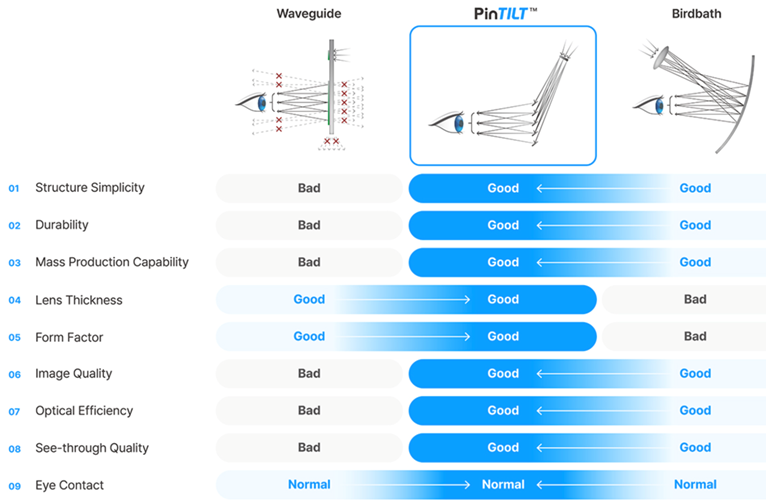
LetinAR’s PinTilt technology was introduced at the three-day OLED & XR KOREA 2025, held in April 16. The development of AR glass optics, on which global interest is concentrated, is still in its current state of development; AR technology begins with optics that superimpose a virtual image on the real environment. Manufacturers such as Google, Upson, Meta, Microsoft, and Sony are competing fiercely with Birdbath and Exit Pupil Expander (EPE) Waveguide optics, maximizing their advantages but failing to address their disadvantages. BirdBath has failed to reduce size and weight, EPE has failed to improve image quality and power consumption, and LetinAR has made it clear that it can chase the double rabbit with its PinTilt technology.

The PinTilt technology is said to be capable of producing a high quality, distortion-free screen with a wide 48-degree FOV on AR glasses weighing the weight of a typical pair of glasses. The company is also working on the production of the glasses by using the conventional injection molding method. The company also says that it is equipped with a conventional method of manufacturing and cost performance, which could be a game changer in the AR glasses industry.

Along with technological solutions such as variable focus and improved drive engines, this is probably why industry experts predict that the day is not far off when AR glasses will be used in real life.

(Source: LetinAR)

(Source: LetinAR)

Joohan Kim, UBI Research Analyst(joohanus@ubiresearch.com)

▶Micro-LED Display Technologies for XR Applications Report Sample

“AI/AR Glasses Growth, Significant Expectations for the Development of Micro-LED Displays”

AI technology is making a soft landing and the AI era is opening up. Recently, the competition among big tech companies to become the winner of the AI war has become more intense. It is expected that the multimodal technology of AI will renew the market’s perception of AI functions through interactions such as voice, video, and photos. AI/AR glasses are expected to be more popular as they have a viewing function and are equipped with various sensors such as cameras, microphones, and speakers to access data, voice, or displays in real time to complete interactions. Accordingly, AI/AR glasses have received a lot of attention in the past year.

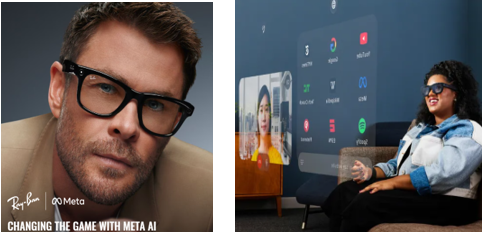
Ray-Ban META AI Glasses (left) and META Orion AR Glasses Prototype (right) (source: META)

Ray-Ban META AI Glasses (left) and META Orion AR Glasses Prototype (right) (source: META)

The Ray-Ban smart glasses can be seen as Meta’s present, and the Orion project as its future. In September 2024, Meta unveiled the Orion glasses prototype, showcasing the new possibilities of AR glasses with innovative display technology. Micro LED was adopted as the display solution for the Orion AR glasses. AR glasses require ultra-high brightness (5,000 nits or more, ideally 10,000 nits or more) to be visible in outdoor environments. In addition, micro-LEDs are essential for lightweight, compact display engines that are required for AR glasses to be very slim and stylish when they are worn.

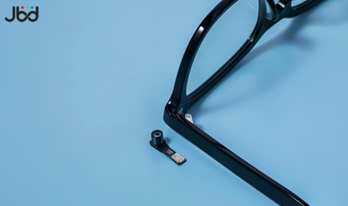
JBD “Hummingbird Mini II” mono-color engine (0.15cc, 0.3 grams) and daily-use glasses (source: JBD)

JBD “Hummingbird Mini II” mono-color engine (0.15cc, 0.3 grams) and daily-use glasses (source: JBD)

“AI” was the highlight of CES 2025, and AI smart glasses were one of the main attractions. Companies such as Vuzix, Rokid, Goertek, and RayNeo introduced new AI glasses products that use micro-LEDs.

Among the manufacturers of micro-LED displays, China’s Jade Bird Display (JBD), a company specializing in micro-LED microdisplays, has begun mass production at its facility in Hefei with a manufacturing capacity of more than 100 million 0.13-inch micro-LED panels per year. In addition to US and European companies, Chinese and Taiwanese companies such as Sitan and Raysolve are moving quickly to develop and prepare for the production of LEDoS displays. At UBI Research’s seminar held on on February 14, a presentation was given on micro-LED technologies for XR and trends in the industry. AI glasses began to blossom in 2024 with the development of AI and AR technology, and more large manufacturers are expected to enter the market in 2025. AI/AR smart glasses are expected to promote the accelerated development of the AI/AR industry, and there are high expectations for the development of micro-LED technology.

UBI Research published a report on micro-LED technology for XR in January. This report summarizes the technology related to the production of LEDoS panels required for XR glasses. It will help to improve the understanding of LEDoS’s micro-LED technology and will be an important reference for companies developing micro-LED display technologies to plan the future direction of technological development.

UBI Research Nam Deog Kim Analyst(ndkim@ubiresearch.com)

▶Micro-LED Display Technologies for XR Applications Report Sample